























The Friedmann equations describe how the scale factor of a homogeneous, isotropic universe evolves over time based on its matter content. The first Friedmann equation relates the expansion rate (Hubble factor) to the density of matter, the cosmological constant, and the curvature of spatial sections. The second Friedmann equation describes the acceleration of expansion. A positive cosmological constant corresponds to dark energy with equation of state ρ = -p, which violates the strong energy condition and causes accelerated expansion of the universe, as evidenced by observations of distant supernovae.
General Relativity: Friedmann Equations & Dark Energy
Added:Einstein's Field Equations: Familiarity with the mathematical structure relating spacetime curvature to the energy-momentum tensor.
The Friedmann-Lemaître-Robertson-Walker (FLRW) Metric: Understanding the metric that describes a homogeneous, isotropic, expanding or contracting universe.
Basic Tensor Calculus: Knowledge of Christoffel symbols, the Ricci tensor, and the Ricci scalar, which are used to derive the Einstein tensor.
The Perfect Fluid Stress-Energy Tensor: Understanding how mass-energy density and isotropic pressure are mathematically represented in cosmology.
The Standard Model of Cosmology (Lambda-CDM): Investigating how the cosmological constant and cold dark matter parameters fit into observational data.
Cosmic Inflation: Exploring the physics of the extremely rapid exponential expansion of the early universe.
Observational Proofs of Acceleration: Studying how Type Ia Supernovae and Cosmic Microwave Background (CMB) anisotropies measure dark energy.
Cosmic Fate Scenarios: Analyzing the long-term behavior of the universe (e.g., Big Freeze, Big Rip, Big Crunch) based on the dark energy equation of state.
1.8K views32likes29:13Original Release: 2021-01-26
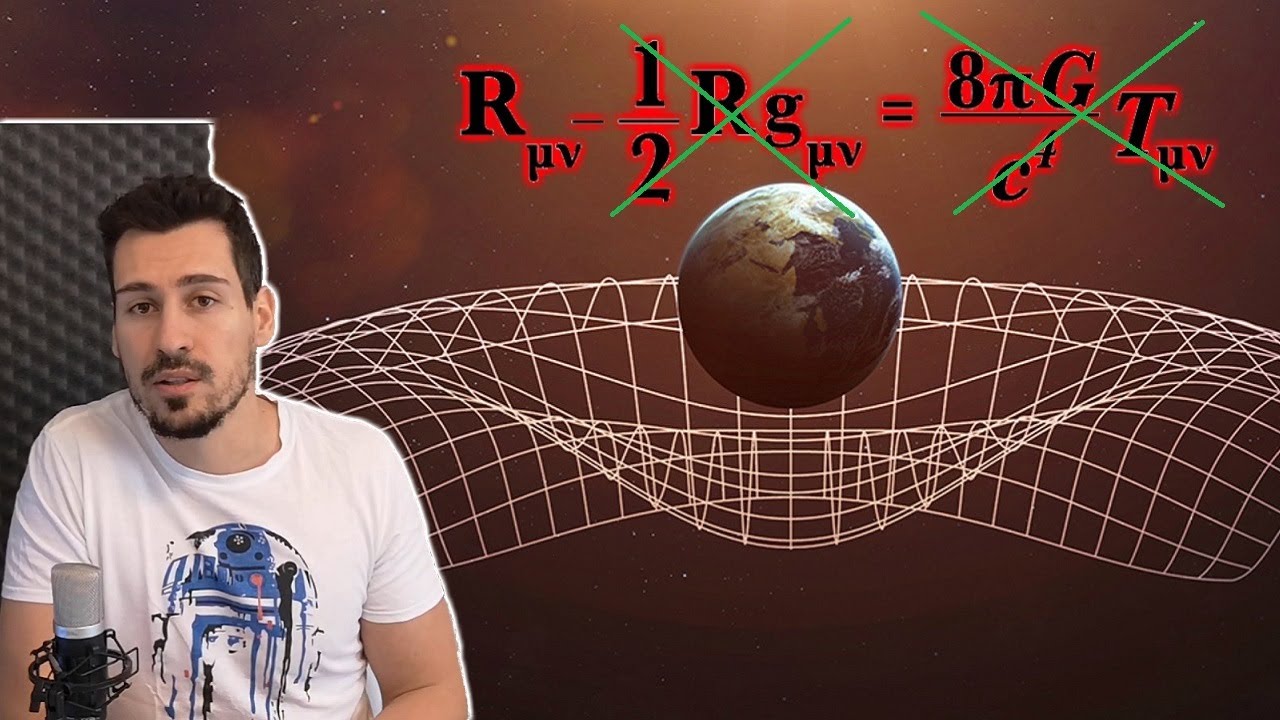
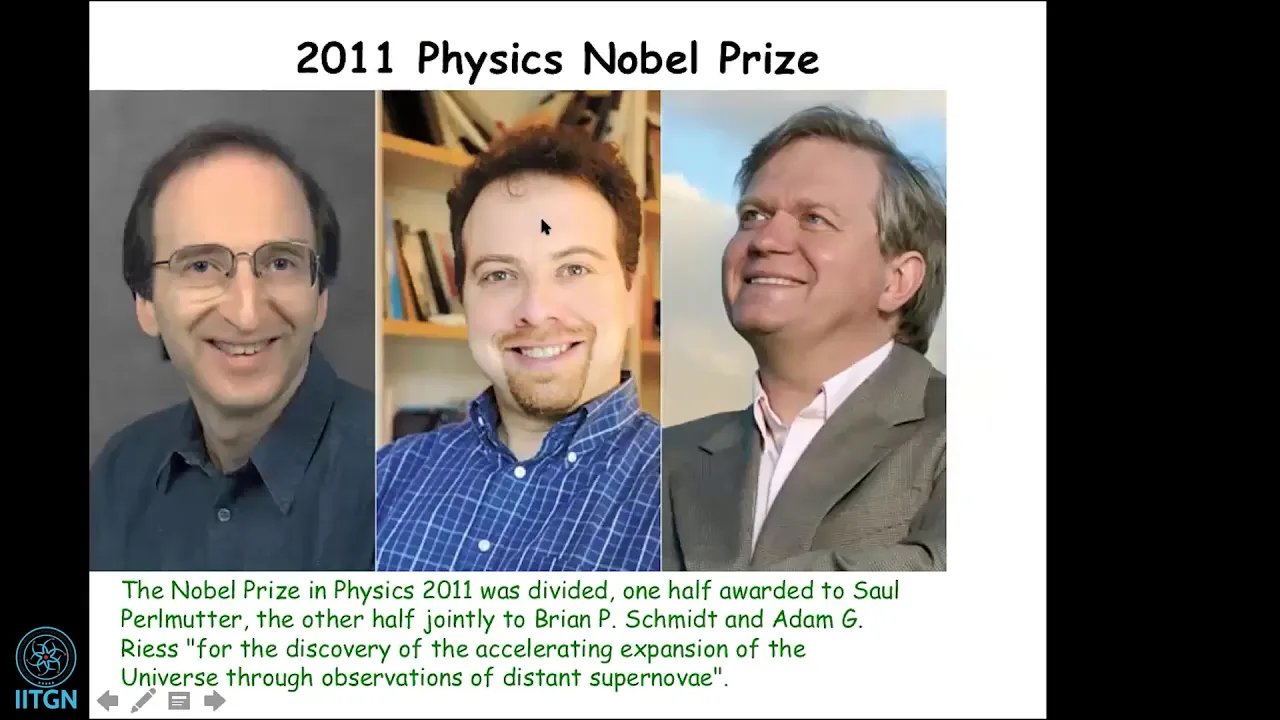
welcome to today's video this is possibly the last video of the course so i hope it's enjoyable my voice is borderline making it so let's see how that goes in this video is the second part of the cosmology part that we talked about the cosmology block uh in this part we're going to take what we did in the previous video which is finding the form for the met friedman robertson walker metric which is the metric that corresponds to a universe that is homogeneous mesotropic and then we're going to plug it into einstein equations and figure out how does this universe evolve in time depending on what it contains so what's inside the universe determines how this scale factor that has the time dependence of the metric will evolve in time so we're gonna deal with that all right so let's let's get to it i design it in the same way as the previous one as an exercise so let's do this as an exercise with several parts part a would be compute the christopher symbols the rigid answer and the rich scalar for the lead meth friedman robertson walker metric now this is tedious because it's computing all the crystal fields you can be a bit intelligent about it and compute less because there's a lot of symmetry in this metric so i will not do all the arithmetic calculations i have here the expression for the crystal symbols and then the riemann tensor as a function of the christopher symbols and uh the ritchie tensor would be contracting the riemann tensor and you will get the richest killer contracting rigid attention right so it's a lot of arithmetics and i know it is a little bit cumbersome but i think it's good to practice sometimes so i recommend to get acquainted with it i'm going to give you the results right now and i'm going to tell you the clever way to do it but make sure that if you have time practice it i think it's a good idea to at least a couple times compute all the you know the the human tensor and the rich intention of the scalar uh for one for one simple metric like is this one so let's get to it and do it here are the results and uh of course the results again you need to compute them but as you can tell there are many zero elements of the christopher symbols and also you can tell that many are the same now the notation here is a is the scale factor a of t of course and a dot is the time derivative of the scale factor now after having all the christopher symbols you can compute the reach via the riemann but remember that it's a trace of the riemann so you don't really need to compute all the components of the riemann tensor this already restricts the fact that you're going to look at the trace is kind of the diagonal elements of the riemann tensor in the first and third index that you need to check anyway if you do it for example the tt component is this one the ii component is this one and it turns out that the richie tensor these are the non-zero components non zero components maybe i'll write the whole thing components the rigid tensor happens to be diagonal in this in the spacetime very nice so we have a diagonal rigid tensor you can tell already though that even if your spatial sections are flat so k is equal to zero and then you have flat spatial sections which is what you hear when people say oh but our universe looks like it's flat the spatial sections are flat notice that the curvature tensors are not zero you do have curvature in the space time you have curvature even though the spatial sections are flat all right here's the rich scalar the metric is diagonal which is scalar diagonal calculation is very simple leading yielding is resolved and notice that again even if k is zero the rich scalar is non-zero there is curvature and is that curvature changes in time there is evolution of that curvature notice that this is the rich scalar for the full space time not the rich scaler just for the spatial sections all right so we have all the crystal fills we have all the rich attention on the rich scalar we are ready for einstein equations all right so i compiled the coefficients of the rigid tensor here and the jersey scaler this is the frequency walker metric here and what we're gonna do now is let's model cosmology as generated by a perfect fluid of density row and pressure p what does that mean so let's assume that cosmology well the universe is evolving it we see expansion of the universe and we see things happening changing the scale factor changes in time now why does it change well because the universe contains matter and those matter fields are acting on space-time by generating you know generating space-time curvature and space-time dynamics so when those molecules draw with space-time they do it through einstein equations now it's a set of non-linear equations so space-time tells matter how to move and matters tells based on how to curve right so let's model let's say that the continue of the universe is modeled by a perfect fluid well is that okay to do so basically we say the universe is full of stuff but that stuff that is full of we can moderate basically there's not that much interaction between them between the things that make uh make the universe the constituents of the universe it looks like there's not that much so what we can do is assume that it's a perfect fluid and we sweep all the details of the microscopic details of the different fluids in what will be the equation of state of the fluid of course if this fluid is made of non-relativistic matter the equation of state will have some form if it's made of dust or interactive dust the equation of state has a particular form if it's made out of relativistic matter like light for example or maybe neutrinos or something really hot in a way then well then of course uh you're gonna have a different equation of state so basically we say okay let's treat it as a perfect fluid so let's assume there's not not a lot of heat conduction going on and not a lot of viscosity which honestly is a very good assumption for the what the matter that fills the universe at the cosmological level and also let's assume that this fluid it's come moving with the hubble flow what we call what does that mean well that fluid it's going to be co-moving with the observers that see the universe homogeneous mesotropic why because that fluid has to be homogeneous mesotropic to live in a universe that respects those symmetries homogeneity and isotropicity so if i already assume that my universe is gonna be isotropic and homogeneous i need to assume that my fluid would be two and that means certainly that is it's another point towards perfect fluid because remember that perfect fluids were isotropic and we proved that so let's assume that this perfect fluid is come moving with the frames that see the universe homogeneous nice entropy that's nice because that tells me that the four velocity of this fluid is gonna be well one zero zero zero with the initials up okay right now something important to realize i wrote here the temporal lines and equation so what is this temporal lines and equation well this temporalis an equation comes from substituting uh the rtt so it's the component zero zero the einstein equation you see this is the zero serial component of the einstein tensor the zero zero component of the term proportional to the cosmological constant and then i wrote here that should be the zero zero component of the strationary density but it doesn't quite look likely right so what did i do let's write here what is t zero zero so t zero zero would be equal to uh let's just write like that rho mu zero mu zero we think this is down plus p mu zero mu zero uh plus g zero zero right that's what it would be just reading from here but realize then that the metric here the friedman robinson worker metric that i wrote here the the g00 components or the gtt component maybe i should write these right right apologies for my voice is at the verge of the virtual failing but i can't delay post in this video anymore so i'll try to do my best i'll try it's the last video so boys please boys stay with me anyway so uh t t t as long as i have a shred of voice i will keep doing physics for you sorry sorry guys it's a bit delirious it's just the time it is and so on anyway so this is the t00 component for the uh for the but then stress realize that because gtt is equal to -1 as you can tell in this coordinates and the fluid is common i know that u mu is going to have or remember what u mu is u mu is g mu nu u nu which of course is only one component right here so it's gonna be g uh mu zero nu zero so the zeroth component of this is gonna be g zero zero times u with index up so if you want to write this because you feel happy about it as a row vector why not i mean whatever at this point so you have that right and then the the zero zero the u zero component is minus one the t component right so you get that this thing is minus one minus one this is the overall one and then this is minus one minus one this is an overall one and this is minus one so this is one plus minus one which is zero and this cancels and this becomes a one and that explains why a times pi g the strategy density component dt component d component zero zero gives me just the row okay wonderful now we also get the following equation for each spatial component of the of the reaches on the metric right here so we get here the spatial part of the diagonal part of the of the einstein tensor and the part the term proportional to the cosmological constant and also a diagonal part of the strategy density which is just the spatial diagonal part of course the spatial components which is used you know this one they they don't have spatial components are common fluid and this one is gi the spatial components so that's what we have here as well now what we do of course is substitute uh the expressions in terms of the scaling factors and the curvature parameter of the richie of the rigid tensor and the richie scalar and also of the metric and then we obtain from the first one we obtain this this equation and this is actually the first friedman equation let me call it first friedmann equation so those of you i'm gonna call this one three uh maybe the three i will put it here all right this equation is one of the results we're looking for those of you doing astrophysics may have seen it because this equation this by the way you remember what this was from the previous video this is the hubble factor maybe you call it a hubble constant but how can you create a constant if it's independent anyway they have a function the hubble factor whatever you want you tell me what you call it in astrophysics all right so this is the first treatment equation and it's related the derivatives of the of the scaling factor with the scaling factor and the density of the fluid and the cosmological constant and the curvature of the spatial sections of the universe all right now from the spatial ones they actually we get three equations right but the three of them give me exactly the same information when i substitute which is this equation here with a little bit of um arithmetic manipulation i get to this equation here now this is not the second frequent equation to get the second female equation i'm gonna have to give a number to this guy and the second frequent equation i obtained by doing this multiply by two equation four and subtract equation three and i get this equation and this equation is the second freeman equation notice how the first freeman equation tells you of that about the velocity of the expansion of the universe right this is how the scale factor changes in time the first derivative and the second frequent equation tells you about the acceleration and of the expansion of the universe all right so yeah we're getting closer to something that is related to our universe now all right okay so these are the frequent equations so in principle we've done what we were asked which is find friedman equations out of einstein equations so we have the equations that give you cosmology but let's do something else too ah before we do it notice that the relationship the equation of state how rho is a function of p would actually determine how the universe would behave the universe would behave differently if it's dominated by radiation if it's dominated by slow matters or non-relativistic matter if it's dominated by a highly interactive matter or if it's dominated by something else then i'm not going to talk too much about about the different possibilities because that's something that you will study in cosmology courses uh we may have a discussion and we will have a discussion probably in the discussion sessions in the in-person sessions and i want to keep some of the mystery for that but again these equations will still tell you how universe would expand how they behave in time when you solve them you solve for the scaling scale factor and tell you what they are and again you the kind of matter that makes up the universe it will be encoded in this now you also have this cosmological constant term here and that bothers me does it bother you it's a bit funny it's cosmological constant term because it's like a positive control so matter look at this matter kind of tense it tells me that the second derivative of a is going to be um kind of negative right because the matter track attracts matter is kind of attracting or kind of like holding the expansion away being very unwavering his negative sign is telling you the contribution of the cosmological constant is positive because multiple constant makes the universe accelerate expansion what sense can we make of the cosmological constant so imagine that i want to make sense to say no this cosmological person has to have from some sort of crazy matter right there's something that i don't know that i don't know yet about physics that makes up this cosmological constant so let's think of the following if this cosmological constant came from a perfect fluid what kind of fluid would it be what kind of fluid would give me a contribution to einstein equations uh equal to the cosmological constants in other words let's assume that it's an equation don't have a cosmological constant and instead have some sort of vacuum energy zero point energy or something like that it's still in other words uh the cosmological cosine is an equation on the left of einstein equations let's put it on the right on the matter side and see what kind of matter equivalently what would be the effective stretching density that would generate a cosmological constant let's see it all right so let's talk about arc energy a little bit so this is these are einstein equations with a cosmological constant of course einstein equations with a cosmological constant will be just this by g timing right whether you have a cosmological constant or not now if you have a cosmological constant and no matter during vacuum then those lines are equivalence in vacuum however i can play the following i can put the cosmological constant term on the right hand side like this and then say that well if i do that i get something like eisen equations without a cosmological constant but now not in vacuum i have now a fluid well a strationary density what i call the vacuum stationary density and this t vacuum has to be lambda g nu divided by a pi g all right so basically this is telling me that t vac mu nu has to be equal to one over so minus one over eight pi g lambda g min that's what it's telling me so in a way i can understand the cosmological constant if i want i put it on the right hand side of the equation as some sort of vacuum stress energy [Laughter] now let's see so if i am bald like that and i say maybe the cosmological constant comes from some matters i don't know yet some or maybe the vacuum of phantom fields or what what what what gets you i mean i don't know but let's say that i try to understand it as matter something that is generating it which is more reasonable than just plugging in a constant in there just because i want a constant in my theory it has to come from somewhere all right so what kind of if i say for simplicity that these were a fluid what kind of fluid would it be what would be the characteristics of the fluid that would give me that kind of cosmological constant now i discussed before that the cosmological constant that we observe in our universe seems to be positive and in fact the expansion of the universe to be accelerating um what are the consequences of that anyway let's see so if i want the perfect fluid if i want the t vacuum u nu to come from a perfect fluid let's go like that this thing is going to have to be a row vacuum some density energy density of the vacuum plus the pressure of the vacuum then u mu u nu uh plus uh p the pressure of the vacuum gm all right so the components again if this is a moving fluid if i write the components what would be in the in the moving coordinates the components t vacuum zero zero has to be equal so the zero zero component remember is rho plus p minus p coming because this is a nua minus p because again the zero zero component of the metric is minus one in three mandrels i'm walking right so we get that this would be raw vacuum of course i mean we already saw it that this is the co zero component of stationary density is uh is the energy density in that frame the frame that you're considering all right what about maybe let's call it tt what about the spatial components tij would be uh pivak and gij right okay well so if we identify let's see what the components of if we have this thing let's compute uh roll back and be back for for this case so robux so let's see rho back has to be equal to again t back t t let's see what's your component and that has to be equal to minus one over eight pi g lambda and then the zero zero components of g d t in the freeman robinson worker universe this thing is minus one that cancels the minus one so the density has to be a positive energy density a pi g there you go that is the the energy density of the fluid of the vacuum if you want that generates a cosmological constant term what about the pressure well p vac g i j oh g i j would be equal to and i write that minus one over a pi g lambda g i j eij cancels and i get that the pressure of this vacuum if you want would be minus lambda 8 pi g now if lambda is positive we have a problem this fluid is funny isn't it so the fluid that generates a cosmological constant that that this uh this accelerated expansion of the universe if it's positive happens to be problematic no matter what if the cosmological constant is positive the energy is positive but the pressure is negative if the cosmological constant is negative you have a positive pressure but then you have a negative energy density and this is a funny fluid very funny fluid all right you can tell what the equation of state x the equation of state for this is rho equals minus p ah that's a weird equation of state this is a very funny equation of state all right okay fair enough let's actually look at this from in the light of the energy conditions that we saw in relativity let's look at that quick note about uh the second frequent equation so i told you that the friedman equation i'm trying to understand is like yeah matter so the fluids that you have here kind of hold the expansion so decelerate the expansion you can think perhaps as the universe asymptotically stopping the expansion or maybe even coming back depending on the regime that you are the kind of matter that you have in here of course and then i told you but then you have the cosmological constant term that what it seems to be doing is the opposite this thing is accelerating the expansion it's kind of repelling everything well of course that assumed that the cosmological constant is positive which is the data that we have now compatible with observation this cosmological constant that we measure the cosmological constant and we have using data for supernovas with supernovae are actually amazing for this and we can discuss how these measurements are taken and how they're so cool mainly is there's a particular kind of supernova that happens when a a particular amount of mass is reached mass threshold is reached in a binary stellar system and when that happens the supernova goes off with the same intensity no matter when it happens it's a very universal phenomenon so then you know that you can actually measure distances uh based on the difference in luminosity when you get this kind of supernova and that is great because that means that you have a really really good way of measuring distances from like distance that are really really far away and that allows you to measure this parameter well the acceleration parameter so it seems that lambda is positive the original lambda that einstein introduced was negative because einstein got a universe that was expanding but the decelerating the expansion right but he didn't like that so he added a negative uh a negative cosmological constant it's easy to understand from einstein points of view let me just get back the first friedman equation if we look at this thing it tells you that the velocity that the universe is expanding and the content of matter of the universe is kind of contributing to that expansion to that velocity of the expansion the magnitude of the expansion i still didn't want that and i wanted the universe not to move to be stationary so yeah add this thing and kill everything else this thing will kill everything else and if you have a flat special section universe then to kill this you need this to be negative so einstein actually introduced a negative cosmological constant however you see that when we measure it the economical constant was dropped later on because einstein realized it was a mistake to just shoehorn it in we had to recover it because we measured an expansion of of the universe that is accelerating so it seems that the cosmological constant is positive because of experimental evidence we see now we see that the universe is expanding and it's accelerating the expansion expansion we can talk a little bit about the consequences of that at the end of the video and in the discussion session but i just wanted to let you know that of course the sign of the chronological constant can go either way positive or negative it seems that it's positive for us though all right let's go back to the video all right let's analyze whether the whatever matter that generates uh the cosmological constant satisfies or not the energy conditions so let's do it for the case of a positive cosmological constant like the one we seem to be observer observing and in the case of a negative cosmological constant the one that einstein decided it was okay to introduce to preserve a universally stationary i wrote here the four energy conditions we saw and the motor i mean i didn't write the null one because the model is not that informative but this motto is kind of uh how wait a way to understand those conditions all right so let's see let's start with the weakest of all conditions which is the known one the no has to be satisfied in order for any of the others to be satisfied okay so if we fail that one we fail all of them all right let's see it tells me that rho plus p has to be larger or equal than zero yeah it's actually the sum of the two is equal to zero always whether it's positive or negative so this is a yes and a yes we always satisfy the energy condition with the uh cosmological constant within the matter that generates the cosmological constant that we're going to call dark energy we call that matter dark energy and we don't know what it is but let's call it dark energy has to satisfy the null energy condition okay cool what about the strong energy condition all right let's see let's let the two cases so if lambda is lighter than zero let's see well row plus p like you're equal than zero is satisfying because it's zero what about this one rho plus three p has to be like you're equal than zero ah that's only true if p is positive so in the case that you have negative uh cosmological constant you do satisfy it because this the row would be negative so if the row we know that you will be positive and three times p over comes pro okay but in the case of a positive cosmological constant this energy condition is violated all right we'll analyze it later weak energy condition all right draw needs to be larger equal than zero and the sum of the two that you're equal to zero okay this is how we satisfy this is satisfied as long as rho the cosmological constant is positive so in the case of the cosmological cause of being positively satisfied it is not in the case that the cosmological constant is negative finally we check dominant energy condition rho has to be larger and equal the absolute value of p that would be satisfied as long as rho is positive nor if raw is negative so if the cosmological constant is positive we satisfy if it's negative we don't which makes sense right remember the chain of implications the chain of implications was strong implies the null and the weak implies the null and the dominant implies the weak right so if you are violating the weak one you're not gonna be satisfied the dominant obviously in order to satisfy the dominant you need to check this one this one as well okay all right so let's analyze the consequences so for the universe that we live in we are violating one of them the strong one that tells you that gravity is attractive well it makes sense this thing the content of energy density is kind of pushing the energy away and making it accelerate that is weird the one that is the weak and dominant so yeah it's weird it's i don't know why einstein accepted this uh we know they're violated by the way we know that they are actually violated by quantum matter quantum matter that we know no dark energy or crazy exotic matter or anything like that no um i'm talking about quantum field theory quantum fields violate them but einstein just showed it in and accepted the consequences that may come with them and the consequences are not nice so there was no good reason to demand the universe to be stationary paying the price of introducing this thing importantly though the strong energy condition is violated for a positive cosmological constant now what is the matter that produces that cosmological constant that is unknown it probably comes from the interaction of quantum field theories with gravity for real as in whatever gravity really truly is and as of today we don't know what it is we can talk about what kind of equation of states would be like that like rho equals minus p rho equals minus p as an equation of state is weird and we call things that satisfy that kind of stuff exotic matter and we don't know what it is that's what we call it dark energy not to confuse with dark matter dark matter is a different thing okay that we can talk about a little bit in the review sessions in the live sessions it's not part of the course per se but at the very least understanding what a cosmological constant does to us and equations is all right i think that with this we have finished this video and my voice made it to the end of the video yay this is the last one i hope that this course was enjoyable i hope that the videos were easy to watch within reason i know that teaching online is not the most optimal way of doing it but i think it's nice to have a course put out an introductory course to general relativity out there on youtube for everybody to see so anyway thank you for all the feedback that you've given me thank you for all your patience and the help and i'll see you probably in the last or i don't know if it will be the last but in the next review session and i hope that we can discuss about what you thought about all that we see because that's our general relativity is amazing it's like listening to me tommy anyway i'm gonna go because my voice is gonna explode thank you very much for staying with me throughout this course and i don't know i'll stay until the next time i see you and until then please do take care bye bye
Up Next

95:46
Cosmology Lecture 1: Expansion of the Universe
@stanford
1.3M views•2013-01-29

12:53
21cm Hyperfine Transition in Neutral Hydrogen: Radio Astronomy Basics
@AaronRobertParsons
12.4K views•2011-10-13

32:32
NMR Spin Physics I: Zeeman Effect, Resonance Condition & Larmor Frequency
@nptel-indianinstituteofsci8064
2.3K views•2024-01-17

27:14
Entropy and the Second Law of Thermodynamics Explained
@veritasium
27.5M views•2023-07-01
Related Study Plans & Knowledge Roadmaps
Structured learning paths in Physics
physics
Nuclear Physics (Decay, Fission & Reactors)
01Atomic Structure and the Binding Force
02Radioactive Decay and Half-Life
03Nuclear Fission Mechanics and Chain Reactions
+ 2 more learning modules
12h5 modules
Explore Roadmap
physics
Soft Matter (Polymers, Colloids & Rheology)
01Foundations of Soft Matter & Thermal Forces
02Polymer Physics and Macromolecules
03Colloids, Surfactants, and Self-Assembly
+ 2 more learning modules
38h5 modules
Explore Roadmap
physics
Analytical Mechanics: Lagrangian & Hamiltonian
01Mathematical Foundations: Calculus of Variations
02From Newtonian Mechanics to Constraint Dynamics
03The Principle of Least Action & Lagrangian Mechanics
+ 3 more learning modules
28h6 modules
Explore Roadmap
physics
General Relativity (Spacetime & Cosmology)
01Foundations of Relativity: Special Relativity
02The Geometry of Spacetime: Equivalence Principle & Curvature
03Einstein's Field Equations: The Mathematics of Gravity
+ 2 more learning modules
55h5 modules
Explore Roadmap