





![A. François – [#T1] Typologie du nombre – cours de Typologie linguistique](https://i.ytimg.com/vi/IOb7H3AQvqI/hqdefault.jpg)









The Indo-European dual number, a grammatical form expressing actions involving exactly two entities (e.g., 'The two of us did it'), was a fundamental feature of the ancient Indo-European language that gave rise to English, Greek, Farsi, Hindi, German, French, and many other modern languages. While most daughter languages have lost or repurposed their dual forms, English retains faint traces including the 'w' in 'two' (from the Indo-European root 'duo') and the word 'octo' (eight, meaning 'two fours'). This linguistic heritage reflects a broader Indo-European cultural pattern of viewing the world through triadic structures (beginning, middle, end) and binary oppositions, which has shaped civilizations from ancient times to modern globalization. The loss of the dual number symbolizes a larger concern about the homogenization of human thought and the potential loss of diverse perspectives that enrich our understanding of the world.
The Indo-European Dual Number: Language, Culture, and Legacy | TEDx Talk
Added:Translator: Tijana Mihajlović Reviewer: Denise RQ "And so, I asked this man, for he had two sons, "duo huei", "O, Kalias," I said, "if your two sons were colts - "polo" - or calves - "moscho" -, we could find and hire a trainer for them, someone who would make them fine and noble - "kalo te kagatho"-."
That's Ancient Greek, which is probably just Greek to most of you.
(Laughter) But for those of you who read Ancient Greek, even for you this is Greek, because this passage contains some unusual, very old forms, which Ancient Greek inherited from its even more ancient linguistic ancestor, a language spoken thousands of years before the lifetime of the author of this passage, Plato.
That ancestral language gave rise to a huge family of languages; not just Greek, but English, and all these other languages, which were - that's right - at one time the same language.
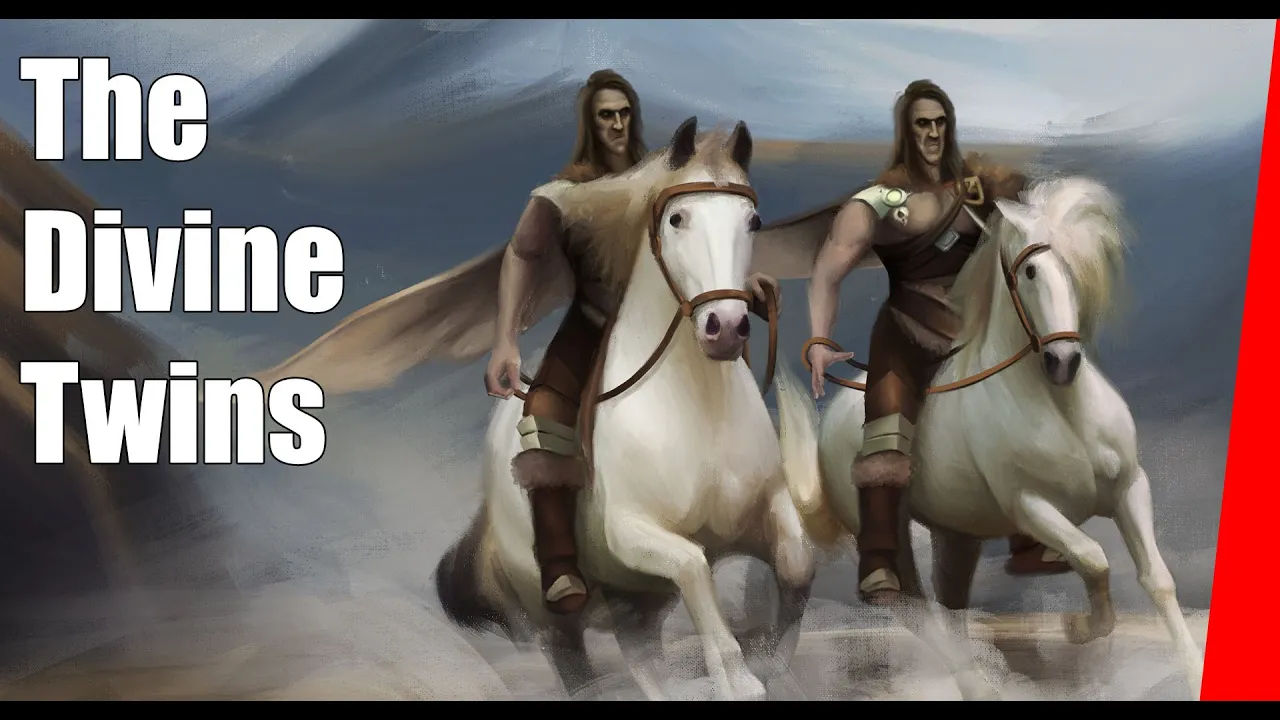
That language contained a grammatical form called the dual.
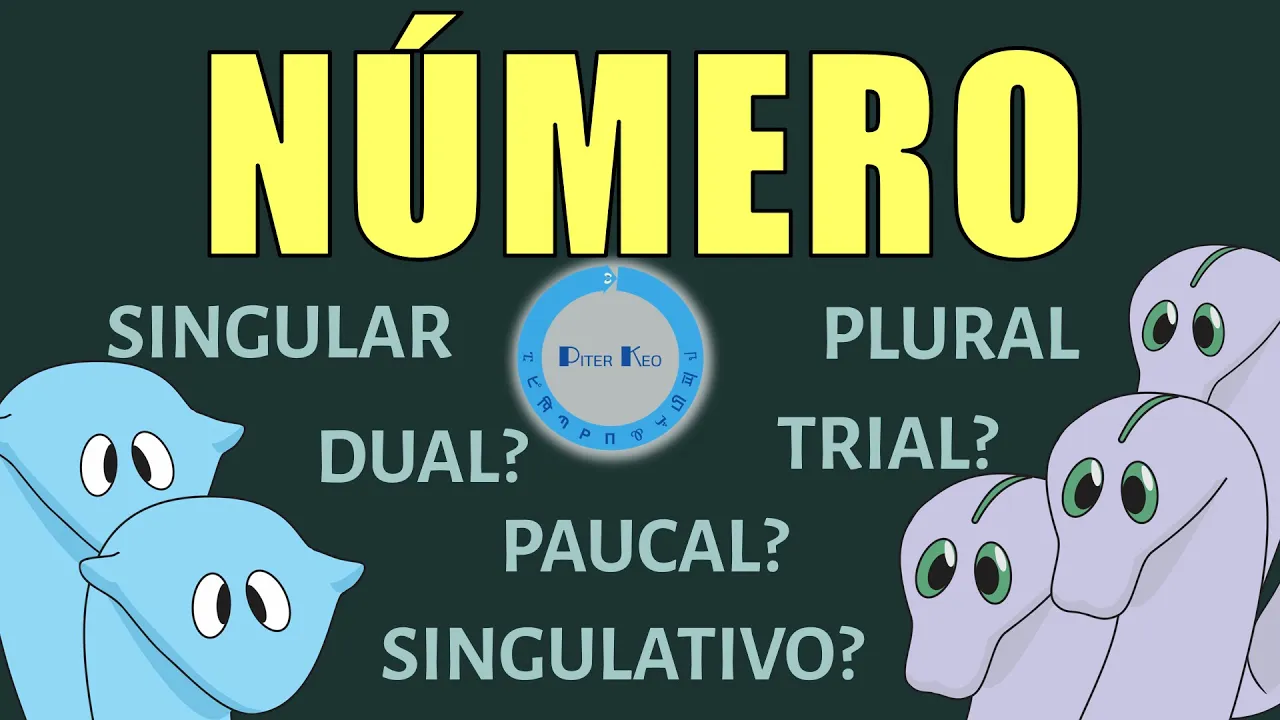
Dual is a number.
English has two numbers: a singular - "I did it," for instance, and a plural - "We did it."
But this linguistic ancestor of ours had a third number, ironically, the dual - "The two of us did it."
Even though many languages are descended from that ancestral tongue, languages that developed in areas as far apart as Iceland and India, most of those languages have by now lost or re-purposed their dual forms.
English only has the vaguest traces of the dual left.
Here, let me show you.
Remember those dual forms in Greek I just mentioned - "polo", "moscho", "kalo te kagatho"?
You notice anything similar about them?
They all end in "o".
That's one of the archaic dual forms.
And what's the duelist word you can think of in English?
(Audience) Tinder!
No. That's pair bonding; it's different.
(Laughter) The duelist word is two.
And what letter does two end with?
See, you've been speaking dual all along, and you didn't even know it.
(Laughter) There's another place to find a remnant of the dual; in, of all things, the number root that means eight, octo.
We get the word octopus from this.
Wait a second. Eight is dual?
If eight is dual, it can be the dual of only one thing: four.
So, our linguistic ancestors counted this way: one, two, three, four, five, six, seven, two fours, nine, ten.
(Laughter) OK.
Curiously, there is still a place where we use fours as the basis of counting.
Anybody knows where it is?
No!
(Laughter) I'll give you a hint.
The height of horses, measured in hands, four fingers at a time, and it's very likely our linguistic ancestors had horses.
Now, before we leave this, I want to talk about two.
I want to explain something you may have always wondered: why is there a W in two when you spell the number out?
But before I enter that, I have to enter something else, that is also too cool - that’s the too without the W.
(Laughter) These linguistic ancestors of ours, today they are called the Indo-Europeans because the civilizations they created are found all the way from India to Europe, but they are actually called the Indo-Europeans because we have no idea what they called themselves, but never mind.
These Indo-Europeans, as they spread across the globe, one of the places they went into was Northern Europe, and there, that branch, the Germanic branch, for some reason, we don't know why, began pronouncing certain sounds differently from the way they had inherited them, and the way other Indo-European groups around them were still pronouncing those sounds.
For instance, the sound that they had inherited as D, they began to pronounce as T, which is why you go to a dentist, starts with D, if you have a toothache, starts with T.
Dent and tooth come from the same root, but dent is the way this root entered English through Latin, where the change didn't happen; tooth is where it entered English through Germanic, where the change did happen.
Now, apply that principle to the Indo-European root for the number two, duo.
What happened to duo when it hit Northern Europe?
The D changed into a T, and duo became two-o.
One, twoo.
(Laughter) For some reason, I'm guessing, to preserve their dignity, our English-speaking ancestors stopped pronouncing that W, but they remembered there was a W there, and they retained it in the spelling.
That's why there's a W in two.
It's duo with a T. It's actually twoo.
(Laughter) Here's something else that's actually twuo.
I don't want to talk about the Indo-European dual.
I don't know very many people who do-o.
(Laughter) What I want to talk about are the Indo-Europeans themselves.
Who they were - we really have no idea, we're not even sure where they lived - and who they are.
Ha-ha-ha, that we know; you're looking at them.
Everybody in this room who speaks or understands English is Indo-European.
Or, if this talk is being translated into French, or Czech, or Farsi, or Hindi, you're Indo-European, too, because Indo-European is not a people, it's not a race.
Okay, it once was, long ago, but no more; that time is past.
Indo-European today means language, and more than that, it means culture.
Ask any anthropologist; language and culture go hand-in-hand.
They're part of the same social mechanism.
Here, I'll show you.
Let's look at another number.
We, Indo-Europeans, are crazy about three.
We see the world as earth, sky, water.
We see things as having a beginning, a middle, and an end.
Do you want a third example?
Sure you do; you're Indo-European.
(Laughter) And guess what?
To us, three examples prove any case, like coincidences don't come in threes.
(Laughter) How many branches of government are there in the US?
The press tried to get in there, but they were four.
No wonder newspapers are dying.
(Laughter) So three shows - and many other things I could cite - that Indo-European is not just language, but culture, a way of looking at life that began spreading millennia ago from southern Russia, Ukraine.
Wave after wave of Indo-Europeans flooded into India, Persia, Greece, Italy, Germany displacing the populations that were there and imposing Indo-European culture.
In the West, they created the civilizations we know as the Greeks, the Romans, the Celts, and they would have kept spreading west, but they ran into the Atlantic Ocean, which proved a formidable barrier (Laughter) for a millennium or so, and then their descendants made a major invention: big boats.
Set sail to sea, discovered the rest of the world, and went about doing what their ancestors had done, conquering natives and imposing Indo-European culture.
Call it the colonization of the Americas; it's really just another Indo-European invasion.
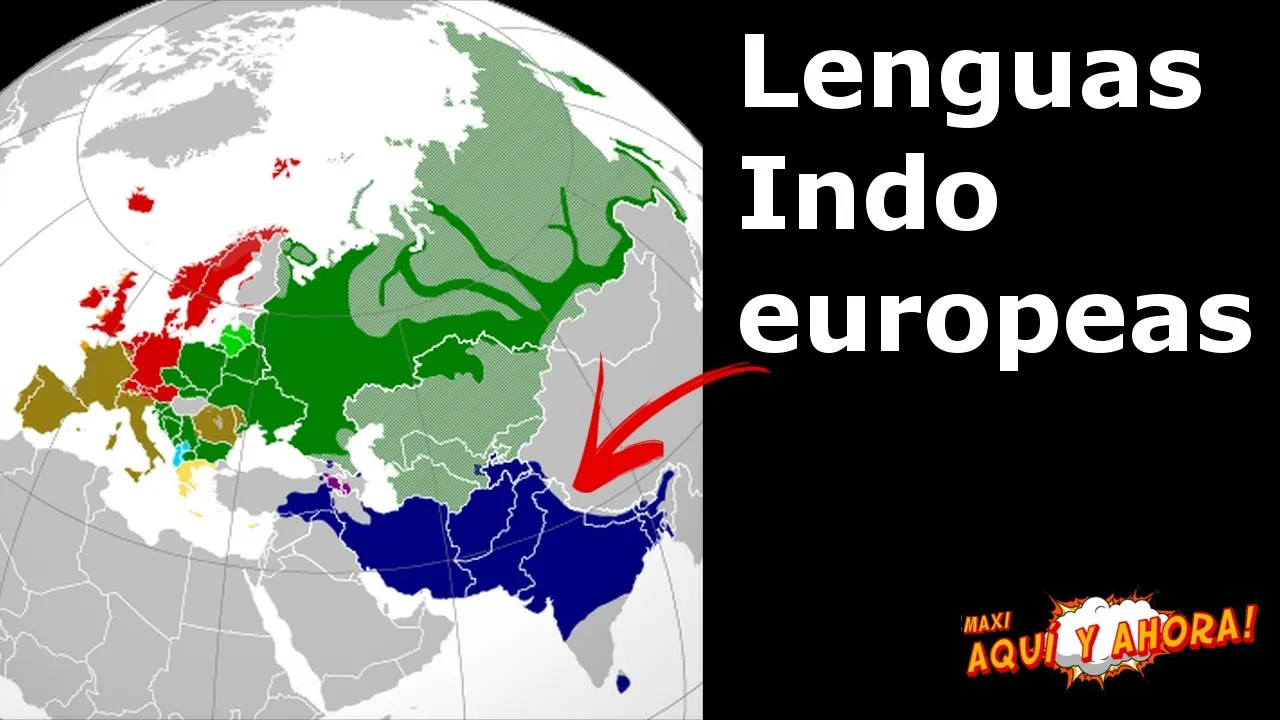
The result is: this map shows how much of the world today speaks either as its native tongue or one of its official languages, a language that belongs to the Indo-European family.
Now, of course it's not that simple.
Indo-Europeans, as they spread across the globe, merged with the cultures they ran into.
But that's not the question.
The question is how balanced has this cultural traffic been, how much culture do we, Indo-Europeans, bestow, and how much do we receive?
Today we have a term for this process; we call it globalization.
But I wonder if some day someone will call it what we historians call it: conquest.
You know, one of our major scientific initiatives today is to find life on other planets.
Before we do, I hope we find better manners.
The sad truth is it's impossible to list all the ways of looking at life that we, Indo-Europeans, in our search across the planet have stomped on and plowed under, ways that might include valuable perspectives on the human condition, and forgetting the power that comes with new and different modes of thought, and all than different; let's not forget, we've forgotten our own dual.
We risk losing, at best, the richness that comes with discovery and insight, and, at worst, an answer we might need, but can't see because we don't have the vocabulary or the grammar to express it.
It is, after all, hard to understand something you can't put into words.
And even if you can, it's all but impossible to communicate it.
The loss of the dual is a small thing, but it's emblematic of bigger things.
Expressing yourself in only a singular and plural blinds you to how often we, humans, operate in pairs, play one-on-ones, have tête-à-tête.
(Laughter) Let's face it, we're dual creatures.
Our bodies are bilaterally symmetrical.
At the core of our being: a double helix.
And I don't know about you, but I talk to myself…a lot.
And I have an evil twin, ha-ha!
(Laughter) If every time you opened your mouth to speak you had to consider the possibility of interacting together with someone else, the way our Indo-European ancestors did, the way speakers of Arabic still do, you might be more inclined to see the world not as it's me or them, but as a constant potential collaboration or a conflict, a dual or a duel.
But in either case, something richer in possibility, richer in number.
The increasing reduction and biodiversity we see all around us today has, I think, a human analogue: a growing and seemingly inevitable loss of linguistic and cultural diversity.
I don't have an answer, so I'm not going to propose one.
That's not my job. I'm a historian.
My job is to ask dazzling questions for other people to answer.
So here's my question for you expressed in English; I hope you appreciate the irony.
Are we better off as a species, are we more likely to survive the travails ahead - and please look at history, there will be travails ahead - are we going to continue thriving because we are more like each other, or if we have at hand a broad range of perspective and expression to pull from?
That's the question your past is asking your future.
Thank you.
(Applause)
Up Next
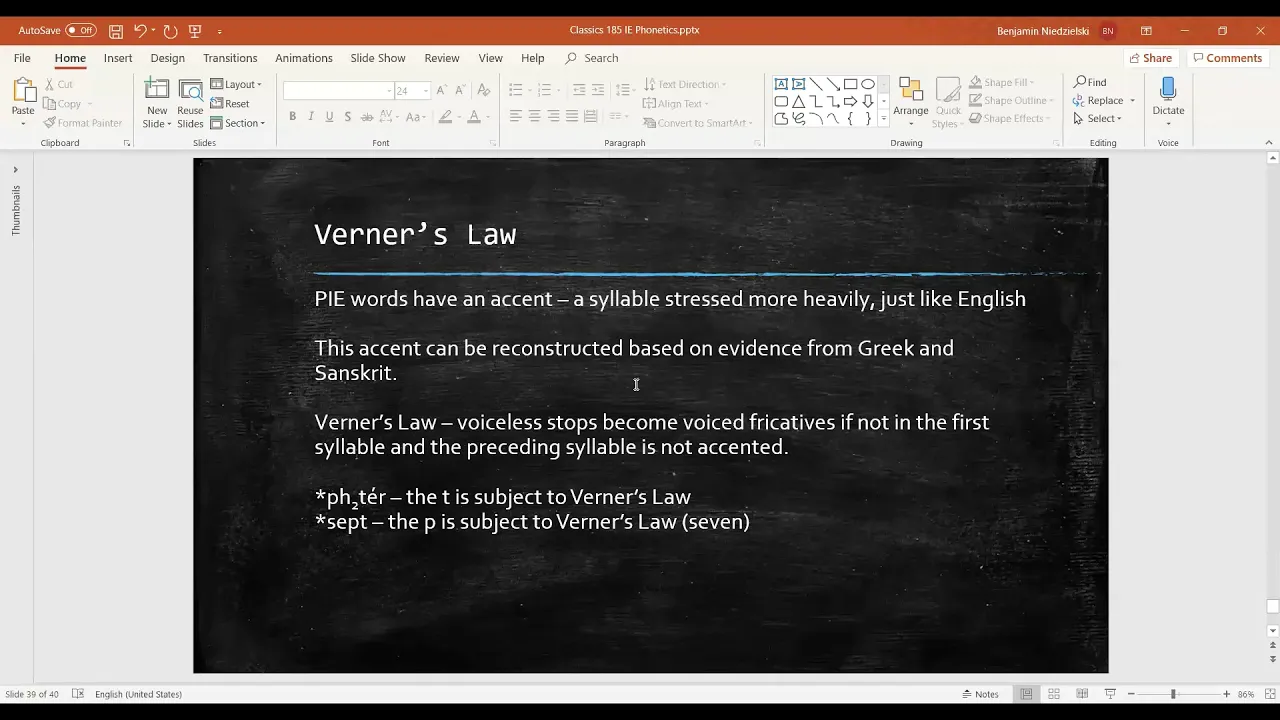
Verner's Law Explained: Exception to Grimm's Law in Historical Linguistics
@bobgant
2.5K views•2020-06-30
Constraint Interaction in Optimality Theory: Epenthesis & Deletion
@Vidyamitra
180 views•2018-08-20

Raising Bilingual Children: Overcoming the Monolingual Myth | Kim Potowski TEDx
@TEDx
124.6K views•2013-05-03

Accent Expert Explains U.S. Regional Dialects | Part 1
@WIRED
9.3M views•2021-01-21
Related Study Plans & Knowledge Roadmaps
Structured learning paths in Linguistics