



![Allosterische Regulation + Endprodukthemmung - Enzymregulation [5/6] - [Biologie, Oberstufe]](https://i.ytimg.com/vi/F8ha1DXw4SU/sddefault.jpg)
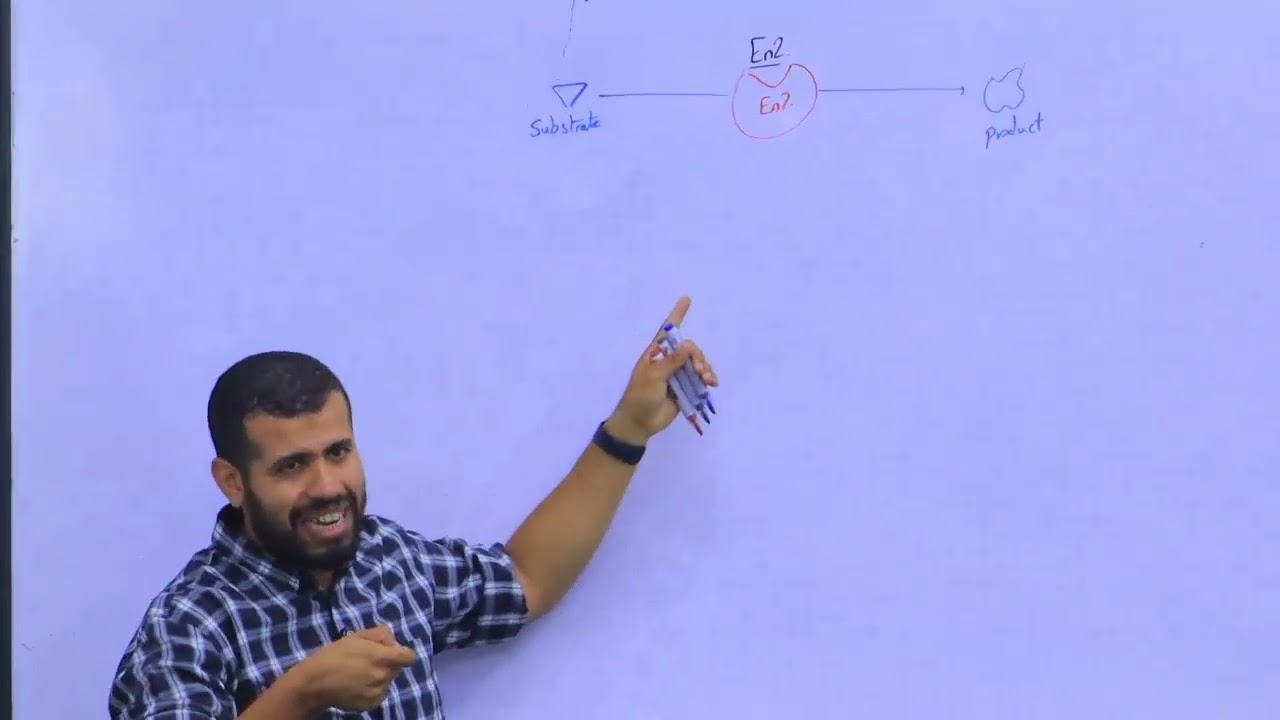
Enzymes are proteins that speed up chemical reactions by binding to specific substrate molecules at their active site, forming an enzyme-substrate complex that stresses or weakens chemical bonds, leading to product formation; after the product is released, the enzyme returns to its original shape and can catalyze additional reactions.
Enzyme Function Explained: Substrate Binding & Catalysis
Added:Understanding of protein structure, specifically how amino acid sequences fold into unique three-dimensional shapes.
Basic knowledge of chemical reactions, including concepts such as reactants, products, and collision theory.
The concept of activation energy and how catalysts function to lower this thermodynamic barrier.
Familiarity with non-covalent molecular interactions, such as hydrogen bonding, ionic interactions, and hydrophobic effects.
Enzyme kinetics, including the Michaelis-Menten model, Km, and Vmax values.
Mechanisms of enzyme inhibition (competitive, non-competitive, and uncompetitive) and how drugs exploit these processes.
The effects of environmental factors (such as pH, temperature, and substrate concentration) on the rate of enzymatic reactions.
Allosteric regulation and feedback inhibition mechanisms within metabolic pathways.
Industrial and medical applications of enzymes, such as in bioremediation, food processing, and diagnostics.
85.2K views192likes1:15Original Release: 2014-11-14
enzymes are proteins that speed up chemical reactions in the cell a special region on the enzyme called the active site has a shape that fits with specific substrate molecules an enzyme works by binding to one or more specific molecules called reactants or substrates binding occurs at the active site the enzyme and substrates form an enzyme substr complex the interactions between the substrates and the enzyme stresses or weakens some of the chemical bonds in the substrates these stresses encourage a link between the two substrates leading to the formation of a different molecule as a result of the chemical interactions within the active site a new product is formed the product is released from the active site the enzyme assumes its original shape and is free to work again although this reaction has specifically Illustrated the formation of a single product from two substrate molecules other enzymes catalyze the formation of two products from a single substrate
Up Next

14:08
Enzyme Mechanism of Action & Activation Energy Explained
@hpdutra
13.8K views•2012-07-19
50:12
Bacterial Communication: Quorum Sensing and Biofilm Formation Explained
@JHUAAP
12.6K views•2011-06-28

5:35
Enteric Nervous System Explained: The Gut's Brain | Neurobiology Lecture
@alumniu6029
438 views•2018-09-12
7:08
Bacteriophages: Earth's Deadliest Killers and Future Antibiotics
@kurzgesagt
34.6M views•2018-05-13
Related Study Plans & Knowledge Roadmaps
Structured learning paths in Biology
biology
RNAi: Biogenesis, RISC & Gene Silencing
01Molecular Biology Foundations: DNA to Protein
02Introduction to RNA Interference (RNAi)
03Molecular Biogenesis of miRNA and siRNA
+ 2 more learning modules
10h5 modules
Explore Roadmap
biology
Mycorrhizae: Signaling, Biophysics & Ecology
01Foundations of Mycorrhizal Symbiosis
02Molecular Signaling and Root Colonization
03Biophysics and Bioenergetics of Nutrient Exchange
+ 1 more learning modules
11h4 modules
Explore Roadmap
biology
Circadian Clocks: TTFL, SCN & Periphery
01Foundations of Molecular Biology & Gene Expression
02Introduction to Chronobiology and Actograms
03The Core TTFL: Molecular Architecture of the Clock
+ 3 more learning modules
14h6 modules
Explore Roadmap
biology
Population Genetics: Math, Drift & Selection
01Genetic & Probability Foundations
02The Hardy-Weinberg Principle and Baseline Models
03Mathematical Modeling of Natural Selection
+ 3 more learning modules
18h6 modules
Explore Roadmap