



























Arbitration agreements, commonly signed by employees during hiring, can significantly disadvantage workers by limiting their ability to pursue legal claims in court, as these agreements typically favor employers through biased arbitrators, restricted discovery, class action waivers, and lack of appeal options; however, employees can potentially avoid or challenge these agreements through various legal strategies including negotiating better terms, citing specific exemptions like sexual harassment claims under HR 4445, or arguing unconscionability based on unfair bargaining power.
Arbitration's Hidden Costs for Employees: An Expert Analysis
Added:Basic principles of Employment Law, including the distinction between at-will employment and contractual employment.
The fundamental differences between litigation (the public court system) and Alternative Dispute Resolution (ADR) mechanisms like mediation and arbitration.
An understanding of what an employment contract is and how standard clauses, particularly dispute resolution clauses, are structured.
The concept of legal 'recourse' and how employees typically seek remedies for workplace issues like discrimination, harassment, or wage theft.
The role of Class-Action Waivers in mandatory arbitration agreements and their compounding impact on systemic workplace litigation.
The 'Repeat Player Effect' in arbitration and how institutional biases can influence dispute outcomes in favor of employers.
Analysis of legislative reform efforts, such as the Ending Forced Arbitration of Sexual Assault and Sexual Harassment Act and the proposed FAIR Act.
Comparative study of international labor dispute resolution systems, contrasting the US private arbitration model with public labor courts in Europe.
Best practices for designing equitable, transparent internal grievance procedures that protect employee rights while effectively resolving workplace conflict.
80.4K views3.9Klikes33:19Original Release: 2022-11-28
- If you're an employee in America, you need to know what arbitration is and the devastating effect it can have on your life.
I'm an employment lawyer, and I'm gonna show you on the whiteboard why arbitration is a scam and how you can avoid falling in the trap.
Let's talk big picture for just a second.
When most people hear the word arbitration, their eyes roll into the back of their head.
I mean, it sounds super boring, but trust me when I say, the knowledge I'm about to share might mean the difference between millions of dollars in your bank account and nothing.
Right, when you start a new job, I know that the last thing cross in your mind is, "What are my legal options if this company ruins my life?"
Just because you are not thinking about your future legal rights does not mean the company isn't because they are, and some companies, not all of 'em, but some, have spent millions of dollars setting up a sneaky system to limit the rights that our federal and state governments have put in place to protect workers like you.
This system is called arbitration, and I'm gonna reveal layer by layer why arbitration stacks the justice system heavily against employees like you.
Well, what is arbitration?
Traditionally, employees have the right to file a lawsuit in the public court system and demand a jury trial for things like unpaid overtime, harassment, retaliation, or wrongful termination.
Arbitration, on the other hand, is a contract between the employee and the employer, whereby you agree to resolve any lawsuits that you have outside of the public court system.
So in a nutshell, arbitration is an alternative legal system to the public court system that we're all familiar with.
Well, when is this contract made?
After you accept a new job offer from a company, the HR there is gonna ask you to sign a bunch of documents.
Happy to have a new job, most people quickly sign all the documents without reading them, and in my estimation, in the USA, about 20 to 40% of employers ask their new hires to sign an arbitration agreement, and they always put that in the new hire documents.
Or the arbitration agreement is buried in the employee handbook and the employee will be asked to sign an acknowledgement page that says that they agree to the terms in the employee handbook.
Sneaky, right?
Now, if you refuse to sign the arbitration agreement, most companies in HR departments will rescind the job offer or they will fire you.
I'm gonna talk a lot more about this later, so stay with me.
Now, if you signed a valid arbitration agreement when you started working at your company and now you wanna take legal action, you cannot bring your case in the regular court system.
You have to bring it via arbitration.
Okay, with all this preliminary stuff out of the way, let me give you a quick roadmap where this video is going.
I'm first gonna detail the differences between court and arbitration, then I'm gonna expose the advantages and mostly disadvantages of arbitration, once you understand that, I'm gonna give you some options on how to avoid it, and finally, I'll conclude by going into detail how you can get out of arbitration if you already signed an agreement.
Now, before we dig into all that, I have two quick last final things.
My name is Branigan and I have a license to practice law in California, but I'm making this video to educate workers all across the United States, but also you should not take anything that I say as legal advice.
If you need legal advice, pick up the phone and call a lawyer in your state.
There are some big differences between court and arbitration.
In arbitration, as opposed to having a judge, like you would in court, you have an arbitrator who oversees the case.
This is usually a retired judge or a former defense attorney.
In court, the judge is paid by our tax dollars, by the government.
In arbitration, the arbitrator is paid hundreds of dollars an hour by the company that is being sued.
In court, a judge is not allowed to have a conflict of interest.
Arbitrators, on the other hand, have them all the time and only sometimes are they disclosed.
In court, you are randomly assigned a judge who's supposed to be impartial and he or she must recuse himself or herself if they have a conflict of interest.
In arbitration, the lawyers get together and pick the arbitrator.
In the public court system, the judges must follow the fairness rules regarding discovery and the deadlines that are set up so that each side gets a fair shot to gather relevant evidence from the other side.
In arbitration, the arbitrator can severely restrict your lawyer's ability to gather evidence.
In court, if the case does not settle, you will have a trial at the courthouse.
In arbitration, it's not called a trial, it's called a hearing, and it's usually held in some private corporate conference room or a lawyer's office.
In court, your trial is decided by a jury of your peers, while the judge is there simply to ensure fairness.
In arbitration, the arbitrator is the sole decision maker.
They act as judge and jury.
And finally, in court, you have the right to appeal bad decisions.
In arbitration, you have no right to appeal a bad decision.
Next, let's talk about 10 of the most important advantages and disadvantages to arbitration, and you need to understand these.
I covered a few of these briefly in the video I released a few weeks ago called How HR Cheats Employees.
I strongly recommend that you watch that video when you finish this one because it's completely related.
I'll link to it at the end of the video.
Okay, let's get to the list.
These get more important as we go, so pay close attention.
Number one, speed, right?
Everybody knows that America's legal system is really slow.
That is absolutely true.
And in comparison to the regular court system, arbitration typically leads to a faster result, but that doesn't mean arbitration gets the right result faster.
It usually just means the case ends faster regardless of correctness.
Number two, incentives.
I start it because you really need to pay attention to this.
The big advantage for companies is that arbitration is a system that monetarily rewards arbitrators who rule in favor of companies and it monetarily punishes arbitrators who award money to employees.
Here's how it works.
If you're an arbitrator, who's paying you?
The company is paying you.
Arbitrators get paid hundreds of dollars an hour by the company being sued.
So if you're an arbitrator and you rule in favor of an employee, guess what?
That company will not agree to use you again in the future, and their lawyer will tell all of his lawyer buddies not to use you as an arbitrator because he lost a case.
Think of the balance of power here.
Companies are repeat customers for arbitrators.
Massive corporations get sued all the time.
If an arbitrator makes them happy, they could make hundreds of thousands of dollars each year from that company alone.
On the other hand, individual employees like you are not repeat customers.
Most people don't get wrongfully terminated twice, right?
It just doesn't happen.
So they have no money or future money to offer the arbitrator.
Arbitrators know if they rule in favor of the company, they will likely receive repeat business from that company, or at a minimum, they will get positive referrals within the defense lawyer community.
A very prominent lawyer once told me a story to drive this home.
When he was young, he got a million dollar plus verdict in arbitration for his client employee.
It was a great result for that client.
Guess what happened?
The arbitrator who made that decision never worked again because no company would agree to use him.
You don't have that flexibility in the regular court system, right?
But this doesn't mean if you are stuck in arbitration that you shouldn't bring your case.
We're gonna talk more about that in a few minutes, so stay with me.
Next, let's talk about privacy.
The regular court system is public by design.
Arbitration, on the other hand, is private by design.
Companies obviously love their privacy because it keeps their dirty secrets out of the public eye.
On the other hand, this can be an enormous disadvantage for you because public pressure when warranted can really motivate a company to settle.
It can discourage them from destroying evidence and it can force them to make actual structural changes at their workplace so that this bad thing doesn't happen to another person.
Okay, let's look at number four.
This is interesting.
You get to pick or your lawyer gets to pick the decision maker.
Once a dispute has been filed in arbitration, the lawyers for each side go back and forth proposing names, and eventually, they usually agree on an arbitrator.
So you have some say on who is going to be the decision maker.
Now, this sounds good at first until you realize that the pool of arbitrators in which to pick from is heavily tainted and defense-oriented.
If your lawyer and the defense lawyer cannot agree on an arbitrator, then the default rules kick in and a system will select one for you.
That isn't a good option either because the entire pool of arbitrators are almost all defense-oriented.
Now, it is possible that you can get an unbiased arbitrator and it's possible that an employee can get a decent result in arbitration, but the odds of that are extremely low and you need to pay attention to odds in litigation.
Number five, finality. This is important.
Companies love that when the arbitration is over, the case is over, there are no appeals.
While that might sound like a good thing, it's not if you're the party who believes the wrong decision was made, and unfortunately in employment arbitration, usually the employer wins.
Remember the odds.
Number six, this is so important, simplified discovery.
The most burdensome part of a lawsuit is discovery.
Discovery is the process that the parties go through to gather evidence from the opposing party.
It involves things like depositions, inspections, document exchanges, and a whole lot more.
Arbitration is supposed to streamline this burdensome process.
In theory, that sounds great, but the reality is much different.
You see, for employment disputes in particular, the employee is usually trying to prove that they were fired because their boss had an unlawful motive, such as, for example, the boss decided to fire you because you made a protected complaint to HR.
After somebody has been fired, they don't have access to documents, witnesses, emails, text messages, et cetera.
They are cut off from all the important evidence.
The company, on the other hand, still has access to all the evidence, all the witnesses, all the emails.
So the employee is at a natural disadvantage at the start of every case.
In court, this is okay because the rules of civil procedure level that playing field by allowing the employee's lawyer to do liberal amounts of discovery so they have an opportunity to gather the evidence, whatever it may show, but arbitrators in reality don't have to follow the rules of civil procedure.
So in order to streamline the discovery process, the arbitrator just severely limits the discovery that your lawyer can do.
For example, let's say in court, your lawyer would ideally like to do 10 depositions and send out 80 document requests.
In arbitration, it's highly likely that the arbitrator will limit that down to like three or two depositions and maybe 15 or 20 document requests.
Unbalance.
This absolutely puts you the employee at a huge disadvantage.
Number seven, the cost or the expense of the case.
One of the big advantages for arbitration is that it's cheaper than going to court, but this is completely misleading.
It is cheaper for your employer, not for you.
If you have a good wrongful termination case, you'll be able to find a good employment lawyer who will take your case on a contingency fee basis.
That means your lawyer is getting paid a percentage of what they recover for you, regardless of how long it takes, regardless of whether it's an arbitration or court.
It's cheaper for the companies primarily because the arbitrators restrict the discovery, like we just talked about.
The affordability of arbitration does not apply to employees at all, so this is completely misleading.
Number eight, class action waivers.
In 2018, the United States Supreme Court ruled that arbitration agreements can include a class action waiver.
That means if you signed an arbitration agreement with a waiver, you cannot bring a class action lawsuit against the company.
Why does this matter?
Well, let's say the company has failed to pay you $7,000 in wages.
$7,000 is a lot of money, but that is not enough to justify hiring a lawyer and pursuing a lawsuit against the company.
The cost will quickly overwhelm the value of that, right?
Those smaller claims are just not worth pursuing even on a contingency basis.
But if you and your lawyer can gather 50 or 100 people together to sue on a class-wide basis, then the case becomes economically viable to pursue.
If you're paying attention, what this means is that if there's an arbitration agreement, those smaller claims just don't get pursued, period.
That means the company essentially gets away with theft.
By my estimate, without question, tens of billions of dollars of employee money across America is lost each year because of these class action waivers and arbitration agreements.
Number nine, settlements and verdicts.
When your case is forced into arbitration, its settlement value is substantially less than if it were in the regular court system.
That's great for the company and obviously terrible for you.
Well, why does this happen?
Well, because you are, one, less likely to win, and two, if you do win, you are less likely to win big.
Therefore, companies are less likely to pay you significant money to settle the case.
Here's a good example.
I was representing a physician in a big case against a major healthcare provider that you've all heard of.
After we selected the arbitrator, I found out that the arbitrator had adjudicated another big case against that same major healthcare defendant.
So what did I do?
Obviously I called up the lawyer who represented the employee in that prior case and asked how the arbitration went.
He told me that it was a nightmare.
He represented a physician employee, just like me, who was suing for millions of dollars, just like I was.
His case did not settle, so went all the way to the hearing, which is also the trial.
He said he absolutely crushed the company in the hearing, and the arbitrator knew it and recognized the employee had overwhelming evidence, and the arbitrator ruled in his client's favor.
Sounds good, right?
No, the arbitrator ruled in his favor but only awarded them $500.
So they won, but in reality, they lost.
They were suing for millions and the arbitrator awarded 500.
I've talked to dozens of my employment lawyer colleagues and they all say that arbitration substantially reduces the value of the case.
But again, that doesn't mean that it's not worth bringing the case if you're stuck in arbitration.
We'll talk more about that in just a minute, so stay with me.
And finally, number 10, if you signed an arbitration agreement, it is harder to find an attorney.
It's gonna be harder, right, if you sign an arbitration agreement.
Lawyers like me don't get paid by the hour.
We get paid a percentage of what we recover for our clients.
So if arbitration reduces the value, it makes it harder for me to justify taking the case.
Now, I will absolutely take a case that is stuck in arbitration.
It just needs to be far above average in terms of liability and value.
Unfortunately, I get a lot of calls each year from people who have a decent case, but it's just an average case, and because it's stuck in arbitration, I'm not gonna take that.
Now, I know lots of good lawyers in California who will take those average arbitration cases.
So I can still help the people when they call my office by referring them to another lawyer who is willing to take the case.
With all this doom and gloom, should you just give up and drop your case if you signed an arbitration agreement?
My answer is absolutely not. But why?
Considering all the bad stuff I just taught you, why should you even try to bring a case?
Well, there's a bunch of reasons.
I've got four here.
Number one, if you don't bring your case, the company is gonna get away with injustice on top of the violation of law.
That means they will be emboldened and they will do the same thing to the next person who is in your position.
By bringing the case and applying legal pressure, you are teaching them how to behave in the future.
Number two, there is a chance that your arbitration agreement is invalid and you will still be able to go to court.
We're gonna talk more about this here in a minute, so stay with me.
There's also a chance that even if it is valid now, it will become invalid in the future due to the growing recognition among policy makers that arbitration is a rigged game.
Number three, you can still get a result that is worth the fight.
While the result might not be as large as it would've been had you been in court, it might still be worth it to you.
And number four, in some cases, the employer is going to want to settle with you faster to avoid having to pay the arbitrator.
The arbitrator's expensive, and some employers don't wanna spend the money, and that will speed up the settlement.
This happens a lot in clear liability cases where the value at issue is under 100 grand.
So how can you avoid arbitration in the first place?
Well, the most obvious way to avoid arbitration is to get a job at a company where they don't require it, right?
By my estimate, like I said earlier, only 20 to 40% of companies in the USA ask their employees to sign an arbitration agreement in the first place.
So if you are looking for a job and you're being interviewed by a company, ask the HR rep, "Do you guys require us to sign an arbitration agreement?"
If they say yes, take that into consideration.
But let's say you're watching this video because you are just asked to sign an arbitration agreement.
What can you do then?
The way I see it, you've got four options, and I strongly recommend that you carefully listen to all four options before you decide what to do.
And I should also say that if you're really facing this decision, it would be wise to contact a lawyer in your state if you really need advice on the matter.
Option number one, don't sign it, say nothing, and see what happens.
Okay, what do I mean by this?
Well, pretty much exactly that.
When you get hired at the company, all the other documents that they require you to sign, sign them all, except for the arbitration agreement.
Put it all in a giant pile and turn everything in, once again, excluding the unsigned arbitration agreement, and don't say a word.
There's a lot of HR reps who are not gonna even notice that you didn't sign it.
Thumbs up. Awesome, right?
Number two, sign the documents, but cross out the bad parts and see what happens.
Again, it sounds very simple, but it can work.
Depending on the structure of your documents that you're being asked to sign, it might be better to sign the documents, but cross out the section on arbitration, initial next to the cross out, date next to the cross out, turn it in, and say nothing.
Again, it's possible the HR rep won't even notice that you crossed out the section on arbitration.
If the arbitration agreement is buried in the employee handbook and the HR rep insists that you sign the acknowledgement page, well, okay, sign it, but right below your signature, something like, "I do not agree to this section on an arbitration, and I do not consent to giving up my right to pursue any case in court in front of a jury."
Then find the page on arbitration, cross it out, initial and date next to it, turn both pages in, and again, wait to see what happens.
It is possible the HR rep will be lazy and just ignore it and you're good to go.
Now, signing something but crossing out the stuff you don't like is not a guaranteed way to avoid the contract.
Every state has different contract laws, right?
But I can guarantee that crossing stuff out, initialing, dating, and doing things like this will give your lawyer a whole lot more ammunition to contest your arbitration agreement down the road, which we're gonna talk about here in a minute.
Number three, refuse to sign it. (laughs) You can just tell HR that you're not gonna sign it.
The risk in doing that is that they're going to rescind the job offer, or if you're already employed, they might fire you if you refuse to sign it.
With this strategy, there are two big things that we need to think about.
The first is that the company is hiring you because you possess skills that it needs to make money.
If you bring enough value to the company, you have what is called bargaining power, my friend.
You can just refuse to sign the arbitration agreement, and if they want you badly enough, they will relent and hire you anyway.
Obviously, everyone's circumstances are different here, so it's hard to say that this will work for you, and unfortunately, if you really think about it, this isn't the reality for a lot of people.
A lot of people just don't have a lot of bargaining power because let's say they just got out of high school and they're applying for a job at Walmart.
You don't have bargaining power 'cause you're not bringing a lot of value to the organization.
So implement this strategy at your own risk.
But the other thing we need to talk about is some states like California, where I practice law, are figuring out that arbitration is contrary to humanity, sense of justice, and fairness.
As a result, California recently passed AB 51.
AB 51 is a law that prohibits employers from requiring employees to sign arbitration agreements as a condition of employment for disputes underneath the California Fair Employment and Housing Act or the California Labor Code.
And luckily for you, the vast majority of the reasons why you would ever wanna sue an employer follow under those two bodies of law.
What this means in simple terms is that employers are prohibited from requiring their employees and their perspective employees from signing arbitration agreements.
So if you are in California, you can refuse to sign the arbitration agreement and tell HR that AB 51 allows you to decline signing and they're not allowed to fire you or refuse to hire you because of that refusal.
However, that is not the whole story.
At the time I'm filming this video, AB 51 is being challenged in the Ninth Circuit Court of Appeals.
A temporary injunction is in place at the moment, so this is not settled law.
It can be overturned by the time you watch this video.
I don't know what's gonna happen.
So if you're in California, you'll have to be careful taking a strong position on this in the future as I don't know what's going to happen.
Option number four, you can negotiate terms.
If the employer won't hire you without your signature on the arbitration agreement, then you can try to negotiate certain terms to get a more favorable arbitration agreement or to just get more favorable employment terms.
Remember, this is a contract, and you can try to change the terms.
Here are a few terms that you can use as bargaining chips.
"I'll agree to sign the arbitration agreement if you increase my base salary by 30% or 40%," or whatever you want.
Another one, "I'll agree to sign the arbitration agreement if I have the sole discretion to pick the arbitrator if a dispute between the company and I arise."
Or, "I'll agree to sign the arbitration agreement if you allow me to work from home three days a week."
Obviously, you can get creative here, and I'm just scratching the surface, and if they agree to one of your terms, please, for the love of Pete, get it in writing before you sign anything.
Before we get to our last topic, let me ask you a quick favor.
If you're getting value out of this video, please click the Subscribe button and share this video with friend because sharing is caring and I'm gonna make a lot more videos about employee rights.
Let's say that you've signed an arbitration agreement already.
Can you get out of it?
Well, yes. How do you do it?
Well, the most obvious answer is to quit and find a new job where they don't require it, but that's obviously not realistic.
If you're happily employed somewhere, I would never recommend that you quit your job just because you signed an arbitration agreement.
Chances are you won't have a legal dispute with the company down the road.
Aside from quitting, what's the best way to get out of arbitration agreements?
Well, the way I see it, there's kind of four options, and the first one has to do with sexual harassment.
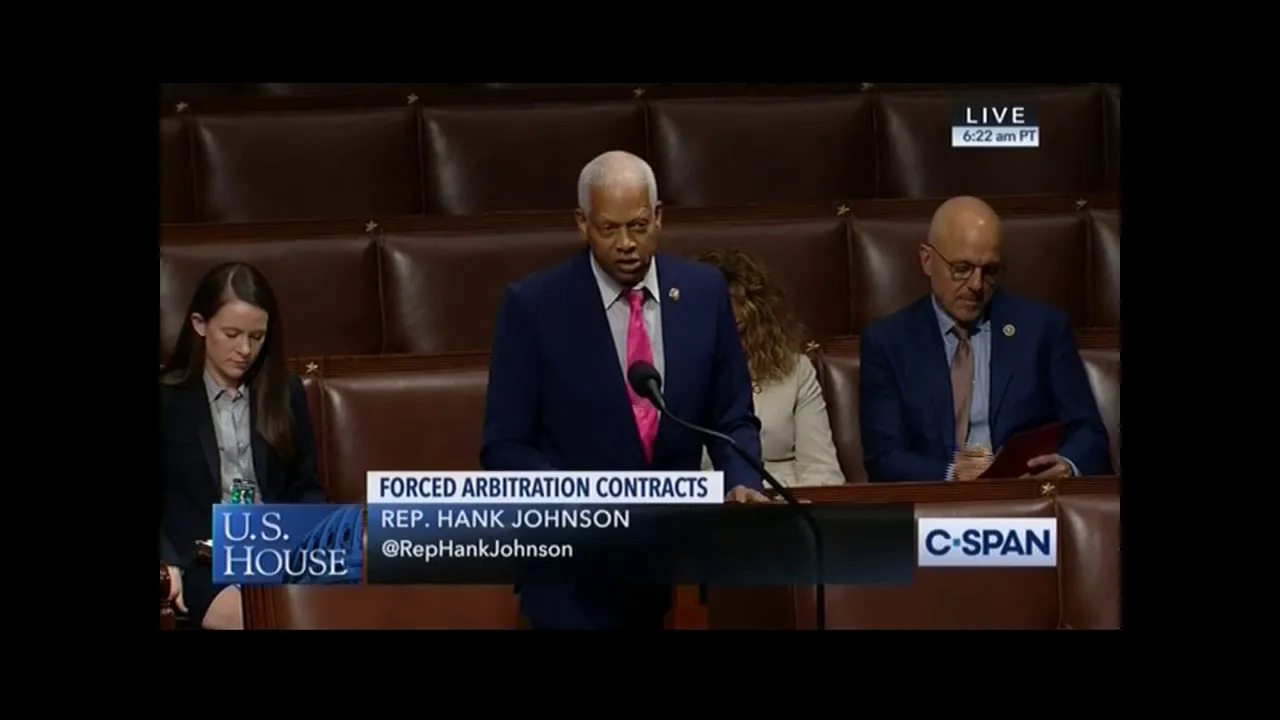
In, I think it was on March 3rd, 2022, the president signed HR 44, 45, which is a nationwide law that invalidates arbitration agreements when one of the underlying claims is sexual harassment or sexual assault.
In other words, 44, 45 says that an employer cannot force you to arbitrate your lawsuit if one of your claims is sexual harassment or sexual assault, even if you signed a valid arbitration agreement.
Now, this can apply to things like wrongful termination as well.
Let me explain.
Let's say you're being sexually harassed by a coworker.
You complain about it to HR, but then the company retaliates against you and you get fired.
While the main claim here is wrongful termination, it's likely you can keep this case out of arbitration because one of the claims you are going to bring is that you were sexually harassed.
Pretty awesome, right? Yeah.
Number two has to do with securities fraud under Sarbanes-Oxley.
Employers are not allowed to force arbitration on whistleblower claims under the Sarbanes-Oxley Act, or I think it's called the Dodd-Frank Act.
These two laws deal with securities fraud when the employer is a publicly traded company.
Here's how it works.
Let's say that you are an accountant for a publicly traded company, and while you're doing your work, you realize that your employer is cooking the books and reporting false information to the public and the SEC.
If you complain about that to your manager or to the SEC or to somebody else that's relevant and then you get fired, you can file a whistleblower claim.
Under this kind of scenario, 18 US Code 1514 A subsection E will prevent the employer from forcing you to arbitrate your claim, even if, once again, you signed a valid arbitration agreement.
Also pretty awesome.
Number three, unconscionability.
This is the main way to challenge an arbitration agreement.
Basic contract law 101 says that you can get out of a contract if the contract is found to be unconscionable.
What the heck does that mean?
Well, in California, unconscionability is the absence of meaningful choice on the part of one of the parties together with contract terms which are unreasonably favorable to the other party.
This definition comes from Armendariz v. Foundation Health, a major California Supreme Court case.
Now, your state's gonna have a different definition, but most states say that unconscionability requires a showing of both procedural unconscionability, which is is unfair bargaining power, and substantive unconscionability, which is a serious defect in the deal in the document.
Procedural unconscionability results from oppression caused by unequal bargaining power.
Usually the employer has more bargaining power.
Substantive unconscionability focuses on overly harsh or one-sided terms.
Now, courts utilize a sliding scale balancing test when analyzing this whole unconscionability thing.
Most of the time employees win that an agreement is procedurally unconscionable, but they usually lose when it comes to substantive unconscionability.
Most lawyers, including myself, have lost at the substantive unconscionability level.
Now, if you're not a lawyer, I wouldn't get bent out of shape researching unconscionability or figuring out what all this means.
That's a waste of your time.
If you have a good case, your lawyer will carefully read your arbitration agreement, and if they believe there's a chance to get out of it, they will file your case at court and force the defendant, which is the company, to make a motion to compel arbitration.
Then your lawyer will file an opposition and the judge will decide if you can get out of it.
Now, there is not anything that you can do to make the agreement that you already signed more unconscionable. (laughs) The best thing that you can do is pray that your lawyer makes good arguments under your state law and that the judge agrees and rules in your favor.
But this is highly variable based on your state law, the predisposition of your judge, and how good your lawyer is, and also how bad the company's lawyer is.
Four, renegotiate.
You can always renegotiate.
I've never heard of anyone trying to do this, but I think it's worth talking about.
You could try to convince your employer to scrap the arbitration agreement by gathering a bunch of employees together and using arbitration as a bargaining chip in a labor negotiation.
So let's say a couple hundred employees are negotiating a pay raise for the next five years.
You could ask the employer to eliminate the arbitration agreement that you've already signed, and in exchange, you will give up some employee benefit that you think that you're entitled to.
Once again, arbitration is a contract, so the parties to that contract can change their minds and get out of it.
Now, there is a lot more that I could say about arbitration, but this video has definitely gone on long enough.
As I said earlier, you should not take anything in this video as legal advice.
If you need legal advice, pick up the phone and call a lawyer in your state.
I have a license to practice law in California.
A lot of people who see my videos wanna contact me, and that's awesome, but the free consultation process at my office is for California workers who got fired and they believe that they have a case for retaliation, discrimination, harassment, or wrongful termination.
If that applies to you and you think I've earned your phone call, please don't be afraid to pick up the phone and call me for a free consultation.
Now, if you've gotten something out of this video, please click the Subscribe button.
I make videos about employee rights, and if you wanna stay in the loop, click the button.
That's all I got for you. Have a great day.
Up Next
62:52
Mediation vs Arbitration: Essential Contract Dispute Strategies
@WilliamsMullen
159 views•2024-10-07

4:27
US Secondary Sanctions Impact on EU Businesses and Blocking Legislation
@Bureauvandijk
1.6K views•2019-03-20

5:27
Forensic Phonetics: Speaker Identification in Legal Cases
@nptel-nociitm9240
539 views•2025-03-19

24:42
Police Interrogation Tactics: False Confessions & Legal Reform
@LastWeekTonight
7M views•2022-04-18
Related Study Plans & Knowledge Roadmaps
Structured learning paths in Law
law
Self-Defense Law: Imminence & Castle Doctrine
01Foundations of Self-Defense Law
02Imminent Threat & Reasonable Belief
03The Principle of Proportionality
+ 3 more learning modules
12h6 modules
Explore Roadmap
law
Defamation Law: First Amendment & Actual Malice
01Introduction to civil torts and the First Amendment
02Elements of Defamation: Libel and Slander
03Public Figures vs. Private Individuals
+ 2 more learning modules
8h5 modules
Explore Roadmap
law
Hearsay Rule: Trial Evidence & Exceptions
01Introduction to Trial Evidence & Courtroom Basics
02Demystifying Hearsay: The Core Definition
03Non-Hearsay: Exclusions Under FRE 801(d)
+ 3 more learning modules
14h6 modules
Explore Roadmap
law
Medical Malpractice: Law, Liability & Care
01Foundations of Tort Law and Civil Liability
02The Four Elements of Medical Malpractice
03Defining and Proving the Standard of Care
+ 2 more learning modules
12h5 modules
Explore Roadmap