Analyzing Mergers: Clayton Act & FTC Rules
Learning Goal: Evaluating corporate mergers under Section 7 of the Clayton Act and the FTC/DOJ Merger Guidelines to analyze market concentration and anticipate antitrust enforcement actions.
- Prerequisites: Basic understanding of microeconomic principles (supply, demand, and market structures).
- Estimated Total Study Time: 10 Hours
Module 1: Introduction to Antitrust Law and Market Competition
This module introduces the historical and economic foundations of antitrust law in the United States. You will study how industrial consolidation at the turn of the 20th century prompted legislative action, starting with the Sherman Act of 1890, and how the legal framework evolved to regulate corporate monopolies and preserve fair market dynamics.
Recommended Videos

Why this video: This video provides a vital historical narrative on how corporate consolidation in the late 19th century led to the passage of the Sherman Antitrust Act. Understanding the historical mischiefs of trusts (such as Standard Oil) is fundamental to analyzing why preventative merger laws like the Clayton Act were later created.

Why this video: A concise, encyclopedic overview of the core statutory pillars of US competition policy. It clearly maps out the relationship between the Sherman Act (1890), the Clayton Act (1914), and the Federal Trade Commission Act (1914), establishing the basic architecture of federal antitrust enforcement.
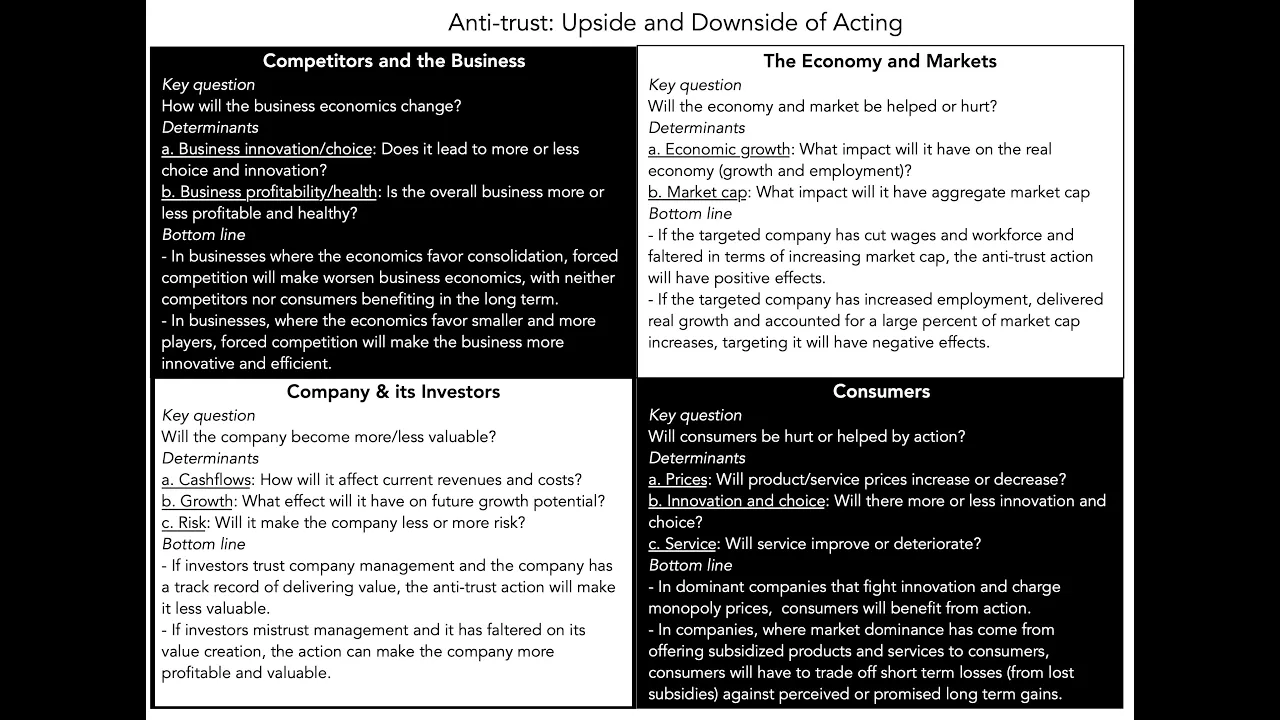
Why this video: Hosted by finance professor Aswath Damodaran, this short video frames the economic transition of America from agrarian to industrial, highlighting how the infrastructure boom (steel, oil, and railroads) directly necessitated modern monopoly regulation.
Independent Study Guidance (Addressing Curricular Gaps)
The video pool lacks simple animated models of pure monopoly versus perfect competition. To master these foundational concepts, independently review standard microeconomic models detailing how a monopolist restricts output and increases price relative to a perfectly competitive market, causing deadweight loss and transferring consumer surplus to producers.
Knowledge Checkpoint
- Detail the historical economic factors that drove the passage of the Sherman Antitrust Act of 1890.
- Explain how the Clayton Act of 1914 was designed to supplement the gaps of the Sherman Act.
- Contrast the core regulatory objectives of the DOJ with those of the FTC.
Module 2: Corporate Mergers and Section 7 of the Clayton Act
This module examines Section 7 of the Clayton Act, the primary statutory weapon used by the US government to block anti-competitive mergers. You will study horizontal, vertical, and conglomerate merger structures, and dissect the precise legal standards used by courts to evaluate whether a transaction's effect "may be substantially to lessen competition."
Recommended Videos

Why this video: This video frames the literal statutory language of Section 7 of the Clayton Act, emphasizing how it prevents mergers where the effect "may be substantially to lessen competition, or to tend to create a monopoly" across "any line of commerce" or "any section of the country."

Why this video: This segment reviews the legal application of Section 7 of the Clayton Act to entertainment industry consolidations. It covers key historic precedents, including the Supreme Court’s established 30% market share threshold which triggers a presumption of anti-competitive harm.
Why this video: Attorney Richard Hoeg dissects the legal mechanisms of the Clayton Act. Crucially, he explains the "probabilistic" standard of Section 7—clarifying that the law is designed to arrest anti-competitive behavior in its incipiency, meaning regulators must demonstrate a reasonable probability of harm rather than absolute certainty.
Knowledge Checkpoint
- Define the difference between horizontal, vertical, and conglomerate mergers.
- Explain why Section 7 of the Clayton Act is described as an "incipiency" statute.
- Recite the primary statutory standard of Section 7 regarding the lessening of competition.
- Identify the market share threshold established by the Supreme Court that triggers a presumption of a Section 7 violation.
Module 3: Defining Markets and Measuring Concentration (HHI)
Before assessing a merger's competitive effects, regulators must define the relevant market and calculate its concentration. This module covers the SSNIP (Small but Significant and Non-transitory Increase in Price) test used to outline geographic and product boundaries, as well as the mathematical mechanics of the Herfindahl-Hirschman Index (HHI).
Recommended Videos

Why this video: David Evans provides a rigorous explanation of the SSNIP test (the "Hypothetical Monopoly Test"). You will learn how economists determine the boundaries of an antitrust market by assessing whether a hypothetical monopolist could profitably impose a 5% to 10% price increase without customers switching to substitutes.

Why this video: Produced by the OECD, this video details the dual components of market definition: the product market and the geographic market. It connects these concepts directly to consumer demand substitution and supply-side substitution metrics.
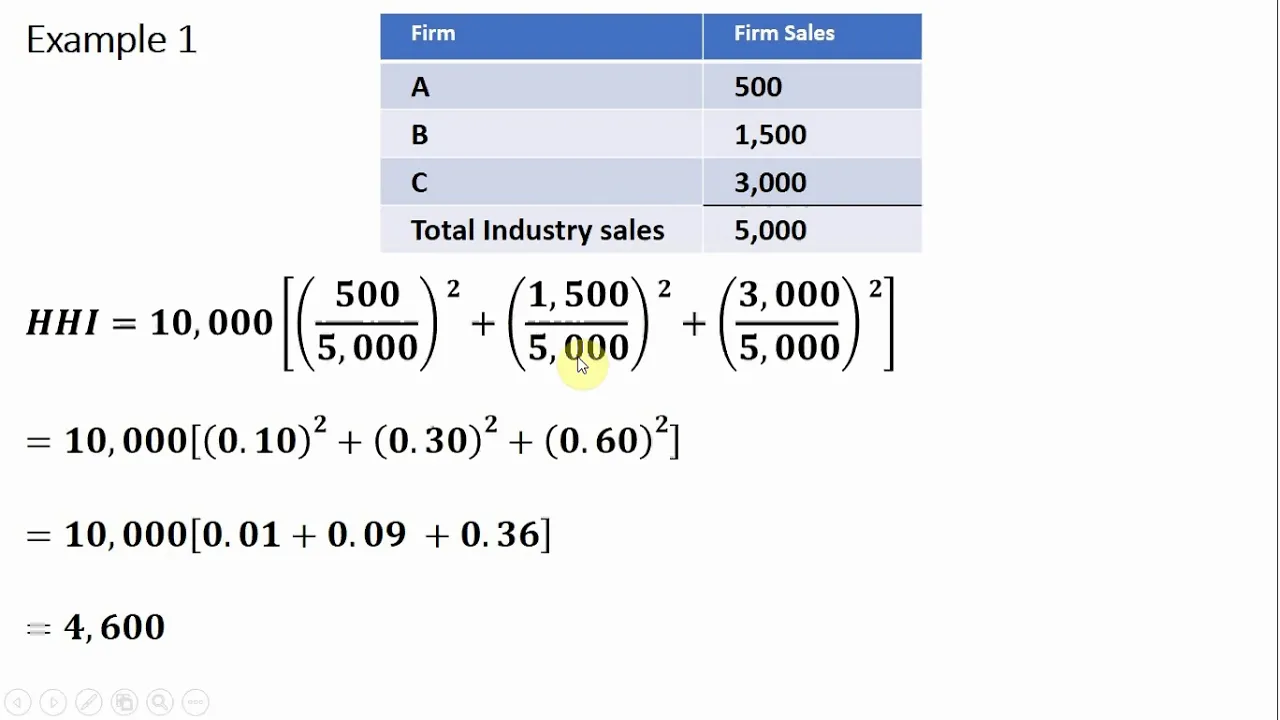
Why this video: A step-by-step mathematical guide to calculating the Herfindahl-Hirschman Index (HHI). It walks through how to square the market shares of competitors and sum them, showing how this mathematical formula disproportionately weighs the market power of larger firms.

Why this video: Professor Ashley Hodgson contextualizes the HHI within real-world economic policy. She demonstrates how HHI scales from 0 (perfect competition) to 10,000 (pure monopoly) and how the FTC/DOJ use changes in HHI ( HHI) to evaluate transaction risk.
Knowledge Checkpoint
- Perform an HHI calculation for a market with 5 firms holding shares of 40%, 25%, 15%, 12%, and 8%.
- Explain how the SSNIP test defines a relevant product market.
- Distinguish between demand substitution and supply-side substitution in market definition.
- State the HHI thresholds that separate an unconcentrated, moderately concentrated, and highly concentrated market under federal review guidelines.
Module 4: Navigating the FTC and DOJ Merger Guidelines
This module examines how the FTC and DOJ review prospective mergers. You will study the updated 2023 Merger Guidelines, analyze how agencies distinguish between unilateral and coordinated competitive effects, and learn the step-by-step procedural lifecycle of an administrative merger investigation.
Recommended Videos

Why this video: This news analysis outlines the modern context and structural shifts of the 2023 FTC/DOJ Merger Guidelines. It explains the federal agencies' heightened scrutiny on multi-sided tech platforms, serial acquisitions ("roll-ups"), and labor market impacts.

Why this video: A concise look at the inner workings of the agency review process. Former FTC Commissioner Josh Wright details how parties present economic data to agency staff, how staff evaluate the evidence, and how the threat of federal court litigation shapes deal structuring.

Why this video: This video provides a precise economic distinction between unilateral and coordinated competitive effects. Unilateral effects focus on the merged entity's direct incentive to unilaterally raise prices by internalizing competition. Coordinated effects analyze whether the merger makes the post-transaction market structural conditions ripe for collusion or tacit coordination.

Why this video: Featuring legendary jurist Richard Posner, this clip highlights the economics of "unilateral effects" in differentiated product markets. Posner explains how a merger between two close substitutes allows the merged firm to raise prices because diverted sales are captured internally rather than lost to a competitor.
Knowledge Checkpoint
- Compare unilateral competitive effects with coordinated competitive effects.
- Describe the primary policy updates introduced in the 2023 FTC/DOJ Merger Guidelines.
- Outline the sequential stages of a standard merger review, starting from the Hart-Scott-Rodino (HSR) filing up to a Second Request and potential litigation.
- Explain how a merger can depress competitive conditions in a localized labor market according to the updated guidelines.
Module 5: Antitrust Defenses, Remedies, and Case Studies
When mergers face regulatory opposition, firms can present affirmative defenses (such as realized efficiencies or the "failing firm" defense) or propose remedies to resolve antitrust concerns. This final module explores these legal paths and analyzes high-profile merger battles.
Recommended Videos

Why this video: This academic lecture breaks down the "failing firm defense"—an absolute defense in merger control. You will learn the strict criteria required to pass this test: showing the target firm is unable to meet its financial obligations, cannot reorganize under Chapter 11, and has made unsuccessful good-faith efforts to find alternative buyers.

Why this video: This video frames the fundamental operational differences between structural remedies (divestitures of business assets) and behavioral remedies (conduct commitments). It explains why regulatory agencies generally favor structural relief over behavioral covenants.
Why this video: Leading antitrust attorney Sara Razi analyzes the major shift in how regulators handle vertical merger remedies. She notes that while behavioral remedies (like firewalls and non-discrimination promises) were once common, modern DOJ and FTC enforcement highly favors structural divestitures.

Why this video: A deep-dive case study of the landmark FTC v. Microsoft/Activision litigation. It details how the FTC failed to secure a preliminary injunction in federal court and how international regulators (like the UK CMA) evaluated licensing remedies.
Knowledge Checkpoint
- Detail the three strict requirements necessary to establish a legally valid "failing firm defense."
- Contrast structural remedies with behavioral remedies, explaining why antitrust agencies prefer the former.
- Explain why the court rejected the FTC’s attempt to block the Microsoft/Activision Blizzard merger.
- Identify the challenges of implementing a divestiture remedy in retail versus tech markets.
Course Map
Key People Index
- Senator John Sherman: Author of the Sherman Antitrust Act of 1890, pioneering federal intervention against industrial trusts.
- Judge Richard A. Posner: Renowned legal scholar and retired judge on the U.S. Court of Appeals for the Seventh Circuit; a pioneer in applying law and economics to antitrust analysis, particularly unilateral effects.
- Joshua Wright: Former Commissioner of the Federal Trade Commission and leading economics professor; recognized for his expertise in quantitative economic evidence during merger reviews.
- Sara Razi: Leading antitrust litigator and partner at Simpson Thacher & Bartlett LLP; specialized in navigating merger clearances and advocating on behavioral versus structural remedies.
Final Self-Assessment
- Explain the legislative and economic history that prompted the passing of the Clayton Act in 1914.
- Identify a horizontal merger versus a vertical merger and list the distinct competitive concerns associated with each.
- Articulate the literal statutory standard of Section 7 of the Clayton Act, including the "incipiency standard" of proof.
- Correctly perform an HHI calculation from scratch and interpret the resulting index level according to agency standards.
- Describe the purpose and mathematical application of the SSNIP (Hypothetical Monopoly) test.
- Identify the analytical differences between unilateral effects and coordinated effects in merger investigations.
- Detail the procedural timeline of an HSR filing, a Second Request, and a preliminary injunction hearing.
- Differentiate between structural remedies (such as divestitures) and behavioral remedies (such as licensing and firewalls).
- State the legal requirements of the "failing firm defense."
- Analyze the legal and economic arguments presented in the FTC v. Microsoft (Activision Blizzard) trial and explain why the FTC was unable to block the deal.