



























The Herfindahl-Hirschman Index (HHI) measures market concentration by summing the squared market shares of all firms in an industry and multiplying by 10,000; the squaring emphasizes larger firms' influence, with values ranging from near-zero in perfectly competitive markets to 10,000 in monopolies, where higher values indicate greater market concentration.
How to Calculate the Herfindahl-Hirschman Index (HHI)
Added:Definition and calculation of individual firm market share within an industry.
Basic algebraic operations, specifically squaring numbers and summing a sequence (summation notation).
The conceptual spectrum of market structures, from perfect competition to pure monopoly.
How a 'market' or 'industry' is defined for economic analysis.
Interpreting HHI threshold values (e.g., highly concentrated vs. competitive markets) based on antitrust guidelines.
Evaluating horizontal mergers and acquisitions by calculating the post-merger change in HHI.
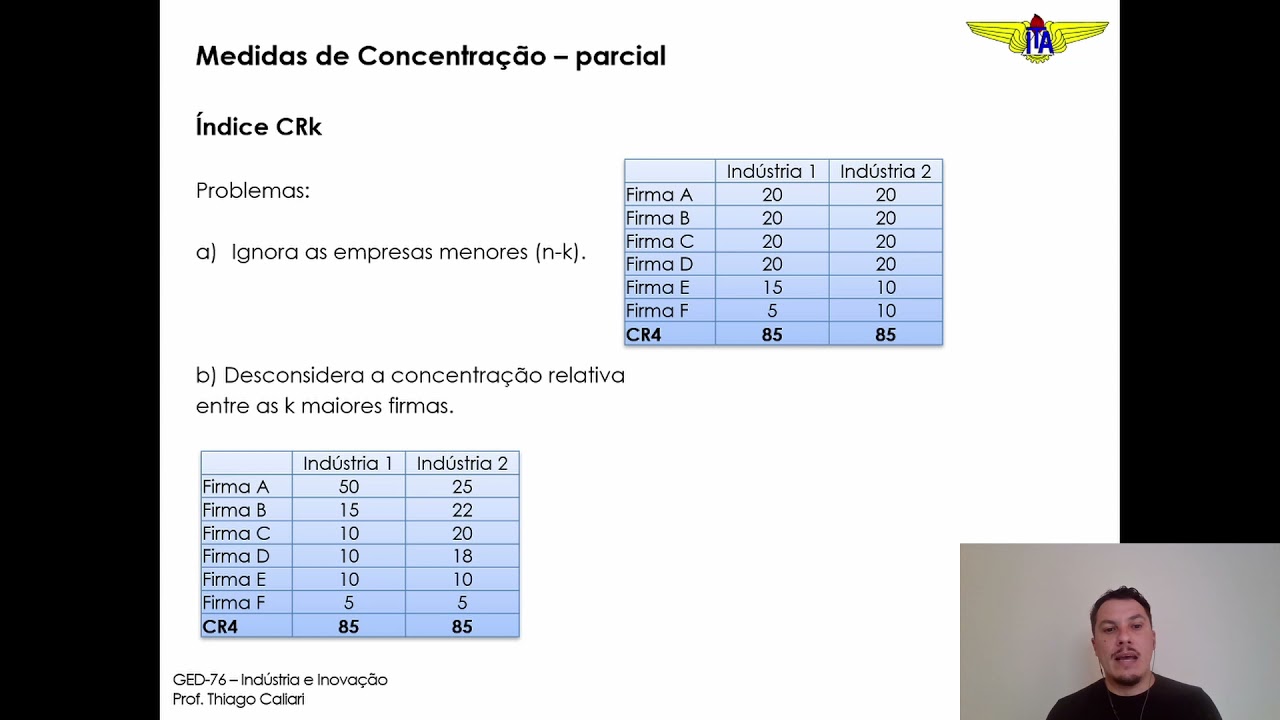
Comparing HHI with alternative concentration measures, such as the Four-Firm Concentration Ratio (CR4).
Analyzing the economic implications of market power, collusion risks, and antitrust regulations.
79.5K views713likes4:18Original Release: 2018-07-23
in this video we're going to be looking at the her fan doll Hirshman index HHI which is a measure of market concentration first the definition the HHI gives the sum of squared market shares for all firms in a given market multiplied by 10,000 here's the formula 10,000 got a summation operator where I is the ice firm's share of the total industry sales so here's si this is a particular firm's share of the industry sales and then we're gonna square it the reason for the square puts increasing weight on larger firms so let's do several examples example one we have a three firm industry firm one has say 500 dollars of sales for the year firm B $1,500 and firms C 3000 so the total industry sales are 5000 taking this information let's plug it into our formula so here's a 10,000 so the first firm has 500 dollars of sales in an industry with total sales of 5000 we're squaring that firm B has 1500 dollars of sales in an industry with 5,000 dollars of sales in total we square that and we do the final thing for the third firm doing the math here firm a accounts for 10% of the industry sales and again we're squaring it firm B we see accounts for 30% of the industry sales and firm C 60 percent of the industry sales so after squaring each of the terms and the brackets we get this summing up the values in the brackets we'll get point four six times ten thousand or forty six hundred so the Hereford all Hirshman index for this industry is forty six hundred let's do another example a simpler example we have one firm in an industry this firm has 45 million dollars in sales the total industry sales then are 45 million so the her friend all Hirshman index in this example is going to be just simply 10,000 we have one firm that accounts for a hundred percent of the industry sales so that her friend all Hirshman index again is ten thousand let's do another example example three we have an industry with twenty firms each with the same market share or a level of sales therefore each firm will account for 5% of the total market share and I just calculated this as one divided by the number of firms where the number of firms in this example is twenty so setting up our - doll Hirshman index it's gonna be ten thousand times the market share of the first firm five percent the market share of the second firm five percent the market share of the third firm five percent all the way up to the market share of the twentieth firm which is five percent again we're squaring all those market shares and this will just simplify in brackets here this will just simplify to twenty times 0.05 squared okay we got twenty firms exactly the same with five percent market share so we can simplify it like that doing some math 0.05 squared is point zero zero to five multiplying that by twenty we get this and we have a her friend her friend all Hirshman index here of 500 a much less concentrated industry compared to example one in example two and just one more example example for an industry here with ten firms each of equal size same market share the her friend all Hirshman index in this example would be one thousand alright I hope you found this video helpful
Up Next
6:43
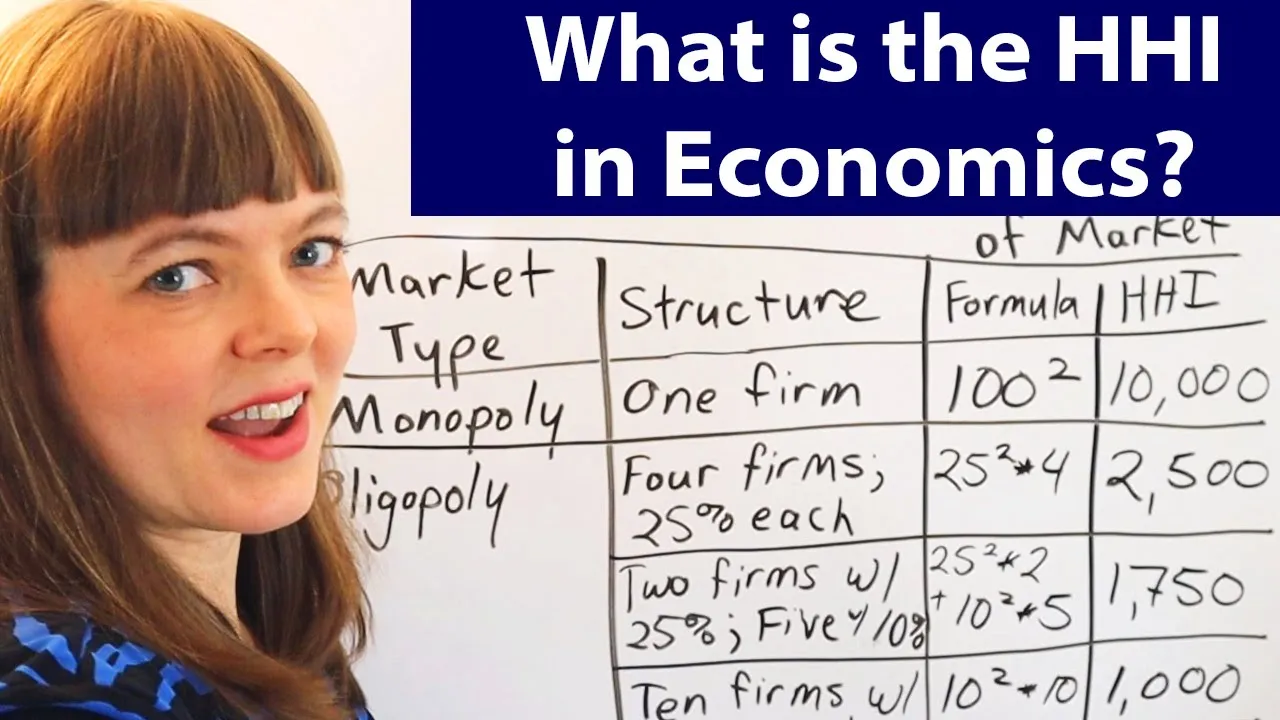
Herfindahl-Hirschman Index (HHI) Explained: Market Concentration in Economics
@AshleyHodgson
26.3K views•2022-04-13

67:20
Globalisation and the 21st Century Enlightenment | Joseph Stiglitz
@EdinburghUniversity
44.8K views•2009-02-10
9:09
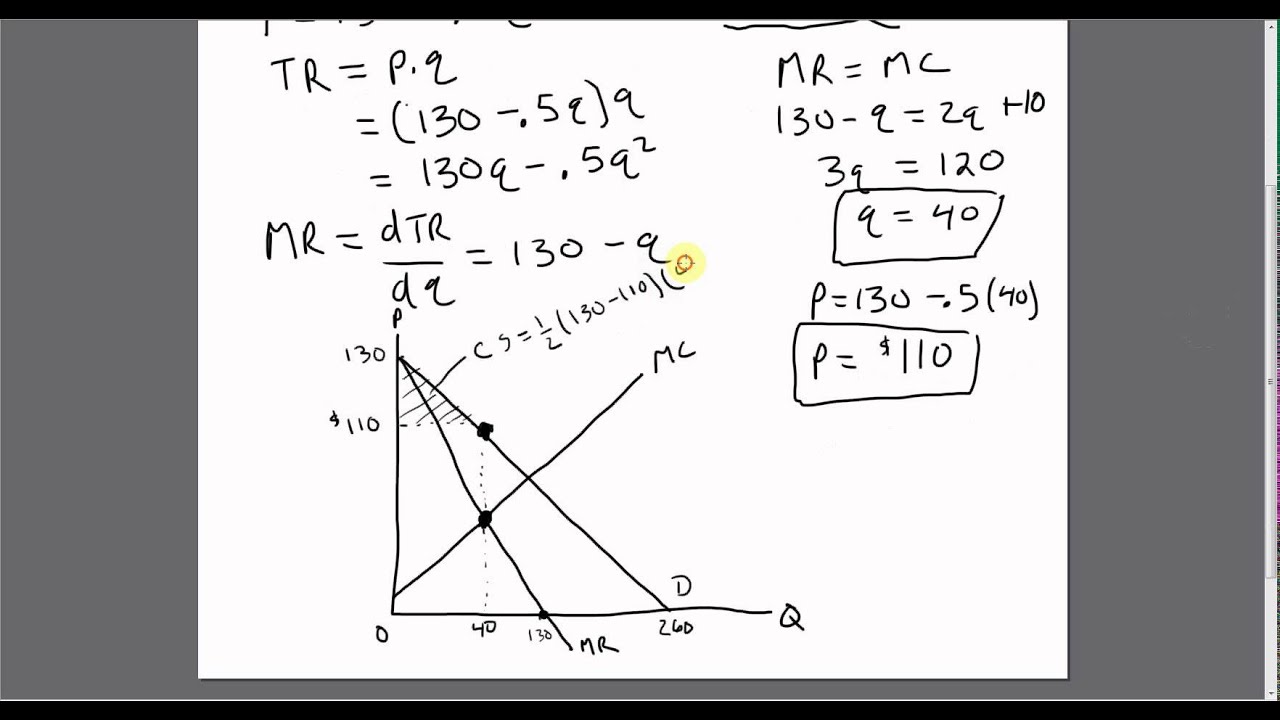
Monopoly Surplus & Deadweight Loss: Economics Problem Solved
@EconomicsinManyLessons
295.8K views•2014-05-06

113:18
The Age of Easy Money: Fed & Inflation | Full Documentary
@frontline
21.2M views•2023-03-15
Related Study Plans & Knowledge Roadmaps
Structured learning paths in Economics
economics
Intellectual Property: Innovation vs Monopoly
01Foundations of Market Power: Monopolies & Deadweight Loss
02The Economic Trade-Off of Intellectual Property
03Patents: R&D Incentives vs. Market Monopolization
+ 3 more learning modules
12h6 modules
Explore Roadmap
economics
Sovereign Debt: Defaults, IMF & Restructuring
01Introduction to Sovereign Debt & Government Bonds
02Debt Sustainability & Credit Ratings
03Anatomy and History of Debt Crises
+ 2 more learning modules
12h5 modules
Explore Roadmap
economics
Market Design: Matching Theory & Gale-Shapley
01Introduction to Market Design and Price-Free Markets
02Two-Sided Matching & The Gale-Shapley Algorithm
03School Choice Systems and Mechanism Design
+ 2 more learning modules
10h5 modules
Explore Roadmap
economics
Impossible Trinity: Forex, Capital & Policy
01Introduction to Monetary Policy and Central Banking
02Exchange Rates and International Capital Flows
03The Mundell-Fleming Model
+ 2 more learning modules
8h5 modules
Explore Roadmap