Intellectual Property: Innovation vs Monopoly
Learning Goal: Analyze the economic trade-offs of intellectual property rights, evaluating how patents, copyrights, and open-source systems balance the incentives for innovation against deadweight loss and market monopolization.
- Prerequisites: Basic understanding of supply and demand curves, consumer/producer surplus, and introductory microeconomics.
- Estimated Total Study Time: 12 hours
Module 1: Foundations of Market Power: Monopolies & Deadweight Loss
This module establishes the foundational microeconomic concepts necessary to analyze intellectual property. To understand why intellectual property policies exist—and the economic damage they can cause—you must first master how monopolies restrict output, manipulate prices, and generate deadweight loss compared to perfectly competitive markets.
Recommended Videos
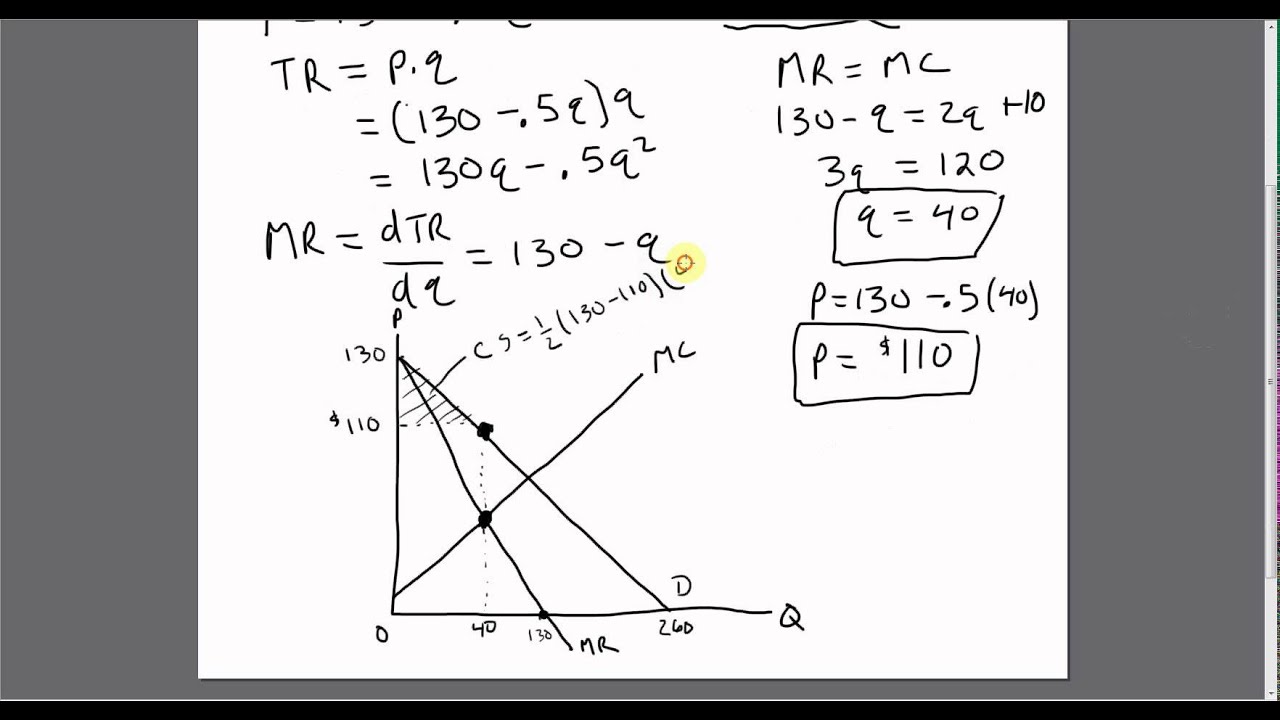
- Why this video: This video provides a highly concise, mathematically precise walkthrough of how consumer surplus and producer surplus are carved up under a monopoly. It visually isolates the deadweight loss triangle, helping you build the geometric intuition required for formal economic analysis.
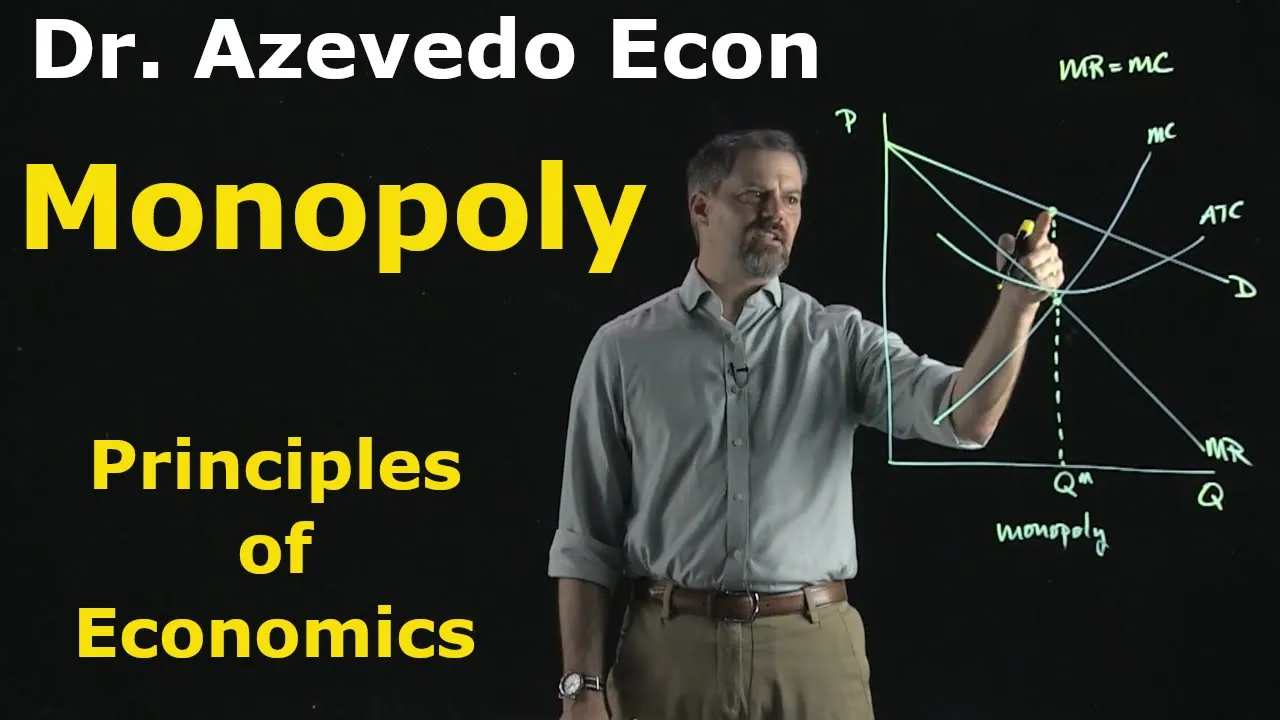
- Why this video: Dr. Azevedo delivers a rigorous, clear breakdown comparing perfect competition to a monopolistic market structure. He highlights how the restriction of output leads directly to economic inefficiency, emphasizing the transfer of welfare from consumers to producers.
- Why this video: This lecture walks through Mankiw's classic economic framework. It clearly explains the "welfare loss" of monopoly pricing as a misallocation of resources, framing the deadweight loss as transactions that should have happened (where consumer valuation exceeded marginal cost) but were blocked by high monopoly pricing.
Knowledge Checkpoint
- Diagram the demand, marginal revenue, and marginal cost curves for a monopolist, locating the profit-maximizing output ().
- Geometrically define consumer surplus, producer surplus, and deadweight loss on a monopoly market graph.
- Explain why a monopolist is a "price maker" and why this results in a market quantity that is lower than the socially optimal level.
Module 2: The Economic Trade-Off of Intellectual Property
Intellectual property (IP) is a government-created market distortion. This module introduces the fundamental economic trade-off of IP: balancing the dynamic incentives to innovate (solving the free-rider problem of public goods) against the static inefficiency (deadweight loss) of granting a temporary monopoly.
Recommended Videos
- Why this video: To understand why we have IP, we must first understand market failure. This lecture outlines the characteristics of public goods—specifically non-excludability and non-rivalry—which explain why competitive markets fail to provide optimal levels of creative and scientific works due to the free-rider problem.

- Why this video: This seminar offers an advanced political-economic critique of IP. It reframes patents and copyrights not as "natural rights," but as state-enforced protectionist barriers originating from historical guild privileges, illustrating the severe economic costs associated with state-enforced monopolies.
- Why this video: A short, punchy economic explainer from the St. Louis Fed that explicitly links government intervention (granting patents and copyrights) to the deliberate creation of legal monopolies, highlighting the policy objective of encouraging invention at the cost of temporary market exclusion.
Knowledge Checkpoint
- Define non-rivalry and non-excludability and explain why ideas fit the economic definition of public goods.
- Explain the "free-rider problem" and how it leads to the underproduction of innovative works in a completely unregulated market.
- Describe the trade-off between "static efficiency" (making existing innovations cheap and accessible) and "dynamic efficiency" (encouraging the creation of future innovations).
Module 3: Patents: R&D Incentives vs. Market Monopolization
Patents protect physical, chemical, and technological inventions. This module evaluates the high-stakes economics of patents, analyzing how they operate in high-cost sectors like pharmaceuticals, and addresses the critical economic concepts of optimal patent life (length) and patent breadth.
Recommended Videos
- Why this video: Renowned economist Alex Tabarrok explores the double-edged sword of the US patent system. He analyzes how patents are theoretically justified for high-upfront-cost industries like pharmaceuticals ($1B+ R&D costs) but can morph into massive barriers to progress by preventing downstream imitation and recombination.
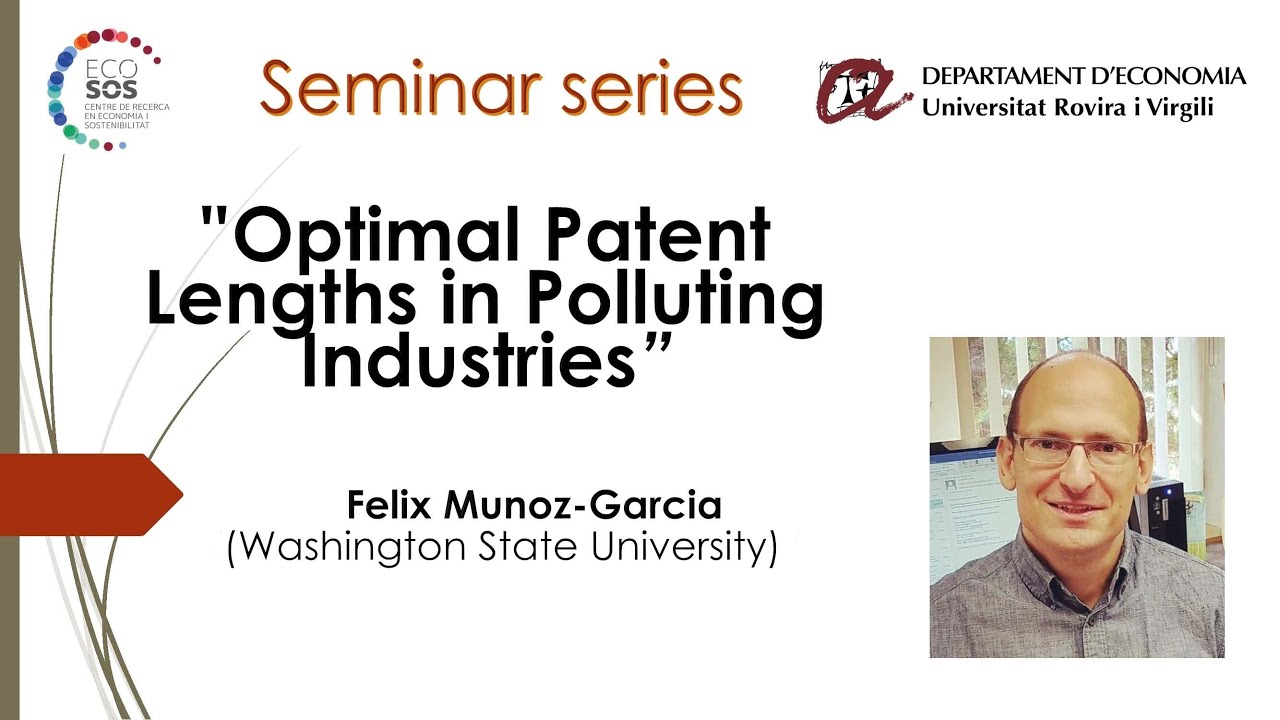
- Why this video: This video addresses a key economic theory gap: the formal modeling of optimal patent life. Utilizing environmental and regulatory economics frameworks, Washington State University's Dr. Munoz-Garcia explains how shifting policy parameters (such as regulator preferences and environmental concern curves) dynamically alter the optimal duration of patent protection.

- Why this video: This segment introduces an essential strategic trade-off for innovators: choosing between patents (which grant a 20-year legal monopoly in exchange for complete public disclosure of the technology) and trade secrets (which rely on absolute secrecy indefinitely but risk legal reverse-engineering).
Knowledge Checkpoint
- Explain why the optimal patent length might differ significantly between software (short lifecycle) and pharmaceuticals (long R&D and regulatory trial periods).
- Define "patent breadth" and explain how overly broad patent terms can stifle downstream innovations that rely on combining existing ideas.
- Contrast the economic protections, disclosures, and risk profiles of patents versus trade secrets.
Module 4: Copyrights: Digital Reproduction & Public Domain
Copyrights protect expression, art, software, and literature. This module analyzes the unique economic challenge of copyright in the digital age—where the marginal cost of copying digital files is zero—and traces how lobbying has extended copyright terms, threatening the public domain.
Recommended Videos

- Why this video: LegalEagle reviews the historical origins of Disney's IP strategies. It highlights how Walt Disney's loss of "Oswald the Lucky Rabbit" led to a fierce corporate culture of aggressive copyright protection, culminating in massive legislative lobbying efforts to extend copyright duration.

- Why this video: A focused analysis of the 1998 Copyright Term Extension Act (often called the Mickey Mouse Protection Act). The video explains how copyright was extended to 70 years after the author's death (and up to 120 years for corporations), demonstrating how corporate lobbying has continuously starved the public domain.

- Why this video: This video introduces the economics of copyright enforcement in the digital era. It covers the concept of "zero marginal cost" duplication online and outlines the legal/economic framework of "Fair Use" as an essential safety valve to prevent copyright from completely monopolizing cultural discourse.
Knowledge Checkpoint
- Explain how the "zero marginal cost" nature of digital reproduction breaks traditional market pricing models for creative goods.
- Describe the economic purpose of the Public Domain and how extending copyright terms too far can harm cultural production.
- Identify the four factors of Fair Use, focusing on how a work's economic effect on the original market dictates its legality.
Module 5: Open Source & Commons: Innovation Without Exclusion
Can innovation thrive without state-granted monopolies? This module explores alternative economic structures, such as open-source software, copyleft licensing, and the Creative Commons, which bypass traditional IP protections to foster massive economic value.
Recommended Videos
- Why this video: This video demystifies the open-source business model. It explains how companies like Red Hat, IBM, and Google generate massive economic value from software they do not legally exclude others from using, highlighting monetization pathways like enterprise support, premium SaaS integrations, and dual-licensing.

- Why this video: An educational breakdown of the Creative Commons framework. It explains how creators can use CC licenses to voluntarily waive certain copyright protections while retaining others (like attribution or non-commercial constraints), creating a flexible middle-ground between strict copyright and the public domain.
- Why this video: A short philosophical clip explaining open source as a mechanism for signaling reputation and capability. It highlights how open-source projects act as a "calling card" for developers, shifting their monetization from the software product itself to their own highly valued specialized labor.
Knowledge Checkpoint
- Explain how an open-source software project can generate private profits without relying on copyright exclusion.
- Distinguish between standard copyright, copyleft (e.g., GPL licenses), and Creative Commons licenses.
- Describe the concept of "reputation signaling" and how it provides economic incentives for individual software developers to contribute to open-source code for free.
Module 6: Systemic Failures & IP Policy Reform
The current global IP system suffers from structural issues. This module investigates modern failures, including patent trolls, systemic trade imbalances caused by the international TRIPS agreement, and advanced economic alternatives to IP, such as public research prize funds.
Recommended Videos

- Why this video: John Oliver provides an engaging yet highly accurate economic critique of "patent trolls" (non-practicing entities). This segment explains how these firms purchase vague patents purely to extract legal settlements from real innovators, turning the patent system into a net drag on macroeconomic productivity.

- Why this video: Nobel laureate Eric Maskin uses mechanism design to compare patents directly against innovation prizes. He mathematically frameworks how prizes can incentivize the creation of essential technologies (like vaccines) while bypassing the deadweight loss of monopoly pricing, allowing the final products to be sold at competitive marginal cost.

- Why this video: Nobel laureate Joseph Stiglitz details the systemic global inequality fueled by the WTO’s TRIPS agreement. He argues that enforcing Western patent standards on developing countries creates massive artificial barriers to life-saving generic medicines, shifting economic surplus from global public health to Western corporate balance sheets.

- Why this video: This documentary segment highlights the battle over open access to academic knowledge. It tells the story of Aaron Swartz and his resistance to paywalled academic journals, illustrating the ethical and economic tensions between private copyright holders of scientific literature and the public interest in free scientific exchange.
Knowledge Checkpoint
- Define "patent trolls" (non-practicing entities) and explain how their litigation strategies drain resources from actual research and development.
- Explain how an "innovation prize fund" works and why it eliminates the deadweight loss associated with patent-protected monopolies.
- Analyze the TRIPS agreement: How does enforcing domestic IP rules globally affect wealth transfers between developed knowledge-exporting economies and developing nations?
Course Map
Below is the recommended sequence of modules and their dependencies.
Key People Index
- Dr. Joao Azevedo (Module 1): Microeconomist and educator specializing in explaining market structures and welfare economics.
- Alex Tabarrok (Module 3): Professor of Economics at George Mason University, author, and co-founder of Marginal Revolution University. Famous for his research on patent reform and the economics of innovation.
- Dr. Felix Munoz-Garcia (Module 3): Associate Professor of Economic Sciences at Washington State University, known for his work in game theory and optimal public policy regulation.
- Eric Maskin (Module 6): Harvard Professor and Nobel Laureate in Economics (2007) recognized for his contributions to mechanism design theory and his work on alternatives to patents.
- Joseph Stiglitz (Module 6): Columbia University Professor, former Chief Economist of the World Bank, and Nobel Laureate in Economics (2001). A leading critic of hyper-globalization, inequality, and the TRIPS agreement.
- Aaron Swartz (Module 6): Renowned computer programmer, writer, and political activist who co-founded Creative Commons and championed the Open Access movement for scientific research.
Final Self-Assessment
Complete this comprehensive self-assessment to verify your mastery of the curriculum's learning goal.
- I can draw a complete market model illustrating how a monopoly reduces consumer surplus, expands producer surplus, and creates deadweight loss compared to a perfectly competitive market.
- I can explain the public good dilemma: why unpriced ideas are highly prone to underproduction due to the free-rider problem.
- I can articulate the core IP trade-off: state-granted exclusivity creates dynamic incentives for new inventions but imposes static deadweight losses during the exclusivity period.
- I can calculate the economic differences between patents (monopoly via mandatory public disclosure) and trade secrets (unlimited protection via total operational secrecy).
- I can mathematically explain the trade-offs of optimal patent length () and breadth, noting how they shift based on the R&D costs of an industry.
- I can explain how the digital revolution—which drove the marginal cost of duplication to zero—disrupted historical copyright enforcement and business models.
- I can outline the legal and economic parameters of "Fair Use" and why it is critical for minimizing copyright-induced market monopolization.
- I can explain how open-source software enterprises generate sustainable corporate profits without relying on copyright exclusion.
- I can define "copyleft" and "Creative Commons" and explain how they construct a functional public commons from within existing copyright laws.
- I can explain how patent trolls exploit the legal system to extract rents, and how this behavior acts as a tax on genuine macroeconomic innovation.
- I can contrast the macroeconomic properties of patents against government-funded "innovation prize funds," specifically explaining how prizes eliminate monopoly deadweight loss.
- I can critically analyze the global welfare effects of the TRIPS agreement, explaining the distributional impact of IP enforcement on developing nations.