










![(AGT11E13) [Game Theory] VCG Mechanism and Vickrey Auction](https://i.ytimg.com/vi/yJIP2nYvQzs/hqdefault.jpg?sqp=-oaymwEmCOADEOgC8quKqQMa8AEB-AHUBoAC4AOKAgwIABABGGUgVChNMA8=&rs=AOn4CLBXndiJHf5TfI_2JyXhmT52D5WNNw)







![[COMSOC 42] Florian Brandl and Maria Polukarov](https://i.ytimg.com/vi/A61aZvY-gi4/maxresdefault.jpg)


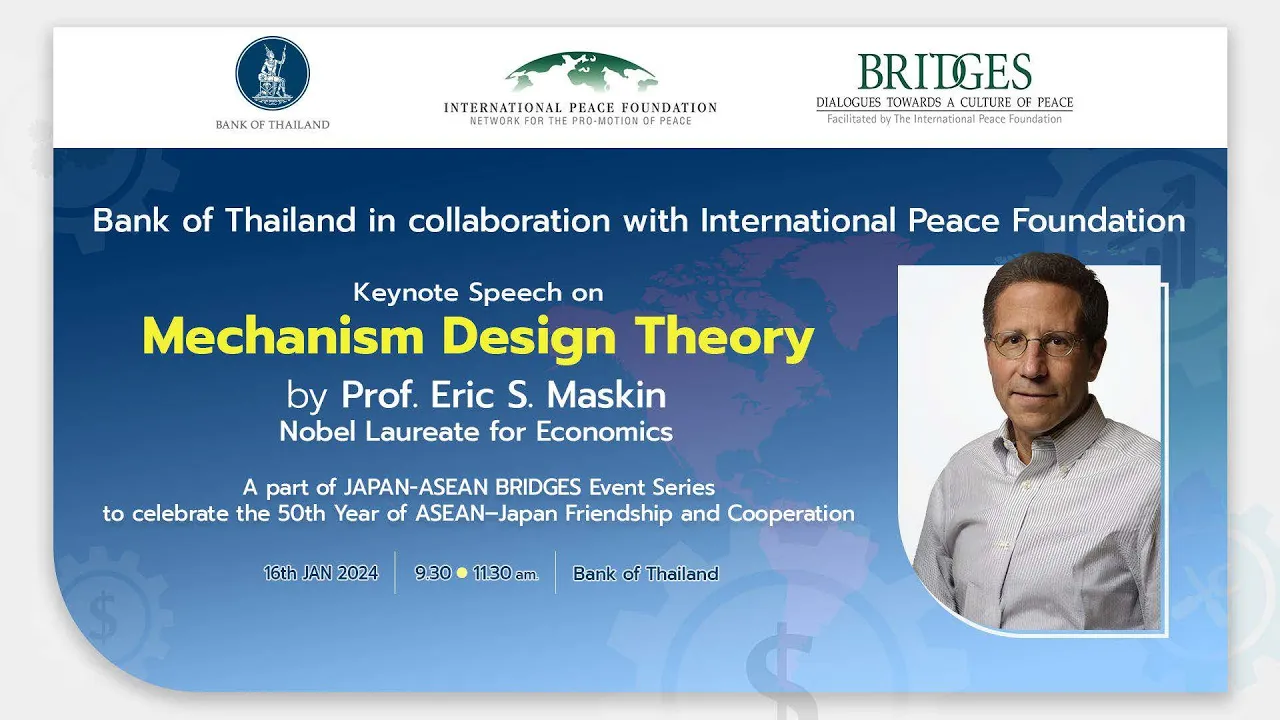

Mechanism design provides a framework for governments to efficiently allocate scarce resources during emergencies like pandemics by using payment schedules that align suppliers' incentives with social welfare, ensuring truthful reporting of costs and achieving optimal production levels without requiring the government to know exact cost functions; this approach combines the speed of command economies with the efficiency of competitive markets, addressing both uncertainty about supplier costs and the public good nature of essential goods like test kits and vaccines.
Mechanism Design for Pandemics | Eric Maskin | Jerusalem School
Added:Basic Game Theory: Understanding Nash equilibrium, dominant strategies, and the concept of incentive compatibility.
Fundamentals of Mechanism Design: The concept of 'reverse game theory' where rules are designed to achieve a specific social or economic outcome.
Vickrey-Clarke-Groves (VCG) Auction Model: How Vickrey auctions work and how the VCG mechanism generalizes them to multi-item allocations to ensure truth-telling.
Market Failures and Public Goods: Why standard competitive markets fail to efficiently or equitably allocate goods with high positive externalities, such as vaccines.
Implementation Challenges of VCG: Analyzing why VCG auctions are difficult to implement in practice, including vulnerability to collusion and budget-balance issues.
Advanced Market Commitments (AMCs): Exploring how governments and philanthropies guarantee markets for future vaccines to incentivize private R&D.
Matching Theory and Healthcare Allocation: Studying algorithmic allocation of scarce medical resources, similar to kidney exchange mechanisms.
Robust Mechanism Design: Designing economic mechanisms that function effectively under extreme uncertainty and incomplete information during crises.
671 views0likes1:17:16Original Release: 2021-07-01
welcome everyone to the uh 31st advanced school in economic theory i know that last year when i greeted you when eric gave his papers i was saying um it's like if you're speaking uh we can't hear you can you just i can't hear you can you hear me now i can hear you it's hard okay so eric eric are you hearing eric can you hear us [Music] uh let's make a try perhaps uh sergio are you hearing us yes okay ben in the states are you hearing us yes good i can i can hear now also can you hear us now excellent good so i'll start over again okay sorry um welcome to the 31st uh uh jerusalem advanced school in economic theory it's really good to see you all i'll bite on zoom and last year when i greeted you and said next year in jerusalem i didn't realize that we'll have another year of pandemic but um i'm going to repeat myself and say next year truly in jerusalem we hope to see you all gathering here and maybe discussing the postcard 19 economics and not the one that you are supposed to discuss uh this time so all i have to say is that welcome to the israel institute for advanced studies and i wish you a a very successful and i'm sure fruitful advanced call and elf on the floor is yours thanks ezek welcome everybody good afternoon to our audience here and good morning to our speakers and audience in the states um first i want to thank eric for preparing for us once again a beautiful program even though it's going to be on zoom and i'd like to thank the speakers for putting the time and effort uh to make this happen um just one procedural comment since uh we are a rather large audience uh questions will be handled by chat so if you have a question please send it by chat to me or to the older audience and i'll try to bring it up i apologize in advance for the fact that some some questions uh might be deferred to the end and if there are many questions not all of them will be it will not be possible to address all of them uh but i'll do my best to bring up as many questions as possible um so thanks again for joining us and participating in this exciting event and uh eric the flow is yours well thank you let me first put up my slides well i i'd i'd first like to say how happy i am that we can meet at all under the circumstances and and many thanks to the iias for making these uh emergency arrangements uh we did it last year it it uh it seemed to work pretty well and uh with any luck it'll work even better this year uh i'd also like to thank uh the speakers who who who you'll be hearing uh over the next few days uh uh all of them have been thinking about these issues for quite some time most of them actually well before the pandemic actually started and you you may have seen their public writings uh on on the matter uh some of them have been writing op-eds advising governments and so on so you'll be getting uh unlike most summer schools you'll be getting uh information which is extremely timely uh it is disappointing that we can't meet uh in person because a lot of the fun of these summer schools is the interaction uh the the the discussions tend to be very lively we'll try to have a lively discussion today but uh it's harder to do it on zoom so uh if if you haven't participated in a live summer school before let me encourage you to uh to come because it it it's better than this okay what i thought i would do this is this is uh something of an introductory lecture uh all i plan to do uh in this talk is to show you that there are some simple ideas from mechanism designed which um which are relevant for emergencies uh like pandemics i don't think uh much of the theory itself in this talk is going to be particularly original but uh the application perhaps is is a bit unusual so um so let me start i think those of us who have been studying economics for a long time would all agree that most of the time markets competitive markets do a a good job of allocating scarce resources to uh to where they should go uh the the market isn't amazingly powerful resource allocation mechanism and an amazingly efficient one uh and just to review the market's power let's let's look at a at a simple model uh of a single good so so so imagine there are many consumers many producers of some good will will attach benefit b i of x i to quantity x i of the good so bi is consumer eyes benefit gross benefits from consuming a quantity x i of the good now in order to produce a quantity yj producer j has to incur cost cj of yj so the these benefits and costs are all going to be denominated in in money let's uh then write the the net social benefits from all of these consumers consuming their xi's and all of these producers producing their yj's as the sum of the benefits minus the sum of the costs here implicitly i'm making some assumptions about quasi-linearity of consumers utilities now if we want an efficient outcome an optimal outcome then uh explicitly or implicitly uh we as the social planners say are interested in maximizing net so social benefits subject to the constraints on this market which first of all are supply this is total supply equals total demand and notice that involved in this maximization are in effect several optimizations so so first of all when we solve this problem we have to get the sum of the yj's the the total production right we also have to get each individual producers production yj right and we have to get each individual consumer's consumption right so that looks pretty complicated there are a lot of different quantities which have to be at exactly the right level nevertheless a price system a market system uh solves these many uh choices uh in an efficient way the the competitive market uh does this straight forwardly through prices uh so let's let p be the market price of of this good which is being bought and sold uh and now uh each consumer will be maximizing her her net benefit which is gross benefit b of x i minus the cost of x i which is p x i the cost to her uh and that means that uh assuming differentiability uh this first order condition for maximization must hold the marginal benefit has to equal the price uh each producer maximizes its profits which is the revenue from selling yj units of outputs of price times quantity minus the cost of that production and once again there's a there's a first order condition associated with that maximization price equals marginal cost and so we see that the the uh what we want to attain is optimization of net social benefit subject to supply equals demand but in fact the competitive market does exactly that because when when price adjusts to equate supply and demand all the four all the first order conditions for this optimization uh will hold and price here ends up simply being a lagrange multiplier uh on the supply equals demand constraint so all of this is all of this is familiar to uh to people who have studied some some price theory but what i'm mostly interested in today uh is uh well what if there if there is no existing market and yet we need to come up with some good right away it's an emergency it's a pandemic and furthermore what if the good that is needed is not purely a private good it's also a public good in the sense that if people have it they will be conferring benefits on other people uh well a good example of such a good is a coronavirus test early in the pandemic before there was a vaccine the only way that you could tell whether it was safe to interact fairly closely with a person was to know that that person uh was not infected and and so an an important part of the response to the pandemic was producing many many millions and millions of coronavirus test kits now because this was a new virus a test kit for this exact good had not been produced before there there was not already markets for this uh for this good uh there there were some firms around that had produced similar products for for other viruses but not this exact good and yet it was important to uh not only create a market for this good but to do so really fast now what the what a country or a government could do in some some it it in circumstances like these is simply to leave everything to the market and and um we know that uh ultimately we'll we'll get something out of the market suppliers will produce the test kits consumers or hospitals or employers will buy test kits from suppliers but we we don't expect the market to to work perfectly uh in these circumstances uh first of all we're talking about a good which hasn't existed before it's a new good uh when a supplier is contemplating how much to produce it faces some uncertainty because uh it does there's no there's not yet a prevailing price to guide uh that supplier so uh we may worry that there'll be delays in supply because suppliers are reluctant to jump in when there is uncertainty about the price that they're going to get we're also and and and one of the reasons why suppliers may be reluctant is because uh whatever whatever these test kits end up looking like there may be large setup costs that have to be incurred to produce them now of course ultimately we might expect the the market to resolve these uncertainties there'll be some equilibration process where perhaps prices will start out high when demand is high and supply is low and then ultimately come down but but we don't want to wait around for that equilibration process to occur uh we need we need these test kits now uh and another problem with the solution is that uh especially at first we might expect uh prices to be very high because suppliers are only beginning to enter this markets demand is very high and that's not that's not so good for large segments of society poorer consumers who perhaps can't afford the uh the high prices it's also bad from the standpoint of the public good aspect of the good remember um a test kit is valuable not just to the to the person who who who gets the test but also to uh all the people uh he associates with so so that it's it's very much uh a public good uh or at least in to to a large extent to public good and therefore if you rely on consumers themselves to buy these test kits it's likely that they're not going to buy enough of them relative to the to the social optima so so these are all reasons why uh a pure market solution so the provision of test kits in a pandemic may not be the way to go so let's um let's consider another solution and and and this was actually used this was used in the in the united states under a law which gives the the government the power in an emergency to actually order producers to produce certain goods i don't think this was done with test kits but it was done with ventilators um so the government's picks some potential suppliers and tells them that they they have to produce the test kits now the this by contrast with a market solution is a a command economy solution that the sort of thing that was done in the in the soviet union well this might get you test kits quickly but it it also has its problems uh for example which suppliers are going to be ordered to produce the test kits uh governments you may not be in a position to know suppliers production costs so uh if it picks supplier a well it may turn out that supplier b could have produced them much more cheaply and in fact since we're talking about a new good a good that hasn't been produced before the government may not even know who all of the potential suppliers are and then the government has to figure out well how many test kits should be produced that also depends on on costs which the government doesn't know uh and how do these costs get covered uh in a market economy they in effect get covered automatically through the equilibration process but we're talking here about a command economy so command economies can be used and and they have the virtue of being quick but uh they have the disadvantage of being uh really quite inefficient so i'm going to give you a a sort of intermediate solution uh which is provided by mechanism design and the government will play a big role for each potential supplier the government is in effect going to commit to a price that will pay for a specified amount of the of the test kit uh and and and that will give the supplier the certainty it needs in order to to go ahead with production this will this will resolve the the suppliers uncertainty and then after the government has has uh made this commitment and the supplier is actually produced the government will turn around and resell the test kits at a low price a price that even poorer consumers can afford uh perhaps the government will even uh give the give the goods away in in the case of vaccines in the u.s consumers have not been paying for those vaccines themselves but then of course the question arises what price and what quantity should the government be committing to and to see how to answer that question let's let's start with the case uh of a single supplier let's imagine that there's only one potential supplier for the test kits uh and see how the solution works in that case well what the government first needs to figure out uh is what are these uh what are these test kits worth to society uh so it it will devise some schedule some function b of y where b is the gross social benefits of having y test kits available and this this can be done partly on medical grounds it can be done partly on the basis of consumer preferences however however the government wants to do it it comes up with this schedule uh and then it tells the the government tells the supplier well um for each uh if if you end up producing y test kits we will pay you b of y so so the government's uh in this case actually leaves it up to the producer how much to produce the the the government is giving the the producer a a schedule of prices schedule of payment so uh the the producer can do the optimization uh itself now let's suppose that the that the producer's production function is is c of y then the producer will be solving this problem max b of y minus c of y this is the amount that it's being paid this is the amount that it has the the cost that it has to incur uh but notice that what the supplier is maximizing is in fact net social benefits and so indeed it will choose a supply which is optimal from the standpoint of society what we're using here is a very simple idea but a very powerful idea uh in in mexico in mechanism design which is that if you if you've got uh agents who don't inherently share the social objective well you can adjust their jet objectives by appropriate transfers so that in fact they end up having the same objective as society and that's what that's what we've done here the supplier may not care about society per se but by giving giving the supplier this objective function uh you get it to behave as though it's optimizing society's objective function okay well it in in this one supplier case uh everything is extremely simple there there is one problem with the solution of course which is that uh the supplier is getting the entire uh net social surplus uh that that doesn't seem uh that doesn't seem right uh after all these test kits are supposed to be produced for the benefit of society why should they why should the producer be getting all the surplus now that can be taken care of to some extent by adjusting the payment to the to the supplier instead of paying the supplier b of y we can pay the supplier b of y minus some constant k adding or subtracting a constant from the payment uh is clearly not going to affect the supplier's maximization problem so it will still choose the right outputs the problem with this modification though is that from the government's point of view it may not be clear how to choose k in a in a in an optimal way uh if k if k is too small well then it then the supplier is still going to get most of the most of the surplus and and that's not good on the other hand if k is chosen to be too big well then the supplier may uh may not be able to cover its costs at all and refuse to supply so so we can't uh so the government has to worry about what k is it's not clear unless the government knows a fair amount about the suppliers costs which we're assuming it doesn't know uh a mustard did know something about cos it might be difficult for it to choose k so so having us a single supplier uh is not a uh is is not a great circumstance but what we'll see is that if there's um if there's some competition among suppliers if there are multiple suppliers uh then uh we we may well be able to get the payments down to a tolerable level so that's what i want to turn to next how we overcome the uh the distribution of surplus problem through competition so now let's suppose that there are multiple potential suppliers and and each each has a cost function as before and just to make matters simple let's suppose that all of these suppliers are going to be producing uh equivalence test kits this actually isn't essential for the argument but it it simplifies matters to suppose that one supplier's test kit is is in effect uh the same as any others so the the gross social benefits uh is of the the sum of the individual supplies it's over total supply and so now the government is interested in maximizing the gross benefit from total supply minus the costs of production just just as before so this is the social objective function um but of course in pursuing this maximization that if it's facing the same uh informational problem uh that it has uh in these in these past examples it doesn't know the suppliers cost functions in fact as i was suggesting before it may not even know who all the potential suppliers even are so what it can do is to uh to make a call for test kits what it'll say we we would like to have test kits produced and if you are interested in potentially producing uh test kits tell us what your cost function is so so each firm will report a cost function of course there's nothing to force a firm to report its true cost function it could report anything it wanted and then once these cost functions have been sent to the government government can compute the supplies that maximize a parent's net surplus of course it doesn't know that these costs are are the true costs but let but it proceeds as though these are the true costs and then it tells each firm what quantity that firm should produce according to this maximization so so firm k is told well you should produce y k star because y k star is part of the solution uh to this maximization and here is the the critical part here here is the mechanism design part this this is what the firm is paid uh it's paid the difference between uh two expressions let's let's look at this expression first the the expression in the first pair of square brackets firm k is is paid the appearance gross social benefits as before in the monopoly case minus the costs that the other firms the firms j not equal decay are incurring to in order to produce uh their part of the allocation so that's the first pair of square brackets now let's look at this second pair of square brackets here we're imagining that firm k didn't exist at all and the government is redoing the op optimization assuming that firm k is out of the picture and is just optimizing uh using the the remaining firms so so this second square bracket is the net social optimum with firm k out of the picture so what so what we have here is firm k is in effect being paid its marginal effects on the rest of society that this this is what society gets in nets if k is there this is what society gets in net if firm k is not there and and and that's what firm k is paid uh well some of you may recognize this as a variance of a classic mechanism design mechanism called the vcg the victory groves mechanism and and i've just applied that idea to a setting where there there are two stages of communication there's a stage where firms reports cost functions and then there's a stage where government report tells each firm how much to produce and pays them accordingly but the the nice thing about this mechanism is first it will indeed pay each firm to report its costs truthfully because look at this expression here that the the second square brackets contain nothing that depends on firm k firm k is out of the picture here so so so this expression doesn't affect firm k's maximization at all and as for this expression well it's just net social benefit but not including firm k's costs if we subtract off firm k's costs from from this expression here firm k is simply maximizing once again the net social benefit and so of course it will choose when it's reporting ck star to to to choose the truthful cost schedule uh so we get to the social optimum and furthermore because firm k is only being paid its marginal impacts on society firm cane need not be uh need not be paid very much at all in fact let's let's look um let's look at a simple example suppose that there were just two firms and let's look at uh at a benefit function that is quadratic in the two firms outputs let's say that two firms have have linear costs margin marginal cost is a constant well in that case because costs are linear either supplier could in principle supply the entire markets efficiently and that means that if either firm is excluded from the economy and that's the exercise we do in in calculating how much each is paid if if either supplier is excluded the other can supply the entire market efficiently and that means that the excluded firm isn't even needed its marginal impact is zero and that means that in an example like this even though they're just two firms the only thing suppliers are going to get is is recouping their costs they're not going to make any positive profit at all and this illustrates the idea that not only can we get to the social optimum using a uh a simple bcg mechanism but we can also in many circumstances ensure that no firm no supplier is going to be getting uh unacceptably high payoffs uh in in in this case they they make no no positive profit at all they just recoup their costs might be good if i if i pause just for a moment to make sure that uh there aren't any questions is there is there anything uh in the chat that we should know about there was a question which you might want to defer to the end um that came up already when you talked about a single firm and that is the idea of nationalizing the supplier [Music] so that is uh one question um now the the two other questions um aren't you concerned about an additional equilibrium where no one produces in the example and how do you account for firms limited production capacities okay let let me let me uh talk about the the uh the second and third questions uh first because they're they're uh they're the easiest so one nice feature of the vicry clark groves mechanism is that it's not only an equilibrium best response for firms to report their cost functions truthfully it's a dominant strategy so so even regardless of what other firms do you want to report your true costs and that means that and that means that there is no second equilibrium where firms don't produce there there's a unique equilibrium which maximizes the social optima now now on the question of uh on on the question of capacity constraints well though those actually are implicit in the cost functions so suppose that a a firm can't produce more than 50 test kits well that means in effect that marginal cost is is very high or even infinite uh beyond beyond that point so so implicit in in this model uh we have in fact captured we have in fact captured capacity constraints now a more complicated question is the case of nationalization what if the government simply took over the uh the firms that that could produce test kits uh whether there is an immediate problem uh that i already alluded to with with nationalization is that the the government may not even know since this is a new good the government may not even know who all the relevant suppliers are and that's going to interfere with rational with nationalization because how can you take someone over if you don't know who they are but um even even if it could identify all the potential suppliers and take uh take them over running an industry is a is a big job at the time of a pandemic government has other matters on its mind besides running the industry for test kits so yes we certainly do have historical examples of industries that have been nationalized temporarily or sometimes permanently but whenever you nationalize your whenever a government nationalizes it it's taking on a much bigger job than simply doing the optimizations in the victory clark groves mechanism perhaps perhaps this bigger job is something that the government might want to avoid okay let let me go on i have one more uh thing i want to do and then we can have some more questions unless there's something urgent now is there anything or more that i should do no no i suggest you proceed okay okay i've been i've been assuming that each supplier can supply uh its good without any uncertainty in uh in production uh notice that there were no no probabilities involved in in any of these expressions uh but uh if the good in question requires a significant amount of innovation then assuming there's no uncertainty is is probably not a good assumption and and there there have been many debates over the years on the extent to which governments should get involved in innovation uh actually i noticed over the weekend that uh ann krieger has has just written a piece for project project syndicates uh suggesting that reminding us that government doesn't always do innovation uh very well uh and and and there there's a an obvious reason why we we might want government to stay out of innovation which is that there's no particular reason to suppose that government will even know what the innovation policies are after all uh when we think of a creative inventor we think of the inventor as imagining what might be possible there's no uh there's no particular reason why the the government should know what these possibilities are too and in fact in recent american history there there have been some particularly embarrassing cases where the government made a guess about what kind of innovation to support and it turned out uh poorly there there was a case uh in the obama administration of a of a solar cell manufacturer it was a new way of producing solar cells called solyndra uh and it ended up losing uh a lot of money for the uh for the governments so there there's at least some hesitancy uh uh in the minds of many economists on how involved in innovation directly involved in innovation government should be but there there there are some important exceptions uh because sometimes the government at least has a good idea of what the goal of innovation should be they may not know how the innovation is going to be accomplished what the technology is going to be but they know what they that they know what the product of innovation should do and and a famous historical case of this was in the 18th century when it was considered critically important to be able for ships to be able to calculate longitude the ship is crossing the ocean it needs to know its latitude that is its distance from its uh horizontal distance from the equator uh and it has to know its longitude which is its vertical distance from uh from the prime meridian now actually latitude had always been easy to determine uh to figure out how far you are from the equator you look at the position of the sun at its highest most point in the sky and you look at the angle that the sun makes with a line going straight up and and that tells you uh latitude uh but longitude was was a much harder problem in the 18th century that could not be calculated accurately and then and that was a disaster uh for for shipping so in fact the british governments put up a large sum of money to any inventor who could solve the latitude problem to a specified degree of accuracy so it's a well-defined problem for for inventors uh and in fact there were a lot of inventors who got into the act and they used different ideas what some were astronomical that is uh looking at the position of the stars or or actually even the position of the moons of jupiter others involved um pronometers that is if you knew that it was uh noon in london uh then and and you could look at at the position of the sun now that would allow you to tell you how far in a uh longitudinal uh sense you were from from london uh and and that it was the chronometer solution that uh ended up solving the problem uh john harrison uh built an accurate enough watch to uh to solve the problem and this had an enormous effect on on sea travel it made it safer more efficient now there's another way of rewarding innovation rather than simply putting up prizes as in the longitude case and that is to award patents uh to successful inventors so a prize is a is an ex-ante uh reward you say uh in advance this is how much you will get if you succeed in the case of a patents there are no promises made uh if it turns out that what you come up with is valuable but the market will will buy it uh and what we're going to do is to protect you from competition if you make the invention you get a monopoly on it uh for at least a certain length of time for some reason my slides froze for a moment so you get a monopoly profit for uh for some number of years uh and patents and prizes uh have their drawbacks and advantages one one drawback to the uh patent system is that you're you are awarding a monopoly and so again a lot of the benefits of your invention is going to include to the inventor rather than to the to the society the invention was created for uh one advantage of awarding a prize for solving the longitude problem is that the invention is not monopolized it it immediately goes into the public domain and everybody can use it and yet the the inventor is rewarded through the prize so recently we we've had the example of these uh of these coveted vaccines uh and uh actually mike michael cramer who's going to be speaking next i think is going to be talking a lot more about this so i'm just going to make a few comments uh in in the u.s there was this program called operation warp speed which was an interesting combination of prizes patents and also upfront investment by government so so government uh came in before the vaccines had been created and said and and and in effect subsidized the production costs and so that that mechanism seems to have worked quite well and i think michael will go into detail on that vaccines were were developed quickly we have been running into some trouble uh now now that uh vaccines are are needed in uh low-income countries uh with the fact that these are patent-protected how how are the low-income countries going to get these patents for get get these vaccines for a reasonable price uh so so i think it it's worth looking at how the uh vaccine innovation could have been done uh under a pure pry system uh so that this is a thought experiment rather than a replication of what actually was done so let's imagine that there are two drug companies two pharma companies who could impossibly develop this vaccine covet vaccine and uh suppose that uh if firm eye produces it uh alone uh the social benefit is is bi uh funny that my slides are frozen again let's suppose that if they both produce it there'll be a a social benefits b12 once again they'll be cost functions now we should think of these cost functions as the cost of succeeding with probability pi so so if if firm i puts more resources into the vaccine it can raise the probability of success maybe not to one or even anything close to one but it it by varying pi and and incurring more costs as pi goes up uh if the firm can increase the probability of success so that that that is the uh pi is the is the figure to be maximized it's the maximizing choice uh in in this problem so the the net social benefits now looks like this uh if if both firms succeed which is p1 times p2 that's the probability of success then social benefit is b12 if just firm 1 succeeds which happens with probability p1 times 1 minus p2 then benefit is b1 and so on and we subtract off from gross expected gross social benefit the the costs of obtaining these probabilities uh by the way i'm i'm assuming that the that probability of discovery is independent across the two firms but that can easily be modified uh so suppose that firm one uh is offered these uh these numbers that i had on the previous slide it's offered b1 if it succeeds by itself and its marginal impacts on society if they both succeed so this is what happens if both firm one and firm two have succeeded this is what happens if just firm two succeeds so firm one is being paid it's marginal impact and it gets nothing if it doesn't succeed so this this is a pure prize uh scheme and in fact it will induce firm one to choose the socially optimal uh the the socially optimal probability uh and similarly for from two and furthermore uh if there's if there's a good chance that both firms will succeed that both moderna and pfizer will succeed then in fact both those companies don't end up getting uh an overwhelmingly high uh payoff they just get their marginal uh that their marginal contributions to society uh now as i said we can modify this calculation uh if there is uh correlation between the firms uh we can also so so i've been assuming that firms are calculating their their expected monetary benefits that that assumes risk neutrality of course there's good reason to assume in a circumstance like this where there are billions of dollars at stake that firms might be risk-averse that can that we can adjust by scaling up the um the size of the the the the size of the prizes make the prizes bigger one problem however with with doing things through a pure prize mechanism in the case of something enormous like vaccines is that the social value is truly huge of having a vaccine as we've seen and so prizes could be very large and and uh if there's risk aversion they're going as i was saying they're going to have to be even bigger so that might run up against all sorts of political constraints if if the pharma companies are seem to be getting these huge prizes that may not be politically or even morally tolerable and so that suggests uh that it may be important perhaps in addition to giving prizes to also covering the upfront costs that innovators have to make and i believe michael will be getting into that more um that is all i have to say though so uh so let me stop there and maybe we if there are any more questions perhaps we could spend a couple of minutes on those uh el canada yes yes now eric the only question that that came up uh on the chat uh is actually is is a point you just referred to and namely the effect of risk aversion right um but uh i mean well let me just discuss this but so if you want to add something i i don't have anything to add but let me just repeat if firms are risk diverse then it may not be enough to give them these prizes because a risk-averse utility function will in effect move down the payoff from a very high price like this so in order to count if you were if you were going to have a pure prize scheme as as they did for longitude you would have to scale these numbers up even higher but that would that might be politically impossible it might be uh if it might not be tolerable for society depend to pay uh fives or a trillion dollars uh if pfizer is the only company to succeed so an alternative strategy and and this was in fact used i i believe that as as michael kramer will will say is for the government not to just or for a prize but also to heavily subsidize the costs the innovation costs themselves and that that will bring down the uh the need to get very high prizes um eric another question now or two that came up is whether mechanisms of the type you described were actually used so that was one question and another question is uh what happens when the supplier doesn't know his uh cp function namely doesn't know what costs would come with what cost would generate what probability of success right uh so let let me take that second question um so i i i've we've been assuming even though there's uncertainty about whether the vaccine will be developed that at least the firm knows um the probabilities of of success for different levels of uh effort that the firm can make but maybe maybe it doesn't even know that so in other words maybe um maybe uh this cost function is itself a stochastic function uh so so there's a probability distribution over costs uh well that that's that's not going to change the analysis um as long as firms are risk neutral because and any uncertainty about cost can just be expected out just this is an expectation we can also introduce uncertainty about the seas and that that's fine um if firms are risk averse of course the uncertainty about costs uh does have to that does really matter um and introduces an additional element of risk uh which is an additional reason why government might want to get involved ex-ante and not just exposed ex-ante in the sense of helping the firm with those with those costs uh then someone was asking about whether mechanism design has been used well mechanism design has been used in many many places it it was it was sort it was sort of used for vaccines uh as as i uh you know well my i again michael might be the uh the right one to to go into that but uh michael and other people uh susan athe who who are mechanism design experts uh were heavily involved in the discussion about what the government should do and what the government ended up doing i think reflected that discussion so mechanism design ideas certainly played an important role with vaccines which michael i think will tell you more about okay eric thank you very much uh we will take now uh a break and at 5 30 uh michael will uh will start his lecture thank you very much and that'll be 10 30 in in investment yeah okay so you stand for the eastern time yeah right okay okay thank you see you soon thank you thank you
Up Next

67:20
Globalisation and the 21st Century Enlightenment | Joseph Stiglitz
@EdinburghUniversity
44.8K views•2009-02-10

56:43
Optimal Patent Length in Polluting Industries | Environmental Economics
@researchcentreoneconomicsa9979
162 views•2023-05-17
99:39
Matching Market Design Explained | Parag Pathak Lecture
@iashuji
2.1K views•2018-07-05

113:18
The Age of Easy Money: Fed & Inflation | Full Documentary
@frontline
21.2M views•2023-03-15
Related Study Plans & Knowledge Roadmaps
Structured learning paths in Economics
economics
Intellectual Property: Innovation vs Monopoly
01Foundations of Market Power: Monopolies & Deadweight Loss
02The Economic Trade-Off of Intellectual Property
03Patents: R&D Incentives vs. Market Monopolization
+ 3 more learning modules
12h6 modules
Explore Roadmap
economics
Sovereign Debt: Defaults, IMF & Restructuring
01Introduction to Sovereign Debt & Government Bonds
02Debt Sustainability & Credit Ratings
03Anatomy and History of Debt Crises
+ 2 more learning modules
12h5 modules
Explore Roadmap
economics
Market Design: Matching Theory & Gale-Shapley
01Introduction to Market Design and Price-Free Markets
02Two-Sided Matching & The Gale-Shapley Algorithm
03School Choice Systems and Mechanism Design
+ 2 more learning modules
10h5 modules
Explore Roadmap
economics
Impossible Trinity: Forex, Capital & Policy
01Introduction to Monetary Policy and Central Banking
02Exchange Rates and International Capital Flows
03The Mundell-Fleming Model
+ 2 more learning modules
8h5 modules
Explore Roadmap