












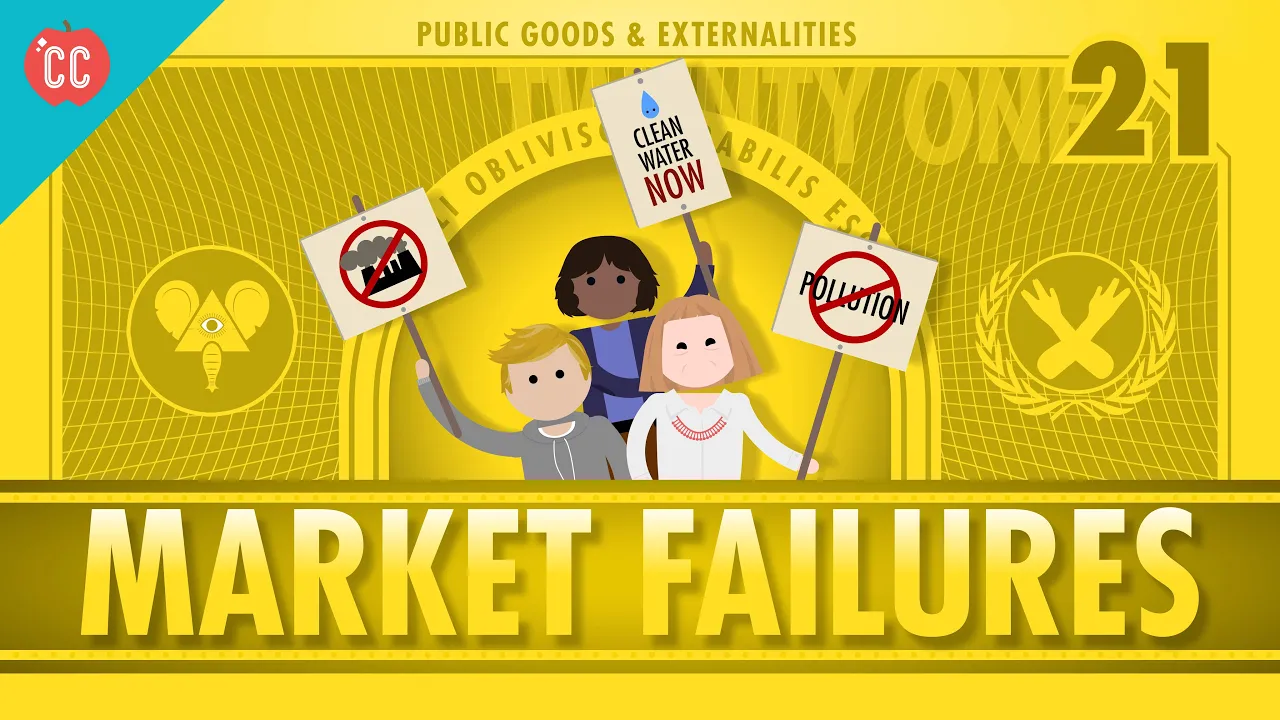











Market failure occurs when freely functioning markets without government intervention fail to allocate scarce resources efficiently to maximize social welfare, leading to inefficient allocation of resources for both production and consumption. This concept is central to environmental economics because markets often fail to allocate resources efficiently in the pursuit of economic growth, resulting in over-exploitation of natural resources and reduced societal welfare. The four main sources of market failure are: (1) Imperfect markets where sellers or buyers have market power to influence prices, causing price distortions and resource misallocation; (2) Imperfect information where information asymmetry between parties leads to adverse selection and moral hazard, reducing demand for environmentally friendly products; (3) Public goods characterized by non-excludability and non-rivalry, which create free rider problems and lead to under-provision of environmental goods; and (4) Externalities, particularly negative externalities like pollution, where the decision maker does not account for the impact on third parties, causing over-production of environmentally harmful goods.
Market Failure in Environmental Economics: Causes and Consequences
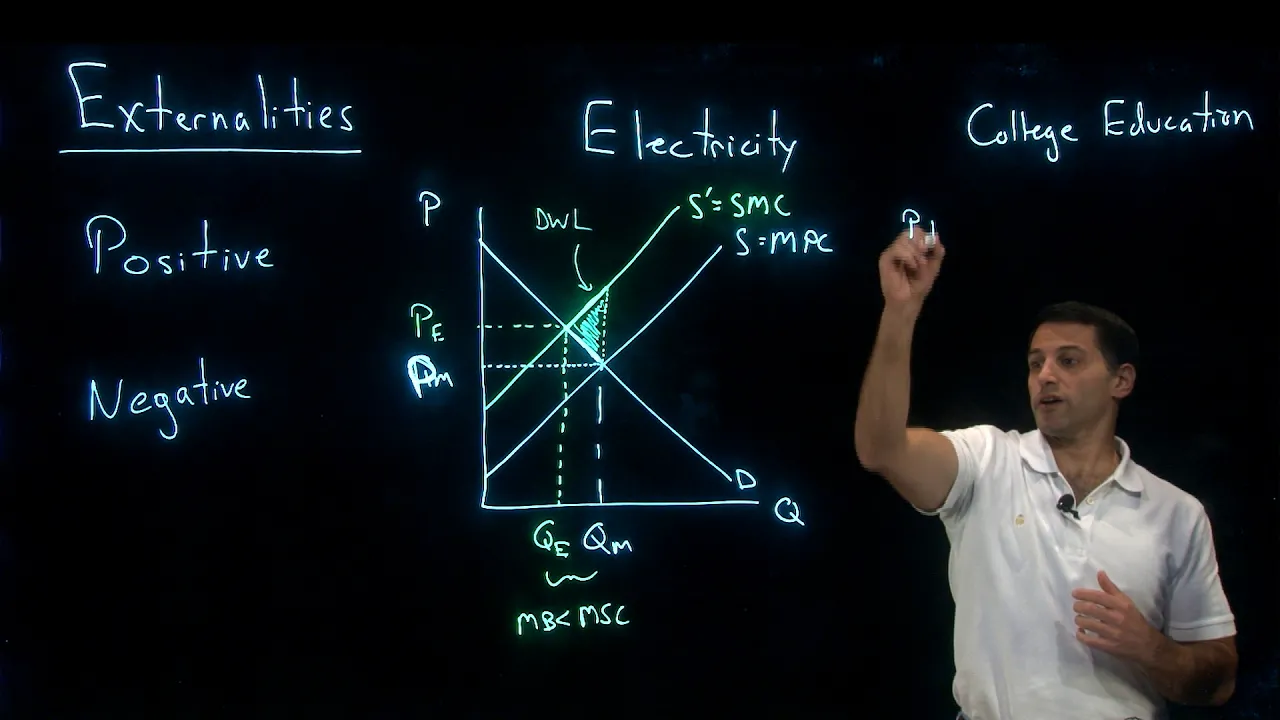
Added:[Music] hello learners we have been talking about environmental economics with respect to the definition its Concepts then we also talked about sustainability and sustainable development in the previous two lectures we have explained the par optimality a condition which explains that how resources can be allocated efficiently if the markets are efficient or what role do the markets play in the efficient allocation of resources whether it is for production or it is for the purpose of consumption in this particular lecture we will be talking about A New Concept which is called as market failure and this is a very very important concept going further as in as we delve deeper into environmental economics let's just have a look at what are going to be the learning objectives of this lecture we will be today first of all defining the concept of market failure and then in this lecture we will identify the sources because of which market failure occurs so let us see what is market failure we have seen that Paro optimality conditions say that the is allocative efficiency of the market if the resources are distributed or redistributed in such a way that we are able to make someone better off without making anyone worse off however what happens is due to various Market imperfections these conditions which are there in parent optimality lead to improper allocation of resources that is the resources do not get allocated the way they should be that leads to Market imperfections and this is what is called as market failure that is the markets on their own failed to allocate the resources the way they should have been done so because we are talking about environmental economics the concept of market failure remains very Central to it because we see that in the Quest for a higher economic growth the market is not allocating the resources the way they should be we see that how overe exploitation of Natural Resources is being done in order to get greater economic growth and in this process we are sacrificing the utility the welfare of certain class of the society so market failure I again repeat is a situation when the markets on their own are not allocating the resources either for production or for consumption in an efficient manner because of which the utility the satisfaction or the uses of resources is inefficient so let us now formally Define market failure market failure is said to occur when the markets fail to allocate scarce resources to generate greatest social welfare that is we are talking about those resources which are scarce when we started the course of environmental economics in the very first lecture only we have said that human wants are unlimited whereas the availability of resources is limited that is the resources are scarce similarly we have talked about the limits to growth we have talked about the finite availability of resources whether it is renewable non-renewable there is a limit to which we can use resources so when markets fails to occur allocate these sces resources in such a way that they generate greater social welfare we say the markets have failed or the market failure has occurred market failure occurs when freely functioning Market operating without government intervention fail to deliver an efficient or optimal allocation of resources that is we are saying that if there is a invisible hand principles if we believe that the markets are efficient enough to distribute resources in their best possible way without anyone intervening in the market through policies then when such markets operate they are freely functioning there is no intervention of the government through any policy but these freely functioning markets also are not able to deliver the a efficient allocation or Optimum allocation of resources a market failure occurs therefore because there is inefficient or suboptimal allocation of resources economic and social welfare may not be maximized so when the economic and social welfare is not maximized it leads to loss of allocative efficiency and productive efficiency that is the first two conditions of pared to optimality with respect to exchange and with respect to production both get violated so a failure of the market to Res to allocate its resources efficiently is leading to loss of economic welfare and loss of social welfare hence the task of environmental economist is to identify these market failure and then suggest policy measures so that the reallocation of resources is done in such a way that we get economic as well as social welfare now when market failure occurs it can be said that there is inefficient allocation of resources when there is inefficient allocation of resources it will lead to production inefficiency and it may ALS also lead to allocative inefficiency maybe production efficiency would mean that those goods which are being produced are produced either more than required or less than required so we are breaking the optimum level of production because the market is failing Market is guiding to use our resources whatever labor and capital we are producing in such a way that it itself is leading to either higher production of undesirable Goods or a lower production of a desirable Goods not only it leads to higher production of indesirable goods it is also leading to inefficient prices so either prices would be more or prices would be less similarly it also leads to allocative effic inefficiency because it means that people who desire Goods which are more Environmental friend ly these goods are not allocated to them so the consumer choices are also getting violated when a market failure occurs so a market failure means suboptimal or unoptimal allocation of resources because of which a productive inefficiency is occurring as well as allocative efficiency is occurring now why does this occur is a very important question we have talked about paratopic optimality we have said that if the markets are perfect if people have perfect knowledge then markets will automatically allocate Goods in such a way that the social welfare increases but in Practical life we see that market fails and what are the reasons for this market failure we will be discussing these four reasons one by one imperfect Market imperfect information public goods and externalities so we'll discuss all of them one by one let us start with the first reason because of which the market fails that is the imperfect markets what do you mean by imperfect Market when we talked about par optimality we had said that we are saying assuming that there is perfect competition perfect competition means that there are no barriers to entry and exit the goods which are being produced are perfectly homogeneous and there is complete knowledge to both consumers as well as producers so when this kind of a market is there the prices in the good prices of the goods in this market is determined by demand and Supply that is the demand market demand which is downward sloping and market supply which is upward sloping and equilibri ium of demand and Supply will determine this equilibrium price and whoever is selling whichever seller is selling this good will be selling at this Price p so nobody has a market power so everybody is going to sell at this Price p also if the firms are wanting to maximize their profits we say the condition is that their marginal revenue should be equal equal to marginal cost since in perfect competition marginal revenue is equal to price this would mean that price will be equal to marginal cost so there will not be any excess price so in perfect competition one the price is determined by the interaction of Market forces that is demand is equal to supply and second the price also becomes equal to the marginal cost because in perfect competition price is the same as marginal revenue and firms want to maximize profit that becomes a point where their marginal revenue is equal to marginal cost since Mr is equal to p and p then becomes equal to MC so in perfect competition the price becomes equal to marginal cost so that is the Assumption by which we are talking about Paro optimality but what we are saying is that in case of imperfect Market that is imperfect Market means that the seller or the buyer has some kind of Market power because of which they can influence the market price what Market power for example if there is only one seller in the market or for example there are very few sellers in the markets then this seller is powerful enough to influence the market price because he knows consumer does not have a choice so he can decide the price in the market similarly many times buyers can also influence the market power let us assume there are very few buyers now these buyers will dominate the market and then the price will be fixed in the market so in case of imperfect Market unlike the perfect Market because because there is Market power of the buyers or the sellers the price is not determined only by the demand and Supply also in imperfect Market what happens is that the price set by the market is greater than their marginal cost so p is greater than MC whereas here we had saiden that P is equal to MC so the price which is being set in the the market is greater than the price which would have been in case of a perfect market so because of this what has happened is that there is a price Distortion we have just seen and also there is resource misallocation so either the producer will be producing Goods less than what is required or more than what is required on they will be charging a higher price than what the Market should actually be charging and this is happening because the market in these imperfect markets individual buyers and sellers are powerful enough to influence the market price let us see an example for example in case of olop what is an olop olop means that there are very few firms in the market and each firm is so big in size that it can influence the market price so once this happens these firms know that they're dominating the market so they have a very little incentive to offer environmentally sustainable options why because they know that they are the ones who are going to decide that how much is going to be produced and what is going to be produced and consumers do not have a choice to move away from away from them so they have a little incentive to offer environmentally sustainable options further perpetuating the environmentally damaging consumption patterns so because the markets were imperfect because the sellers had a power in the market to produce what they want they have a very little incentive to offer environmentally sustainable options which leads to Greater environmentally damaging consumption patterns so the market has failed to allocate the resources which was having more of environmentally sustainable options so that is one imperfect Market reason for market failure the second reason for having a market failure is imperfect information what is imperfect information when we talk about par optimality we are saying we talk about perfect competition now perfect competition says that there is perfect knowledge that is both the consumer and the producers know have complete information about in all about whatever is happening about around them but imperfect markets also suffer from what we call as information asymmetry that is there is mismatch of information between the sellers and the buyers so asymmetrical information means that one party has more information compared to another party this because of this imperfect information what happens is that there may be an adverse selection or there may be a moral hazard problem adverse selection means because I do not know that uh how much environmental damage this product is making I make a selection of that product without actually knowing are having the complete information so maybe I am a consumer who wants to have more sustainable products but because the information provided to me by the seller is less than what he should have given me it leads to adverse selection similarly there are a lot of moral hazard problems also wherein intentionally certain unethical practices are done as again I'm telling you for many times consumer May lack complete or accurate information about environmental attributes of these products so many times when we when we say that certain vegetables now these are available around the season around the year there are no more seasonal vegetables we buy those without understanding that how much pesticides have been used on them just because we want to have that vegetable all around the year so since we do not have that complete information we buy that so in hence we are you know contributing to uh unsustainable consumption practices so because of this because consumers lack complete information and not only complete but accurate information this leads to consumption of environmentally hazardous Goods also imperfect information leads to lower demand of environmentally friendly products than it would have been if the consumers had complete information because certain information is hidden from them or it is Comm flaged from them or very smartly worded information is given consumers have incomplete information so even if they want the demand for environmentally friendly products is lower on the other hand products that are less environmentally friendly are marketed in such a way that they enjoyer higher demand and this also leads to Market distortions so imperfect information which happens because basically one party has a greater information than the other party and they are withholding this information from the consumers hence it leads to adverse selection it also leads to moral hazards and hence there is a consumption pattern where environmental friendly products are demanded less comp compared to to those goods which they would have otherwise taken if they had complete information about the environmental damage these products are making so hence it leads to a what we call as a market failure another important reason for market failure is the goods being environmental Goods particularly being what we classify as public goods of course we will be having a one full lecture on public goods but let me just give you a brief on what is public goods as I said environmental goods and services possess the features of a public good what is a public good the characteristics of the public good one is what is called as nonexcludability excluding means we can keep someone away from the consumption of that good but non-excludability means that individuals cannot be excluded from its usage that is you cannot disallow someone to breathe clean air right you cannot say to someone since you are not paying for clean a you are not allowed to do that or you cannot say that the National Defense or the Law and Order being maintained by the government someone who is not willing to pay for it or someone who's not paying for it cannot take the advantage of that National Defense so nonexcludability means that we cannot disallow people from using that product just because they're not paying for it and because of that we come to a very peculiar of term which is called as a free rider Free Rider means that someone is consuming that good without actually paying for that good so for example conservation of Natural Resources is in order to for example wildlife habitats or endangered species because we want to maintain the biodiversity and the ecosystem so all those who may not be interested in this uh maintainance of these natural resources are still taking the advantage of having a balanced ecosystem because we are unable to exclude them from this service so a very peculiar feature of a public good is that of non-exclusion the second feature of a public good is that they are nonrival in consumption that is consumption by one person does not prevent the consumption of another person for example cleaner if I am inhaling cleaner it doesn't mean that you cannot because it is available to everyone so consumption of one does not reduce the availability of cleaner hence we cannot prevent someone else from consuming this so when these any good or a service has both of these features that is of non-exclusion and of nonrivalry we say that that good is called as a public good so non-exclusion means you cannot exclude someone from the usage of a good or a service even if he or she is unwilling to pay for that product on on the other hand nonrival means that consumption of one person of a that good or a service does not prevent the consumption of another person because it does not reduce the availability of that good or service for the rest of them so these are nonrival in consumption so when both of these are there we call it as a public good as we just said that because there is non-exclusion there is a very peculiar problem of a public good which is called as a free rider who are Free Riders Free Riders are all those people who are not willing to pay for a particular good but they would benefit from it if it were offered as a public good okay for example I say I do not need any uh know so many uh security guards in my residential Colony so I will not like to pay for those Services of the security guards but since if the government is providing you that it is offered as a public good and I am taking the benefit of that without actually paying for it so a free rider problem suggests that what would happen if the government stop producing public goods for example government says okay if you're not willing to pay for Law and Order we will stop having these poce we will stop having National Defense then this would mean that many people because they are refusing to pay these Services would be eliminated from the system because no private individual or no private producer will be willing to provide that service without getting any compensation so when people refuse to pay for consumption of a service or a good and if the government says that we will not provide it anymore that particular good or service is will be totally eliminated from the system so free rider problem because of this we see most of the goods and services of such types are then generated or taken care by the government therefore they are also called as public goods that is these goods are being taken as a public service further the next reason for an imperfect Market is having externalities what is externalities externalities are the effect of a decision on a third party that is not taken into account by the decision maker that is if I am doing something today and it has an impact on a third party and he is nowhere into this decision making that is called as an externality for example I decide to have a DJ system in my party at my home and I am I have taken decision to play it at a very high volume because of which if the third the society the neighbors around me are getting Disturbed that is an externality that I'm producing because I have not taken the consent of that third party in taking this decision so externalities are the effect of a decision on a third party that is not taken into account by the decision maker that is the decision maker is not considering that my decision what impact it is going to have on a third party when such a market outcome affects parties other than the buyers and sellers in the market the side effects which are created are called as externality so we have taken as a decision to do something as a buyer and seller this is my decision let us say I am I started pretty producing paper so I have a paper mill I start producing paper so there is an agreement between I am a seller of that paper there is a buyer of that paper but I am also you know uh there are certain industrial influence in this whole production process of papers which I'm discharging in a nearby stream and because of that someone else is using that stream water for the purpose of let us say bathing or for washing clothes and because of which they have certain chemical reactions it is an externality to the third party because these buyers and sellers have decided to produce something without taking into consideration what impact it is going to have on the third party so such side effects on the third party are called as externalities when these externalities occur society's interest in the market outcome extends beyond the well-being of the buyers and sellers in the market of course by buying paper and selling paper there is certain economic transaction which is taking place there may be certain satisfaction of bonds which leads to a well-being but because of this externality this Market outcome is not only getting restricted to these buyers and sellers because its impact of the affluent which is being discharged in the water stream nearby is having an impact on those people who were nowhere associated ated with this buying and selling of paper so in the presence of externality society's interest in the market extends beyond what is happening to the well-being of the buyers and sellers and then these externalities can be either positive they can be or negative let us have a look at what do we mean by negative externalities and then we will understand what is a positive externality negative externalities are basically the cause to some other people okay if because of my action there is certain damage to someone some cost is getting Associated of my production or my consumption that is called as a negative externality for example pollution noise traffic jams there are typical examples of negative externality from our everyday life negative externality lead to market failure why because sometimes the production or consumption of these Goods which are causing externalities they lead to production of larger quantities than what is socially desirable because they are creating social cost we are not taking into account the social cost while deciding how much to produce the producer is only taking the private cost of production of that that good he is not taking into consideration that what is happening uh to the society because of the action of the production that I am doing hence the social cost is different from the private cost and it leads to large production of this over production of these Goods now what are positive externalities they are just opposite of the negative externalities these externalities benefit some other people therefore they are called as positive externalities if because of my action whatever production or consumption I'm doing there is a positive impact on the society on a third party it is called as a positive externality now these are unpaid benefits why because whoever is getting benefited because of the consumption of the third party getting benefited of this is not paying for this neither they are directly involved the production or consumption of this these are just the unpaid benefits so unpaid benefits leads to the Divergence between the marginal social cost and the marginal private cost or the benefit social benefit and the private benefit some of the examples of positive externalities can be immunization for example if you are taking vaccination against a communicable disease and because of that I am not spreading this disease to a third party it is a positive externality similarly technological research and scientific research we are not paying for that research but benefits I'm you know acquiring as a third party trash collection is also an example of a positive externality now let me uh before uh going further let us do a small quiz which will help you to recap this concept it's a small uh multiple choice quiz you have to pick up the right answer the first question is that a market failure is when a markets enable buyers to gain utility second is markets fail to enable sellers to make profit third is markets fail to allocate resources efficiently and then markets enable producers to take risks so if we have to Define market failure what will be Market failure apart from all of these uh options is it a market enabling buyer to gain utility is it a market failing to enable sellers to make profit or is it Market failing to allocate resources efficiently or is it markets enabling producers to take risk market failure is when markets fail to allocate resources efficient ently that is when the markets are not giving you know allotting the resources efficiently because there is a gap in what is desired and what is happening to actual allocation second question is which of the following is an example of negative externality we have just understood what are externalities is it a beekeeper providing pollination services to nearby Farms is it a factory in pollutants into the air and water is it a homeowner installing solar panels to generate electricity or is it a consumer purchasing a smartphone which of the following options is an example of negative externality a beekeeper providing pollination services to nearby Farms b a factory emitting pollutants into the air and water c a homeowner installing solar panels to generate electricity or d a consumer producing a smartphone what will be an example of negative externality out of these four the answer would be B that is a factory is emitting pollutants into the air and water a will be an example of positive externality c will also be an example of positive externality so this is just a quiz to refresh your knowledge of whatever we have done now let us just revise what we have done we have understood that market failure are preventing social socially efficient equilibrium from being reached because there is a gap between what Society desires to be produced and consumed and what is being actually produced and consumed market failure is associated there are various reasons for market failure it is associated with imperfect Market it is associated with externalities it is associated with public goods and it associated with asymmetric information or imperfect information Economist explain environmental degradation using this theory of market failure primarily by identifying negative externalities and public goods and these are the two which we are going to explain in the subse qu lectures both negative externalities how do they have an impact on environment and how they can be corrected and what are public goods we have seen how do they lead to market failure and then what are the consequences so I hope you enjoyed this lecture so take care and we'll meet you in the next lecture thank you so much [Music]
Up Next
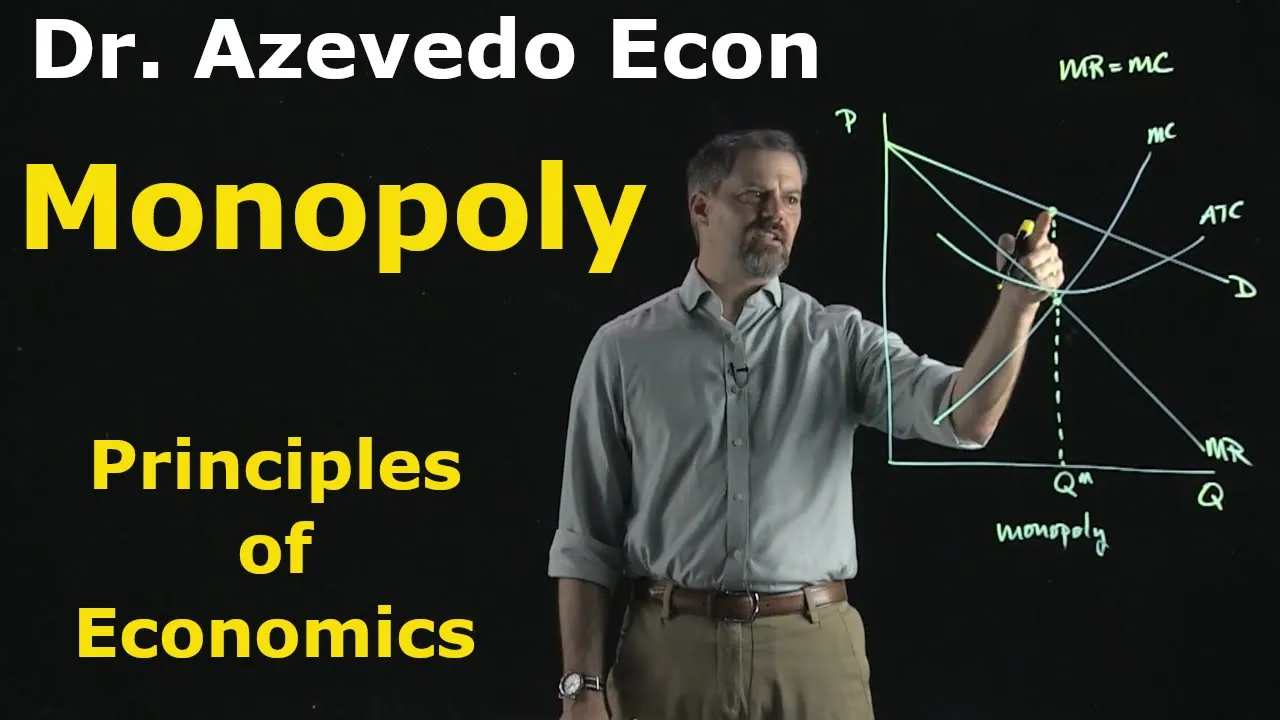
Monopoly Market Structure: Price, Profit & Deadweight Loss
@DrAzevedoEcon
132.7K views•2020-03-26

Globalisation and the 21st Century Enlightenment | Joseph Stiglitz
@EdinburghUniversity
44.8K views•2009-02-10
Behavioral Economics Explained: Rationality, Nudges, and Risk
@crashcourse
1.1M views•2016-03-12

The Age of Easy Money: Fed & Inflation | Full Documentary
@frontline
21.2M views•2023-03-15
Related Study Plans & Knowledge Roadmaps
Structured learning paths in Economics