









![[공기업경제학 기본강의 19] 제5장 시장이론 (6)](https://i.ytimg.com/vi/JyvevU7w4Pw/maxresdefault.jpg)
















Modern merger enforcement has shifted from traditional market definition and market share calculations toward a more economic approach that emphasizes competitive constraints (entry possibilities, supply substitution, demand elasticity, and buyer power), unilateral effects, and coordinated effects, with efficiencies and remedies gaining greater importance in merger assessments.
Merger Control Defense: Economic Trends & Key Strategies
Added:Basic principles of antitrust law and the regulatory framework governing merger reviews (e.g., FTC, DOJ, or European Commission guidelines).
Fundamental microeconomic concepts of market power, barriers to entry, and market structures such as oligopoly and monopoly.
The methodology of market definition, including the SSNIP (Small but Significant and Non-transitory Increase in Price) test and demand elasticity.
Key metrics used to measure market concentration, specifically the Herfindahl-Hirschman Index (HHI) and concentration ratios.
Quantitative econometric techniques used in merger simulation models to predict unilateral price effects and upward pricing pressure (UPP).
The design and negotiation of merger remedies, distinguishing between structural remedies (divestitures) and behavioral commitments.
Analysis of historical antitrust case studies to evaluate how economic defense arguments (e.g., the failing firm defense or entry arguments) succeeded or failed in court.
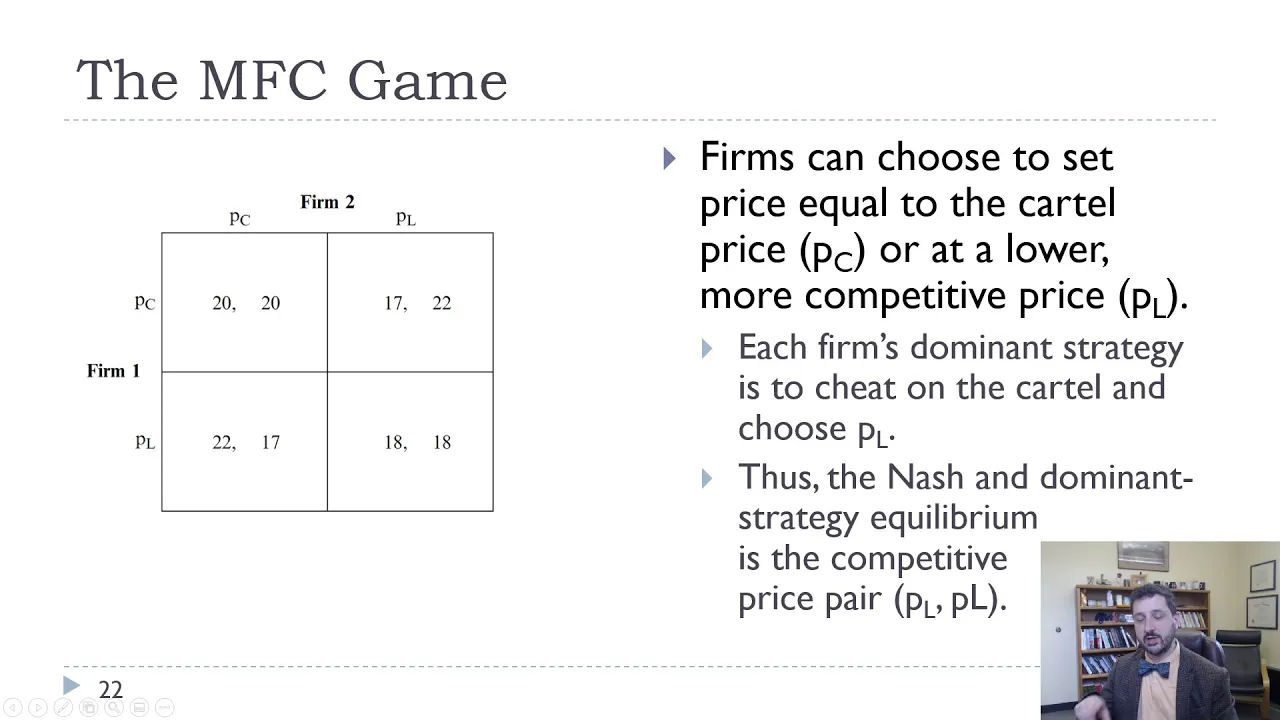
Advanced game theory applications analyzing coordinated effects and the likelihood of tacit collusion among remaining market competitors.
292 views3likes7:16Original Release: 2011-07-30
okay so thank you very much for this opportunity to talk in this distinguished conference I I will talk a little bit about uh from an economic perspective but at a very high level discuss the trends uh in merger enforcement in both the European for the European commission and for the UK because I'm based in the UK so I'm more familiar with that I think there is nothing revolutionary actually happening but there has been in the last perhaps eight nine years a trend towards a certain direction which I will discuss and so um my the purpose of this talk is to cover this main three aspects um merger enforcement Trends in the UK and and the European commission uh and basically you saw what is this uh more economic approach to merger control what what does it entail or what does it mean is it really a big difference or when it's springy and then finally if I have time perhaps not a lot of time but maybe I'll just uh touch on on these I give an example of a type of merger in a kind of Market in this kind of new markets where you might use New Economic uh analyzes and and that type of approach so an example of a more economic approach so um a merger assessment has these main elements that I've put there in that slide and these are basically the main element everywhere so they are like the ingredients of the cake but it may vary you vary the the kind of uh proportions with which you you use and you combine these ingredients so for example the main element of market definition is something that traditionally was was given a lot of weight and a lot of effort by by the side by the by the parties and by the competition authorities um and I think gradually it's been recognized that it's not so worth doing so much effort in getting the right market definition because competitive constraints are more important I think the UK authorities recognize these first but I think that is a trend overall in this direction and so and the same thing goes for market shares except for very extreme cases there are other aspects less formalistic that are gaining more importance and these are competitive constraints so it's more important to look at competitive constraints if you want to defend a merger a merger that you think it's probably going to be problematic rather than spending a lot of effort in the market definition and the calculation of the exact market shares it's important to see to uncover competitive constraints and this can be the possibility of Entry Supply substitution demand elasticity so saying that your your consumers will be able to switch very easily if you raise prices uh buyer power you have you are selling to powerful buyers so you cannot raise prices so this these type of arguments I think will will bring you much further than than a lot of investment in very complicated economic techniques used for market definition then the other two elements are unilateral effects and coordinated effects so unilateral effects are the incentives such as the direct incentive that firms have to raise prices and then once they merge there is an internalization of the externality of increasing prices and so there is a direct impact that you have you gain more by raising prices than you did before your merch so this is very easy thing and then the coordinated effects are gaining uh importance because they are very difficult to analyze so this is a this is a very rich area for economics but see the idea of coordinated effects is that uh after the merger maybe it's easier in that market to implement tacit collusion and so uh or collusion we'll just add will just happen naturally and if that's the case then this is this this might be a reason to stop the merger and so uh this is a big scope for there's a big scope here for using your economic imagination and you know come up with good reasons why tacit pollution would not work well in the market and so there are a number of tests and a number of models to be used there so uh and and um yes and I will not talk about efficiencies but obviously I think the the impression overall these at efficiencies are gaining more weight by by a number of these jurisdictions so uh the European commission even the UK even though these things are done on a case-by-case basis but they accept the notion that efficiencies if they are very large could be a reason to let a merger that is potentially problematic go ahead efficiencies however are very difficult to prove because the burden of proof will be on the merging parties so it's not it's not only that you need to prove that there will be efficiencies which perhaps in itself might not be so complicated but you have to prove uh exactly that these efficiencies will will benefit consumers directly so these these games will be passed for bus pass forward to final consumers otherwise you will not get the benefits from these efficiencies and these have to be compared to the cost so even though there is a scope for efficiencies to to be used as an argument it's a difficult is a difficult burden of proof it's a higher level of and remedies uh of course they are accepted in general um remedies are accepted all the authorities prefer structural remedies some authorities will say that we don't even consider or we don't like to consider behavioral remedies but uh as Kathy will discuss that there is a trend that perhaps on a case-by-case basis authorities are in fact accepting behavioral remedies more and more so I think I've as as I said in my first slide I said already a lot of of the things that are coming in the in an exercise so I'll be shorter now uh the new guidelines in the UK um so there is not a lot of change the they reflect less weight put on market definition uh a lot of weight put on competitive constraints the test Remains the Same it the so a merger will be prohibited if it if it results in a substantial lessening of competition uh and the approach to remedies is in principle the same in practice perhaps a bit more lenient towards behavioral remedies uh
Up Next

47:01
Broadband Competition: Former FTC Commissioner Josh Wright Keynote
@Thecapitolforum
482 views•2015-12-21

6:55
Understanding Copyright and Fair Use in the Digital Age
@techquickie
144.1K views•2016-07-22

5:27
Forensic Phonetics: Speaker Identification in Legal Cases
@nptel-nociitm9240
539 views•2025-03-19

24:42
Police Interrogation Tactics: False Confessions & Legal Reform
@LastWeekTonight
7M views•2022-04-18
Related Study Plans & Knowledge Roadmaps
Structured learning paths in Law
law
Analyzing Mergers: Clayton Act & FTC Rules
01Introduction to Antitrust Law and Market Competition
02Corporate Mergers and Section 7 of the Clayton Act
03Defining Markets and Measuring Concentration (HHI)
+ 2 more learning modules
10h5 modules
Explore Roadmap
law
Self-Defense Law: Imminence & Castle Doctrine
01Foundations of Self-Defense Law
02Imminent Threat & Reasonable Belief
03The Principle of Proportionality
+ 3 more learning modules
12h6 modules
Explore Roadmap
law
Defamation Law: First Amendment & Actual Malice
01Introduction to civil torts and the First Amendment
02Elements of Defamation: Libel and Slander
03Public Figures vs. Private Individuals
+ 2 more learning modules
8h5 modules
Explore Roadmap
law
Hearsay Rule: Trial Evidence & Exceptions
01Introduction to Trial Evidence & Courtroom Basics
02Demystifying Hearsay: The Core Definition
03Non-Hearsay: Exclusions Under FRE 801(d)
+ 3 more learning modules
14h6 modules
Explore Roadmap