Language acquisition follows five universal stages: (1) Cooing (0-4 months) where infants produce various sounds and can discriminate all 200 human phonemes; (2) Babbling (5-12 months) where children narrow focus to phonemes common to their native language; (3) One-word utterances (9-18 months) where words become tools of thought and control the environment; (4) Two-word utterances (18-30 months) where vocabulary triples from 300 to over 1,000 words; (5) Basic adult sentence structure (around age 4) establishing the foundation for adult language.
5 Stages of Language Acquisition | Child Language Development
Added:Deep Dive
Basic understanding of linguistics, specifically the distinction between phonemes (speech sounds), morphemes (meaningful units), and syntax (grammar rules).

CTET 14 DECEMBER 2024 CDP NCERT शब्दावली by Sachin choudhary live 8pm
486.6K
Phonemes are the smallest units of sound in a language that distinguish meaning. Morphemes are the smallest units of meaning in a language, such as prefixes, suffixes, or root words. Syntax refers to the rules governing the structure and arrangement of words in sentences. Together, these three components form the basic building blocks of language structure and meaning.
Click to watch →

CTET FEB 2026 Sanskrit Important Topic ✅ by Sachin Academy live 6pm | Kavita Ma'am
164.3K
Language consists of hierarchical units that build meaning progressively. Phoneme (स्वनिम) is the smallest unit of language, representing sounds. Phonemes are the basic building blocks that combine to form words. Children first learn to recognize and produce phonemes before learning letters and words. Morpheme (रूपिम) is the smallest unit of language that carries meaning. Morphemes combine to form meaningful words. Syntactic structure (वाक्य विन्यास) refers to the arrangement of words to form meaningful sentences. Syntactic structure combines morphemes and words to create complete sentences that convey complete thoughts and meanings.
Click to watch →

Language development/phoneme,morpheme,Syntax/ഭാഷാവികാസം/Language Disorders /Psychology Class-21
108.3K
Language development involves the acquisition of three fundamental components: phonemes (the smallest units of sound in a language), morphemes (the smallest units of meaning), and syntax (the rules governing sentence structure), which together enable effective communication and understanding.
Click to watch →

ENG.LISH CLASS-1(BATCH-20)
495
Phonology is the study of sound patterns in language, dealing with how sounds are organized. Morphology is the study of meaningful sound combinations, examining how sounds combine to form meaningful units. Phonemes are the smallest speech units that do not have meaning in themselves. Morphemes are the smallest meaningful units in language. Syntax is the part of grammar that governs the arrangement of words to form acceptable phrases and sentences, following rules such as subject-verb-object order.
Click to watch →

Morpheme Vs Phoneme II What is Morpheme? II What is Phoneme? II Linguistics Definition II UGC NET
3.6K
In linguistics, a morpheme is the smallest meaningful unit of language (such as prefixes like 're-' or suffixes like '-ed') that carries meaning when combined with other morphemes, while a phoneme is the smallest contrastive sound unit (like /p/ or /b/) that distinguishes one word from another; morphology studies word formation and morphemes are open-ended (unlimited), whereas phonology studies sound patterns and phonemes are closed-ended (English has exactly 44 phonemes).
Click to watch →
Deep Dive
The fundamental theoretical debate between Nativism (Noam Chomsky's concept of an innate Language Acquisition Device) and Behaviorism (B.F. Skinner's reinforcement model).

Pstet English 2026 | Pstet 2026 English 100 MCQ's By Isha Maam
35K
Chomsky's generative grammar theory fundamentally opposes behaviorism. While behaviorism (Skinner) views language as habit formation through stimulus-response, Chomsky argues language acquisition involves innate cognitive structures. Chomsky proposes humans possess an innate language acquisition device (LAD) enabling systematic rule acquisition. This theory emphasizes that language learning cannot be explained solely through repetition and conditioning, as behaviorism suggests.
Click to watch →

CTET SEP 2026 सम्पूर्ण हिन्दी Pedagogy by Sachin Choudhary live 8pm | CTET Hindi
192.9K
Three types of listening skills: (1) Conceptual listening - understanding and recognizing specific voices or sounds in a noisy environment, (2) Appreciative listening - listening for enjoyment and pleasure, (3) Analytical listening - critically analyzing and evaluating what is heard. Noam Chomsky proposed that children have an innate Language Acquisition Device (LAD) enabling natural language learning. This theory faced criticism from behaviorists (like B.F. Skinner) who argued that language is learned through imitation, practice, and reinforcement (rewards and punishments). Critics also argued that Chomsky's theory undervalued the role of social interaction in language learning.
Click to watch →
![Биология поведения человека: Лекция #23. Язык [Роберт Сапольски, 2010]](https://i.ytimg.com/vi/_knieax3HK8/maxresdefault.jpg)
Биология поведения человека: Лекция #23. Язык [Роберт Сапольски, 2010]
380
The debate between B.F. Skinner and Noam Chomsky represented a fundamental disagreement about how language is acquired. Skinner proposed that language is learned through reinforcement and punishment, similar to other behaviors. Chomsky argued that language acquisition involves innate cognitive structures that cannot be explained by behaviorist principles. Chomsky proposed that children are born with an innate 'language acquisition device' that allows them to learn language rapidly and efficiently. This debate shaped the field of linguistics and psychology for decades and continues to influence our understanding of language acquisition.
Click to watch →

Lecture 1: Introduction to Cognitive Science | COGSCI 1 | UC Berkeley
21K
Cognitive science is defined as the interdisciplinary study of mind and intelligence, drawing upon seven subfields: anthropology, AI, education, linguistics, neuroscience, philosophy, and psychology. Unlike these subdomains, cognitive science integrates findings to provide comprehensive understanding. Key distinctions exist: neuroscience focuses on implementation level (brain hardware), while philosophy addresses computational/algorithmic level (problem-solving strategies). Two competing theories explain language acquisition: behaviorism (Skinner, 1957) treats language as learned through conditioning via rewards/punishments; nativism (Chomsky) argues language is an innate cognitive module with grammatical rules. Chomsky's critique demonstrated behaviorism couldn't explain language's rule-like nature. This debate represents a broader tension between empiricism and nativism, with implications for understanding cognition itself.
Click to watch →

Skinner X Chomsky na Aquisição da Linguagem
44.7K
This video presents two contrasting theories of language acquisition: B.F. Skinner's environmentalist approach, which posits that language learning occurs through stimulus-response-reinforcement conditioning where children learn from their environment, and Noam Chomsky's nativist approach, which argues that language acquisition is an innate genetic process driven by Universal Grammar that children activate through minimal environmental contact, even in impoverished linguistic environments.
Click to watch →
Deep Dive
An introductory grasp of cognitive development in infancy, particularly how physical growth and sensory exploration relate to communication.

UPTET 2026 full Course | Class 2: विकास की अवस्थाएँ (CDP) | 100% पक्की तैयारी
1.4K
Infancy (birth to 2 years) is characterized by sensory exploration as the primary learning method. Infants learn by touching, seeing, hearing, and tasting - putting objects in their mouth is not a bad habit but their way of exploring the world. Their senses serve as their first classroom. During this period, there is rapid physical growth and a significant cognitive milestone called object permanence develops around 8-9 months.
Click to watch →
Infancy or Toddlerhood | Stage 2 | Physical Development | Developmental Psychology |Lecture 8 | Urdu
1.6K
At birth, all sensory organs are present but not fully functional. Touch is most developed, while vision focuses only on close objects. Cognitive development involves thinking, perception, memory, and language. In Piaget's sensorimotor stage, infants lack object permanence initially. They learn through sensory exploration - touching, tasting, and manipulating objects. This stage establishes the foundation for later cognitive abilities.
Click to watch →

Child Development and Learning | D.Ed Special Education | Common Subject | Unit -02
12.5K
From birth to age 2, infants experience rapid physical growth with weight approximately tripling and length increasing by about three times. Newborns sleep 18-20 hours daily and cry for about 2 hours per day. Sensory perception develops rapidly, enabling recognition of faces, voices, touch, smell, and taste. According to Piaget, cognitive development occurs through sensorimotor experiences, where infants learn by interacting with their environment through senses and physical movements.
Click to watch →

CG TET 2026🔥बाल विकास (शैशवास्था|Last 20 Days Preparation|CG Teacher Bharti McQ#cgtet2026 #cgvyapam
4.8K
Infancy (birth to 2 years) is characterized by extremely rapid physical and mental development. Physical development occurs first, with rapid growth in body size, weight, and height. The infant's head is proportionally larger due to accelerated brain development. Infants first recognize their mother and form emotional bonds with her. Imitation is the primary learning method, where infants copy others' actions. Touch is the first active sense organ from birth. Crying is the first form of language development and communication. These foundational developments establish the basis for all subsequent learning and growth.
Click to watch →

مظاهر النمو في مرحلة الرضاعة
151
Infancy (third week to end of second year) is characterized by rapid physical growth and cognitive development. Physical growth involves individual differences based on heredity, environment, and gender. Key measurements: birth length ~50cm, end of first year ~74cm, end of second year ~84cm. Birth weight ~3-3.5kg, end of first year ~9kg, end of second year ~12kg. Proportional changes: head decreases from 25% to 10-12% of body length. Tooth eruption begins at 6 months. Muscle development follows large-to-small pattern. Males are typically larger due to testosterone. Cognitive development follows Piaget's sensorimotor stages: reflexive actions (0-1 month), primary circular reactions (1-4 months), secondary circular reactions (4-8 months), coordination of secondary schemes (7-10 months), tertiary circular reactions (11-18 months), and mental representation (18-24 months).
Click to watch →
Prerequisite Knowledge
- Concept 01Basic understanding of linguistics, specifically the distinction between phonemes (speech sounds), morphemes (meaningful units), and syntax (grammar rules).
- Concept 02The fundamental theoretical debate between Nativism (Noam Chomsky's concept of an innate Language Acquisition Device) and Behaviorism (B.F. Skinner's reinforcement model).
- Concept 03An introductory grasp of cognitive development in infancy, particularly how physical growth and sensory exploration relate to communication.
Subsequent Learning
- Step 01The Critical Period Hypothesis, which investigates the biological timeframe during which native-level language acquisition must occur.
- Step 02The role of Child-Directed Speech (or 'parentese') and the Social Interactionist Theory in facilitating phonetic and vocabulary development.
- Step 03Simultaneous Bilingualism, examining how infants successfully map and differentiate two distinct native languages during the same developmental timeline.
- Step 04Developmental language disorders (such as Specific Language Impairment or speech apraxia) and how pediatricians identify deviations from standard acquisition milestones.
Acquisition Stages
Advanced Stages
Acquisition Stages
0:03Playing Section
- 1
Humans learn language in universal stages and order.
- 2
Infants initially discriminate all human phonemes.
- 3
Babbling narrows to native language sounds by 12 months.
Usage-Based and Constructivist Theory of Language Acquisition
While the "five universal stages" model suggests a linear, biologically predetermined progression, the Usage-Based and Constructivist perspective (championed by linguists like Michael Tomasello) argues that language development is highly individualized, non-linear, and driven by social interaction rather than innate, rigid milestones. Instead of progressing through pre-programmed grammatical stages, children acquire language piecemeal by learning concrete constructions from their unique linguistic environment using general cognitive skills like pattern-finding. Furthermore, cross-cultural research indicates that the sequence and pace of language acquisition vary significantly across different cultures and languages, challenging the notion that these developmental stages are strictly universal.
Deep Dive
The Critical Period Hypothesis, which investigates the biological timeframe during which native-level language acquisition must occur.

Adquisición del lenguaje según el Innatismo
64.5K
The Critical Period Hypothesis states that there is a biologically determined window during which language acquisition must occur for normal proficiency. If the Language Acquisition Device is not stimulated during early childhood, the resulting language will have significant limitations. This hypothesis is supported by case studies of children who were isolated from human contact during critical developmental periods.
Click to watch →

Critical Period Hypothesis - Language Acquisition Part of Psychology Video Course @doorsteptutor.com
4.8K
The Critical Period Hypothesis, proposed by Lenneberg in 1967, suggests that humans have a biologically determined window (typically the first 2-5 years of life) during which language acquisition occurs most naturally and effortlessly; after this critical period, language learning becomes significantly more difficult and requires conscious effort, explaining why children acquire native languages so easily while adults struggle with second language acquisition.
Click to watch →
Theories of language development: Nativist, learning, interactionist | MCAT | Khan Academy
535.8K
The critical period hypothesis states that there is a specific timeframe during which children are most capable of learning language. This period is typically considered to extend from birth until approximately age eight or nine. During this window, the language acquisition device operates optimally. After this age, while language learning remains possible, it becomes significantly more challenging because the LAD specializes to the native language and loses its ability to detect sounds and grammatical structures from other languages.
Click to watch →

mod02lec12 - Critical Period Hypothesis
1.7K
The Critical Period Hypothesis, popularized by Eric Lenneberg in 1967, proposes that human children have a biologically determined window (approximately 12-13 years of age) during which they can acquire language naturally and effortlessly. This hypothesis is supported by case studies of feral children like Genie (discovered at age 13 who could not acquire language properly) and Isabelle (discovered at age 6.5 who acquired language successfully), demonstrating that early childhood exposure to a linguistically rich environment is crucial for normal language development. The hypothesis complements Chomsky's theory of an innate Language Acquisition Device and Universal Grammar, suggesting that while humans are biologically programmed to acquire language, this capability diminishes after a certain age threshold.
Click to watch →

NOAM CHOMSKY | Linguistics | Theory of universal grammar
73.5K
The Critical Period Hypothesis states that there is a specific window of time (approximately ages 0-5) during which children can acquire languages most easily and completely. After this period, typically around adolescence, the brain's plasticity decreases significantly, making it much more difficult to learn new languages to native-like proficiency.
Click to watch →
Deep Dive
The role of Child-Directed Speech (or 'parentese') and the Social Interactionist Theory in facilitating phonetic and vocabulary development.
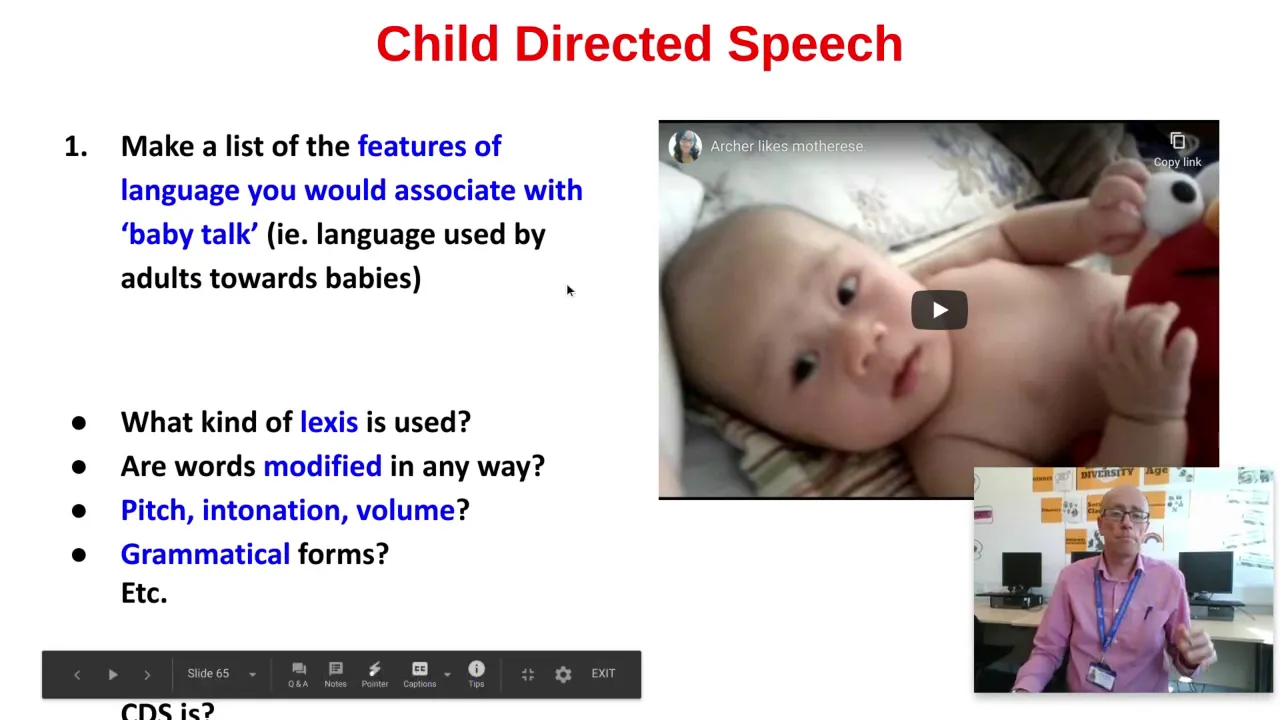
English Language A Level CLD Theory Social Interactionism Paul Heselton
1.3K
Social interactionism, developed by Jerome Bruner and Lev Vygotsky, proposes that language development occurs primarily through social interaction rather than innate ability or environmental conditioning; Bruner introduced the Language Acquisition Support System (LASS) emphasizing adult scaffolding, while Vygotsky developed the Zone of Proximal Development (ZPD) concept, which describes the gap between what a child can do independently and what they can achieve with guidance from a more knowledgeable other, along with features of Child Directed Speech (CDS) including higher pitch, simplified grammar, repetition, and expansion that adults use to support children's language learning.
Click to watch →

“The Effect of Parentese on Language Learning in Autistic Children and Bilingual Children”
274
Infant-directed speech (IDS), or 'parentese,' is the modified speech caregivers use with young children, characterized by higher pitch, exaggerated intonation, simplified vocabulary, and slower rate. Research across 21 societies shows universal acoustic modifications including mean pitch, pitch range, vowel parameters, and vocal quality. IDS facilitates language development through two mechanisms: social interactive effects encouraging child vocalization, and acoustic salience grabbing attention. Evidence shows infants prefer IDS, and IDS improves word segmentation, recognition, and novel word learning. Parent coaching increases IDS use, leading to more conversation turns and vocabulary growth, making IDS a potentially cost-effective intervention target.
Click to watch →

MODULE 2.1 - THEORIES OF CHILD DEVELOPMENT AND ITS IMPLICATIONS TO LANGUAGE LEARNING AND ACQUISITION
2K
This video presents four major theories of child development and their implications for language learning: (1) Behaviorism (Skinner) emphasizes environmental influence and imitation, but fails to explain rule overgeneralization and the critical period; (2) Innateness/Nativism (Chomsky) proposes an innate Language Acquisition Device (LAD) with Universal Grammar, supported by evidence like creole formation and sign language acquisition; (3) Cognitive Theory (Piaget) links language to intellectual development stages, though syntax may not always depend on general cognitive growth; (4) Input/Social Interactionist Theory (Bruner) emphasizes caregiver-child interaction, child-directed speech, and scaffolding as essential for language acquisition.
Click to watch →
Theories of Language Acquisition-Input or Integrationist Theories
858
The Interactionist Theory of Language Acquisition, proposed by Jerome Bruner in 1966, suggests that children learn language through social interaction and communication with caregivers, who use specially adapted 'child-directed speech' (CDS) to support the acquisition process. Bruner introduced the concept of 'scaffolding' and the 'Language Acquisition Support System' (LASS) as a response to Chomsky's Language Acquisition Device (LAD), emphasizing that language learning occurs through meaningful communication contexts, games, and non-verbal interactions rather than innate biological mechanisms alone.
Click to watch →

Lingüística II - Prof. Iliana Sancevich
1.1K
The Interaccionismo theory views language as the essence that constitutes the subject, where the child's productions are enigmatic and require interpretation to enable subjective constitution, while the Socio-interaccionismo theory sees language as an instrument of communication where a more expert subject (like a parent) facilitates the child's linguistic development through scaffolding and correction of errors.
Click to watch →
Deep Dive
Simultaneous Bilingualism, examining how infants successfully map and differentiate two distinct native languages during the same developmental timeline.
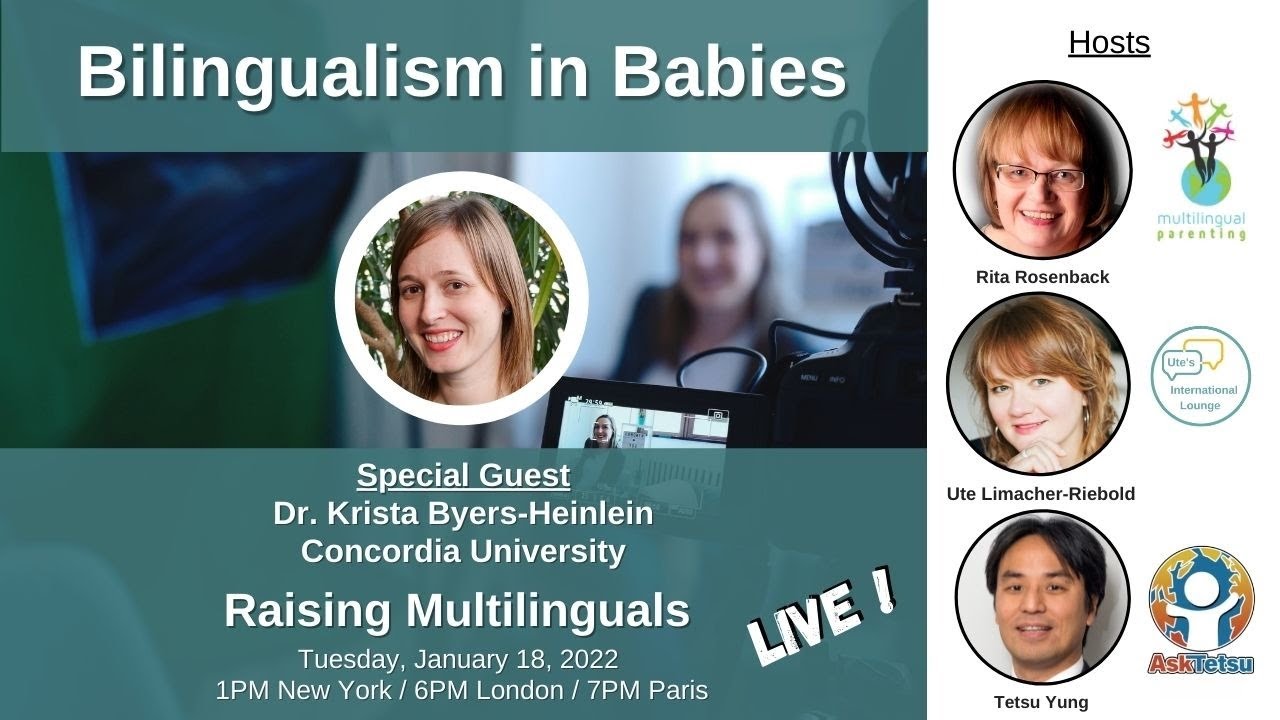
S36: Dr. Krista Byers-Heinlein - Bilingualism in Babies
896
Babies exposed to multiple languages from birth naturally develop separate language systems without confusion, using perceptual cues like sounds, rhythms, and word patterns to distinguish between languages; they apply the same fundamental language learning skills as monolingual babies but distribute these skills across multiple languages, meaning they learn at comparable or even faster rates than monolingual babies when considering total vocabulary across all languages, rather than per-language vocabulary alone.
Click to watch →

2.3.7 The relationship between the two languages of a bilingual child
314
Simultaneous bilingualism refers to children acquiring two first languages from birth through regular exposure. Unlike sequential bilingualism, this simultaneous acquisition shares the same developmental stages and rates as monolingual acquisition. The core theoretical debate centers on language separation: whether children build one fused system or two separate systems. Since the 1970s, consensus emerged that bilingual children can separate languages without explicit teaching, building two distinct systems from the onset. This challenges earlier views suggesting initial fusion followed by differentiation.
Click to watch →
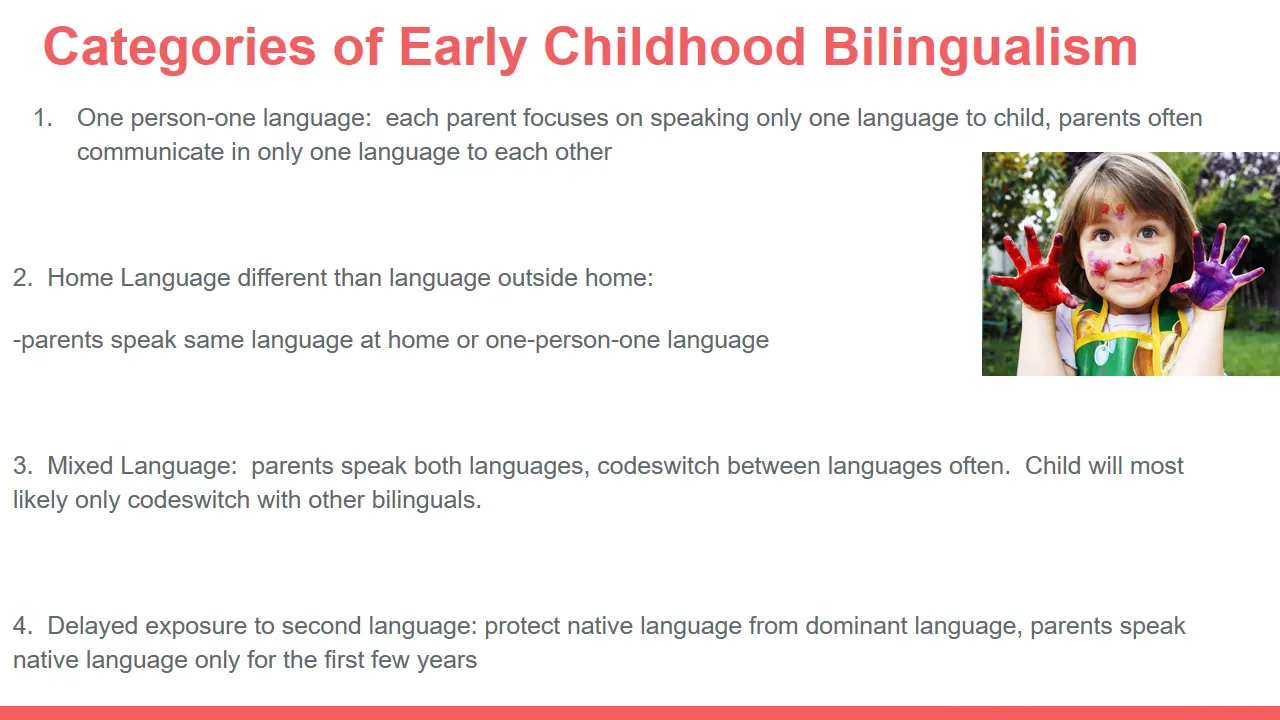
Baker Chapters 5, 6, and 8 version B
265
This section covers the developmental milestones of simultaneous bilingual infants. Babies begin differentiating between languages from birth, recognizing their mother's voice and responding preferentially to prenatal sounds. By 4-5 months, infants distinguish native from non-native languages. Babbling emerges around 10-12 months, with children attempting sounds from both languages they hear regularly. By age two, bilingual children develop metalinguistic awareness, knowing which language to use with whom and in what context, demonstrating sophisticated social language navigation skills.
Click to watch →

Understanding How Young Children Learn Multiple Languages 1.25.24
192
By six months of age, infants raised as simultaneous bilinguals can discriminate between different languages and babble in the appropriate sounds for each parent. If one parent speaks exclusively French and another speaks exclusively Lingala (a language from the Democratic Republic of Congo), the infant will babble in French sounds when interacting with the French-speaking parent and in Lingala sounds when interacting with the Lingala-speaking parent. This demonstrates that infants naturally follow the linguistic input provided by adults in their environment without explicit instruction.
Click to watch →

☀️How Bilingual Kids Learn To Talk: Resource Guide from a Speech-Language Pathologist
77K
Simultaneous acquisition occurs when a child is raised bilingually from birth or when the second language is introduced before age three. Children learning two languages simultaneously go through the same developmental stages as children learning one language. While bilingual children may start talking slightly later than monolingual children, they still begin talking within the normal range. From the very beginning of language learning, simultaneous bilingual children seem to acquire two separate languages early on, are able to differentiate their two languages, and have been shown to switch languages according to their conversation partner.
Click to watch →
Deep Dive
Developmental language disorders (such as Specific Language Impairment or speech apraxia) and how pediatricians identify deviations from standard acquisition milestones.

Trastornos de aprendizaje
187
Speech disorders include fluency problems (stuttering), tone disorders (hypophonic, hyperphonic, hyponasal), and motor problems (articulation disorders, dysarthria, apraxia). Language disorders are divided into receptive (understanding problems) and expressive (production problems). Early language development milestones include: 0-2 months (alert to sounds, strong cry, smiling); 4 months (laughing, orienting to voices); 12 months (gestures like waving goodbye); 15 months (4-6 words, pointing, showing objects); 2-3 years (pronouns, two-word expressions, 250-word vocabulary). Deviations from these milestones indicate alarm signs requiring evaluation.
Click to watch →

Speech Developmental Milestones
7.1K
Speech and language developmental milestones are age-specific markers used to identify delays and determine therapy needs: infants learn eye contact, sound imitation, and vowels; by 18 months children should have 50 words; by 2 years, 250 words with two-to-three word sentences; by age 3, 75% intelligibility to unfamiliar listeners and four-to-five word sentences; by kindergarten entry, 90% mastery of grammatical structures and sounds. Pediatricians use screening questionnaires like ASQ to identify delays, and parents can access free evaluations through infant-toddler programs (birth-3) or preschool programs (3-5) if concerns arise.
Click to watch →

KAYLAN DAPAT MAG PA CHECK UP SA DEVELOPMENTAL PEDIATRICIAN by Dr. Pedia Mom
23.1K
Developmental pediatricians are specialists who focus on children's growth, behavior, learning, and development, particularly addressing delays or special needs. General pediatricians refer children to them when necessary. Key speech milestones include: by 18 months, children should have at least one word; if only cooing and babbling are present, specialist evaluation is needed. At 1 year, children should recognize their name and make eye contact. These milestones help parents identify when professional assessment is required.
Click to watch →
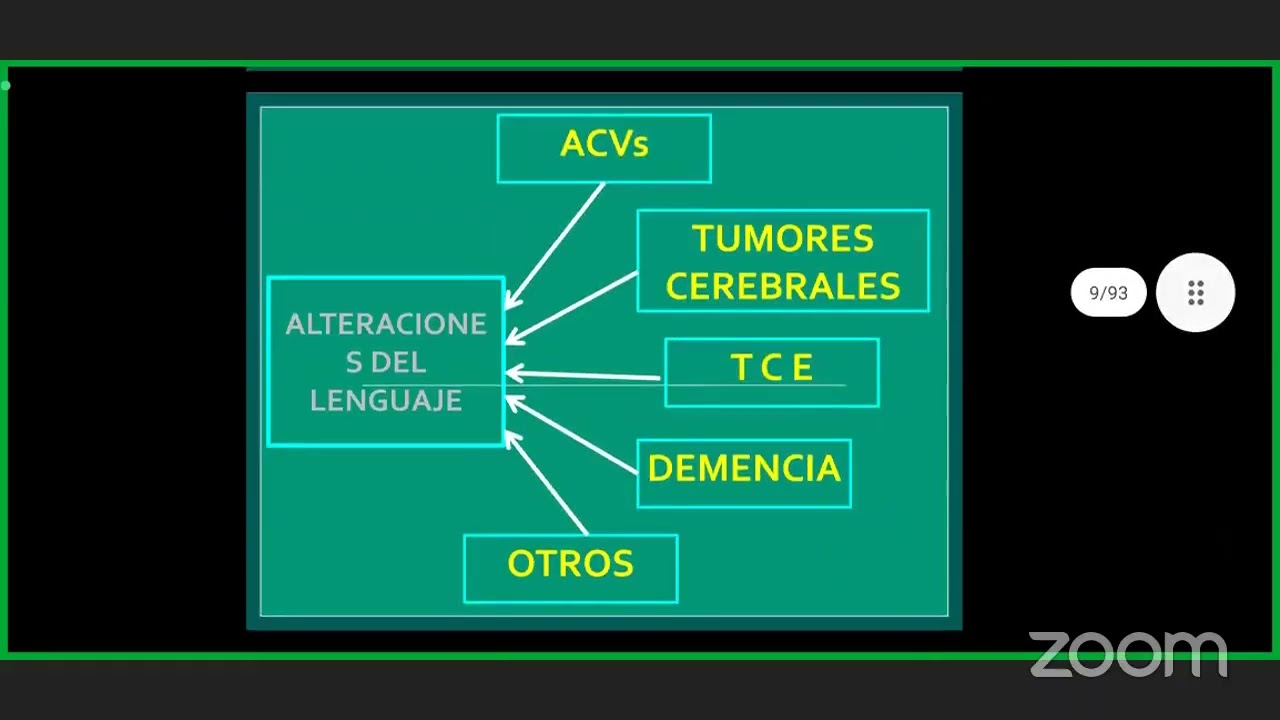
ABORDAJE MÉDICO DE LOS TRASTORNOS DEL HABLA, LENGUAJE Y COMUNICACIÓN
108
Speech and language disorders are classified as temporary or permanent, affecting voice (dysphonia, aphonia), language (oral or written), and speech (articulation or fluency). Voice disorders include dysphonia (voice quality changes from respiratory or coordination issues) and aphonia (voice loss from inflammation or trauma). Articulation disorders include dyslalia (phoneme articulation problems from developmental, hearing, or organic causes), phonological immaturity (normal until age 4, abnormal beyond 5), and dysarthria (central nervous system defects). Fluency disorders include dysfluency and stuttering. Developmental milestones include first words between 12-18 months, two-word combinations by age 2, and resolution of phonetic difficulties by ages 6-7. Simple language delay shows gradual improvement, while Specific Language Impairment presents with first words after 3 years and comprehension problems.
Click to watch →

Identification of Specific Language Impairment
12K
Specific Language Impairment (SLI), now commonly called Developmental Language Disorder (DLD), is identified when a child's language development is significantly delayed compared to peers, yet their non-verbal abilities remain within normal limits; diagnosis requires ruling out other causes like hearing loss or lack of language exposure, and is typically conducted by speech and language therapists using standardized assessments to measure both expressive and receptive language skills.
Click to watch →
Acquisition Stages
Advanced Stages
Acquisition Stages
0:03- 1
Humans learn language in universal stages and order.
- 2
Infants initially discriminate all human phonemes.
- 3
Babbling narrows to native language sounds by 12 months.
Usage-Based and Constructivist Theory of Language Acquisition
While the "five universal stages" model suggests a linear, biologically predetermined progression, the Usage-Based and Constructivist perspective (championed by linguists like Michael Tomasello) argues that language development is highly individualized, non-linear, and driven by social interaction rather than innate, rigid milestones. Instead of progressing through pre-programmed grammatical stages, children acquire language piecemeal by learning concrete constructions from their unique linguistic environment using general cognitive skills like pattern-finding. Furthermore, cross-cultural research indicates that the sequence and pace of language acquisition vary significantly across different cultures and languages, challenging the notion that these developmental stages are strictly universal.
Basic understanding of linguistics, specifically the distinction between phonemes (speech sounds), morphemes (meaningful units), and syntax (grammar rules).
The fundamental theoretical debate between Nativism (Noam Chomsky's concept of an innate Language Acquisition Device) and Behaviorism (B.F. Skinner's reinforcement model).
An introductory grasp of cognitive development in infancy, particularly how physical growth and sensory exploration relate to communication.
The Critical Period Hypothesis, which investigates the biological timeframe during which native-level language acquisition must occur.
The role of Child-Directed Speech (or 'parentese') and the Social Interactionist Theory in facilitating phonetic and vocabulary development.
Simultaneous Bilingualism, examining how infants successfully map and differentiate two distinct native languages during the same developmental timeline.
Developmental language disorders (such as Specific Language Impairment or speech apraxia) and how pediatricians identify deviations from standard acquisition milestones.
144.2K views830likes2:11@Dr.Andy.ReadingOriginal Release: 2015-08-06
we are looking at language acquisition and development the stages remember all human beings learn language approximately the same way in approximately the same stages and Order we're looking at the five stages of language acquisition the first stage kui 0 to four months one word utterances or sounds the child is making a variety of different sounds at this stage the infant can discriminate between all 200 human phon names however in the second stage the Babbling Stage 5 to 12 months the child loses that ability and because of efficiency focuses in on those phones common to the language that is heard around him or her that's the second stage between 5 and 12 months and we'll be looking at the brain in the next video the Third stage one word utterances the first word emerges anywhere from 9 to 18 months and it's called telegraphic speech Telegraph one word is used to communicate a whole idea cookie means I want a cookie word become a tool of thought for the first time the child is using a word to try to control his or her environment around around him or her two- word utterance es anywhere from 18 to 30 months a year and a half to 3 years put two words together now at age two the infant knows approximately 300 words in one year the number of words that a child knows almost triples to a thousand words more than triples actually and then around age for the basic adult sentence structure and this becomes the foundation of adult language and sequence that is the basic order Queen babbling one-word utterances two-word utterances and basic adult structure
Up Next
43:47
Holophrastic Stage: Early Language Acquisition & Child Speech
@marjoriefreggens9657
306 views•2015-04-02
36:52
Constraint Interaction in Optimality Theory: Epenthesis & Deletion
@Vidyamitra
180 views•2018-08-20

8:59
Forensic Linguistics: How Language Solves Crimes | PBS
@pbsstoried
1M views•2024-01-25

21:32
Accent Expert Explains U.S. Regional Dialects | Part 1
@WIRED
9.3M views•2021-01-21
Related Study Plans & Knowledge Roadmaps
Structured learning paths in Linguistics
linguistics
Optimality Theory: Tableaux & Constraints
01Phonological Basics: Sounds, Syllables & Rules
02Foundations of Optimality Theory: GEN, CON, and EVAL
03The Constraint Inventory: Markedness vs. Faithfulness
+ 2 more learning modules
15h5 modules
Explore Roadmap
linguistics
Morphosyntactic Alignment: S, A & P Systems
01Foundations of Syntax: Transitivity and Arguments
02The Linguistic Variables: Mapping S, A, and P
03Nominative-Accusative Alignment
+ 3 more learning modules
12h6 modules
Explore Roadmap
linguistics
Analyzing Sign Language: Phonology & Syntax
01Foundations of Sign Language Linguistics
02Phonology: The Five Parameters of a Sign
03Morphology: Word Formation and Classifiers
+ 2 more learning modules
14h5 modules
Explore Roadmap
linguistics
Pragmatics: Speech Acts, Grice & Politeness
01Introduction to Pragmatics: Meaning in Context
02Grice’s Cooperative Principle & Implicature
03Speech Act Theory
+ 2 more learning modules
14h5 modules
Explore Roadmap