




![오늘 특징적인 반도체 주식, 빠르게 정리해드립니다! | 김장열 유니스토리자산운용 본부장 [김장열의 반도체•테크 세션]](https://i.ytimg.com/vi/yboBSoRig5o/hqdefault.jpg)










![How to a business [the right way] and replace your day job feat. Jordan Kelliher](https://i.ytimg.com/vi/_Ib2hmCre2A/maxresdefault.jpg)







Business valuation involves calculating Seller's Discretionary Earnings (SDE) by adding back owner benefits like wages, insurance, and personal expenses to net profit, then applying industry-specific market multiples (typically 3-5x for businesses under $1M net profit, 5-8x for larger businesses) to estimate fair market value; this approach helps business owners understand their company's worth and set realistic financial goals for selling or growing their business.
How to Value a Business in 5 Minutes: A Quick Guide
Added:Understanding of basic financial statements, particularly how to read an income statement (P&L) to identify revenues, expenses, and net profit.
The concept of cash flow versus accounting profit, and why cash flow is critical for business buyers.
A fundamental definition of 'valuation multiples' and how they are used to compare assets within the same industry.
The distinction between owner-operated small businesses and larger corporations, as valuation metrics differ significantly between them.
The process of financial recasting, specifically how to identify and calculate 'add-backs' to accurately determine Seller's Discretionary Earnings (SDE).
Advanced valuation methodologies, such as Discounted Cash Flow (DCF) analysis and the Asset-Based Approach, to compare against multiples-based valuation.
How to perform market research using databases like BizBuySell or Pratt's Stats to find reliable, industry-specific valuation multiples.
The role of qualitative factors (e.g., customer concentration, brand strength, owner dependency) in adjusting the baseline valuation multiple up or down.
Understanding deal structuring (e.g., seller financing, earnouts, and stock vs. asset purchases) and how it affects the final net proceeds of a business sale.
50.2K views1Klikes44:42Original Release: 2022-12-24
Hey, guys, this is Toby Mathis with the Anderson Business Advisors podcast.
And I'm joined today by Trent Lee.
Welcome. Trent.
Thanks for having me.
I appreciate it.
Yeah, and this is going to be had a had a value of business in 5 minutes or less.
And Trent.
Trent, are you the largest by volume business broker in the United States or is that something that I just heard somewhere that that's not accurate?
You know what?
I hope you heard it because it's true.
So good rumors get good gossip.
So, yeah, there's a group called the eBay, the International Business Broker Association.
They're like the governing body for business brokers, kind of like the realtor organization for real estate agents.
They track kind of what's going on, what's happening, who's doing what out there.
And there are guys who do a lot bigger deals than I do, guys in New York, L.A.
I mean, there's some there's some really big mergers and acquisition guys.
But the last four years in a row, and we're kind of coming up here on the on the on the end of this year and no one's even close.
But the last four years in a row, I've been the number one business broker in the country for deal volume, number of closed transactions.
And I really want to hit on that because that sounds like like you could go out there and do $1,000,000,000 deal.
You could go a whole bunch of, you know, a whole bunch of smaller deals.
Sounds like you spend your time doing a lot of the smaller deals, which is exactly true.
Yeah.
Is it more rewarding to do that, by the way?
Because it sounds like you're probably give me an idea of some of the businesses you've you've represented, buying and selling.
Yeah. So in one sense, yeah, absolutely.
It is rewarding.
It depends on the dynamics of the buyer and seller.
Sometimes deals are smaller deals, they're just easier.
They go quicker, they're cleaner.
Sometimes, if the dynamic between buyer and seller is difficult and you know, then sometimes it's like, man, that little deal was just as much work as the the big deal.
But I'll give you an example of some of the transactions that we've done.
So, in fact, let me just talk about some of the transactions maybe I'm doing now that are in escrow.
Small deals.
I've got a restaurant absentee owner.
This guy lives in California, comes in a couple times a month just to kind of check on things.
Truly, one of those like absentee owner restaurants, there's not a lot of most of them take a little bit more time.
That one's in escrow right now for $240,000.
And there's deals plenty smaller than that as well.
But I've got a really great trampoline in Park.
In fact, two trampoline parks.
And you would know I'm Toby here in Las Vegas, one of the bigger Trampoline Parks non franchise in escrow right now for $5 million.
So that general range is kind of like my sweet spot.
We do deals bigger than that and then we do deals smaller than that.
Anything from the little neighborhood pizzeria that might only sell for 60 or $70,000.
I've sold plenty of those before.
I do those make money.
Like they do.
Yeah. Yeah. Well.
Maybe investing in the markets, crashing everything else, inflation, this, that and the other. There's certain things that are kind of recession proof.
I remember Dairy Queen is always been like it's recession proof.
Right.
But is pizza shop like you make good money off a pizza show?
Yeah.
So before I answer the question on, on that pizza shop, let me just tell you a funny story.
We had a Dairy Queen for sale.
The buyer, the seller agreed on the price.
They finished buyer finished the due diligence the buyer and was satisfied with everything.
The buyer went to Dairy Queen franchise corporate and failed the training and was not able to close the transaction.
And I thought to myself, how do you you just hold down the lever of I screamed, I do not know how they failed.
That failed the train, but it's.
What is like the Peanut Buster Parfait.
They kept putting cashews in it or something like how the heck do you fit?
Well, I.
Yeah, I don't know it.
We've laughed about it ever, ever since.
But to your question on the on the little pizza, three of those make money.
There's no question about it.
You get a small business like that and we'll talk about this later on here.
In the next little bit, we'll talk about market multiples.
They sell for pretty low market multiples.
So, yeah, they're making money.
If a pizzeria sells for, you know, 70, $80,000, it might be making 40 or $50,000 profit.
But it's primarily generating that profit from an owner who's buying himself a job.
Yeah.
So they're going in there and working it.
And so really maybe didn't take much of a salary, but it may.
It pulls out 50 or 60 grand and.
Yeah, they might take it as distribution or however.
You're your own boss, right?
That's the thing. It's the American dream.
You get a few of those and you're doing all right.
Yeah, yeah, absolutely.
What's the you know, the $10,000 question everybody wants to know is, how do you value a business?
Do you have any rules of thumb in different industries or just in general that you use?
Yes. So rules of thumb are like high level, just kind of gut checks.
You can kind of get a general idea what you really want to do.
And we can talk about this in detail.
But what you really want to do is look it up by industry.
So most business brokers, business appraisers, anyone in the M&A space will have access to what's called basically like a done deals transaction database where we can look up in the private market and also in the SBA market.
And those multiples change a little bit, right?
If someone's getting SBA financing, their tendency is to is to pay a little bit more.
And then they could because the bank is paying for it and the private market multiples come down a little bit because someone's using their own capital and they're a little bit more savvy with with it.
But an SBA small business Administration loan, so they're backing a loan of a regular bank saying, hey, we got this in case they fail, right?
Yeah, exactly.
Exactly.
And so most of these guys, myself included, can look up this database and we look it up by the next code, like on YouTube.
You'll know this on the tax return, the business has some sort of industry standard code where we might look up.
For example, I'm working with a steel fabrication company right now, gone through evaluation.
They've they're probably we had about a $10 million value valuation.
We haven't taken them to market yet, but we're just preparing it.
And we look at other steel fabrication companies, what they've sold for, and we also make sure to compare it to general size.
So we're not comparing it to a $150 million steel fabrication company, but we're also not comparing it to something too small.
And so the goal is to find by industry what that market multiple is by average and then narrow it down by size and then geographic region if we can.
And just for people's understanding, when you say market multiple is that of the EBIDTA or the net profit, something along those lines?
Or is it the gross revenue regulated?
What are you using when you're when you're talking about multiples?
Yeah, good question.
Let me if you don't mind, let me talk a little bit for just a minute on on the three general rules of thumb or three multiples that we're looking at, we're looking at sellers discretionary earnings.
And let me I'll tell you what that is here in a minute, because most business owners really don't they're not overly familiar with that term.
Some are more familiar with the term EBITDA.
And that's a multiple, different multiple than the SDI or the seller's discretionary earnings multiple.
And then we're looking at again, high level, the most inaccurate type of multiple or percentage is out of the growth revenue.
How much percentage wise, what are we looking at?
And so that's what Shark Tank always does.
You always see somebody sitting there saying, I want $100,000 or 10% and they go, see, your business is worth $1 million.
And let me see what you're making, making $1 million.
You know how much gotten out of that?
You know they go down that. Yeah.
Exactly.
Exactly.
So let's let's just talk a little bit about sellers, discretionary earnings, EBITDA, multiple, what it is and how it works.
So traditionally, sellers discretionary earnings is well, let me let me maybe take a step back.
First and foremost, when I get in, I meet with the business owner and I start talking with them about the valuation.
I want to look at the last 3 to 5 year tax returns as well as 3 to 5 year profit loss and balance sheet.
The reason I want to look at that is I'm trying to what's called normalized the financials, the stability of that business and look at trends.
So with COVID, obviously it's done and over with for the most part.
What we're trying to do is normalize that some businesses got killed and just did awful during COVID.
Other businesses had a really significant positive bump for COVID.
And what we're trying to do is normalize those outlying years.
The expectation is COVID doesn't happen again.
At least we hope it doesn't happen again.
And so we're trying to normalize that over a period of 3 to 5 years.
And so in order to do that, we're going to look at 3 to 5 years financials, 3 to 5 year tax returns, and then it's called recast in the financials.
We're going to make some adjustments or add backs.
So I'll give you a couple examples here.
Add backs would be owners wages that he's paying himself, W-2 wages, not distributions.
We can add back the distributions, but whatever that owner might be paying himself in distributions.
If they're following Toby, your your your great advice, maybe there's some family members that they're paying on there from a tax standpoint that may or may not be active in the business.
And so we made we need to make some adjustments to those nonworking family members that are paid through the business.
We need to add back depreciation, amortization and any other expenses that would be considered discretionary to the business or in other words, owner benefit expenses.
The business might be paying for the owner's life insurance.
They might be paying for the owner's health insurance, the whole family's health insurance.
The the spouse might have a gas car that they're running running gas.
Or a car for a. Car again.
Yeah.
Lower to lower my income last year for the end of the year they put it in the service hundred percent is.
Yeah.
So, so all of those things are requested or added back or adjusted to calculate seller's discretionary earnings.
The easiest way to think about calculating the seller's discretionary earnings is, for example, Toby, if I owned a business and you bought that business from me, what expenses that I'm running through the business that are to my benefit would go away once I leave the business.
And in fact, when you come in my wages go away.
How I'm depreciating might be different than you.
My benefits to the family would be different.
And so we're trying to take those out and really value the free cash flow of that business and that that's what's considered seller's discretionary earnings that has a market multiple as well as EBIT earnings before interest taxes, depreciation, amortization.
Both of those have multiples and and they're different.
But in theory, they should be somewhat close.
So let me give you just like a general example.
Let's say there's a business, I'm just making this up of $6 million gross revenue.
Let's say the there's $1,000,000 of sellers, discretionary earnings.
There's $750,000 of EBITDA.
And just a little side note there, sellers discretionary earnings is always typically higher than EBIDTA because the easiest way to think about it is seller's discretionary earnings is basically EBIDTA plus one owner's wages added back. Yep.
So let's let's call it $1,000,000 seller's discretionary earnings, $750,000 EBIDTA.
And we do some market research.
We look at the multiples. And again, I'm just making this up.
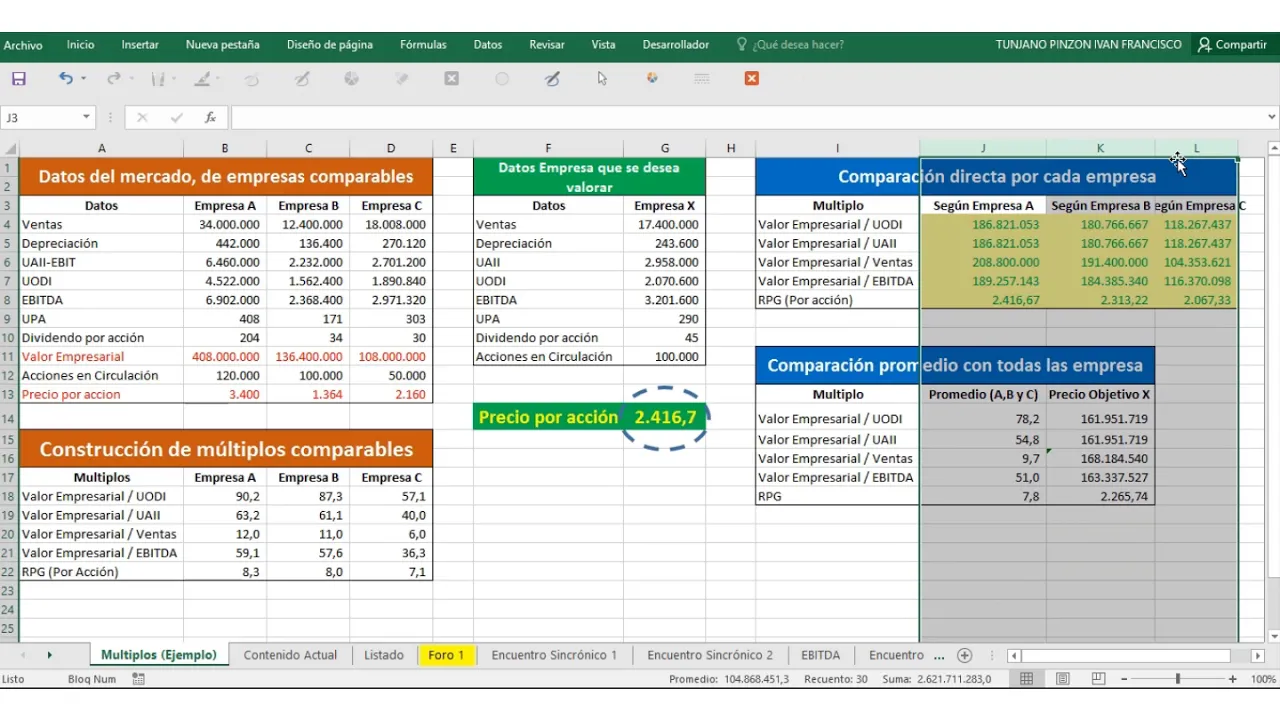
Let's say the in the industry average for the size of business in this type of business is a 3.5 multiple on seller's discretionary earnings, which is a valuation of 300 or 3.5 million or a call it a five of multiple of or EBIDTA.
And that puts the valuation at 3.75.
Now we look up the market multiple and let's say on average these businesses are selling for 58% of the top line revenue that that 58% of top line revenue, 6 million is roughly $4 million.
So in theory, between these kind of three ways to measure a business, we're at 3.5 million.
We're a 3.75 million and we're at 4 million.
So it's a general gut check to say, yeah, you know what, these all kind of match up to the same general range.
And then we might take an average of those three valuations and come up with something right in the middle.
But it's more of a sanity check to make sure that all of those multiples add up and something's not significantly off when we're doing those valuations.
So we've done three valuations.
You have your ball, your ballpark, is there a ballpark number that you use for a multiple like on the EBIDTA that you say, Hey, you know what, most businesses are going to be six or seven.
Could be it sounds like a seven year profit, right?
You're basically getting back seven years, whatever that business is making ahead of time if you're the.
Yeah, so, so kind of going back to the intro how to value your business in 5 minutes or less.
The real goal here is, is quickly calculate what that seller's discretionary earnings is.
And most business owners generally will have at least kind of a back of the napkin idea of what that is.
If your business is is under, call it $1,000,000 of of net profit, your multiples going to be somewhere in kind of that 3 to 5 range where your business is is above that, you know, 1 million to, you know, three or 4 million.
You might be in that 5 to 8 range depending on the the industry.
And then you get above that.
That's when you start to hear, you know, news articles.
Someone paid a, you know, ten mil, ten multiple, 12 multiple.
It depends on the industry and it depends on the size of the business.
But that gives you a general range to really kind of quickly in 5 minutes or less calculate what your seller's discretionary earnings is.
Take us 3 to 5 multiple based on your your revenue or somewhere like a 5 to 7 multiple.
And you'll get a pretty good indication what that value is worth.
And you could do that even with publicly traded companies and stuff to raise it's kind of the P is that is that they're saying hey if we took your net net profit and without getting all the discretionary spending and adding a back end but you can kind of say stock market's probably, what, 20, 23 times if I forget the number, what it is right now.
But I've seen it 17 times.
I've seen it get down into the ten times.
You see the market go through fluctuations.
Yeah.
And those are those type of companies that the public companies that are doing a significantly higher amount of revenue, the multiples go up.
You know, we're at ten and above easily and we're also not really dealing with sellers discretionary earnings anymore.
Those primarily do not have I mean, they strictly are just driven off of it that because they've got very clean financials, there's not a lot of owners benefits going through those those type of companies.
Yeah, but on, on a flip side, it just maybe something of interest to someone who's listening to this.
Let's say now that they understand how market multiples work to determine the value of their company, let's say they come up with the valuation of their company at in this example, you know, we said three and a half million to three, kind of 3.75 million.
And let's say, you know what their goal is really to be at $5 million.
They're closed.
They're not quite there now that they understand how valuations work to calculate the multiple, all they have to do is do simple, backward math to then determine if their goal is to sell it for 5 million instead of divide instead of multiply seller's discretionary earnings or even a times the market multiple, take your goal price and simply divide it and that tells you how much you need to show in annual EBIT or annual seller's discretionary earnings to them.
Justify a $5 million valuation that really gives business owners a pretty good roadmap to say, okay, here's my valuation now I want to get to here.
Instead of blindly just kind of hoping to grow the company, they can really quite simply back into that number and say, divide the my ideal sales price by the market multiple.
And that's exactly what I need to be, what I need to show from a net profit standpoint.
And you see that actually happening because people are always cash.
I wish I had a nickel every time my client said, I don't want to pay taxes and or, you know, I want to get it down to zero.
And I was like, well, let's what's your intent with it?
If my intent to sell something, obviously that may not be in your best interest for what you just said.
If you're if you need to get some sort of financing, obviously, that could be a buzzkill, too, if you have no income.
So there's always the way and here's something that's really important for these folks.
They they should understand this is my industry.
Here's my multiple talk to somebody like yourself, what, probably two or three years before they're thinking of selling.
Yeah.
Because the goal is we want to get, like I mentioned before, 3 to 5 years financial.
So one good year doesn't necessarily make or break a company because we want to look at a weighted average over a 3 to 5 year period of time.
So one killer year doesn't make up for a few bad years over here.
We need to we need to even that out and get an average over that kind of 3 to 5 year period.
Would you be willing to share some of your some of the success stories that you've seen?
People hear so-and-so about a business.
First off, I'm making a huge assumption that you've probably had the same business get sold more than once.
Yes, I have more than one.
Okay.
And then number two is they've ever seen somebody kind of build these things with the intent to sell them, sell them, build another one, sell it, build another one, sell it.
And then that's that's kind of it's almost like they're a builder instead of building. Yeah, absolutely.
Absolutely.
So I've got to tell you about a couple of good stories on the on that.
Before we touch on that, let me go back to just one thing that I think is relevant for buyers.
When they look at the valuation of their business before I forget.
So now that they understand the, the how market multiples work and I deal with this again, small businesses, you see this often, I can't tell you how many times I go into a small business and I look at their financials and we start I started to educate them on on what sellers discretionary earnings is, what we're adding back, how we're looking for through their expenses to see what we can justify.
And I come across the line item.
This is a true story, more than one true story, and there's $10,000 of advertising.
And they say, oh, you know what?
That on the PNL statement on the tax returns, it really says advertising.
But that was our annual trip to Disneyland for the family that we took.
And it's you need to add it back.
And I'm like, Oh, okay, so let's, let's just talk about how that affects them because there are certain things we can add back and there's certain things if you're kind of going to push the limit a little bit, we can't necessarily add back.
But but let me just walk you through the math on this as to how the value that they lose when they do that.
So let's say let's call it this $10,000 annual trip to Disneyland.
If they're paying for simple math at a 25% tax rate, they save themselves 20 $500 on taxes.
But think about what they did to the value of the business.
If we use that five multiple, yeah, they saved themselves $2,500 on taxes, but they'd lost $50,000 in valuation for that company, for that, for their business.
So there's this dichotomy between minimizing expenses to minimize your or maximizing expenses to minimize your taxes and maximizing the value.
I mean, there's got to be a little bit of a balance there and especially.
Yeah, go ahead.
Their misbehave no matter what at that point.
Like if they're writing off their vacations. Yeah.
The expense. Let's be real.
But what we see the same thing with small businesses all the time that they'll just be doing some weird stuff because they don't really have an account and they don't really have a bookkeeper.
They just like, Hey, if I take this into TurboTax or whatever they happen to be using and it's like work the number lower.
Yeah.
And they might have gotten away with it because they didn't get audited or whatever.
But you got to think long term if the goal really is to sell in a couple of years, to your point, totally a couple of years to get into this point, you want to show as much profit as you can because you're going to make up for it ten times over when it comes to the valuation. Yep.
Want to be somebody who's who's setting up in there, buying a business to sell it.
We look at it differently from from a structure standpoint because there's 1202 stock and you're like, hey, if you're going to hold it for five years, spending less than 10 million, we could avoid all the capital gains.
If this business if somebody is buying a business or selling a business, there's asset sale versus the they said there's always that sort of stuff that kind of kind of leads it.
But then they behave much differently when they're going to sell it, because now they're not in a rush to try to write everything off.
They're gladly putting it into salary because like you said, most buyers are going to say, Yeah, that's going to go away.
And like unless they're negotiating a a non-compete and you're going to stay maybe, you know, maybe an employment agreement, you're going to stay with the company for three years or something.
Then maybe it's relevant, but otherwise usually that but the small one to me, maybe I'm mistaken.
But a lot of these people, they're not sticking around for any length.
Yeah, I was going to mention that if you start selling the company for two, three, $4 million or more, the likelihood of you sticking around for some sort of an earnout or management employment agreement is is quite high.
Yeah. So that that is common on small businesses.
No, it's traditionally like hand-wash after two or three weeks training transition in Post-Closing.
Everyone kind of starts ways.
And then to answer your question, before Tobi had asked about selling multiple businesses a couple of times, and some of these guys who buy these are there's one talking about pizzerias, there's one pizzeria literally in the last three years of sold that five times so the one that I've learned.
Come on you got to tell us about it.
So one thing I've learned is buyers become sellers and sellers become buyers.
Yeah.
You know, especially entrepreneurs.
They they're like you and I at heart.
You go on vacation for five or six days and all the sudden you're you're bored and you can't sit around the beach and drink margaritas and play golf forever.
And you're kind of itching to do something.
And so they sell their business.
They think they want to play golf all day.
And then after a couple of months, six months later, they call me back and want to buy something.
And so in this case.
What do you got?
I sold it. This was fine.
Come on, I'm burning.
I, I go. Yeah, and.
And in this case, that pizzeria that I sold a bunch of times, it was that exact example I saw.
I mentioned before it it makes depend on kind of who's running it and what they're doing.
30 to 40, $45,000 a year profit.
It it's profitable business.
It's owned bought every single time by kind of a a owner that's going to be working in it day to day.
And sometimes people don't realize how much work restaurants are and want to sell it after a year.
And in the end, in the case of two examples, health issues or family health issues, that the pizzeria was fine, they were happy with it.
It was exactly what they wanted.
But one of them had unfortunately got sick and another one, unfortunately, had a child that got sick.
And just it was it was too tough for them to manage.
And so it's a it was a good little steady pizzeria.
It's proven itself year after year.
It's been there for, I think, 20 plus years.
And it's changed hands, hands a bunch of times and still have pretty consistent revenue.
So for a small business owner that's looking for a little bit of a steady income, it it was fine for them.
Are they buying it, buying the company trend or are they buying the shares of the of the company?
Are they buying the assets, including the name.
Or some assets, including assets, including trade name and all the intangible assets, you know, the name, the reputation, the goodwill, the social media accounts.
Very rarely do we do stock sells unless there's some type of a agreement.
Or I'll give you an example.
A couple of weeks ago, I sold a surgical center here in town to point one, if I remember right, 2.1 million.
And they had dozens of contracts with hospitals and insurance.
And in that case, something like that would be a stock sale just for the sake of of ease of transition.
But most of the time, 99% of the time, these are asset transactions, not stock transactions, where the seller kind of can limit buyer and seller can limit their their liability as well.
And then I was going to tell you, Toby, as well, because you asked about people buying these companies and building them up and selling them.
There's two people I can I can think of that I've worked with over the years, and this is exactly what they do.
It's essentially the same as buying and flipping houses.
It's just a longer term play.
So I had one guy here he is in the kind of a jiffy Meineke Lube, you know that that industry he knows it and so he'll buy these.
I sold him a meineke shop that was really struggling, but because he he he knew it well.
He knew the location, he knew what problems they had.
It's been a been a couple of years, if I remember, and I sold it to him for 70 or $80,000.
He kept it for two years, turned it around, build it into a nice, profitable business.
And we sold it to it.
We sold it for him for $430,000.
Couple of years later, he completely turned that turn, that place around.
And there's one other gentleman here in town.
He's got to own 20 or 30 companies, and he does.
He buys a company big enough in size to put a really good, competent manager in place, puts them on a quarterly revenue share so he gets a nice salary, incentivize them with quarterly revenue share.
And you've got these companies all over that just kind of report to him.
And he lets let's see the individual.
He identifies the operator before he goes and buys company.
So he'll sometimes come to me and say, okay, I've identified my next operator, I need a company to place him in.
And then he'll, he'll put him in and, and he's got the right compensation, incentivization package compensation plan for him and it's worked out well for him.
So there's definitely an opportunity there.
It's just a longer term play.
Have you seen families do that where like a mom and dad are really good at this and they have kids they're trying to train and they don't want to just hand over the businesses to the kids.
So they're like, Hey, I'll buy a business this or This is when you're going to run, kid too.
Hey, you can run this one, kid three. Hey, you can run this one.
Never seen anybody do that.
I've seen parents buy one child a business.
I have not come across like parents buying each child a business.
And that's the family I need to meet because then I can find a business for each one of the kids.
If they have ten kids, you'll be doing this.
Great. Yeah. Yeah.
But I do see plenty of parents who have bought businesses for their kids.
In fact, I had one that's probably been about a year that he said basically gave the son the option.
Look, you can go and do your your car, pay for your college education, or I'll buy your business.
And we we sold them a business and, and he's quite happy with it.
I don't know if that was the right decision for, for him or not.
It's not my, my, my spot to say, but it worked out well for him, at least that I'm aware of. You remember the kind of business it was like, what are these restaurants? Yes.
That one was a restaurant.
Yeah, it's it's it's interesting.
You see the different skills as people, like all his friends have sent him to college where they get your pay and some of to try to teach them and give them a credential or buy them an actual business where they, you know, they're going to learn the skill or they're going to fail at, in which case send him to college.
Yeah, at that one.
I mean, doing something like that, you really have to find some sort of industry where someone without a lot of experience can can kind of slide into it without a high degree of failure.
There's there's some other really great companies.
In fact, I'll tell you another one we're closing on at this Friday.
They do.
But you'll know this, Toby, here in Las Vegas, a lot of the neighborhoods have gates in front of them.
And either a guard or most of them have some like little box.
And you can look up and dial the person to get in to the neighborhood.
They manufactured the gates and then they service that box.
And a great, great company makes $600,000 profit per year.
We're in escrow just to sell.
Like I said this Friday, we'll close on it.
That would be a harder that would be a harder business for someone to come in to without any experience.
Because I'll get people who call me all the time like, Hey, I have a little bit of money, I want to buy a business.
What do you recommend? And that's a hard question to answer because my my first question to them as well.
What's your background?
I mean, some companies like that require a contractor license each.
They require experience.
And so I can't in good, you know, good conscience say, hey, let me tell you about this great company over here.
If they have no experience in that industry, and that one's going to be tougher for for them to really step in and be able to do to continue to grow without needing any major hiccups.
You have to have some favorites, though, like you have to have some where you've said like, oh, this person's going to fail.
There's this like, oh my God, how do they get up in the morning and figure out how to get out of their own house?
And they buy something and you're like, whoa, they've, they've done very, very well at that.
Is, are there any businesses where you're like, Hey, anybody could do it or that you were kind of you were surprised at somebody that you didn't think would have been capable and you're like, Wow, this person's killing it.
Yeah, boss, let me tell you about on the positive side, I'll tell you about a couple who bought a little eyelash extension business.
So, you know, the girls go in and get the eyelash and the.
Head had several of those actually.
Yeah.
Now talk about that's not like contractual reoccurring revenue, but that is some reoccurring revenue because once the girls go on those eyelash extensions, they're hard to kit off.
And so they have they have very different trends.
And so you're hitting right in my heart.
So these guys these guys have, I believe, five or six locations. Now, in addition to that, they set up a program with Hyatt Hotels where they have a partnership and they go all around the country and they train these stay at home moms how to be eyelash artists.
So they teach them how to from home do the eyelash extensions.
But guess where they buy all these all their products from?
They got into the manufacturing side.
So they have the retail side, they have the education side, they have the manufacturing side.
And I mean, let me tell you, those guys are killing it.
Millions of dollars in profit, not revenue in profit per year.
I was I was blown away by by how much volume is happening there.
Wow. Yeah.
No, know I was in the entrepreneur's organization years ago and know we had one of those.
There was somebody who had a chain of a she didn't have to do a lot be straight up.
And but she had all these everybody was going there and it was like 100 bucks a month or something like that or every time.
Like, it was it wasn't a small amount of money that these folks, when they get hooked into getting the eyelashes done, they showed it.
Oh, yeah, yeah.
It was it was great.
And then unfortunate.
I've seen the other I've seen the flip side where I'm like, Are you sure you want to be buying a business? Are you sure this is the right decision?
And, and some of them have been okay and some of them have have not been okay.
And I get the call when they bought a in fact, I'll give you another poor example.
This company does the I am going to blink on the term the water and care for all the indoor live plants in like the library.
Is one I use one I have a I have a live wall in our in our rainbow office in about 100 different separate plants because we had 300 people there.
And I always believe in light plants.
But yeah, an interior garden place really.
Exactly.
And they service it. I know.
I know exactly what you're talking about. Yeah, exactly.
So we I sold one.
This is probably three years ago or so.
So I mean, it's been long enough for I can kind of see how it's if carried out and it wasn't a huge company, but we sold it if I remember right for four $450,000.
And unfortunately, the the the buyer just and it was kind of one of those things where I you know, it's not my spot to her, hey, I don't think you should be buying a business.
But when they're really struggling to fill out basic applications and, you know, SBA documents, are you going to be able to, like, operate the business?
And and unfortunately, it didn't it didn't work out well.
And and they call me usually two or three years later and say, hey, I need to sell it.
And I look at the financials.
I'm like, what happened here?
This used to be a business that I that was making some money.
Now it's it's not.
You have to figure out what actually makes the money and do that.
And a lot of people get it and they say, I'm going to change it.
And we see that all the time.
I have ideas.
They're doing it wrong and I'm like, Well, they're profitable doing it this way.
If you want to do wholesale changes, you might just change yourself out of having the profit, which is and for.
Yeah, and that's one of the first things I tell these buyers is whatever you do, unless you really have experience in this industry and you know exactly what you're doing, just don't touch anything for six months.
Just get get familiar with everything, get comfortable with everything, get you know, build your culture built.
Let everything stay.
And then you can start making some adjustments and improvements unless you really know, like you've got experience and you, you know, immediately where there's issues and where there's problems and there's certainly lots of opportunities for buyers to do that.
But first time buyers, I usually tell them, don't, don't rock the boat too much get you can get to that later.
It's your meineke guy.
He already knows what his numbers are when you run it. Right.
So he's looking at going, okay, here's what they're doing wrong.
If you're good enough where you can identify that, or if you're a restaurant tour and you're like, here's what your food costs should be compared to this or this, I was thinking tap or going in and yelling at people that are running bars incorrectly and says, this should be your ratio or this is this is how many drinks you should get out of each.
But like, you know, he had the numbers in the back of his head so he could identify where there was bad management or bad inventory or bad something he could he knew enough.
But otherwise, like most of us, I was trying to learn an industry.
If I was trying to learn a business and I was buying and I wouldn't have any idea.
You know, and there's there's lots of good educational companies out there for how to run businesses, how to grow them.
And that's one thing I've learned over the years in all the transactions I've done.
It's very rare that I walk into a business and the business might be good and profitable and fine.
But despite a decent sales business or a decent, profitable, decently profitable business, where I walk into a business and I think to myself, the seller is on it, I mean, they really are.
They really have the systems and the processes and the procedures and they're maximizing it most.
Again, small businesses, they just don't know how to they don't even know necessarily what average lifetime value is or how to begin to calculate it or maximize it.
They don't have a database of past customers.
You know, the carpet cleaner that's just kind of gone from from from job to job to job, but has done 2000 jobs over the years and doesn't have any type of a program to return and and maintenance and referral program.
It's so it's often where I see a lot of business owners that have tremendous amount of profit that they're leaving on the table by just not really being good.
I mean the MFA strategy, right, of they get so caught up in working in the business that they're not working the business per percent.
I was just saying it that part of it is just grabbing.
I'm better, but they're happy.
They may be in the pizza shop and they're making 30, 40 grand and yeah, they could be making 100, but they're happy making pizzas or I think in the method was pie shop they're happy making it work in their kids shop and they're never going to make much money at it.
But they love making pie.
Yeah. And the same thing applies to some business owners making three or $400,000 profit.
It's it's still a good, good little business that honestly, if you started increasing your number of leads and your conversion and your cost per transaction and your average lifetime value started increasing each of these by just five or 10%, all sudden it doubles the size of the business because it is these incremental changes just make a huge impact, but they're not necessarily even tracking that stuff to begin to know how to measure it and what to do to increase it.
Well, there's some there's there's a lot of value in opportunity.
There is groups that come in there and do that.
I keep thinking like we have a Spartan that does the self-storage.
And I think it's like storage is what their brand is.
And they go out there and they put their technology right on.
They find anybody that has a storage facility and they look and say, Hey, how much of your actual square footage are you using?
How much is being used by the family, by the manager that's living there?
Let's get rid of the managers living there.
Let's get rid of all the family stuff.
We'll put the tack on it.
Now we have saved on personnel cost and their net goes in and then they sell it because the net just went up and you get a multiple five, six, seven times whatever it is, and they're like two years later, we can we can double our money and then let's go find another one and do it again.
And it's always a small mom and pop where they're doing things that they're happy with, they're comfortable with, but it's not the most efficient method.
Yeah.
And then you see the who's the guy on TV, the and what is it, the.
Marcus Lemonis You know. Marcus.
Marcus, yeah. Yeah. The profit.
I love that one. Yeah.
Because you just described him.
He comes in and he goes, Oh, he could do this, you know, but if I'm going to invest, we're going to do it my way.
I actually like that better than than Shark Tank because you actually get a get in the business and see their operations and see really what sort of operational changes and efficiencies he's putting in place.
I do like that one a lot.
Is this like how do we scale?
How do we scale, how do we increase our net?
You know, and that's I think everything that you said and first of it, thanks for coming in and just chitchatting.
And this is always enlightening.
And I've known Trent for years, so I always and I could tell you, if you're looking for a business, you don't need to look any further.
Call Trent and can put your head down.
Is that he knows what he's talking about, guys.
But but I think it helps somebody identify where the actual value in their businesses.
Like when we're looking at real estate is the same thing.
Like trust your numbers.
I have a stupid saying.
I always say there's only three rules and anything financial planning which is calculate, calculate, calculate.
You know and I beat it into people.
It's like the numbers don't lie, everybody else does.
But that whenever I see those shows, I realize how annoying it is.
When you have somebody who's a numbers denier like they don't want the numbers, this is what it feels like.
They always used, you know, a lot of techy terms.
And and I'm like, man, but the numbers don't care about your feelings.
Yeah. So if you're going to.
You're going to need a guy like Trent in Trent's going to probably say the same thing, which is they're going to buy it on a multiple.
Yeah, I can.
And they're not going to pay for potential.
I see that all the time.
But Seller comes in and says, Man, my business.
If I if I put more time in my business or if I did this, it really could be something.
And I'm like, Well, great, we're going to market it for what it could be, but we're not going to value it for what hypothetically could be.
I mean, someone's going to pay someone's going to buy it for potential, but they're not going to pay for unrealized potential.
They're going to pay for historical performance.
Yeah.
Why would they pay you for something that you haven't done yet?
But if I did, it would be worth this.
Fantastic. Do that for two years.
Yeah. And then call me.
Yeah, that's awesome.
Speaking of calling it, a lot of people get a hold of you.
Trent My email address is Trent at f c b dot com stands for first choice business brokers dot com and Toby as always it's been fun it's always fun to chat with you.
I appreciate it. Oh, I love the Enlightenment.
And hopefully there's some people out there that say, what should I be doing?
Buy a business.
I, I learned running a business like there's different levels that you go at.
And I used to have a really good mentor, he said.
Businesses under a million bucks are different than million to 10 million, which are different than 10 million to 100 million.
And you say, Oh, how do you learn how to run them?
Because you run a Yeah, sometimes just going out there, get yourself something.
When I wanted to work with clients, I wanted to know what they're doing.
I opened up retail stores.
I want to see what it's like to run them. It was hard.
To. Buy real estate.
When I deal with real estate investors, it's hard.
Lots of nuances. But you know how you learn to do it?
You do it. Yeah.
So I think Trent could probably get you in.
Right.
And then if you build it up or you get tired or you have second thoughts, it could probably get you out. Right, too.
That's. That's right.
Probably you have a line right now because everybody's like, what are we going to do with inflation?
You got to get out there and got to have some.
You can't just invested in something that's going to devalue it in businesses.
One of the few places where you can increase your value.
Yeah, and that's one thing that'll beat inflation.
A good business properly run will almost always beat out inflation.
And I think Warren Buffett would agree with you.
Yeah. All right. Thanks, Chuck. Thanks.
Have a good one.
Up Next

6:40
Flippa vs Empire Flippers vs Acquire.com: Marketplaces Compared
@jackhaigh
3.6K views•2025-09-13

46:36
Retention Habits of Top DTC Ecommerce Brands Revealed
@SendItPodcast
44K views•2026-03-03

15:23
Decoy Effect: How Pricing Psychology Influences Consumer Spending
@bobinvestsUS
90K views•2026-01-05

17:30
The Planned Obsolescence of Light Bulbs and Tech
@veritasium
25.3M views•2021-03-26
Related Study Plans & Knowledge Roadmaps
Structured learning paths in Business
business
Pop-Up Retail: Strategy, Design & Execution
01Introduction to Pop-Up Retail & Strategic Goal Setting
02Budgeting, Site Selection, and Legal Essentials
03Experiential Retail Design & Visual Merchandising
+ 2 more learning modules
15h5 modules
Explore Roadmap
business
Reg CF: Startup Funding, Marketing & Launch
01Introduction to Equity Crowdfunding & Reg CF
02Platform Selection & Legal Preparation
03Crafting High-Converting Campaign Assets
+ 2 more learning modules
14h5 modules
Explore Roadmap
business
Productized Services: Scaling Solo Freelance
01Foundations of Productized Services
02Packaging and Scope Definition
03Pricing and Subscription Models
+ 2 more learning modules
15h5 modules
Explore Roadmap
business
Gov Procurement: Find, Bid & Win Contracts
01Introduction to Government Procurement & Business Setup
02Small Business Certifications & Set-Asides
03Finding and Analyzing Contract Opportunities
+ 2 more learning modules
14h5 modules
Explore Roadmap