
















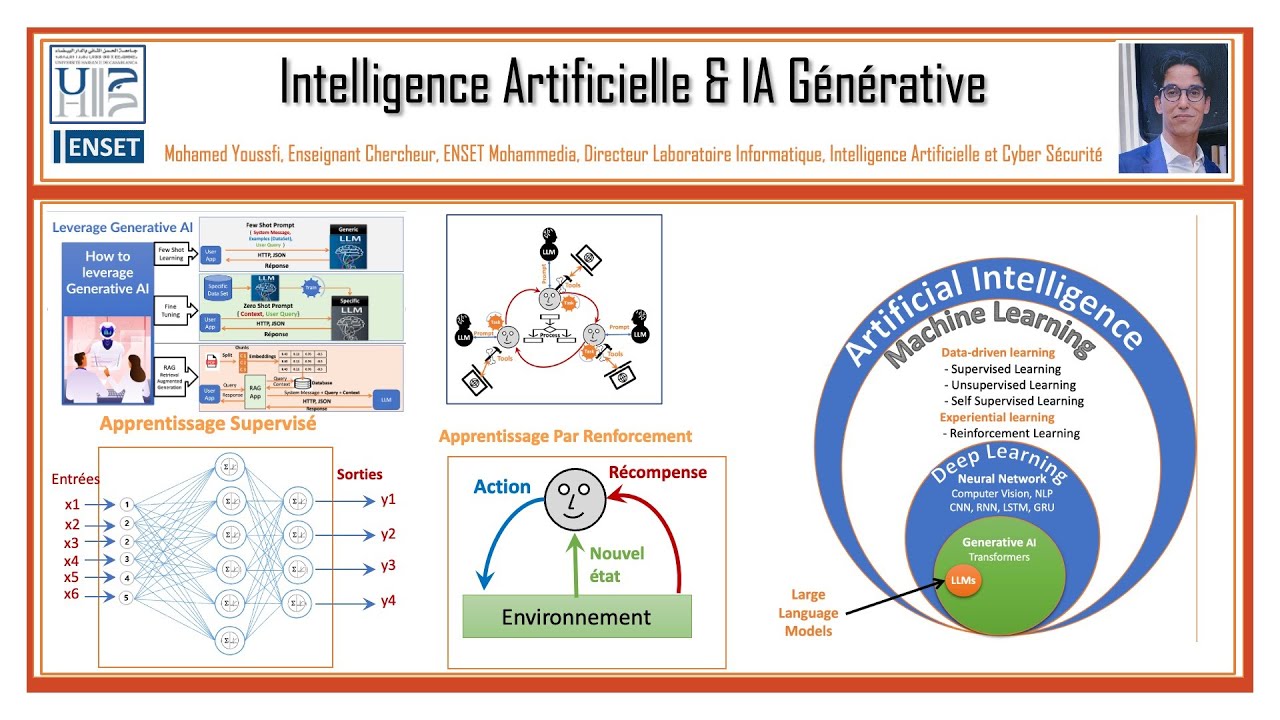









Machine learning is a subset of artificial intelligence that enables systems to learn from data and improve over time without being explicitly programmed, with three main types: supervised learning (training on labeled data for predictions), unsupervised learning (finding hidden patterns in unlabeled data through clustering), and reinforcement learning (agents learning to maximize rewards through actions); key algorithms include decision trees, support vector machines, neural networks, and clustering algorithms like K-means, while data quality and proper preprocessing are critical for model success, and common challenges include overfitting, underfitting, and data bias.
Machine Learning Basics: Supervised, Unsupervised & Reinforcement
Added:Basic understanding of statistics and probability, including concepts like mean, variance, and probability distributions.
The fundamental distinction between traditional rule-based programming and data-driven paradigm shifts.
Elementary linear algebra concepts, specifically vectors, matrices, and basic coordinate geometry.
Familiarity with how data is collected, structured, and stored (e.g., features, labels, and datasets).
Deep dive into specific supervised algorithms such as Linear Regression, Decision Trees, and Support Vector Machines (SVMs).
Understanding model evaluation techniques, including the bias-variance tradeoff, overfitting, underfitting, and metrics like precision and recall.
Exploration of Neural Networks and Deep Learning architectures for handling complex, unstructured data.
Practical hands-on implementation of ML models using Python libraries such as Scikit-Learn, TensorFlow, or PyTorch.
1.3K views2likes9:55Original Release: 2026-01-13
Welcome to our course uh this lecture generative AI for leaders.
In this session we will explore the foundational concepts of machine learning.
The driving force behind generative AI.
Understanding these basics will provide you with the necessary knowledge to grasp more advanced AI topics later in the course.
Machine learning is at the core of many applications from predictive analytics to generative models. Today we will break down the essential elements of machine learning and discuss how it power the AI systems we use today.
So in this slide introduction to machine learning.
So what we see from the uh this introduction like machine learning is a subset of artificial intelligence that enables systems to learn from data and improve over time without being explicitly programmed.
Unlike traditional programming by what we see in the left side where rules are predefined, machine learning algorithms identify patterns in data and make decisions based on those patterns. For example, instead of manually coding every rule to recognize a cat in a photo, a machine learning model can learn to identify the cats by analyzing thousands of level images. See it can identify. So this you can see the difference what I mentioned types of machine learning. This is these are there are three main uh types of machine learning. Uh supervised learning, unsupervised learning and reinforcement learning. Each type is used for different tasks depending on the nature of data and desired outcome.
Let's let's let me explain each of them.
Supervised learning.
It involves training a model on level data where the correct output is known and the model learns to map inputs to outputs making predictions on new unseen data. So this is supervised learning model. Then the next is unsupervised model. This will deal this with unlevel data.
Uh the model tries to find hidden patterns or intrinsing structure within the data.
Clustering is a common technique used in unsupervised learning.
And next is reinfor learning uh re reinforcement uh learning.
is a type of learning where actually an agent learns to make decision by performing actions in an environment to maximize some notion of cumulative reward.
So these types of learnings are applied to different tasks uh depending on the nature of the data and problems being solved.
Key algorithms in machine learning.
There are several key algorithms in the machine learning each suited to different types of uh problem like the decision tree. These are used for classification and regression task where the model splits the data into branches to make decisions. But we see here also here the next is support vector machines.
So this is actually uh or it is called as SVMs are powerful for classification tasks especially when the data has clear margins of separation.
Next is neural networks. So is the backbone of deep learning and are used for complex tasks such as image and speech recognition.
uh clustering application uh sorry clustering algorithms like K means are used to group data points into clusters based on their similarity.
Next we will discuss the role of data in machine learning. So data is foundation of machine learning. The quality and quantity of data directly impact the performance of machine learning models.
Proper data prep-processing such as cleaning, normalization, and feature engineering is crucial to building effective models.
For example, in a generative A model, the more diverse and high quality for the training data, the better the model will be at generating realistic and useful outputs.
Training uh training and testing in machine learning.
Training a machine learning model involves feeding it data and adjusting adjusting its parameters based on the performance. The goal is to minimize the error between the model's predictions and actual outcomes.
Uh once the model is trained, it's essential to test in on a new unseen data to evaluate the generation ability. This process of training uh and testing is key to developing robust AI system that perform well in real world applications.
So here we see the some diagram here the high level overview machine learning process.
They train the model and they test the model and finally they deploy the model. So these are the steps we are mentioning here. The processing of training and testing in a machine learning model.
Applications of machine learning.
Machine learning parts many application across various industries like e-commerce.
Recommendation system support products based on customer uh behavior.
Then in finance, predictive analytics model forecast market trends and manage risks. In healthcare, machine learning is used for diagnostics and personalized medicine. In genetic models like GPT4 create new contents such as text, images, and music. So these applications demonstrate the versatility and power of machine learning in solving comp complex problems.
Next is challenges in machine learning.
So despite its power, machine learning comes with challenges. Issues such as overfitting where a model performs well on training data but poorly on new data.
and underfitting uh where the model is too simple to capture the underlying patterns can affect performance.
Additionally, the data bias are the need for large data sets are ongoing challenges that require careful consideration. Addressing these challenges is is crucial for developing effective and reliable machine learning models.
Then recap of machine learning back basics. What we learned to recap machine learning is a powerful tool that enables systems to learn from data and improve over time. It encomp encompasses various types of algorithms each suited to different task with data playing a critical role in model success.
Understanding these basics is essential as we delve uh deeper into the world of AI. uh like what we see that training data machine learning algorithm then building logical mathematical mode and output so learn from the data.
So looking ahead in our next lecture we will explore the key technologies in generative AI including the neural networks and deep learning. So these technologies form the foundation of AI's ability to generate uh new content and will provide deeper insights into how AI systems operate.
So do you have any question of the machine learning concept as we covered today? So we can you can ask any questions. So thank you Joe for joining me in this lecture on machine learning basics. I look forward to seeing you in the next session as we continue our understanding of AI and its transformative potential. See you then.
Thanks everyone.
Up Next

12:05
Recommendation Systems Overview with TensorFlow: Key Concepts
@TensorFlow
142.1K views•2021-06-29

57:48
Secure Multiparty Computation (MPC): Foundations & Challenges
@SimonsInstitute
7.3K views•2015-05-28

13:03
Bypassing Tor Censorship: Bridges and Pluggable Transport Guide
@Coding_ForEveryone
397 views•2024-06-11
18:41
Neural Networks Explained: Math, Layers, and Learning Fundamentals
@3blue1brown
21.9M views•2017-10-05
Related Study Plans & Knowledge Roadmaps
Structured learning paths in Artificial Intelligence
artificial-intelligence
Aligning LLMs: DPO, TRL & Custom Datasets
01Foundations of Python & Machine Learning
02Transformers and Large Language Models (LLMs)
03Aligning LLMs: SFT and RLHF
+ 3 more learning modules
24h6 modules
Explore Roadmap
artificial-intelligence
Federated Learning: PyTorch, Flower & Privacy
01Python & Machine Learning Foundations
02Deep Learning Basics with PyTorch
03Introduction to Federated Learning
+ 2 more learning modules
35h5 modules
Explore Roadmap
artificial-intelligence
Securing LLMs: Guardrails AI & NeMo Gateway
01Introduction to LLMs, Python, and APIs
02Understanding LLM Vulnerabilities & Threats
03Defending LLMs with Guardrails AI
+ 2 more learning modules
15h5 modules
Explore Roadmap
artificial-intelligence
Building Recommenders: Two-Tower & Vector DBs
01Foundations of Python & Machine Learning Basics
02Introduction to Recommender Systems
03Deep Learning & Representation Learning
+ 3 more learning modules
75h6 modules
Explore Roadmap