NeRFs: 3D Reconstruction & Instant-NGP
Learning Goal: Generate interactive 3D scene representations from 2D image sets using Neural Radiance Fields (NeRFs) and Instant-NGP.
Prerequisites
- Mathematics: Intermediate linear algebra (vectors, matrices, matrix multiplication).
- Programming: Basic Python programming, including familiarity with variables, lists, and basic matrix operations using NumPy.
- Hardware: A computer running Windows/Linux with a CUDA-compatible NVIDIA GPU (RTX series recommended for real-time acceleration).
Estimated Study Time
- Total Duration: ~16 Hours
Module 1: Math & Python Foundations for 3D Vision
This module establishes the core mathematical and computational building blocks for computer vision. To reconstruct 3D scenes from 2D images, you must first master coordinate transformations, rotation/projection matrices, and translation vectors. In addition, you will learn how to translate these linear algebra concepts into executable Python code using the NumPy library to manipulate 3D transformation matrices.
Recommended Videos
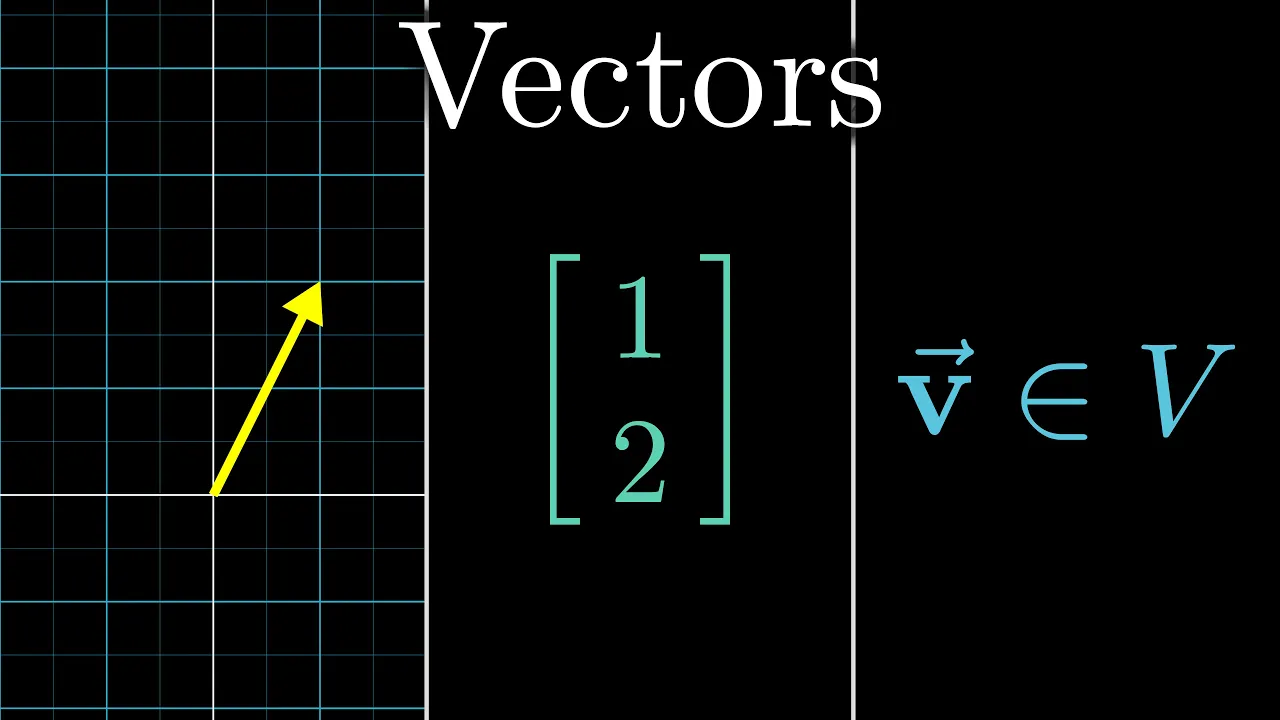
Why this video
This video provides an intuitive visual foundation of what vectors actually represent from both geometric (physics) and coordinate-based (computer science) perspectives. Understanding how coordinates translate to arrows in space is critical before scaling up to 3D projection systems and camera extrinsics.
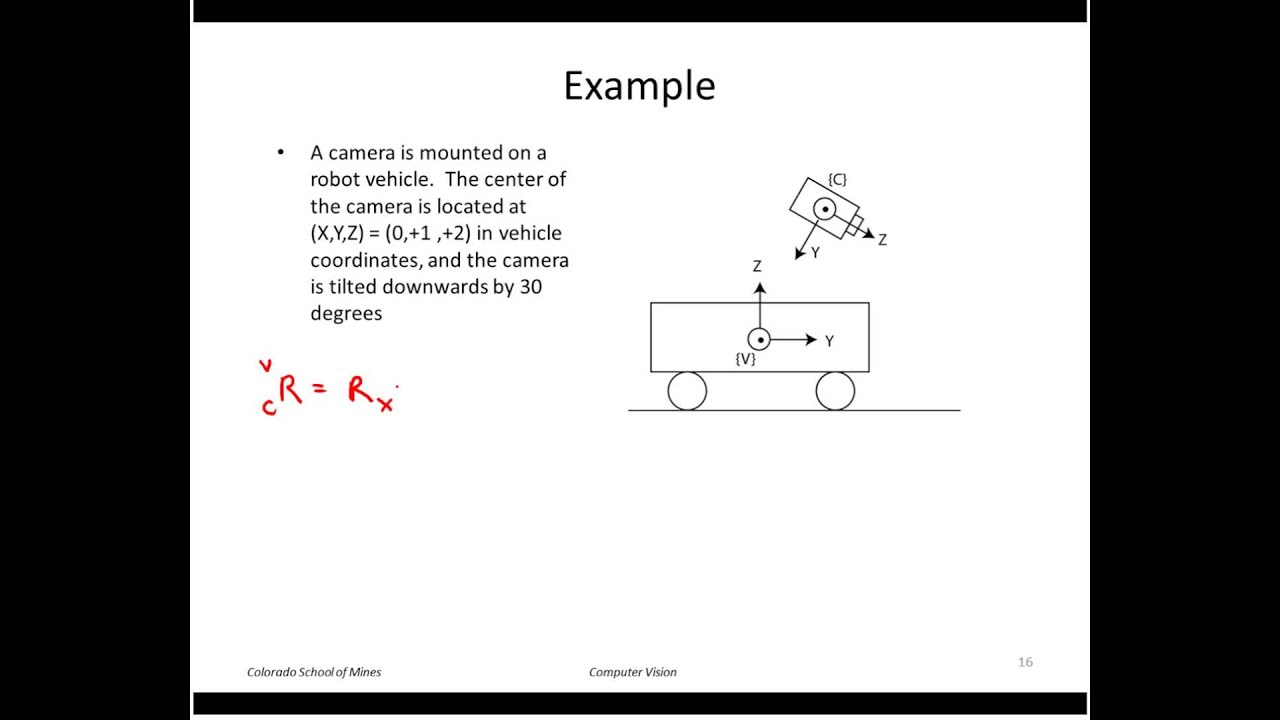
Why this video
This academic lecture bridges the gap between pure math and 3D computer vision. It breaks down the mathematical projection of 3D world space coordinates onto a 2D image plane, explaining the core relationships between camera intrinsic parameters (the matrix) and extrinsic orientation parameters (the matrix).

Why this video
A vital micro-tutorial that addresses a major programming gap. It shows exactly how to implement and multiply 3D rotation matrices in Python using the numpy.dot() function. This is a crucial skill for manipulating the camera extrinsics you will extract later during coordinate frame alignment.
Why this video
This video explains how to build custom transform matrices inside a Python environment using NumPy arrays. It translates the raw mathematical equations of rotation, translation, and scale into code structure, which is invaluable for writing custom scripts to handle view directions and camera poses.
Gap Acknowledgment & Search Recommendation
While these videos cover essential matrix mathematics and basic Python implementations, there is a lack of deep, end-to-end tutorials on implementing 3D camera coordinate mapping (such as PINHOLE camera models and ray generation formulas) in PyTorch/NumPy.
- Independent Study Tip: Search for "Implementing pinhole camera ray generation in PyTorch" or refer to the coordinate mapping sections of PyTorch3D documentation to supplement your understanding.
Knowledge Checkpoint
- Represent a 3D point as a homogeneous coordinate vector and compute its transformation using a 4x4 matrix.
- Explain the structural difference between camera intrinsic matrices (focal length, principal points) and camera extrinsic matrices (rotation, translation).
- Write a short Python script using NumPy to instantiate a 3D rotation matrix around the Y-axis and perform matrix multiplication with a coordinate array.
Module 2: Photogrammetry & Camera Pose Estimation
Before feeding images into a NeRF pipeline, the computer must know exactly where the camera was positioned for every photo. In this module, you will learn about Structure from Motion (SfM) pipelines and how traditional photogrammetry compares to NeRFs. You will also learn how to run COLMAP to estimate highly accurate camera poses from raw 2D images.
Recommended Videos

Why this video
This lecture provides an excellent breakdown of Structure from Motion (SfM). It walks through local feature extraction, feature matching across image pairs, relative pose estimation, and triangulation to build sparse 3D point clouds. This is the exact underlying framework that COLMAP uses.
![FREE COLMAP A beginner tutorial, introduction to photogrammetry [fix GPU timeout]](https://i.ytimg.com/vi/mUDzWCuopBo/hqdefault.jpg)
Why this video
A step-by-step practical guide to COLMAP, the industry-standard tool for camera registration. It explains how to load image sets, configure feature extraction, match image pairs, and execute the reconstruction process to generate camera pose metrics.

Why this video
This video explains the conceptual differences between photogrammetry (which uses point matching to build geometric triangle meshes) and Neural Radiance Fields (which treats scenes as continuous volumetric density clouds representing perspective, specularity, and lighting).
Knowledge Checkpoint
- Define "Structure from Motion" (SfM) and outline its main execution steps.
- Detail how feature extraction and feature matching work inside COLMAP to link overlapping camera perspectives.
- Describe the primary difference between a triangle-based photogrammetric mesh and a volume density representation.
Module 3: Neural Radiance Fields (NeRF) Core Concepts
This module covers the core concepts of Neural Radiance Fields (NeRFs). You will study how continuous 3D scenes are modeled using neural networks, understand the role of Multi-Layer Perceptrons (MLPs), and learn how volume rendering is used to synthesize photorealistic novel views.
Recommended Videos

Why this video
An exceptional academic breakdown of the landmark NeRF paper. Aladdin Persson meticulously explains the mathematical foundations of the method, including continuous 5D coordinate inputs , volume rendering equations, positional encoding, and hierarchical sampling.
![[ECCV 2020] NeRF: Neural Radiance Fields (10 min talk)](https://i.ytimg.com/vi/LRAqeM8EjOo/hqdefault.jpg)
Why this video
Presented by the original primary author, Ben Mildenhall, this concise presentation offers a clean, visual explanation of the rendering pipeline. It illustrates how rays are shot through pixels, how points are queried along those rays, and how color and density are accumulated.
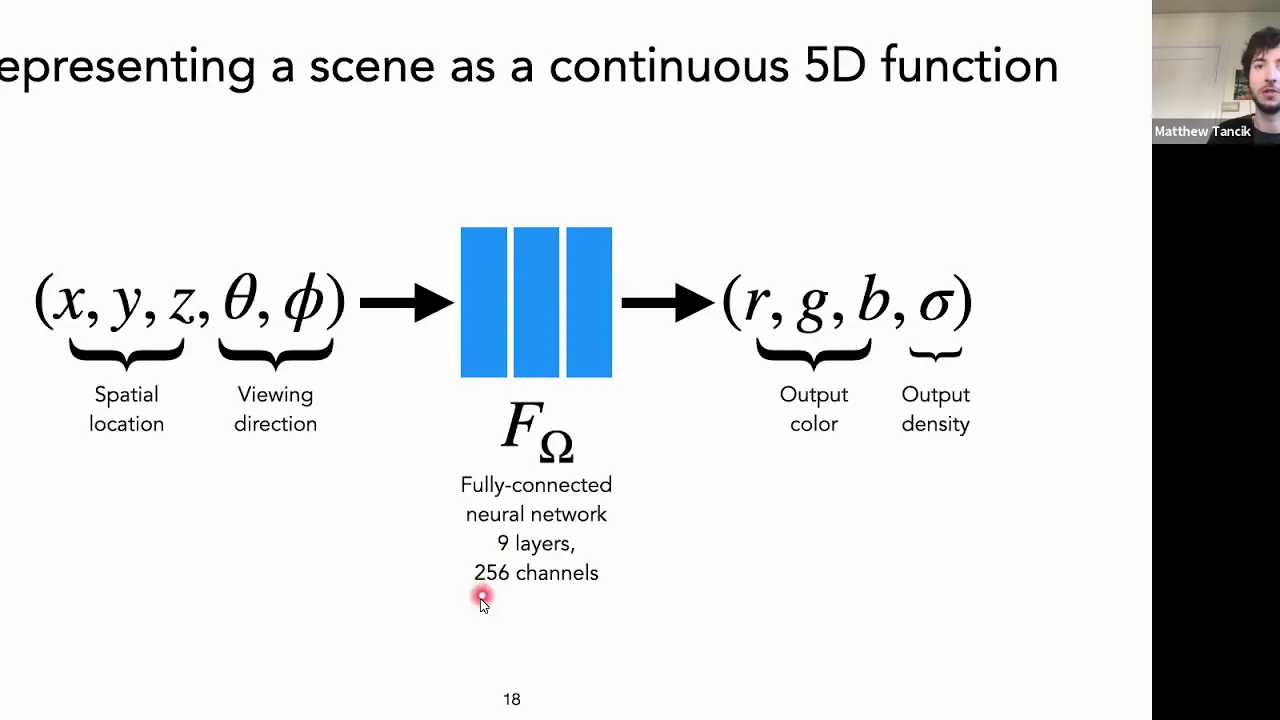
Why this video
In this video, co-author Matthew Tancik contrasts traditional view synthesis (discrete voxel grids) with coordinate-based neural representations, explaining how NeRF bypasses voxel storage limits using a continuous neural network.
Knowledge Checkpoint
- Draw the mathematical input-output structure of a standard NeRF (identify the 5D coordinates input and the 4D output).
- Explain the purpose of Positional Encoding in NeRF and why high-frequency representations are necessary for high-fidelity details.
- Describe how color and volume density () are combined along a ray to compute the final pixel color via numerical integration.
Module 4: Instant-NGP & 3D Gaussian Splatting
Traditional NeRF optimization takes hours or even days. This module covers acceleration techniques, focusing on NVIDIA's Instant-NGP and its multi-resolution hash encoding. It also introduces 3D Gaussian Splatting, a rasterization technique that achieves real-time rendering speed and fast optimization times.
Recommended Videos

Why this video
This technical overview explains the mechanics of NVIDIA's Instant-NGP. It details how multi-resolution hash tables replace large, slow MLPs with a fast parametric lookup system, shrinking NeRF training times down to seconds.
Why this video
Bilawal Sidhu provides an exceptional and engaging high-level breakdown of 3D Gaussian Splatting (3DGS). He explains how 3DGS skips neural networks altogether, representing scenes using millions of rasterized 3D ellipsoids (splats) for 100+ FPS rendering speeds.
Why this video
This video compares 3D Gaussian Splatting directly with NeRF. It highlights optimization speed, showing how 3DGS achieves state-of-the-art results on standard datasets up to 50 times faster than NeRF while running in real-time.
Knowledge Checkpoint
- Explain how a multi-resolution hash encoding table optimizes parameters instead of relying purely on deep MLP layers.
- Contrast 3D Gaussian Splatting with NeRF in terms of representation structures (continuous neural fields vs. discrete mathematical splat parameters).
- Identify why tile-based rasterization in 3D Gaussian Splatting is faster than standard ray-marching volume rendering.
Module 5: Practical Project: Custom 3D Scene Generation
In this final module, you will build a complete end-to-end 3D reconstruction pipeline. You will learn best practices for capturing images or videos, convert them into camera-registered frames, train models using NVIDIA Instant-NGP or 3D Gaussian Splatting pipelines, and export interactive renders.
Recommended Videos

Why this video
This tutorial walks you through creating custom datasets from videos. It demonstrates how to extract clean frames using tools like ffmpeg and OpenCV, run the colmap2nerf.py script, and format the output metadata to make it compatible with Instant-NGP.

Why this video
A step-by-step practical guide to working within NVIDIA's Instant-NGP graphical interface. It covers frame extraction rates, path rendering, adjusting cropping parameters, and exporting animations from trained models.
Why this video
A comprehensive masterclass on configuring, running, and rendering 3D Gaussian Splat models locally on Windows. It covers installation of prerequisites (CUDA, Anaconda, Git), dataset structuring, COLMAP pose extraction, model training via command line, and interactive real-time viewing.
Knowledge Checkpoint
- Capture a scene using ideal NeRF/Splat photography guidelines (optimal overlap, minimal blur, controlled lighting).
- Run automated scripts (
colmap2nerf.py) to convert a video file or photo set into calibrated transforms output (transforms.json). - Load your generated dataset into an Instant-NGP window or a Gaussian Splatting trainer and export a completed interactive 3D render.
Course Map
The following flowchart outlines the structural sequence of prerequisites, concepts, and implementation tracks needed to complete this curriculum:
Key People Index
The following researchers and educators have made significant contributions to the development and accessibility of NeRFs, Instant-NGP, and Gaussian Splatting:
- Ben Mildenhall & Matthew Tancik: Co-lead authors of the original landmark paper, NeRF: Representing Scenes as Neural Radiance Fields for View Synthesis (ECCV 2020), which catalyzed the neural rendering field.
- Jon Barron: Principal Researcher at Google Research. He pioneered key expansions of the NeRF core framework, including anti-aliasing techniques (Mip-NeRF) and fast, zip-like scene sampling (Zip-NeRF).
- Daniel Cremers: Professor of Image Processing and Pattern Recognition at the Technical University of Munich (TUM). He has contributed foundational research to multiple-view geometry and dense visual SLAM.
- Bilawal Sidhu: Creative technologist, educator, and prominent presenter who has played a vital role in making 3D Gaussian Splatting and spatial computing accessible to developers and the general public.
Final Self-Assessment
Review your understanding of the entire curriculum using this self-assessment checklist:
- I can describe the mathematical difference between 3D world space coordinate frames and 2D camera sensor space.
- I can write a basic Python script using NumPy to apply rotations and translations to spatial vectors.
- I can explain how Structure from Motion (SfM) resolves camera positions without pre-existing location metadata.
- I can configure and run COLMAP feature matching on a custom folder of raw images.
- I can explain how NeRF uses an MLP to map a coordinate location and viewing direction to color and density.
- I can write out or visually demonstrate the concept of volume rendering via ray marching.
- I can explain why positional encoding is critical for MLPs to represent high-frequency visual details.
- I can explain how Instant-NGP's multi-resolution hash encoding speeds up training times.
- I can explain the differences in storage, training, and rendering between NeRFs and 3D Gaussian Splatting.
- I have successfully trained a custom spatial representation using either Instant-NGP or 3D Gaussian Splatting from my own custom capture data.