










![Sociology Class-12th (Social Stratification) [Gender & Gender Bias]](https://i.ytimg.com/vi/DuIGdvjuAzM/sddefault.jpg?sqp=-oaymwEmCIAFEOAD8quKqQMa8AEB-AG-BIAC0AWKAgwIABABGEYgSShlMA8=&rs=AOn4CLBgpT3SyZoT9PCl7ywmEVAtU4O0yQ)



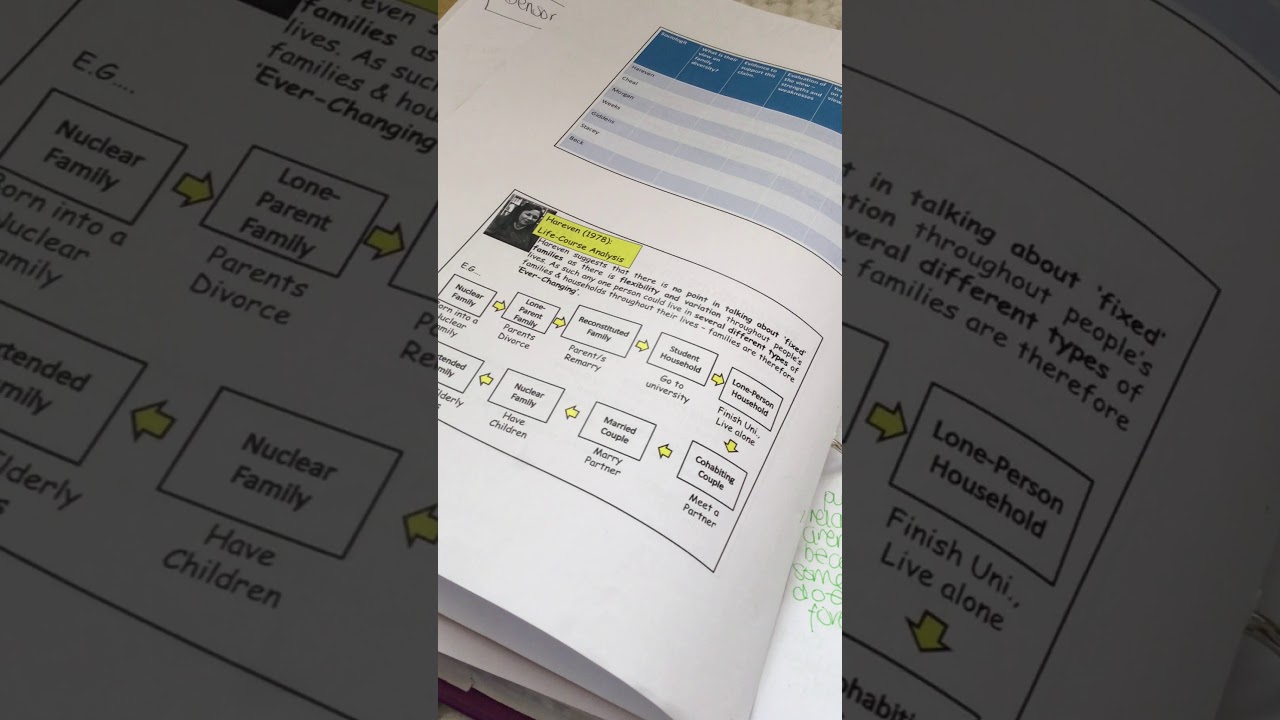









Sociology defines family as groups of people related by genetics, marriage, or choice who share material, emotional, and economic resources, encompassing both biological families (family of orientation) and chosen families (family of procreation); marriage practices vary across societies through residential patterns (patrilocality, matrilocality, neolocality) and descent systems (patrilineal, matrilineal), while three sociological schools of thought analyze family's role: structural functionalism emphasizes socialization and sexual regulation, social conflict theory highlights how family perpetuates inequality, and symbolic interactionism focuses on daily family interactions and role expectations.
Sociological Theories of Family and Marriage Explained
Added:Familiarity with the three core sociological perspectives: Structural Functionalism, Conflict Theory, and Symbolic Interactionism.
An understanding of what a 'social institution' is and how institutions organize and stabilize society.
Basic knowledge of primary socialization and how individuals learn cultural norms and values.
A foundational understanding of social stratification, particularly regarding gender and social class roles.
Investigation of contemporary family diversities, such as cohabitation, blended families, single-parent households, and same-sex partnerships.
Exploration of feminist sociological theories on the family and the gendered division of domestic labor.
Analysis of how social policies, economic shifts, and legal frameworks (e.g., divorce laws, family leave policies) impact family dynamics.
Comparative study of marriage, kinship, and descent systems across different global cultures and historical periods.
797.5K views13.9Klikes10:59Original Release: 2017-12-11
You’ve probably heard people say that blood is thicker than water.
That’s supposed to mean that family relationships – blood – are stronger than all other relationships.
Which I guess are the water?
But what do you think? Is that true?
Can friends be considered your family?
Or do you only think of your parents or siblings as family members?
And how strong are familial relationships?
Do they come with obligations that you don’t have for other people?
Let’s try to tell the blood from the water here, and figure out what makes a family a family.
[Theme Music] You probably have your own idea of what makes a family, but here’s how sociologists define it.
Families are groups of people who are related by genetics, marriage, or choice, and who share material, emotional, and economic resources.
So, the family isn’t a formal organization, like a government or a church.
Instead it’s a social institution.
That’s because the members of a family are held together by the commonly shared goal of the well being and mutual support of its members – and they organize people and power based on positions of social status within the family, like mother or daughter.
Family often goes hand in hand with kinship, a social bond based on common ancestry, marriage, or adoption.
These are the relationships that are most commonly thought of as ‘family’ – parents and kids, spouses, siblings, aunts and uncles.
And some of these relationships you’re born into – the biological children of parents, for example.
But other family relationships are created through legal bonds, like marriage or adoption.
And it’s also important to recognize that for many people, family is a matter of choice.
Marriage is the most prominent example of this – choosing to get married is two people coming together to say to each other and the world that they choose to be a family.
Another family-by-choice is when close friends are also considered family, a practice called fictive kin.
These family friends are incorporated into the larger family, interacting daily, living together, having their kids grow up together, calling the friend Uncle Joey – wait, that’s just the plot of Full House.
But fictive kin isn’t a fictional concept.
These found families consist of people who have chosen to care for each other, share resources, and share their lives together.
This can make a family bond as strong as any based in ancestry or law.
Now, no matter what type it is, the family that you grow up in is known as your family of orientation, because it orients you to the world and teaches you how families work.
And the family that you create on your own, as an adult, is known as a family of procreation.
A common type of family of procreation is a nuclear family, a unit made up of two parents and biological or adopted children.
Consider this a contrast to another two common types of families: single parent families and extended families.
A single parent family is exactly what it sounds like – one parent raising children.
Both nuclear and single parent families are also sometimes referred to as immediate family – parents and siblings.
Extended family is everyone in your family who isn’t a parent or sibling – grandparents, uncles, cousins, great aunts, third cousins twice removed.
In the United States, most people live with their immediate family, though they may live nearby or regularly visit members of their extended family.
And in many cultures – including in the US – families most often form around marriages.
Marriage is a legally recognized relationship, usually involving economic, social, emotional, and sexual bonds.
I know, that’s not a very romantic way to describe marriage.
But marriage isn’t always based on love and romance.
The idea of marrying for love alone is actually fairly new.
Sure, people have always fallen in love.
But you didn’t need to be in love to get married.
Instead, more practical concerns – like creating tighter bonds between families, or finding economic security – have historically been more common reasons.
Cultural norms – that are sometimes enshrined into laws – also limit romantic love by marking some people as acceptable spouses, or not.
Some norms promote endogamy, or marriage between people of same social category.
Essentially, like marries like.
For example, college-educated Americans are more likely to marry other college-educated Americans.
And people are more likely to marry others of the same race – though that pattern is slowly changing.
Interracial marriage is an example of exogamy, or marriage between people of different social categories.
Another example of exogamy is ‘marrying up’, where a person of a low socioeconomic status marries someone of a higher socioeconomic status.
Traditionally, women are more likely to use marriage to move up the socioeconomic ladder than men, partially due to broader patterns of gender inequality that limit other opportunities for improving their status.
And forms of marriage can vary across time and across cultures.
In modern-day high income countries, marriage is, by law, only between two people – a practice known as monogamy.
Polygamy, or marriage to two or more spouses, is legally recognized in the majority of African countries and in some South Asian countries.
Marriage practices are deeply tied to the economic and social structures of society.
For example, the most common form of polygamy is polygyny or the marriage of one man to two or more women.
But in societies with low male-to-female ratios, polyandry, or the marriage of one woman to two or more men, can also occur.
In countries where polygamy isn’t legally recognized, the term bigamy is used to refer to going through the legal processes of marrying while still married to another person.
Now, marriage is the main way that individuals move from their family of orientation into a family of procreation.
And with marriage comes decisions about how to fit your new family into your existing, separate families.
Let’s go to the Thought Bubble to look at how marriage practices have varied across societies.
Say a man and a woman get married…where should they live?
If we’re in a pre-industrial society, the couple will most likely move to live with or near the husband’s family, a practice known as patrilocality.
In a study of 1,153 cultures, cultural anthropologist David Levinson estimated that about 70% have a patrilocal residence pattern.
This was most common for societies with frequent warfare, where families wanted to keep sons around as a form of protection.
But in some pre-industrial societies, our newly married couple will practice matrilocality, where they live with or near the wife’s family.
Many Native American tribes, particularly those in the Southwestern United States, such as the Hopi and Zuni, have historically been matrilocal, with newly married couples settling into the clan of the wife.
In these societies, women generally own the home and resources of the family.
These tribes are also matrilineal, meaning that they trace descent through the mother’s family tree.
Most societies, however, are patrilineal, meaning that they trace kinship through the father.
This means that all inheritance – land, wealth, titles – passes from father to son.
We see patterns like this even in relatively recent times.
Until the mid-nineteenth century, all land inherited by women in the US was solely owned by her husband, encouraging inheritance patterns that preference sons.
And it was only in the last decade that Britain changed its line of succession to allow the monarchy to be passed on to the firstborn child, regardless of sex.
Thanks Thought Bubble!
So that’s how residential choice and family inheritances worked in the past.
But what about nowadays?
Industrialization has resulted in huge job growth in city centers, which has stoked greater migration from hometowns to big cities.
As such, many married couples have been more likely to be living apart from both sets of parents, a practice known as neolocality.
While patrilineal traditions, like passing on the father’s last name to children, persist, most families in industrial societies trace descent through both men and women.
This continues to be true in most high-income countries, and neolocality is most common among the highly educated and households where both spouses are working.
Because cities are where most of the jobs are.
But even if modern day Americans live far from their parents, it’s impossible to escape the impact that families play in molding us, both on an individual and a societal level.
Family is yet another social institution that we can use the three schools of sociological thought to examine.
Structural functionalists emphasize the role that families play in socializing children, so they can function in society, while of course also giving them emotional and material support.
But the other role of family in a structural functionalist framework is the regulation of sexual activity.
Which again, I know, sounds super romantic.
What I mean is that our societal norms about who can marry whom generally tells us something about what we hold to be acceptable or taboo sexual behavior.
For example, incest is taboo in most cultures.
This norm exists partially because reproduction among close relatives increases the likelihood of genetic inbreeding.
These taboos mean that people must find their partners outside their family, creating social ties across families within a community.
In contrast, social conflict theory, particularly feminist theory, focuses on the ways in which traditional notions about family perpetuate social inequality.
Some of these inequalities might be obvious, based on what we’ve talked about already – like patrilineal lines of descent that make it impossible for women to hold wealth or gain power.
There’s also the negative side of family as a form of sexual regulation.
We might think it’s a good thing that family status ties prevent incest, but historically, this sexual regulation has also meant that married women have been seen as the sexual and economic property of their husbands.
I’ve mentioned already that in the 19th century, women’s inheritance and earnings legally belonged to their husband.
But for a more recent example, look at how the law treats women’s control over their own body within marriage: marital rape was not made illegal in all states in the US until 1993.
Social conflict theory also points out the ways in which marriage entrenches social advantages and disadvantages.
Because most people marry those who are similar to themselves, inequalities across class and race lines are often enhanced and further entrenched by marriage.
Oftentimes, endogamous marriage occurs because of social norms and preferences.
But it also stems from laws that regulate who can marry whom.
Anti-miscegenation laws, which outlawed interracial marriage, were not ruled unconstitutional until 1967, in the aptly named Supreme Court case Loving vs Virginia.
Finally, through the lens of symbolic interactionist theories, we can see families in terms of the daily interactions of family life.
Family statuses come with their own expectations of behavior.
The stereotypes of mother as nurturer and father as breadwinner shape how people think about themselves, and others, as ‘good’ or ‘bad’ fathers and mothers.
Social exchange theory argues that relationships are a form of exchange between people, attempts to gain benefits from their interaction while avoiding the costs.
If the costs outweigh the benefits, the marriage ends.
Of course, much of what we’ve discussed today has looked at marriage under a heteronormative lens, and many of these theories don’t hold up as well when definitions of marriage and family are broadened to cover the wide spectrum of family types that we see today.
So next week, we’ll talk about what families look in the here and now, and how society shapes these family forms.
But today, we learned about how sociology defines family and the different terms used to describe specific types of family.
We discussed marriage in different societies, as well as marital residential patterns and patterns of descent.
Finally, we ended with a discussion of three schools of thought on the societal role of marriage and family.
Crash Course Sociology is filmed in the Dr. Cheryl C. Kinney Studio in Missoula, MT, and it’s made with the help of all of these nice people.
Our animation team is Thought Cafe and Crash Course is made with Adobe Creative Cloud.
If you'd like to keep Crash Course free for everyone, forever, you can support the series at Patreon, a crowdfunding platform that allows you to support the content you love.
Thank you to all of our patrons for making Crash Course possible with their continued support.
Up Next

5:57
The Second Shift: Arlie Hochschild on Work-Family Balance
@stanfordcenteronpovertyand276
127.7K views•2016-12-06
54:57
Contemporary Sociological Theory: Micro, Macro, Integrative
@NaSESYNC
45.7K views•2016-02-17

11:31
Food Access and Agricultural Revolutions: A Geography Lesson
@crashcourse
117.1K views•2022-02-15
9:41
What is Sociology? The Sociological Perspective Explained
@crashcourse
4.6M views•2017-03-13
Related Study Plans & Knowledge Roadmaps
Structured learning paths in Sociology
sociology
Celebrity Culture: From Hollywood to TikTok
01Foundations of Celebrity Sociology
02The Rise of Micro-Celebrity & Digital Platforms
03Parasocial Relationships & Algorithmic Intimacy
+ 2 more learning modules
12h5 modules
Explore Roadmap
sociology
Hostile Architecture: Space, Power & Control
01Introduction to the Sociology of Space
02Social Control and Surveillance in the City
03Hostile Architecture and Defensive Design
+ 2 more learning modules
12h5 modules
Explore Roadmap
sociology
Loneliness Epidemic: Third Places & Isolation
01Foundations of Social Capital and Community Cohesion
02The Death of Third Places and Urban Space Erosion
03The Privatization of Leisure and Atomization
+ 2 more learning modules
12h5 modules
Explore Roadmap
sociology
Sociology of Tourism: Gaze, Power & Heritage
01Foundations of the Sociology of Travel and Leisure
02John Urry and the 'Tourist Gaze'
03Staged Authenticity and Cultural Commodification
+ 2 more learning modules
14h5 modules
Explore Roadmap