Value-based pricing is a strategy where businesses determine the right price for each customer, product, and transaction by understanding customer value perception, their alternatives, and how the business differentiates itself, rather than simply adding a margin to costs; this approach captures additional value beyond what cost-plus pricing achieves, though transitioning to it typically requires a four-to-five-year journey.
What Is Value-Based Pricing? | Pricing Strategies Explained
Added:Deep Dive
Understanding of traditional pricing models, such as Cost-Plus (pricing based on production cost plus margin) and Competitor-Based pricing.

Estrategia de Precios: ¿Cómo construir una estrategia de precios efectiva para el mundo post-COVID?
3.7K
Three fundamental pricing models exist: (1) Cost-plus pricing adds margin to costs—most common in retail, easy to calculate but risks pricing above or below willingness to pay. (2) Competition-based pricing matches competitor prices, useful in competitive markets but ignores elasticity. (3) Value-based pricing charges based on customer-perceived value, maximizing profitability but requiring difficult-to-obtain customer data. Each model has distinct advantages and disadvantages depending on market conditions and product differentiation.
Click to watch →

💲METODE PENETAPAN HARGA💲
3.2K
Cost-based pricing determines prices by adding margins to production and marketing costs. Standard markup pricing applies percentage margins to resellers (e.g., adding 10% to Rp50,000 items), while cost-plus markup applies to manufacturers (e.g., adding 20% to Rp90,000,000 construction costs). Competition-based pricing sets prices relative to market competitors through five methods: customary pricing maintains traditional prices; marketplace pricing sets prices above, at, or below market rates; below-market pricing targets generic products and private-label items; loss leader pricing sells products below cost to attract customers; and sealed-bid pricing uses agents to solicit competitive bids.
Click to watch →

Why Old Pricing Logic Is Dead | @Rajiv.Talreja | Raj Shamani #shorts
265.7K
The traditional pricing model taught in commerce schools follows the formula: Cost Price + Profit Margin = Selling Price. This approach was historically used when businesses calculated prices by adding a desired profit margin to the production cost.
Click to watch →

ACCA Skill: Performance Management:Ch 3: Advances in Management Accounting CA Yogesh Panchakshari.
110
Traditional cost plus pricing models calculate product cost as the starting point for pricing, then add a profit margin to determine the selling price. This approach becomes flawed in competitive markets where the estimated price may be too high for the market to accept. In competitive markets, companies must accept market-determined prices rather than setting prices based on their costs.
Click to watch →
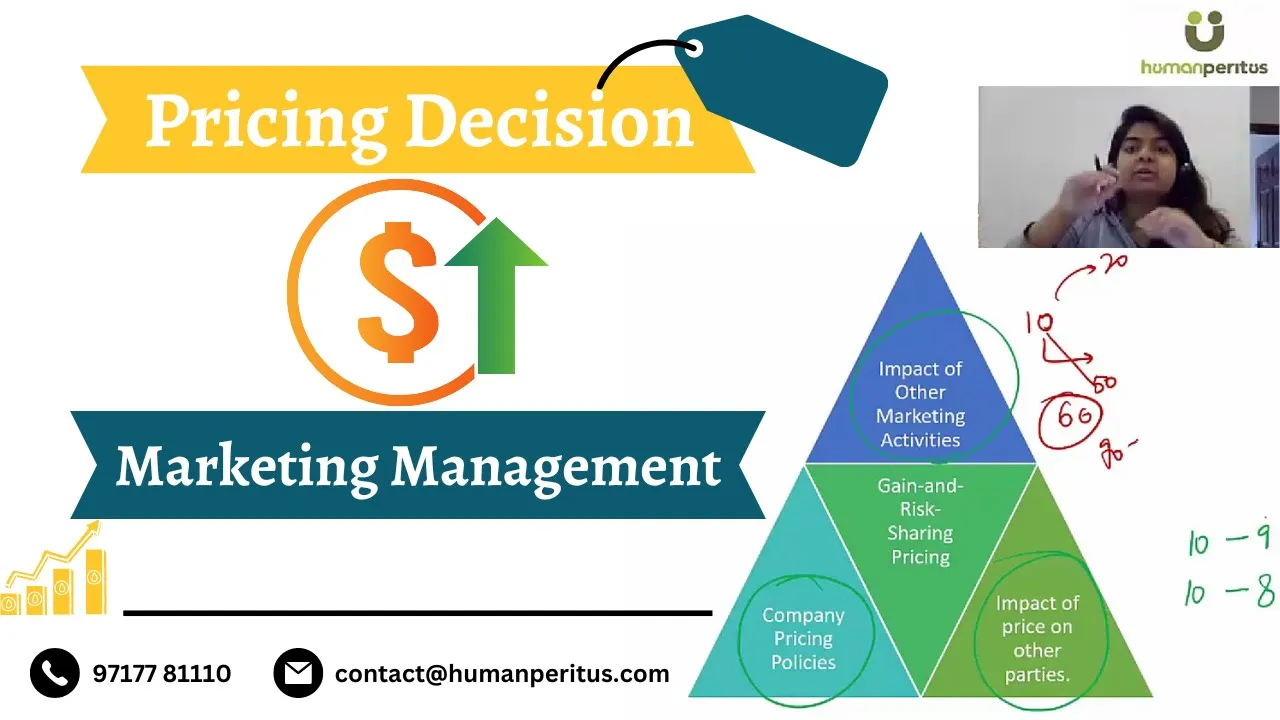
Pricing Decisions - Marketing Management
705
Cost-based pricing methods include: (1) Cost plus pricing - Cost + Profit = Selling Price (e.g., 100 rupees cost + 10% profit = 110 rupees), (2) Markup pricing - profit calculated as percentage of selling price rather than cost, (3) Break even pricing - selling price equals cost (no profit, no loss), (4) Target return pricing - based on desired return on investment. Competition-based pricing (going rate pricing) sets prices based on market rates regardless of costs. Auction pricing formats include English auction (one seller, many buyers, highest bid wins), sealed bid auction (confidential quotations, lowest bidder wins), and Dutch auction (one seller, many buyers, first matching price wins).
Click to watch →
Deep Dive
The concept of Customer Perceived Value (CPV) and how customers weigh perceived benefits against monetary costs.

Customer perceived value (CPV): Definition, determinants and examples
23.1K
Customer Perceived Value (CPV) is the mental calculation consumers perform when deciding to purchase a product, weighing perceived benefits (physical, logical, and emotional) against perceived costs (psychological, energy, and monetary); businesses can improve CPV by reducing purchase time, emphasizing positive user experiences, building brand credibility, offering risk-free trials, and providing personalized promotions that enhance perceived benefits while mitigating perceived costs.
Click to watch →

Hora da Verdade Banco do Brasil: Vendas e Negociação - Escriturário – Ag Com - Prof. Stefan Fantini
64.4K
Customer perceived value is the relationship between the benefits a customer receives from a product or service and the costs they incur to obtain it. Customers evaluate value by comparing what they give up (costs) against what they receive (benefits). Costs include both monetary expenses and non-monetary costs such as time, effort, and psychological discomfort. Benefits include the functional value of the product or service, emotional satisfaction, and social status. Companies can increase perceived value by either increasing benefits, decreasing costs, or both. The key insight is that perceived value is subjective and varies from customer to customer based on their individual needs and circumstances.
Click to watch →

Hora da Verdade CAIXA: Atendimento Bancário e Administração - Prof. Stefan Fantini
32.6K
Customer perceived value is the comparison between the total costs a customer incurs to obtain a product/service and the total benefits they receive in return. Costs include both financial costs (price) and non-financial costs (time, effort, stress, risk). Benefits include all positive outcomes from the purchase. To increase perceived value, companies should either increase benefits while keeping costs stable, decrease costs while keeping benefits stable, or increase benefits more than costs. Simply increasing both benefits and costs proportionally does not increase perceived value.
Click to watch →

UGBS 614 Marketing Management Session 1 - Understanding Marketing
972
Customer perceived value is determined by comparing total benefits against total costs. Total costs include psychological costs (mental effort to create affiliation with the product), energy costs (effort to obtain and consume), time costs (time spent purchasing and consuming), and monetary costs (money paid). Total benefits include monetary value, functional benefits, psychological benefits (image benefits), and service benefits. This comparison determines satisfaction, delight, or dissatisfaction.
Click to watch →

Valor Percebido pelo Cliente : Como aumentar o Valor Percebido.
34K
Customer perceived value is the evaluation that a customer makes about the cost-benefit relationship of a product or service. It represents how much value the customer believes they are receiving in exchange for what they pay. This perception can be positive or negative and is formed based on the customer's experience and expectations.
Click to watch →
Deep Dive
Basic differences between B2B (Business-to-Business) and B2C (Business-to-Consumer) buying behaviors and decision-making processes.

Buyer Behavior Simplified for B2B & B2C
1.3K
B2B buyer behavior involves multiple decision-makers, longer buying cycles, rational evaluation based on ROI and business value, and relationship-driven purchasing, while B2C buyer behavior is characterized by faster, emotional decision-making, shorter buying cycles, and impulse purchases driven by personal preferences and immediate gratification.
Click to watch →

The Marketing Expert: Sell Anything with this Trick | April Dunford
865.2K
B2B and B2C differ fundamentally in value propositions and decision-making. In B2B, value is typically about making or saving money, unlike consumer products where emotional or irrational factors apply. B2B purchases involve 5-11 stakeholders with significant career risk if poor choices are made, driving fear-based decisions. This explains why incumbents dominate B2B technology markets. Additionally, 50-70% of B2B deals end in no decision, not because customers chose to stay with current vendors, but because they cannot confidently make decisions without risking their careers.
Click to watch →

B2B и B2C – что это простыми словами! / Что нужно знать для успешной продажи?
20.7K
B2B (Business-to-Business) - это продажи товаров или услуг другим бизнесам, где покупка осуществляется для обеспечения их операций или получения прибыли, тогда как B2C (Business-to-Consumer) - это продажи конечным потребителям для личного использования. Основные различия включают: 1) в B2B длина сделки может быть как длиннее, так и короче, чем в B2C, в зависимости от продукта и аудитории; 2) в B2B часто один лицо, принимающее решение, а не несколько, как часто думают; 3) в B2C тот, кто ищет товар, часто является лицом, принимающим решение; 4) B2B не обязательно более выгодны, так как крупные клиенты могут заказывать мало; 5) конечный потребитель покупает для себя, а B2B-клиент покупает для бизнеса; 6) B2B-продажи не менее эмоциональны, чем B2C, так как покупатели также имеют свои критерии выбора.
Click to watch →
B2B vs B2C Marketing (What Are The Differences?)
143.6K
B2B (Business-to-Business) marketing typically involves fewer customers, larger orders, higher value transactions, longer decision times, and longer customer relationships, while B2C (Business-to-Consumer) marketing involves more customers, smaller orders, lower value transactions, shorter decision times, and shorter or transactional relationships; however, regardless of whether you're marketing to businesses or consumers, the most effective approach is Human-to-Human (H2H) marketing, which focuses on genuine, authentic communication that connects with people rather than treating them as faceless entities or products.
Click to watch →
![Marketing B2B vs B2C: 30 Diferencias Clave [Súper Completo]](https://i.ytimg.com/vi_webp/RDzCSENFdSM/maxresdefault.webp)
Marketing B2B vs B2C: 30 Diferencias Clave [Súper Completo]
244
B2B and B2C marketing operate under fundamentally different rules. B2B involves multiple stakeholders across departments (finance, procurement, operations, technical), requiring comprehensive messaging addressing various value angles. B2C decisions involve one or two individuals driven by emotions and immediate perceptions. B2B purchasing processes extend beyond 16 weeks with 6-16 decision-makers, while B2C decisions happen in hours or seconds. B2B focuses on long-term relationships, trust, and credibility, while B2C is more transactional with loyalty based on branding. B2B transactions are significantly larger (hundreds of thousands to millions), while B2C relies on volume. B2B buyer journeys have many more stages and participants, while B2C moves from consideration to decision in fewer steps. B2B procurement involves formal processes like RFPs, while B2C relies on promotions. B2B messages focus on logic and ROI, while B2C emphasizes emotion and immediate benefits.
Click to watch →
Deep Dive
An introduction to economic utility and how products solve specific customer pain points to create value.

BUSINESS OPPORTUNITIES
539
Utility in marketing refers to product attributes satisfying consumer wants and needs. Five types of economic utility exist: (1) Form utility - transforming raw materials into useful products like assembling components into shoes; (2) Place utility - providing convenient purchasing locations; (3) Time utility - offering products at convenient hours like 24-hour stores; (4) Possession utility - facilitating easy product receipt like home delivery services; (5) Information utility - enabling clear communication between companies and consumers through customer service. Economic utility measures total satisfaction from consuming products. Companies increase perceived value to enhance customer satisfaction, boost sales, and drive earnings. This concept falls under behavioral economics, which helps companies attract maximum customers and revenue.
Click to watch →
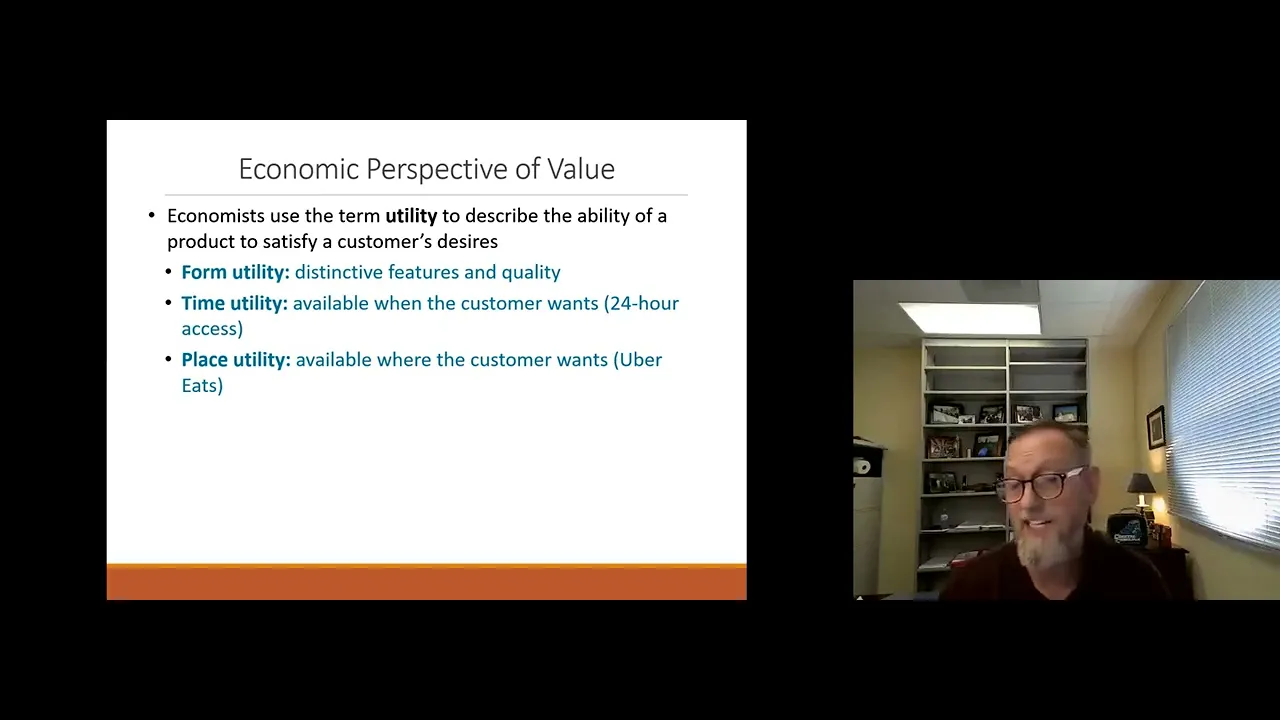
1. Creating Customer Value and Satisfaction
154
Value creation is rooted in economic theory through the concept of utility—the degree to which products satisfy customer needs. Four types of utility exist: form utility (transforming raw materials into finished products), time and place utility (availability when and where needed), possession utility (ownership transfer mechanisms), and psychological utility (meeting internal emotional needs like self-esteem). From an economic perspective, value emerges from balancing what customers gain against what they sacrifice, forming the foundation of why organizations exist.
Click to watch →

Introduction to Marketing: How Marketers Create Value | Episode 49
37.5K
Utility is the ability of a good or service to satisfy consumer wants and desires. The extent to which a product or service can provide utility directly creates additional value in the marketplace. Marketers create value by providing utility—making products or services so valuable that consumers cannot live without them. The greater the utility provided, the more valuable the product or service is perceived to be.
Click to watch →

Ep40 UX คืออะไร และประกอบด้วยอะไรบ้าง-The pyramid of UX Model (by Jeff Patton)
265
Utility refers to how well a product addresses user needs and solves their problems. A product has utility when it provides genuine value to users by helping them accomplish tasks they couldn't do before. The example of the TV remote control illustrates this: before remotes, people had to physically walk to their TVs to change channels, which was inconvenient. The remote solved this problem by allowing users to change channels from their seat, demonstrating how utility comes from addressing real user pain points.
Click to watch →
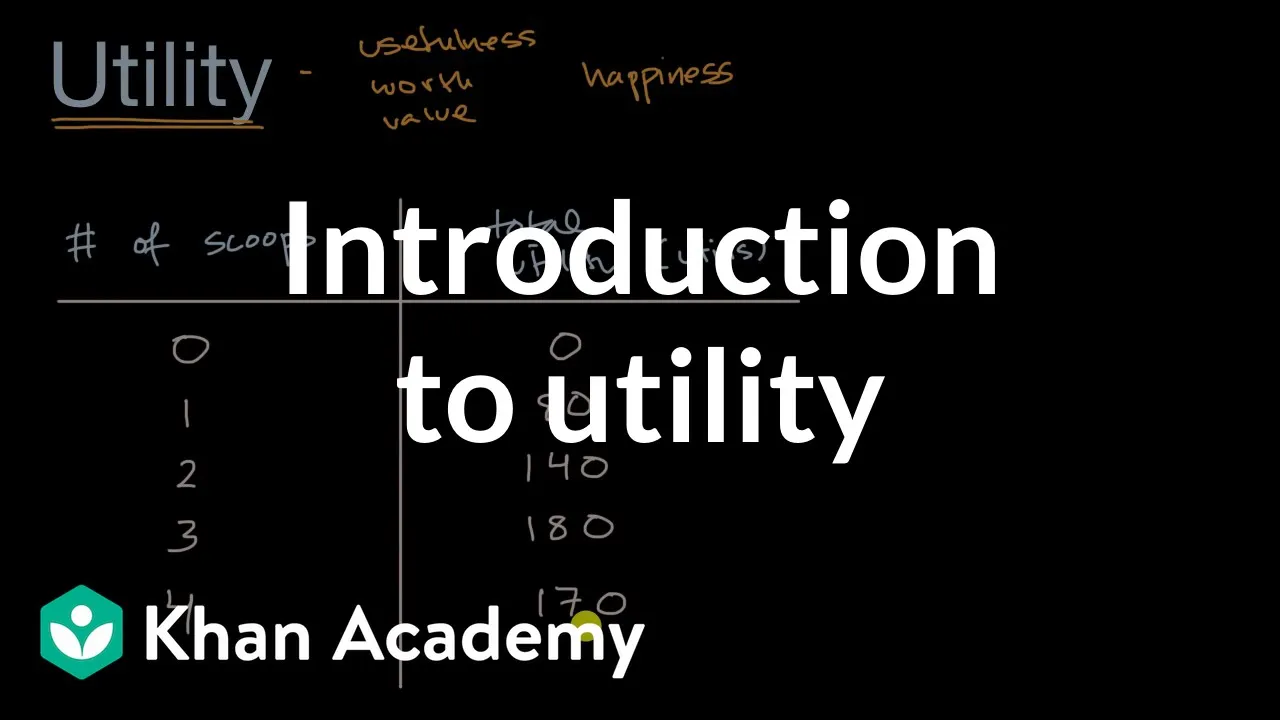
Introduction to utility | APⓇ Microeconomics | Khan Academy
253.1K
Utility in economics measures usefulness, worth, value, and satisfaction/happiness derived from goods or services. Unlike everyday usage, economic utility quantifies subjective satisfaction even for items lacking practical function. Economists use arbitrary units called 'utils' to measure utility, where absolute values are less important than relative ratios between different quantities. Methods to estimate utility include willingness-to-pay surveys and happiness scales. This framework allows economists to analyze consumer behavior and decision-making processes systematically.
Click to watch →
Prerequisite Knowledge
- Concept 01Understanding of traditional pricing models, such as Cost-Plus (pricing based on production cost plus margin) and Competitor-Based pricing.
- Concept 02The concept of Customer Perceived Value (CPV) and how customers weigh perceived benefits against monetary costs.
- Concept 03Basic differences between B2B (Business-to-Business) and B2C (Business-to-Consumer) buying behaviors and decision-making processes.
- Concept 04An introduction to economic utility and how products solve specific customer pain points to create value.
Subsequent Learning
- Step 01Quantitative methods for measuring customer willingness to pay, such as Conjoint Analysis and the Van Westendorp Price Sensitivity Meter.
- Step 02Value Communication strategies: How to effectively market and justify premium pricing to B2B buyers based on ROI.
- Step 03Customer segmentation techniques to offer tiered, value-based pricing structures (commonly used in Software-as-a-Service / SaaS).
- Step 04Developing Value-Based Selling frameworks to train sales teams on selling solutions and outcomes rather than features.
Value vs. Cost
Value vs. Cost
0:09Playing Section
- 1
Value-based pricing defines a right price per customer, focusing on perceived value and alternatives.
- 2
Cost-plus pricing, common in B2B, ignores customer value, leading to underpricing and lost revenue.
- 3
Transitioning to value-based pricing is a multi-year journey with significant challenges.
Cost-Plus Pricing and the Transparency Model
While value-based pricing is praised for maximizing profit margins, critics and traditionalists advocate for Cost-Plus Pricing as a more stable and ethical alternative. Cost-plus pricing determines price by adding a fixed percentage markup to the actual cost of production. Proponents argue that value-based pricing relies on highly subjective, difficult-to-measure customer perceptions, which can lead to unpredictable revenue and complex sales cycles. Furthermore, value-based pricing can border on price gouging or discrimination, potentially alienating customers who feel exploited by opaque pricing models. In contrast, cost-plus pricing offers transparency, simplicity, and predictability. It fosters long-term customer trust because buyers understand they are paying a fair margin over actual production costs, rather than a premium based on their perceived dependency or urgent need.
Deep Dive
Quantitative methods for measuring customer willingness to pay, such as Conjoint Analysis and the Van Westendorp Price Sensitivity Meter.
Master this MISUNDERSTOOD pricing strategy | Willingness to pay
919
There are four effective methods to measure WTP: (1) Conjoint Analysis - presents customers with different feature-price combinations to determine which features drive value; (2) Smart Surveys using the Van Westendorp Price Sensitivity Model, asking four key questions about price thresholds; (3) Behavioral Data analysis through conversion rates at different price points and upsell success rates; (4) AB Testing by experimenting with different price points on different audience segments. These methods help uncover true customer WTP since direct questioning often fails to elicit honest responses.
Click to watch →

Understand in Under 5: Van Westendorp Pricing Analysis
11.5K
The Van Westendorp Price Sensitivity Meter (PSM), developed by Dutch economist Peter Van Westendorp in the 1970s, is a market research technique that measures customer price preferences for new products by asking four price-related questions instead of directly asking for desired prices, thereby avoiding response bias. The analysis identifies two key price points: the Range of Acceptable Prices (where equal percentages consider prices too cheap versus getting expensive, and too expensive versus being a bargain) and the Optimum Price Point (OPP, where equal percentages consider prices both too cheap and too expensive). While useful when no pricing benchmark exists, the method has limitations including susceptibility to strategic responses, ignoring competition and substitutes, and lacking direct links to purchase probability.
Click to watch →

Pricing: Willingness-to-Pay (WTP)
4.7K
Four approaches exist for collecting willingness to pay data. Historical sales data uses scanner data (store-level sales) or panel data (customer-specific purchases) to analyze price-demand relationships. Field tests conduct controlled experiments in isolated markets. Pricing surveys ask yes/no questions at various price points but require large samples and suffer from response biases. Conjoint analysis presents realistic product choices and infers willingness to pay from preferences, offering superior accuracy by mimicking actual purchasing behavior.
Click to watch →

Understand in Under 5: Willingness to Pay
8.1K
Companies can determine how much customers are willing to pay for new product features by using conjoint analysis to calculate utility scores for different attribute levels, then creating a market simulator to compare preference shares at varying price points; for example, if a non-organic product has an 18% preference share at $14.99 and an organic version reaches the same 18% share at $19.99, customers are willing to pay a $4 premium for the organic feature.
Click to watch →

Here’s the prompt 👇🏼 #marketingdigital #business #marketingstrategy #marketingtactics #pricing
73.2K
To determine the optimal product price, ask customers four specific questions about price perception: at what price does the product seem too cheap and doubt quality, at what price does it feel like a good deal, at what price does it start to feel expensive but still acceptable, and at what price is it so expensive that you wouldn't buy it; then plot these responses on a graph where the intersection of all four lines indicates the optimal price point that balances perceived value with customer willingness to pay.
Click to watch →
Deep Dive
Value Communication strategies: How to effectively market and justify premium pricing to B2B buyers based on ROI.

20 KỸ THUẬT KINH DOANH ONLINE HIỆU QUẢ | COACH DUY NGUYỄN
146K
Effective content and value communication drives online sales. Key strategies include: (1) Using high-quality product photography to showcase items professionally; (2) Writing compelling product descriptions that answer customer questions and address objections; (3) Implementing the decoy pricing strategy to guide customers toward profitable options; (4) Using pop-up marketing for customer retention and email list building. These approaches communicate value effectively and guide customers toward purchasing decisions.
Click to watch →

¡LISTA NEGRA!: Sheinbaum NEGOCIA con EU a quién entregar y a quién proteger | MLDA
154.2K
Incarcerated cartel leaders employ strategic communication to maintain influence over criminal organizations and negotiate better conditions. These strategies include coded messages to family members, complaints about treatment, and demands for improved living conditions. Despite incarceration, these leaders maintain authority over criminal networks and possess valuable information about operations, creating ongoing value for authorities while they pursue their own strategic interests.
Click to watch →

Ramit Sethi | Chase Jarvis LIVE | ChaseJarvis
267.5K
Photo editors and art directors face significant risk when hiring new creatives because they're accountable for large budgets. Their primary fear is bringing in unqualified talent who can't deliver results. Creatives must address these fears by demonstrating proven capability rather than expecting clients to recognize brilliance automatically. Price becomes trivial when value is clear—specializing in a narrow niche makes you indispensable. The key is being different, not just better, and teaching clients to revere your work by explaining your unique approach and preparation. Understanding that clients want recognition from peers within their organizations helps position your value appropriately.
Click to watch →

MỀU BẤT NGỜ PHÁT HIỆN TIỆM TẠP HÓA ĐÁNG SỢ NHẤT MINECRAFT*REDHOOD TRỐN KHỎI GIA ĐÌNH KINH DỊ 3H SÁNG
1.3M
This segment explores pricing strategies and value communication in retail environments. The shopkeeper demonstrates how to communicate product value to customers, including explaining pricing, highlighting product features, and creating perceived value. The segment shows how retail workers can justify prices by emphasizing product quality, durability, and benefits. It also illustrates the importance of transparent pricing and building customer trust through honest communication. The segment provides practical examples of how retail workers can effectively communicate product value and justify pricing to customers.
Click to watch →

বহাগী মেলা 2023 sale day 5/toss মেখেলা offer
66K
This segment demonstrates pricing and value communication strategies. The content shows original pricing of 6000 rupees being reduced to 2700 rupees, representing a significant discount. The presentation emphasizes the importance of communicating value through quality indicators, design features, and competitive pricing. The segment illustrates how businesses use price reductions and quality assurances to attract customers and communicate product value effectively.
Click to watch →
Deep Dive
Customer segmentation techniques to offer tiered, value-based pricing structures (commonly used in Software-as-a-Service / SaaS).
![Why SaaS Pricing is So Hard [And How To Make it Easier]](https://i.ytimg.com/vi_webp/s64wyIoqu50/maxresdefault.webp)
Why SaaS Pricing is So Hard [And How To Make it Easier]
4.3K
Railroad tycoons solved the pricing challenge by segmenting customers into affluent, middle-class, and poor groups. A single ticket price creates an optimization problem: pricing for middle-class customers loses revenue from affluent customers who would pay more for first class, while poor customers are priced out. The solution is product differentiation through tiered packaging—adding features like dining wagons and bedding to create first-class options at higher prices while maintaining a core solution for lower-tier customers.
Click to watch →

AI has a subsidization problem
64.2K
Different user archetypes have vastly different lifetime values. A 12-year-old learning to code might use only $15 worth of inference over their lifetime and never pay anything. In contrast, a 42-year-old professional developer could use up to $5,000 in inference monthly and potentially pay $200/month or have their company pay $1 million+ over their career. Even though the professional user costs the company $4,800 more than the child user, the professional represents significantly higher long-term value. Companies must balance attracting users across this spectrum while maintaining profitability.
Click to watch →

How To Price A SaaS: 5 Steps to Follow
2.6K
To price a SaaS product effectively, follow these five steps: (1) segment your audience into distinct groups with different needs and price sensitivities; (2) determine your product's relative value using methods like relative preference analysis; (3) measure customer willingness to pay through techniques such as the Van Westendorp price sensitivity meter or Lincoln Murphy's raise-until-it-hurts method; (4) create tiered pricing packages that match different buyer personas, starting with simple models like free, pro, and enterprise tiers; (5) design a clear, complete, and consistent pricing page that helps customers make informed decisions. This value-based approach ensures pricing reflects customer perceived value rather than just costs or competitor prices.
Click to watch →

Peter Reinhardt, CEO & co-founder, Charm Industrial; CEO & co-founder, Segment
388
Companies should price based on the value delivered to customers rather than development costs. Segment learned to increase prices from $10/month to $120,000 annually by understanding that customers valued time saved on engineering integrations. This demonstrates the importance of value-based pricing over cost-plus pricing models.
Click to watch →

Why Value Based Pricing is the Best Pricing Strategy
7.4K
Value-based pricing is superior to cost-plus pricing for SaaS businesses because customers purchase software to achieve specific business results (making more money, saving money, or reducing risk), not based on the software's development costs; successful SaaS founders must shift their mindset from thinking about what the software costs them to understanding the value customers receive and how much they're willing to pay for that value, while also recognizing that businesses perceive money differently than individuals—$50,000 is a rounding error for large companies but represents significant personal wealth, which helps overcome psychological barriers to charging appropriate prices.
Click to watch →
Deep Dive
Developing Value-Based Selling frameworks to train sales teams on selling solutions and outcomes rather than features.
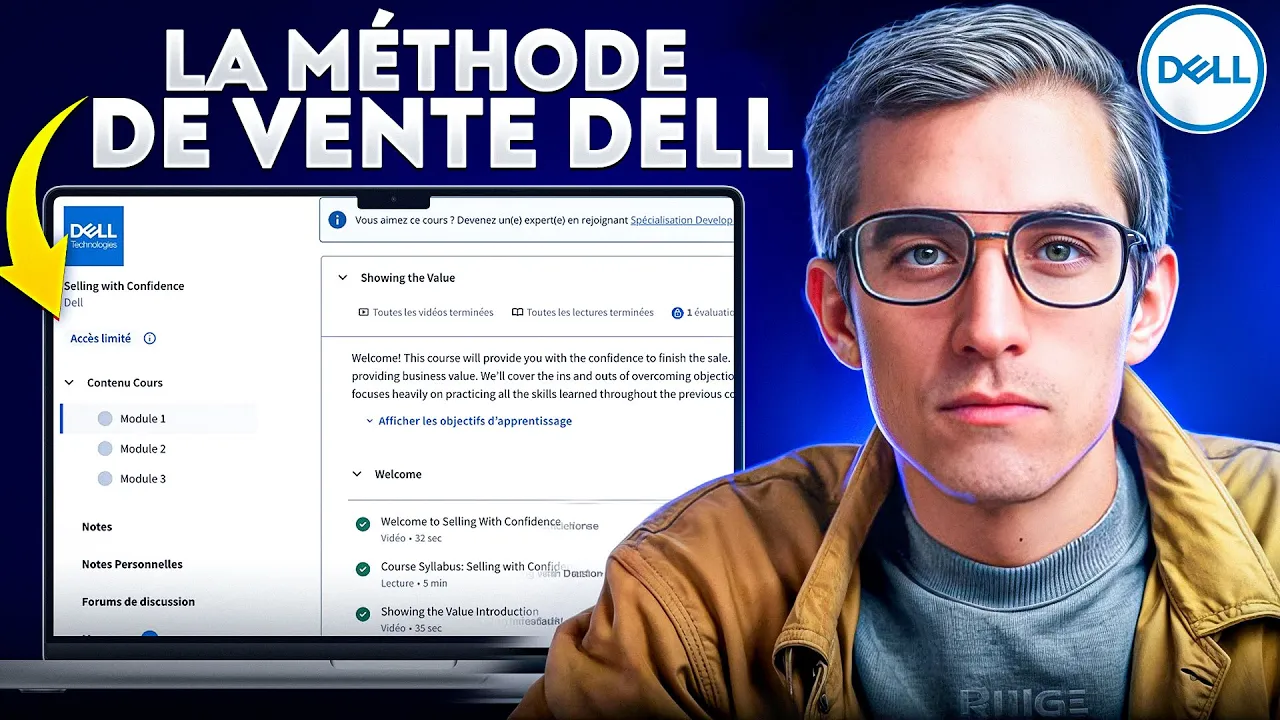
Méthode DELL : J'ai suivi ce cours sur la vente, voici ce qu'il faut retenir
3.8K
Value-based selling centers on demonstrating how solutions improve customer outcomes rather than simply listing features. The CAB model (Caractéristiques, Avantages, Bénéfices) provides a framework: Features describe technical specifications, Advantages explain functional benefits, and Benefits demonstrate personal or business impact. Business value addresses six key areas: improving efficiency, reducing costs, enhancing customer satisfaction, increasing sales, improving ROI, and improving cash flow. Only 3% of buyers believe sellers can clearly differentiate their solutions, highlighting the critical importance of articulating concrete value propositions.
Click to watch →

Why Value? The Fiserv Experience
267
Best organizations increase sales velocity by focusing on customer value rather than product features. Organizations should invest in developing their value propositions because they know their solutions' value better than anyone else. The framework involves: (1) understanding and quantifying organizational value, (2) collaborating cross-functionally to define how solutions help clients make money, save money, reduce risk, or drive retention, (3) validating value propositions with existing customers to ensure relevance, and (4) using value propositions as tools for demonstrating strategic partnership. This approach transforms customer conversations from feature discussions to financial result discussions.
Click to watch →

How to Train Sales Teams on Discovery That Digs Deeper and Closes Bigger | Eleanor Dorfman
742
To successfully transition sales teams from feature-based to value-based selling, organizations must implement a comprehensive approach that includes upfront training with cross-functional leadership, ongoing reinforcement through quarterly trainings and deal reviews, banning product-specific language in discussions, making discovery certification a prerequisite for accessing opportunities, and ensuring managers model complete commitment to the new methodology.
Click to watch →
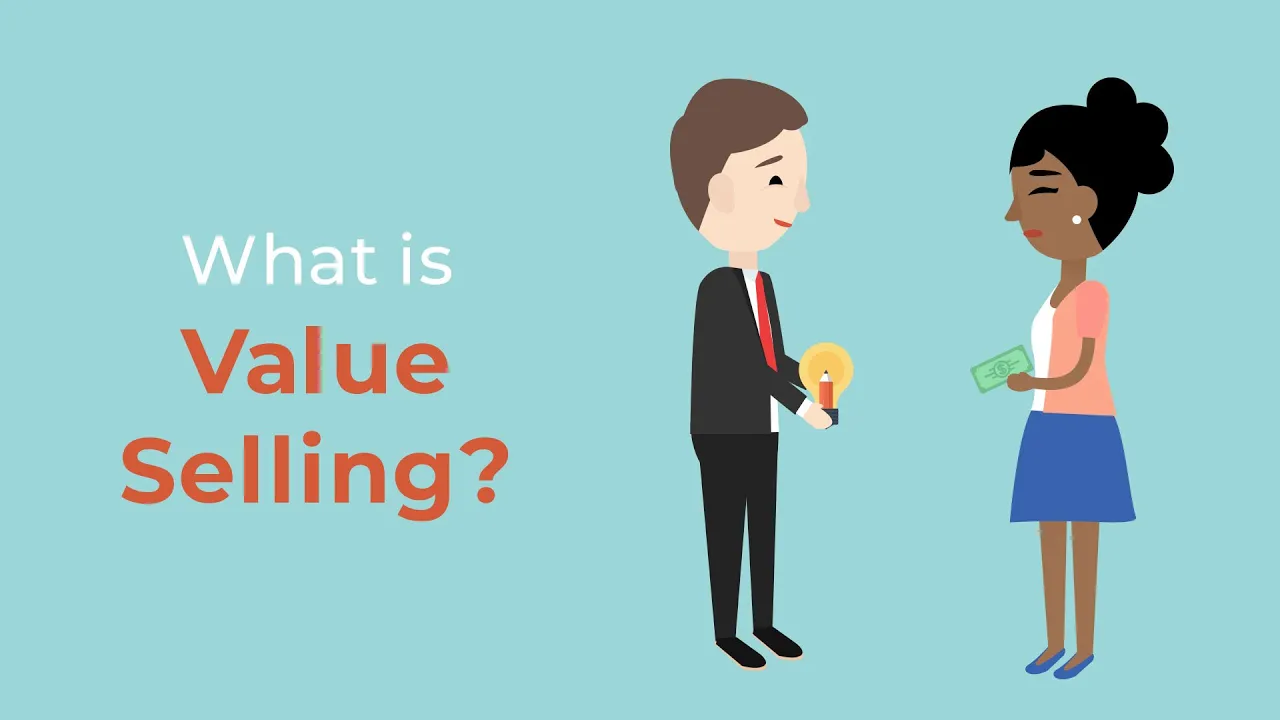
What is Value Selling & Why to Use It | Brian Tracy
43.8K
Value selling is a sales technique where customers don't buy products—they buy the results and benefits. The framework involves: (1) knowing your buyer through research on their needs, preferences, and past experiences; (2) identifying the specific problem they want to solve and how competitors failed; (3) creating a value proposition that connects your solution to their problems; (4) providing evidence of success with similar customers; (5) presenting as a trusted partner rather than a salesperson. This approach builds trust and creates long-term partnerships where both parties benefit.
Click to watch →

Value-based selling for the UX Centric Enterprise
116
Value-based selling is a sales approach that shifts focus from product features and price to quantifiable business outcomes, enabling sales teams to co-create solutions with customers by understanding their specific problems and demonstrating measurable value through iterative prototyping and minimum viable products, thereby transforming the sales process into an innovation pathway grounded in user needs and stakeholder value creation.
Click to watch →
Value vs. Cost
Value vs. Cost
0:09- 1
Value-based pricing defines a right price per customer, focusing on perceived value and alternatives.
- 2
Cost-plus pricing, common in B2B, ignores customer value, leading to underpricing and lost revenue.
- 3
Transitioning to value-based pricing is a multi-year journey with significant challenges.
Cost-Plus Pricing and the Transparency Model
While value-based pricing is praised for maximizing profit margins, critics and traditionalists advocate for Cost-Plus Pricing as a more stable and ethical alternative. Cost-plus pricing determines price by adding a fixed percentage markup to the actual cost of production. Proponents argue that value-based pricing relies on highly subjective, difficult-to-measure customer perceptions, which can lead to unpredictable revenue and complex sales cycles. Furthermore, value-based pricing can border on price gouging or discrimination, potentially alienating customers who feel exploited by opaque pricing models. In contrast, cost-plus pricing offers transparency, simplicity, and predictability. It fosters long-term customer trust because buyers understand they are paying a fair margin over actual production costs, rather than a premium based on their perceived dependency or urgent need.
Understanding of traditional pricing models, such as Cost-Plus (pricing based on production cost plus margin) and Competitor-Based pricing.
The concept of Customer Perceived Value (CPV) and how customers weigh perceived benefits against monetary costs.
Basic differences between B2B (Business-to-Business) and B2C (Business-to-Consumer) buying behaviors and decision-making processes.
An introduction to economic utility and how products solve specific customer pain points to create value.
Quantitative methods for measuring customer willingness to pay, such as Conjoint Analysis and the Van Westendorp Price Sensitivity Meter.
Value Communication strategies: How to effectively market and justify premium pricing to B2B buyers based on ROI.
Customer segmentation techniques to offer tiered, value-based pricing structures (commonly used in Software-as-a-Service / SaaS).
Developing Value-Based Selling frameworks to train sales teams on selling solutions and outcomes rather than features.
13.5K views52likes2:26@fisherosuOriginal Release: 2009-09-10
In this segment, I'll define valuebased pricing and explain why it is still a minority of major businesses that pursue valuebased pricing in instead pursue other strategies for pricing. Valuebased pricing starts with the premise that there is a right price. A right price for each customer, for each product, for each transaction. And at that right price is the one we seek to achieve.
Which means we have to begin by understanding what is value to our customer. And what are their al alternatives, their next best alternative if they choose not to buy from us? And we have to identify how we are different from and better than that alternative. And then we price so that we can achieve some of that additional value perhaps even most of that additional value while retaining the relationship with our customers. Now compare that with what is practiced by many companies.
Cost ba cost plus pricing is perhaps the most common in the businessto business world. And cost plus pricing starts with the idea that we identify our unit cost and then we add a percentage to that that will cover all of our uh fixed cost and profit objectives. The issue with costbased p cost plus pricing is that it does not take into account what is value as perceived by customers. The very best cost plus companies end up leaving substantial amounts of money on the table and they leave that on the table.
Why? Because they have priced for efficiency and their customers stay with them, but their customers would be willing to pay more if if they understood the the additional value that they're receiving. So, so moving from cost plus pricing to valuebased pricing is not easy and it is a journey. I am aware of several major companies that have made that journey and it takes four or five years before you can achieve uh the transition and it has a lot of issues involved in that transition.
We'll comment more on those issues in our next segment.
Up Next

24:42
Consumption-Based SaaS Pricing Models on Snowflake | Guide
@snowflakedevelopers
205 views•2023-01-04

46:36
Retention Habits of Top DTC Ecommerce Brands Revealed
@SendItPodcast
44K views•2026-03-03

15:23
Decoy Effect: How Pricing Psychology Influences Consumer Spending
@bobinvestsUS
90K views•2026-01-05

17:30
The Planned Obsolescence of Light Bulbs and Tech
@veritasium
25.3M views•2021-03-26
Related Study Plans & Knowledge Roadmaps
Structured learning paths in Business
business
Pop-Up Retail: Strategy, Design & Execution
01Introduction to Pop-Up Retail & Strategic Goal Setting
02Budgeting, Site Selection, and Legal Essentials
03Experiential Retail Design & Visual Merchandising
+ 2 more learning modules
15h5 modules
Explore Roadmap
business
Reg CF: Startup Funding, Marketing & Launch
01Introduction to Equity Crowdfunding & Reg CF
02Platform Selection & Legal Preparation
03Crafting High-Converting Campaign Assets
+ 2 more learning modules
14h5 modules
Explore Roadmap
business
Productized Services: Scaling Solo Freelance
01Foundations of Productized Services
02Packaging and Scope Definition
03Pricing and Subscription Models
+ 2 more learning modules
15h5 modules
Explore Roadmap
business
Gov Procurement: Find, Bid & Win Contracts
01Introduction to Government Procurement & Business Setup
02Small Business Certifications & Set-Asides
03Finding and Analyzing Contract Opportunities
+ 2 more learning modules
14h5 modules
Explore Roadmap