DeFi Tokenomics: veTokens & DAO Governance
Learning Goal: Designing DeFi Tokenomics and Governance: Implementing veToken Models and Governor Contracts for DAOs.
By the end of this curriculum, you will master the economic foundations of token design, transition from basic ERC-20 models to complex Vote-Escrowed (veToken) systems, understand how protocols align incentives to prevent governance attacks, and acquire the practical engineering skills required to build, secure, and deploy on-chain governor and timelock contract systems.
- Prerequisites: Basic understanding of programming concepts (variables, functions, control flow). No prior blockchain experience is strictly required, though familiarity with basic Web3 terminology is helpful.
- Estimated Total Study Time: 18 Hours
Module 1: Blockchain, Ethereum, and Smart Contract Basics
Overview
This foundational module introduces you to decentralized computing. You will learn how blockchain structures trust, explore the design of the Ethereum Virtual Machine (EVM) as a "world computer," and start writing your first lines of smart contract code using Solidity.
Recommended Videos
- Why this video: It bridges the gap between Bitcoin's peer-to-peer cash transfer model and Ethereum's programmable ecosystem, explaining smart contracts, gas, and decentralized execution in plain, visual English.
- Why this video: A rapid, zero-friction introduction to Solidity coding. It introduces the Remix IDE, basic types, state variables, arrays, mappings, and function structures required to start programming.

- Why this video: This video offers a quick conceptual layout of how the EVM compiles Solidity high-level contracts into compiled bytecode executed via system opcodes across Ethereum nodes.
Knowledge Checkpoint
- Understand the difference between an Externally Owned Account (EOA) and a Smart Contract Account.
- Explain how gas fees prevent infinite loops on the EVM (Turing-completeness protection).
- Deploy a basic state-storing smart contract inside the Remix IDE sandbox.
- Understand key Solidity visibility modifiers:
public,private,external, andinternal.
Module 2: DeFi Foundations and Tokenomics 101
Overview
This module explores how financial primitives are reconstructed without intermediaries. You will study token economics (supply, demand, allocations, and inflation) and write, compile, and deploy a standard ERC-20 utility token using audited library templates.
Recommended Videos

- Why this video: Serves as a direct, concise introduction to the concept of decentralized finance, highlighting how open-source smart contracts replace the transactional infrastructure of traditional banks.

- Why this video: This high-value breakdown details tokenomic designs, covering circulating vs. fully diluted valuation (FDV), inflation/deflation mechanisms, emissions, and allocation cliffs.

- Why this video: A clear walkthrough showing how to import OpenZeppelin's standard ERC-20 template, inherit constructor logic, mint supply to deployers, and build a customized token on a live test network.
Knowledge Checkpoint
- Define the functions defined in the ERC-20 standard interface (
transfer,transferFrom,approve,allowance,balanceOf,totalSupply). - Differentiate between initial token allocation structures (e.g., team vesting, public sales, liquidity mining).
- Explain the risk of high FDV (Fully Diluted Valuation) combined with low circulating supply.
- Deploy an ERC-20 token and verify its compiled code manually on Etherscan/block explorers.
Module 3: DAO Mechanics and Governance Models
Overview
This module explores Decentralized Autonomous Organizations (DAOs). You will transition from centralized protocol designs to community-owned business models. This section covers off-chain signaling, on-chain voting mechanics, and how smart contracts automate trustless collective decision-making.
Recommended Videos

- Why this video: Provides a dynamic overview of why DAOs are built, emphasizing incentive alignment, the proposal lifecycle, and the democratization of community-owned protocol treasuries.
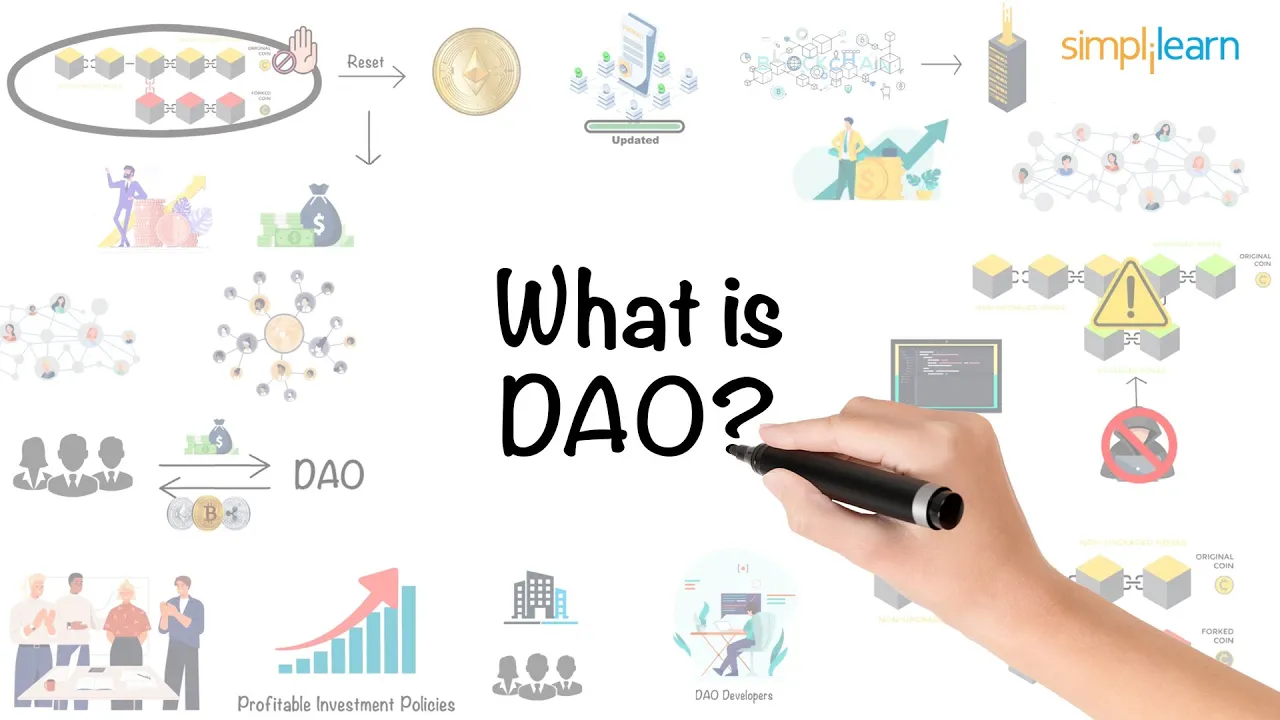
- Why this video: Delves deeper into organizational topology, explaining the role smart contracts play in replacing legacy corporate bylaws, and highlighting operational security considerations.

- Why this video: A practical developer video demonstrating how to construct a custom voting and treasury contract, illustrating how to enforce rules that permit token holders to vote on proposals.
Knowledge Checkpoint
- Understand the core differences between on-chain governance execution and off-chain signaling (e.g., Snapshot).
- Explain how a multi-signature wallet (e.g., Safe) functions as an execution or emergency mechanism for a DAO.
- List the steps of a typical DAO proposal pipeline, from initial RFC (Request for Comment) to code execution.
- Explain the "1 token = 1 vote" model's vulnerability to governance capture by capital-heavy "whales."
Module 4: The Vote-Escrowed (veToken) Model
Overview
This module explores advanced tokenomic engineering. You will dissect the Vote-Escrowed (veToken) model popularized by Curve Finance, studying how locking up utility tokens aligns long-term stakeholder incentives, multiplies voting power, boosts yields, and sparks ecosystem proxy wars.
Recommended Videos
- Why this video: An exceptional structural analysis of the "Curve Wars," explaining why protocols buy up governance influence to direct token emission rewards (bribes) to their specific pools.
- Why this video: Explores the relationship between Curve (CVX). It illustrates how Convex acts as a secondary optimization layer that aggregates voting power.

- Why this video: Explains the evolution of the veToken model into the ve(3,3) design, which merges vote-escrow mechanisms with game-theoretic Olympus DAO mechanics (rebase mechanics).
⚠️ CRITICAL KNOWLEDGE GAP ALERT
While the recommended videos explain the economics and history of the "Curve Wars" and Convex optimization layers, the current video pool does not contain a step-by-step Solidity coding guide for veToken smart contracts from scratch.
To fill this gap, you are highly encouraged to independently search for:
- "Curve VotingEscrow.vy GitHub" to read the original mathematical contract written in Vyper.
- "How to code a veToken staking contract in Solidity" on YouTube or Cyfrin Updraft.
- Analyze how voting power decays linearly over time using the formula: .
Knowledge Checkpoint
- Explain why locking up tokens reduces circulating sell pressure while aligning staker interests with long-term protocol health.
- Explain the mathematical decay of voting power in a veToken model as the unlock date approaches.
- Describe how Convex Finance accumulated veCRV tokens to offer liquid wrapper tokens ($cvxCRV) to users.
- Compare the classic veToken framework to Andre Cronje's ve(3,3) tokenomics model.
Module 5: Implementing On-Chain Governor Contracts
Overview
In this final, highly technical module, you will learn how to design, deploy, and configure secure, production-grade on-chain governance systems. You will learn how to connect OpenZeppelin's standard Governor implementation with a TimelockController to defend against flash-loan voting attacks.
Recommended Videos
- Why this video: Deeply technical tutorial showing how to write a Time Lock contract from scratch. It explains why a delay buffer is essential to protect users from malicious upgrades or sudden administrative actions.

- Why this video: A comprehensive, full-stack guide that introduces OpenZeppelin standard parameters, demonstrating how Governor contracts utilize voting delays, proposal thresholds, and voting periods.
⚠️ CRITICAL KNOWLEDGE GAP ALERT
OpenZeppelin's Governor standards rely heavily on ERC20Votes (checkpointing token balances to prevent double-voting inside a single block). Standard ERC-20 tokens are not directly compatible with governance without this wrapper!
To ensure your code compiles and operates securely under real-world conditions, search for:
- "OpenZeppelin Governor contract Solidity tutorial Patrick Collins" or visit Cyfrin Updraft to watch full-scale deployment workflows.
- Study ERC20Votes.sol to understand checkpoints, delegation functions, and how they protect governance against flash-loan manipulation.
Knowledge Checkpoint
- Explain why we must use an ERC-20 token that inherits
ERC20Votes(checkpointing) instead of a vanilla ERC-20 token for governance. - Identify the purpose of a
Voting Delay(allowing users to delegate or purchase voting weight before the vote snapshot occurs). - Explain why a
TimelockControlleris set as the executive "owner" of a DAO's smart contract infrastructure. - Define "Quorum" and "Proposal Threshold" as configured parameters in OpenZeppelin's wizard.
Course Map
This map outlines the path of your study journey. Ensure you complete the checkpoints in each module before progressing to the next.
Key People Index
- Vitalik Buterin Co-founder of Ethereum. First proposed the abstract concept of Decentralized Autonomous Organizations (DAOs) in 2013-2014, shifting block networks from financial registries to general-purpose execution engines.
- Michael Egorov Founder of Curve Finance. He designed and implemented the original Vote-Escrowed () token model to align liquidity providers with long-term governance participants.
- Andre Cronje Prolific DeFi builder and creator of Yearn Finance. He designed the ve(3,3) model, combining locking mechanisms with emission-regulating game theory.
- Nick Szabo Computer scientist and cryptographer. He originally defined the concept of "Smart Contracts" in 1994, describing them as digital vending machines that automate the execution of contract terms.
Final Self-Assessment
Complete this comprehensive self-assessment to verify that you have achieved the core competencies of this program:
- EVM Fundamentals: Can you explain the structural execution differences between storage, memory, and calldata inside a Solidity smart contract?
- ERC-20 Architecture: Can you implement, test, and deploy a standard ERC-20 token contract using OpenZeppelin imports?
- Tokenomics Design: Can you calculate a project's FDV and explain the economic hazards of high emission cliffs for early investors?
- DAO Topology: Can you describe the benefits and security trade-offs of off-chain signaling (Snapshot) versus direct on-chain execution?
- veToken Mechanics: Can you explain the exact mathematical relationship between locking duration, token quantity, and resulting voting power?
- The Convex Layer: Can you explain how Convex Finance aggregates veCRV to dominate emissions directions, and how "bribes" motivate this ecosystem?
- Checkpointed Tokens: Can you write a Solidity contract that imports
ERC20Votesand explain how checkpoint historical records protect against flash loan attacks? - Timelock Security: Can you detail why the on-chain Governor contract issues executions to a Timelock contract instead of directly acting on target systems?
- Governor Architecture: Can you map out the state transitions of an on-chain proposal from
Pending, toActive,DefeatedorSucceeded,Queued, and finallyExecuted?