

![[Introduction to Linguistics] Constituency Tests](https://i.ytimg.com/vi_webp/5wTem6TBbPI/maxresdefault.webp)
![[Introduction to Linguistics] Word Classes and Constituency](https://i.ytimg.com/vi/0mGhB0hHleY/maxresdefault.jpg)
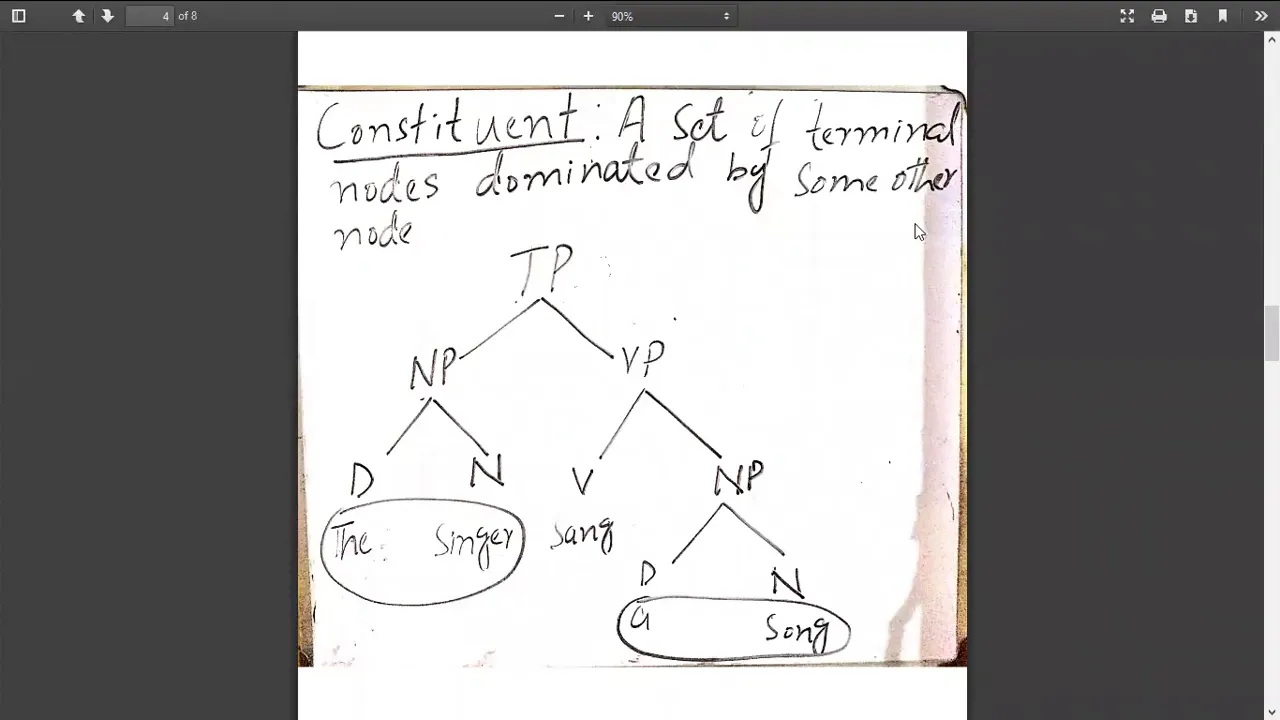
![[Syntax] Constituents](https://i.ytimg.com/vi_webp/Ia7d4slVL6s/maxresdefault.webp)



![[렉처북] ≪Syntax - A Generative Introduction≫ by 김정석 교수 E04 - Phrase Structure](https://i.ytimg.com/vi/d5IjjPjm-QE/hqdefault.jpg)


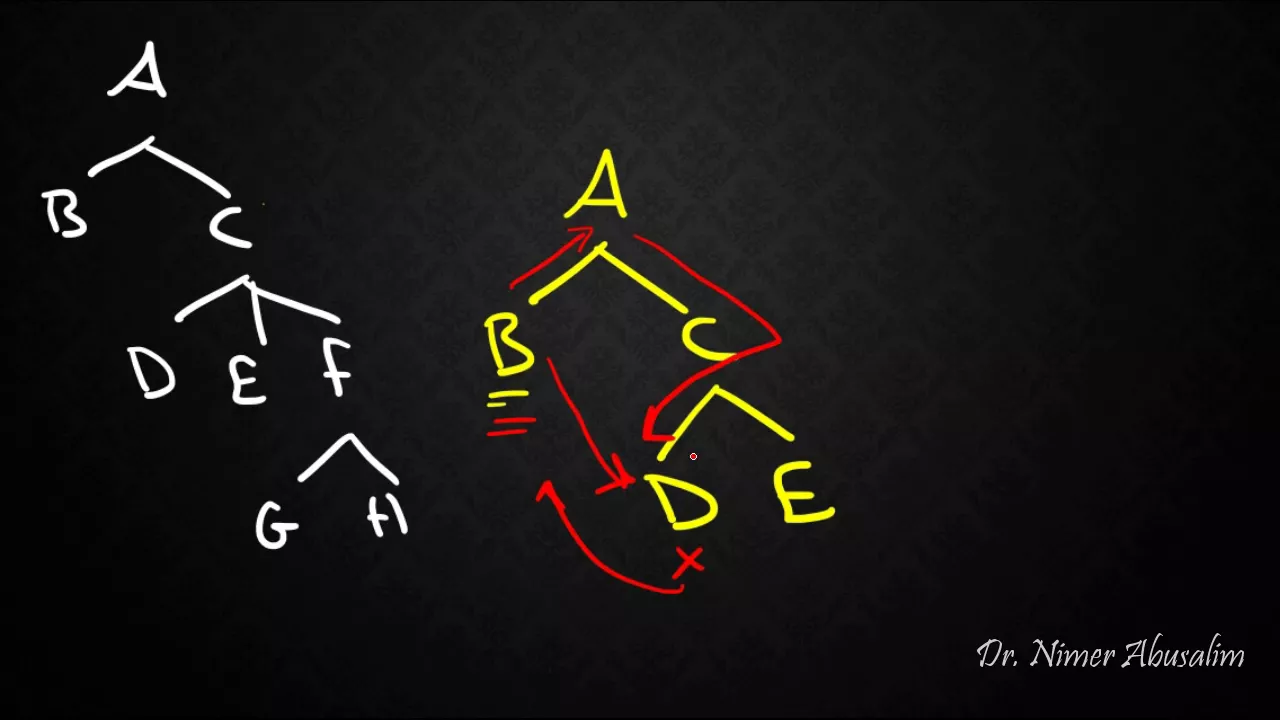
![[Syntax] Tree Structure Relations and C-Command](https://i.ytimg.com/vi_webp/YlflE0flai0/maxresdefault.webp)



![Syntax IV: Linguistics 101 [Video 8]](https://i.ytimg.com/vi/D8N_jNJLats/hqdefault.jpg)






![[Syntax] Binding Principles A, B, and C](https://i.ytimg.com/vi_webp/U6McDsR9YeA/maxresdefault.webp)







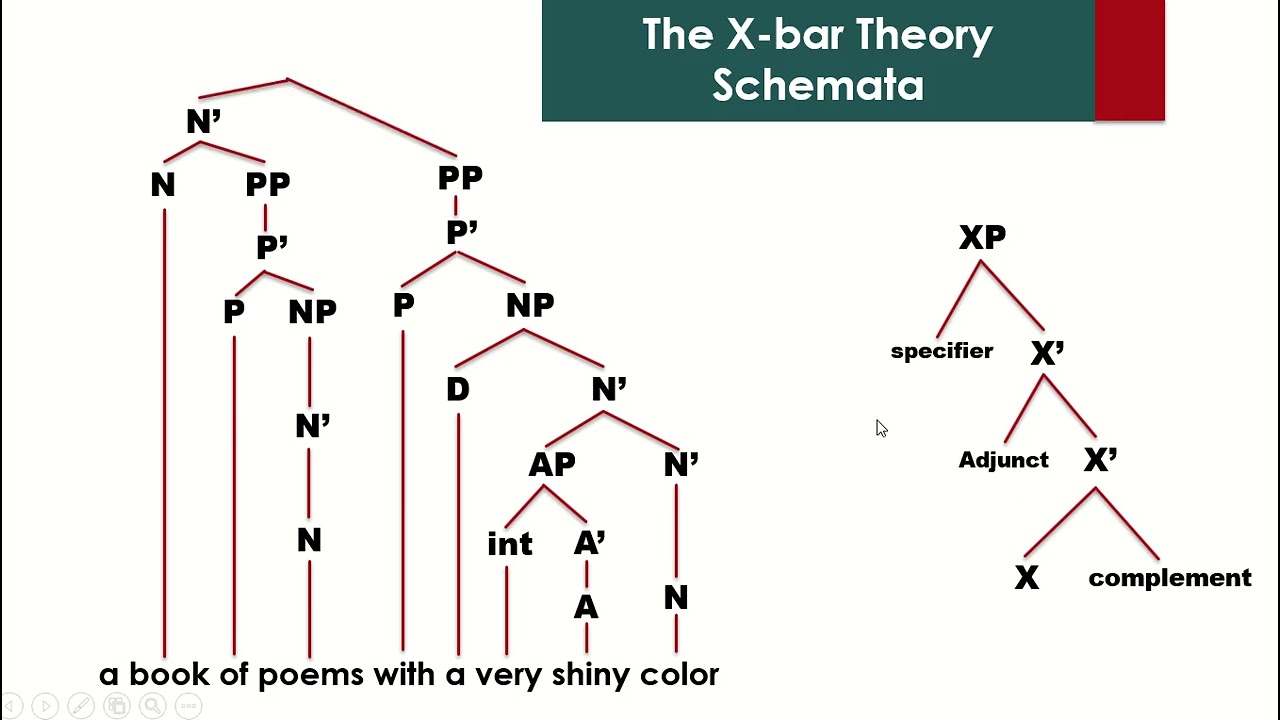
In X-bar theory, when drawing phrase structure trees, you must distinguish between three types of modifiers: complements (which are daughters of bars and sisters to heads), adjuncts (which are daughters of bars and sisters to bars, requiring an extra bar level), and specifiers (which are daughters of phrases and sisters to bars); the number of bar levels equals the number of adjuncts plus one, and you should attach complements first, then adjuncts, then specifiers when building trees from bottom to top.
How to Draw X-bar Trees: Complements vs Adjuncts Explained
Added:Basic syntactic categories (lexical vs. functional) and parts of speech such as Nouns, Verbs, Adjectives, and Prepositions.
The concept of constituency in linguistics and how to perform basic constituency tests (e.g., substitution, movement, coordination).
An introduction to Phrase Structure Rules and the basic concept of hierarchical sentence structure vs. linear word order.
Familiarity with structural tree terminology, such as nodes, mother/daughter relationships, and sisterhood.
Defining and calculating advanced structural relations in trees, specifically c-command and asymmetric c-command.
The syntax of functional projections, including Tense Phrases (TP), Complementizer Phrases (CP), and Determiner Phrases (DP).
Syntactic movement operations (such as head-to-head movement and Wh-movement) and how to represent them using traces or copy theory in X-bar trees.
Applying hierarchical tree structures to Binding Theory (Principles A, B, and C) to explain pronoun and anaphor distribution.
Exploring cross-linguistic parametric variation in X-bar theory, such as head-initial versus head-final parameter settings.
20.2K views339likes13:13Original Release: 2020-08-24
[Music] welcome to syntax a generative introduction fourth edition my name is andrew carney i'm a professor of linguistics at the university of arizona i'm the author of your textbook and i'll be leading you through this series of video tutorials this video is about how to draw x-bar trees it relies upon many of the skills that you've already learned about for drawing trees using phrase structure rules but there are a couple of additional little twists that you have to be aware of so first of all just like when you're drawing a tree with a phrase structure rule you want to identify the parts of speech for all the words that go together you do want to figure out what goes together in phrases just like you do in with phrase structure rules and again you're going to apply the rules bottom uh from backwards effectively from bottom to top if if you want to do it that way or you can also do it from top to bottom but the order of things you do is effectively reversed you've got to determine and this is the new thing you've got to determine whether each modifier to a head is a complement an adjunct or a specifier and then you have to draw it in the right way so compliments are sisters to heads daughters of bars address our sister to bars daughter of bars and specifiers are daughters of phrases sister to bars one of the most common kinds of errors that people make in x-bar trees is they draw adjuncts and as complements or adjuncts and as specifiers not noticing that they're doing so so you'd be you have to be really careful to make sure that if something is an adjunct then it's in as a daughter of bar sister to bar and if it's a compliment it's daughter of a bar sister to a head and if it's a specifier daughter of a phrase sister to a bar don't forget uh to check your trees against your rules that's an important thing and another thing is that if you're working from the bottom to the top you want to start with the modifiers that are closest to the head because if you look at x-bar trees when you move away from the head that's when you're going up the tree now if you want to draw trees from the top to the bottom that is also fine i'm not going to demonstrate that here but effectively you do things in the reverse order you're going to put specifiers in first then you're going to do adjuncts then you're going to do compliments let's look um at one thing that i want to draw your attention to to be very careful about first of all all phrases have at least this amount of structure in them because there's none of the rules are actually optional so um for example you in order to have a head noun you have to have an n bar on top of it and in order to have a noun phrase you have to have an n bar underneath it so the minimal structure you're going to have for any phrase is this amount of x of tree now this may seem excessive to you why do you have all this structure when it's just a noun inside of a noun phrase but we'll come back to that secondly you want to make sure that you don't forget about those adjuncts that adjuncts are daughters of bars sister to bars you've got to have that extra bar level in here here's a cue that might help you one way to know how many bar levels there are in a tree is to count the number of adjuncts and add one so in this noun phrase we have one adjunct from phoenix that means we have to have two n bars similarly if we had two adjuncts we would have to have three n bars this is a really great way to check to make sure that your tree has the right number of bar levels in it count the number of adjuncts add one and that's the number of bar levels you have so let's draw a tree here as practice we're going to start with we're doing a bottom to top tree and we're going to start with our adjectives there are no adjectives here or adverbs so we're going to go straight to noun phrases and we're going to start on the right hand edge of the tree because that's the most deeply embedded structure and we can ask ourselves about the noun puddle um what elements modify puddle there's only one here it's the determiner and determiners have to be daughter of phrase sister to bar so we're going to need a bar level for it to be sister 2 and we want this d to be daughter of the phrase so we're going to draw this much structure in this determiner is sister to a to a bar daughter of a phrase now um we're going to just work our way to the left here it's often best to just do prepositional phrases whenever you have the opportunity whenever you have a preposition followed by a noun phrase that's a prepositional phrase but in x-bar theory this noun phrase is the complement to the preposition so it has to be daughter of a bar so that mp is daughter of a bars to a head that makes it the complement of the preposition then to close off this prepositional phrase to show that there are no more modifiers we put the pp on top vacuously next let's look at poems does anything modify poems well are the poems in a puddle i don't think that's what in a puddle modifies in a puddle tells you where the finding happened so be careful not to attach in the puddle into this now remember the principle of modifications as you attach the phrase into the structure precisely so that it is near the head or attached to a projection of the head that it modifies so in this case there are no modifiers of poems so we're just going to stick that minimal amount of structure on top now again we have a preposition followed by a noun phrase that is always going to be a prepositional phrase that noun phrase is a complement to the preposition so it's daughter of a bar sister to a head and you put the pp on top make sure you have that structure just like that okay now let's go to net the noun books now what modifier does book have it has two modifiers it has the determiner ah and it has the the prepositional phrase of poems we can tell of poems as a compliment here because you can't stick anything in between you can't say a book from phoenix of poems that's not grammatical you also can just quickly tell this using the heuristic i gave you that of always marks compliments so this prepositional phrase is going to be um a sister to the head and a daughter of the bar the determiner is going to be the ant is going to be the specifier if you're doing um trees from the bottom up you want to do your compliments then your adjuncts then your specifiers so we're going to attach the compliment in first and it's going to be daughter of a bar sister to a head next we have a bar level here and we want this determiner to be sister to that that bar level and we want it to be daughter to a phrase ask yourself this question how many adjuncts are there in this noun phrase the answer is zero add one that's the number of n bars you have so we have one n bar because there's no adjects okay let's move on to brazil nothing modifies brazil so we're just going to draw the the full x um x-bar structure on top of it and just as before we're going to put the prepositional phrase on top of that okay now let's look at man what modifies man man has two modifiers it has the the determiner and it has from brazil so let's ask ourselves what these things are the determiner is going to be the specifier so it's going to be the last thing we join into this noun phrase what about from brazil is it a compliment or an adjunct you could use your quick test which is it has a preposition other than of which tells you it's an adjunct but you can do other tests as well so you can say things like the man with the coat from brazil so you can put in another modifier between man and from brazil so that tells you it's an adjunct here's the tricky thing you have to do adjuncts have to be sister to bar and daughter to bar so we had to add in an extra little n-bar category above the n for this prepositional to b this prepositional phrase to be sister to this in effect is what creates that prepositional phrase as an adjunct we can add the specifier in on top it's that determiner is sister to a bar level daughter of a phrase let's just check this noun phrase with our rule about counting n bar levels how many adjuncts do we have we have one adjunct that means we have two n-bar levels okay next we're going to do the verb phrase so what things modify the verb there are two nouns well there's a noun phrase and a prepositional phrase that modified the verb the noun phrases a book of poems and the prepositional phrases in the puddle so are we are these complements or adjuncts well we can first of all see that the noun phrase is a complement there's a number of ways to know this one heuristic is it's the direct object so that means it's going to be the complement but it's also the case that in english you can't stick anything in between it and the head so you can't say found quickly a book of poems that's not grammatical in english so we know then that this noun phrase has to be the complement of the verb that means it's sister to the verb and daughter of the verb bar like this the prepositional phrase we add next because it's an adjunct how do we know it's an adjunct because we already have a compliment and you're only allowed to have one compliment so this adjunct here has to be sister to a bar daughter of a bar now this is a little bit different than the previous case that we looked at with man from brazil although in the puddle is an adjunct just like from brazil is an adjunct we don't need to add an extra v bar into the structure we already have one it's the one that we put on top of the complement and the verb so we want this prepositional phrase to be sister to that v bar that already exists and we're going to put the v bar on top of it we always just close out our tree with the vp on top like i said we're going to come back to that little puzzle later and for the moment we're going to treat tp as we did with our phrase structure rules when you have a noun phrase followed by a verb phrase you have a tp so that's constructing a tree using x-bar theory you want to pay attention to what is a complement and what is an adjunct and you want to make sure that the number of v-bars or n bars etc is one more than the number of adjuncts you also want to construct it so that you attach complements to heads first then adjuncts then specifiers if you were drawing the tree from the top down it's the reverse order stick the um specifier in first then do all the adjuncts and then put the complement in last [Music] you
Up Next
16:02
CP in X-bar Syntax: Yes/No Questions & Clause Structure
@DrNimerAbusalim
31K views•2017-09-30
36:52
Constraint Interaction in Optimality Theory: Epenthesis & Deletion
@Vidyamitra
180 views•2018-08-20

18:22
Syntax: DP Movement & Case Theory Explained by Andrew Carnie
@CarnieSyntaxthEdition
14.3K views•2020-09-29

21:32
Accent Expert Explains U.S. Regional Dialects | Part 1
@WIRED
9.3M views•2021-01-21
Related Study Plans & Knowledge Roadmaps
Structured learning paths in Linguistics
linguistics
Optimality Theory: Tableaux & Constraints
01Phonological Basics: Sounds, Syllables & Rules
02Foundations of Optimality Theory: GEN, CON, and EVAL
03The Constraint Inventory: Markedness vs. Faithfulness
+ 2 more learning modules
15h5 modules
Explore Roadmap
linguistics
Morphosyntactic Alignment: S, A & P Systems
01Foundations of Syntax: Transitivity and Arguments
02The Linguistic Variables: Mapping S, A, and P
03Nominative-Accusative Alignment
+ 3 more learning modules
12h6 modules
Explore Roadmap
linguistics
Analyzing Sign Language: Phonology & Syntax
01Foundations of Sign Language Linguistics
02Phonology: The Five Parameters of a Sign
03Morphology: Word Formation and Classifiers
+ 2 more learning modules
14h5 modules
Explore Roadmap
linguistics
Pragmatics: Speech Acts, Grice & Politeness
01Introduction to Pragmatics: Meaning in Context
02Grice’s Cooperative Principle & Implicature
03Speech Act Theory
+ 2 more learning modules
14h5 modules
Explore Roadmap