





![Glucólisis anaeróbica y aeróbica [FERMENTACIÓN Y RESPIRACIÓN]](https://i.ytimg.com/vi/L2ydeTGEU-8/maxresdefault.jpg)










Cellular respiration is the process by which cells convert glucose and oxygen into ATP (adenosine triphosphate), the energy currency of cells, through three main stages: glycolysis (breaking glucose into pyruvate, producing 2 ATP), the Krebs Cycle (processing pyruvate into acetyl-CoA and generating NADH and FADH2), and the electron transport chain (using NADH and FADH2 to produce approximately 34 ATP); overall, one glucose molecule yields about 38 ATP molecules through this aerobic process.
Cellular Respiration & ATP: Crash Course Biology
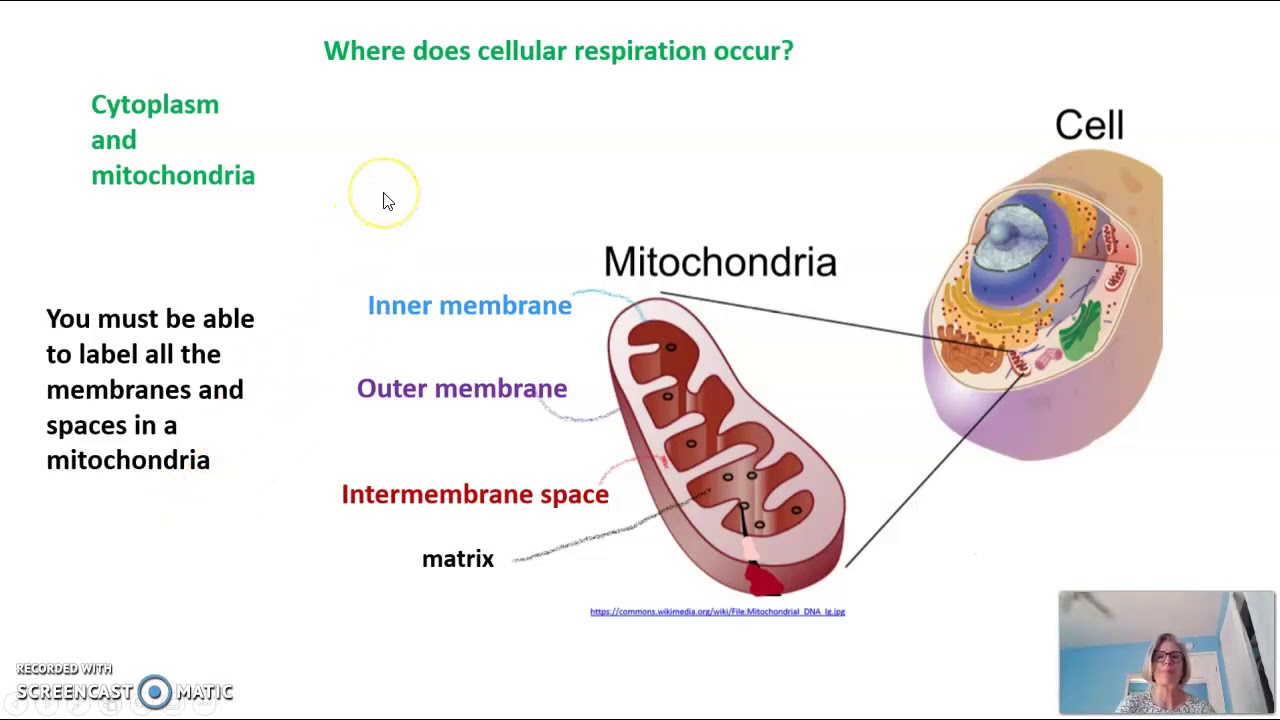
Added:Basic cell anatomy, specifically the structures of the cytoplasm and the mitochondria where cellular respiration takes place.
The chemical structure of glucose and the concept of ATP (Adenosine Triphosphate) as the universal energy currency of cells.
Fundamental chemical concepts, including covalent bonds, oxidation-reduction (redox) reactions, and how enzymes function as biological catalysts.
The overarching chemical equation for cellular respiration, identifying the key reactants (glucose and oxygen) and products (carbon dioxide, water, and ATP).
Anaerobic respiration and fermentation pathways (such as lactic acid and alcoholic fermentation) used by cells in the absence of oxygen.
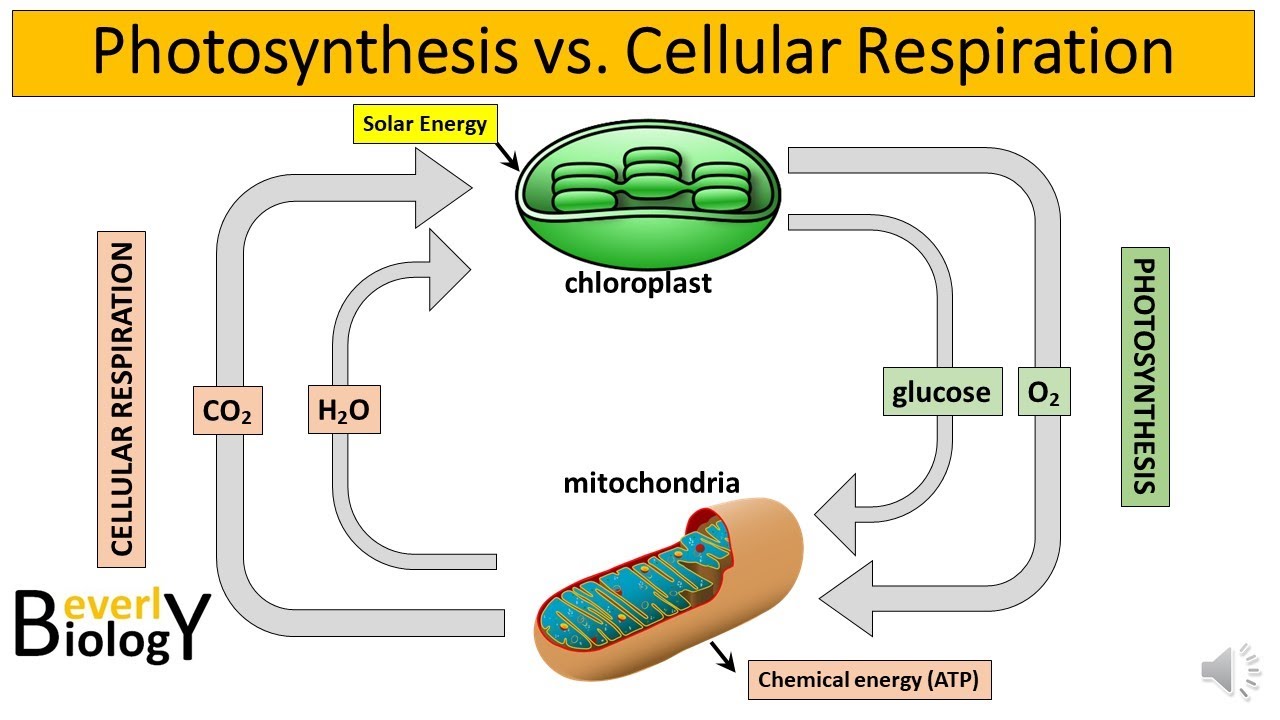
The process of photosynthesis, examining how autotrophs capture light energy to synthesize the glucose that fuels cellular respiration.
Alternative metabolic pathways, including how lipids (beta-oxidation) and proteins (amino acid deamination) are integrated into the citric acid cycle for energy.
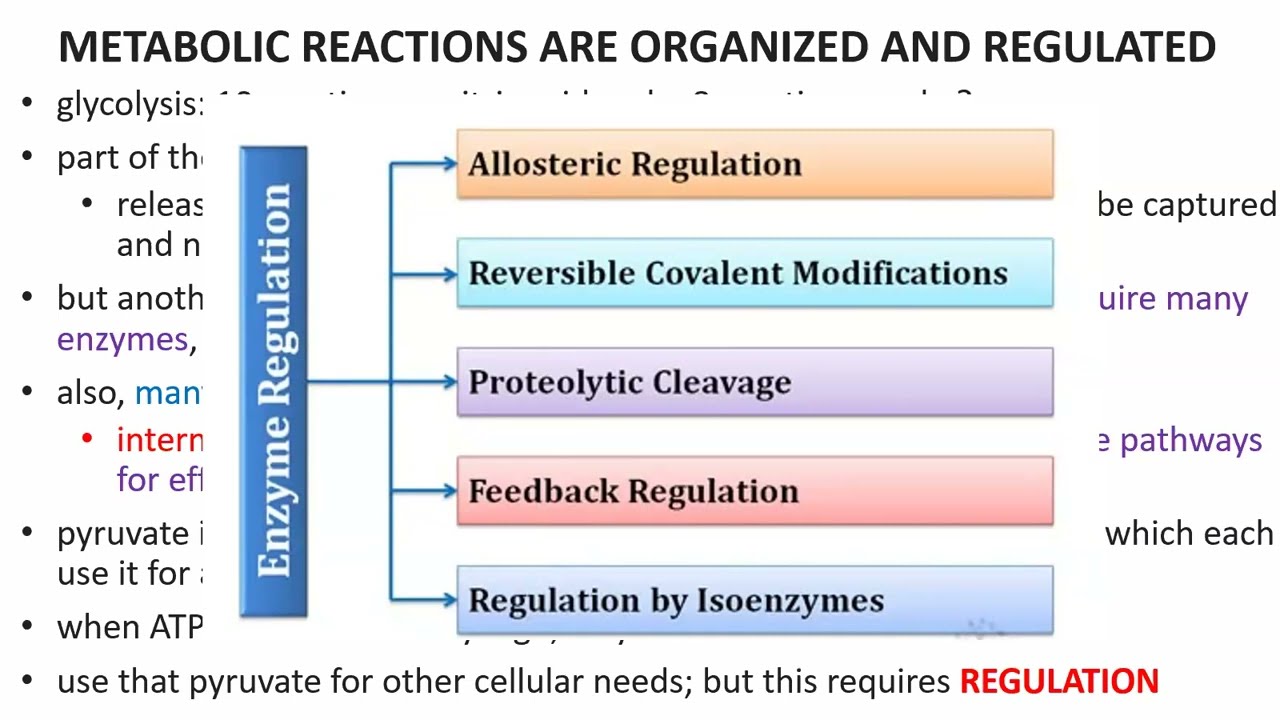
Metabolic regulation and feedback inhibition, specifically how cells control ATP production through key regulatory enzymes like phosphofructokinase.
The evolutionary significance of metabolic pathways, such as the primordial origins of glycolysis and the endosymbiotic theory of mitochondria.
11.4M views115.8Klikes13:25Original Release: 2012-03-12
Oh, hello there. I'm at the gym. I don't know why you're here, but I'm going to do some pushups, so you can join me on the floor if you want.
Now, I'm not doing this to show off or anything. I'm actually doing this for science.
[pained grunt] You see what happened there?
My arms moved, my shoulders moved, my back and stomach muscles moved, my heart pumped blood to all those different places. Pretty neat, huh?
Well, it turns out that how we make and use energy is a lot like sports or other kinds of exercise It can be hard work and a little bit complicated but if you do it right, it can come with some tremendous payoffs.
But unlike hitting a ball with a stick, it's so marvelously complicated and awesome that we're still unraveling the mysteries of how it all works. And it all starts with a marvelous molecule that is one of you best friends: ATP.
Today I'm talking about energy and the process our cells, and other animal cells, go through to provide themselves with power.
Cellular respiration is how we derive energy from the food we eat--specifically from glucose, since most of what we eat ends up as glucose.
Here's the chemical formula for one molecule of glucose [C6H12O6]. In order to turn this glucose into energy, we're going to need to add some oxygen. Six molecules of it, to be exact.
Through cellular respiration, we're going to turn that glucose and oxygen into 6 molecules of CO2, 6 molecules of water and some energy that we can use for doing all our push ups.
So that's all well and good, but here's the thing: We can't just use that energy to run a marathon or something. First our bodies have to turn that energy into a really specific form of stored energy called ATP, or adenosine triphosphate. You've heard me talk about this before. People often refer to ATP as the "currency" of biological energy.
Think of it as an American dollar--it's what you need to do business in the U.S. You can't just walk into Best Buy with a handful of Chinese yen or Indian rupees and expect to be able to buy anything with them, even though they are technically money. Same goes with energy: In order to be able to use it, our cells need energy to be transferred into adenosine triphosphate to be able to grow, move, create electrical impulses in our nerves and brains. Everything. A while back, for instance, we talked about how cells use ATP to transport some kinds of materials in and out of its membranes; to jog your memory about that you can watch it right here.
Now before we see how ATP is put together, let's look at how cells cash in on the energy that's stashed in there.
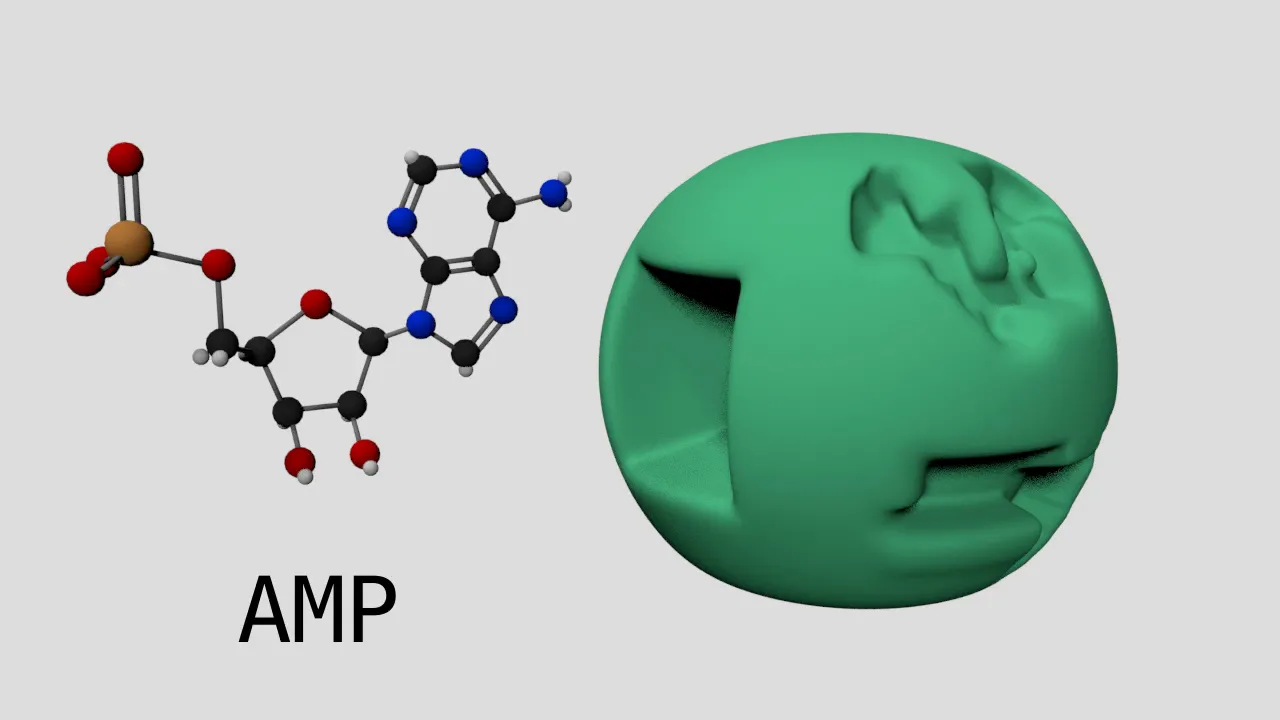
Well, adenosine triphosphate is made up of an nitrogenous base called adenine with a sugar called ribose and three phosphate groups attached to it: Now one thing you need to know about these 3 phosphate groups is that they are super uncomfortable sitting together in a row like that -- like 3 kids on the bus who hate each other all sharing the same seat.
So, because the phosphate groups are such terrible company for each other, ATP is able to do this this nifty trick where it shoots one of the phosphates groups off the end of the seat, creating ADP, or adenosine diphosphate (because now there are just two kids sitting on the bus seat). In this reaction, when the third jerk kid is kicked off the seat, energy is released.
And since there are a lot of water molecules just floating around nearby, an OH pairing -- that's called a hydroxide -- from some H2O comes over and takes the place of that third phosphate group. And everybody is much happier.
By the way? When you use water to break down a compound like this, it's called hydrolysis -- hydro for water and lysis, from the Greek word for "separate."
So now that you know how ATP is spent, let's see how it's minted -- nice and new -- by cellular respiration.
Like I said, it all starts with oxygen and glucose. In fact, textbooks make a point of saying that through cellular respiration, one molecule of glucose can yield a bit of heat and 38 molecules of ATP. Now, it's worth noting that this number is kind of a best case scenario. Usually it's more like 29-30 ATPs, but whatever -- people are still studying this stuff, so let's stick with that 38 number.
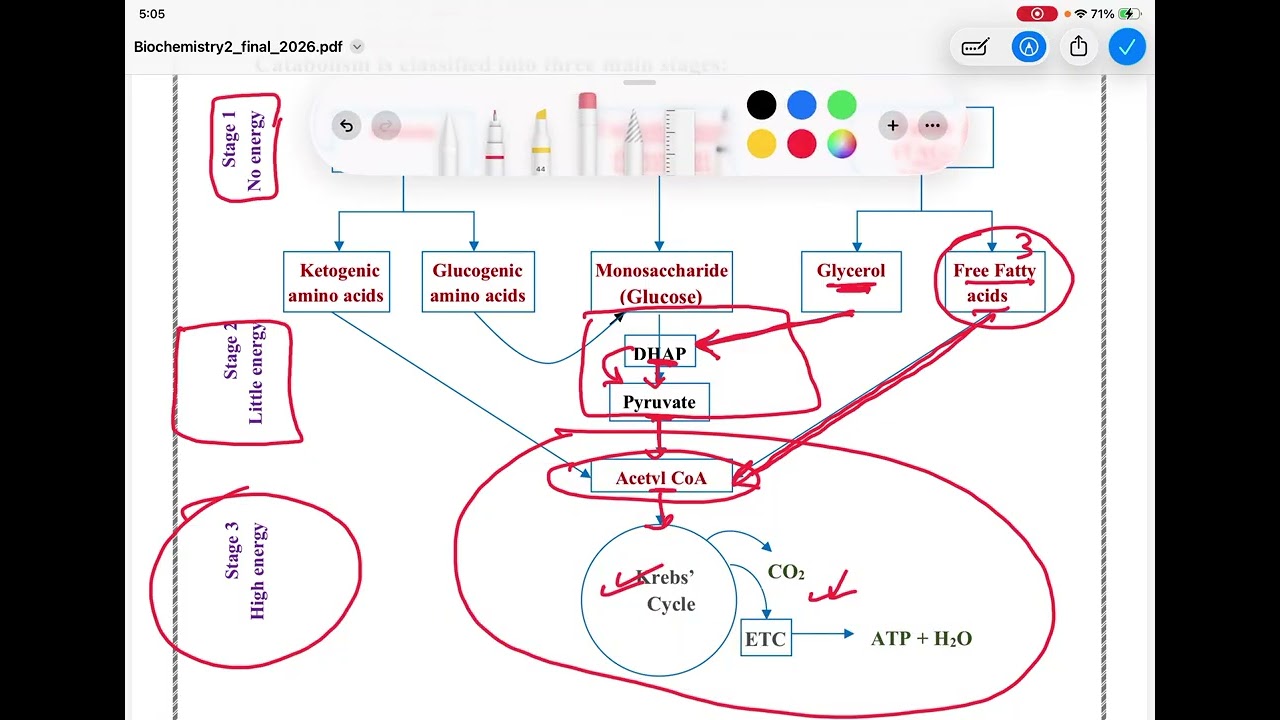
Now cellular respiration isn't something that just happens all at once -- glucose is transformed into ATPs over 3 separate stages: glycolysis, the Krebs Cycle, and the electron transport chain. Traditionally these stages are described as coming one after the other, but really everything in a cell is kinda happening all at the same time.
But let's start with the first step: glycolysis, or the breaking down of the glucose.
Glucose, of course, is a sugar--you know this because it's got an "ose" at the end of it. And glycolysis is just the breaking up of glucose's 6 carbon ring into two 3-carbon molecules called pyruvic acids or pyruvate molecules.
Now in order to explain how exactly glycolysis works, I'd need about an hour of your time, and a giant cast of finger puppets each playing a different enzyme, and though it would pain me to do it, I'd have to use words like phosphoglucoisomerase.
But one simple way of explaining it is this: If you wanna make money, you gotta spend money.
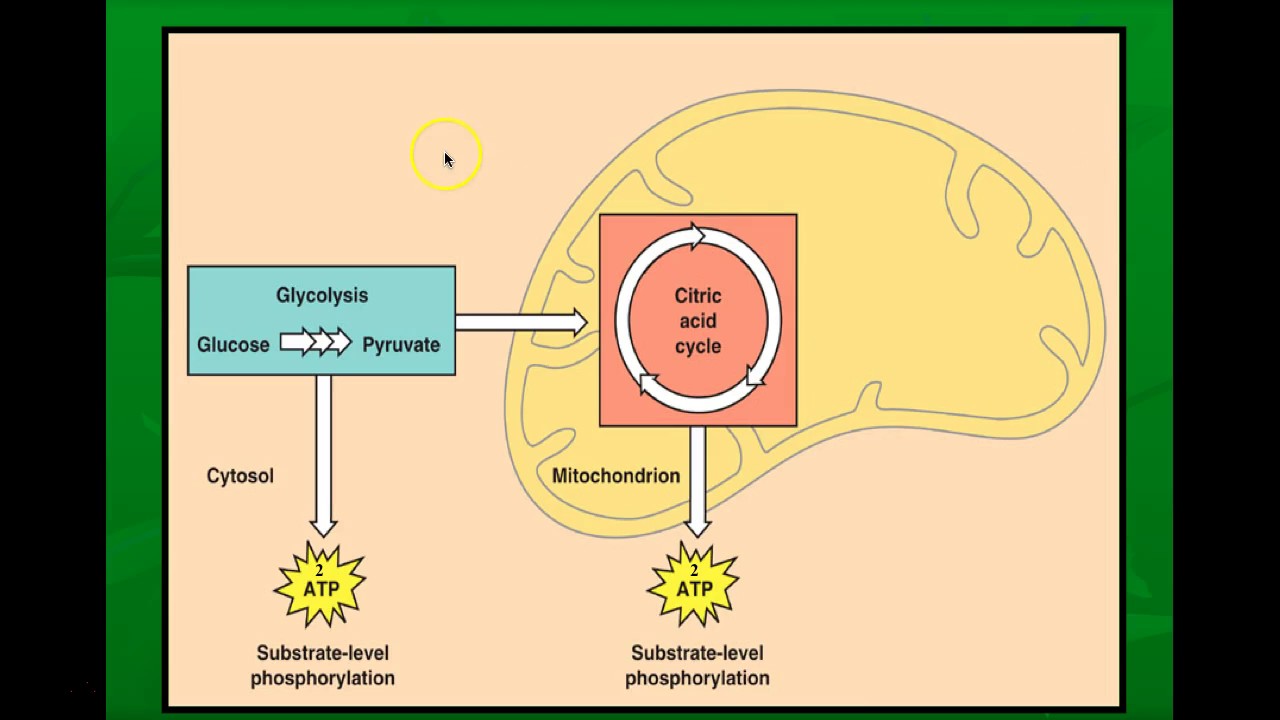
Glycolysis needs the investment of 2 ATPs in order to work, and in the end it generates 4 ATPs, for a net profit, if you will, of 2 ATPs.
In addition to those 4 ATPs, glycolysis also results in 2 pyruvates and 2 super-energy-rich morsels called NADH, which are sort of the love-children of a B vitamin called NAD+ pairing with energized electrons and a hydrogen to create storehouses of energy that will later be tapped to make ATP.
To help us keep track of all of the awesome stuff we're making here, let's keep score?
So far we've created 2 molecules of ATP and 2 molecules of NADH, which will be used to power more ATP production later.
Now, a word about oxygen. Like I mentioned, oxygen is necessary for the overall process of cellular respiration. But not every stage of it. Glycolysis, for example, can take place without oxygen, which makes it an anaerobic process.
In the absence of oxygen, the pyruvates formed through glycolysis get rerouted into a process called fermentation. If there's no oxygen in the cell, it needs more of that NAD+ to keep the glycolysis process going. So fermentation frees up some NAD+, which happens to create some interesting by products.
For instance, in some organisms, like yeasts, the product of fermentation is ethyl alcohol, which is the same thing as all of this lovely stuff. But luckily for our day-to-day productivity, our muscles don't make alcohol when they don't get enough oxygen. If that were the case, working out would make us drunk, which actually would be pretty awesome, but instead of ethyl alcohol, they make lactic acid. Which is what makes you feel sore after that workout that kicked your butt.
So, your muscles used up all the oxygen they had, and they had to kick into anaerobic respiration in order to get the energy that they needed, and so you have all this lactic acid building up in your muscle tissue.
Back to the score. Now we've made 2 molecules of ATP through glycolysis, but your cells really need the oxygen in order to make the other 30-some molecules they need.
That's because the next two stages of cellular respiration -- the Krebs Cycle and the electron transport chain, are both aerobic processes, which means they require oxygen.
And so we find ourselves at the next step in cellular respiration after glycolosis: the Krebs Cycle.
So, while glycolysis occurs in the cytoplasm, or the fluid medium within the cell that all the organelles hang out in, the Krebs Cycle happens across the inner membrane of the mitochondria, which are generally considered the power centers of the cell. The Krebs Cycle takes the products of glycolysis -- those carbon-rich pyruvates -- and reworks them to create another 2 ATPs per glucose molecule, plus some energy in a couple of other forms, which I'll talk about in a minute. Here's how: First, one of the pyruvates is oxidized, which basically means it's combined with oxygen.
One of the carbons off the three-carbon chain bonds with an oxygen molecule and leaves the cell as CO2. What's left is a two-carbon compound called acetyl coenzyme A, or acetyl coA. Then, another NAD+ comes along, picks up a hydrogen and becomes NADH. So our two pyruvates create another 2 molecules of NADH to be used later.
As in glycolysis, and really all life, enzymes are essential here; they're proteins that bring together the stuff that needs to react with each other, and they bring it together in just the right way. These enzymes bring together a phosphate with ADP, to create another ATP molecule for each pyruvate. Enzymes also help join the acetyl coA and a 4-carbon molecule called oxaloacetic acid.
I think that's how you pronounce it.
Together they form a 6-carbon molecule called citric acid, and I'm certain that's how you pronounce that one because that's the stuff that's in orange juice.
Fun fact: The Krebs Cycle is also known as the Citric Acid Cycle because of this very byproduct. But it's usually referred to by the name of the man who figured it all out: Hans Krebs, an ear nose and throat surgeon who fled Nazi Germany to teach biochemistry at Cambridge, where he discovered this incredibly complex cycle in 1937. For being such a total freaking genius, he was awarded the Nobel Prize in Medicine in 1953.
Anyway, the citric acid is then oxidized over a bunch of intricate steps, cutting carbons off left and right, to eventually get back to oxaloacetic acid, which is what makes the Krebs Cycle a cycle. And as the carbons get cleaved off the citric acid, there are leftovers in the form of CO2 or carbon dioxide, which are exhaled by the cell, and eventually by you. You and I, as we continue our existence as people, are exhaling the products of the Krebs Cycle right now. Good work.
This video, by the way, I'm using a lot of ATPs making it.
Now, each time a carbon comes off the citric acid, some energy is made, but it's not ATP. It's stored in a whole different kind of molecular package. This is where we go back to NAD+ and its sort of colleague FAD.
NAD+ and FAD are both chummy little enzymes that are related to B vitamins, derivatives of Niacin and Riboflavin, which you might have seen in the vitamin aisle. These B vitamins are good at holding on to high energy electrons and keeping that energy until it can get released later in the electron transport chain. In fact, they're so good at it that they show up in a lot of those high energy-vitamin powders the kids are taking these days.
NAD+s and FADs are like batteries, big awkward batteries that pick up hydrogen and energized electrons from each pyruvate, which in effect charges them up. The addition of hydrogen turns them into NADH and FADH2, respectively.
Each pyruvate yeilds 3 NADHs and 1 FADH2 per cycle, and since each glucose has been broken down into two pyruvates, that means each glucose molecule can produce 6 NADHs and 2 FADH2s.
The main purpose of the Krebs Cycle is to make these powerhouses for the next and final step, the Electron Transport Chain.
And now's the time when you're saying, "Sweet pyruvate sandwiches, Hank, aren't we supposed to be making ATP? Let's make it happen, Capt'n! What's the holdup?"
Well friends, your patience has paid off, because when it comes to ATPs, the electron transport chain is the real moneymaker. In a very efficient cell, it can net a whopping 34 ATPs.
So, remember all those NADHs and FADH2s we made in the Krebs Cycle? Well, their electrons are going to provide the energy that will work as a pump along a chain of channel proteins across the inner membrane of the mitochondria where the Krebs Cycle occurred. These proteins will swap these electrons to send hydrogen protons from inside the very center of the mitochondria, across its inner membrane to the outer compartment of the mitochondria.
But once they're out, the protons want to get back to the other side of the inner membrane, because there's a lot of other protons out there, and as we've learned, nature always tends to seek a nice, peaceful balance on either side of a membrane. So all of these anxious protons are allowed back in through a special protein called ATP synthase. And the energy of this proton flow drives this crazy spinning mechanism that squeezes some ADP and some phosphates together to form ATP. So, the electrons from the 10 NADHs that came out of the Krebs Cycle have just enough energy to produce roughly 3 ATPs each.
And we can't forget our friends the FADH2s. We have two of them and they make 2 ATPs each.
And voila! That is how animal cells the world over make ATP through cellular respiration.
Now just to check, let's reset our ATP counter and do the math for a single glucose molecule once again: We made 2 ATPs for each pyruvate during glycolysis.
We made 2 in the Krebs Cycle.
And then during the electron transport chain we made about 34 in the electron transport chain.
And that's just for one molecule of glucose. Imagine how much your body makes and uses every single day.
Don't spend it all in one place now! You can go back and watch any parts of this episode that you didn't quite get and I really want to do this quickly because I'm getting very tired.
If you want to ask us questions you can see us in the YouTube comments below and of course, you can connect with us on Facebook or Twitter.
[manly grunt]
Up Next

9:49
Methanogenesis: Coenzymes, Pathways, and Archaea Explained
@microbiology-igcas3360
273 views•2022-12-27
50:12
Bacterial Communication: Quorum Sensing and Biofilm Formation Explained
@JHUAAP
12.6K views•2011-06-28

11:04
Population Genetics: Darwin Meets Mendel | HHMI BioInteractive
@crashcourse
1.8M views•2012-05-28
7:08
Bacteriophages: Earth's Deadliest Killers and Future Antibiotics
@kurzgesagt
34.6M views•2018-05-13
Related Study Plans & Knowledge Roadmaps
Structured learning paths in Biology
biology
RNAi: Biogenesis, RISC & Gene Silencing
01Molecular Biology Foundations: DNA to Protein
02Introduction to RNA Interference (RNAi)
03Molecular Biogenesis of miRNA and siRNA
+ 2 more learning modules
10h5 modules
Explore Roadmap
biology
Mycorrhizae: Signaling, Biophysics & Ecology
01Foundations of Mycorrhizal Symbiosis
02Molecular Signaling and Root Colonization
03Biophysics and Bioenergetics of Nutrient Exchange
+ 1 more learning modules
11h4 modules
Explore Roadmap
biology
Circadian Clocks: TTFL, SCN & Periphery
01Foundations of Molecular Biology & Gene Expression
02Introduction to Chronobiology and Actograms
03The Core TTFL: Molecular Architecture of the Clock
+ 3 more learning modules
14h6 modules
Explore Roadmap
biology
Population Genetics: Math, Drift & Selection
01Genetic & Probability Foundations
02The Hardy-Weinberg Principle and Baseline Models
03Mathematical Modeling of Natural Selection
+ 3 more learning modules
18h6 modules
Explore Roadmap