





















Population genetics combines Mendel's principles of inheritance with Darwin's theory of evolution through five key factors—natural selection, sexual selection, mutation, genetic drift, and gene flow—that change allele frequencies in populations over time; the Hardy-Weinberg equation (p² + 2pq + q² = 1) provides a mathematical framework to predict genotype frequencies under ideal conditions where none of these evolutionary forces are acting, allowing scientists to detect when populations are actually evolving.
Population Genetics: Darwin Meets Mendel | HHMI BioInteractive
Added:Darwin's theory of evolution by natural selection, specifically how selective pressures lead to adaptation over generations.
Mendelian genetics, including the concepts of dominant and recessive alleles, homozygous and heterozygous genotypes, and segregation.
Basic cellular biology concepts, particularly chromosome behavior during meiosis and how it leads to genetic variation.
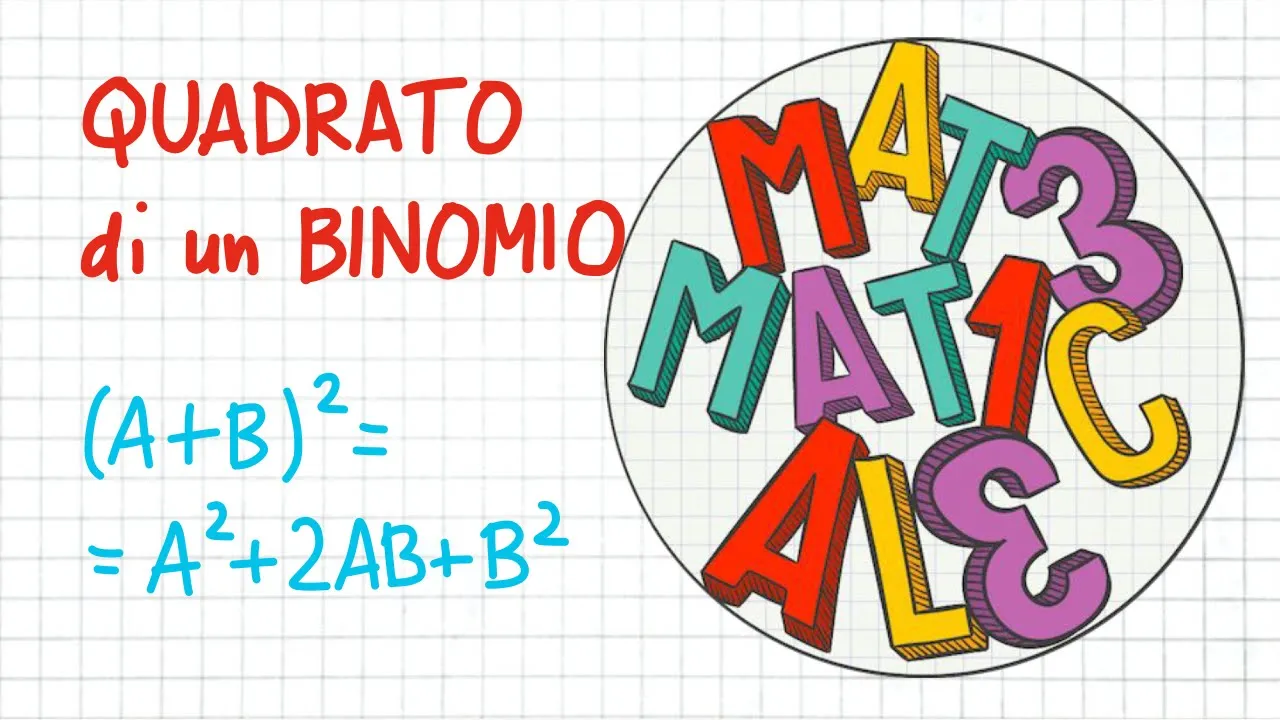
Basic algebraic proficiency, specifically binomial expansion (e.g., squaring a binomial), which is essential for understanding the Hardy-Weinberg formula.
The five evolutionary forces that disrupt Hardy-Weinberg equilibrium: mutation, gene flow, non-random mating, genetic drift, and natural selection.
Practical applications of the Hardy-Weinberg equation in public health and medicine to calculate carrier frequencies for recessive genetic disorders.
An in-depth study of genetic drift, including its pronounced effects in small populations via the bottleneck and founder effects.
How cumulative changes in allele frequencies (microevolution) scale up to drive speciation and macroevolutionary patterns over geological time.
1.8M views18.8Klikes11:04Original Release: 2012-05-28
Hey look!
It's our friend Gregor Mendel, the supermonk who discovered the basic principles of genetics.
Hopefully you remember all of this.
Both parents contribute one version of each of their genes called an allele, to their offspring.
And some of those alleles are dominant, or always expressed, while others are recessive and only expressed when they're not paired with a dominant one.
Oh, and here's our old friend Chucky D, he lets me call him that.
All this information that Mendel figured out would have been really quite interesting to him, because Darwin spent his whole life defending his ideas of Natural Selection as the primary force for Evolution.
But, Darwin had no idea how traits were passed on to their offspring, even though these two guys were living and working at the same time.
Both Mendel and Darwin died not knowing how their ideas fit together.
So today we're going to introduce them, and their ideas, to one another, through the science of population genetics, which demonstrates how genetics and evolution influence each other.
And I have good news!
It involves a lot of math!
Population genetics, on the surface, is not a complicated idea.
It's the study of how populations of a species change genetically over time, leading to a species evolving.
So let's start out by defining what a population is.
It's simply a group of individuals of a species that can interbreed.
And because we have a whole bunch of fancy genetic testing gadgets, and because, unlike Darwin, we know a whole lot about heredity, we can now study the genetic change in populations over just a couple generations.
This is really exciting and really fun because it's basically like scientific instant gratification.
I can observe evolution happening within my lifetime, so cross that off the old bucket list.
Now part of population genetics, or Pop-Gen, I know, we've got fancy abbreviations for everything now, involves the study of factors that cause changes in what's called allele frequency.
Which is just how often certain alleles turn up within a population, and those changes are at the heart of how and why evolution happens.
So, there are several factors that change allele frequency within a population.
And just like Fast and Furious Movies, there are five of them.
And unlike Fast and Furious movies, they're actually very very important and are the basic reason why all complex life on earth exists.
This main selective pressure is simply natural selection itself, Darwin's sweet little baby which he spent a lot of his career defending from haters.
Obviously, we know this, Natural Selection makes the alleles that make animals the strongest, most virile, and least-likely-to-die more frequent in the population.
Now, most selective pressures are environmental ones, like food supply or predators or parasites. But at the population level one of the most important evolutionary forces is sexual selection, and population genetics gives it special attention, particularly when it comes to what's called nonrandom mating.
Which is a lifestyle that I encourage in all of my students.
Do not mate randomly.
Sexual selection is the idea that certain individuals will be more attractive mates than others, because of specific traits.
This means they'll be chosen to have more sex and therefore have more offspring.
The Pop-Gen spin on things is that sexual selection means mating isn't random. There are specific traits that are preferred, even though they may not make the animals technically more fit for survival. So sexual selection changes the genetic makeup of a population, because the alleles of the most successful maters are going to show up more often in the gene pool.
Maters gonna mate!
Another important factor here, and another thing that Darwin wished he understood, is mutation.
Sometimes when eggs and sperm are formed through meiosis, a mistake happens in the copying process of DNA.
"Bad" errors in the DNA could result in the death or deformation of the offspring, but not all mutations are harmful.
Sometimes these "mistakes" can create new alleles that benefit the individual by making it better at finding food, avoiding predators or finding a mate.
These "good" errors, and the alleles they made, are then passed to the next generation, and into the population.
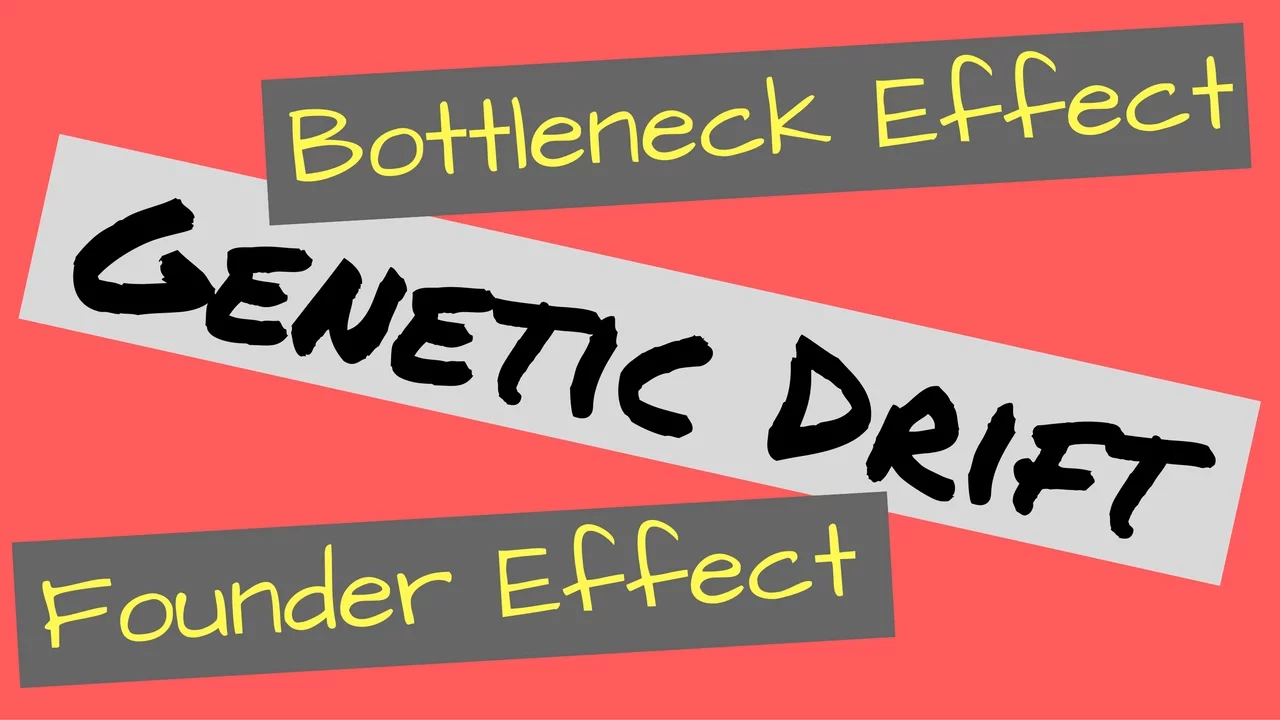
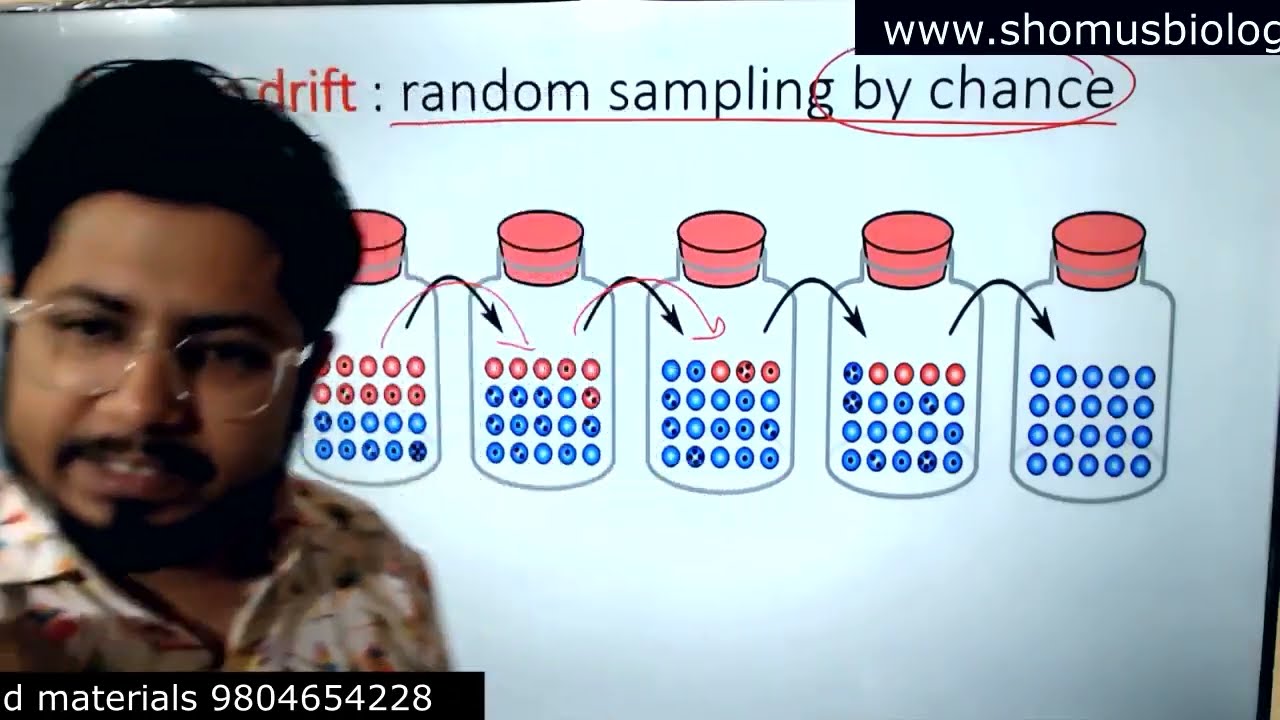
Fourth, we have genetic drift, which is when an allele's frequency changes due to random chance.
A chance that's greater if the population is small, and thus happens much more quickly if a population gets knocked way back by a tornado or something.
Genetic Drift does not cause individuals to be more fit, just different.
Finally when it comes to allele game-changers, you gotta respect the gene flow.
Which is when new individuals with different genes find their way into a population and spread their alleles all over the place.
Immigration and emigration are good examples of this, and as with genetic drift its effects are most easily seen in small populations.
Again, our factors: Natural Selection: Alleles for fitter organisms become more frequent.
Sexual Selection: Alleles for more sexually attractive organisms become more frequent.
Mutation: New alleles pop up due to mistakes in DNA.
Genetic Drift: Changes in allele frequency due to random chance.
Gene Flow: Changes in allele frequency due to mixing with new, genetically different populations.
Now that you know all that, in order to explain specifically how these processes influence populations, we're going to have to completely forget about them.
This is what's called the Hardy-Weinberg Principle.
Godfrey Hardy and Wilhelm Weinberg were two scientists in 1908 who independently, at the same time, came up with the exact same equation that describes how, under the right circumstances, Mendelian genetics works at the scale of a whole population.
But those "right circumstances" assume that none of the factors I just mentioned are at play.
Hardy and Weinberg's simple equation shows us the frequency with which you could expect to find different alleles within a hypothetical population that's not evolving.
This weird hypothetical state is called the Hardy-Weinberg Equilibrium, in which the frequency of alleles in a population remains constant from generation to generation.
And to make sure that happens, NO FUNNY STUFF is allowed to go on.
To wit, the Hardy-Weinberg Equilibrium requires: 1. NO natural selection, which means that no alleles are more beneficial than any other, so the better alleles will not be selected within a population.
2. NO sexual selection, which means mating within the population must be completely random no individual can have a better chance of getting it on than other.
3. NO mutations, because mutations modify the gene pool.
4. Hardy-Weinberg demands a gigantic population size because the smaller the population, the more likely you are to get genetic drift.
5. Finally, NO gene flow, that means nobody can bring over their hot cousin from the next island over, because that would significantly mess with the allele frequencies, if you know what I mean.
So, clearly, no fun and lots of rules.
Hardy and Weinberg, they figured this out at the exact same time, so it can't be that complicated, because it wasn't some kind of stroke of Einsteinian inspiration, they just figured out a thing that was pretty simple. So the question is, can we do the same thing right now?
Can we figure it out on our own?
What we're looking for is the relationship between the phenotype and the actual frequency of the genes in the population.
So how do we proceed from here?
Alas...earwax.
The consistency of earwax is a Mendelian trait.
Wet earwax is a big W because it's dominant and dry ear wax is recessive so it's a little w. Now let's call the frequency of the dominant, wet allele of the population p and the frequency of the recessive, dry allele q.
Which if you've ever noticed, q is kind of a backwards p.
Since there are only two alleles for this gene in the entire population, p + q = 1.
So if the frequency of p is 75%, the only other thing it could be is q, so that's going to be 25%.
Which is 1.
So imagine we go to this hypothetical, no-fun, Hardy-Weinberg island and there are 100 people.
We poke every single one of them in the ear and 9 of them have dry ear wax.
So that's 9/100 or 9% or 0.09. You know math?
But this is not q.
It's not the frequency of the little w, it's the frequency of the homozygous ww.
So this is the expressed phenotype. It's not the genotype.
We don't know that yet. We know the frequency of ww.
But you know there's got to be a lot of other w alleles hanging around in heterozygous pairs.
So how do we figure out where those are, how many of those there are?
Well, I have no idea. I now, am stuck.
I do not know. I am lost.
When I'm stuck in situations like this, what I do, is I go back to what I DO know.
And what I know is that the frequency of Big W plus the frequency of little w = 1.
But that's in the entire population, and in each individual, we want to know their genotype, so two different alleles.
So what's happening is this is happening twice in every individual, so what we need to do, is square it.
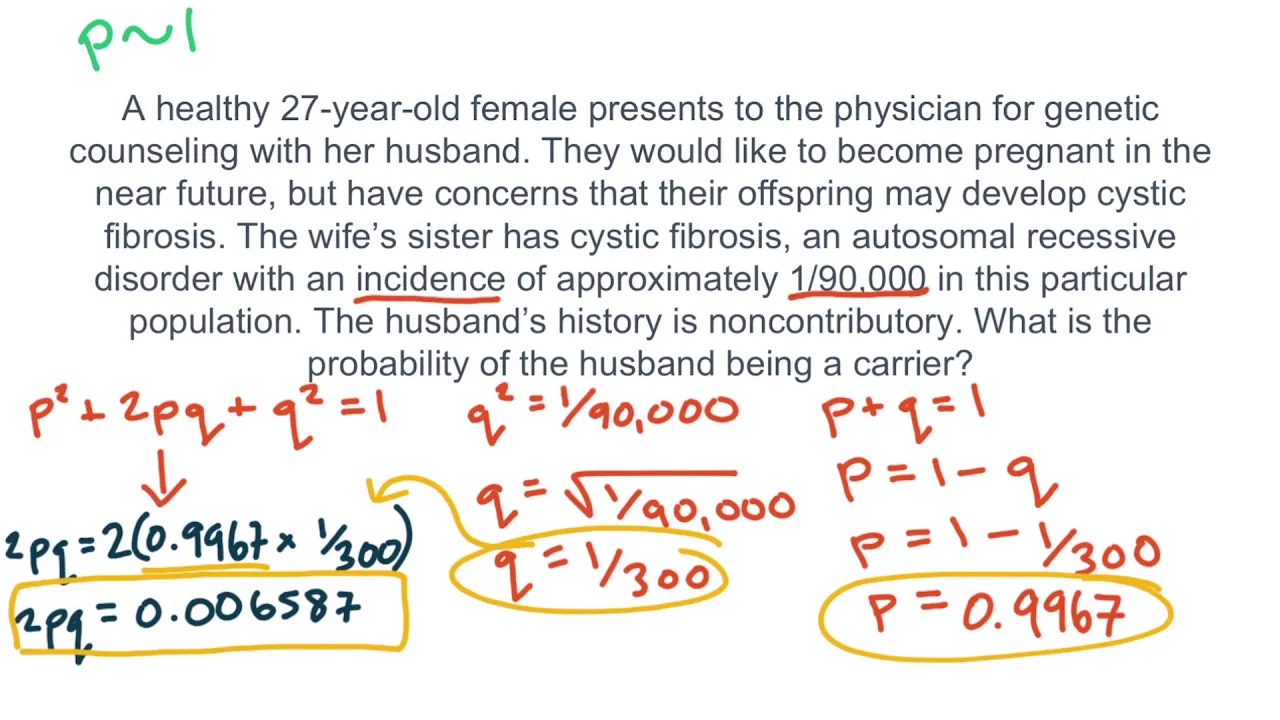
And when we square that equation, if you remember algebra at all, you get: p^2 + 2pq + q^2 = 1 And that, my friends, is what Hardy and Weinberg did, and IT is the Hardy-Weinberg equation!
So p squared is the odds of it being a WW.
This 2pq here is the heterozygotes, and the q squared is the homozygous recessive.
Well good news! We know ww.
We know the homozygous recessive is 0.09, so we already have that information.
We know what q squared is, it's 0.09, and in order to get what q is we just take the square root of that.
That was a horrible square root symbol.
Which is 0.30 or 30%. A 30% frequency of the q allele in the population.
Then we just use the simplest equation in the world to figure out what p is.
This minus 1.
And that's 0.70.
Now, using our Hardy-Weinberg equation we can go beyond the frequency of the alleles and actually talk about the frequency of the genotypes.
So the frequency of the WW homozygous dominant is p squared.
We have p. So we just square this and that equals 0.49.
Or 49% of the population is homozygous dominant.
Now the math gets even easier because we know p and q.
So to figure out how many heterozygotes there are, we just do 2 times p which is 0.70 times 0.30, which is q, which is 0.42.
Which is math that I did beforehand.
No, I didn't just know that.
So 9% of the population is homozygous recessive, 49% is homozygous dominant, and 42% heterozygous, displaying wet earwax, but with that little w in there as well.
What's awesome about all of this is we can see Mendel's ideas work in a big population, and when things aren't lining up with this equation, then we know that there are one of those 5 factors at work.
Probably more than one.
For example, a bunch hot surfers moved to the island, and they all happened to have dry earwax.
And they start spreading their hot surfer genes all over the place.
Nonrandom mating: it always goes out the window whenever the hot surfers get involved.
I don't know about you, but this stuff's pretty beautiful to me.
So don't give me too hard of a time in the comments, where you can ask questions!
Or on Facebook or Twitter.
Thank you for watching this episode of Crash Course Biology.
We will see you next time.
Up Next

11:43
Hardy-Weinberg Equation: Allele & Genotype Frequency Explained
@Bozemanscience1
578K views•2013-09-24
50:12
Bacterial Communication: Quorum Sensing and Biofilm Formation Explained
@JHUAAP
12.6K views•2011-06-28

11:35
Animal Cell Structure and Function: Crash Course Biology
@crashcourse
6M views•2012-02-20
7:08
Bacteriophages: Earth's Deadliest Killers and Future Antibiotics
@kurzgesagt
34.6M views•2018-05-13
Related Study Plans & Knowledge Roadmaps
Structured learning paths in Biology
biology
RNAi: Biogenesis, RISC & Gene Silencing
01Molecular Biology Foundations: DNA to Protein
02Introduction to RNA Interference (RNAi)
03Molecular Biogenesis of miRNA and siRNA
+ 2 more learning modules
10h5 modules
Explore Roadmap
biology
Mycorrhizae: Signaling, Biophysics & Ecology
01Foundations of Mycorrhizal Symbiosis
02Molecular Signaling and Root Colonization
03Biophysics and Bioenergetics of Nutrient Exchange
+ 1 more learning modules
11h4 modules
Explore Roadmap
biology
Circadian Clocks: TTFL, SCN & Periphery
01Foundations of Molecular Biology & Gene Expression
02Introduction to Chronobiology and Actograms
03The Core TTFL: Molecular Architecture of the Clock
+ 3 more learning modules
14h6 modules
Explore Roadmap
biology
Population Genetics: Math, Drift & Selection
01Genetic & Probability Foundations
02The Hardy-Weinberg Principle and Baseline Models
03Mathematical Modeling of Natural Selection
+ 3 more learning modules
18h6 modules
Explore Roadmap