




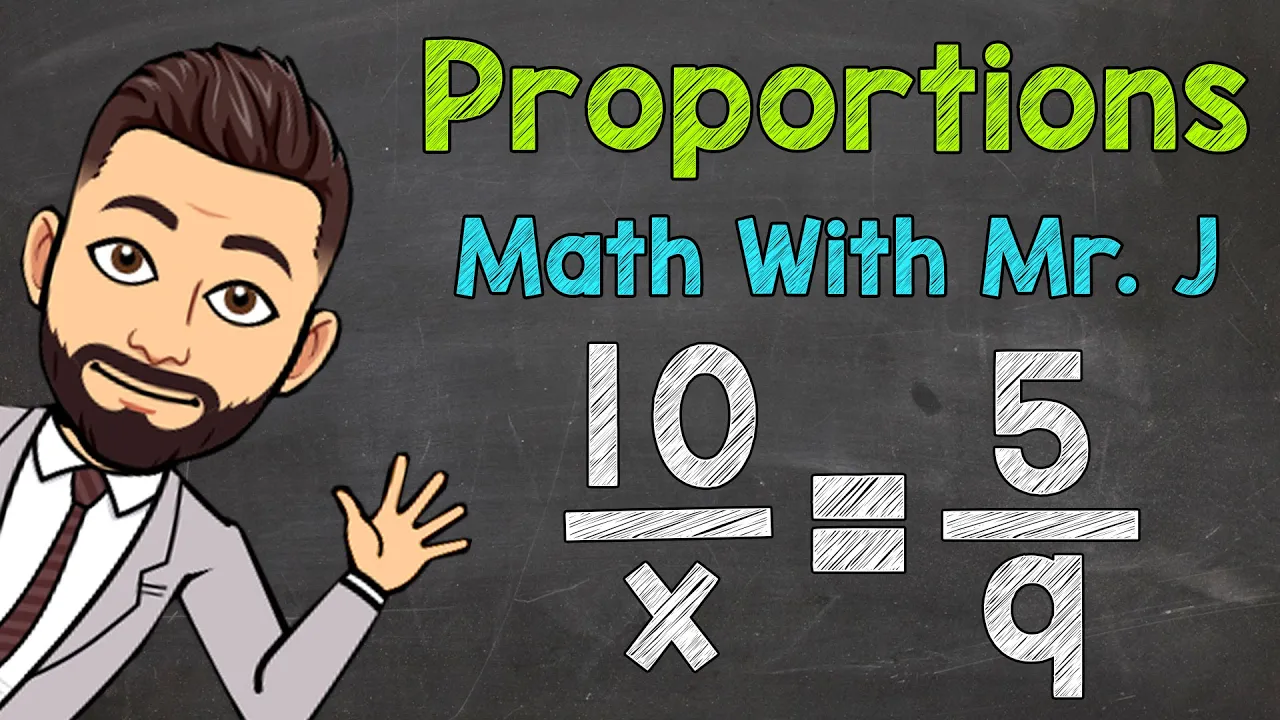


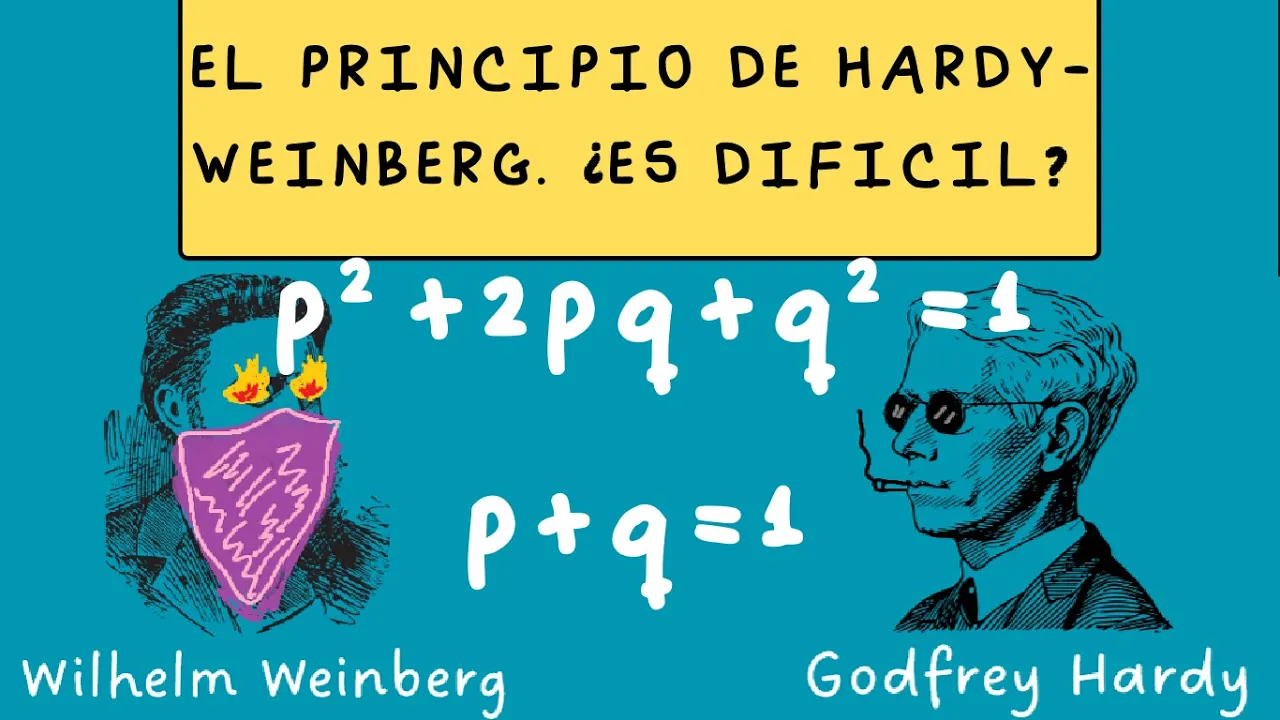






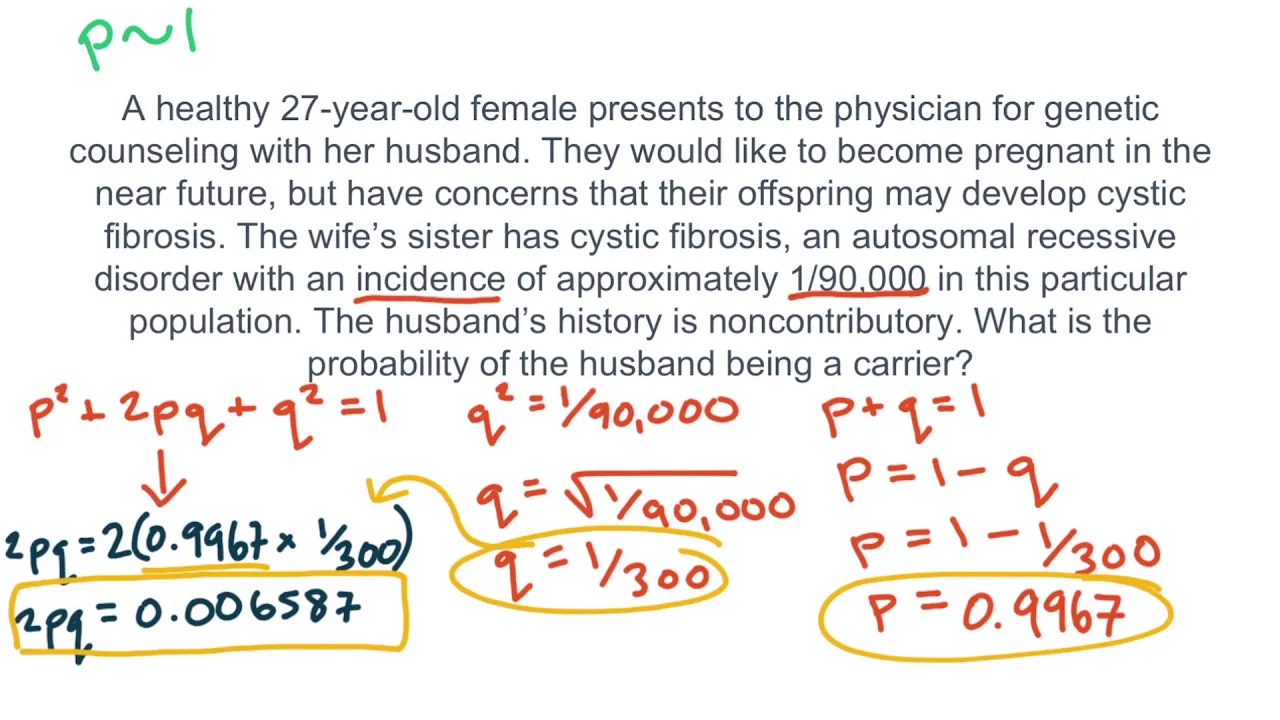







The Hardy-Weinberg equation (p² + 2pq + q² = 1) calculates allele and genotype frequencies in a population, where p represents the frequency of the dominant allele and q represents the recessive allele; since p + q = 1, knowing one value allows calculation of the other, enabling prediction of heterozygote frequencies (2pq) from observed recessive phenotype frequencies (q²).
Hardy-Weinberg Equation: Allele & Genotype Frequency Explained
Added:Basic Mendelian genetics, including the concepts of dominant and recessive alleles, phenotypes, and homozygous versus heterozygous genotypes.
The definitions of a population, gene pool, allele frequency, and genotype frequency.
Fundamental principles of probability, specifically the multiplication and addition rules for independent events.
Basic algebraic skills, including solving simple equations and understanding variables representing proportions (e.g., p + q = 1).
The five conditions required for a population to remain in Hardy-Weinberg equilibrium (no mutation, random mating, no natural selection, extremely large population size, and no gene flow).
How evolutionary forces (genetic drift, natural selection, gene flow, and mutation) disrupt equilibrium and drive microevolution.
Applying the Hardy-Weinberg principle to medical genetics, such as estimating carrier frequencies for autosomal recessive genetic disorders.
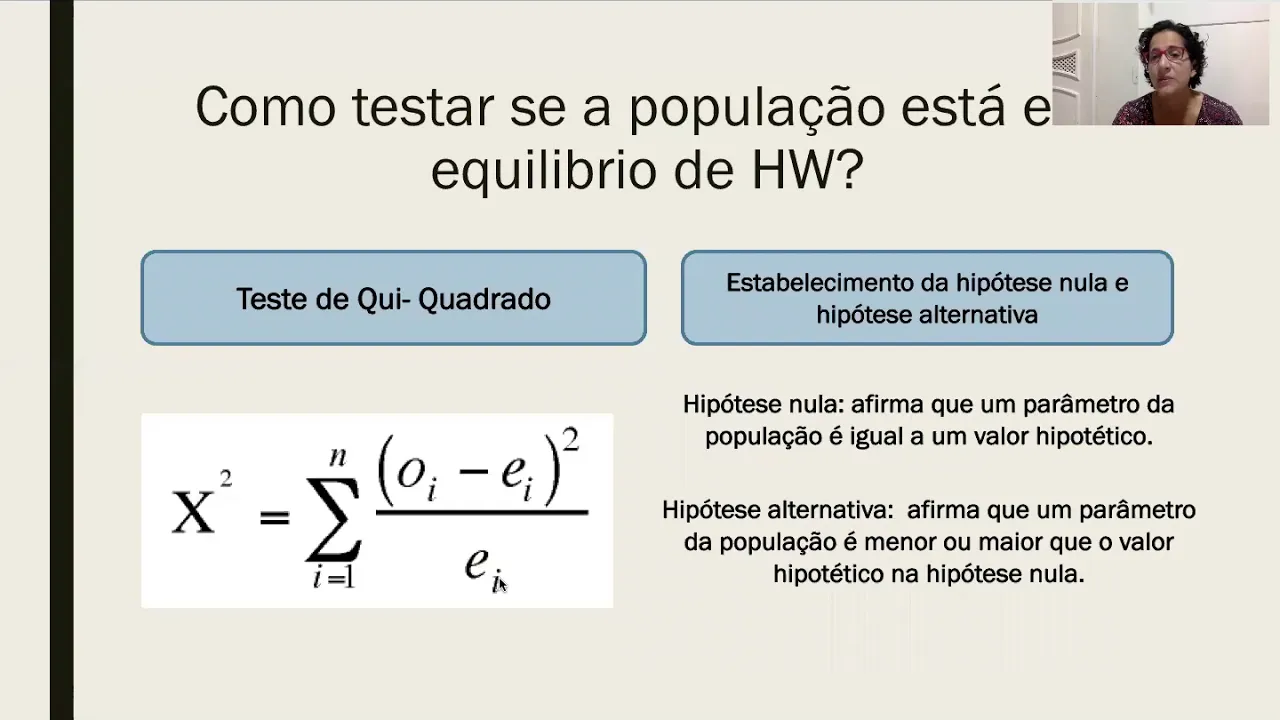
Using statistical methods, like the Chi-square goodness-of-fit test, to determine if an actual population is in Hardy-Weinberg equilibrium.
578K views4.7Klikes11:43Original Release: 2013-09-24
hi it's mr. Andersen and in this video I'm going to talk about the hardy-weinberg equation which is an equation that's used to determine the frequency of genes in a population before we get to the equation let's define a few terms the first one is a phenotype a phenotype is going to be the physical characteristics that an organism has and so the only difference between these two individuals here is in the color of their hair and so the difference is going to be in their phenotypes this person has red hair and this person has non red hair now when you're looking at me you're looking at my phenotypes now the phenotypes however are caused by genes that we possess and so we're going to possess two genes and a gene is simply a section of DNA that codes for a specific phenotype and so the types of genes are called alleles and so in this case this individual has two genes but both of them are going to be non red jeans or non red alleles this person right here has red hair phenotype but its alleles are going to be two red genes and when we're solving genetic problems we'll use letters to represent those big R big R stands for non-red genes and little R little R stands for red hair but what happens if you were to get one of each what happens if an individual has one of the non-red genes and one of the red genes what color is their hair going to be well if you know anything about genetics you know that they're going to have non red hair and that's because the red gene is recessive to the non red gene and so these two things pictured here are the phenotype or the physical characteristics of this individual and the genotype or the genes that they possess and so let's check our understanding I'm going to show you a few things and what I want you to do is tell me if this is a phenotype or a genotype I'll pause for a second to let you answer and so let's start with the first one let's say an individual has Huntington's disease that's right that should be a phenotype because it's going to be the physical manifestation of their genes let's try another one let's say an individual can taste PTC or a chemical that would also be a phenotype because it's our physical manifestation of their genes let's try another one let's say an individual is a carrier of cystic fibrosis that would be their genotype now what that means is that they're carrying one cystic fibrosis gene but we couldn't see that by looking at them in other words they're not going to have cystic fibrosis and so this would be a genotype and when you're solving problems related to hardy-weinberg it's important that you figure out right away are we talking about a phenotype or are we talking about a genotype now the way I like to explain alleles and how genes are interact is using socks and so basically you might think of it like this if you have a red sock that's like having an allele for red hair and if you have a non red sock that's like having an allele for non red hair and so basically an individual is going to have two copies of a gene and so if you have two red genes then you are going to have a genotype of red red and what kind of a phenotype are you're going to have well using socks what we can do is if I talk one inside the other because you really only see that one thing you really see only see that phenotype of the individual so again if you have two red genes you're going to have red hair likewise if I have two non-red genes what color hair are you going to have well let me tuck this in to make our phenotype basically you're going to have non red hair and so that's pretty easy to read genes you're going to have red hair to non-red genes you're not going to have red hair but what happens if we were to have an individual that has one red gene and one non red gene well since this one is dominant to this gene that basically means that this other gene is going to remain hidden and so when we look at this individual we can't tell what that other gene is they're going to have non red hair and so if I were to pick up another individual and look at them so this is their phenotype this is physically what they look like you don't know what this individual is going to have for it's two genes because that other one is hidden and until we actually pull that gene out and we see that oh this individual had on non red and one red gene we really don't know what their genotype is and so it's very important when you're solving problems that we go to the individuals who have two of the recessive alleles because if you have two of the recessive alleles in other words you have the recessive trait we know not only what your phenotype is but we know what your genotype let's look at a sample population of ten individuals in this case we have five individuals who have red hair and five individuals who have non red hair this is their phenotype now what we learned from the Sox is that you only know the genotype of individuals who have both of those recessive alleles and so now let's take a look at their genotypes and what we'll find is that all the individuals who had red hair are going to have both of those red alleles but if you have non red hair you might have one of the alleles for red and one of the alleles for non red or you might have both of those for the non red allele and so these are their genotypes now the alleles in a population when they're all combined makes something called a gene pool so a gene pool is simply a collection of all the alleles in a population and when you're solving these problems it's important that you calculate the frequency of each and so frequency is simply going to be a ratio the number of those alleles compared to the total number of alleles in the population and we use letters to represent these two frequencies P will always represent the frequency of the dominant allele and Q is going to represent the frequency of the recessive allele so it's kind of hard to count these so let me stack them up so we can look at them and so basically what this means is that P is going to be the frequency of the dominant alleles and so what was dominant remember the non-red genes are going to be dominant so if I count those there are six of those non-red alleles divided by a total of 20 alleles and so that's going to be 0.3 Q then is going to give us the frequency of the recessive alleles well there are 14 total recessive alleles divided by total number of 20 and so our Q value is going to be 0.7 and what you should notice right away this is very important that P plus Q will always equal 1 in other words 0.3 plus 0.7 is going to equal 1 and in any problem that you solve P plus Q will always equal 1 and that allows you to solve some some tough problems and so basically let's get to the hardy-weinberg equation hardy-weinberg equation is going to tell us the frequency of different genotypes in a population and so it's written as this P squared plus 2pq plus q squared equals 1 now lots of times when biology students are trying to solve problems related to hardy-weinberg equilibrium they will simply try to plug in numbers in and then solve this equation and that's not how it works basically P squared is going to represent the frequency of the individuals in a population that are homozygous dominant now that's a new term what does it mean they have both copies of this dominant gene q squared is going to tell us the individuals who are homozygous recessive that means they have both copies of the recessive gene and 2 PQ is simply going to tell us the frequency of individuals in a population that have one of each and we call those heterozygous for this trait and so let's get to a problem and so that's say the problem presented is this 2 percent of humans on the planet have red hair what percent of humans are heterozygous for this trait well the first thing you need to do is figure out what the question is giving us and so they're saying that 2 percent of humans have red hair and so what are they telling us well they're telling us a number here but when they're telling us that individuals who have red hair are they telling us a phenotype or are they telling us a genotype well red hair is going to be a phenotype and so they're telling us that but the nice thing is that since this is a recessive trait red hair is recessive not only are they telling us the phenotype that they're telling us the genotype and so in this case that's going to be Q squared since red there is recessive q squared is going to be the individuals who have red hair and so when you're solving hardy-weinberg problems you want to make sure that you always convert that to a decimal value otherwise you're going to get results that really won't make sense and so we've got Q squared equals point zero two why did I use Q squared well we know that these are the individuals who are homozygous recessive for that trait so how do I solve this well basically I could take the square root of this and I could take the square root of that and so Q is going to equal the square root of 0.02 and so that's going to be roughly 0.14 once I figured out my Q value and I know in the back of my head that P plus Q will always equal 1 I automatically know what P is in this case P is going to be 0.86 okay so now I've already determined P and Q when you're solving hardy-weinberg equations the first thing you want to do is find your P and your Q value so let's kind of talk about what this means if 2 percent of the humans on the planet have red hair that means if we were to take all the alleles of all the people on our planet and put them together in this one gene pool we'd find that point 1 4 or 14% of those genes are going to be actual red hair now let's get to the question that they're asking they're saying what percent of individuals are heterozygous for that trait well looking back to our hardy-weinberg problem we know that the heterozygous individuals are always going to equal to P Q and so that's going to be 2 times our p value which is 0.8 6 times our Q value which is going to be 0.14 and if I plug that into my calculator I'm going to get a value of around point 2 4 or since they're asking as a percent that about 24 percent and so on the planet 24 percent of the individuals or almost 1/4 of the individuals on our planet are going to be heterozygous for that trait or they're going to be carriers of that trait so now let me give you a problem let's say that 12% of the individuals in Ireland have red hair what percent of this population is going to be homozygous for non red hair and so what you should do is figure out what the question is asking you should figure out what they're giving you and then you should use the hardy-weinberg equation to give this a try
Up Next

9:59
Genetics: Calculating Progeny Genotypes Using Probability Rules
@GeneticsLessons
27.9K views•2013-12-03

50:12
Bacterial Communication: Quorum Sensing and Biofilm Formation Explained
@JHUAAP
12.6K views•2011-06-28

10:09
DNA Replication Explained: Enzymes, Leading & Lagging Strands
@Bozemanscience1
1.4M views•2012-04-07

7:08
Bacteriophages: Earth's Deadliest Killers and Future Antibiotics
@kurzgesagt
34.6M views•2018-05-13
Related Study Plans & Knowledge Roadmaps
Structured learning paths in Biology
biology
RNAi: Biogenesis, RISC & Gene Silencing
01Molecular Biology Foundations: DNA to Protein
02Introduction to RNA Interference (RNAi)
03Molecular Biogenesis of miRNA and siRNA
+ 2 more learning modules
10h5 modules
Explore Roadmap
biology
Mycorrhizae: Signaling, Biophysics & Ecology
01Foundations of Mycorrhizal Symbiosis
02Molecular Signaling and Root Colonization
03Biophysics and Bioenergetics of Nutrient Exchange
+ 1 more learning modules
11h4 modules
Explore Roadmap
biology
Circadian Clocks: TTFL, SCN & Periphery
01Foundations of Molecular Biology & Gene Expression
02Introduction to Chronobiology and Actograms
03The Core TTFL: Molecular Architecture of the Clock
+ 3 more learning modules
14h6 modules
Explore Roadmap
biology
Population Genetics: Math, Drift & Selection
01Genetic & Probability Foundations
02The Hardy-Weinberg Principle and Baseline Models
03Mathematical Modeling of Natural Selection
+ 3 more learning modules
18h6 modules
Explore Roadmap