









![[7/9] BIOQUÍMICA BÁSICA E METABOLISMO (Resumo) - UNIDADE 3 - TÓPICO 1](https://i.ytimg.com/vi_webp/Vds7gEIXPUY/maxresdefault.webp)




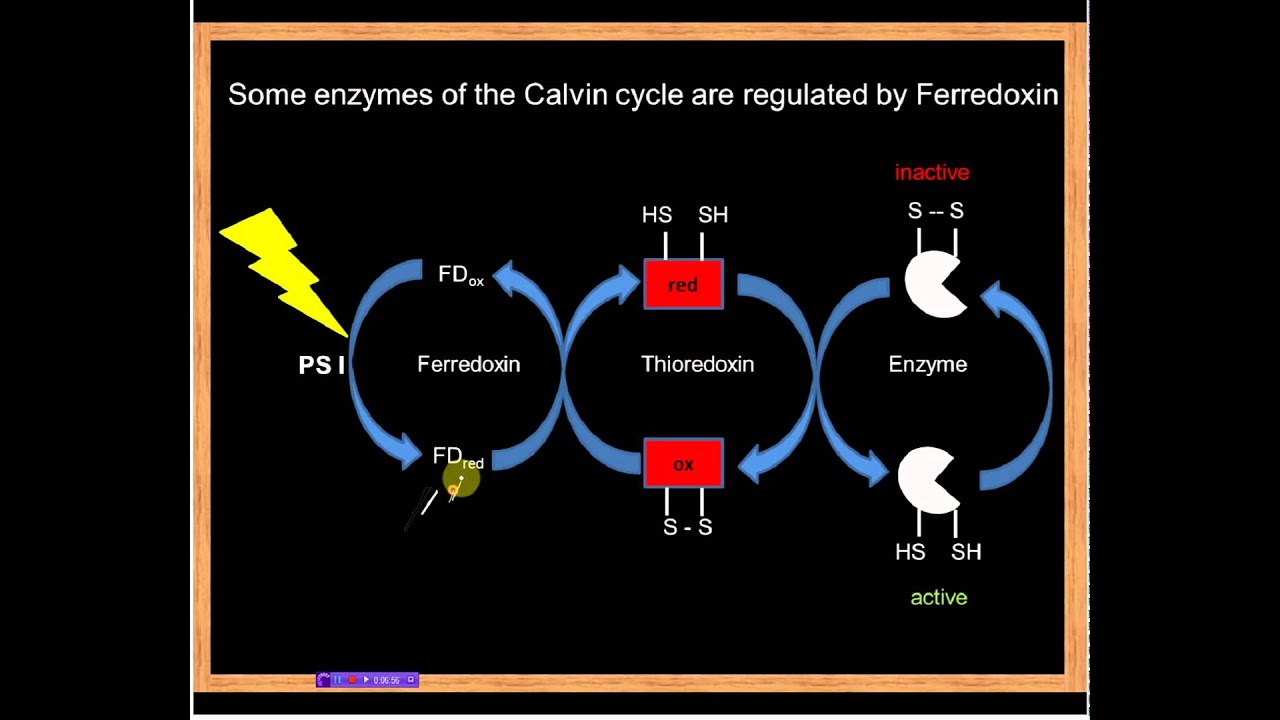

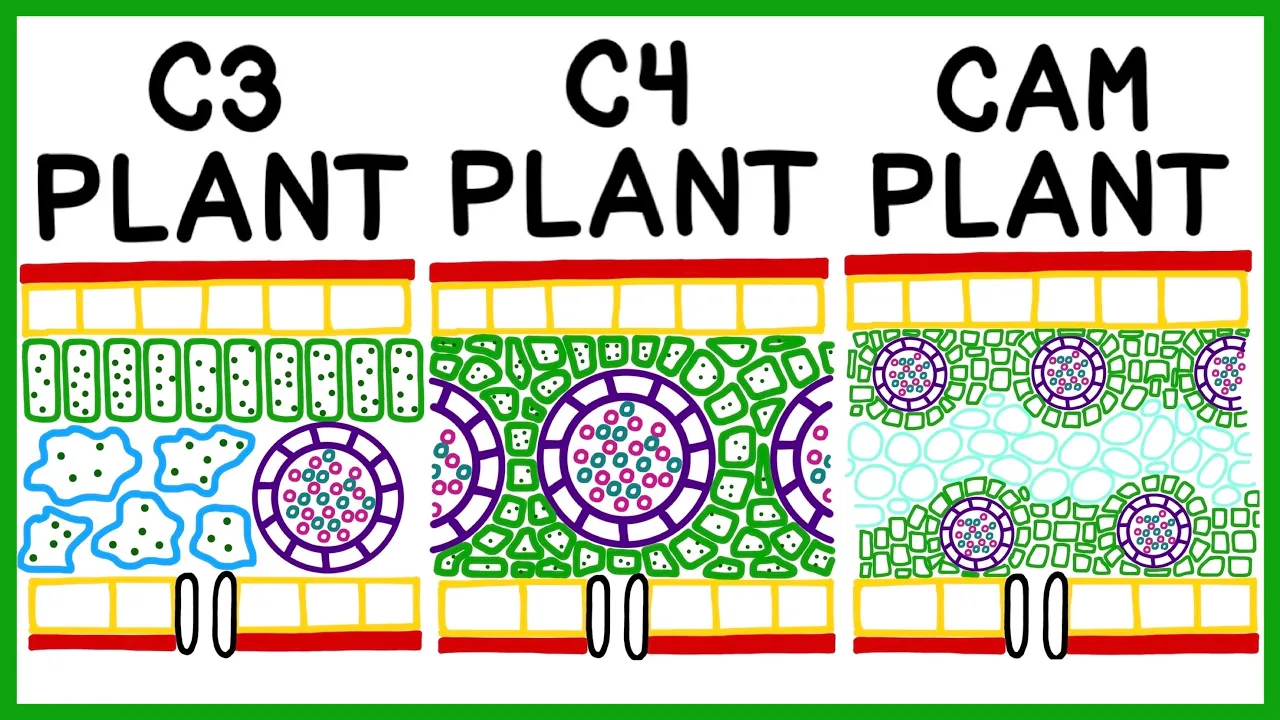




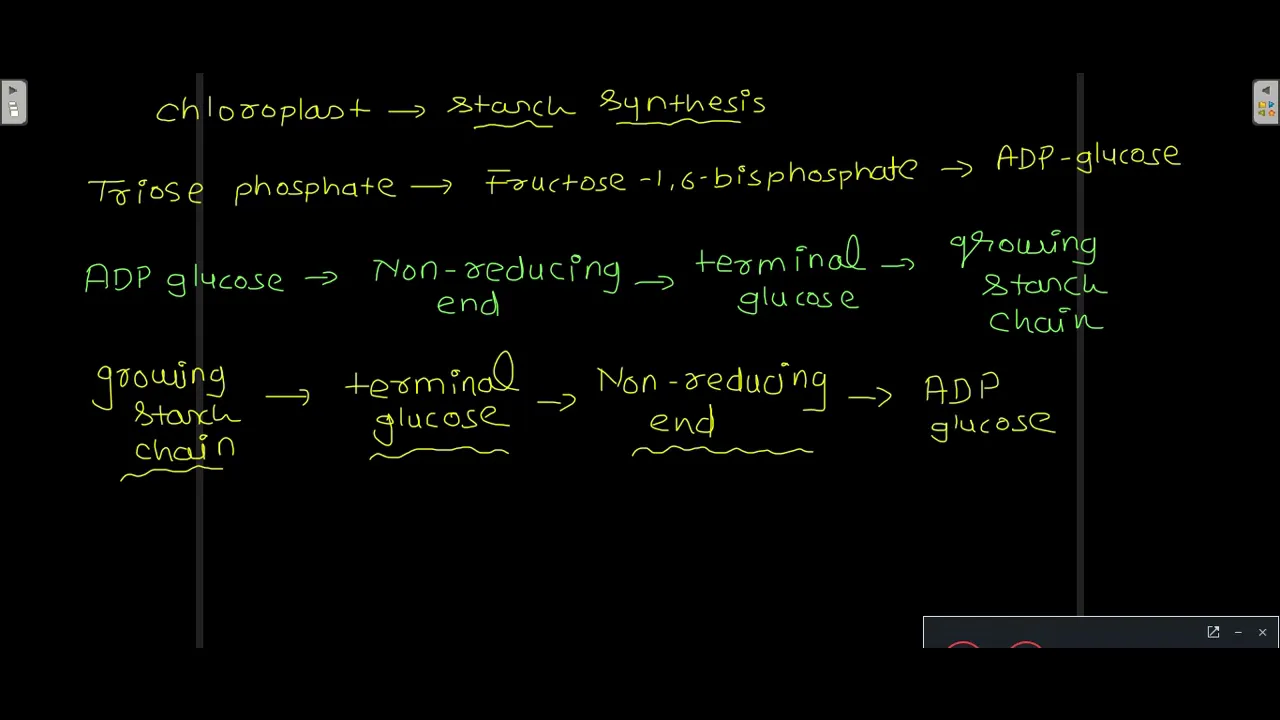





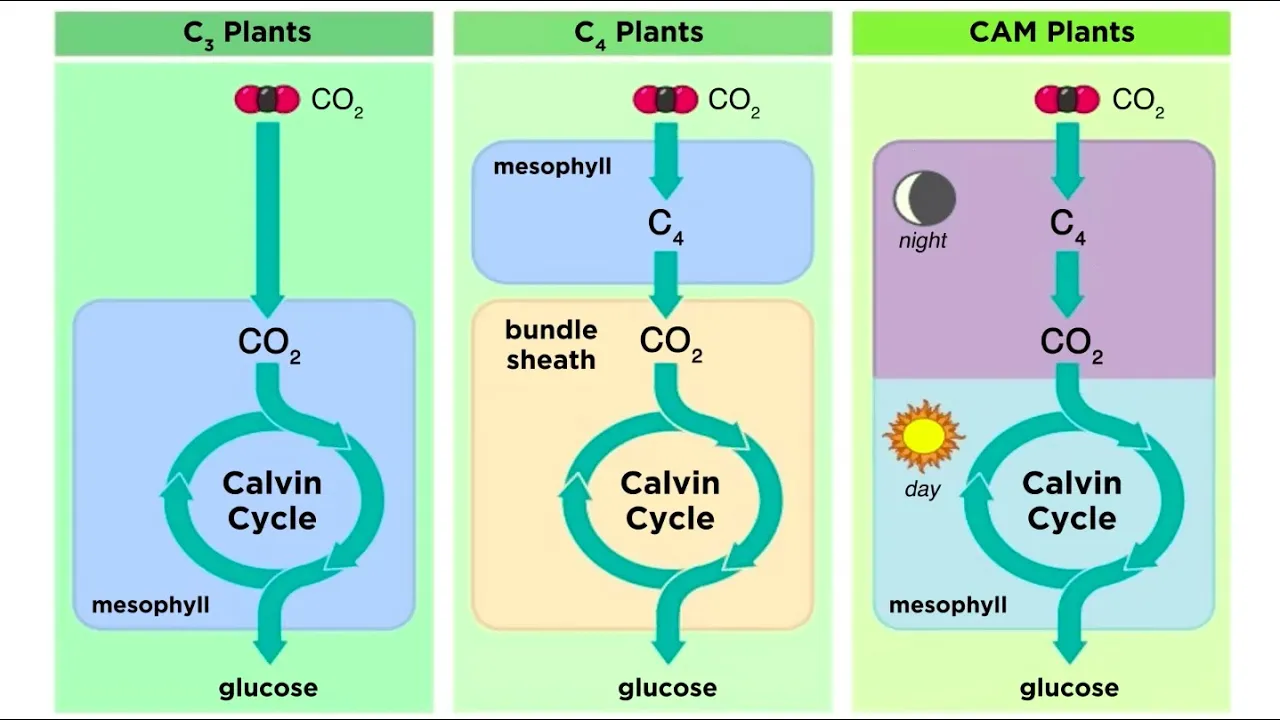
The Calvin cycle (dark reactions) converts carbon dioxide into glucose using ATP and NADPH from light reactions, occurring in the chloroplast stroma with rubisco as the key enzyme. To produce one glucose molecule, the cycle requires 6 CO2, 18 ATP, and 12 NADPH. Photorespiration occurs when rubisco fixes oxygen instead of CO2 under high temperatures, producing a 2-carbon compound (phosphoglycolate) that must be recycled through chloroplast, peroxisome, and mitochondria, consuming additional energy. C4 plants avoid photorespiration through Kranz anatomy and PEP carboxylase, while CAM plants use temporal separation by opening stomata at night.
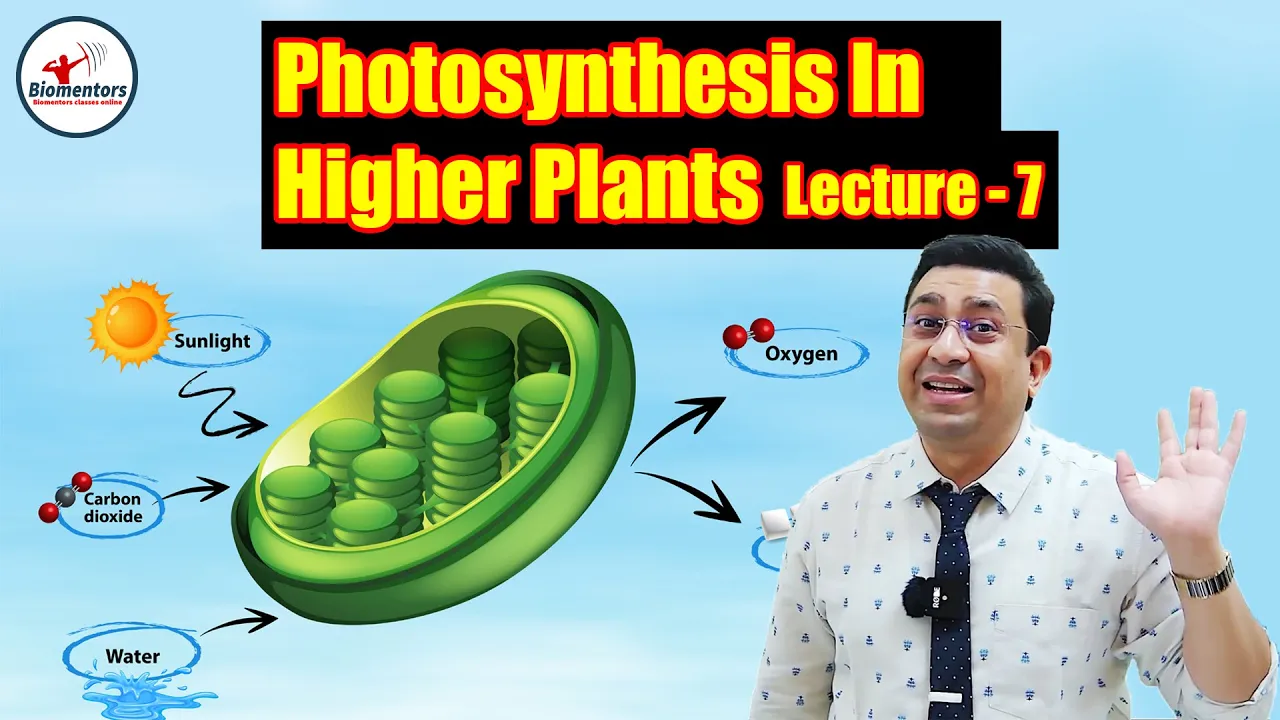
Photosynthesis Dark Reactions: C3, C4 & CAM Pathways | CSIR NET Plant Physiology (Part 3)
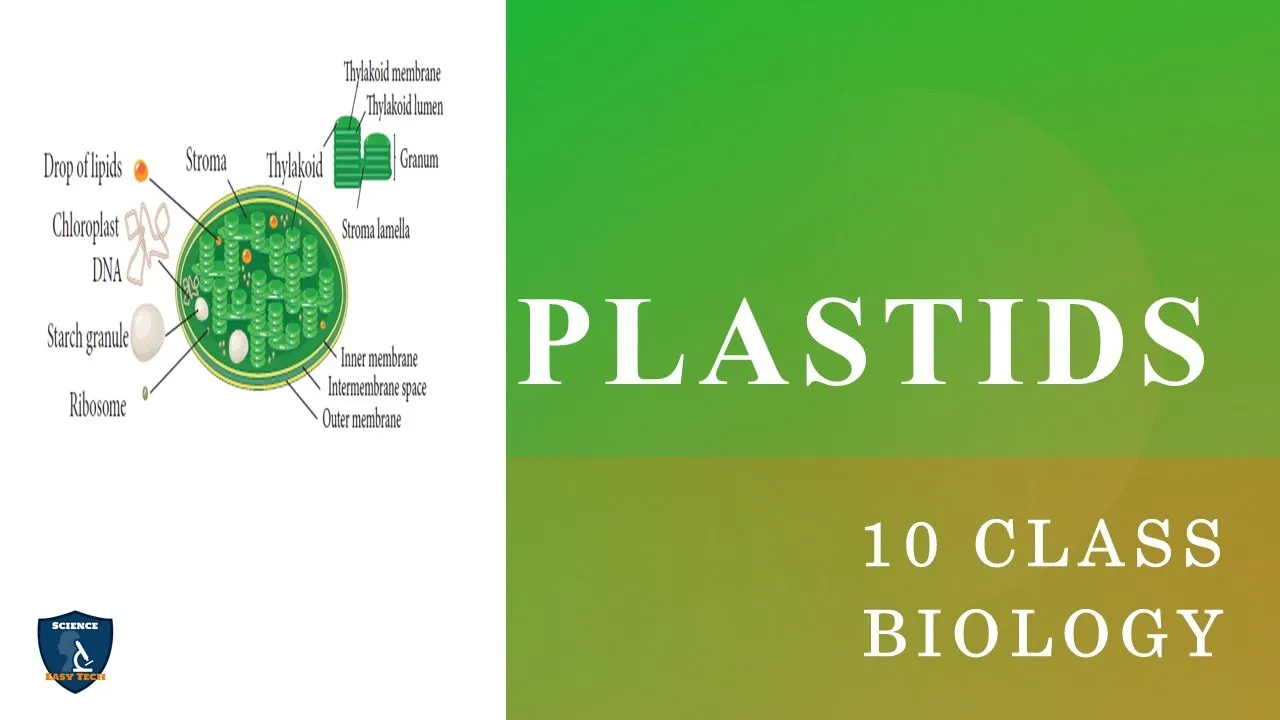
Added:Chloroplast anatomy, specifically distinguishing between the thylakoid membrane (site of light reactions) and the stroma (site of dark reactions).
The light-dependent reactions of photosynthesis, including how ATP and NADPH are generated as energy carriers.
Basic biochemical concepts of enzyme action, catalytic efficiency, and competitive inhibition (essential for understanding Rubisco's dual activity).
Fundamental principles of carbon chemistry and metabolic pathways, such as phosphorylation and redox reactions.
The photorespiratory pathway (C2 cycle), focusing on how plants salvage carbon lost due to Rubisco's oxygenase activity.
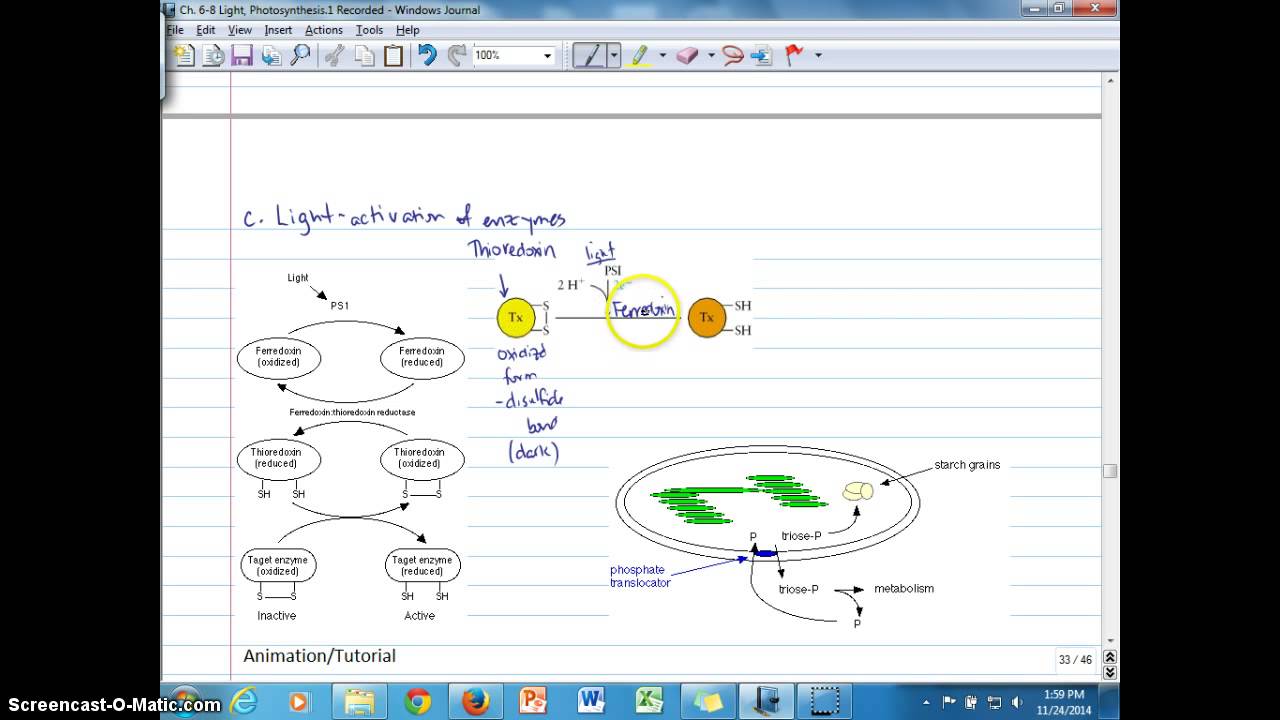
Regulatory mechanisms of the Calvin-Benson cycle, such as light-activation of enzymes via the ferredoxin-thioredoxin system.
Ecological and evolutionary adaptations of C3, C4, and CAM plants to varying global temperatures, water availability, and CO2 concentrations.
Starch and sucrose synthesis pathways, detailing how the primary products of carbon fixation (triose phosphates) are utilized by the plant.
Agricultural biotechnology applications, such as genetic engineering efforts to introduce C4 traits into C3 crops (e.g., C4 rice) to enhance yield.
5.5K views114likes1:06:10Original Release: 2022-03-14
um good evening all of you friends good evening very good evening to every one of you so friends uh in this particular class we are going to complete the photosynthesis that we are doing the dark reactions we are going to finish the entire dark reactions and we will see the questions also good evening everyone very good evening everyone friends good evening please continue please continue okay so friends listen to me for the period of 10 minutes continuously 10 to 15 minutes continuously so immediately i'll solve all your doubts so next one we called uh we completely understood the light reactions and friends what is the ultimate goal of the photosynthesis i hope all of you remember friends the ultimate goal of the photosynthesis is what friends are reduce the carbon into glucose everyone please continue but we all read very clearly if the plant want to reduce the carbon into glucose what does the plant require my friends undoubtedly friends plant require the energy actually so that energy we have prepared already in the light reactions now energy is ready my friends now what we have to read what we have to do good evening everyone we have to just convert the carbon into glucose so friends to convert the carbon into glucose we did not require any kind of the light what we only require is what friends energy always remember that point so that's why we can call it as a dark reactions my friends dark reactions doesn't mean that they are occurring in the dark dark reactions means that we will be calling them as a light independent reaction war are my friends we will be calling it as the carbon fixation reaction friends we can also call it as what friends carbon a simulation reaction you can call light independent also you can call it carbon fixation also friends even you can call it as the carbon assimilation what do you mean by the word carbon assimilation we are incorporating the carbon into the body uh to convert into glucose so friends so all of you listen my statements very very carefully friends based on the dark reaction what friends are based on the dark reaction are based on the carbon fixation all the plants present on this planet earth quickly i'll recall they are broadly categorized into three major types all the plants present on this planet earth one we call a c3 plant one we call c4 plants one we call it as the cam plants all of you listen i have told you in the last class also friends listen to me carefully 95 to 97.5 percent of the plants present on this planet earth they will be following the c3 plants only they will follow the c3 pathway only friends c4 pathway the plants which are exclusively living at the high light intensities which are leaving at the highlight intensities they will follow the c4 pathway and my friends cam pathway especially the plants which are living in the desert conditions they will follow the cam pathway so friends okay now listen every one of you from this particular slide next to six to seven slide whatever i'm going to discuss about the c3 plans i am requesting all of you pay utmost attention about every single slide if the question comes question is going to come from here only question won't go beyond that level so i'm encouraging everyone pay attention towards that by that you can easily understand the concept i will explain in the utmost simple and elaborative way okay let's focus dark reaction pay attention for 15 minutes friends you only try to understand friends in the light reactions what we have done good evening everyone in the light reactions friends we have producer the atp and friends in the light reactions we have also produced the nadph now this particular atp and nadph which we produced in the light reaction what the plant is going to do good evening everyone please continue by using these two plant is going to reduce the carbon into glucose very simple point it is my friends all of you please kindly keep it in your mind when the plant is basically fixing the carbon into glucose plant never fix the carbon directly into glucose instead of converting directly into glucose first it can produce trios of phosphates anyway we are going to read it now friends we all people read very clearly the light reactions where it has been taken place the light reactions are occurred on the thylakoid membrane we can also call it as the lamella my friends then where this particular dark reactions are taking place friends the dark reactions are exclusively taking place only in the chloroplast stroma why you can ask me sir why the dark reactions only is taking place in the stroma the reason behind that every single enzyme my friends pay utmost attention every single enzyme required for the dark reaction they are present in the stroma only so that's the major reason you all people has to understand dark reactions are taking place in the stroma only now all of you remember friends what is the unique enzyme that is involved in the dark reactions we will be calling it as friends rubisco what is the full form of rubisco ribose ribose one five bisphosphate carboxylase and oxygenase friends why i am using a word carboxylase and oxygenaser the reason behind that my friends rubisco fix the carbon also friends rubisco fix the oxygen also so it is having the ability to fix both that's the major reason we will be calling it as the carboxylase also friends even we will be calling it as the oxygen is also pay at most attention i'll make it extremely simple you will understand and you can remember for very long time so carbon dioxide assimilation occur in the three stages stage one stage two stage three what is stage one listen to me ten minutes continuously there are three steps are there fixation reduction followed by friends regeneration all of you look into this what is the ultimate goal once again remember the ultimate goal is what reduction of the carbon into glucose this is the ultimate goal but how we are reducing we are fixing the carbon into what my friends into three passport glycerate this is what exactly friends we will be calling it as the fixation now friends this three pass four glitch rate can be converted into g3p we will be calling it as the reduction ultimately my friends we will be calling it as the regeneration i will explain everything friends listen for all of you i will explain the cycle twice what i am expecting for you is just your better understanding i'll explain twice undoubtedly you will you will understand it pay attention as i already told you friends the ultimate goal is what friends conversion of the carbon into glucose this is the ultimate goal that we have already discussed now all of you listen so we have to fix the carbon into glucose if i want to fix the carbon into glucose someone has to accept the carbon listen to me friends focus someone has to accept the carbon who is going to accept the carbon the carbon can be accepted by rubp don't forget bp is called as what my friends a primary carbon acceptor what do you call my friends primary carbon acceptor we called it as a rubp friends everyone pay utmost attention rubp is how many carbon one two three four five carbon so five carbon rupp except one carbon so five plus one will become how many carbons six carbon but here comes the point in case of a calvin cycle the stable product and intermediate product is how many carbon three carbon once again listen the stable product or the intermediate product is the three carbon all of you pay at most attention friends now this particular six carbon containing compound can be break down into what this is six carbon containing compound break down into two molecules of three pca this is what you call a carbon fixation now every student listen my words once again who is going to accept the carbon the carbon can be accepted by the rupp rupp is a five carbon except one carbon total six carbon giving rise to two intermediate molecules each one is the three carbon we call three pca but let me tell you one interesting point here what is that interesting point listen everyone this is very unique statement if i want to produce half glucose i am talking i am not talking i am not talking about complete glucose in order to produce a half glucose the kelvin cycle has to turn three times friends never if you forget this point you can't understand the numerical part ha in order to produce a half glucose my friends cycle has to turn three times so if one time one are you bpp then three times three rubp we already read my friends one rubp is going to accept one carbon then my friends three rubp is going to accept how many carbon three carbon one rubp is how many carbon five carbon so total how many rubps are there three rubps are there so total how many carbon 15 carbon so each rebp is accepting one carbon 15 carbon plus three carbon 18 carbon my friends now every one of you pay at most attention as we read that our stable product our intermediate product should be three carbon containing compound only my friends now we are having how many carbons in our hand we are having 18 carbons by using this particular 18 carbon how many intermediate molecules i can produce undoubtedly my friends i can produce the six molecules of three pg simple point it is so six molecules of three pg are going to be produced a simple step this is what do you call carbon fixation okay now what is the second step everyone pay attention second step we call it as a reduction what is happening in this particular step there will be no change friends here i told you sixth molecule of three pga is present friends each three pga is how many carbon containing compound each three pieces three carbon one two three how many three pg are there six are there friends during the process of reduction everyone pay attention six molecule of three pga can be converted into six molecule of g3p friends is there any change in the number of carbon each three pg is how many carbon three carbon each g3p is how many carbon three carbon is there any change in the carbon number not at all now you can ask me sir what happened then just friends three pga just get reduced to the g3p that's all friends in order to reduce one molecule of three pca listen to me carefully in order to reduce one molecule of g3p into sorry three pca into one molecule of g3p we require one molecule of atp one molecule of nadph but my friends how many molecule of three pg i am going to be converted into g3p frenzer i am converting six molecule of three pga into six molecule of g3p so my friends i will use a six molecule of atp and six molecules of nadph a simple step now the toughest step every student has to understand this and without without confusion you people has to focus how many g3p are there finally friends six molecule of g3p are there my friends out of six molecule of g3p how many g3p are left sorry how many g3p are involved in the production of glucose everyone understand friends out of six molecule only one molecule just one one molecule of g3p exit the cycle and it is going to produce a half molecule of glucose once one molecule of g3p comes out my friends how many molecule of g3p is actually left you all know very well five molecules of g3p is left a very simple point friends this particular five molecule of g3p each g3p is how many carbon three carbon very simple so five molecules means how many carbon 15 carbon of you only understand by using listen my statements every one of you by using five molecule of g3p or r by using 15 carbon how many rubp we can regenerate undoubtedly my friend so we can regenerate the three molecules of rupp because each rebp is how many carbon 5 carbon and we are having how many carbons in our hand 15 carbons in our hand so by using 15 carbon i can easily produce the three molecules of rubp by spending three molecules of atp this is the calvin cycle i am repeating everyone pay attention and every one of you has to solve my simple questions if you answer my questions correctly you can answer 2022 paper questions also just like that very easily now listen to me you know listen to me carefully in order to produce half molecule of glucose the calvin cycle has to turn three times so three molecules of rubp each rebp is a 5 carbon total 15 carbon combined with 3 carbon 15 plus 3 18 carbon 18 carbon catalyzed by the rubisco and it can be broken down into what three carbon containing compound how many three carbon containing compounds we will get six molecules we will get because we are having 18 carbon this is the step we call carbon fixation now my friends this particular six molecule of three pga can be reduced to six molecule of g3p how my friends by spending six molecules of atp and spending six molecules of nadph now friends this part out of six molecule of g3p frenzer 5 molecules of g3p are remember in this way out of 6 molecule 1 g3p come out and produce the glucose then remaining 5 g3p total how many carbon 15 carbon going to give rise to three molecules of rubp by that by spending three molecules of atp now every student has to answer my simple question without spending much time my question is very clear my question is how many molecules of atp how many molecules of nadph how many molecules of carbon dioxide are required to produce a 100 and other 140 molecules of glucose my question is very easy to pro how many molecule of atp how many molecule of nadph how many molecule of carbon dioxide is required to produce 140 molecules of glucose my friends i don't give them much time just one minute less than one minute everyone has to calculate faster because we have to cover so much everyone everyone at least one fellow give me the answer correctly enough then i'll explain for all of you faster friends just like that you can calculate anyone grishma amar beauty quarry sumiya everyone has to answer jay shri deepika shahani anyone come on come on okay that's okay that's okay i will be telling you answers just look into this i did not ask any difficult question right all of you listen how many molecules of carbon dioxide is required for half glucose how many carbon dioxide required for half glucose half glucose my friends we require three carbon dioxide then for one glucose how many carbon dioxide we require we require six carbon dioxide 6 into 140 very simple fantastic very good friends and where most of the students will get confused where most of the students will get confused when i ask you half molecule of glucose ninety percent of the students will think that we are spending only six molecules of atp this is wrong statement we are not using six molecules for half glucose we are using six plus three nine molecules of atp we are using so for half glucose nine atp then for one glucose 18 atp so 18 into 140 then friends half glucose how many nadh we will use 6 nadh we will use then for one glucose how many nadhs we will use 12 nadh we will use so 12 into 140 how much you have to calculate that's a simple calculation you don't need to get a confused at all okay 840 carbons now my friends say every one of you look into this everyone everyone good some people given the correct answer some people given the wrong answer to summarize to all of you just listen three carbon dioxide combined with three rupp to make six molecule of g3p we studied very correctly out of six molecule of g3p produced one molecule of g3p exit the cycle and goes towards making glucose now everyone pay attention look into this we were written very clearly here friends and nine atp are converted most of the students will think that 680p that is wrong statement friends 980p are converted to 980p where we used 680p we have used during the reduction step of friends and 380p we have used during the regeneration step then how many nadhs we used my friends sixth molecule of nadh we used so i am summarizing friends to make one molecule of glucose if you remember for one molecule enough you can calculate whatever they may ask to produce one molecule of glucose we require six molecule of carbon dioxide friends we require 18 molecules of atp and friends we also require 12 molecules of the nadph once again everyone to produce one glucose 6 carbon dioxide 18 atp one nadph into how many number they may ask you can easily multiply it simple my friends now i am giving you just one minute every one of you think and answer this particular question that's a very good question very logical question i am expecting at least some people will give me the correct answer not much time 30 seconds don't take too much time friends 30 seconds that's all what is the net synthesis of g3p on carboxylation of three molecules of rebp in the calvin cycle anyone not much time not much time 90 percent of the students will give the wrong answer for this question i hope you people will think correctly and give me the right answer think it friends think it you can think it easily and you can answer one saima said one okay what about others okay tiwari said sex okay faster friends faster others beauty kumari priya voya grishbach six half glucose saphia half we did not ask the glucose dear okay anyone else sumaya yes yes oh yeah said one six amar okay my friends all of you understand the answer is one use your brain listen my question carefully the question says that what is the all of you all of you okay okay whoever made it wrong listen my statements carefully listen friends look into this the question says that what is the net synthesis of g3p on carboxylation of three molecules of rupp in the calvin cycle my friends every student has to remember when they ask you a question what is the net synthesis no problem on everyone look into this what is the net synthesis every one of you has to understand net synthesis means how many molecule of g3p are directly involved in the production of glucose listen my question how many molecules of g3p are involved in the production of glucose directly you only look into the picture my friends we got six molecule of g3p out of six molecule of g3p how many molecule of g3p is involved in the production of glucose you can look into this only one molecule of g3p is involved in the production of the glucose very very simple point so the answer will be only one the question says that what is net synthesis net means which are directly involved so answer will be one it's a simple question logical question some people said six that is right because we produce a sixth molecule of g3p my friends that is right but out of six how many we use for the production of glucose we use only one that is what do you call net synthesis i hope every one of you understand okay now every one of you answered this question which was asked in the february 2022 question paper this is the first part to be questioned from the photosynthesis or the plant physiology in the february 2022 paper everyone yes sima what's the answer dear deepika hamar is d this is the first question asked in the exam obviously the answer will be d simple two marker what you can see right my friends where we have used our energy we have used energy during the process of reduction also my friends and most of the students will forget this we have used the energy at the regeneration also very simple question two marks are in our hand nothing difficult very very simple okay now friends pay attention pay attention now this particular half molecule of glucose what it is going to do friends this particular half molecule of glucose it is going to give rise to this sucrose also my friends and this particular half molecule of glucose it is going to give rise to the starch also once again this question also asked in the exam twice in the part b what is the question they have asked in the exam which of the following are the locations involved in the production of sucrose and which of the following location is involved in the production of this starch friends please don't forget glucose is what monomer writer so glucose can give rise to the dimer also glucose can give rise to the polymer also now glucose is going to give rise to the sucrose what you people have to remember for the exam point of view is a location always my friends sucrose is synthesizing in the cytosol my friends where the glucose is going to be converted into the starch in the chloroplast stroma i will be asking you the same questions in the tomorrow class also don't forget while we are solving the pyqs and while we are solving the practice questions you have to remember everything okay that is the calvin cycle but my friends from now onwards till next 10 minutes listen my every single statement at most care why because many times we got the four marker question from here just listen to me carefully here what is the principle enzyme involved my friend so the important and the principle enzyme involved is the rubisco we can understand that and friends what is the uniqueness of the rubisco the uniqueness of the rubisco is it can fix the carbon also it can fix the oxygen also so but what is the ultimate goal of the plant body ultimate goal of the plant body is not to fix the carb sorry not to fix the oxygen ultimate goal of the plant body is to fix only carbon not the oxygen but all of you listen when certain conditions what is happening you know rubisco will fix the oxygen instead of carbon so my friends whenever rubisco fix the oxygen instead of carbon that kind that reaction you called photo respiration and every single student has to remember for the exam point of view most of the students will get confused that photo respiration can occur in the c4 plans also and cam plans also that is absolutely wrong statement c4 plans and cam plans never allow the photo respiration to occur they will always try to avoid it by using their mechanisms we are going to read now where this particular photo respiration is happening only c3 plants they're happening only in the c3 plants pay attention for 10 minutes don't interrupt you will get a crystal clear concept when this particular photo respiration is occurring listen my statements carefully it is occurring when the rubisco fixes the oxygen instead of the carbon dioxide what is the uniqueness of rubisco having carboxylase activity also oxygenate activity also now all of you can ask me a question sir how can you say when the rubisco fix the oxygen how can you say when the rubisco fix the carbon i can give you a wonderful explanation for that rubisco is going to fix the oxygen only certain condition what are the particular certain condition use the brain it occurs only in the high light intensities it occurs only in the high temperatures it occurs in the areas of highlight intensities it occurs in the area of high temperature now you can ask me sir what is happening at the high temperature listen my friends understand this beautiful line at a high temperature the solubility of oxygen in the cytosal and chloroplastoma is less affected as compared to co2 what do you mean by that friends when the temperature is high carbon dioxide will be completely solubilized then which is available is only oxygen friends oxygen is not completely soluble which is completely soluble carbon dioxide is completely soluble then which is left oxygen is left then obviously rubisco will fix what undoubtedly oxygen now once again in a given four marker question two times they have asked the same statement you know what is the same statement they have asked we are going to solve that they ask her that rubisco having two separate active sites for the carbon dioxide and oxygen which is absolutely wrong statement it's not possible you only try to understand this is the enzyme rubisco rubisco having which side only one active site my friend such a simple step it is to this particular active site carbon dioxide is competing my friends oxygen is also competing friends so whichever associated with the active site rubisco only will fix that you should not think that the rubisco having two different active said by that it can fix the carbon dioxide and oxygen at a time that's wrong statement whichever compete for the active set whichever is more available rubisco only fix that so in order to understand the photo respiration right now whatever the two equations i am writing if you understand that two equations photo respiration is crystal clear to all of you if you understand the two equations whatever i am writing the concept is clear listen so first let's take who is the carbon acceptor carbon acceptor is the rubp rubp accepted what carbon now what is the enzyme here the enzyme is the rubisco so here you know what the rubisco has done rubisco fix the carbon only no problem rubp is five carbon rubisco is one carbon total six carbon we already read then how many molecule of three pga we are going to get two molecule of three pizza then calvin cycle will continued without fail it will continue but you listen my friends now are you bp same reaction now there is no carbon friends the available is what only oxygen then same enzyme what is the same enzyme rubisco only now are you bp is a five carbon is there any carbon available here no carbon only five carbon now you only answer my question friends by using five carbon how many three pcr we will get my friends we will get only one molecule of three pca then how many carbons are left friends two carbons are left this two carbon containing compound you know my friends what do you call it as you how to remember this friends we call it as the passport glycolate listen to me listen to me we call it as passport glycolate now once again i'm revising when rubp fixed the carbon with the help of rubisco we got a two molecule of three pg a calvin cycle never continued it will go on but when the rubp fix the oxygen in the presence of rubisco what is happening we get only one molecule of three pieces now you only understand my friends if one molecule of three pga is a present there is a no way there is a no way the calvin cycle will be continued only 1 3 pga is left as a result what happened calvin cycle will stop now you can ask me sir what should i do in order to yellow the calvin cycle to continue here what how many carbons are left two carbon what is that two carbon phosphoglycerate everyone listen to me we have to convert this particular passport glycolate back to what my friends i have to convert the passport glycolate back to 3 pga then only calvin cycle will be continued otherwise calvin cycle is not going to be continued and friends here we produce a two carbon containing compound as a waste product that's why photorespiration also called as my friends c2 cycle simple point now since the byproduct is a two carbon containing compound then i will be calling it as the c2 cycle so friends c2 cycle is same friends and photorespiration is also same kindly do not confuse all of you look into this oxygen and carbon dioxide compete for the same site on rubisco this is the same line they repeated in our exam more than thrice not twice thrice now you only understand when rubisco fixes the oxygen we will get a one molecule of three pca and one molecule of two passport glycolate that is why we can call it as a metabolically useless product and this entire photorespiration is only waste reaction this should not happen actually okay now you only try to understand now listen what happened right now all of you all of you pay attention and understand whatever i'm writing are you bp taken the oxygen in the presence of rubisco i got one molecule of three pca and i got one molecule of two passport glycolate i got what should i do in order to allow the calvin cycle to be continued i want to convert this passport glycolate to the another three pcr molecule then i will get two molecules of three pca then the calvin cycle will be continued now i am going to prove how can we convert this particular two passport glycolate back to the three molecule three pca and you people no need to remember not even a single structure also once you download the ppt the ppt will be very clear don't worry just listen my words first thing you don't need to remember any structure what you have to remember is schematic presentation you have to remember every single step now listen first what are the various organelles involved the organelle involved is the chloroplast peroxisome mitochondria friends more than six times six times in a given four marker question they used to ask the organelles you people has to remember the organelles in the order remembering order is at most important friends chloroplast peroxisome followed by the mitochondria listen to me friends i will explain in a simple way focus rubp fixed the oxygen i got one molecule of three pga i got one molecule of three passport glycolate now how i am going to convert the two passport glycolate back to the three past four glycerate everyone friends just listen my words carefully now the two passport glycolate upon listen my words the two passport glycolate upon losing the phosphate group it is converted into glycolate now the glycolate from the chloroplast it entered into the peroxisome this is also asked question now in the peroxisome glycolate converted into glyoxylate glyoxylate in the peroxisome it is converted into glycine now the glycine from the peroxisome it entered into the mitochondria now the glycine converted into serine glycine is an amino acid cell is an amino acid now the serine from the mitochondria it entered into the peroxisome now the serene converted into hydroxy pyruvate hydroxy pyramid converted into glycerate glycerate from the peroxisome it enter into the chloroplast glycerate my friends ultimately it is going to converted into three passbook listed simple point it is very simple i am summarizing for all of you pay utmost attention what is the first step to pass for glycolate upon losing the prospect group in the chloroplast converted into glycolate glycolytic enter into the peroxisome the question a screen or csr part b exam the first metabolite that he entered into the peroxisome is the glycolic acid or glycolate absolutely true statement now glycolate converted into glyoxylate glyoxylate convert into glycine glycine from the peroxisome enter into the mitochondria everyone remember this particular reaction my friends glycine is going to be converted into serine now everyone pay attention when glycine is basically converted into serene we gain energy here it's a reduction reaction where we produce radiation but what i said to you i said it's a waste reaction because we have to spend energy listen my statement i said to you it's a waste reaction because we have to spend energy but here surprisingly we gain the energy just listen that now glycine convert into serine now serine entered where into the peroxisome once again serene convert into hydroxy pyruvate hydroxy pyruvate convert into glyceride my friends when the hydroxy pyruvate is going to be converted into glycerate this is what kind of reduct a reaction oxidation so here we have to spend energy so whatever we gained whatever the energy we gained we spent here chart balanced now glycerate from the from where from the peroxisome we enter into the chloroplast now the rate is going to be converted into the three pass progress rate my friends ultimately see here we producer three pass progress rate now you only understand if the glycerate wants to be converted into three pass per glazer obviously what should i add my friends i should add the atp so here we are spending energy unnecessarily we have already discussed that in the light reaction plant struggled a lot to produce the energy now whatever the energy we synthesize over there we are spending unnecessarily here that's why we will be calling this particular photo respiration or the sea to cycle as the expensive side reaction this is how friends the c3 plants can show the c2 cycle or the photorespiration anyway undoubtedly we converted the glycolytic back to the three pass processor rate and we have skipped this particular photo respiration now you you have to get one wonderful doubt what is the doubt you have to get sir does this particular photo this is the real good doubt does the photo respiration occur very oftenly or very rarely in the plant body i can tell all of you in the c3 plant photo respiration occur very oftenly because you only understand friends when the temperature is high even we are also one of the reason because of the human activity what is happening you only tell me the temperatures get increased when the temperatures get increased what is happening friends the carbon dioxide will get completely solubilized then which is available oxygen is available then the plant fix the oxygen then obviously it leads the photorespiration so you should not think that the photorespiration is a rare phenomena photorespiration is the more often phenomena in the c3 plans okay friends everyone say yes or no is that clear everyone till c3 cycle and c2 cycle if you say yes we will go ahead if you ask me doubt i will explain quick quick we have to finish two more pathways faster friends faster these pathways are easy okay i hope it's clear for every one of your friends that's great that's great that's great you can ask me friends you can ask me if you have anyone having any kind of a doubt now friends let's talk about the c4 pathway and cam pathway and friends you have to remember these two plants c4 plants as well as the camp pathway plants they never ever involved in the process of photorespiration never ever involved so they will always develop certain kinds of mechanisms friends where they are going to avoid this particular photo respiration in a very easy manner let's talk about one by one pathway very easily i'll explain and very depth we will read you will be very clear and first let's talk about the c4 pathway so friends c4 pathway can be shown by what kind of plans i want every student has to remember my friends more than 18 000 more than 18 000 types of angiosperms more than 18 000 type of angiosperms are basically follow this particular c4 pathway especially mono cards but my friends there is an exception 99.99 percent monocots will follow the c4 pathway but friends at a point one zero zero one percent even dicots will also follow this particular c4 pathway the best example is amaranthus amaranthus is the dicot which can follow this particular c4 pathway please kindly do not forget this particular point now c4 pathway our plans just listen to me 10 minutes i'll explain in an elaborative way c4 pathway or plants where the plants that are growing in the hot and dry climate whenever you heard the name of a c4 pathway one of the most common point everyone has to remember for the exam point of view is that c4 plants are the those type of plants which are involved in the crunch anatomy this statement also asks more than three times c4 pathway involves contains a crunch anatomy absolutely true point there is a no doubt i will tell you what is this particular crunch anatomy how exactly it look like and one more unique statement is what friends very very unique statement in case of a c3 plants the principle enzyme is the rubisco but my friends in case of a c4 plants the major principle enzyme is what is that frenza we will be calling it as the pepper carboxylase enzyme use pepper carboxylase to fix what friends atmospheric carbon dioxide never ever forget that and it will fix the carbon dioxide into how many carbon containing compound for carbon this is interesting point why we have given the name c3 pathway tell me because the stable or intermediate product is the three carbon that's why we call c3 pathway here the stable or intermediate product is four carbon that's why we can called c4 pathway what is the best example for that we call call it that four carbon containing compound is the oxaloacetic acid simple point what are the best example sugar cane maize sorghum millet these are all the four standard example i request every student at least remember another four plants apart from these standard four plants friends now i want every one of you look into this beautiful diagram this is the crying anatomy try to understand friends see this how beautiful this this is the upper epidermis of the leaf and this is the lower epidermis of the leaf please listen my statements crystal clearly if you look into the kran's anatomy it contained two type of cells one we called it as the mesophyll cell another one we called it as the bundle sheet cell my friends so what are the major differences between the mesophyll cell and bundle sheet cell everyone listen mesophyll cells are those type of cells friends which are always present very close to the leaf surface you only see here this is the surface right mesophyll cells are always present to the leaf surface you have to listen this and the unique statement it is present very closer to the leaf surface and having great amount of the inter cellular spaces great amount of the intercellular spaces and one more important point is what if you look into the bundle sheet cell all of you pay attention they are present in a very deep if you don't understand this statement you can't get the concept bundle sheet cells are present very deeper and they are not having any intercellular spaces you can see the diagram very clearly once again look into this mesophyll cells are having very they are associated with the leaf surface and they are having large intracellular spaces whereas friends bundle sheet cells do not have any intracellular spaces they are associated very tightly now you can ask me sir in the c4 pathway which kind of cells are involved do we require mesophyll or bundle sheath the point here we require both mesophyll also we require both band bundle sheath also both the cells are extremely important so you can ask me sir you are saying that the two cells both mesophyll and bundle sheath is involved then the question is here how these two are connecting with each other that is the question my friends mesophile and bundle sheet cells are connected with each other by the every one of you remember both the cells are required desperate with the help of plasmodesmeta they can be connected so friends before understanding the pathway just listen to me carefully every one of you pay at most attention this is the mesophyll cell this is the bundle sheet cell friends i just said to all of you this is important for five minutes pay attention mesophyll cells are very closer to the leaf surface i have shown you in the diagram very clearly the interesting point every student has to remember is that whatever the cell that are very closer to the surface they do not have rubisco simple point if there is a no rubisco someone has to fix the carbon we should not stop the carbon fixation so who is going to fix the carbon my friends the another unique enzyme phosphoenol pyruvate carboxylase is the enzyme which is involved in the fixing of the carbon now here comes a beautiful and interesting fact about the pap carboxylase enzyme is that it cannot fix the oxygen it cannot fix the oxygen it is going to fix only the carbon that's a great advantage now whatever you will understand in the diagram just listen to me whatever the carbon fixed by the pep carboxylase it will send it to the bundle sheet cell friends bundle sheet cell what is present in the bundle sheet cell rubisco is present now you will get immediately doubt sir you are sending carbon to the bundesliga cell bundles itself there is no problem and there is a rubisco also that's advantage but rubisco can fix the oxygen also right then how can you confirm me that the rubisco only fix the carbon the greatest point here here is that bundle sheet cell oxygen never diffuse because bundle sheet cell is presented very deeper to the deeper layers oxygen having a poor access it cannot diffuse hence there will be a no process of oxygen fixation now i will summarize it listen to me very very very carefully everyone who is the carbon acceptor my friends everyone pay attention the carbon acceptor is the p e p passport in all pirate don't confuse my friends in case of a c3 plant who is the carbon acceptor in the c3 plant carbon acceptor is the rubp which is the five carbon containing compound but my friends in case of a c4 plants the carbon acceptor is the pepp is how many carbon just three carbon pepper combined with this particular carbon so p e p three carbon plus one carbon how many carbon will get four carbon what is that particular four carbon we will be calling it as a we will be calling it as the oxaloacetic acid my friends we all people know very well auxiliastic as it is a four carbon hence the name of the pathway also c4 pathway but the point every student has to remember friends this particular oxaloacetic acid cannot enter into the bundle sheath cannot enter into the bundle sheath it is it do not have active site actually my friends for that reason oxaloacetic acid can be converted into either malic acid or the aspartic acid my friends myelic acid also for carbon there is a no doubt about it everyone pay attention now the malic acid entering where the malic acid is basically entering into this particular bundle sheath cell it entered here malic acid is how many carbon my friends four carbon now friends malic acid can be treated by an important enzyme all of you pay attention we call it as the malic acid decarboxylase enzyme my friends we know that d carboxylase enzyme function is what it is going to break down the malic acid four carbon into three carbon plus one carbon now here comes the unique one this one carbon taken by the rubisco because rubisco is present in the bundle sheet right now friends rubisco continued the calvin cycle calvin cycle is common it has to occur in every plant do not forget that now how many carbons are left three carbons are left what i can call that particular three carbon i can call that particular three carbon as the pyruvate now that particular three carbon containing pyruvate entered where it entered into the mesophyll cell what is that pyruvate now my friends what is happening this particular pyruvate with the help of atp it is converting into what friends are passport in all pyruvate so wherever the cycle started it ends there only now you only listen is there any fixation of the oxygen here no not at all is there any uh occurrence of the photorespiration here no not at all so that's why we can say c4 pathway plant by using crunch anatomy they can easily avoid the photorespiration once again every one of you pay attention i'll quickly summarize passport on pyruvate is a three carbon containing compound combined with one carbon total become four carbon giving rise to oxaloacetic acid oxaloacetic acid converts into malic acid malic acid from the mesophyll enter into the bundle sheet cell malic acid can be treated by an enzyme called as malic acid decarboxylase enzyme so malic acid decarboxylase enzyme will break down into one carbon plus three carbon what is that no i'm not understanding someone is asking then this particular three carbon pyruvate can enter into the mesophyll and pyruvate is converted into passport in all pyruvate oh i got it i got it so this c is what we call c4 pathway i understand okay now everyone say s or no is that clear everyone c4 pathway you can ask me friends everyone can ask me c4 pathway is clear just say yes or no okay i hope it's clear for everyone right perfect perfect perfect i hope it's extremely clear for all of you now my friends then the last and the final pathway that we have to study is the cam pathway my friends undoubtedly in case of a cam pathway also we have to avoid the photorespiration there is no doubt about that in the cam pathway there there is a two problems what are the two problems first problem we have to avoid the photo respiration oh yeah i will explain once again here please wait we have to avoid the photo respiration and my friends in the camp pathway another goal is what friends another goal is to minimize the transpiration to mean i will explain jay shree minimize the transpiration and avoid the photo respiration there are two goals are there for the cam plans all of you pay attention friends pay attention and listen to me very very carefully now what kind of plants are going to follow the cam pathway the plants which are belonging to the crassulation acid sorry crushed relation family all these plants follow the camp pathway best example all the dessert plants like cactus pineapple bromeliads are gay succulents remember many and what is the unique point you have to remember we have to avoid the transpiration we have to avoid the photorespiration also friends listen my interesting statement here if you observe the temperature i will repeat just listen to me please listen please listen have patience i'll explain i'll explain cam pathway all of you listen in case of a cam pathway friendship we have to avoid the photo respiration and we have to avoid the transpiration also and what is the speciality of camp cam plants they are growing in the desert now whenever they are growing in the desert everyone pay attention whenever they are growing in the desert if you observe the temperatures in the desert during the daytime the temperature is very very very very very high but my friends when it comes to the night time the temperature is dramatically fall off it will be extremely cool in the night time is extremely cool in the day time it is extremely hot now you only understand use the brain if a cam plant open their stomata during the day time what is going to happen if it opens during the daytime obviously what friends are the entire water loss will occur so that is the reason what is the uniqueness of the cam plants they will open the stomata only during the night time they never open the stomata during the day time whatever the stomata that is opening the night time everyone has to remember the name we will be calling it as this sun canistomate sun can yes we and s-u-n-k-n sun can stomata just everyone listen i will explain twice so this is the condition where the stomata is open that is the night time this is the condition where the stomata closed during the day time very simple friends listen now what is the function of tomato we all know very well the function of the stomata is the gaseous exchange so when the stomata is open gases are coming inside so carbon dioxide enter inside all of your same function no difference no difference just listen to me carbon enter inside who is going to accept the carbon in case of a c3 plants in the c3 plant carbon is accepted by rubp like this also we can get the question in c4 plants carbon accepted by pap my friends even in the camp plant also carbon is getting accepted by the pep only french now the passport enol pyruvate accept one carbon four carbon same enzyme no doubt pep carboxylase so pep carboxylase convert this into oxaloacetic acid everyone answer my question in case of c4 pathway what happened my friends oxalistic acid convert into malic acid same way here oxaloacetate also convert into malate my friends listen now in case of c4 plants what happened mallet entered into which cell bundle sheath but friends where are the bundle sheet no bundle sheath in the cam plants then the malic acid can be stored in the vacuum where the malic has risk stored friends in the vacuole during the night time whomever did not understand once again listen to me when the stomata opened during the night time carbon enters inside passport on pyruvate accept the carbon with the help of pep carboxylase enzyme it is converted into oxalis data auxilia state convert into malnet mallet anyway malnet or malic acid they can store it in the vacuole during the night time don't confuse malic acid is the organic compound manic it is a acid one is acid or organic compound anything is same now listen during the daytime what happen stomata is closed if the stomata is closer during the daytime carbon never enters inside but the point is very clear plant has to survive plant has to survive without food they can't survive now see what they are doing they have stored the malic acid during the night time whatever the malic acid that they stored during the night time they will bring that particular malic acid out and once again they will be treated with an enzyme called as a malic dehydrogenase enzyme what is happening malate is how many carbon four carbon so it break down into three carbon plus one carbon very simple now that one carbon can undergo the kelvin cycle that's so common then what about the three carbon three carbon is the pyruvate pyruvate is going to be converted into starch simple now you only try to understand my friends where the photorespiration occur not at all we did not fix the oxygen we fixed carbon only moreover what has happened moreover there will be no transpiration there will be no water loss whomever did not understand the camp path will summarize in one minute focus cam pathway having two goals avoid the photorespiration minimize the transpiration so for that reason they open the stomata during the night time carbon enter insert past point pyruvate accept the carbon convert into oxalis state auxilia state convert into mallet mallet can stored in the malic acid now all of you listen this particular malic acid during the day time it will come out right then mallet once again break down into three carbon pyruvate and one carbon carbon dioxide pyruvate convert into starch one carbon undergo the calvin cycle simple cam pathway uh sahani that's really very very good question dear enzymes are going to damage at a higher temperature that's absolutely true statement but you also know note here 97.5 of all the enzymes are stable at 37.5 degree centigrade but the enzymes which are present in the plants which are living at the desert condition they can withstand up to 70 to 80 degree centigrade very easily hence there is no problem for that particular enzymes now whomever did not understand the c4 pathway i'm repeating for all of you and i will explain one by one and someone has asked a doubt and beauty kumari you look into your doubt first i will come one by one first pass point all pyruvate combined with one carbon three plus one four carbon four carbon convert into oxalistic acid oxalistic acid convert into malic acid malic acid entered here many cases is how many carbon four carbon once the malic acid converts is a four carbon it is treated by an enzyme called as malic acid decarboxylase enzyme malic acid decarboxylase enzyme breakdown malic acid into three carbon plus one carbon that one carbon can be used by the rubisco and calvin cycle will be continued then how many carbons are left three carbons are left now the three carbon what do we call it as pyruvate that pyruvate from the bundle sheet cell it enter into the mesophyll now all of you listen now pyruvate is going to be converted into passport in all pyruvate now if the pyruvate wants to convert into passport or pyruvate we have to add the passport group then only if pyruvate convert into passport i'll private right so how can we add the password group someone has to donate the password group who is going to donate the password group atp so simple friends is that clear everyone i hope all of you clear now if you look into the c3 plants there is only mesophyll cell if you look into the bundle sheet cell both mesophyll sorry if you look into the c4 both mesophyll and bundle sheath if you look into the cam plans only misophil but you know right stomata opened during night time stomata closure during day time you know my friends you call it this as the temporal separation please kindly do not forget this temporal separation yes i think your doubt is very clear now now itself in this slide it is only contain mesophyll okay that's about photosynthesis i hope everyone is very clear with the photosynthesis without having any confusion now you can ask any kind of a doubt in the entire photosynthesis i hope it's clear friends that's all for now we will meet in the tomorrow class okay and friends tomorrow we don't have the early morning 5 45 class 5 45 classes i will start from the wednesday okay so first i have to finish two extra classes are there i have to finish that from wednesday onwards we will start the 5 45 am classes okay thank you all of you thank you thank you so much that's all for now i'm telling you once again i will remember every one name and i will take utmost care of everyone when it comes to the uh when we are going forward i will help individually by providing the study materials also so i'm requesting all of you friends please be regular i don't expect anything just be regular and have patience okay friends thank you all thank you so much good night bye okay sadhguri i will tell that in the tomorrow starting class dear how many atp i will tell you in the tomorrow starting class
Up Next
6:50
Photosynthesis in Plants: C3, C4, and CAM Pathways Explained
@ProfessorDaveExplains
485.4K views•2021-04-07
50:12
Bacterial Communication: Quorum Sensing and Biofilm Formation Explained
@JHUAAP
12.6K views•2011-06-28

67:55
Auxin Transport in Plants: CSIR NET Plant Hormones
@chandubiologyclasses8327
960 views•2022-12-02
7:08
Bacteriophages: Earth's Deadliest Killers and Future Antibiotics
@kurzgesagt
34.6M views•2018-05-13
Related Study Plans & Knowledge Roadmaps
Structured learning paths in Biology
biology
RNAi: Biogenesis, RISC & Gene Silencing
01Molecular Biology Foundations: DNA to Protein
02Introduction to RNA Interference (RNAi)
03Molecular Biogenesis of miRNA and siRNA
+ 2 more learning modules
10h5 modules
Explore Roadmap
biology
Mycorrhizae: Signaling, Biophysics & Ecology
01Foundations of Mycorrhizal Symbiosis
02Molecular Signaling and Root Colonization
03Biophysics and Bioenergetics of Nutrient Exchange
+ 1 more learning modules
11h4 modules
Explore Roadmap
biology
Circadian Clocks: TTFL, SCN & Periphery
01Foundations of Molecular Biology & Gene Expression
02Introduction to Chronobiology and Actograms
03The Core TTFL: Molecular Architecture of the Clock
+ 3 more learning modules
14h6 modules
Explore Roadmap
biology
Population Genetics: Math, Drift & Selection
01Genetic & Probability Foundations
02The Hardy-Weinberg Principle and Baseline Models
03Mathematical Modeling of Natural Selection
+ 3 more learning modules
18h6 modules
Explore Roadmap