
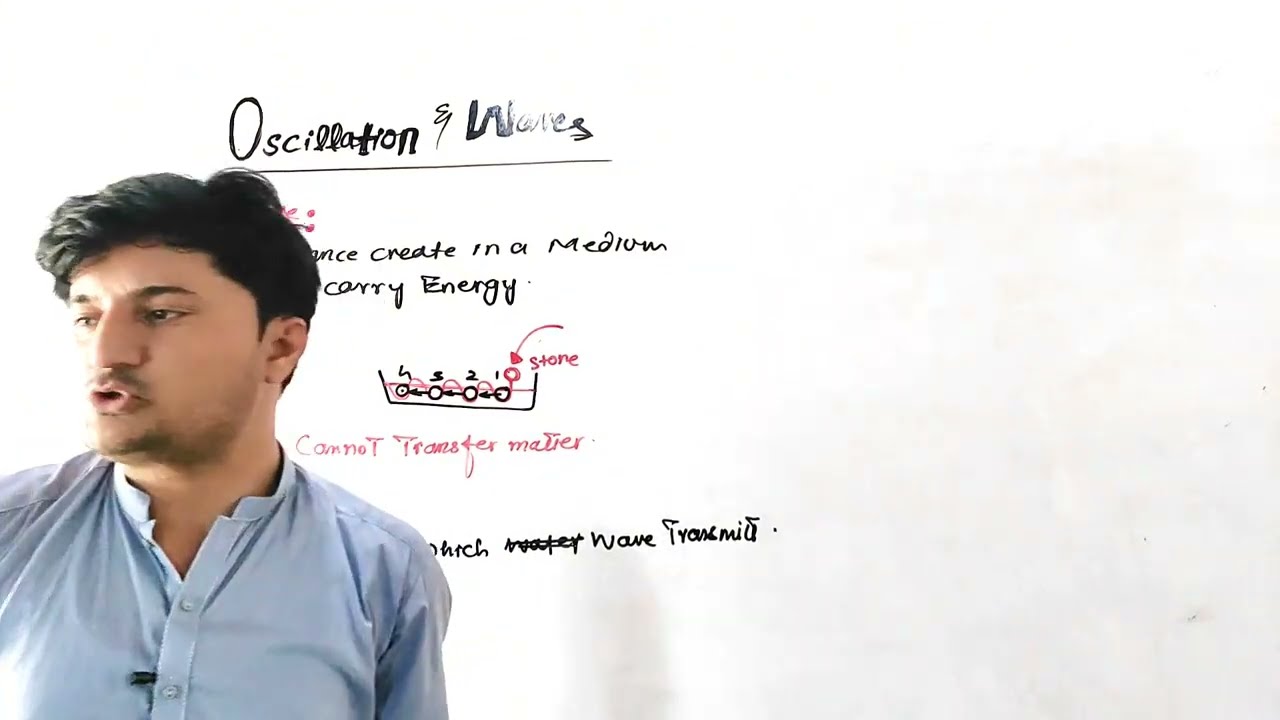
![IGCSE Physics [Syllabus 3.1] Wave properties](https://i.ytimg.com/vi/xobSuCkaiU8/maxresdefault.jpg)
























Sound is fundamentally a pressure wave created when vibrating objects cause air particles to compress and expand in sequence, generating alternating regions of high pressure (compressions) and low pressure (rarefactions) that travel through the air as waves; these pressure variations can be visualized as waveforms where the vertical axis represents pressure and the horizontal axis represents time, and different sounds produce distinct waveform patterns based on how the air particles are disturbed, with simple sounds showing clear cycles and complex sounds like orchestral music creating unique combined waveforms that can be recorded and reproduced using technologies like vinyl records that physically encode these pressure patterns into grooves.
Sound Waves Explained: Physics of Sound for Beginners
Added:What is Sound? Understanding the fundamentals of sound and sound waves.
Physics of sound by Branch Education.
Why does everything around us generate sound?
Also, there are a whole variety of sounds- running water, a cellphone, music, someone’s voice.
The list of sounds you hear throughout a given day is endless.
But, when you are shown what sound looks like, inevitably you are shown something like this… which sounds like this... and to me, that doesn’t make much sense because you never hear that sound in the real word.
In this Branch Episode, lets try to better understand what is sound?
Let’s start with a simple sound.
*POP* That was popping an inflated polka dot balloon.
This polka dot balloon is filled with high pressure air particles and when popped, all these particles rush out and hit the adjacent air particles.
Those particles hit the next set of adjacent particles, and so on, thereby creating an expanding shell of air particles just bouncing into one another This is called a pressure wave or sound wave.
This wave travels throughout the room and eventually the bouncing particles apply a force to your ear drum which causes parts of your internal ear to move.
Then your brain processes this motion in your internal ear and tells your cognition that oh this motion in my ear sounds like a balloon popping.
Let’s, rewind, go back to take deep dive into what this sound wave looks like.
Even though popping the balloon makes a relatively simple sound when we take a cross section and zoom in on a molecular level we can see the complex pattern depicting how the air particles are bouncing into one another.
This pattern is produced within a tenth of a second after the balloon is popped.
You may ask- where does this pattern come from?
Well, the high-pressure air particles rush out and generate a high-pressure wave, but when they do, they create a low-pressure void in the balloon’s center The air particles rush back into fill this void, there by generating a low-pressure wave When the particles rush back in to fill the void, they rush in too much thereby creating second-high pressure zone.
This cycle repeats itself and each time it does it generates a high pressure & low-pressure wave which can be graphed.
This graph shows the pressure waves or waveform produced by a popping balloon.
The vertical axis is pressure, or the amount of force the particles bounce into one another.
The horizonal axis is time.
These high points in the waveform are called compressions and they are where the particles are compressed and bouncing around a lot and thus have a higher pressure.
The low points in the waveform are called rarefactions, and they are where the air particles are more spread out and not bouncing around as much, and thus have a lower pressure.
Both the graph and particle animation help to visualize sound, which as we know is invisible to our eyes.
The measurements are taken at a single point in space, in this case the pressure was measured a by microphone In order for your speakers to duplicate this sound the diaphragm in your speakers just have to move in a similar fashion.
The entire sound takes one tenth of a second for your speaker to duplicate.
*POP* This visualization is just the first section of the overall pattern popping balloon.
of cycling compressions and rarefactions produced from a popping balloon.
In just this quick sound, there were about 50 of these cycles.
If we slow down this sound to 4 seconds, *RUMBLE* you can hear some of the cycles between compression and rarefaction.
Most sounds last much longer than this quick duration, so in visualizations of sounds, we usually see the squished version of this graph which looks like this.
Let’s consider another sound, here is a running faucet.
*SWOOOOOOOOOOOOOOOOOOOOOOOOOSSSHHHH* The moving water molecules apply a force to the nearby air particles thereby causing the air particles to bounce into one another thus creating a sound wave The sound wave propagates throughout the room and hits your eardrum, or a microphone, and the waveform of looks like this The difference between the balloon popping and the running faucet is the way the air particles are moved which can be seen in the shape of the waveform Another difference is that the sound of the running water is continuous whereas the popping balloon only lasted a tenth of a second *Beethoven's 9th Symphony* Now, let’s consider a significantly more complex sound.
This sound of Beethoven’s 9th is constructed from dozens of instruments.
Each instrument when played applies a force to the air particles around it thus causing the air particles to bounce into one another thereby generating a soundwave So, when the waveforms of different instruments meet in the air they combine to make a new unique waveform or sound Wait wait wait- let's actually rewind and clarify three quick things.
First, this animation properly shows how a sound wave is a sequence of alternating compressions and rarefactioins, however it doesn't show how sound propagates in all directions.
It propagates kinda like this- as an expanding sphere. So- just keep that in mind.
Also, second, with this animation, it looks like the particles are travelling, however in reality it is the force of the air particles that is travelling, and this propagation of force along with the alternating compressions and rarefactions is what constitutes a sound wave.
Take a look at the video of how sound travels to better conceptualize this bouncing-like movement of the air particles.
And finally third, this sound waveform is just a quick snapshot of what the entire soundwave looks like.
It's about four thousandths of a second in duration.
To say it differently, there would be 440 of these waveforms hitting your ear in one second, or to say it technically, the frequency of this violin sound is 440 hertz, or musically it is the musical note A.
Ok, now that we have those details clarified, let's jump back to where we were.
So, when the waveforms of different instruments meet in the air they combine to make a new unique waveform or sound With simple combinations of instruments our brain is able to analyze this combined waveform and pick out individual instrument However when many instruments are combined, only a trained ear would be able to determine all of the instruments used to create the music because the combined new waveform is so dissimilar to the individual instruments.
Furthermore, for us to record and play back the sound of Beethoven’s 9th symphony we would just need to convert the pressure waveform in the concert hall into something like the movement of a needle This is the core concept behind vinyl records.
A device measures the force or pressure levels from the air particles in the concert hall or recording studio and graphs them into the grooves on a vinyl record.
You can see how the shape of the grooves closely resembles the waveforms we have been talking about.
To play this record, a needle just needs to follow the recorded grooves, and convert this motion into the motion of a diaphragm, which applies a force to the air particles, thereby reproducing the original sound.
Thanks for joining us to learn about sound!
If you have any further questions, post them to the comments below Subscribe, like, and tell your friends or family about something you learned.
This episode is about understanding what sound waves are.
Branches from this episode are how do sound waves travel?
Understanding pressure, how ears work, how a microphone and speaker work understanding air, frequency and amplitude, loudness and intensity, and understanding wind movement vs sound.
Thanks for watching and until next time, consider the conceptual simplicity yet structural complexity in the world around us.
Up Next

Sound Properties: Amplitude, Period, Frequency, Wavelength
@khanacademymedicine
691.6K views•2014-01-01

21cm Hyperfine Transition in Neutral Hydrogen: Radio Astronomy Basics
@AaronRobertParsons
12.4K views•2011-10-13

NMR Spin Physics I: Zeeman Effect, Resonance Condition & Larmor Frequency
@nptel-indianinstituteofsci8064
2.3K views•2024-01-17

Entropy and the Second Law of Thermodynamics Explained
@veritasium
27.5M views•2023-07-01
Related Study Plans & Knowledge Roadmaps
Structured learning paths in Physics