














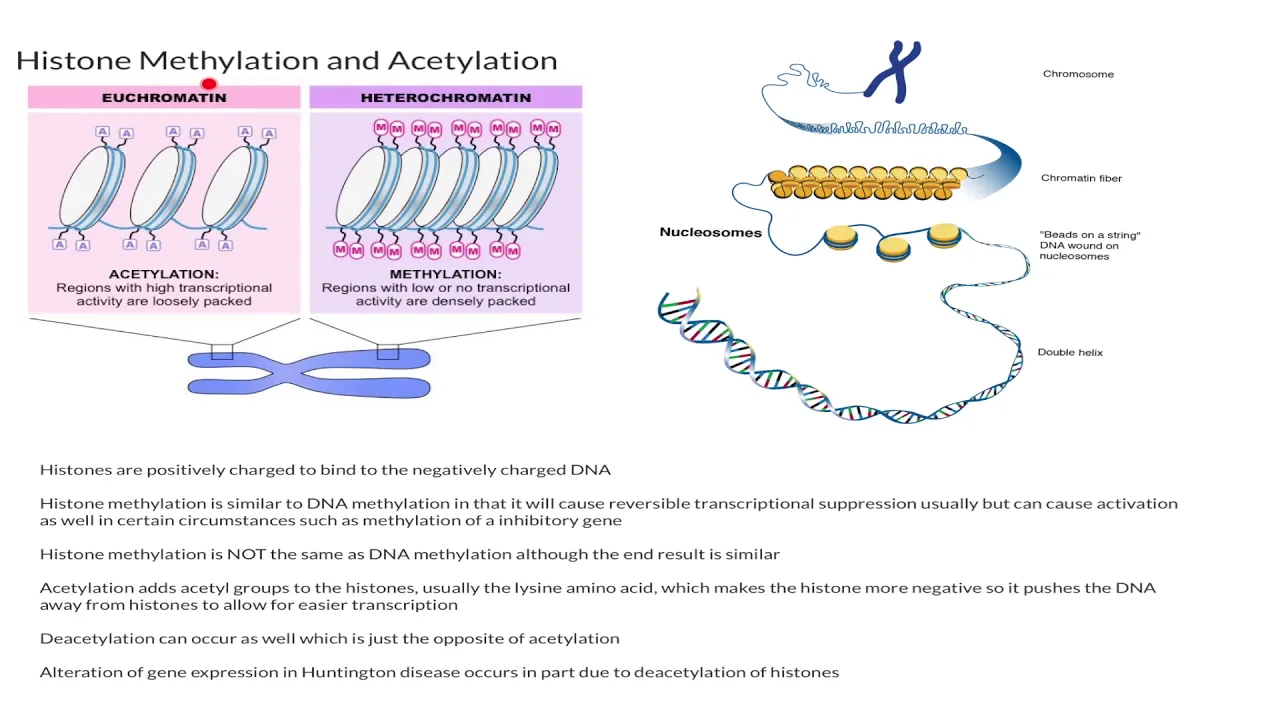



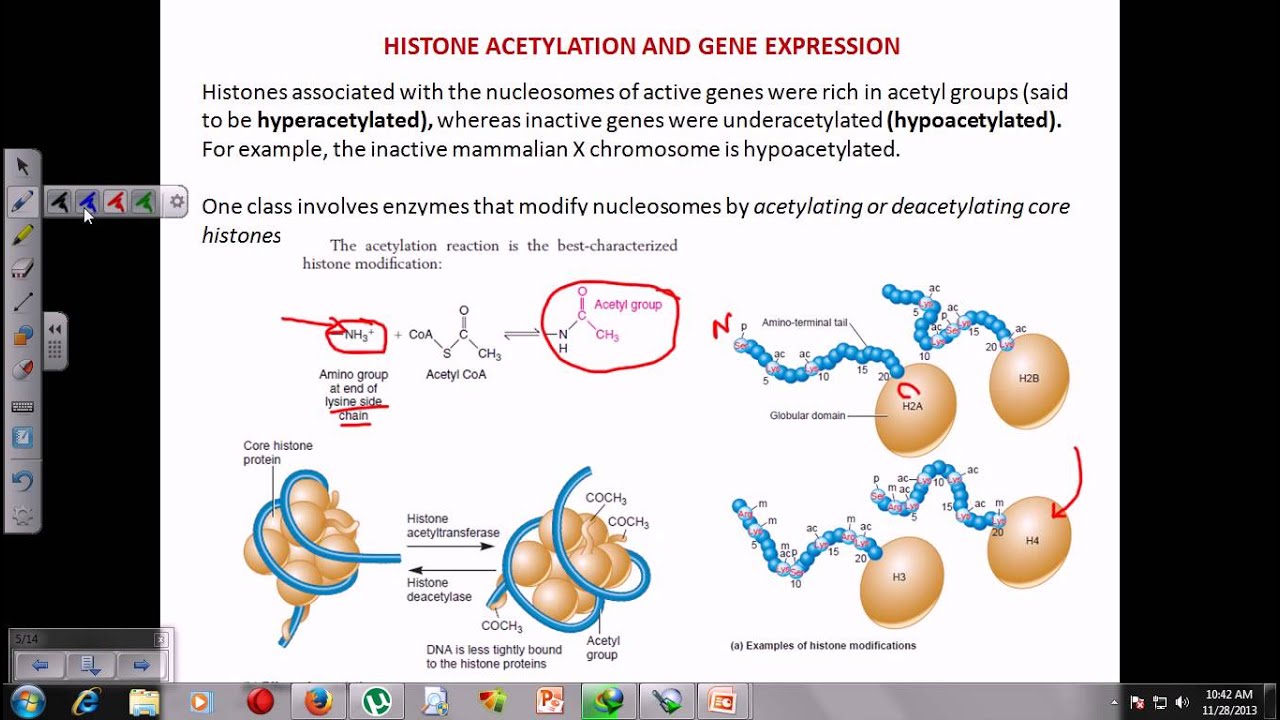
Chromatin is composed of DNA wrapped around histone proteins, forming nucleosomes that package the long DNA molecules into a compact structure suitable for fitting inside the cell nucleus; each nucleosome consists of an octameric histone core (two copies each of H2A, H2B, H3, and H4) with approximately 147 base pairs of DNA wrapped 1.7 times around it, and these nucleosomes arrange into a zigzag 30-nanometer fiber that further folds into 300-nanometer loops, enabling the 2-meter-long DNA of human chromosomes to fit within the tiny nuclear space.
Chromatin Organization Animation: Nucleosome Structure
Added:The basic double-helix structure of DNA, including its negatively charged phosphate backbone.
The fundamental difference between eukaryotic and prokaryotic cellular organization, specifically regarding the presence of a nucleus.
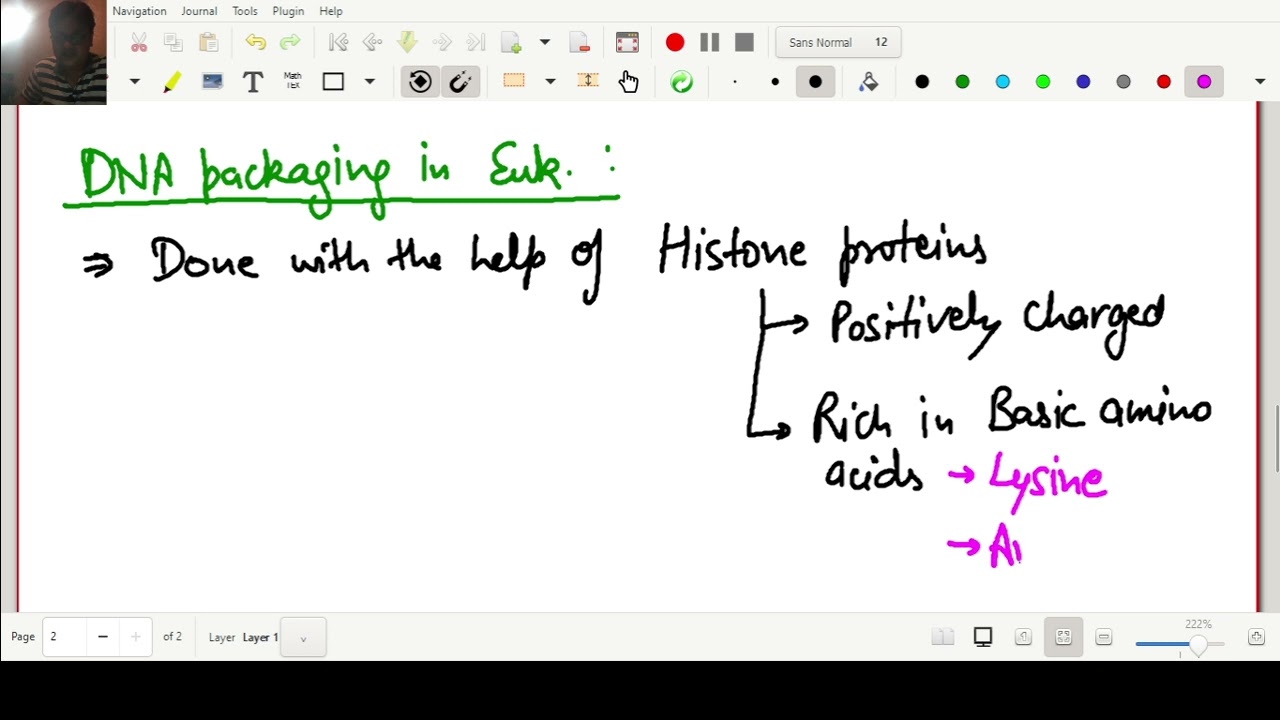
Basic protein chemistry, particularly how positively charged amino acids (like lysine and arginine) interact with negatively charged molecules.
The concept of genomic scale and why eukaryotic cells require highly efficient DNA packaging systems to fit genetic material into the nucleus.
Higher-order chromatin packaging, including the formation of the 30-nm fiber, looped domains, and mitotic chromosomes.
The distinction between euchromatin (transcriptionally active, loosely packed) and heterochromatin (transcriptionally inactive, tightly packed).
Epigenetic mechanisms, specifically how chemical modifications to histone tails (such as acetylation and methylation) regulate gene expression.
The function of ATP-dependent chromatin remodeling complexes in dynamically exposing DNA for transcription, replication, and repair.
121.4K views1.7Klikes4:29Original Release: 2021-04-22
[Music] today's topic is chromatin organization [Music] dna is held together by histone and non-histone chromosomal proteins which are collectively known as chromatin [Music] a human cell is made up of 46 chromosomes [Music] if those chromosomes are stretched and joined end to end they could reach up to 2 meters but the nucleus has a very small space to hold such long chromosomes so it is obvious that chromatins needs to be highly condensed in order to be placed inside the nucleus chromatin appears as a series of 11 nanometer beads which are wrapped by dna of approximately 200 nucleotides each bead with associated dna molecule is known as nucleosome the unit of chromatin the nucleosomes on the dna chn is called beads on a string structure if one nucleosome core particle is subjected to dissociation with increasing salt concentration we will get a octameric histone core protein and a 147 base pairs double stranded dna this 147 base pairs long dna wrap 1.7 times around the histone core proteins the octameric structure of core histones were suggested by roger converge in 1974 h2a h2b h3 and h4 these are four types of histone proteins each of which is present in pair to form the octameric structure of the histone core it shows the 3d conformation of the nucleosome core particles [Music] each of the core histone protein contains an n-terminal tail and a histone-fold region all eight n-terminal tails protrude from the core structure they provide binding site for several other proteins every nucleosome has 142 hydrogen bonds between the dna and the histone core the 80 rich minor group of dna binds with the arginine and lysine residues on the histone core proteins these amino acids are positively charged so that they can tightly bind to the negatively charged dna the outer side of the minor groove of dna is gc rich another important factor is an additional histone that is often present in a one is to one ratio with nucleosome course known as h1 each h1 which is also called linker histone binds to each nucleosome contacts both dna and protein and changes the path of dna as it exists from the nucleosome [Music] nucleosomes are arranged in a complex zigzag structure known as 30 nanometer chromatin fiber these fibers further form 300 nanometer loops [Music] this is the general overview of chromatin organization [Music] [Applause] you
Up Next

6:33
Histones & Nucleosomes: Structure, Modification & Function
@animatedbiologywitharpan
54.2K views•2022-12-17
50:12
Bacterial Communication: Quorum Sensing and Biofilm Formation Explained
@JHUAAP
12.6K views•2011-06-28

5:35
Enteric Nervous System Explained: The Gut's Brain | Neurobiology Lecture
@alumniu6029
438 views•2018-09-12
7:08
Bacteriophages: Earth's Deadliest Killers and Future Antibiotics
@kurzgesagt
34.6M views•2018-05-13
Related Study Plans & Knowledge Roadmaps
Structured learning paths in Biology
biology
RNAi: Biogenesis, RISC & Gene Silencing
01Molecular Biology Foundations: DNA to Protein
02Introduction to RNA Interference (RNAi)
03Molecular Biogenesis of miRNA and siRNA
+ 2 more learning modules
10h5 modules
Explore Roadmap
biology
Mycorrhizae: Signaling, Biophysics & Ecology
01Foundations of Mycorrhizal Symbiosis
02Molecular Signaling and Root Colonization
03Biophysics and Bioenergetics of Nutrient Exchange
+ 1 more learning modules
11h4 modules
Explore Roadmap
biology
Circadian Clocks: TTFL, SCN & Periphery
01Foundations of Molecular Biology & Gene Expression
02Introduction to Chronobiology and Actograms
03The Core TTFL: Molecular Architecture of the Clock
+ 3 more learning modules
14h6 modules
Explore Roadmap
biology
Population Genetics: Math, Drift & Selection
01Genetic & Probability Foundations
02The Hardy-Weinberg Principle and Baseline Models
03Mathematical Modeling of Natural Selection
+ 3 more learning modules
18h6 modules
Explore Roadmap