




















Beggiatoa bacteria, identified by their serpentine shape and sulfur granules, were discovered by Sergei Winogradsky in 1887 to perform chemolithotrophy—using sulfur compounds as an energy source for cellular respiration—by oxidizing hydrogen sulfide to form sulfur granules that serve as their primary fuel, representing a groundbreaking discovery that expanded understanding of how organisms can derive energy from inorganic compounds.
Beggiatoa Bacteria and Sulfur Granules: Chemolithotrophy Explained
Added:Basic principles of chemical oxidation-reduction (redox) reactions and how electron transfer releases energy.
The fundamental structure and function of the bacterial electron transport chain and ATP synthase.
The classification of organisms by their energy and carbon sources (e.g., autotrophs vs. heterotrophs, phototrophs vs. chemotrophs).
An introductory understanding of the global sulfur cycle and the chemical properties of hydrogen sulfide (H2S).
The ecological significance of Beggiatoa in benthic boundary layers, hydrothermal vents, and oxygen minimum zones.
The metabolic coupling of sulfur oxidation with nitrate reduction (denitrification) in giant sulfur bacteria.
Comparative analysis of other chemolithotrophic pathways, such as iron oxidation, nitrification, and methanogenesis.
Applications of sulfur-oxidizing bacteria in environmental biotechnology, including bioremediation of toxic sulfide wastes.
39.4K views2.6Klikes9:33Original Release: 2023-06-19
This episode is sponsored by Squarespace.
Go to Squarespace.com/microcosmos to save 10% off your first purchase of a website or domain.
Hi, I’m Matt, and I’m not really new here.
I’ve been a producer for Journey to the Microcosmos from the very beginning, editing videos for the first few years of the channel and keeping our journey running smoothly.
And some of you maybe have even seen me in our livestreams.
But this is new, right?
Me, talking to you all?
I’ll probably be around a bit more along with some other new voices as our usual voice, Hank, takes some time to take care of himself.
So our journey will sound a bit different, maybe even look a bit different at times.
But every journey has to take unfamiliar paths, and we hope you’ll be able to enjoy this one with us.
And like I said, I spent the first few years of this channel editing the videos together, and in that time, I’ve gotten so much better at identifying our microbial friends than I ever would have imagined.
Like these organisms.
Before I worked on this show, if you’d asked me what they are, I maybe would have told you that they look like some long threads.
But we’ve seen them quite a bit now, watching them glide across our slides as we talk about their sediment homes.
And that’s how I know that these are a type of bacteria called Beggiatoa There’s a few things that give them away.
First is the simple serpentine shape of their bodies, sliding against each other like a pile of pythons buried on a microscopy slide.
The second detail that identifies them as Beggiatoa are those little dots inside of them.
They look like bubbles, but they’re actually sulfur granules.
So why do our Beggiatoa friends stuff themselves full of sulfur?
To understand that, we have to first talk about where they live.
James, our master of microscopes, usually finds his Beggiatoa at the bottom of his fish tank, where their accumulated bodies turn the sediment white.
And in the wild, Beggiatoa can be found in both freshwater and marine environments, layering themselves upon each other to form mats that can end up looking like nature’s weirdest shag rug.
They gather in the area of water that will give them the access they need to particular nutrients, but… what does that mean exactly?
We all like to live in a spot that gives us the access we need to particular nutrients, but we don’t all form clumps and mats on the bottom of fish tanks.
So what is it about their particular location that particularly suits the Beggiatoa?
The answer came in the year 1887 from a scientist named Sergei Winogradsky.
Winogradsky is sometimes credited with discovering Beggiatoa, but from what we’ve read, scientists had been describing and studying Beggiatoa before he did.
In 1870, one researcher described the fact that those granules would increase in number when the Beggiatoa was in its normal habitat.
There was something about these sulfur granules that made sense given that these Beggiatoa were found in sulfur-rich environments, like sulfur springs.
And when other scientists began to look at bacteria in those environments, they found similar granules.
But the creation and purpose of those granules remained unclear.
Winogradsky did not first encounter Beggiatoa with the intention of solving those mysteries.
In 1885, he began working for the botanist Anton de Bary at the University of Strassburg.
The question that Winogradsky was initially meant to pursue revolved around the shape of bacteria, and really just how fixed that shape is.
To answer that question, Winogradsky began traveling around Switzerland and Germany to gather Beggiatoa growing in sulfur springs.
But then he got a bit distracted and wandered down a different path.
Winogradsky needed to figure out how to keep the Beggiatoa he was studying alive in the lab, so he grew them in tiny little cultures and watched as the Beggiatoa filaments stuck to the side of their chambers.
He would wash them with various fluids with different compositions, and as he watched them, he could begin to see what nutrients best sustained the Beggiatoa.
And as he watched, Winogradsky’s curiosity around the sulfur granules grew as he asked more and more questions about how they got inside the organisms, and what their role is.
In one of his experiments, Winogradsky kept different batches of cells in different types of spring water, and then monitored them under the microscope.
He found that the cells grown in the presence of hydrogen sulfide would end up full of those sulfur granules.
But cells grown in spring water full of calcium sulfate didn’t.
That experiment showed that the Beggiatoa were getting their sulfur granules by oxidizing hydrogen sulfide.
This also explains how the bacteria find their ideal spot in the water, a narrow band where hydrogen sulfide and oxygen are both present, and that allows Beggiatoa access to both chemicals they need to form those sulfur granules.
But this still didn’t explain what the Beggiatoa do with the sulfur granules.
Winogradsky could see that when the Beggiatoa were deprived of hydrogen sulfide, those granules would disappear… so where did they go?
Were they released into the environment?
Were they absorbed by the cell in some way?
What was the point of the sulfur?
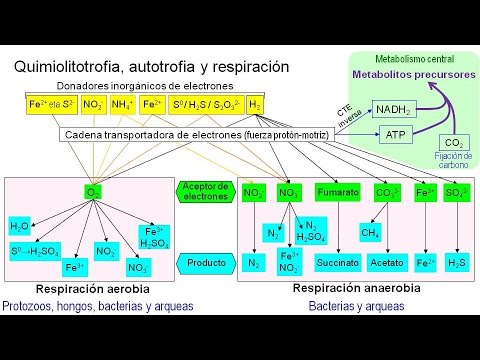
What Winogradsky found is that the sulfur was essentially food for the Beggiatoa, fueling their cellular respiration.
This was the first ever description of what would later be known as chemolithotrophy, and it was groundbreaking.
It meant that Winogradsky had found an organism that could draw energy from an inorganic compound— in this case, using sulfur to drive the reactions it needs to produce energy.
Eventually, scientists discovered more organisms that could use sulfur in this way, as well as others that relied on different inorganic compounds like nitrogen.
And in doing so, they are able to convert these chemicals into biological forms that can travel through ecosystems and then back into the environment.
For sulfur, that journey will take it through many lives, as part of rocks and amino acids and even acid rain, transforming our lives and landscapes in the process.
Organisms like Beggiatoa usher sulfur through that odyssey, a mundane act of consumption that shapes our entire world.
And so perhaps it's fitting to end with Winogradsky’s own words, a moment from his memoir where he describes the moment of discovery.
The work was humdrum, it dragged on and on sluggishly, and all of a sudden it developed into an interesting result and was finished.
All the beating around suddenly made sense, and I matured in my own eyes.
Even so, I could not see that my discovery would become an epoch-making discovery, would determine the course of all my future work, and that it would open a new chapter in microbiology and physiology.
Thank you for coming on this journey with us as we explore the unseen world that surrounds us.
And thank you to Squarespace for sponsoring this episode.
Squarespace offers an incredible online platform from which to create your website.
Whether you're a budding entrepreneur or looking to expand your current venture, Squarespace provides all the necessary tools to help you thrive.
Maybe you have a passion for gourmet baking and want to establish an impressive online presence for your bakery.
Squarespace enables you to craft a visually stunning and professional website that showcases your delectable creations and embodies your unique brand.
With their comprehensive suite of features, including third-party extensions, you can effortlessly manage your inventory, simplify bookkeeping, and ship your baked goods worldwide.
And if you also want to share your baking journey and engage with fellow baking enthusiasts, Squarespace makes it a breeze to create a seamlessly integrated blog alongside your bakery's online store.
You can captivate your readers by sharing your latest recipes, baking tips, and behind-the-scenes insights into your creative process.
And you can engage in meaningful conversations with your clientele through threaded comments and replies, cultivating a passionate community of baking enthusiasts.
Start building your online bakery today by signing up for a free trial at Squarespace.com.
And when you're ready to launch, don't forget to visit squarespace.com/microcosmos to enjoy a 10% discount on your first purchase of a website or domain.
Experience the power of Squarespace and watch your bakery business rise to new heights.
Those names you're seeing on the screen right now are names of our Patreon patrons.
They are some of the people who support this channel and keep it going, So, if you enjoy the fact that this show has existed for four years now, you can drop a little thank you in the comments to those Patreon patrons, but you can also become one of them and support the channel directly at Patreon.com/JourneytoMicro.
If you'd like to see more from our Master of Microscopes James Weiss, you can check out Jam and Germs on Instagram.
And if you'd like to see more from us, well, there's probably a subscribe button somewhere nearby, probably below the video or on the screen right now.
One of those two.
Just click it.
Check that it works.
Up Next
3:03
Understanding Chemosynthesis: Chemistry in Nature | KS3 Biology
@revisionmonkey3859
44K views•2020-06-02
50:12
Bacterial Communication: Quorum Sensing and Biofilm Formation Explained
@JHUAAP
12.6K views•2011-06-28
10:04
Microbial Life at the Oxic-Anoxic Interface in Sediments
@journeytomicro
266.2K views•2019-10-01

7:08
Bacteriophages: Earth's Deadliest Killers and Future Antibiotics
@kurzgesagt
34.6M views•2018-05-13
Related Study Plans & Knowledge Roadmaps
Structured learning paths in Biology
biology
RNAi: Biogenesis, RISC & Gene Silencing
01Molecular Biology Foundations: DNA to Protein
02Introduction to RNA Interference (RNAi)
03Molecular Biogenesis of miRNA and siRNA
+ 2 more learning modules
10h5 modules
Explore Roadmap
biology
Mycorrhizae: Signaling, Biophysics & Ecology
01Foundations of Mycorrhizal Symbiosis
02Molecular Signaling and Root Colonization
03Biophysics and Bioenergetics of Nutrient Exchange
+ 1 more learning modules
11h4 modules
Explore Roadmap
biology
Circadian Clocks: TTFL, SCN & Periphery
01Foundations of Molecular Biology & Gene Expression
02Introduction to Chronobiology and Actograms
03The Core TTFL: Molecular Architecture of the Clock
+ 3 more learning modules
14h6 modules
Explore Roadmap
biology
Population Genetics: Math, Drift & Selection
01Genetic & Probability Foundations
02The Hardy-Weinberg Principle and Baseline Models
03Mathematical Modeling of Natural Selection
+ 3 more learning modules
18h6 modules
Explore Roadmap