


















The oxic-anoxic transition—the boundary where oxygen-rich water meets oxygen-poor sediment—creates a challenging chemical environment that has driven the evolution of specialized microorganisms. While most organisms rely on oxygen to accept electrons in cellular respiration, anaerobic microbes have developed alternative metabolic strategies using sulfur compounds and other electron acceptors. For example, purple sulfur bacteria like Thiospirillum and large sulfur bacteria like Achromatium oxaliferum store sulfur globules and adapt to the unique conditions at this interface, demonstrating how life has conquered this environmental challenge through metabolic innovation.
Microbial Life at the Oxic-Anoxic Interface in Sediments
Added:Understanding of aerobic versus anaerobic respiration, specifically how different terminal electron acceptors (like oxygen and sulfate) are used in metabolic pathways.
Basic knowledge of the sulfur cycle, including the chemical differences between sulfides, elemental sulfur, and sulfates.
Concept of redox (reduction-oxidation) gradients and how chemical stratification naturally occurs in aquatic sediments.
Familiarity with microbial trophic groups, particularly chemolithotrophy and how organisms derive energy from inorganic compounds.
Exploration of 'cable bacteria' and their unique ability to conduct electricity across centimeter-scale distances in sediment redox zones.
Investigation of benthic-pelagic coupling and how sediment-level microbial activity influences larger marine and freshwater ecosystems.
Applications of sulfur-cycling microbes in bioremediation, such as treating acid mine drainage or removing heavy metals from contaminated aquatic systems.
Astrobiological implications, using terrestrial sulfur-based sediment communities as analogs for potential life in extraterrestrial oceans (e.g., Europa or Enceladus).
266.2K views11.7Klikes10:04Original Release: 2019-10-01
So far, as we’ve journeyed through the microcosmos, the organisms we’ve shown you are mostly aquatic.
You might find them in oceans or rivers or lakes, finding their own niche in their watery ecosystem.
And surrounding them, dissolved in the water, is always oxygen, which is essential to their survival.
But as you travel down and find where water meets sediment, a transition occurs.
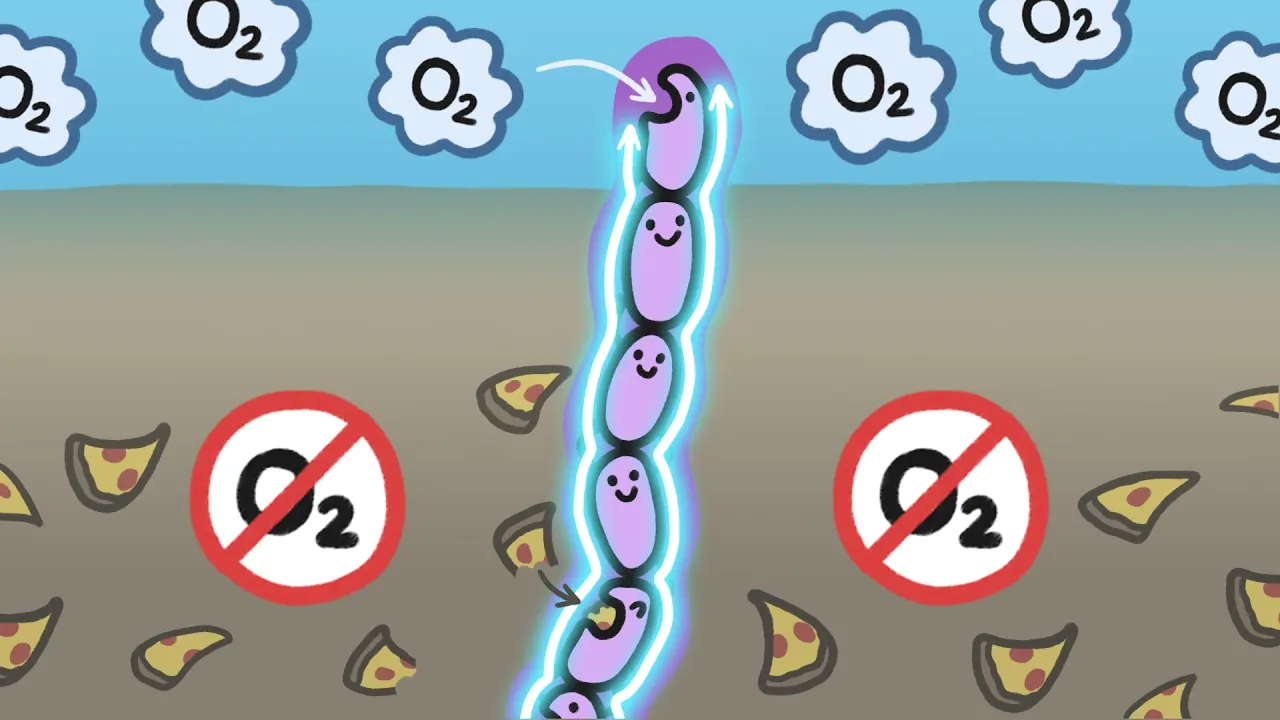
Yes, from more liquid to more solid, but more importantly, the sediments impede the movement of oxygen.
Which means that, as oxygen gets consumed by living organisms, the concentration goes down.
The transition here is, in many ways, even more distinct than the transition from the land to the sea in our macro-world.
Yes, it is difficult for fish to live out of water, and hard for us to live in it, but ultimately, fish and humans are both based on roughly the same metabolic chemistry.
We both rely on oxygen.
But here at this transition, where the environment goes from oxic, meaning there is oxygen, to anoxic, meaning there isn’t, life’s metabolic chemistry fundamentally shifts.
It’s muddy there.
Slimy, a little smelly, maybe even a little gross, but to many organisms, the oxic anoxic transition is a shifting chemical boundary that has created a challenge for life...a challenge that changed it’s nature, a challenge it conquered.
So let’s talk about the organisms that prefer an environment void of oxygen, because many of them will end up shaping the world around the organisms that live along this transition.
Now we’re not quite sure, but we believe this long, large, tightly-coiled bacterium is a type of spirochete, many of which prefer to live without oxygen.
They come up often in these mud samples and you might know some of their kind as the more familiar, and less welcome organisms that cause syphilis and Lyme disease.
And just to note, this video is not sped up—the organism really moves like this.
Spirochete’ are uniquely motile, able to move around even in thick, viscous substances.
To vastly oversimplify the entire basis of our life as we know it, oxygen’s big, important role is to accept electrons in the chemical processes that make our cells go and our existence possible, so, thanks oxygen.
But organisms that live in anoxic environments substitute oxygen with other chemicals.
Some, like this ciliate Caenomorpha, are found in environments rich in oxygen’s downstairs neighbor on the periodic table, sulfur, along with bacteria that thrive in a sulfuric world.
Now these look like vibrating, hyperactive worms, but they’re actually bacteria, specifically a purple sulfur bacteria, these are Thiospirillum.
Inside the Thiospirillum are little globules where they stock sulfur for later use.
They’re photosynthetic and they often prefer anoxic environments.
These bacteria use various forms of sulfur to produce their energy—including, in the case of thiospirillum, those sulfur stores.
In these kinds of sulfuric sediments, you’ll find concentrations of sulfur and oxygen as opposing gradients.
As you descend into sediment, the concentration of oxygen decreases, consumed by the life that depends on it.
Meanwhile, sulfide diffuses upwards from the anoxic microbes below, and as you travel further down, the sulfur concentration increases as you get closer to its source.
But in that sediment is a layer where oxygen and sulfur co-exist.
This is the oxic-anoxic interface, a several 100 uM thick boundary that attracts bacteria like these Achromatium oxaliferum, a large sulfur bacteria found in freshwater and salt marsh sediments that comes up often in our mud samples.
Similar to Thiospirillum, Achromatium has small sulfur globules.
But the bacteria is also able to roll upwards through the sediment in what seems to be a response to the presence of oxygen, suggesting that it might take up oxygen as well.
Currents in the water and various other changes in the environment can affect where the oxic-anoxic interface is, so Achromatium and other bacteria that thrive in this layer need the ability to sense and move in response to the shifting oxygen and sulfur layers.
These gradient roving Achromatium have so far been difficult to grow in large quantities in a lab, perhaps because their natural environment and the relationships they have with their surrounding microbes are just too complicated.
As a result, these bacteria remain mysterious giants.
Their bodies contain sizable stores of calcite, but we don’t know what they’re for.
Some scientists have guessed that they might help control the acidity of the cell, while others have suggested it might help regulate the cell’s buoyancy.
There are many theories, including that the amount of calcite inside Achromatium makes them off-putting to predators.
Now, we don’t know if that’s the case with this Loxodes magnus, which is valiantly trying and failing to eat this Achromatium.
We did observe it for a while, and it kept rejecting the giant bacterium, so at the very least, there seems to be something unappetizing about them.
Here with some Achromatium, is a fellow interface bacteria Macromonas, moving around with the use of its flagella.
Macromonas seem to also keep a sulfide stock in little globules, and they’re distinguished by inclusions where they store calcium oxalate, which may help the cell keep up its metabolism even when the conditions around it aren’t good.
You can see the inclusions in this clip here—the larger those calcium oxalate stores are, the slower the bacteria moves.
There is, of course, so much more to the story of mud and microbes.
The oxidations and the reductions.
The various forms of the sulfurs and the oxygens, not to mention the carbons and nitrogens that…we did not even mention.
It’s messy, and we don’t mean muddy...we mean, complicated.
As you might have noticed, oxygen is pretty important to biochemical mechanisms.
We can live weeks without food, days without water, but only moments without oxygen.
And metabolic systems on this planet evolved largely in the presence of this marvelous, versatile, and common electron acceptor.
Without it, everything changes.
Every balance has to be re-weighted.
Every gradient shifted.
And yet when you step back and look at these anoxic environments, everything seems to come together in a muddy elegance.
One gradient gives way to another, one process swaps out for another.
And the microcosmos distributes itself accordingly.
Thank you for coming on this journey with us as we explore the unseen world that surrounds us.
Journey to the Microcosmos is produced by Complexly.
If you want to keep imagining the world complexly with us, we have a bunch of other things.
We’re producing a Crash Course on Artificial Intelligence right now, hosted by Jabril Ashe.
Over 20 episodes, we’ll going to unpack the logic behind AI systems, and even write and implement code in labs.
Check out the first video about the history of artificial intelligence and the revolution that is happening today!
There's a link in the description.
If you want to see more from our master of microscopes James check out Jam and Germs on Instagram.
And if you want to see more from us, there's always a subscribe button somewhere nearby.
Up Next

6:50
siRNA and miRNA: Generation and Gene Silencing Mechanisms
@OUPAcademic
435K views•2014-08-12
50:12
Bacterial Communication: Quorum Sensing and Biofilm Formation Explained
@JHUAAP
12.6K views•2011-06-28
9:34
How Stressed Algae Curl Into Protective Cysts
@journeytomicro
70K views•2021-08-02
7:08
Bacteriophages: Earth's Deadliest Killers and Future Antibiotics
@kurzgesagt
34.6M views•2018-05-13
Related Study Plans & Knowledge Roadmaps
Structured learning paths in Biology
biology
RNAi: Biogenesis, RISC & Gene Silencing
01Molecular Biology Foundations: DNA to Protein
02Introduction to RNA Interference (RNAi)
03Molecular Biogenesis of miRNA and siRNA
+ 2 more learning modules
10h5 modules
Explore Roadmap
biology
Mycorrhizae: Signaling, Biophysics & Ecology
01Foundations of Mycorrhizal Symbiosis
02Molecular Signaling and Root Colonization
03Biophysics and Bioenergetics of Nutrient Exchange
+ 1 more learning modules
11h4 modules
Explore Roadmap
biology
Circadian Clocks: TTFL, SCN & Periphery
01Foundations of Molecular Biology & Gene Expression
02Introduction to Chronobiology and Actograms
03The Core TTFL: Molecular Architecture of the Clock
+ 3 more learning modules
14h6 modules
Explore Roadmap
biology
Population Genetics: Math, Drift & Selection
01Genetic & Probability Foundations
02The Hardy-Weinberg Principle and Baseline Models
03Mathematical Modeling of Natural Selection
+ 3 more learning modules
18h6 modules
Explore Roadmap