














![[BioMD TV]식물호르몬에 대하여 알아봅니다](https://i.ytimg.com/vi/2SXAeqeaNtc/maxresdefault.jpg)


Haematococcus algae, a member of the Chlorophyta phylum, responds to environmental stress by curling into a ball and forming cysts, eventually producing astaxanthin—a powerful carotenoid antioxidant that can comprise up to 5% of its dry weight—providing protection while also coloring the flesh of animals like salmon and flamingos that consume it.
How Stressed Algae Curl Into Protective Cysts
Added:Basic eukaryotic cell biology, specifically the structure of microalgae and organelles like chloroplasts.
The concept of environmental stress (such as UV radiation, high salinity, or nutrient deprivation) and how microorganisms adapt to survive.
Fundamentals of photosynthesis and the role of cellular pigments like chlorophyll in energy conversion.
The biological life cycle of single-celled organisms, including the distinction between vegetative (active) and dormant (encysted) states.
The commercial and industrial applications of astaxanthin in pharmaceuticals, cosmetics, and aquaculture.
Bioprocess engineering and bioreactor design optimized for cultivating microalgae and triggering metabolite accumulation.
The biochemical pathways of carotenogenesis, focusing on how cellular stress signals trigger the synthesis of secondary carotenoids.
Comparative survival strategies in other extremophilic microorganisms, such as bacterial endospore formation or cryptobiosis.
70K views4.2Klikes9:34Original Release: 2021-08-02
Thanks to Babbel, a language learning app, for sponsoring this episode.
If you’re interested in growing your language skills, Microcosmos viewers get up to 65% off when you sign up using our link in the description.
This algae is stressed. And we can tell it’s stressed because it’s doing something that you might also do when you find yourself in a difficult situation. It’s turning red. But while blushing brightly for everyone to see might make your situation worse, this algae can do something else that sounds, honestly, very appealing: it can curl up in a ball and just wait out the worst of it.
This algae is called Haematococcus, and it is not, physiologically speaking, turning red through the same mechanisms that you and I do when we are stressed and blushing.
We flush with blood. Meanwhile, the Haematococcus does not have blood. But depending on the state of your ancient Greek, you might recognize its name translates loosely to “blood berries,” a name that seems fitting for a round, reddish organism like this one.
But as poetically sanguinary as the name is, Haematococcus flushes with something else altogether, a chemical we can see traveling through the algae and up the food chain, until it winds up on our own plates. But before we get to the dinner table, let us talk about where we got our Haematococcus: from a centuries old cemetery in Warsaw, Poland, filled with beautiful sculptures and birdbaths. For James, our master of microscopes, it is important to respect the tombs there. So, don’t worry, these microbes don’t have particularly spooky origins. He’s there for the birdbaths, where the algae lines the surfaces like rust.
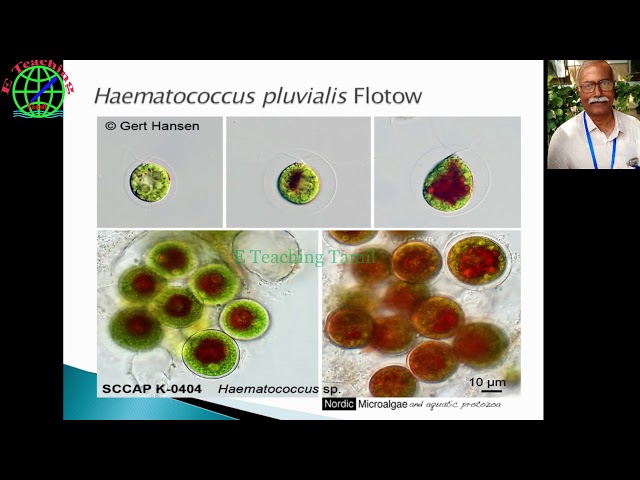
The Haematococcus likely arrived at the birdbath thanks to the birds themselves, and there it would have remained until maybe another bird came along, except this time, your favorite microbe hunter came first. In addition to birdbaths, Haematococcus are often found in transient pools of freshwater, like puddles after a rainfall. And as you can see on your screen, not all Haematococcus are red. Plenty of them are green, which makes sense because Haematococcus is a member of the phylum Chlorophyta and that phylum is full of many other unicellular green algae like the volvox. And as algae, Haematococcus are green, photosynthetic, and very easy to eat, which makes them a simple solid foundation for an ecosystem.
But even seemingly simple creatures have requests of the world around them, whether that’s for certain levels of light, or a particular temperature. And if you were to say, go to a hotel and your room was 100 degrees, you got a few solid options to fix that problem.
You could find the thermostat. And if that doesn’t work, you could complain to the manager or even just go find another place to stay. But those are not great options for the Haematococcus. There’s no thermostat to change, there’s no manager and if the temperature gets too high, there’s only so much a single-celled body can do to survive.
So instead, the Haematococcus does what I’m sure many of us wish we could do when we were in an uncomfortable situation: it takes a little bit of a break, forming a cyst that allows it to rest and survive until conditions are good again.
When you’re looking at this mixture of Haematococcus, you’re looking at a gathering of algae in different phases of their lives. The most active ones are called macrozooids, or zoospores. They might be shaped like spheres, ellipsoids, or even pears. And they’re encased in a thick gelatinous wall, with two flagella extending out in front to zip the algae around.
But most importantly, here at this stage, the algae is green.
The Haematococcus rarely reproduces sexually, and when it’s a macrozooid, it divides rapidly, forming around 2 to 32 copies of itself. But it makes sense to move around and make more of yourself when conditions are good. What happens though when you’re in a comfortable pool of water one day, and in much more dire straits the next? Well, for the Haematococcus, this is the point at which it all begins to change. The algae sheds its flagella, layers up its wall, and shifts into a ball. This is the Haematococcus as a palmella, a resting cell.
But if stress has taught me anything, it is that things can always get worse.
And for this little cell, it can get hotter or saltier or just too bright. And when that happens, the palmella morphs into an aplanospore. Its walls become even heavier duty, shielding it from the outside. But most striking, this is when the haematococcus becomes red.
The red is practical, the product of a chemical called astaxanthin.
Astaxanthin is a carotenoid, a type of reddish yellow pigment found in plants and microbes. But it’s more than just a pretty color. Astaxanthin is an extremely powerful antioxidant, protecting the cyst from potential damage as it rests. You’ve probably seen astaxanthin in real life, except you might not have called it that. You might have just called it “pink,” or “salmon pink.” Astaxanthin is found in plants, fungi, bacteria, and yes, in algae. And haematococcus, is considered to be one of the best natural producers of astaxanthin, able to produce up to 5% of its dry weight in astaxanthin. For comparison, another astaxanthin-producing algae called Chlorella makes around 0.001% of its dry weight in astaxanthin Now the reason we find astaxanthin in so many animals is because, algae make for good food, whether you are a shrimp, salmon, or flamingo.
It’s striking that the color we call “salmon pink” is a sign of both the salmon’s contentment and the algae’s demise. Perhaps we should start calling it “haematococcus pink” instead, an acknowledgement of the work of the haematococcus, which endures so long after its death.
It would be a fitting tribute after all to a color you might have eaten a few times yourself.
The salmon, sure, which might have fed on synthetic astaxanthin or algae. But even the chicken eggs you buy might have gotten their yolk color boosted by algae added to chicken feed.
Astaxanthin has its uses outside of our food, whether in our cosmetics or nutraceuticals.
And while much of that is synthetic, a copy we’ve learned to make by studying the chemistry of astaxanthin, there’s also a push in the market for “natural” products, a push that has led to renewed interest in the haematococcus algae and its wondrous ability to produce its own astaxanthin.
But for the haematococcus that’s just something weird going on in the outside world, a factor far beyond its control and its interest. Whatever comes its way--whether it's a scientist, a bird, or a fish--all the haematococcus is concerned with is its own survival. What belongs to the algae will one day belong to another organism, passed on through chemistry and made into something new Thank you for coming on this journey with us as we explore the unseen world that surrounds us.
And thank you again to Babbel for sponsoring this episode of Journey to the Microcosmos.
Babbel is a language learning app that helps you use a new language in real-life situations after only five hours of practice. And it offers lessons in 14 different languages.
Whether you want to travel somewhere new and be able to speak the language when you get there, or you’re just looking for some self-improvement that you can do from the comfort of your couch, Babbel courses are professionally designed by language experts who take into account your native language and it will teach you vocabulary and grammar skills that you can use in real life situations -- like asking for directions or ordering at a restaurant.
And Babbel even has a podcast, short stories, games and new live virtual classes from certified teachers so you can learn in whatever format works for you.
As a Microcosmos viewer, you’ll get up to 65% off if you download Babble and sign up by clicking the link in the description.
All the folks on the screen right now, they are our Patreon patrons. And if you are one of those people, the Microcosmos team is very grateful and we just want to say “Thanks.” If you would like to become a Microcosmos patron, you can go to Patreon.com/journeytomicro where you can also find some really good stuff that we’ve got only for our patrons.
If you want to see more from our Master of Microscopes James Weiss, you can check out Jam & Germs on Instagram.
And if you want to see more from us, there’s always a subscribe button somewhere nearby.
Up Next

27:31
Astaxanthin Production from Haematococcus pluvialis: Industrial Microalgae Aquaculture
@KENNETHFRANCISRODRIGUES
5.9K views•2021-03-03
50:12
Bacterial Communication: Quorum Sensing and Biofilm Formation Explained
@JHUAAP
12.6K views•2011-06-28
10:04
Microbial Life at the Oxic-Anoxic Interface in Sediments
@journeytomicro
266.2K views•2019-10-01
7:08
Bacteriophages: Earth's Deadliest Killers and Future Antibiotics
@kurzgesagt
34.6M views•2018-05-13
Related Study Plans & Knowledge Roadmaps
Structured learning paths in Biology
biology
RNAi: Biogenesis, RISC & Gene Silencing
01Molecular Biology Foundations: DNA to Protein
02Introduction to RNA Interference (RNAi)
03Molecular Biogenesis of miRNA and siRNA
+ 2 more learning modules
10h5 modules
Explore Roadmap
biology
Mycorrhizae: Signaling, Biophysics & Ecology
01Foundations of Mycorrhizal Symbiosis
02Molecular Signaling and Root Colonization
03Biophysics and Bioenergetics of Nutrient Exchange
+ 1 more learning modules
11h4 modules
Explore Roadmap
biology
Circadian Clocks: TTFL, SCN & Periphery
01Foundations of Molecular Biology & Gene Expression
02Introduction to Chronobiology and Actograms
03The Core TTFL: Molecular Architecture of the Clock
+ 3 more learning modules
14h6 modules
Explore Roadmap
biology
Population Genetics: Math, Drift & Selection
01Genetic & Probability Foundations
02The Hardy-Weinberg Principle and Baseline Models
03Mathematical Modeling of Natural Selection
+ 3 more learning modules
18h6 modules
Explore Roadmap