

















Trademarks are any words, names, symbols, or devices used to identify and distinguish goods from those manufactured or sold by others, serving as a consumer protection measure that prevents confusion and allows consumers to easily select desired products; they function along a spectrum of distinctiveness from generic (unprotectable) to fanciful (highly protectable), with famous trademarks also receiving protection against dilution through blurring or tarnishment even without direct consumer confusion.
Trademark Law: Consumer Protection and Source Identification
Added:The fundamental differences between the main branches of intellectual property: patents, copyrights, and trademarks.
Basic marketing concepts of brand identity, brand equity, and the economic role of brand reputation in commerce.
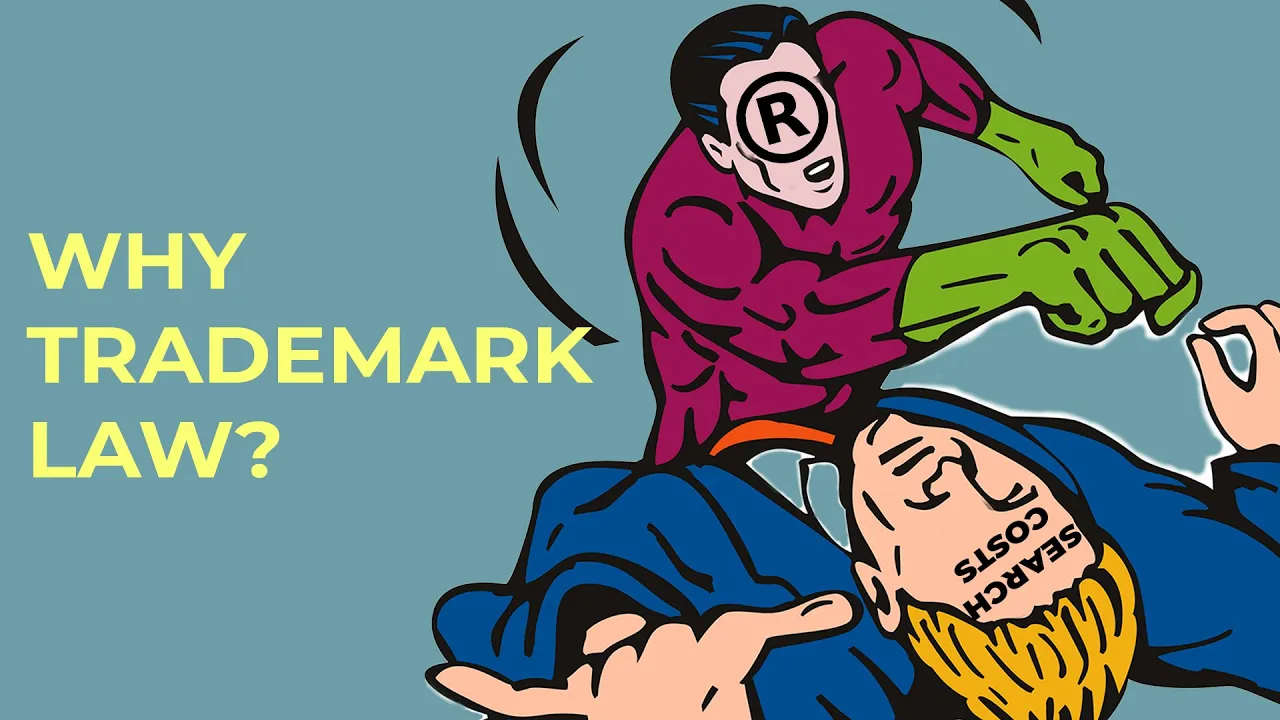
The concept of consumer search costs and how brand consistency helps lower these costs in competitive markets.
An introductory understanding of market competition and the general legal framework surrounding unfair competition.
The Spectrum of Distinctiveness (from generic to fanciful) and how it determines a mark's eligibility for federal registration.
The legal standards for trademark infringement, focusing on the multi-factor tests used to establish a 'likelihood of confusion'.
The concepts of trademark dilution (blurring and tarnishment) and how they protect famous marks beyond consumer confusion.
Defenses to trademark infringement, including nominative fair use, descriptive fair use, and the intersection with First Amendment rights (such as parody).
318.2K views5.8Klikes11:19Original Release: 2015-05-28
Hi! I'm Stan Muller, this is Crash Course Intellectual Property, and today we're talking about trademarks.
Trademarks are everywhere, and they can often be confusing, so today we're gonna talk about why just about everything seems to be trademarked, and why trademarks are good for business.
Mr. Muler! Trademarks don't intersect with my life, so I really don't see why we need to cover this.
One, its Muller, and two, just watch the video.
[Theme Music] A trademark is any word, name, symbol, or device, used to identify and distinguish goods from those manufactured or sold by others, and to indicate the source of the goods, even if that source is unknown. This bit about unknown sources means that you, as a consumer don't usually know the person or factory that actually made the goods you buy.
Before the industrial revolution, you often knew exactly who was making your stuff, and how it was made. If you wanted a hammer, you went to the blacksmith, and you knew his name.
It was probably Smith.
These days, brand names assure you that you're buying the same product, say toilet paper, that you bought last time you went shopping. You know, like the stuff with the ripples.
Seriously though, getting the wrong medication because of brand name confusion or counterfeiting could be disastrous. The rational for granting legal protection for trademarks is that they're a type of property -- it demonstrates to the purchasing public a standard of quality and embodies the good will and advertising investment of its owner.
In other words, companies expend a tremendous amount of resources to develop the product, market it to customers, and provide customer support, and back up their product with warranties.
At its core, trademark law functions like a consumer protection measure. It prevents consumer confusion, and makes it easier for consumers to select and purchase the goods and services they want.
For example, if you go shopping for a new television, you don't have to sift through dozens of products that are confusingly similar to Samsung. Knockoffs like Samsong or Wamsung or Sony.
You want the Samsung, maybe based on past experience, or the company's reputation, or even a funny ad.
Because the law protects the manufacturer's use of the trademark, you can be reasonably sure that the TV you're picking up at Best Buy is the TV you saw the Verge reporters freaking out about at CES. Though trademarks are often classified as intellectual property, the Supreme Court held, in the 1879 trademark cases, that Congress has no power to protect or regulate trademarks under the intellectual property clause of the Constitution. Which, as you'll recall, provides congress with the authority to regulate and protect copyrights and patents. But this didn't stop congress from regulating trademarks - they used the commerce clause of the constitution which gives them the power to regulate commerce with foreign nations, and among the several states, and with the Indian tribes.
Beyond trademarks, there are also service marks, which are very similar in that they distinguish one particular service. An example of a service mark is that roaring lion at the beginning of MGM movies - it's registered for motion picture production or something.
Trade dress or product packaging is protected if it's distinctive and nonfunctional. Like, the shape of a nutter-butter cookie is protected trade dress. What they oughta trademark is the smell. Some people have registered smells, but we'll get to that in a minute.
Trademarks are symbols, and since human beings might use as a symbol or device almost anything that is capable of carrying meaning, just about anything conceivable thing can function as a trademark. Trademarks can be words like Kraft or Lego, logos, designs like the Nike swoosh, aromas, like there's a brand of oil for race cars that smells like cherries, sounds like: *to the tune of the NBC ad* bong bong bong or *to the tune of the T Mobile ad* ba da da da dong or *to the tune of the Intel ad* dong dong dong dong or *to the tune of the McDonald's ad* ba da ba ba baaaa.
Even *in the manner of Homer Simpson* "Doh!" is a registered trademark.
You can register colors like UPS brown or Home Depot orange or Tiffany blue or John Deere green, personal names like Taylor Swift - T Swizzy's name is registered for 61 different goods and services, from shoes to Christmas tree ornaments. Even containers like the Coca-cola bottle or this perfume bottle shaped like a human skull can be registered. In short they can be almost anything that distinguishes the product from others and which signifies the source of the goods.
Despite the breadth of potential trademark subject matter, there are some limits on what can be a valid trademark. Recently, a restaurant in Texas asserted trademark rights in the flavor of it's pizza. One of the restaurants former employees allegedly stole the recipe and opened up a competing pizza joint, selling pizzas that tasted a lot like those made by his former employers. The judge rejected the claim and dismissed the case, finding that it is unlikely that flavors can ever be inherently distinctive because they do not automatically suggest a product's source. Also, functional product features are not protectable under trademark law. Pizza has only one function - and that's to taste delicious.
So, there are three requirements for trademarks. We just discussed the first one - that a trademark has to be a symbol or a device that a court or the patent and trademark office deems to qualify. The second requirement is that the mark has to be used in interstate commerce, and the third is that it has to identify the mark owners goods and distinguish them from those manufactured or sold by others. It has to be distinctive.
Let's talk about trademarks and what makes them distinctive in the Thought Bubble.
Courts rank trademark distinctiveness along a spectrum, ranging from unprotectable to highly protectable. At the bottom end of the spectrum is generic. Generic names refer to stuff like using the word orange for the fruit or dog for the canine or cheese for... cheese.
Descriptive terms simply describe the goods and convey an immediate idea of what the product is, such as "break and bake" for scored cookie dough.
Suggestive marks require some imagination or perception to link them to the goods, like Sheikh for middle eastern food or Froot Loops for circular fruit flavored breakfast cereal.
Arbitrary marks are commonly used words used in unexpected ways - Apple for computers, or Amazon for book sales, or Shell for gasoline. The most distinctive marks are usually made up words. Fanciful marks are non dictionary words such as Google for an internet search engine, or Clorox for bleach, or Kodak for film.
Fanciful, arbitrary, and suggestive marks receive automatic protection upon use because they are considered to be inherently distinctive. So the owner of the break 'n bake mark has to show that the consumers identify the product with Nabisco or Pillsbury or whoever makes the product. I honestly don't know who makes it, which isn't a good sign as to whether it's acquired secondary meaning.
Generic terms are never entitled to protection. This becomes important when trademarks are gradually assimilated into the language as common names. Through a process sometimes called "genericide," the public comes to view such names as referring to the products themselves rather than as distinguishing the source of the products. As a result, the name loses its protection. Words like escalator, cellophane, and aspirin were all once protected by trademark.
This process is ongoing today and there are a lot of modern marks that are threatened by genericide, like Google or Kleenex or Photoshop or Xerox. Thanks, Thought Bubble.
So, once an owner meets the requirements for trademark and has a protected product they'll often put a TM or a little r in a circle next to a product name or brand. The TM shows that the owner is asserting trademark in the product. When you see the little circle r, that means the trademark has been registered with the US patent and trademark office. Like in copyright law, one you're registered with the feds, you have standing to take your case to federal court and maybe be awarded damages. Once the PTO is satisfied that the mark meets all the requirements the application is published for opposition. Anyone who might be affected by the registration has 30 days to oppose it. If no one opposes, the mark is registered!
The owner is then required to file affidavits of continuous use -- basically you have to submit proof you are still selling the product associated with the trademark. You have to do this every five years to maintain the registration. Trademark owners can do this forever. This is different than patents and copyrights, whose trademarks are DOOMED by the limited times language in the intellectual property clause.
So when it comes to trademarks, you have to use it or lose it.
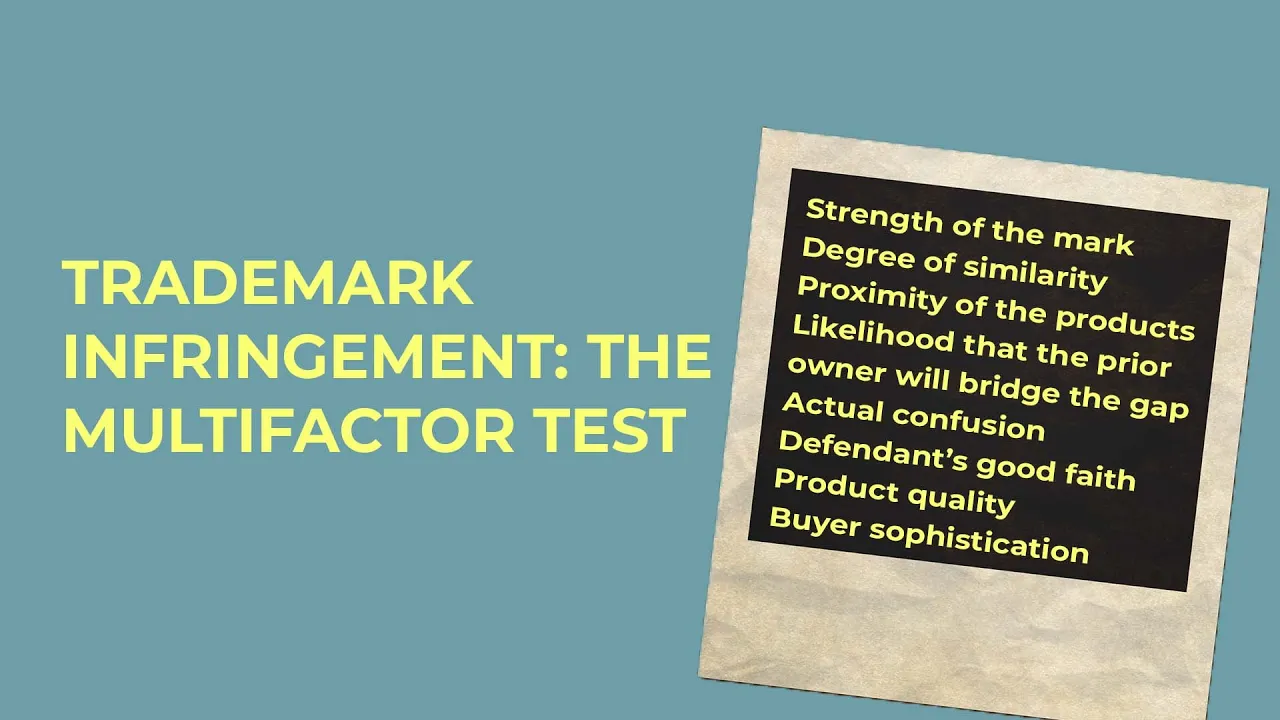
Trademarks are often disputed, and in pretty much every case, likelihood of confusion is the central issue. The principles set forth in an 1877 Supreme Court opinion in an unfair competition case: "What degree of resemblance is necessary to constitute an infringement is incapable of exact definition, as applicable to all cases. All that courts of justice can do, that regard, is to say that no trader can adopt a trade-mark, so resembling that of another trader, as that ordinary purchasers, buying with ordinary caution, are likely to be misled."
Every court uses a slightly different set of criteria for deciding trademark cases.
We're going to talk about the 7th Circuit Court of the United States' definition, which has seven parts.
Those criteria are: One, similarity between the marks in appearance and suggestion.
Two, similarity of the products.
Three, the area and manner of concurrent use, which means where in the United States the product is for sale.
Four, the degree of care likely to be exercised by the consumers.
Five, the strength of the plaintiff's mark or how distinctive it is.
Six, whether there is evidence that people were actually confused, which is a pretty strong sign that there's a likelihood of confusion.
And seven, whether the defendant intended to palm off his product as that of the plaintiff.
These factors are going to be weighed differently in individual cases, but the court has often noted that the similarity of the marks, the defendant's intent, and evidence of actual confusion are of particular importance. In addition, the Seventh Circuit has held that a court may consider other relevant factors such as the party's marketing channels and whether a trademark is being used in a parody. Trademark protection is also available under certain circumstances, even in the absence of likely or actual confusion. The Federal Trademark Dilution Act benefits only famous trademarks trademarks against a weakening of their valuable distinctive quality.
There are two basic types of dilution: dilution by blurring, and dilution by tarnishment.
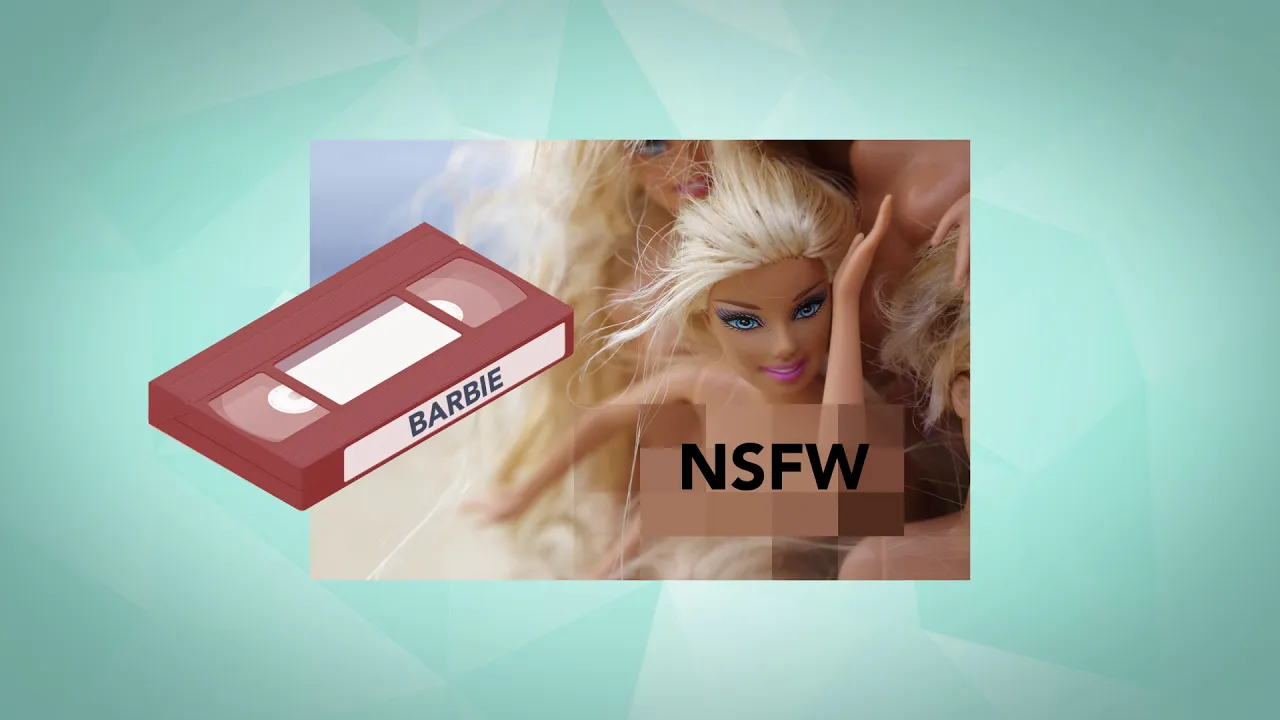
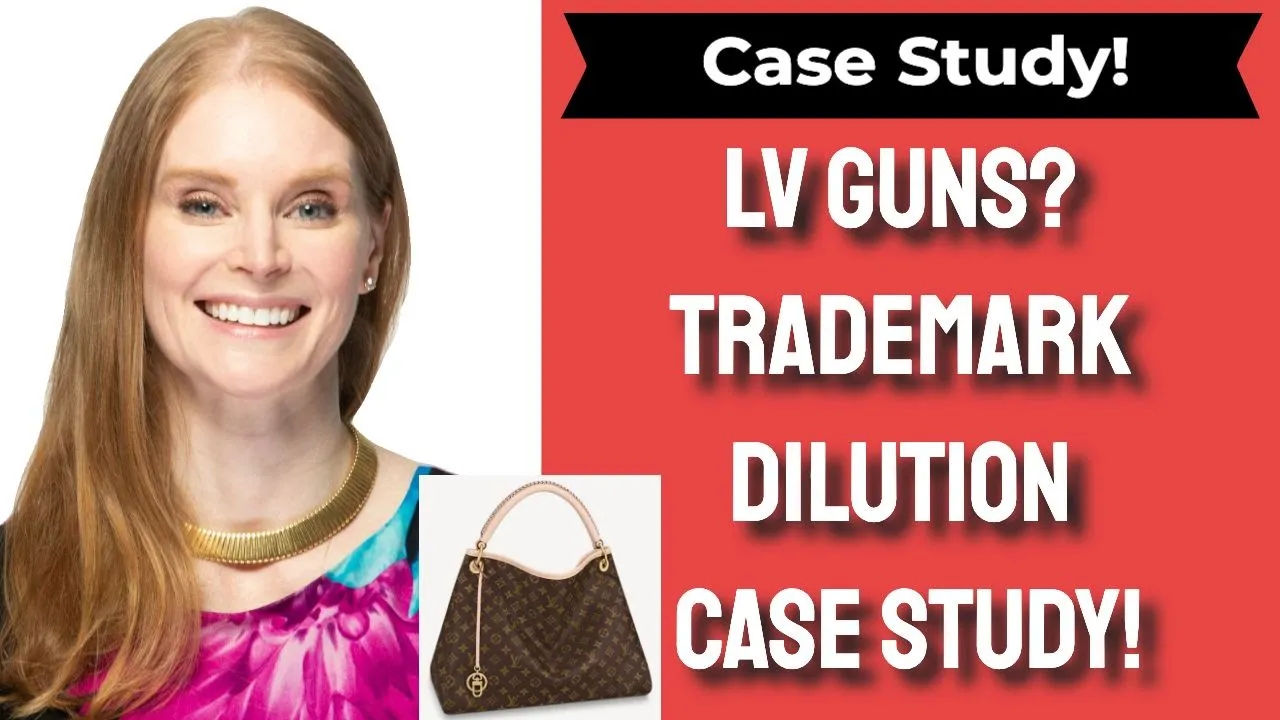
Dilution by blurring happens when a similar trademark chips away at the distinctiveness of a famous trademark. For example, someone selling Apple brand toilet seats or bulldozers will blur the ability of Apple to identify a single source, even if people buying that stuff didn't think Apple computer made their bulldozer. Dilution by tarnishment happens when similarity between a mark or trade name and a famous mark harms the reputation of the famous mark. For example, and this is a real case, the guy that uses the trade name Victor's Little Secret for his store selling sex related products is likely to tarnish the famous Victoria's Secret mark. There's no real risk of confusion here, but the company Victoria's Secret is seeking to prevent the gradual tarnishing of their mark. One major issue with dilution is that famous trademarks are hard to come by. While there are super marks, like IBM, Google, Budweiser, Microsoft, courts have typically been hesitant to find less well known trademarks to be famous. It's not like YouTube or something, where you can be kind of famous, your trademark has to be really, actually, IRL famous to attain this status.
Trademarks are fascinating, regardless of whether you are someone who enjoys strolling through the shopping mall with logos firmly affixed to your bags and coffee and clothes, or whether you believe brands and trademarks have become so powerful that they have been internalized by modern society and dictate our aspirations, our self image and our lifestyles.
As we've watched Don Draper and James Bond conspicuously guzzle Heinekens, maybe we worry that brands are controlling and corrupting our creative content. Regardless, trademarks are ubiquitous.
Trademarks help us make sound decisions about the products we need and want. They protect us from knock off goods and allow us to go about the daily business of our lives more quickly and more efficiently so that we can sit down tune our Samsung television to PBS on our Comcast cable tuner, watch the season finale of Downton Abbey, brought to you by Viking River Cruise Lines and Ralph Lauren.
Thanks for watching, and as they say in Hank and John's hometown, don't forget to be awesome.
Which is not a registered trademark. Which is how this happened: Tell either Eleanor or Alice not to forget to be awesome.
Oh! Thank you, sir!
Crash Course Intellectual Property is filmed at the Chad & Stacey Emigholz studio in Indianapolis, Indiana, and it's made by all of these nice workers for hire. If you'd like to keep Crash Course freely available for everyone forever, you can support the series at Patreon, a crowd funding platform that allows you to support the content you love.
Speaking of Patreon, we'd like to thank our Headmaster of Learning Thomas Frank and our Vice Principals Kathy and Tim Philip and Linnea Boyev. Thank you so much for supporting Crash Course. You can get awesome rewards for your support. You cannot get ownership of the Crash Course copyright, but you can get the satisfaction of helping people learn.
Thanks for watching. We'll see you next week.
Up Next
54:53
Trademark Infringement in Gaming: Iron Maiden v 3D Realms Legal Analysis
@HoegLaw
851 views•2019-05-31
4:27
US Secondary Sanctions Impact on EU Businesses and Blocking Legislation
@Bureauvandijk
1.6K views•2019-03-20
10:00
International IP Law Explained: Berne, Paris & TRIPS
@crashcourse
235.2K views•2015-06-03

24:42
Police Interrogation Tactics: False Confessions & Legal Reform
@LastWeekTonight
7M views•2022-04-18
Related Study Plans & Knowledge Roadmaps
Structured learning paths in Law
law
Self-Defense Law: Imminence & Castle Doctrine
01Foundations of Self-Defense Law
02Imminent Threat & Reasonable Belief
03The Principle of Proportionality
+ 3 more learning modules
12h6 modules
Explore Roadmap
law
Defamation Law: First Amendment & Actual Malice
01Introduction to civil torts and the First Amendment
02Elements of Defamation: Libel and Slander
03Public Figures vs. Private Individuals
+ 2 more learning modules
8h5 modules
Explore Roadmap
law
Hearsay Rule: Trial Evidence & Exceptions
01Introduction to Trial Evidence & Courtroom Basics
02Demystifying Hearsay: The Core Definition
03Non-Hearsay: Exclusions Under FRE 801(d)
+ 3 more learning modules
14h6 modules
Explore Roadmap
law
Medical Malpractice: Law, Liability & Care
01Foundations of Tort Law and Civil Liability
02The Four Elements of Medical Malpractice
03Defining and Proving the Standard of Care
+ 2 more learning modules
12h5 modules
Explore Roadmap