














A customer health score is a single actionable metric that serves as an early warning system for customer success organizations, composed of multiple weighted signals derived from business outcomes, adoption metrics, delivery/operations performance, customer feedback, and relationship indicators; effective health scores require starting small, iterating based on results, considering context-specific factors like lifecycle stage and customer size, and aligning with clear goals and actions to drive meaningful interventions rather than simply collecting data.
Designing a Customer Health Score: A Strategic Framework
Added:Understanding of Customer Success (CS) fundamentals, including the core objectives of CS teams in subscription-based or SaaS business models.
Familiarity with key customer metrics such as Churn Rate, Net Revenue Retention (NRR), Customer Lifetime Value (LTV), and Net Promoter Score (NPS).
Knowledge of the Customer Lifecycle stages, from onboarding and product adoption to renewal and expansion.
Basic data analysis concepts, specifically how to identify, categorize, and weigh different customer behavior inputs.
Operationalizing health scores within Customer Success Platforms (CSPs) like Gainsight, ChurnZero, or Totango.
Designing automated playbooks and action workflows triggered by shifts in customer health score segments.
Applying predictive analytics and machine learning to transition from heuristic-based scoring to advanced churn-prediction modeling.
Methods for backtesting and iteratively auditing health score algorithms against actual renewal and expansion outcomes.
846 views7likes39:48Original Release: 2018-04-11
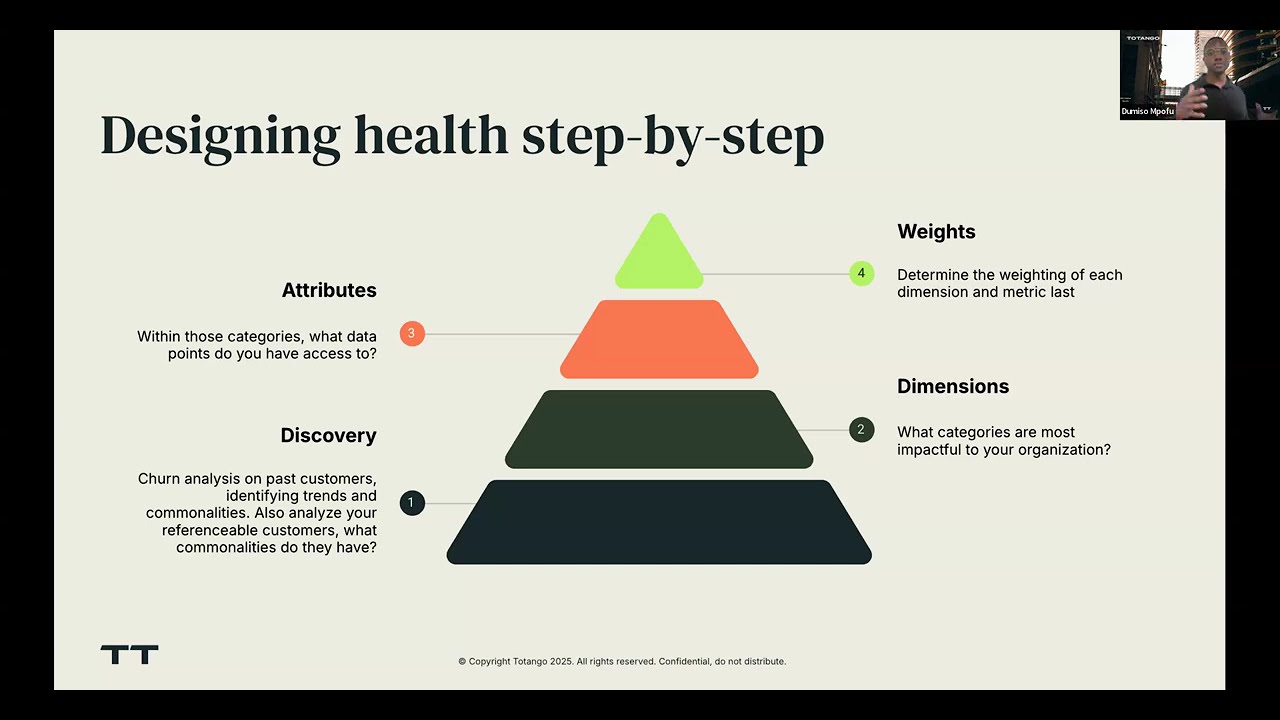
hello everyone thank you so much for taking the time to join us live today's customer success workshop with Paul Phillip the founder and CEO at amedy my name is Matilda and I'm the manager of marketing here at amedy where we provide customer success managers with a platform that they need to retain and grow their customers at scale we're super excited to be discussing our framework around how to design your customer house for today before that introducing our presenter Paul is the founder and the CEO at amedy he's the leading innovator in sass and customer success and since founding amedy she spoken with customer success professionals from all industries and he's acquired a great wealth of knowledge about best practices which he shares with our customers on a daily basis and with us today so before we get started a couple of housekeeping notes as usual join us on Twitter take a screenshot and share it using the hashtag CS workshop and Tyga's at gate Amity and at people um we will be recording it the webinar today and sending out the slides before the weekend so check your inbox and you'll get a replay link feel free to share with your network as well and we do have a Q&A plan - at the end of the webinar today so at any point in your resume control panel you you can open the QA the Q&A section and you can send us questions in there delay until the end just send them as they pop into your head we also do have a chat that's open if you want to engage with other attendees and that's it for me so Paul thank you so much for joining us excited for today's webinar and I'll let you take it from here lady thanks Mathilde thanks everybody for attending today we're really thrilled to have you and as Matilda said if you have any questions if anything comes up during today's webinar that you want to be answered at all we we love being interactive and your questions are way more valuable than our opinions so please PLEASE ask a question at any time and so let's uh let's kick in so the goal of any work though that we do in our practical customer success workshop has to be to improve customer success performance and at a MIDI we've we've been doing a lot of thinking about this we've been talking to a lot of SAS companies about this we've been talking to our customers about this is how do you how do you systematically go about improving the performance of your customer success organizationally in your business and we're starting to roll out a model based on what we've learnt there and so we're very excited to give you a preview of that model today and to show you how designing your customer success health score can be a key capability for improving your customer success performance and we all know that the goal of customer success is you don't have to have that conversation anymore make our customers successful and predictably drive revenue growth what's less clear to everybody and I mean everybody you know customer success vendors SAS vendors public sauce vendors startup SAS man there's non satis vendors everybody is what's the path to getting there predictably what's the path to improving performance predictably and we had a MIDI we believe there is a path and we're gonna start that conversation today so when people want to improve the performance in their SAS organization just a few predictable things that they do one is if if they're not happy with their results they change the people and you know when you've got a high degree of customers that's executive turn that's probably not a good thing and so and we've seen this happen we've seen you know companies replace a VP thatp room places all the team overtime and a year later they have exactly the same results and then they do the same thing over again and so just replacing people typically doesn't work and then they'll try okay well replacing people the replacement team didn't work when we get some new tools so we'll get a we'll get an NPS tool we're get a customer success platform and we'll get a better ticketing system and we'll add in app messages and they implement all of that and your later.we results are the same and then they ruin place the people that did all that and then some companies will roll out a brand new process so we're not doing customer success that way anymore we're doing customer success this way and it'll typically be very prescriptive here's the new recipe and they'll roll that out in a year later they won't have any difference in their results so therefore it's got to be a product problem so let's let's change our UI let's change the way the product works let's add all of these new features and then year later same thing so just changing your people changing your tools changing your product changing your processes isn't guaranteed isn't a predictable way of improving your customer success process so yeah let's back for a second and you could you can think of a SAS business as having two arms all built around your value proposition so you've got the marketing and sales you can tell that the marketing team put this slide together and the marketing and sales team sales customer on your value proposition and it's the customer success organizations job to deliver on that value proposition both initially and repetitively over time and hopefully in a creative and increasing way and so if if the customer success organization is getting better at delivering the value proposition that this sales and marketing teams are delivering your performance will go up and so what to happen is that your people your processes your tools they all need to work together they need to be aligned to delivering your value proposition both at a macro level for all of your customers all of your segments all of your industries all of your products and at and at a micro level for this particular customer this particular new user and it's is the magic comes when you get these aligned and it's why I'm and swap out generally doesn't work is you know in this diagram here if you swap out all of your people and replace them but your tools and your processes are the same you're probably not going to change your results very much and so the way to think about improving your customer success performance and designing your customer health scores is how do we get better at working all of these together to deliver our value proposition and so just the double-click on that make it a little more operational the way you can think about this is that your customer success organization is a portfolio of capabilities that go into working on delivering your value proposition and the universe of possible customer success capabilities is really large but it'll look something like onboarding Health score a customer experience management customer coaching training maybe a domain area expertise and these of course can be hierarchical so underneath the onboarding capability you can have an implementation capability you could have a project management capability so it's the capabilities working together that actually deliver your value proposition and one of the first places to start when you're thinking about improving your customer success performance is asking yourselves do we have all of the capabilities we need to deliver the value proposition because the lowest hanging fruit is to add add a missing capability so if you're if you can only walk on your left foot you'll probably hop and not be very fast and if you can add a left foot in the right foot then then you can run and do a lot of faster and then inside each capability you can think of them as being a process tools and people and they have to be aligned at delivering the goals of the particular capability that you're talking about so if you think about onboarding your onboarding process people and tools need to work together to onboard your customers in a way that you know accelerates the value proposition okay and so it starts looking a lot like a fractal diagram and you know this inventory negative capabilities this way and just making sure that you've got the right process people and tools and that they're working together for each individual capability because the way to systematically improve your performance over time is to systematically improve the performance of your capabilities so get that a little bit better at coaching and a little bit better at onboarding get a little bit better at customer insight and how scores and customer experience and then rinse repeat rinse and repeat okay so so if you think of your customers successful organization as a portfolio of capabilities then one of the core capabilities that every customer success organization is going to want to have in one way or the other is that a customer health score or customer insights ways of measuring and comparing how your customers are doing in your in your organization and so that you can then use this custom keps customer health scored in the visibility you get in improving your other capabilities so this is this is a core capability because this is a capability you need to improve the other capabilities that you have I need a word with fewer syllables than capabilities okay so customer health scores core capability of any customer success organization and it supports and informs and drives other capabilities and for that reason it's it's foundational that slide says what I just said okay so customer health score you can think of it as as your early warning system and it can be a macro level early warning system that says this customer is healthy or unhealthy or it could be a capability level early warning system that says the onboarding for this customer is unhealthy or the business outcomes for this customer are unhealthy or are very healthy and so you can think of the health score as being the canary in the coalmine and the way the canary the coal mine works is that when you're when you're a coal miner it's very important that you get out of the mine if certain gases are released from inside the mine but the gases don't have an odor or so it's very hard to detect and so miners would hang a canary from the roof and if the canary was happy and chirping everything was good but if a canary died it was time to get out of the out of the mine as soon as possible and so the canary was a signal the canary told you that something had changed something important and something that you needed to act on and and getting your signals straight is an important part of designing the health score and your customer success operations so a signal is just a piece of data we have an expected range so you know maybe this is the average you average number of users in a week and the expected value is 75 but if if it goes below 50 that's a problem and so the fact that that your average number of users in a week has gone above or below your acceptable range that's the signal so knowing that it's 71 or 67 or 104 by itself doesn't really matter you can't really act on that what really matters is that it's outside of the acceptable or the expected range and so those would those are what signals are something is outside of a rage or something that was outside of arrangement back inside of it a healthy rage so customer health scores are a signal that tell you it's time to take an action so when designing your your customer health score it's the first thing you want to do is really figure out your goals for the health score there are no useful health scores there are no good health stories there are no bad health scores outside of are they helping me achieve my goals or not helping me achieve my goals so the questions you want to ask when you're designing your health score is who's going to be using the health score so this may be a health score for CSM and what capabilities are going to be improved by using that health score and so maybe it's an onboarding key to build oh and then what actions will be triggered so really critical is knowing what actions are you're going to take because if the action is getting on the phone with a customer then you want to help score that it's not very volatile because you can't get on the phone with a customer if the health store changes every hour and so you you know if the action is get on the phone with the customer you probably want that to change maybe once or twice a week and then what other impact what other metrics that you gather will be impacted so you might have risk metrics that are driven from a health score so this is the very first thing to think about when thinking about your health score is you know who what when why how this is going to be used and all of the all of the health equipment here is there's no point taking your blood pressure every hour if you I'm gonna be doing something about it with that data you can take it once in the morning and you know and if you're not going to exercise there's much not much reason to be taking your pulse all the time okay so once you've once you've got your goals clear you want to define what actions are you're going to take so the some of the questions to ask yourself when designing the actions you're going to take are what challenges are the customers likely going to face yeah you know so having um you know having a health score that says the customers are using less features might not necessarily on its own be particularly useful what might be useful is customers find it difficult to set up dashboards and so you might want to have a health store that tells you how well they're doing with the dashboards and so what's what's you clear about what challenges your customers are going to might be facing then what are you going to do about that what actions are you going to take that will impact that particular customer challenge and you know is that are going to train mom are you going to apologize for something are you going to submit a bug report are you going to talk to the executive sponsor what are you gonna do about the challenge that you looking to to find out because that'll tell you again what type of health score you're going to need how often that it's going to change and then what signals will tell you it's time to to take this action and so again if the the challenge is that the customers have a hard time setting up a dashboard then you might want to see how many times dashboards are being created how many times the dashboard creator - was being used how often people are looking at the dashboard have a goal for that you know but it's you know very specific and when you see the health score change it should automatically at least suggest the option that you want to take that you want people to take if not absolutely point people in that direction okay another key design principle for designing a health store is to start small and iterate I really can't emphasize this enough is that we've seen SAS companies we've seen customers design really really sophisticated [Music] multivariate hellspores that don't really help them or maybe even get in the way because the what they needed to do was implement something simple put that out test it see what works see what doesn't work make some changes measure the results and iterate on that and if you do this repeatedly if you make your health score a little more accurate a little more actionable a little more valuable every month and six nine twelve months you'll have a great set of health scores whereas if you start with something fancy after a year you may have to just start all over again another key point when when designing your health score is context really matters and in this example we're using the your life cycle stage as context so the health score during a trial period will probably be very different than a housecoat during the launch period will be very different than a health store during the expand' period and the health score that you want to drive upsell or cross-sell will be very different than a health store that you designed to help you improve adoption and this can also be different industries different types of sized businesses different types of businesses different product lines different regions all of those things can have an impact on your your health score so while you may have a rollup overall health score per account or the likely Bute most useful ones are going to be very context-specific okay so let's talk specifically about the designing your your signals and so this is a little spreadsheet you can quickly put together to tell you what the what the source of the signals are going to be so in this case you know we've identified business outcome as one source of signal adoption as another source of signals delivery and operations as another source of signals customer feedback as another source of signals and customer relationships as another source of signals that's a pretty good list but I'm sure you guys that you'll have others and and then that's signal will be by one or more measures and so if you take a look at the outcome example you can see that you have an outcome level that's above a particular particular level or an outcome level that's gone up 10% or down 10% or an outcome level that's above a particular goal these are all you know all ways of defining the acceptable or expected range for a particular value and your health score may be a combination of all three of these and and so you you may have just one health score that says that business outcomes are healthy business outcomes are normal business outcomes are unhealthy and but there can be multiple measures that go into into calculating that and and and also you can weight those measures so you may know that outcome one is the most important and so you may give it a weight of 75% and then the other two of twelve and a half percent but they're still important so the so that the actual signal will come in and something that's you know it's operation Eliza ball and your operation Eliza belen your business but it may be made up of multiple different measures and one of the I think one of the mistakes is really easy to make is to drive your health scores from one particular one particular measure and so uh you know business outcomes are like that work that way customer feedback maybe you have a CSAT survey tool or an NPS survey tool and you may want a particularly low NPS score to be to be unhealthy so anything below a four is unhealthy anything above a seven is healthy and anything in between is is neutral so this is on you know this this is really the the heart of designing your this is where it comes into the auction or what are the what are the signals you want what what type of signals outcome signals adoption signals relationship signals and then what data do you have that that will help you detect that that's signal okay okay so that's the that's the main content of the webinar if you like to talk about how a MIDI can help you with your with your health stores or how a MIDI can help you to align all of your tools your people and your processes to deliver better customer success performance just come to our website and request a demo it can be you know a me can really help you simplify the process of implementing a powerful and effective health spore we love to show it show that to you okay and now we're going to move into Q&A Matilda need any questions awesome yeah thanks we already have a really good list of awesome questions from the audience I really encourage everyone to send us more through the Q&A panel in soon so let's get started with one question that we've been getting repeatedly from people polled you have examples of metrics to include in your health score people often mention support tickets and PS what else right so again that's the you know the eggs the data that you're going to use the metrics you're going to use are going to pend on the goal that you have for your health score and the action you're going to take but yeah you know tickets tickets is a good example so tickets could be a source of of health store the question is is an increase or a decrease in the number of tickets a healthy thing or an unhealthy thing and that will really depend on the context during onboarding if they stop asking questions could be a problem and if they submit a lot of tickets and that goes down that could be a problem yeah on the other hand you know if if there are submitting a lot of tickets maybe that are finding a lot of bugs and that could be a problem so it's you know so there's you know I don't want to say this so that they ask the metric itself can-can yeah you have to think about how you can use that metric to be able to pick it but you know typically things are you know changes in ticketing rate changes in engagement changes in product usage by far the most important one if you can measure it is business outcomes you know are they getting all of the value propositions that you promised them where where are they sure that they shorten one not others because ultimately if customers are happy but not getting value they're going to turn and if they're getting value and not happy you have a much higher chance of being able to turn them around so those those are examples awesome we just got a question which is can a midi assist in automation with customer communications so yes yes absolutely you know you can you can have you know emails generated by a change on a health score or a particular health score level you can create tasks so when uh when a particular health score goes from healthy to unhealthy you can create a task for the CSM on that account for example send them an email that's what family can help you manage all of that awesome another really good question that we've been getting a lot of is how do you identify which components of the health score to weigh more heavily yes um so that's definitely one that comes out of the iteration process you at the very beginning you probably can't get it right so you can take a good guess and iterate and and see what's working but definitely one way of doing it is if you have if you can compare your successful customers with your unsuccessful customers in for each metric so if you have a business outcome metric and you've got a happy successful customer unhappy unsuccessful customer see how that metric has changed over time for the successful customer and the unsuccessful customer and if that's if that has some predictive value then you might want to wait that more than the ones that have less predictive value awesome another question here is how do you account for customer size when for instance some accounts have only two or three users it can seem chattery and inconsistent to use overall usage frequency if the example given here is for example if one of the two users leaves on vacation it will mark the health score is low any tips around that yes so that's that's a that's a great example of context mattering and so you know in in that case where where the there's inherent volatility in the signal that you want to use in your health score what we do in the Amity product what we do in our customer success team here are they am we have a manual override and so we can you know we can mute the signal for a period of time because we know that somebody went on vacation but you can also wait that signal differently for a large customer and a small customer awesome another question here is how do you sell management on implementing a health scoring capability well ask them ask your management if if they like flying blind and if they drive their car looking in the rearview mirror you know health stores are what provides the executive the management with with visibility with transparency into what's happening in the company but again go back to the two things you need to do when you're thinking about your health store is what are the goals for the health store and one of the options you're going to take based on those health scores and if you're having trouble selling health score to an executive it probably means that you you don't have a goal that is lined up with what's important with that executive and I suggest that you get your health score your goals for your health score lined up with the executives that you need support from awesome we have some time for a couple more questions so a really good question that we got in life today is do you recommend creating health scores on the individual user and user level or a company account level yes it really it really depends on the nature of your of your business and but you know if if there are unhealthy users eventually you're going to have an unhealthy account but there are times when user health is less important than account health or account health is less important than user health so it really depends on your business but but if one of your goals is to keep your users engaged and happy and one of your actions is to turn them around if they're unhappy then absolutely user level health scores and maybe roll-ups of user health love user level health sports are important awesome thanks another great question here is an example so this person said one-third of our health score is based on CSM health assessment which is kind of a gut feeling based on non tangible factors and the other two-thirds are measurable like open tickets threats of product usage etc do you think that 1/3 to 2/3 is to higher proportion I again I have no idea it really depends on your business you know so you have to be 2-headed about it because I think having a subjective custom customer success manager component is smart and that everybody should do that but it's going to it's going to then change from cut from CSM to CSM and so you do need some standards for for how you assess you know how they assess their customer success that they're intuitive score just because you know different types of personalities will score different things in different ways and the thing you can do is to take a look at what's the history of the intuitive health score and how well does that correlate with what happened with that customer yeah and a good example is an angry customer isn't always at risk and a silent customer isn't always safe and so it you know those those can really throw off your intuitive score but it but if you take a look at what that average CSM score was over the last year and whether that led to churn churn or not or growth or not that'll give you some insight and and then also tweak it a little bit and see what happens awesome why don't we take one more question before we wrap up so a question here a lot of people don't have a health score yet but they've been tracking MPs for a long time so they have data around MPs yeah so question that we're getting a lot of is is MPs a good starting point for your health score yeah so first of all if this is a is does give you insight especially how it changes so you know some people may regularly give you a seven and it means the same thing as the people who regularly give you a ten you know and so I you know I never scored my uber driver a five I always score them before and if they get a three that means they really messed up and but you know not everybody is like that so you have to keep those those types of things in mind but you know in the spirit of starting small and innovating MPs isn't the place to start what if one of the questions you'll have to ask is is is it the individual NPS scores that are really important or is it the aggregate or average scores over the whole account those are things that you're going to want to figure out and then when you start getting surprised low NPS score upsells and a high NPS for terms you can start looking at your other data and see what you missed all right thank you so much thank you so much everyone for attending the workshop today I hope it was helpful Paul thank you so much for taking the time to to present on this topic today and yeah that's it for today so great thanks Patil thanks everybody if you think of any questions just drop us an email we'd be happy to help
Up Next
27:53
Building a Customer Success Strategy from Scratch
@TheCustomerSuccessPro
186 views•2025-10-22

23:08
Building Iconic Brands: Marketing Strategies from Rohan Oza
@CNBC
16.7K views•2017-09-28

15:23
Decoy Effect: How Pricing Psychology Influences Consumer Spending
@bobinvestsUS
90K views•2026-01-05

17:30
The Planned Obsolescence of Light Bulbs and Tech
@veritasium
25.3M views•2021-03-26
Related Study Plans & Knowledge Roadmaps
Structured learning paths in Business
business
Gov Procurement: Find, Bid & Win Contracts
01Introduction to Government Procurement & Business Setup
02Small Business Certifications & Set-Asides
03Finding and Analyzing Contract Opportunities
+ 2 more learning modules
14h5 modules
Explore Roadmap
business
Greening Supply Chains: ESG Audits & Net Zero
01Introduction to Supply Chains and ESG Standards
02Measuring Carbon Footprint: Scope 1, 2, and 3
03Auditing Legacy Systems & Lifecycle Assessment (LCA)
+ 2 more learning modules
14h5 modules
Explore Roadmap
business
13-Week Cash Flow: Liquidity & Forecasting
01Excel & Financial Statement Foundations
02Working Capital & Liquidity Dynamics
03The Direct Method of Cash Forecasting
+ 2 more learning modules
16h5 modules
Explore Roadmap
business
Migrating to Usage Pricing: Strategy & Value
01Foundations of Business Pricing Models
02Understanding Enterprise Contracts & Value Metrics
03Designing a Usage-Based Pricing Structure
+ 2 more learning modules
12h5 modules
Explore Roadmap