


























A Customer Success Manager (CSM) in a SaaS business should focus on five key activities: (1) creating a health score system to categorize customers into risk levels (red, yellow, green, purple), (2) being outcome-project focused by understanding each client's specific goals and managing their implementation like a project, (3) engaging in renewal and upsell processes to maximize expansion revenue, (4) escalating value through referrals, testimonials, and case studies to turn satisfied customers into advocates, and (5) serving as the voice of the customer to provide feedback to product development teams. This framework ensures CSMs drive both retention and revenue growth, with the expectation that every dollar invested in CSMs should yield five times return on investment.
What Does a Customer Success Manager Do? Key Roles and Strategies
Added:- Hey there, Dan Martell here, serial entrepreneur, investor, and creator of SaaS Academy, and in this video I'm gonna share with you the five things that a customer success manager, also known as a CSM, should be doing for you and your SaaS business.
Be sure to stay the end, because I'm gonna share with you how to get access to my EBR Flow Planner, also known as the executive business review.
Sometimes I call it the QBR, quarterly business review, step-by-step process to have a meeting that allows you to increase the engagement and also revenue from your customer.
Let's get into it.
(funky music) So, here's the deal.
Maybe you're at 10k in MRR, monthly recurring revenue, and you're wondering, I keep hearing about a customer success manager, but how is that different than a support person, or what are they actually gonna work on that's gonna make me money?
Because the last thing I want to do is hire somebody that just sits on their hands and does nothing to actually increase the revenue.
So, here's the deal.
When I first started off in SaaS, this concept wasn't even a thing.
Salesforce, in the early days, called it the revenue retention team, and it kind of had the same characteristics of what you would find in a CSM, but over the years, companies like Gainsight and many others have really not only created the category and the term, but really set the precedence for what types of activities and outcomes should your CSM be achieving for your SaaS product, and I had to learn this, because I built my company sphere.
We had account managers that kind of acted as a customer success manager, and over the years, even with my coaching business, I now have a dedicated CS, customer success team, and they're really accountable for what it says, making sure, I always though that SaaS should be called successes of service, and for me, customer success is making sure clients achieve the desired outcomes that they get, but you need to understand the five things that they should be focused on achieving for you that's actually gonna make the revenue needle move.
Here's what I got.
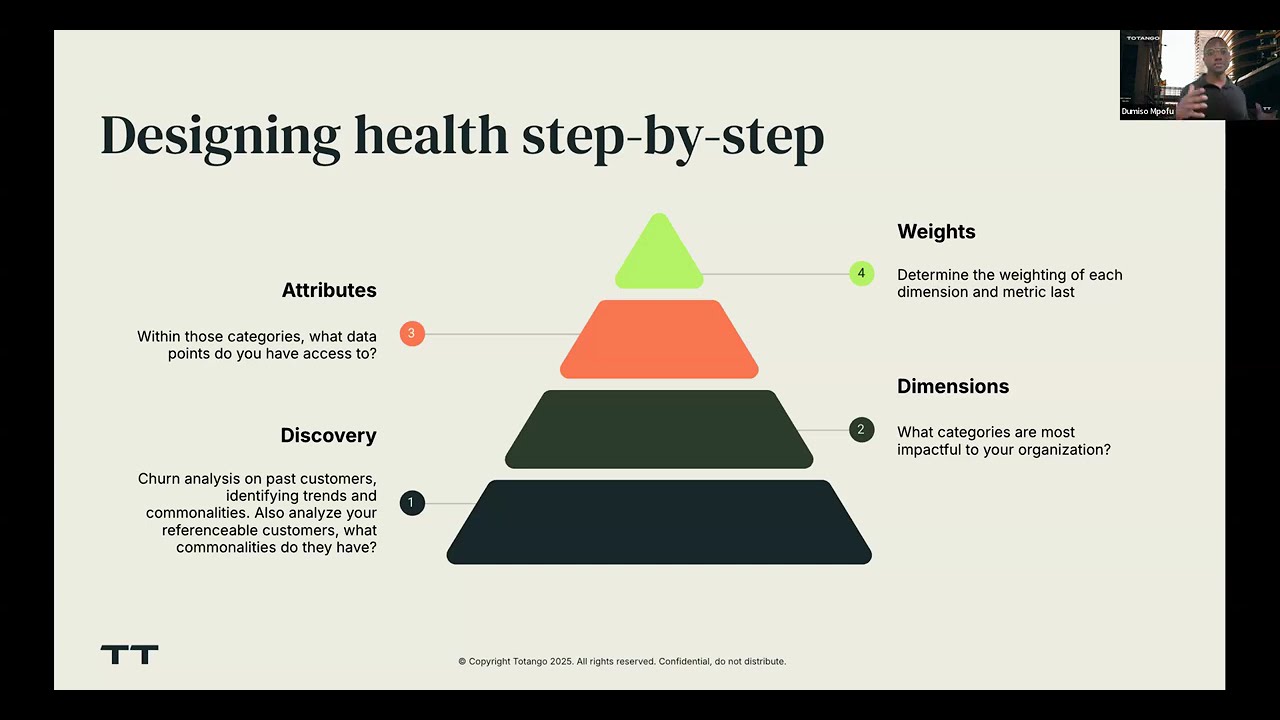
Number one, create a health score, so what this means is you should have the ability to outline kind of key activities or characteristics or stages of a new account within your software so that you can quantify kind of where they're at in that process to make sure that they have a high activation or engagement score.
So, every business is gonna have some changes or different aspects of their score that's gonna make it relevant for them.
The easiest one is just to make sure that people are engaged in the product, right?
But I like to go even deeper.
I remember HubSpot, they talked about their CHI, their customer happiness index, which is essentially different kind of utilisation of different aspects of the tool the customer may have bought, so if they bought a module, that's part of their CHI for that account, and that way they had a unified way of identifying customers that were red, green, or yellow.
I teach my clients to implement a process called the member-at-risk monitor.
Everybody calls it the MAR.
New people get confused because they're like, "What's a MAR?"
Well, member-at-risk monitor is essentially a simple way of quantifying customers into those three buckets so that when you're talking to your CSM you can clearly ask them who's red, what's the strategy to execute the red playbook?
Who's yellow?
What are you gonna do to get them green?
And my favourite colour is purple.
Purple is referenceable, meaning that they are engaged and advocates for your product, and that is the next level of health score.
Number two, outcome project focused, so what this means for me is a CSM, a customer success manager, needs to be focused on the outcome the client came into the product to achieve.
The mistake that a lot of CSM makes is they think they know what was desired by the client because hey, we have a product, it does X, Y, and Z, people bought it, that's what they want.
And if you treat every account, especially if you're talking five-figure deals, annual contract values, kind of 10,000 plus, you need to understand the specific desired outcome of each client, and manage their implementation or activation within your product like a project.
So, great CSMs have a product management understanding or bent regards to needs analysis, timelines, expectations, and for me, I teach my clients this framework called the EBR Flow Planner, the executive business review, which is essentially a nine-box model that you use to guide all of your interactions with the customer, because there's so much that could happen to allow you to not only activate a customer, more importantly, upsell and retain them over the long-term, and I'm gonna talk about that in a second, but if you don't have somebody that is outcome-focused that can manage projects, manage expectations, move things forward, unblock friction points for your customer in the customer journey, then they're gonna fall backwards and they're not gonna get you what you need in your SaaS.
So, make sure that they're outcome and project-focused.
Number three, engage the renewal and upsell.
For me, one of the most valuable opportunities of a CSM is to make sure that you create what's called a land and expand model, meaning that somebody buys your product, they invest, let's say, 5,000 or 10,000 annually for your technology, but that should just be the beginning.
You should definitely have a pricing structure or product roadmap.
I have videos on those on my YouTube channel you can go check out, where you figure out how can I engage the customer to extract more value from them and have them get more value from our product?
That, to me, is really about the process, what we call a renewal path.
Do you have a structured and detailed process, ideally within the 90 days of a contract renewal, that your CSM executes that playbook to encourage the renewal, but not only that, throughout the lifetime of the customer, the life cycle of the customer, is there a touchpoint and a process, in my world, we call it the EBR Flow Planner, to make sure that we're maximising what's called expansion revenue?
We're trying to figure out how can we grow an account?
Because if you spend a dollar on a CSM, my rule is you should be getting a five times ROI on that dollar expenditure.
It's just like in sales.
If I spend a dollar on sales, I want 10 times that dollar in total contract value.
I think the revenue opportunity, if managed properly of a CSM, is a five-to-one investment, and if you've looked at any SaaS businesses, the reason why they peter out and they can't grow anymore is because they hit the growth ceiling primarily driven by their lack of ability to retain and grow customers.
I have a whole video, you can search growth ceiling, again on my YouTube channel, to dive into that.
But for me, if you don't have somebody that knows how to really build out the renewal path and the upsell opportunities, then they're not gonna get you the revenue expansion or the expansion revenue that you need to justify that investment.
Number four, escalate value.
The way I think about it is getting somebody to become a customer, that's step one out of several steps, because that captures the value in regards to their investment in your technology to get results or success, but there's so much more, right?
When I talk about taking a customer, when they start, maybe they're red because they haven't deployed the software.
So, red.
Yellow, they're getting better.
Green, they've got activated, they've got success.
The next colour is purple.
Purple means that they are a referenceable account, meaning that if you have somebody in a sales process and they ask for references, you're able to actually introduce them.
They're so excited about your technology that they ask you, "Hey, if anybody needs to talk to "a customer, I'm such a big fan of what you guys are doing.
"Send them my way.
"I'll make sure I can kind of "elaborate on how we're using your technology "and maybe get you some more customers."
That's purple, so how does a CSM escalate that path and, really, value?
Well, a few things.
Number one, they can ask for a testimonial, right?
Somebody has a great experience, best time to ask for a testimonial.
Number two, they can ask for a referral.
My rule for growth, especially in SaaS, is a very simple formula.
The number of referrals, so track your lead sources.
If you can increase the number of referrals on a monthly basis to overcome the number of cancelled accounts on logo churn, that's what cancelled accounts is, if you just got that to zero, meaning that your customer base is referring the same amount of customers that are churning, that means that that covers your bases, and then every new marketing or sales initiative that adds new customers hits the bottom line, and that is a powerful place to be.
For me, referrals needs to be a strategy and a process.
I have a whole referral page system.
I've talked about that I teach my clients it's gonna allow you to make sure that equation works out.
The other things is you can do case studies.
If somebody's purple, asking them, the customer success manager should engage, identify, produce maybe one case study a month that helps increase the sales motion.
If you have a sales team out there talking to clients, they're always gonna be asking, "Who's a company like me "that's using your product?"
You want to make sure that your CSM is always creating these case studies, and one of my favourite opportunities for you to do is customer marketing, which is inviting your customers to podcasts, to speak, maybe, at your annual customer conference, to speak at other industry conferences, talking about implementation of your technology, really engaging your top customers, because there's so much, and that's why I call it escalate value that your CSM could be doing that's more than just upsells and renewals.
Number five, voice of the customer.
This is the probably, obviously, I always say it's the most important, but the truth is, if you have somebody talking to your customers, understanding the friction points in your softwares, monitoring their deployments and how they're using your software, having that person be the voice of the customer to your product development process, so you should have somebody accountable, product manager, or maybe it's you if you're a small SaaS, a CEO.
Having that person represent the customer's voice in product meetings is invaluable.
At minimum, understanding where customers are getting tripped up through their perspective to feed that to the product team.
This is, to me, I always think about feedback cycles, and if you have a team and you're not getting feedback, critical feedback from your team, it doesn't mean that it doesn't exist, it just means that you haven't created a process to escalate and elevate and open up those conversations.
It's in that critical feedback that the real growth opportunities lie.
So, that's why, for me, making sure that my CSM is part of that feedback loop and really fighting for the customer and having that customer empathy is so critical in regards to how they add value to the organisation, your SaaS business.
So, quick recap on the five key areas that your customer success manager should be focused on.
Number one, creating a health score.
Number two, outcome project focused.
Number three, engage the renewal and upsell.
Number four, escalate value, and number five, voice of the customer.
As I mentioned at the beginning of this episode, I want to share with you an exclusive resource called the EBR Flow Planner.
Stands for the executive business review.
It is my nine-box, nine specific steps that you should be going over when you meet with an account with a customer to ensure that you get an understanding of what they want to achieve, the progress they've made so far, the friction points that they might be having, and the opportunity, the best part, to maybe identify things that you can essentially upsell or cross-sell.
That's called land and expand.
You need a repeatable playbook.
Use the EBR Flow Planner.
You can click the link below to download your copy.
It's all there for you to give to your CSM or implement yourself to start growing your account revenues, and with that, if you liked this video, be sure to smash the like button, subscribe if you're not, and click the notification bell so you get notified when new videos get uploaded, and as per usual, I want to challenge you to live a bigger life and a bigger business, and I'll see you next Monday.
Do we still do outtakes at the end, or no?
- [Distant Voice] Yeah.
Up Next
Bubble SaaS Payments: Stripe Subscription Management in Bubble.io
@BubbleIO
9.2K views•2024-07-26
Web3 Social Decentralization: Farcaster Co-Founder on Crypto Social Networks
@levychain
1.5K views•2022-10-18
Build a SaaS Cancellation Page: Reduce Churn Framework
@danmartell
34.3K views•2020-02-10

The Planned Obsolescence of Light Bulbs and Tech
@veritasium
25.3M views•2021-03-26
Related Study Plans & Knowledge Roadmaps
Structured learning paths in Business