


![직업상담사 2급 필기 노동시장론 《제1강》 명품기본이론 [노동시장의 이해] 김덕희 교수](https://i.ytimg.com/vi/_70V8DeCwIQ/maxresdefault.jpg)
![[직업상담사 2급 필기 무료강의] 노동시장론 《1강》 노동시장의 이해 30분 완벽정리](https://i.ytimg.com/vi_webp/b-OiYqNGXnU/maxresdefault.webp)





![Cours Finances Publiques : Généralités [Chapitre 1]](https://i.ytimg.com/vi/n_E2ZZkOoaM/hqdefault.jpg?sqp=-oaymwEmCOADEOgC8quKqQMa8AEB-AHUBoAC4AOKAgwIABABGDEgVChyMA8=&rs=AOn4CLA9Y761AZRDKkkTIL8pHvkUGzBUsQ)

























Immigration is economically beneficial for host countries because it increases GDP and productivity; while there may be short-term costs such as potential wage suppression for low-skilled native workers and increased use of social services, the overall economic benefits outweigh these costs, as demonstrated by studies showing that labor markets quickly adapt to immigrant inflows and that granting legal status to undocumented immigrants would result in net positive economic effects including higher wages, increased tax revenues, and job creation.
Economics of Immigration: Costs vs. Benefits Explained
Added:Basic Labor Market Economics: Understanding the laws of supply and demand, wage determination, and how shifts in labor supply affect wages and employment.
Macroeconomic Indicators: Familiarity with Gross Domestic Product (GDP), GDP per capita, and the primary components of economic growth.
Public Finance Basics: Conceptual understanding of public goods, tax revenues, and how government budgets fund infrastructure, healthcare, and social services.
Human Capital Theory: Understanding how skills, education, and labor mobility contribute to productivity and innovation within an economy.
Empirical Econometrics of Migration: Studying landmark economic papers (e.g., David Card's research on the Mariel Boatlift) to understand how researchers isolate the causal effects of immigration.
Brain Drain vs. Brain Gain: Exploring the economic consequences of emigration on sending/origin nations, including the impact of remittances and human capital loss.
Comparative Immigration Policy: Analyzing the economic outcomes of different immigration systems, such as points-based systems (Canada/Australia) versus family-reunification systems (USA).
Political Economy of Immigration: Examining the divergence between economic theory/evidence and public policy, including the influence of interest groups, labor unions, and voter sentiment.
658.4K views11.8Klikes11:21Original Release: 2016-05-18
Hi, I’m Adriene Hill, this is Crash Course Economics, and today we’re going to talk about Immigration and how it affects economies.
So, that poem on the statue of liberty? The one that reads in part, “Give me your tired, your poor, Your huddled masses yearning to breathe free, The wretched refuse of your teeming shore.” That’s some lofty stuff, right?
Well, sentiment aside, immigrants are good for the economy.
[Theme Music] Before we get into the Economics of Immigration, let’s step back and have a quick look at the history.
Homo Sapiens have been moving around the planet for a long, long time.
Estimates vary, but modern humans started to spread out from Africa between 80,000 and 60,000 years ago, and since then they’ve been busily migrating all over the globe.
By 12,000 years ago, we were on all the continents except Antarctica.
Because Antarctica is a terrible place to live if you aren’t a penguin.
And honestly, even they seem unhappy there.
Today we’re going to look at international migration, when people move between countries, rather than internal migration, which refers to people moving around within their home country, because international migration has the most appreciable economic effect.
We’re also not going to talk about forced migrations, like the Atlantic Slave Trade that kidnapped many million Africans, and transported them to the Americas as chattel between the 16th and 19th centuries.
We’re going to focus on voluntary migration because people who choose to move internationally are very often seeking economic opportunity.
In 1889, a geographer named Georg Ravenstein wrote in his Laws of Migration, “Bad or oppressive laws, heavy taxation, an unattractive climate, uncongenial social surroundings, and even compulsion... all have produced and are still producing currents of migration, but none of these currents can compare in volume with that which arises from the desire inherent in most men to ‘better’ themselves in material respects.” Ravenstein was writing during the Great Atlantic Migration, which began in the 1840s as huge numbers of Europeans relocated to the Americas.
Between 1880 and 1910 alone, somewhere in the neighborhood of 17 million Europeans arrived in the United States.
The 19th century also saw a smaller, but still significant, number of Asian immigrants arrive in the US, mostly settling on the West Coast.
Many of them came to join in the Gold Rush -- working as laborers in the mines.
They also worked in factories and helped build the Transcontinental Railroad.
All this immigration was, in many ways, a result of technological advances.
Improved transportation like steamships reduced the cost and difficulty of migrating across the Atlantic, and the rapidly growing industries of the United States needed workers to keep producing.
This influx of immigrants, while good for the industrial economy of the US, eventually ran into resistance.
Beginning in the late 19th century, a series of laws were passed to restrict immigration.
By the 1930s, European immigration was severely curtailed, and Asian immigration was banned outright.
Many of these laws remained in effect until the 1960s, when new laws helped precipitate a wave of immigration.
And today, immigration's a really big deal.
Even as we’re making this video, immigration is one of the most contentious issues in the 2016 U.S. presidential primaries.
The executive, legislative, and judicial branches are in a three way fight about how we handle immigration.
We’re not going to give an up-to-the-minute journalistic report on immigration policy, but we can talk about the economic arguments for and against.
First, and let’s just get this out of the way, the overwhelming majority of economists agree that immigration is a good thing for national economies.
Many, many studies indicate that increased immigration is associated with overall increases in GDP and productivity.
Opponents of immigration, however, point to some of the costs that can come along with immigration.
They point to data indicating that immigrants with low skills are likely to remain poor, and that some of those economic disadvantages can be passed to their children; that recent immigrants use a lot of social services; that immigration might result in short term drops in wages and contribute to inequality by shifting money from labor to capital.
And the data -- it bears some of this out.
The thing is, though, these arguments don’t look at the net effects of immigration.
Let’s go to the Thought Bubble.
Harvard economist George Borjas wrote about a family of economic models he called the Immigration Surplus.
Population growth via immigration increases the demand for goods, which can, in the long run, lead to more hiring and higher wages.
This can come at the cost of people who are already working, as inexpensive immigrant labor can drive down wages.
But most economists point to this as a short-term effect, and that the overall growth in the economy driven by population growth will eventually push wages up.
So the benefits of immigration tend to not only outweigh, but to exceed the costs.
Studies indicate this holds true, even in cases of extreme immigration events.
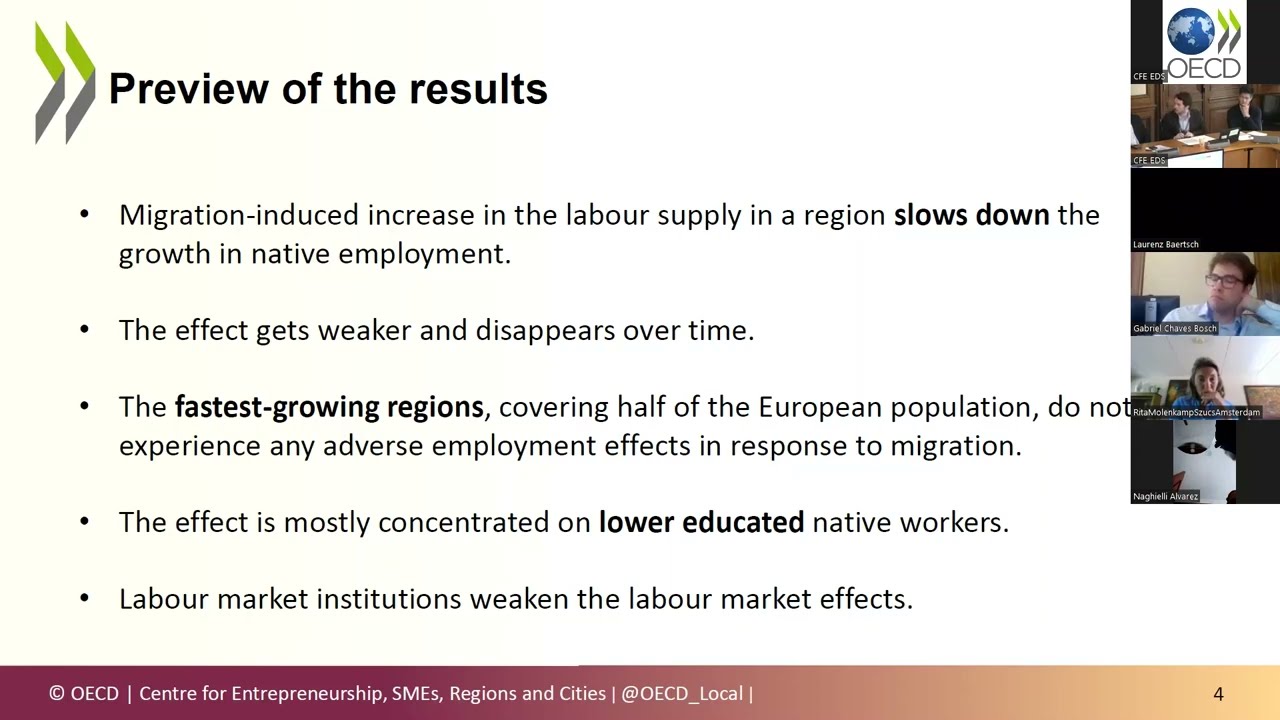
Labor markets quickly adapt to inflows of new workers.
One study looked at the effects of the Mariel Boatlift on the labor market in Miami.
In 1980, nearly 100,000 Cuban migrants arrived in South Florida, and around 60,000 of them settled in Miami.
Despite this massive influx of labor supply, the study found the Mariel immigration didn’t drive down wages of native workers, and didn’t cause widespread unemployment.
The immigrants were quickly absorbed into the workforce with negligible effects on other workers.
One of the interesting things about the immigration surplus is that it only accounts for benefits that accrue to citizens who already lived in the country before the immigrants arrived.
It doesn’t take into account the huge economic benefits the immigrants themselves enjoy.
Irish workers who came to the US in the 1870s could double their wages.
Guatemalans who immigrated to the US in the 1990s, were able to increase their incomes sixfold.
An economist named John Kennan has estimated that if immigration restrictions were eliminated worldwide the world’s labor supply would double, there’d be significant economic growth, and that workers from developing countries could see their wages jump from $8,900 to more than $19,000.
Thanks Thought Bubble.
Borjas’s Immigration Surplus findings do draw a distinction between high and low skill workers.
It notes that the arrival of larger numbers of high skill workers is associated with a larger immigration surplus.
And the model also indicates that if immigrant flows are too weighted toward unskilled workers, the immigrant surplus will be smaller, and the growth that comes along with immigration can be slowed.
But, the surplus, in most cases, still exists.
Encouraging the immigration of high-skill workers has other benefits as well.
Studies indicate that high-skill immigrants are innovators.
One such study found that foreign-born entreprenuers register about 25% of new patents in the US, and another found that a 1998 doubling of the quota for H1-B visas -- which enable employers to more easily hire high-skill foreign workers -- that led to an average 15% revenue increase for companies that participated.
Doesn’t take an Einstein to figure maybe you want to expand the H1-B Visa program.
One subtext to this high-skill versus low-skill conversation here in the United States -- and it gets to one of the most contentious parts of the immigration debate -- is how immigrants actually get or got into the country.
It centers on the differences between immigrants who arrive in the U.S. via official channels, and those that enter the country without going through the legal documentation process.
So, what do we do with 11 million undocumented immigrants who are already here?
Well, in 2014, the federal government deported 369,000 immigrants, 9 times as many as were expelled in 1994.
And from an economic standpoint, kicking people out might not make the most sense.
In fact, a wide range of studies find that extending legal status to undocumented immigrants would be a net positive.
Proponents say that newly documented workers would gain labor protections, and would be free to pursue work that better matches their skill-set.
As a result, on average, some economists estimate these workers wages could rise up to 15%.
And when workers get paid more, they tend to buy more stuff.
That increased demand, once again, leads to more production, which leads to more hiring.
And that’s not just pie in the sky liberal thinking.
The non-partisan Congressional Budget Office projected in 2007 that immigration reform would bring undocumented workers into the tax base, and that growth in revenue would offset costs by a ratio of two to one.
Many partisan organizations agree on this point as well.
The liberal think tank, Center for American Progress, estimated that giving undocumented workers legal status could create more than 200,000 additional jobs per year.
Grover Norquist, of Americans for Tax Reform, wrote that legalizing undocumented workers would, “free millions of those now working to move to where their work is most productive for themselves and the national economy.” And the conservative Heritage Foundation wrote in 2006 that, “Whether low-skilled or high-skilled, immigrants boost national output, enhance specialization, and provide a net economic benefit.” Let’s stop for a minute, and really appreciate the rareness of this situation, that the Center for American Progress and the Heritage Foundation AGREE on something.
Researchers have modeled the economic effects of different possible policy responses to undocumented immigrants in the U.S.
-- full deportation, full legalization and full legalization with added border control.
They found that full deportation would cut GDP by 0.61% and full legalization would, on the other hand, INCREASE GDP by 0.53%.
Legalization with more border enforcement winds up in the middle increasing GDP by 0.17% So, if the debate over immigration were solely about economics, there wouldn’t be much of a debate.
But, as we’ve learned, the world is a complex place.
Many immigration opponents argue that expanding immigration is a security risk.
They argue that relaxed border enforcement can lead to more illegal items like drugs being smuggled into the country.
There’s also a strong sentiment that people shouldn’t be rewarded with citizenship for breaking the law.
But let’s go back to the broader community of all immigrants.
Cliché as it might sound, the US really is a nation of immigrants.
The United States has the world’s largest total immigrant population -- at 41 million.
And sentiment in the U.S. about immigrants is changing.
A 2015 study from the Pew Research Center found that about half of U.S. adults say immigrants strengthen the economy.
Compared to 40% who say they are a burden.
Back in 1994, that was reversed.
Nearly 2/3rds of the population then saw immigrants as a burden.
Only 30% said they strengthened the country.
Pew also discovered that young people hold a more positive view of the contributions of immigrants to the country than older generations.
Which means it’s likely, pro-immigrant sentiments gonna keep on growing. Economically, and otherwise.
Thanks for watching. See you next week.
Thanks for watching Crash Course Economics, which is made with the help of all these nice people, some of whom are immigrants.
You can help keep Crash Course free for everyone, forever by supporting the show at Patreon.
Patreon is a voluntary subscription service where you can help make the show with your monthly contribution.
And you get rewards!
Thanks for watching. Don't forget: sometimes partisan think tanks agree!
Up Next

13:51
The Economic Impact of Immigration | Benjamin Powell
@catoinstitutevideo
3K views•2016-02-12

5:07
Impact of Yuan in Indo-Russian Trade Amid Sanctions
@WION
261.9K views•2022-07-01

7:31
Deficits & Debts Explained: Economics of Government Spending
@crashcourse
1.5M views•2015-09-23

113:18
The Age of Easy Money: Fed & Inflation | Full Documentary
@frontline
21.2M views•2023-03-15
Related Study Plans & Knowledge Roadmaps
Structured learning paths in Economics
economics
Sovereign Debt: Defaults, IMF & Restructuring
01Introduction to Sovereign Debt & Government Bonds
02Debt Sustainability & Credit Ratings
03Anatomy and History of Debt Crises
+ 2 more learning modules
12h5 modules
Explore Roadmap
economics
Market Design: Matching Theory & Gale-Shapley
01Introduction to Market Design and Price-Free Markets
02Two-Sided Matching & The Gale-Shapley Algorithm
03School Choice Systems and Mechanism Design
+ 2 more learning modules
10h5 modules
Explore Roadmap
economics
Impossible Trinity: Forex, Capital & Policy
01Introduction to Monetary Policy and Central Banking
02Exchange Rates and International Capital Flows
03The Mundell-Fleming Model
+ 2 more learning modules
8h5 modules
Explore Roadmap
economics
Healthcare Economics: Market Failures & Systems
01Introduction to Healthcare Markets and Market Failure
02Asymmetric Information and Adverse Selection
03Moral Hazard and Insurance Design
+ 2 more learning modules
12h5 modules
Explore Roadmap