
































Immigration has minimal negative effects on native-born workers' wages and employment; while it increases labor supply, it simultaneously creates demand for goods and services and allows workers to specialize in their comparative advantages, resulting in overall economic gains estimated at 50-150% of world GDP if borders were fully opened, with the primary scholarly debate focusing on how immigrants impact institutions rather than economic outcomes.
The Economic Impact of Immigration | Benjamin Powell
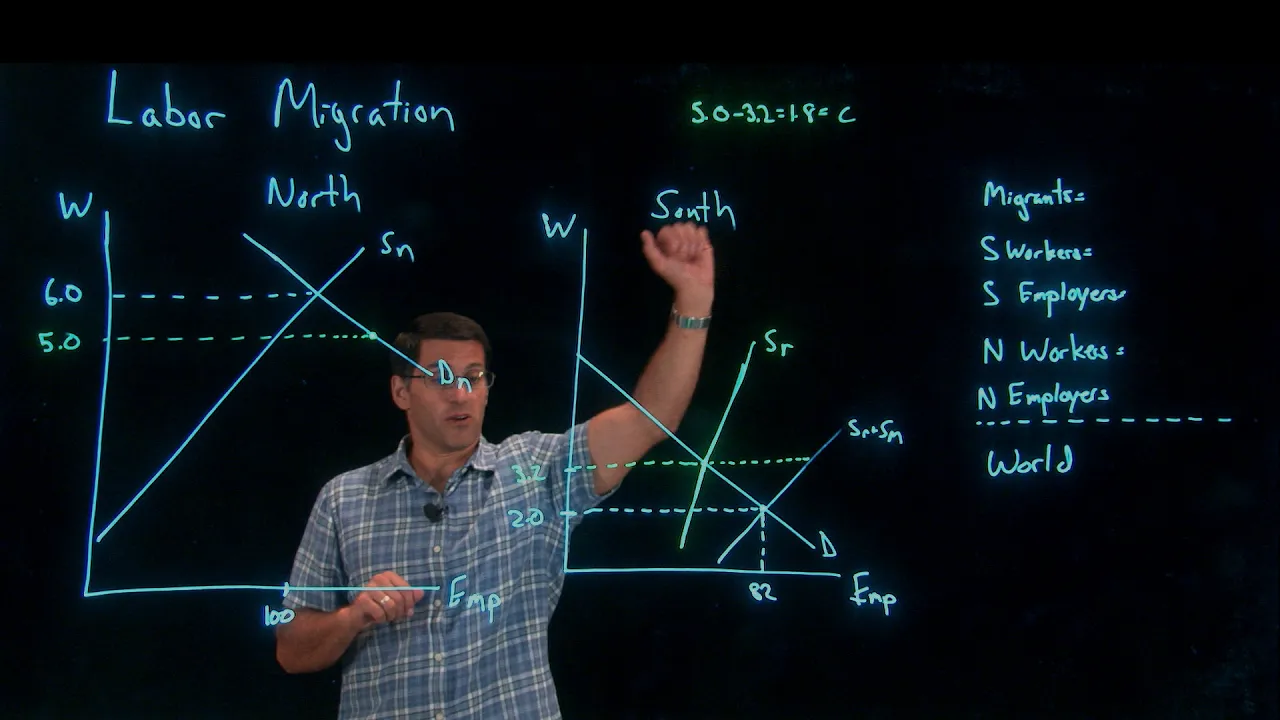
Added:The basic model of labor supply and demand, including how shifts in supply affect equilibrium wages and employment levels.
The distinction between labor substitutes (workers who compete for the same jobs) and labor complements (workers whose skills enhance each other's productivity).
Fundamental principles of public finance, specifically how tax revenues are generated and how government expenditures are distributed at local, state, and federal levels.
The 'lump of labor' fallacy—the economic misconception that there is a fixed, finite amount of work or jobs available in an economy.
Comparative analysis of international immigration policies, such as points-based merit systems versus family-reunification models.
The economic consequences of 'brain drain' on the sending nations and its long-term effects on global development and inequality.
The relationship between immigration, demographic aging, and the sustainability of national social safety nets and pension systems.
Advanced econometric methodologies used to study immigration, such as natural experiments (e.g., the Mariel boatlift) and spatial correlation models.
3K views64likes13:51Original Release: 2016-02-12
for about a decade now I've been giving talks in immigration around the country and what's striking to me is that the debate among social scientists about the impacts of immigration is just vastly different than what it is throughout Capitol Hill or public radio across the country the the degree of difference among the scholars is like this compared to the degree of difference in the population like this and the idea was not to show that all economists or social scientists agree about optimal immigration policy it's to show what are the finer points they debate and then in the second half how would they differ in policy in light of that then maybe it it's just vastly different than what we see in other parts of society so what I'll do with my remarks today I think is go through it first some of the economic impacts where the debates among scholars are just vastly different than the general populace and then I'll end with we're the big question for scholars I think is on terms of the impacts and then Alex will fill in more about the the fiscal impact which is an excellent chapter that he wrote for the book so first as was pointed out in the in the introduction the gains that economists predict from moving to a world of open borders are just jaw-dropping the staggering so we're talking 50 to 150 percent of world GDP doubling of GDP level and it's staying doubled and continuing to grow from that level every year this is just massive if The Economist's are off by a lot it's still massive when we think about other problems associated with immigration that people worry about be a crime the educational system whatever which of these problems can't be at least partially addressed resolved with double world GDP that's just like a massive corrective to whatever objection it is to most to almost all of the objections and I'll come back to the one that I think might be an exception to this later whatever up other objections you might have so that alone I don't think the population in general appreciates how big these gains could be and it's because what Julian's was Simon of course referred to as the ultimate resource human ingenuity a lot of it's trapped in places with lousy institutions not much respect for economic freedom and bad rule of law bad property rights so it's not made use of effective if you take them out of the poor environment all the sudden their human capital becomes more valuable so what we call the place premium and immigration economics take a Haitian out of Haiti drop him in the United States overnight average earnings go up a thousand percent ditto for Nigeria for a Mexican it's about a hundred and fifty percent this is just putting that human capital that's really going to you know not being made very good use of in poorer parts of the world and all of a sudden mobilizing it that's where these big gains come from and I think this is just vastly underappreciated by most Americans now when it comes to their objections usually I mean you've got kind of the the Lou Dobbs trio of they're gonna impoverish our economy they're gonna steal our jobs that's also the South Park one and they're gonna depress our wages so first for the US economy the economists who are critical of immigration agree that existing immigration both illegal and legal combined are a net benefit to native-born Americans so not just to the economy that includes the gains to those immigrants which are big but to the native-born as well it but it's small modest as a percent of GDP take George bohr house was probably the most prominent economist critical of Greater immigration and use his standard method for estimating and updated for current levels of immigration it's around forty billion dollars per year to the US economy u.s. economy that immigrants are add to it so as a you know fifteen trillion dollar or so economy forty billions kind of small but note this is the debate among economists the guy who's critical says the net economic gains are positive but then we'll say but they're relatively modest so if we just got rid of it because I care about other things well we wouldn't lose that much this is much different than Lou Dobbs telling everybody they're gonna make us a third world country no this isn't the debate amongst responsible social scientists so what about jobs they steal our jobs this is the most popular and probably it's a classic case I think of what Basquiat called the seen and the unseen when an immigrant comes in and displaces as a native-born worker there's a you can stick a camera on the native-born worker this guy can say I used to do landscaping now look it's all people from another country who are doing landscaping here you can see the guy who is displaced but immigration both creates and destroys jobs so it took that person's job but immigrants also demand goods and services which creates needs for other jobs and it frees American labor to do what it's compared of advantage note I just used the economic catchphrase comparative advantage and it's because the case for free trade and labor isn't fundamentally different than the ones for trade and goods and services it's still based on comparative advantage and freeing the labor up to do what it is best suited to do given the relative scarcity of other types of labor the main difference with immigrants is unlike goods and services they can commit other acts while they're here whether it be crime terrorism or voting those are the differences yeah lump those together those are the differences compared to goods and services but the core economics are basically the same to it so think if they did steal our jobs on net it's not something particular about an immigrant that's making the job stall and it would just be increasing the labor force and it's like a notion of a fixed pie of jobs well what's happened to the civilian labor force since the 1950s massive entry of baby boomers women and post 1965 immigrants into the workforce we've seen close to a tripling of the number of workers in the economy since 1950 we should be seeing massive long-term structural unemployment if there's some fixed pool of jobs of course we don't see this what we see if you if I brought a PowerPoint in your track these things you can look at total civilian employment and size of the labor force a little gap between them of unemployment as always and during recessions it gets bigger but the two of them basically triple in size over this time period there's just no net effect on jobs overall short-term displacements longer-term reemployment all right so what about wages the overall finding for wages across skill levels and occupations not very much basically nothing that doesn't impact our the wage rate of existing Americans now I have I once published this in an op-ed and as Alex knows well when you publish op eds on immigration you get a lot of hate mail and this one generated some hate mail and I usually just delete it when it's curses but I erupted she responding side had some cocktails and then it became a dialogue back and forth with the person where he became more reasonable and what it boiled down to is he said I didn't understand supply and demand which is a curious thing to accuse an economist of he's like you can't claim that they don't steal jobs or they don't push down our wages look it increases the supply of labor therefore it must push down wages and much displaced jobs total jobs increase but native held jobs with decrease under that framework had actually after the whole exchange he said he wanted to publish it on his immigration website and I had to look back at that first email I sent and I said okay go ahead but just no excerpting published the whole thing to my knowledge it's the only time I've been featured on a neo-nazi website but because because he was attacking me I kind of liked it and he ended up making the title of the article economics profession denies the laws of supply and demand I was gonna just be economist denies the laws of supply demand but he actually started looking up the references that I was sending him which was to this mainstream social science research and economics that says there's not much of an impact here and the reason why I think about it it's not simply a shift out in the supply of Labor one if immigrants also create demands for goods and services when they come here it's gonna shift out the demand for labor to now there's not a theoretical certainty of what happens it depends on the magnitude of each of these shifts wages could stay the same could go up could go down too it's not simply the supply of labor labor is heterogeneous if we think about the skill composition of immigrants who come disproportionately many of them are very high skill if you walk around any university in the United States you see a lot more foreign-born people there than you do in the general population and disproportionately low skill thinner in the middle when you think about the educational profile of the United States overall you think of it very can use PhD for high skill I'm not sure we can but very small percentage who would have PhDs lots who have college education or high school very few without high school diploma well once they're complements rather than substitutes for American labor it's free American labor up to do the task that it's better suited to which would actually enhance your wage is not pushing down furthermore as Adam Smith pointed out specialization and division of labor are limited by the extent of the market bring more people into an area you can have a more fine specialization of Labor which can lead to higher output in thus higher wages as well all of these things offset the basic notion of you're just shifting out supply of labor here so where does the where is the economics debate on the wages it's about the low-skilled workers in the United States economists who study immigration debate how does it impact high school dropouts in the United States from immigration here and the debate ranges from it might be slightly positive for them to it might be at worse negative 8% this is the vigorous debate not Lou Dobbs they're gonna drive down our wages and make us poor no it's high school dropouts maybe slightly positive maybe negative 8% and then how long does it last and most of them find it's not permanent to temporaries which goes with our notion of being reallocated to a better use at first you have a depression in your wages but then you retool your school skill set and go do something you're better suited to do we just go back up that's where the margin of debate is these things don't amount to what we hear in politics and the pop press about what immigration are doing and I think if people had a better appreciation for the general social science on this they could actually concentrate on where there are bigger differences of opinion where my immigration might have bigger effects and the main one of those I think the main area of social science that still I don't say wide open pretty close to wide open is how do immigrants impact our institutions so it's not a narrowly economic impact but if immigrants come here and I said at the beginning the main cause of their poverty is a bad institutional environment at home that doesn't let them make use of their human capital if you bring a few of them here in their human capital then it interacts with our institutions whom productivity goes up world GDP doubles but if you bring tons of them here maybe that's too much they undermine our institutions and then if we don't have as good of institutions not only do they not create as much value and they come we ourselves stopped creating as much value as what we could create before this I think is the most reasonable objection to immigration and note it would only be an objection to mass immigration not simply the immigration that we have now or for that matter significantly increasing the amount of immigration we have now according to that same Clements article survey that was mentioned at the beginning just a migration of 5% of the world's poor to the richer countries would increase global GDP more than eliminating all remaining tariffs to goods and services crossing borders and all capital account restrictions so even a smaller one that's not going to necessarily at all challenge institutions could be create massive gains so now where's the real policy debate is can we go more than that and I think reasonable social scientists here could disagree based on what they think about the institutional impact Jorge Bohr housed the prominent economist is critical of Greater immigration I mentioned before he recently published a paper in the journal of economic literature where he modeled six different scenarios I think of how much of their negative social capital immigrants import into the host country's institution and what that does to the projected global gains and in some scenarios actually makes those global gains become not just smaller not doubling of world GDP but negative now he didn't offer any evidence that this is in fact true he made it up actually it's called making assumptions he made six different assumptions did the math and then said what the projections would be but that doesn't mean they actually have this impact but I think it's a reasonable area to study and Alex and I and a few co-authors took that as a jumping-off point cuz it's a common I think it's a common objection among libertarian leading and conservative people but also among some scholars were critical collier would be another example like this who want to claim that they're going to destroy the societies institutions so Alex co-authors and I what we did is we actually said well and Bohr Carson is article by the way says what do we know about this we know little about this parenthesis read nothing and then he just makes up six scenarios that all go in the same direction it's a little bit questionable so Alex and I said well no nothing like it's the first thing to do is start and figure out what the slope of the line is from existing immigration so we looked at I think it's roughly 110 countries around the world and that we could get data for on migration and on your economic freedom as a proxy of how good their institutions are and we looked at stocks of immigrants accumulated by 1990 and also flows over the 20 years subsequent period and said to either stocks or flows of immigrants impact institutions we actually found you get a slightly positive effect more immigrants built up it leads to a little bit greater economic freedom if that's the case for house every one of those simulations in the wrong direction and the estimates that Clements cites underestimate because it doesn't account for the improvement in institutions you get from the immigrants now of course I sent this paper to Tabora house and he wrote me a polite email back and said that that was nice but it has all the benefits and drawbacks of a cross country study and he doesn't know what existing immigration tells us about a world with open borders fair enough but if you start with knowing nothing getting this first slope with a line might tell you something about what assumptions you might want to make afterwards but I think this is an area where there can be significant difference disagreements among scholars that would impact what the global gains could be and that reasonable scholars would disagree about this more study is certainly warranted on it but that is just so radically different than where the policy studies and discussion around what we should do about immigration here in the United States is there's no way that we in endanger our institutions by legalizing people who are currently legally here and increasing legal immigrant flows to levels like we had at the turn of the last century here through legal channels but I think more scholarships necessary on these bigger institutional questions but hopefully this book and events like this will do a little bit more to spread rationality about what basic economic impacts are
Up Next

56:01
The Economics of Refugee Migration: Labor Market Impacts
@economicsdepartmentoxfordu4373
955 views•2024-05-21

5:07
Impact of Yuan in Indo-Russian Trade Amid Sanctions
@WION
261.9K views•2022-07-01

9:43
Zoning Rules! The Economics of Land Use Regulation (William Fischel)
@catoinstitutevideo
13.3K views•2015-11-10

113:18
The Age of Easy Money: Fed & Inflation | Full Documentary
@frontline
21.2M views•2023-03-15
Related Study Plans & Knowledge Roadmaps
Structured learning paths in Economics
economics
Sovereign Debt: Defaults, IMF & Restructuring
01Introduction to Sovereign Debt & Government Bonds
02Debt Sustainability & Credit Ratings
03Anatomy and History of Debt Crises
+ 2 more learning modules
12h5 modules
Explore Roadmap
economics
Market Design: Matching Theory & Gale-Shapley
01Introduction to Market Design and Price-Free Markets
02Two-Sided Matching & The Gale-Shapley Algorithm
03School Choice Systems and Mechanism Design
+ 2 more learning modules
10h5 modules
Explore Roadmap
economics
Impossible Trinity: Forex, Capital & Policy
01Introduction to Monetary Policy and Central Banking
02Exchange Rates and International Capital Flows
03The Mundell-Fleming Model
+ 2 more learning modules
8h5 modules
Explore Roadmap
economics
Healthcare Economics: Market Failures & Systems
01Introduction to Healthcare Markets and Market Failure
02Asymmetric Information and Adverse Selection
03Moral Hazard and Insurance Design
+ 2 more learning modules
12h5 modules
Explore Roadmap