













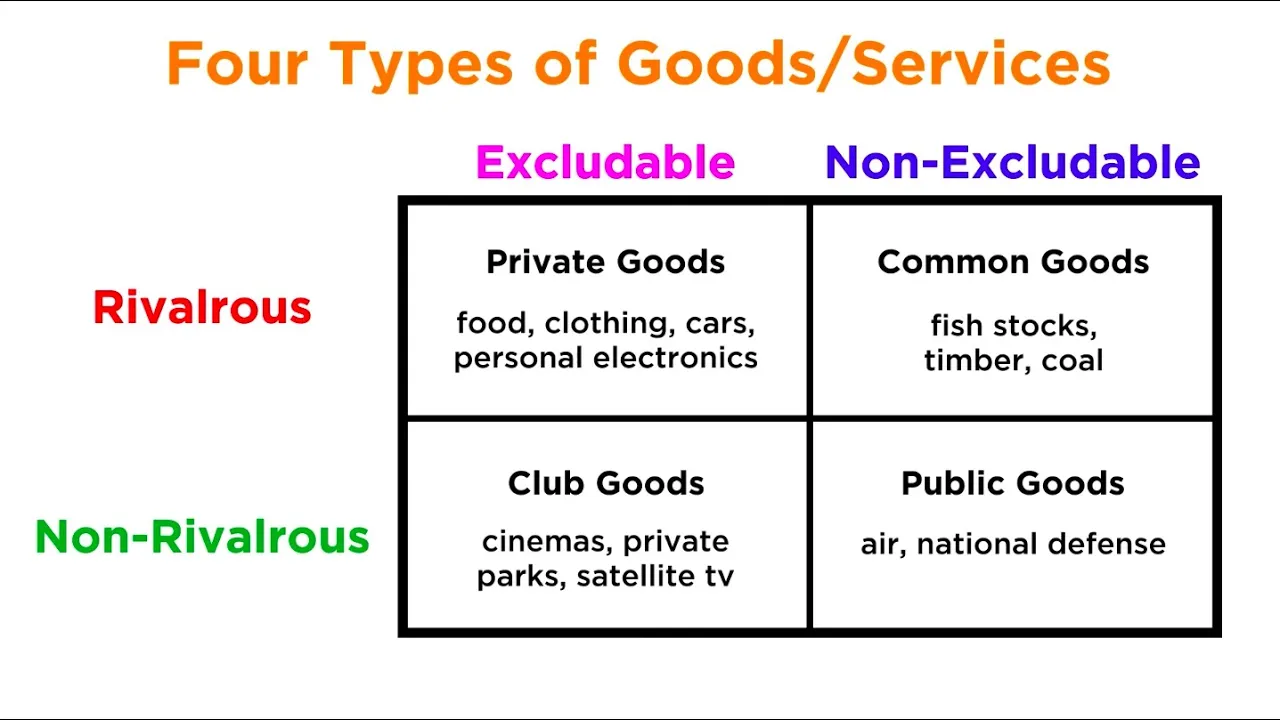

The Tiebout model proposes that local governments can efficiently provide public goods through competitive markets where individuals 'vote with their feet' by choosing jurisdictions that match their preferences and ability to pay, thereby solving the free rider problem through residential mobility; however, this solution depends on assumptions like perfect mobility, full information, and no cross-community spillovers, and may not fully resolve preference revelation issues when property taxes create incentives for wealthier residents to free ride on others' contributions.
Tiebout Model & Club Theory: Local Public Goods | Public Finance
Added:Definition of public goods, including the properties of non-rivalry and non-excludability.
The free-rider problem and why decentralized markets fail to efficiently allocate pure public goods.
Basic microeconomic principles of utility maximization and consumer preference revelation.
The concept of market failure and the traditional role of government intervention in public finance.
Empirical testing of the Tiebout hypothesis and the capitalization of local public goods and taxes into property values.
Critiques and limitations of the Tiebout model, such as moving costs, information asymmetry, and income sorting or exclusionary zoning.
Oates' Decentralization Theorem and the broader study of fiscal federalism and intergovernmental grants.
The economics of club goods in practice, including gated communities, toll roads, and private membership associations.
12.6K views111likes21:53Original Release: 2016-04-14
e we shall commence this module by discussing about public economics some of the phenomenal work in the field of public economics has been done by Musgrave and Samson according to these two writers there is no way in the which a market outcome can provide for the provision of public good if at all there is private provision to the public goods then we can only expect a suboptimal allocation of resources under such scheme thus the writers pressed hard for the optimal allocation of the federal resources towards the provision of the public goods but their argument can be diluted when we talk about the expenditure at the local level thus tyout Theory deals in the difference in the nature of the federal expenses and the local public expenses the hardcore of the model lies in the fact that there is a non-political solution to the free rider problem in the local governance according to Samuelson public goods are defined as the collective consumption of goods such that the consumption is neither rival amongst the individuals nor it is excludable for some this not just implies that the action of consumption by one person does not reduce the opportunities for consumption by another person but that it also allows this consumption to be in another form for example consider a street light street light is a good that cannot be rival good amongst the people who consume it nor it can made excludable in the logic that one cannot debar any other individual to not consume the light from the street light hence streetl is a public good the core issue with the provision of public good is that a price mechanism cannot be built to assertain the proper price of the public good and hence the optimal allocation of resources cannot be done to solve this matter the requirement of a third social planner that is the government is needed the government can make a proper price of the public good and can tax according to cover up the cost of provision another issue with the character of the public good is that for market demand the public good is vertically added instead of horizontally as in the case of private good this means that in the case of public good the quantity is determined first and then the total cost of provision is calculated of that quantity then the cost is divided amongst the users to fund the cost in total according to their marginal benefits this very nature of public goods leads to another problem that is of Free Rider since the good is provided in collection the users keep thinking that some other might pay for it and hence they try to free ride on others and when majority of the users try to free right it will lead to suboptimal provision of the public good the only solution to this is if the users expose their true benefits out of the public goods if true preferences of all consumers users could somehow be forced to reveal for public goods then the amount of such Goods to be produced and the appropriate benefit tax could be determined as things are studied in theory there is no such system to force the consumers voter to State his correct preferences in fact the rational consumer will understate his preferences and look forward to benefit from the goods while avoiding tax tybouts explained that the local governments have a more accurate and comprehensive knowledge of the needs of the local people thus making them more readily available to precisely tax the people on the goods and services it provides to the local people he later on tried to explain how municipalities in the region can offer different Goods at different prices given the individuals have conflicting personal valuations on these services and wearing ability to pay the attendant taxes individuals will move from one local community to another which maximizes their personal utility the model states that during the choice method of individuals jurisdiction and residents will decide an equilibrium provision of local public goods in accord with the taste of the residents thereby sorting the population into Optimum communities the model has the advantage of solving two major problems with government provision of public goods preference Revolution and preference aggregation after studying this module you shall be able to learn about the Ty outs model learn about the symbol tybouts model and understand the theory of Club let us start our discussion on Ty out's model according to tyout the communities have two ways to acquire more person in their Community First by forming cartle and enforcing a singular tax rate among various communities and second is health tax competition amongst the communities to acquire the individuals to their communities this tax competition is what tyout stressed in his model as an integral part of allocation of local resources without any governmental provision as a formal definition of local public good it is one that instead of benefiting the total population of consumers it benefits only consumers in the local community the fundamental notion here is that individ uals must consume all Goods both public and private at the same location although in many public good theory bundling is rather implied the tybouts elucidated that if the public goods are local that is that the consumption of the public goods and locational Choice are bundled then a market type solution may exist at least approximately and hence no government intervention will be required the basic tybouts model takes many communities offering different levels of public good it takes into account a unique way to come down to the optimal tax rate in a community which is called as voted with their feet according to this the individuals will prefer their most preferred community and reveal their demand for public good and overcoming the greatest problem with the public good theory that is of the difficulty of revelution of true individual preferences the concept of foot voting can be utilized to maintain discipline in the communities the assumptions of the models are first consumers are perfectly mobile where their preference patterns which are set are best satisfied second full information knowledge of differences among revenue and expenditure patterns and to react to these differences third huge number of communities in which the consumer voters may choose to live fourth all income from dividend that is given exogenous fifth no spillover among communities that is the Public Services subli exhibit no external economies or dis economies between communities sixth average cost of providing public good as a function of population is u-shaped that is there exists a cost minimizing population size seventh communities with population size below or above the cost minimizing size seek to expand or contract an allocation in thot's Model includes two standards a consumption bundle for each consumer and a production plan for each firm the case of the city that is too big and tries to get rid of residents is more complicated to imagine nevertheless economic forces are at work to push people out of it by making their cost of living go up every resident who moves to the suburbs to find better schools more parks and so so forth is reacting in part against the pattern the city has to offer the case of the community which is at the optimum size and tries to remain so is not hard to visualize again proper zoning laws implicit agreements among Realtors and the like are sufficient to keep the population stable for the community is small and easy to manage compared with the city tybouts asserted that under these assumptions efficient provision of public good would obtain that is communities would be of the optimal size and cost minimizing size and citizen voters would live in communities where the public good tax bundles were optimal for them according to Musgrave and Samson the expenditures are made by the central government the services such as police education fire protection Etc are mainly provided by the local government hence it is important to look into the activities of the local local government the expenditures made by the local government are generally more than that of the central governments toward such activities the elements affecting the choice of municipality by a person relies on the availability of schools availability of recreational activities such as Golf Course Parks police protection roads parking facilities Etc will all enter into the decision making process some non-economic variable will also be considered but we are deliberately not putting much stress on such factors the basic framework of the model is based on the general equilibrium model framework so according to tyout model there is an allocation plan and a production plan respectively for the consumers and for the Farms along with it a public good bundle for the regional government and one region for each consumer a tybouts equilibrium is composed of an allocation a price for each commodity and a tax system for each region such that the following conditions are fulfilled first consumers select their consumption bundles optimally second consumers select their regions of residence or consumption optimally that is no houses wishes to move treating as given public good levels and taxes across regions third firms maximize profits fourth markets clear fifth each Regional government balances its budget sixth each Regional government's public good and tax plan maximizes its objective the question about the efficiency of the tybouts model is still debatable the new efficiency margin that emerg in the tybouts model relative to the standard arod de type models of the private Goods economies are first whether the number of regions or communities is correct second whether the allocation of individual among communities is correct third whether the level of provision of public goods within each Community is correct the the general message from most of the tybouts literature is that efficiency is not likely to obtain in tybouts equilibrium except under very restrictive assumptions some of the characteristics of the models that are critical to the equilibrium properties consist of first the objectives of local governments second the tax instruments assumed to be feasible third the pattern of factor ownership fourth the nature of local government competition next we shall discuss about simple tyout model an economy is composed of identical individuals each of whom is endowed with a unit of Labor that is in elastically supplied independent of residents labor is used to produce output good why a unit of Y can be transformed into one unit of private good X or one unit of pure public good G the Assumption about the Y technology are fo o is equals to Z where f- is greater than Zer and F Double Dash is less than zero preference for each public good G and the private good X for each individual I is given by u g comma x i if there are n people in the community then the total resources is nxi + G is equal to FN if the resources are equally divided among all people in the community then the allocation is given by x i + G by n is equals to a function of n n ided n now consider the optimal Community size question there is a tradeoff involved in increasing n in this model the per capita quantity of the productive good Y is decreasing in N while the per capita resource cost of providing a unit of the non- congestible local public good is also decreasing in N Paro efficient allocation is given by following optimization the planner problem is given by the following optimization maximize u g comma x i subject to nxi + gal to FN then the first order conditions are uux - Lambda n is equal to 0 U minus Lambda is equal 0 Lambda into f- nxi is equal to 0 then the first two equation implies that n into U by ux is equal to 1 which is a Samson condition from the Third equation f-n is equals to XI that is individual added until marginal product equals their allocation thus combining the resource constraint and the three conditions gives the following result G is equal to FN minus n into f-n if worker or consumers are rewarded the marginal product of labor then at the optimal population the return to fixed factors for example land precisely covers up the cost of the local public good two related points need to be mentioned here in order to show the allocative results of this model first changes in the cost of one of the Public Services will cause changes in the quantity produced and second the cost of moving from Community to community should be recognized both points can be Illustrated in one example suppose lifeguards all over the country organize and accomplish upgrading their wages total taxes in communities with beaches will go up now residents who are mostly indifferent to beaches will be forced to make a decision is the saving of this added tax worth the cost of moving to a community with little or no beach obviously this decision depends on many factors among which the availability of and proximity to a suitable substitute Community is important if enough people leave communities with beaches and move to the communities without beaches then the total amount of die Card Services used will fall these models then unlike their private Market counterpart have Mobility as a cost of registering demand the higher this cost setris peribus the less optimal the allocation of resources next we shall discuss about the theory of club club goods are that type of goods in economics that are excludable but non rious at least till they reach a point where in congestion occurs these goods are often provided Ed by a natural monopoly Club Goods have artificial scarcity Club theory is the area of Economics that studies these Goods we distinguish among private Goods Club goods and local public goods as per the optimal size of the sharing group relatively to the size of the community a private good is one in which the optimal sharing group is the smallest possible a club good is one of which the optimal size of its sharing group is finite but still small relative to the community size the optimal sharing group of a local public good is the community itself the classification is revealed to the endogeneously determined rather than being inbuilt in the facility itself Club Theory occupies a very important place in recent economic literature the basic theorems of Club Theory using a different somewhat more rigorous approach than that used in the literature is proved here the proof of the optimality of Market provisions of Club good is variant of the model of the market provisions of goods with variable quality the distinction made between club and the local public goods applies to the analysis of transportation for example neighborhood roads can be dealt with within the context of the club model thus it follows from that in the optimal allocation the toll can be expected to cover up the cost of infrastructure let us now summarize what we have learned in this module the contention of of the model described here is that for a substantial portion of all Collective or public goods this problem does have a conceptual solution if consumer voters are fully mobile the appropriate local governments whose revenue and expenditure patterns are ready made are adopted by the consumer voters while the solution may not be perfect because of the institutional inflexibilities this does not invalidate its importance the solution like a general equilibrium solution for a private economy is the best that can be obtained given the preferences and resource endowments since Ty out's allocation mechanism depends on residential location decisions it seems clear that a full-blown model of local fiscal Behavior must somehow integrate local housing markets such a model must address the housing market and the provision of local public services in particular it must explain how the housing market allocates households among jurisdictions where local services and tax rates vary the basic approach with stepen rosan John yinger 1999 called the consensus bit function where he showed how bidding leads to Optimal allocation in this framework mobile utility maximizing households divided into distinct income or preference classes bid for places in the different jurisdictions which offer a variety of local service tax packages the bid functions of the different groups generate and aggregate bid function and the places in the various communities are filled by the households with the highest bids the approach has some interesting implications it implies first that the level of local services and the Associated Tax liabilities are capitalized into housing prices and second that the Sorting outcome are not in general characterized by the perfect homogeneity jurisdictions can contain in range of different income classes they tend to be more homogeneous than a pattern of random sorting but they can Encompass a substantial degree of heterogeneity in household income early attempts to introduce housing into the tybouts model revealed a basic problem they showed that in a model with housing and local property taxation which is the primary form of the local Finance at least in the United States tyout sorting does not fully resolve the preference revolu and free rider problem in a world in which local government Finance their budgets with property taxes there exist a basic incentive for free rider Behavior a household in such a world can purchase a house with a value substantially below those of the other residents in the community and thereby consume the public good at a tax price below that of other households in the community such a household can effectively get a partial or free ride on the higher tax payment of other residents of the community according to Ty out's model policies that encourage residential mobility and augment the understanding of the consumer voter will improve the allotment of government expenditures in the same logic that Mobility between jobs and knowledge significant to the location of industry and labor improved allotment of private resources finally we may Elevate the normative question whether local government should to the extent possible have a fixed Revenue expenditure prototype
Up Next

69:15
Tim Harford: Fifty Inventions That Shaped the Modern Economy (EconTalk) | Tim Harford on Economic Lessons from Key Inventions - EconTalk Podcast
@econtalkwithruss
676 views•2020-04-13

67:20
Globalisation and the 21st Century Enlightenment | Joseph Stiglitz
@EdinburghUniversity
44.8K views•2009-02-10

19:48
Mundell-Fleming Model | Fixed Exchange Rate Analyses
@Vidyamitra
3.3K views•2016-03-16

113:18
The Age of Easy Money: Fed & Inflation | Full Documentary
@frontline
21.2M views•2023-03-15
Related Study Plans & Knowledge Roadmaps
Structured learning paths in Economics
economics
Intellectual Property: Innovation vs Monopoly
01Foundations of Market Power: Monopolies & Deadweight Loss
02The Economic Trade-Off of Intellectual Property
03Patents: R&D Incentives vs. Market Monopolization
+ 3 more learning modules
12h6 modules
Explore Roadmap
economics
Sovereign Debt: Defaults, IMF & Restructuring
01Introduction to Sovereign Debt & Government Bonds
02Debt Sustainability & Credit Ratings
03Anatomy and History of Debt Crises
+ 2 more learning modules
12h5 modules
Explore Roadmap
economics
Market Design: Matching Theory & Gale-Shapley
01Introduction to Market Design and Price-Free Markets
02Two-Sided Matching & The Gale-Shapley Algorithm
03School Choice Systems and Mechanism Design
+ 2 more learning modules
10h5 modules
Explore Roadmap
economics
Impossible Trinity: Forex, Capital & Policy
01Introduction to Monetary Policy and Central Banking
02Exchange Rates and International Capital Flows
03The Mundell-Fleming Model
+ 2 more learning modules
8h5 modules
Explore Roadmap