







![[295회] 에너지 안보 1부 흔들리는 석유 패권ㅣ뉴스멘터리 전쟁과 사람 / 밀덕스](https://i.ytimg.com/vi/osxV0diSb7E/maxresdefault.jpg)













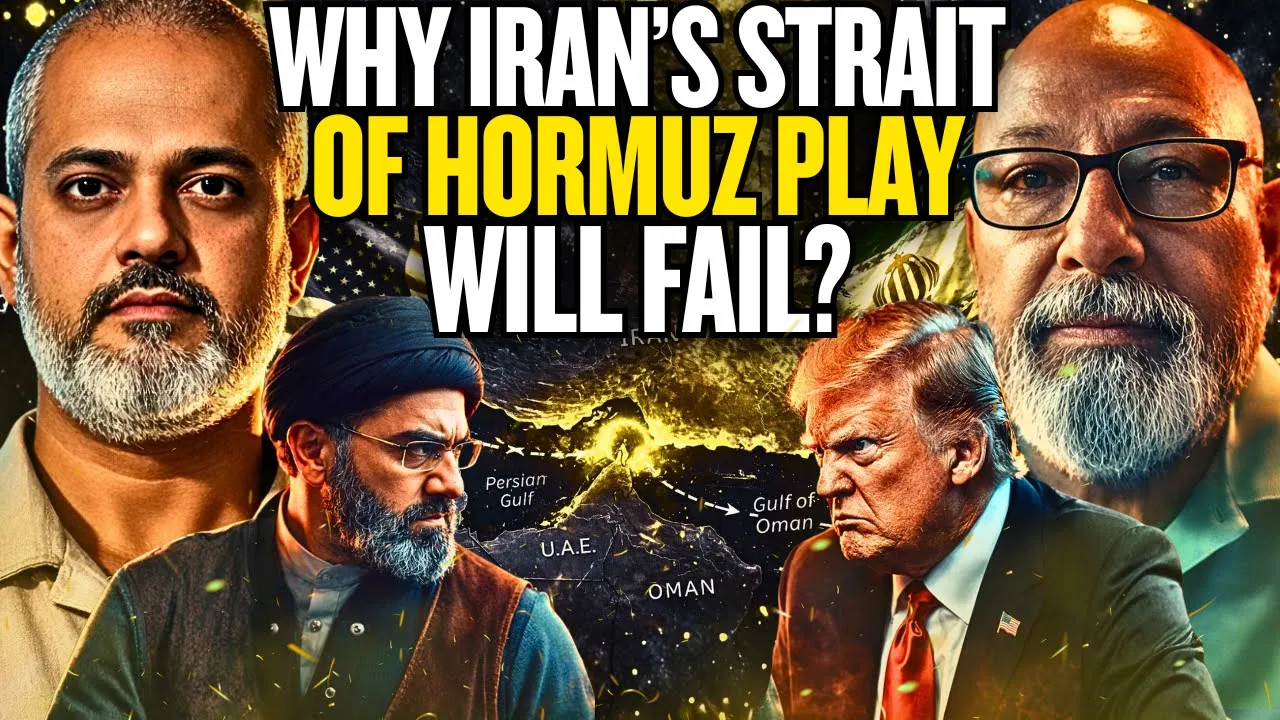




The Strait of Hormuz represents the world's most critical oil chokepoint, with approximately $2 billion daily in crude oil and one-fifth of global liquefied natural gas trade passing through this narrow passage connecting the Persian Gulf to the Gulf of Oman. Despite its immense strategic importance, the Strait has remained open for decades due to the high costs of potential closure—both economically and politically—for all parties involved. This demonstrates how the very destructive potential of a chokepoint can paradoxically serve as a deterrent, creating a form of mutually assured destruction at the strategic level that prevents actual conflict despite underlying tensions between regional powers like Iran, Saudi Arabia, and Israel.
Strait of Hormuz: Iran's Strategic Military Threat Analysis
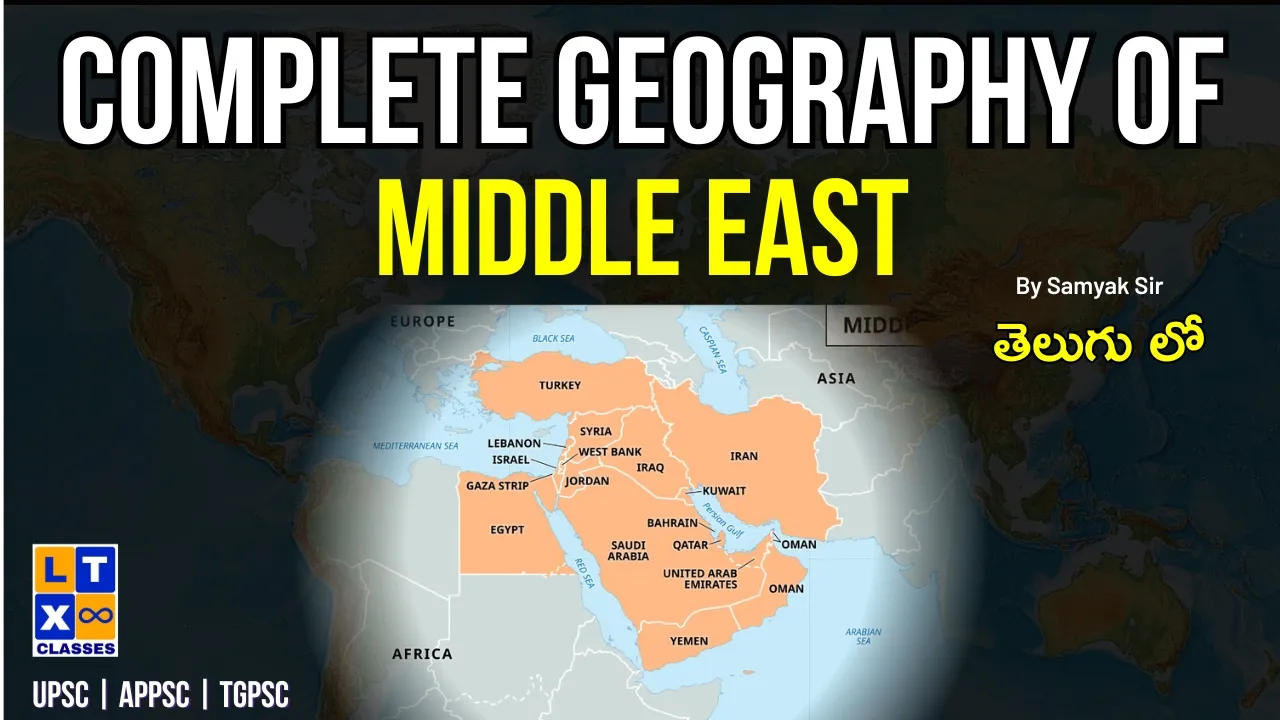
Added:Fundamental geography of the Middle East, specifically the location of the Persian Gulf, the Gulf of Oman, and the surrounding nation-states.
The concept of maritime 'chokepoints' and their historical significance in global trade and naval strategy.
Basic understanding of the global energy market, including how crude oil is transported, the role of OPEC, and the concept of energy security.
An overview of post-1979 Iranian history, including its geopolitical stance, its relationship with Western powers, and its regional influence.
Asymmetric warfare tactics in maritime environments, including Iran's use of fast attack craft, naval mines, and anti-ship missiles.
The economic and financial market impacts of supply chain disruptions, specifically looking at oil price spikes and insurance rates for shipping.
Alternative energy transport infrastructure, such as overland pipelines in Saudi Arabia and the UAE designed to bypass the strait.
International maritime law, specifically the United Nations Convention on the Law of the Sea (UNCLOS) regarding 'transit passage' through international straits.
The role of multinational naval coalitions (e.g., Combined Maritime Forces) in maintaining freedom of navigation in contested waters.
1.1M views20.8Klikes1:32:38Original Release: 2024-10-26
Hello there, and welcome to the world’s most dangerous chokepoint. Regardless of whether that is true in an objective sense, it is definitely true in terms of oil— which truth be told is probably the thing that matters.
And that is not my opinion.
That is the belief of the U.S. Government’s Energy Information Administration.
You see, today, we are vacationing in the Strait of Hormuz, very inconveniently situated between the United Arab Emirates and Oman to the south, and Iran to the north.
Well, actually the true borders are this, but we will get there.
Oh, and Israel is somewhere over here, which probably does not help matters. But again, let’s wait on that.
Anyway, like it or not, we can thank the Ayatollah for every moment that peace prevails along the Strait.
Because at a moment’s notice, Iran has the ability to shut it down and light the world on fire to the tune of about $2 billion per day in just crude oil, never mind that a fifth of global liquified natural gas trade also runs through there.
And despite its geopolitical importance, your average Joe on the street has never heard of the Strait of Hormuz, never mind how the global economy runs through it, or why the United States still cares so much about it even after becoming a net exporter of oil, or how Iran could go about grinding the world down to a halt if it wanted to.
And those that are familiar with the area often overestimate the likelihood of a war over it and misunderstand why a war might start in the first place, while simultaneously believing that the Hormuz hullabaloo is overblown, that reversing a shutdown would be rather easy, and that the inevitably futility of the enterprise will deter Iran from trying to block it in the first place.
But today, we will see how the threat to the world is much, much more complicated.
This is the Hardest Truth about the World’s Softest Spot.
Chapter 1: Dangerous Geography Let’s quickly situate ourselves to get a better appreciation of why this is such a global weak spot.
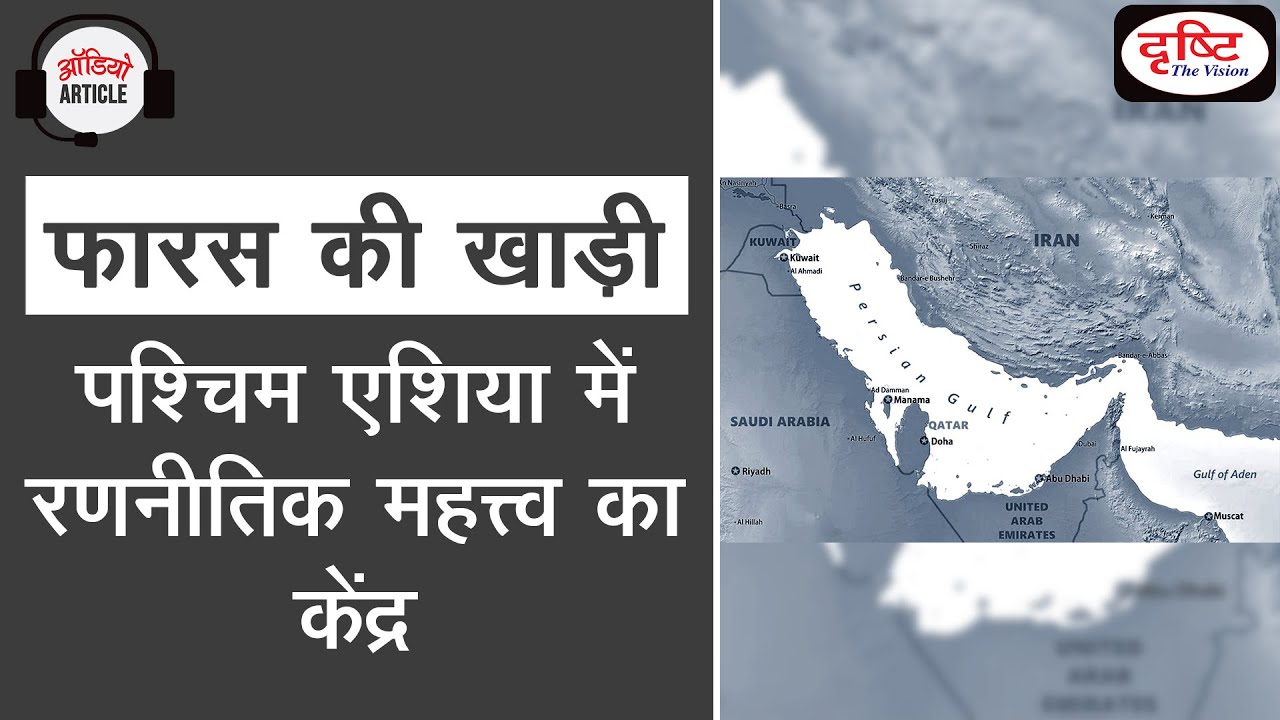
The Strait itself connects the Persian Gulf to the Gulf of Oman, before ultimately reaching Indian Ocean.
It also has a sister strait over here, which you may be familiar with due to an actual crisis but we will talk about that one later.
Back to Hormuz, if you know anything about the last fifty years or so of regional geopolitics here, then you will immediately realize that things are about to get spicy.
But, oh man, does the situation get weird as soon as we approach the target location.
If I asked you to point to Oman on a map, I bet that you would pick right here— because that is a normal, sensible thing to do.
However, sometimes the lines on maps are far from normal or sensible.
Let’s hide the real lines to build suspense, zoom in, and twist because we need the widescreen.
You see, we have normal Oman over here, and for fun, Oman Jr also taking the peninsula into the Strait. The rest of it is the United Arab Emirates. Except for this, which is back to being Oman. Except for this, which is back to being the UAE!
And, yes, once upon a time, they actually did sit down to negotiate this.
And, yes, these lines on maps have persisted over time because the alternative would be costly war that neither Oman nor the UAE would prefer. Besides, the populations are tiny.
For now, say goodbye to both the layered enclaves and the lines. But do not despair. We will see them again later.
Also for now, remember that tip over here, where the Strait is the narrowest, is Oman— because Oman has beautiful architecture but really, really hates contiguous land masses.
Meanwhile, Hormuz’s entire northern side belongs to Iran.
But that cannot be all of the fun. No, no. It is not an adventure until everyone is invited to the party.
Hence we must zoom out to the entirety of the Persian Gulf and welcome back both lines and old friends, and then let Qatar, Bahrain, Saudi Arabia, Kuwait, and Iraq join the festivities.
Of course, when you tick through all of those countries, the first thing that probably comes to mind is oil. And, indeed, you would be right.
This is why the Strait of Hormuz is so important. Those countries are not going to consume all of that oil by themselves.
Now, the easiest way to transport oil away from the Gulf is through the Gulf itself.
Indeed, for Bahrain, Qatar, Kuwait, and Iraq, it is the only way to export oil without passing through international borders first.
In light of that, unsurprisingly all of Kuwait’s, Bahrain’s, and Qatar’s exported oil takes a stroll through Hormuz.
And almost all of Iraq’s does too, with a pipeline to Turkey being its saving grace.
Meanwhile, the UAE and Saudi Arabia have their own saving graces in the form alternative maritime access, with the Saudis able to take a detour to the far west, and the Emirates able to peek right across it. Although these pipelines are pathways to locations some consider to be unnatural, they serve an important purpose. And Hormuz indeed is the reason that both countries began those projects.
While chaos reigned during the Iran-Iraq War, Saudi Arabia began to wonder about the safety of the Persian Gulf corridor.
Thus, Saudi Arabia constructed a pipeline to take oil all the way to the Red Sea. They call it the “East-West Crude Oil Pipeline” because it flows east to west, it contains crude oil, and—get this—it is a pipeline.
Meanwhile, Abu Dhabi opened a separate pipeline in 2012 to have its oil bypass the chokepoint.
The UAE’s solution may be the only good one, because it does not create further disruptions to the supply chain.
By comparison, imagine that Saudi Arabia suddenly tried to pipe all of its oil westward, or the Hormuz-locked countries began seeking international pipe partners.
Yes, this works in theory, and pipelines in practice are not that pricey.
However, the whole solution ignores how an estimated 83% of Hormuz-transiting oil ultimately goes east toward China, Japan, South Korea, and India.
That makes starting the journey westward ultimately counterproductive.
Oh, and there is also another complication with the Bab el-Mandeb chokepoint, which is Hormuz’s sister strait to the southeast, but we will get back to the Bab later.
And aside from that, tanker space is already at a premium in an era of sanctions against Russia, which has forced Russian producers to put their oil on tankers and send it to Asia, instead of efficiently delivering it to European markets.
Anyway, back to Hormuz. With so much at stake there, it has unsurprisingly been the host of many high stakes crises.
For four years during the Iran-Iraq War, oil tankers frequently came under fire. Toward the end of this so-called “Tanker War,” a helicopter from the USS Vincennes was on a routine patrol when it came under fire by Iranian speedboats.
The Vincennes then rerouted to provide support, thinking that a larger engagement may have been brewing.
As that was happening, over at Bandar Abbas airport, Iran Air Flight 655 took off toward the gulf.
This caused a bit of a panic inside the Vincennes’ combat information center. You see, the airport served both civilian and military aircraft.
Just seven minutes later, Captain William C. Rogers III made a fatal mistake.
Under the false impression that an Iranian F-14 Tomcat was on its way— ironically part of an arms sale during the Shah era— he ordered two surface to air missiles be fired at the plane. 290 civilians died.
Though the Vincennes missile strike remains a low point for the area, more recent times have not been particularly harmonious either.
In 2007, Iran detained the HMS Cornwall’s 15 crew members for allegedly crossing into Iranian waters. They were released after a week and a half.
Later that year, the U.S.S. Whidbey Island fired warning shots at a small Iranian boat, which then retreated.
At the end of 2011, Iran threatened to close the Strait should any effort be made to restrict Iran’s own transit through the choke point— lest we forget that Iran also needs to use it. It does not help Tehran that more than half of the government’s revenues come from energy exports.
Iran further paired the threat with ten days of naval exercises to try to scare off a Western response.
As the saga spilled over into 2012, the United States sent three of its carriers, Headlined by the Abraham Lincoln, the John C. Stennis, and the Carl Vinson to serve as a warning to Tehran.
Fast forward to May 2019, when four oil tankers anchoring in the Gulf of Oman that were waiting to bunker at this UAE port were sabotaged by some type of underwater explosive.
One month later, the crew of two more vessels needed to be rescued after they hit what were likely mines in the Gulf of Oman.
This is surveillance footage shows Iran allegedly removing an exploded mine.
Here we have U.S. Central Command’s original analysis of the damage.
You can see the outline of the mine on the hull here.
Ultimately, only one person was hurt, with sailors from the U.S.S. Bainbridge responding quickly to provide medical attention.
Six days later, Iran spotted an RQ-4 Global Hawk surveillance drone and decided that no, it did not like it very much.
In 2021, it was two more attacks on tankers within the Gulf of Oman, this incident where the Iranian navy cut off the USCGC Monomoy, or what the DoD media archive describes as an “unsafe and unprofessional interaction,” and this separate incident where the Revolutionary Guard approached the USCGC Maui in speedboats, with weapons uncovered and manned.
All in all, fun times for the White House.
More recently, there has been a series of disputes and attempts to confiscate various vessels. Or at least that is what I am told is happening here in this incredibly grainy, incredibly redacted video.
Anyway, you may be asking yourself here, if Iran is causing all of these problems, why doesn’t everyone just stay far away from Iranian waters?
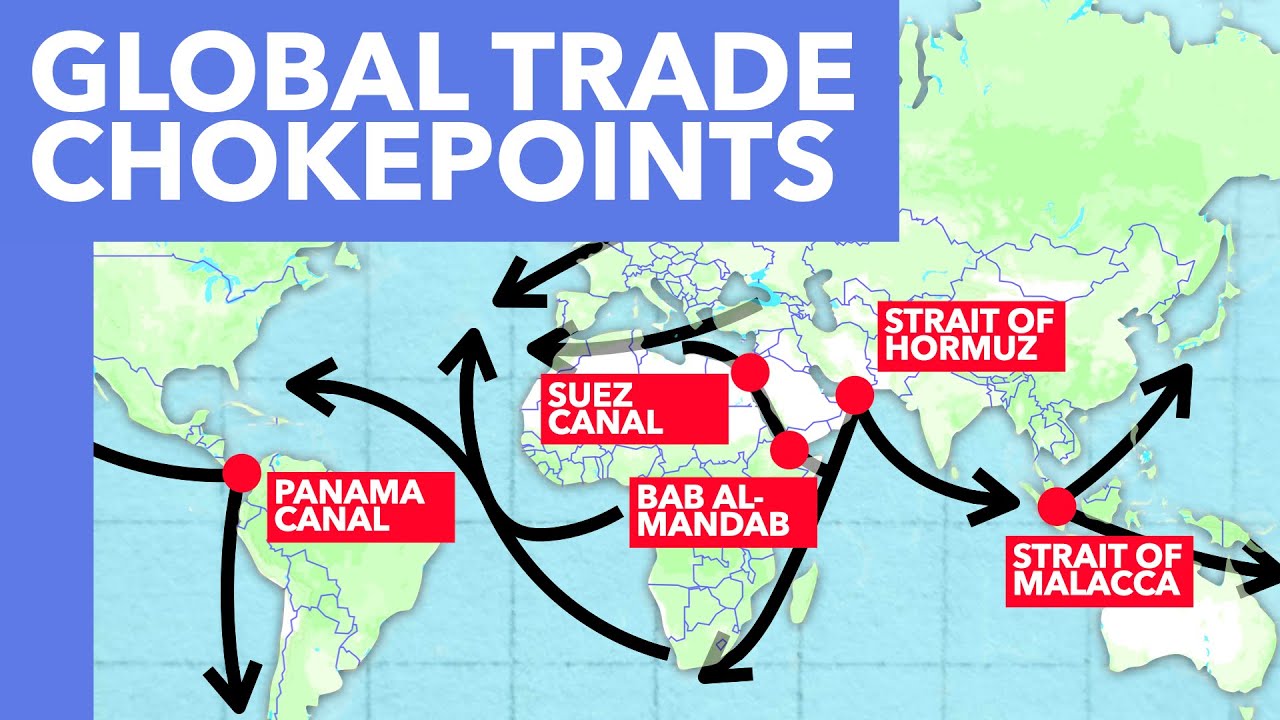
Well, remember: it is a choke point, so that is hardly an option. Sure, it is not as tight of quarters as the Panama Canal or the Suez Canal, or even the Strait of Malacca. But it does shrink to only 39 kilometers as you reach the turn.
Moreover, as this satellite image shows, the water gets shallow on the friendlier side over here, even ignoring all of the artificial islands that the UAE has created.
Now, fortunately for Iran’s opponents, the worst of this is on Iran’s side, including the giant Qeshm Island, which is almost twice the size of Bahrain.
But other hazards still leave relatively little space to coordinate traffic flows.
As such, the United Nations created a system that defines three narrow pairs of paths at the tightest points, with dedicated traffic in the respective directions: one on approach to the Strait, one rounding the Strait, and a final one that flanks some small islands.
Now, if we overlay the territorial waters, we see a problem: you cannot go through the highway without spending substantial time in Iran.
And even if we ignore navigational hazards and moved the designated shipping to seemingly safer waters, it is not like that would stop Iran from committing an attack if it really wanted to.
In fact, in 2010, a Japanese tanker was hit with a mysterious explosion here. Put simply, it is not as if Iran will follow those silly lines on maps anyway, and all of that is asking for trouble.
Chapter 2: Faultlines The good news is that it is very difficult for a war to start based on random accidents or military agents going beyond what the government wants them to do.
The sheer number of flare ups in the region that have ultimately gone nowhere is a testament to that.
At the same time, though, it is not like there is a shortage of potential flashpoints here.
Iran’s rivalry with the United States dates back to the Islamic Republic’s founding.
You see, a lifetime ago, Iran was ruled by the Shah, backed by Washington’s support. Now, Iran had outwardly democratic institutions like a legislative Senate, but in practice the Shah controlled the body and dismissed it went doing so was expedient.
Despite the democratic deficit, Washington supported the Shah because it was just happy to have an oil-rich ally in the region. And that continued over the course of all sorts of administrations. It keeps going. The Shah really was in charge for a long time.
The point is that the United States did not care during the era when Cold War politics dominated all other decisions.
But within Iran there was growing domestic resentment of the government, and by 1979 a revolution led by Ayatollah Khomenei sent the Shah into exile.
Revolutionaries holding American diplomats hostage at the former U.S. embassy in Tehran set the tone for the next half century, even if they all did eventually make it back home.
Moving from one Ayatollah to another in 1989 has not changed that.
Iran today still sees itself as a regional power, held back by the U.S. order in the region.
But the United States is not alone in these efforts.
Iran also has a long-running rivalry with Israel due to completely incompatible ideologies, especially as it relates to the holy lands.
The current iteration of this appears through Iran’s “Axis of Resistance,” whereby proxies including Hamas, Lebanese Hezbollah, Yemen’s Houthis, and the government of Syria work to harass Israeli interests in the region, which overlaps a fair bit with the United States’ goals.
This has led to a whole mess of interactions: Israel targeting Iranians for providing that assistance, direct strikes on each other in retaliation, and separately Israel targeting Axis members when they visit Iran.
But this is not exclusively an Iran-versus-the West story. Remember, Iran views itself as a regional power. And that concerns other countries around the Persian Gulf, including Bahrain and the UAE—the latter of which has further reasons to worry about Iran, given the disputes it has over a few islands just past Hormuz.
Indeed, these concerns largely motivated those two countries to sign the Abraham Accords on September 15, 2020.
The public-facing side of the agreement was to normalize relations with Israel— look, nary a Trump buffer!
But what was going on behind the scenes was a recognition that Iran was a bigger threat to their economic interests, so it was better to overlook any apprehensions about aligning with Israel and secure a partnership with one of the most powerful countries in the region, never mind the help of the United States.
It was less of a “the enemy of my enemy is my friend” logic and more of a realization that “the enemy of my enemy is someone that I can make a lot of money with.” That leaves one remaining major actor: another powerful player in Riyadh.
Conflict between Saudi Arabia and Iran also dates back to the 1979 revolution, but after the United States eliminated Saddam Hussein in the 2003 Iraq War, the only Arab country left that could rival a neo-Persian Empire was Saudi Arabia.
More recently, the rivalry has played out across yet more proxy battles. The biggest confrontations within this sphere have occurred in the Syrian and Yemeni Civil Wars. But there is lower-level conflict also in Iraq, Bahrain, Lebanon, Afghanistan, Pakistan, Libya, and even all the way over in Nigeria.
The conflict briefly turned hot in 2019 when a pair of Saudi refineries came under attack by drones.
Turns out, it was a sign of things to come in terms of war strategy.
Anyway, the United States and Saudi Arabia claimed that Iran was the perpetrator.
For its part, Iran denied it, and instead the claim of responsibility came from Houthi rebels, which hardly seems like much of an explanation given that they were Iran’s proxy in the Yemeni Civil War.
To wit, a United Nations report indicated that the Houthis were not responsible.
Either way, this did not escalate beyond some subtle trolling. Vladimir Putin publicly offered to sell Saudi Arabia a Russian missile defense system … … with an amused Iranian President at his side.
In any case, a diplomatic breakthrough between the countries came in 2023, thanks to some nudging from China. You really get the feeling that they want the oil to keep flowing eastward, don’t you?
Well, Saudi Arabia and Iran now operate embassies in the other’s country, but the underlying tensions between them have not gone away.
Chapter 3: Why Not War?
Also known as the lines on maps extravaganza.
It is tempting to think that those aforementioned faultlines will guarantee a war.
But good news! Fortunately, they do not.
Although the general climate in the region has been far from harmonious for decades, there is a reason that Iran has not engaged in a full-scale war against any of those rivals.
Well, not yet, anyway.
Regardless, the point is that those substantive disagreements alone do not cause war. Rather, you need both a substantive disagreement plus a bargaining friction to get war.
Have just the one, and you get a lot of angry words but not much in the way of big booms.
To visualize the problem, we turn to some lines on maps.
Now, as fair warning, by some accounts, what follows will be utterly useless information. But then again, who’s the more foolish: the fool with the lines or the fool who keeps watching his videos?
Anyway, although the details for each rival vary, the basic issue that the United States, Israel, and Saudi Arabia have with Iran is the same.
Iran wants to extend its influence westward, while each of the others want to minimize it.
Do not think of these lines as strictly territorial, as might be the case with Russia and Ukraine. Sometimes, they are just metaphorical.
Indeed, it may help to conceive of them as a combination of perhaps territory but more importantly political control— such as whether Iraq has a pluralistic system with protections for minorities, or is just an Iranian vassal state.
Now, one could fight a war to militarily decide the division of political influence in the region. A variety of outcomes are possible and might depend on things as random as a sandstorm that stops your plan in its tracks.
The area around Hormuz certainly has a lot of them.
But imagine that we just averaged out all of those possibilities, weighted by their relative likelihoods.
Then perhaps the expectation ends up being, say, here.
So, as arbitrarily drawn for illustrative purposes, it appears that Iran is 40% happy with the policy outcome, and whatever combination you want to build from the others is about 60% happy.
Now, under normal conditions, as long as the actual influence is split somewhere close to that division, then, happily, we can avoid war.
The reason is that war ultimately produces roughly that outcome anyway in expectation— it even appeared in the label— but everyone could enjoy it today for free, without the cost of death, dollars, and destruction.
In fact, if you think about how Iran internalizes those losses in terms of influence, Tehran would be willing to settle for less.
Back to our spectrum of political influence, those costs bite into the value of political influence.
If Iran cares a lot about those costs, then it might devalue the policy outcome by quite a bit. If Iran does not, then the policy outcome is a bigger priority. Regardless, though, those costs are still there.
As such, we can use this literal red line to represent Iran’s figurative red line in coercive negotiations.
So, here, Iran would prefer fighting if it receives less than about 30% of the policy influence.
Of course, the same is true running the opposite direction. The coalition of your choosing also suffers war costs, with this blue line reflecting their minimum.
So the opponents would prefer fighting if they receive less than about 45% of the policy influence.
But look at what is going on here.
Any division of policy influence between these lines are outcomes that both would prefer to a costly conflict.
Call it a bargaining range. That’s what we do in the discipline, anyway.
Now, within this range, the parties are diametrically opposed on where to settle. Think about a hypothetical split here. As we push it to the left, this deal is getting worse all the time for the coalition. But that does not change how all of them are still better than fighting.
This is broadly why we have not yet observed a full-blown war in the region despite sharp disagreements about what the ideal world would look like there.
And thus, historically, the Strait of Hormuz has remained open.
But there is no guarantee that such a peace will hold forever.
Chapter 4: Why a War May Begin, or, revenge of the lines.
What the previous diagram illustrated was that bargaining is good because it avoids a lot of suffering.
Hence the earlier assertion that disagreements do not cause war.
You need that plus a bargaining friction.
Unfortunately, though, there is an abundance of possible problems that could satisfy that second condition.
For today, let’s focus on the three that appear to be the greatest threats.
Option one is the least likely but certainly makes for the better headlines— and bigger explosions.
Iran has been working on a nuclear program for decades now, dating back to the era of the Shah.
Now, the current government claims that it is for civilian research and energy production. The Ayatollah even publicized a fatwa in 2003 that possession of nuclear weapons was contrary to Islamic principles.
Western intelligence is not impressed and thinks that all of this is a thinly-veiled cover for what is an obvious weapons program.
One of the main pieces of evidence for this is that Iran has about 140 kilograms of uranium enriched to 60% purity.
For perspective, 90% is weapons grade, and there is little purpose for civilian researchers to go anywhere near that number.
In contrast, a nuclear power plant usually take around 5% enriched uranium.
The reason that Tehran might want nuclear weapons, of course, is to deter foreign military action that intends to overthrow the regime a la Saddam Hussein in Iraq but just a little bit east or even assist a domestic rebellion attempting to do the same a la Muammar Gaddafi in Libya.
An ongoing subplot over the prior two decades regarding this is whether Israel would attempt preventive action to stop Iran from acquiring a nuclear weapon.
It would not be the first time that the IDF tried such a move. Most recently was Operation Outside the Box.
In 2007, Israel struck an alleged nuclear reactor in Syria that allegedly North Korean scientists were helping to construct. Not much was left afterward.
This felt like a callback to Operation Opera.
In 1981, Israel executed a very similar strike on a reactor in Iraq. This time, it was French scientists who were helping to construct it.
Iraq’s program was never the same. United Nations inspectors cleaned up the mess following the Persian Gulf War, and Saddam’s attempts to restart things had failed well before the United States invaded in 2003.
And let’s not forget about Operation Scorch Sword.
Also notable for our overall conversation today, Iran had tried to destroy the Iraqi reactor in 1980 as a part of its broader operations during the Iran-Iraq War.
The operation was unsuccessful.
Nonetheless, Tehran sent Israel its intelligence regarding the reactor afterward, which facilitated Operation Opera. The enemy of Iran’s enemy was still not a friend but was strategically useful.
That leaves us with a couple of interrelated questions for right now.
First, will Iran attempt to finish an atomic bomb and thus become the tenth member of the nuclear club?
And second, will Israel intervene if Iran takes such an action?
The answer to number two is not obvious. Iraq and Syria had nascent programs.
Iran, in contrast, has one of the most advanced programs in the world, spread out over multiple sites, and some of its facilities are protected in underground bunkers.
But if Israel figures out to handle that situation, what it can obtain by fighting to prevent Iran’s nuclear acquisition might be better than the best it could hope to obtain post-proliferation.
However, the broader puzzle here is that Iran’s answer to the first question is predicated on its beliefs regrading Israel’s answer to the second.
We could find ourselves in a position where Iran concludes that Israel will not intervene, but Israel calculates otherwise, and lo and behold we find ourselves in a major war.
I would draw this with some lines, but the whole illustration would be a mess that would confuse more than elucidate. This is what I used to study once upon a time, and there is a reason that I made this scenario the last substantive chapter of that book.
Okay, that takes care of the first possibility. Onto entrapment.
The second possible pathway to war feels more tangible because we are already halfway there. Yep, I have a bad feeling about this.
Imagine for a moment purely hypothetically that Israel is already embroiled in some other conflict with a smaller militant group.
We could spend an entirely separate video on the ways that could arise— wait a minute, we have, many times— but let’s just stick to a couple of quick examples.
For one, Israel and Saudi Arabia have not yet formalized a diplomatic relationship or a military partnership.
Now, if such a day were to ever to approach the horizon, militant groups around Israel would grow concerned about their future ability to coerce their opponent.
Thus, they have strong incentives to disrupt any sort of normalization process between the two countries.
Indeed, this is a common explanation for why Hamas attacked Israel on October 7, 2023— to compel Israel to strike back, enrage Arabs across the region, and make normalization with Saudi Arabia politically infeasible. And it worked, by the way.
For another reason that Israel may find itself at war with non-state actors, we must focus on inter-group competition.
Although wars tend to be inefficient at the state level, smaller militant groups may have different incentives.
Sometimes, they must play a careful game of committing attacks to draw public attention while simultaneously not provoking their targets into taking large-scale retaliatory measures that will ultimately destroy them.
This is a natural consequence of having large populations who are disaffected with the target.
They would like to see some action taken to hurt that target and they are willing to support the perpetrating groups with their own personal service or, alternatively, some donations.
Consequently, militant groups use violence as a perverse means to advertise themselves to their receptive audience.
This helps make sense of a wide variety of such groups in the region.
Unfortunately, either the advertising concerns or an alliance blocking issue can lead to a bargaining problem in the broader stage.
If these guys are determined to keep attacking, then eventually their target— let’s use Israel as an example— will want to engage in countermeasures. But this creates a period of strategic vulnerability for Israel.
You see, while Israel is distracted by a separate conflict, Iran has a window of opportunity where its ability to prevail in a conflict is higher.
If it does not pursue that option, then later Israel’s other conflict will eventually culminate, and its balance of power with Iran will return to normal.
It may be that Iran would prefer the expected outcome of war while Israel is vulnerable, even net its costs, to whatever the best it could possibly hold Israel to after things cool off, even considering those costs.
What’s worse, that gives the groups a perverse incentive to begin “advertising,” knowing that the more powerful ally will be entrapped into helping.
Ultimately, this is just a complicated way for a classic shifting power preventive war to start, which is the same underlying mechanism regarding nuclear proliferation before it and is also the same underlying mechanism that we previously covered with China and Taiwan.
There’s another ninety minutes for you in case the ninety minutes you are currently spending are not enough lines on maps for one sitting.
Finally, we run into a meta-problem where war occurs … because it is going to occur.
There is a tradeoff in being the country that initiates hostilities.
On one hand, you get to dictate the rhythm of the battle and perhaps destroy a good portion of your opponent’s war machine, assuming that you can catch your rival off guard.
Think about Pearl Harbor here.
On the other hand, you also risk suffering a diplomatic black eye, as other countries might see you as the instigator.
But in a part of the world where loyalties—or, perhaps more precisely, disloyalties—are so set in stone, the element of surprise wins out.
Fortunately, such concerns do not immediately spiral everyone into a conflict.
After all, even if you do get a small boost for striking first, you are also saddling yourself with the costs of war.
The same goes for the other side, of course.
However, if you think that the other side is about to strike, then you are stuck with your costs of war anyway.
But if the other side actually plans to wait and see, then this is a bad strategy.
Unfortunately, world leaders do not always have the luxury of knowing what their opponents have planned.
So when an intelligence organization generates a report that an attack is possibly imminent, it puts the leader back at the casino, having to decide which side of the gamble to play: the “risky” option that could keep the peace but could also allow a war to begin under relatively unattractive circumstances.
or the “safe” option that guarantees war under relatively better circumstances.
The meta-problem arises because leaning toward the “safe” option is self-reinforcing: if Israel thinks Iran might preemptively attack, then it would encourage Israel to preemptively attack, which in turn reinforces Iran’s original decision to preemptively attack, which reinforces Israel’s decision to attack, which reinforces Iran’s decision to attack which reinforces Israel’s decision to attack… [Sigh.] You can see where this is going.
Unsurprisingly, conversations about preemptive strikes pop up whenever tensions rise in the Middle East.
Indeed, this has been the starting motivation of a war in the area once before.
In May 1967, Egypt began mobilizing troops to the Sinai Peninsula and announced that it would close the Straits of Tiran.
Hmm, the closure of a strait in the Middle East causing a war. What are the odds of that happening?
This is all just one big coincidence, right?
Anyway, if we zoom out and kindly request that my lines be returned to me—thank you— you would see that this would shut off Israel’s access to the Red Sea.
So, rather than wait around, Israel preemptively struck Egyptian airfields on June 5.
It was a surprise attack to be sure, but a welcome one for those who supported Israel.
In contrast, things were not looking so good in Cairo. The Egyptian Air Force was decimated, making the rest of IDF operations relatively easy. Within six days of the coincidentally named Six Day War, Israel had captured the Sinai Peninsula and the Gaza Strip from Egypt, the West Bank from Jordan, and the Golan Heights from Syria.
Certainly none of those actions would lead to further problems later… Chapter 5: The Shutdown Imagine that you wake up on May the Fourth, 2027, discover that the world is spinning into chaos, and that Iran has shut down the Strait of Hormuz. What might that look like exactly?
Well, there are a few ways that Iran could go about doing this: a nuisance campaign, a soft shutdown, and a hard shutdown.
A nuisance campaign would aim to hit a grey zone of conflict. Rather than militarily threatening or striking anyone, Iran would begin by conducting “routine searches” of commercial vessels, with some type of pretext like looking for illicit weapons.
The upshot for Iran here is that this would not evoke the same type of public outcry as a true military campaign would.
Sure, there would be plenty of questions raised as press conferences, but the likelihood it would immediately erupt into full-on war is minimal.
Meanwhile, the benefit to Iran is that it would slow transit through the Strait to a crawl and thereby spike global oil prices and in turn increase geopolitical instability— albeit not to the same level that the other two options would.
Meantime, the soft shutdown option is basically outright financial warfare. Iran publicly announces that it will target any ships that pass through the Strait.
Whether the means of execution is by anti-ship missiles, patrol boats looking to sink blockade runners, or armed sailors aiming to use speed boats to board the violators is almost irrelevant for the effect on the markets.
After all, international shipping is a capital-intensive process.
The standard tanker class running from the Persian Gulf to Asia is the aptly-named Very Large Crude Carrier.
Indeed, they are very large and carry crude. A new one runs into the low nine figures to purchase. One of them can hold about the same amount of value of crude oil or more in a single trip, depending on current market prices, and chartering one will cost the client about $100,000 per day. And therein lies a problem.
With those huge numbers at stake, few companies are willing to have their carriers hit the open seas without insurance. But when a regional power threats to sink anyone in the neighborhood, either insurance companies get so nervous that they stop providing coverage altogether, or the premiums balloon to the point that the enterprise is no longer profitable. Either way, not good.
Thus, Iran can get what it wants without having to do much, other than lob a few bombs at anyone thinking about pressing their luck.
In this light, an explicitly declared closure may not add much to global oil instability.
Even if all we have is a generally high threat environment in the Gulf, insurance companies will worry about potential claims even if Iran pinky promises that nothing will be intentionally targeted.
However, if Iran wanted to go to go full force and impose a proper blockade, then it has some options.
At the top of the list would be naval mines, especially given how narrow the passageway is for tankers.
This itself would form a bit of a minigame. Iran’s goal would be to lay as many mines as possible before getting caught.
However, Iran would be racing against the clock. You see, Hormuz is one of the most heavily monitored locations on earth. What you are looking at is an international surveillance group stationed in Bahrain, created specifically to find things like this. And once spotted, mine layers are easy targets.
Indeed, under normal circumstances, mine layers sail on friendly waters, usually laying their stocks to block entry to one’s own port when staring down an invasion.
In contrast, once the monitoring group spots the very first mine deployed, the Strait will immediately become contested waters, which is a major problem for Iran’s vulnerable mine layers.
To combat the monitoring problem, submarines would give Iran a stealthy option. But they still have some limits.
Primarily, unlike more sophisticated Western designs, they cannot stay underwater for extended periods of time.
They would need to surface at the nearby port of Bandar Abbas, and it would not take long before the monitoring service would see this and connect the dots.
Meanwhile, actually laying mines comes with its own set of challenges.
As this hyper-realistic graphic visualizes, subs need to operate at about 60 meters to avoid contact underwater. Meanwhile, tankers need at least 25 meters of clearance.
Thus, there is a sweet spot deep enough for tankers to pass but not deep enough for Iranian subs to lay mines.
The upshot for shippers is that there is a large safety corridor that meets those requirements west of the Strait.
But at the chokepoint and to the east, the only suitable areas are up against Iran’s coastline.
Everything in between has suitable depth for a submarine.
Thus, Iran could cause trouble at the chokepoint itself, but proliferating the problem beyond that would be a greater challenge, to the west because of the safety corridor and to the east because of how much open sea there is.
Now, would such a blockade be leeegal? No, and Iran does not have the votes at the United Nations to make it legal.
But we are assuming that Iran has moved past the point that it cares about such trivialities.
Meanwhile, de-mining is expensive and time consuming for the opponent. That is a win for Tehran, as some ships will realize that it’s a trap and turn backward, while anyone who still pushes forward might end up with a hole in their haul that will cost an untold amount of time and money to repair never mind the environmental disaster that leaking oil might unleash.
Another option is to handle everything from shore with anti-ship cruise missile batteries. Simply wait for the ships to pop up on radar, then lock and load.
Options three and four get more expensive: put Iranian ships in the water or craft in the air for a more direct confrontation.
But no matter what combination Iran opts for, the complete success of a blockade depends on no one willing to challenge it.
And that is a very strong assumption.
Chapter 6: The Damage Whether a country would want to intervene to reopen the Strait of Hormuz depends on how much that country is affected, so let’s look into that as a starting point.
Obviously, the headline problem is the two billion dollars in oil that passes through the Strait daily.
First, let’s discuss the impact on importers. As mentioned earlier, the lion’s share of oil goes to Asia: specifically, India, China, South Korea, and Japan.
So clearly they will be the first ones who feel the pain when the oil disappears— and it is somewhat reassuring that China is on that list, meaning that closure of the Strait will not immediately result in World War III, with the sides forming along the current geopolitical rivalries.
This is also part of reason why China was so eager to broker the aforementioned peace between Iran and Saudi Arabia.
However, it is a fallacy to believe that the pain will end with those importers.
In the first few days of closure, oil companies around the world are going to begin recalculating their profit-making strategies.
Everyone will immediately see that a supply shortage is about to plague Asia, and anyone not beholden to long-term contracts will begin figuring out how to ship more product to the east, where the shock has caused prices—and therefore potential profits—to spike.
As a result, the entire global economy will bear the price of higher fuel prices.
That includes the United States of America, regardless of its newfound status as a net oil exporter.
Now, how much those prices will skyrocket is hard to predict with precision. But let’s turn to an old friend for a point of comparison.
When Saddam Hussein briefly captured Kuwait in 1990, both Iraqi and Kuwaiti oil vanished from the market, and prices only came back down when Saudi Arabia began increasing supply.
But for the period when things were looking out of control, prices more than doubled, from a quaint sounding $17 per barrel to $36 per barrel.
In contrast, shutting down the Strait of Hormuz would cause sourcing problems well beyond just Iraq and Kuwait, and the Saudi solution would also be off the table.
The price inelasticities here further do not help: small decreases in the oil supply lead to substantial increases in oil prices.
Yes, the United States’ shale boom will soften the blow, but fracking does not promise some sort of magicial Christmas land where Americans do not notice what is happening in the Middle East.
A more subtle effect comes from the damage to global supply chains.
Let’s pretend for a moment that somehow none of the oil normally headed for the Americas or Europe would be diverted to Asia.
Well, it would still be a worldwide economic calamity.
Think for a moment about the American automotive industry. Actually, let’s specifically focus on the vehicles that are “made in America.” That phrase, of course, is misleading.
“Assembled in America” is more accurate—because, in truth, Detroit imports all sorts of parts from elsewhere before putting them together on the assembly line.
Here, the things that you are mostly likely familiar with are semiconductors, which primarily come from Taiwan.
And Taiwan primarily gets oil to power the island … yup, you guessed it, through the Strait of Hormuz. So, no oil means no semiconductors means no American cars.
And I mean no American cars. Factory Zero becomes factory zero.
You cannot just remove the parts coming from Asia and expect the vehicle to operate properly.
Such is the consequence of globalized supply chains, and that is why the United States spends untold billions of dollars per year to uphold freedom of navigation worldwide.
The global economy is like a glass cannon—very powerful, but if not carefully monitored, also liable to self-destruct.
If you need further confirmation of the problem, just think about how difficult it was to purchase consumer goods during the pandemic.
And that is why the United States, never mind all the other members of the neoliberal order, would not let the closure of Hormuz go unchallenged.
But it is not like Western countries would be the only ones feeling the pain.
The Gulf states would face a double bind. If no one is importing Gulf oil, then none of the Gulf countries are exporting it either.
Moreover, although we have been pretending like Hormuz is a dedicated oil expressway, that is a rather narrow reading of the situation.
In terms of the Strait’s overall traffic, 62% consists of tankers, which is a lot. But 38% carry other goods.
So if no ships are going out of the Strait of Hormuz, then no ships are coming in either— meaning that suddenly all of the imports that Gulf countries rely on, including food, vanish overnight… …not that they could afford any of them without the oil money.
Regardless, this will lead to political instability in each of their capitals—meaning more headaches for those involved, and more motivation for the United States to intervene so that one type of instability does not snowball into an even worse kind of instability— and yes, it can snow there, even if Baghdad normally looks like this on Christmas.
Now, those at risk of these financial crises have taken steps to try to mitigate the damage.
Remember, the UAE has a pipeline that skips the Strait, Saudi Arabia has a pipeline that runs to the other side of the country, and Iraq has a shortcut to Europe.
But none of these are designed to handle the Strait of Hormuz’s load of 20-something million barrels per day.
To put that in context, the Emirati pipeline only handles about 1.5 million per day. and the Saudi pipeline only handles about 5 million per day.
Furthermore, that is total capacity, which includes what normally flows through the system during non-emergencies.
Even after doing some funky tricks with gas pipelines, the Energy Information Administration estimates that combined only 2.6 million barrels per day currently go unused.
And though the Iraqi pipeline is designed for 1.6 million per day, it is in a state of disrepair and probably can only handle something closer to 350,000 when operable.
“When” is the key word there, though.
As much as one might want to get on top of the situation, pipelines are stationary targets.
And if Iran’s strategy is to use its military to cut global oil supplies, then bombs can be pointed toward those backup pipelines as well.
The countries can try to bulldoze exclusion zones as an extra layer of protection, but it will not stop a dedicated attacker, especially one coming from the skies.
And that goes beyond just Iran.
Indeed, this is smoke from an Iraqi pipeline fire in 2006. ISIS later struck the main Iraqi pipeline in 2013, putting it out of commission for more than a decade.
And in 2019, the Houthis sent a swarm of drones to the Saudi pipeline, briefly taking it offline.
Moreover, if you think about what Ukraine has shown is possible by targeting Russian refineries in the intervening years, you can see how this is a losing battle.
And even if the Saudi pipeline solution somehow works, this will still put tons of additional strain on tanker supplies— at a time when Russia rerouting its oil to Asia, low rainfall in the Panama Canal, and everyone wanting to avoid the Red Sea is already causing strain on those tanker supplies.
Oh, and I almost forgot— any oil going this way but headed toward Asia still has to make it through the Houthis. And that’s not easy.
And we have not even mentioned how there really is no solution for natural gas supplies that should transit Hormuz.
Bottom line, shutting down the Strait will be an earth-shattering event, and Iran is free to try it.
However, whether Iran can successfully execute a shutdown for an extended period of time is another question.
The United States, as the guarantor of freedom of navigation, would quickly execute a response.
Now, there is a menu of escalating options here.
As a starting point, you have a naval intervention, physically forcing the Strait to reopen.
Second, you can pair that with a bombing campaign inside of Iran, with some freedom of just how far to extend it.
Finally, you can do both of those things while launching an outright invasion.
Be careful with your choice, though… Chapter 7: A Naval Intervention In fact, there is a common belief that the United States Navy and its friends would make quick work of Iran.
And while that thinking is not wrong in broad strokes, it also misses the larger strategic problem.
Much of that expectation goes back to lessons learned from the 1980s. And Apologies, because we are about to hit a set military operation nesting dolls.
Recall how, in 1980, Saddam Hussein woke up one day and realized that he did not much care for Iran. Hence he started the Iran-Iraq War.
Iraq’s initial operations were successful. They fought on flat ground, which was advantageous to Iraq, and conveniently was where Iran’s oil fields were concentrated.
The main benefit was that mechanized units could storm right in without issue. However, a mountain range lies behind the plains.
Here is what they look like from space. They are big.
Correspondingly, Iraq’s assault was over. Iran had the high ground, leading to a much longer conflict.
That is doll one: the war itself. Now onto doll two: something known as the “Tanker War”.
Starting in 1984, Iran and Iraq attacked each other’s shipping assets.
It is the closest historical analogue to a shutdown of the Strait of Hormuz, except that it was happening further up in the Persian Gulf.
Among the targets for Iranian speed boats like these were Kuwaiti oil tankers. At the time, Kuwait was in the broader Arab coalition that supported Iraq— a decision that definitely would not cause more problems later on, or indirectly cause yet further problems yet later on.
Regardless, Kuwait worried about a collapse of its oil industry and sought external assistance— again, a sign of things to come later.
That takes us to the third layer, known as Operation Earnest Will— which is a very good name for an operation in my unbiased opinion.
The United States draped Kuwaiti tankers with the Stars and Stripes, literally just reflagging them and calling them American, and then the U.S. Navy escorted the vessels in its largest operation since World War II.
The ships would travel in convoys like this one, giving the escorts direct eyes on any threats to the tankers.
This did not go unchallenged, though. The former al-Rekkah turned MV Bridgeton received the first American escort and immediately struck an Iranian mine.
Thus, in came Helicopter Mine Countermeasures Squadron 14 and their Sea Stallion mine sweeping helicopters, equipped with a hideous insignia but a fantastic logo.
A few months later, Iran struck the MV Sea Isle City with a missile barrage.
In response, the United States lit up two Iranian oil platforms in the Persian Gulf.
Washington was showing that it was in this for the long haul, wanting to end any further Iranian plans to disrupt maritime trade.
That takes us to the final layer: Operation Praying Mantis.
Underscoring the difficulty of clearance operations in troubled waters, somehow the Iranian mines returned.
On April 14, 1988, the USS Samuel B. Roberts struck one while in the Gulf as part of the Earnest Will protection plan.
The blast tore a significant hole in its hull, first forcing the Samuel B. Roberts to limp back to Dubai for emergency repairs before being manually hauled all the way back to Rhode Island for a proper job. But it was not the last domino to fall.
The Samuel B. Roberts incident also led to the Vincennes’s arrival and the aforementioned tragedy thereafter.
Regardless, Praying Mantis was the U.S. Navy’s response to the attack on the Samuel B. Roberts.
Playtime was over. Four days later, the United States had destroyed one Iranian frigate and crippled another. Further, one Iranian gunboat and three speedboats were lost.
It was about as bad of a day for the Iranian Navy as one could possibly imagine.
In exchange, there were only two American casualties from a crashed Ah-1T Sea Cobra helicopter.
Soon thereafter, the Iran-Iraq War came to a close.
As a result, a common conclusion drawn here is that the United States still retains the ability to dismantle the Iranian Navy.
All it needs is the call to go ahead.
And, indeed, any naval confrontation between the two will not be close. A look at Iran’s potential order of battle reveals why.
Iran only has seven frigates. Believe it or not, three were built by the United Kingdom because that was during the Shah era. Yes, they are that old. The class construction for the other four only began in 2010, as if to foreshadow the conflict on the horizon.
Beyond that, Iran also has three corvettes, four submarines, and a whole bunch of smaller craft.
All of that is no match for the U.S. Navy.
Consider this: there are as many American aircraft carriers as there are Iranian main combat craft of any kind.
Sure, Washington will not deploy all of those carriers to the region in the event of a conflict. They have other considerations and maintenance schedules to balance out. But that shows you the funding disparity.
And it is not like the United States will have very far to go to address the problem either.
Now, it is well known that U.S. soldiers and sailors hate sand— it’s coarse and rough and irritating… and it gets everywhere.
Not like here. Here everything is soft and smooth inside the halls of the Pentagon.
But that has not stopped the United States from placing bases and such all over the Gulf.
However, conclusively winning a naval battle is not the same thing as reopening a Strait to civilian traffic.
Chapter 8: Naval Warfare Is Not an Easy Button It would be convenient if destroying Iran’s Navy ended the problem.
Inconveniently, however, one can fundamentally warp international shipping without even having a navy.
Indeed, even given a naval victory, we do not need to speculate on how difficult it will be to coax the international shipping market back to the Strait of Hormuz.
We have all of the data that we need on the opposite side of the Arabian Peninsula. Remember the Houthis from earlier? Well, they launched a civil war in Yemen in 2014. A decade later, periodic clashes were still ongoing, but the political arm had secured control over the Western edge of the country.
It may look small by comparison, but the country’s political center of gravity lies along the Red Sea.
Thus, the Houthis may not have outright won the war, but they certainly ended up in the most favorable position.
Still, as the World Bank would tell you, civil wars are “development in reverse”.
The Houthis inherited destitute poverty and continue to look for new members and more funding.
Put differently, they are no regional power. Rather, they are a weak militant group that, with the help of a friend, has simply outlasted everyone else.
Fast forward to October 7, 2023, the date of Hamas’ surprise attack on civilian targets just outside of the Gaza Strip.
Israel eventually struck back… and continued to keep striking back.
As the months passed, public opinion of Israel in the Arab World cratered.
In the midst of this political chaos on the northern side of the Red Sea, the Houthis realized that it gave them an opportunity on the southern side.
You see, the mass resentment of Israel spawned a large pool of both volunteers and donations.
But militant groups do not just find people and money sitting at their doorsteps. Rather, they must chase after those resources.
In the world of militant competition, the perverse implication is that they must commit attacks.
The corresponding media coverage serves as advertisements to the receptive audience that the perpetrating group is the one that deserves the volunteers and donations.
What began as a simple operation to launch missiles into Israel eventually morphed into a problem for the entire global economy.
On November 19, a group of Houthi militants bordered the Galaxy Leader, a roll-on roll-off vehicle carrier that was on a routine trip through the Red Sea.
Commandeering the vessel, they sailed back to Yemen, where the ship remains a tourist attraction— I guess for whatever tourists think that a vacation to a war-torn country would be enjoyable.
Yeah, not my cup of tea either.
In any case, the Houthis more broadly announced a policy to continue striking any Israeli-affiliated vessels passing through the Bab el-Mandeb Strait.
And they indeed made good on that promise, striking close to one hundred within a year.
Of course, what it means to be an “Israel-affiliated” vessel is ambiguous. Crewed by Israelis? Sailing to or from Israel? Containing Israeli products? Owned by an Israeli? Israelis having at least a 1% ownership stake?
Regardless of the precise definition, international shippers were not convinced that the Houthis were going to be particularly careful in auditing their targets.
Case in point: the Houthis striking a Russian tanker heading to China, even though Russia is using those sales to fund its war effort in Ukraine, which includes the purchase of Iranian arms, and Iran has recently surged Axis of Resistance activity thanks to it sudden increase in cashflow. So, in a roundabout way, the Houthis were shooting themselves in the foot.
Passage through the Bab began to plummet. Pre-crisis, more than 70 vessels would pass through the Strait daily. Immediately following the initial attack, traffic began dropping off a cliff. By December, the number was in the 50s.
As the enforcer of freedom of navigation, the United States was not happy about the threat that this placed on the global economy.
On December 18, the U.S. Navy in conjunction with some international partners began “Operation Prosperity Guardian,” which had the goal of protecting vessels sailing through the Bab. To facilitate that, the United States also launched offensive strikes to destroy bases from which the Houthis were launching their own operations.
Undoubtedly, Operation Prosperity Guardian improved the situation compared to a counterfactual world where the United States did not intervene and the Houthis shut down all traffic.
But it was a long way from solving the problem.
By January 2024, the Bab el-Mandeb Strait’s daily traffic had dropped into the 30s. Nine months into operations, it fell into the 20s.
It’s funny. “Bab el-Mandeb” translates to “Gate of Grief,” and it certainly lives up to that name.
Now, there are a couple of important geographic differences between the Bab and Hormuz.
First, the Bab lies on the southern end of the Red Sea, with the Suez Canal at the top.
Because the Canal is a shortcut to Europe, the Bab is the more important connection between Europe and Asia— though the Strait of Hormuz’s oil trade still means that more ships— usually between 90 and 100—go through the Persian Gulf’s portal daily.
Second, the Bab el-Mandeb Strait is not the only game in town. If you do not want to go through there, you do not have to.
It just requires sailing all the way around Africa instead. Doing so will add four weeks to your journey, which for an oil tanker from earlier would cost just under $3 million more, but it is feasible.
Indeed, in 2023, the Cape of Good Hope would see about 40-something visitors daily.
In the post-Houthi world, it became common for that to number to hit into the 90s.
Put differently, a whole bunch of businesses believed that it was more financially profitable to add four weeks to a journey than to test the Bab’s waters.
Consequently, following an attempted Iranian shutdown, traffic in Hormuz will not drop by the same margin as with the Bab, especially because there is just no alternative for some.
However, the risk premium will run higher because there is no safe way out.
For a taste of what that is like, in November 2023, it was possible to charter some tankers to Japan for under $30,000 per day. But those happy days came to an end. By January, the price eclipsed $100,000.
The main point here is that if the United States has been unable to terminate a significant threat to the global order in Yemen— that is moreover perpetrated by an Iranian proxy group— then how will it magically clear the Strait of Hormuz when Iran is applying the full weight of its regional power capabilities?
Chapter 9: Invasion Well, if a naval engagement is the gentle form of conflict, the opposite approach is a full-on invasion of Iran.
The attractive feature of the strategy is that if the Islamic Republic’s government no longer exists, then it cannot direct organized forces to continue targeting ships along the Strait.
The unattractive features of the strategy are … basically everything else.
So, if you will permit me, we need to go on a brief digression before eventually returning to Iran. You see, the template for such an operation would be the 2003 Iraq War.
Now, if you are thinking to yourself, wow, that is a really bad starting point … well, you are right. But let me convince you that it is not as awful of an idea as it might seem before pivoting back to how it still not a good idea. What can I say? I love roller coaster narratives.
You see, Iraq eventually became a disaster for the United States.
And it remained a major issue through multiple administrations. But it did not seem so bad as it was happening.
After more than two decades, it is easy to forget that the American public saw the initial invasion as a masterstroke by U.S. policymakers.
Let’s follow George W. Bush’s approval rating to see what I mean. It hit a record 90 percent in September of 2001 but steadily dipped until it reached 58 percent in March of 2003. But then the United States invaded Iraq that month, some statues of Saddam Hussein came toppling down, and major combat operations were over by May 1. And Bush’s approval rating? Well, it jumped back to 71 percent. It only fell into the 30s in 2005.
To summarize the situation simply, the invasion itself was a stunning success. What was not was basically everything else that came afterward. Mission accomplished, it was not.
The Bush administration had no plan for what came next. The country fell into disrepair, and a critical failure in lines-on-maps reasoning ended any hope of fixing it.
Iraq underwent a process known as “De-Ba’athification,” coined from Saddam’s Ba’ath political party.
Basically, if you were Ba’ath, it was time to say goodbye: all members of the party were banned from public sector jobs.
This did not seem to be wholly unreasonable on the surface. It was akin to a modern-day De-Nazification process.
Saddam was a brutal dictator, and therefore in theory anyone complicit with his policies had no place in the new government.
However, this left no one in the new government who knew how anything worked.
Worse yet, taking a government job prior to his overthrow might have required Ba’ath membership.
I had been born an Iraqi and wanted to teach at the University of Baghdad, I might have joined the Ba’ath party— not because I actually liked Saddam Hussein, but because it was the only way for me to do my job.
And I for one would like to think that the world is a better place when we are thinking critically about conflict.
For a more practical problem outside my ivory tower, you probably would prefer having someone who knows how a waste treatment plant works to operate this waste treatment plant. Ba’ath party identification seems irrelevant for that.
Well, multiply that problem by a thousand, and you basically have Iraq in 2003.
To make matters worse, former Ba’ath party members were by and large the people in the country who had guns. Basically, if you fire the army, the army is going to keep those weapons.
And if you have spent more than a minute watching this channel— or just remember from 45 minutes ago— then you know that the distribution of goods needs to be commensurate with the balance of military power for a peaceful agreement to be sustainable.
The fallacy here is that the Bush administration treated the fall of Saddam Hussein as the end of coercive negotiations.
It was not. There was a group of well-armed people who were about to be squeezed out of the picture.
Well, we all know what happened next: an insurgency that effectively turned the word “Iraq” into political poison in the United States, and nearly cost Bush the 2004 presidential election.
A full generation has passed since the beginning of the invasion, and lessons learned or not, even the idea of nation building in a place like, say, Iran is still toxic within Washington.
Now, later administrations know not to repeat De-Ba’athification. But there will always be some new mistake to make, and so avoiding the process altogether is the solution.
Then you get to the differences in what a military invasion would look like.
We have already talked about the mountains that serve as an entrance to Iran. Well, they are everywhere in the country, as opposed to Iraq’s mostly flat terrain.
There is also just more country: 437,000 square kilometers of Iraq versus 1.6 million for Iran.
We have seen how the United States loves its military bases in the region.
Well, the existing shops that Uncle Sam had set up in Kuwait and Saudi Arabia made things easier in 2003.
So did its relationship with Kurdish resistance in the north.
In contrast, there is not going to be any flanking of Iran today. However the West decides to go in, it is going to be ugly.
In fact, in 2002, the United States staged the “Millenium Challenge” the most expensive wargame in American history, to the tune of a cool quarter billion dollars.
It simulated a war between the United States and a hypothetical country that definitely was not Iran. I said not Iran. Thank you.
It did not go well. Definitely Not Iran won handily, causing a minor scandal within the Department of Defense.
And that was just focusing on the military phase—not a later-stage counterinsurgency. Regarding domestic help, Saddam Hussein was an unpopular figure within his country, and there was a genuine feeling of liberation in Iraq when American troops first rolled through.
Meanwhile, though Iran’s current regime has plenty of resistance to it, there would be significant anger at the United States for removing the Ayatollah, and not just because those individuals are worried about the distributional consequences like former Ba’ath Party members were in Iraq.
Sure, Iran is far from a liberal democracy despite holding presidential elections. But autocratic rule does not immediately imply incredibly unpopular rule.
Then, in the irony of ironies, we have each country’s nuclear program.
Saddam had a nuclear weapons program in the strictest sense of the meaning. Above all, though, he enjoyed tricking Iran into believing that he was serious.
But the reality is that economic sanctions dating back to the Persian Gulf War had left Saddam broke, and the war itself had left his nuclear infrastructure completely broken.
All told, a nuclear program without facilities and without major funding is not much of a nuclear program at all— though that did not stop the Bush Administration from selling the war as a means to limit nuclear proliferation.
By comparison, Iran’s nuclear program is real. And the drama involving it that would unfold during a long-running war would be intense.
Iran has a decent stockpile of uranium enriched to 60%, with evidence of some smaller amounts above 83%.
Quick science tangent: more than 99% of naturally occurring uranium is the 238 isotope. Less than 1% is the 235 isotope.
Fortunately for the world, the rare one is the thing that goes boom.
Now, centrifuges exploit the slight weight differences between the isotopes to isolate the lighter 235 version.
Spinning is a good trick, and these things spin faster than the speed of sound. Enrich your uranium to around 90% of that 235 isotope, and you have something suitable for a bomb.
From the outside, it may sound like Iran still has a long way to go with that 60% stockpile. Sure, less than 1% to 60% is a large jump, but the difference between 60% and 90% still seems substantial.
However, the goal of enrichment is to “find” atoms of 235 and move them to a separate location.
It is much harder to find a 235 atom when 99% of the sample is 238. You literally have to find just this single one. It is like trying to find an explosive needle in an atomic haystack.
Meanwhile, it is much easier to find a 235 atom when the more of it is already 235. That is because you do not actually need to find every single 235. If you just find enough, you can discard the rest and still be good.
As a result, going from 1% enrichment to 5% enrichment is actually about half of the work. Going from 60% to 90% is relatively simple.
Of course, there are still questions about Iran’s ability to take enriched uranium and then manufacture a functioning bomb.
But the moment that the United States begins threatening Tehran, the clock starts ticking on whether we will find out.
And that is something that all of us would prefer to avoid, the White House included.
Now, contrary to some discussion surrounding the situation, nuclear weapons would not suddenly make Iran untouchable.
Nuclear weapons are blunt tools, best left for protecting core interests.
That is why Ukraine could invade Russia’s Kursk region, and yet Kyiv did not immediately become a nuclear wasteland thereafter.
Back in the Middle East, these factors mean that toppling the government in Tehran would no longer be feasible post-proliferation.
But it would not stop the fighting from continuing along the Strait of Hormuz.
Actually, it might embolden Iran to try something after it feels that it has a safety net.
Along with that, the nuclear rhetoric coming from Iran would undoubtedly increase.
However, both the United States and Israel have their own nuclear stockpiles—one of them publicly, one of them not-so-privately.
So unless Saudi Arabia was the only participant in this invasion, firing a nuclear weapon against the coalition is a good way to see nuclear fire returned— and by countries with better stockpiles. There’s always a bigger bomb.
And although there will be plenty of popular discussion in the West of how the Iranian government is inherently irrational and that the world will be about to reach a nuclear apocalypse, a regime does not survive in power for almost a half a century by acting haphazardly.
Iran understands the incentive structure that underlies mutually assured destruction.
Of course, that does not make the use of nuclear weapons impossible. Just that it remains unlikely.
In any case, though, it is still one more reason to avoid a full-scale invasion.
Chapter 10: Creating a Safe Corridor So a simple naval campaign might not be enough to end a crisis in the Strait of Hormuz if Iran wanted to press the issue.
Meanwhile, invading to overthrow the Iranian government would not have enough domestic political support in the United States to be a relevant factor.
Thus, reopening the Strait might require a middle ground— something palatable to Americans but not palatable to Iranians, that will allow for cargo to safely flow through the region.
The most straightforward solution is to use aerial bombing until Iran concedes.
Now, obviously, aerial bombing would also be a part of a naval campaign or a full-on invasion.
For a naval campaign, Washington would want to eliminate as many Iranian assets along the Persian Gulf coast as possible.
That means hitting both Iranian ports like Bandar Abbas as well as any anti-ship missile batteries in the area.
It would also make hitting Iran’s anti-aircraft installations a prerequisite so that the United States can control the air in relative safety.
There are a lot of these. For example, S-300 systems are commonplace, after having been Soviet-era workhorses.
Of course, the most efficient way to take care of all of that is to fly over the targets and drop some payloads.
In contrast, a full-on invasion would begin with a similar “shock and awe” style campaign from the Iraq War, where the United States lights up as many major targets as it can—including some deep into Iran—over a short period of time to disorient Iranian defenses.
As such, the middle ground is figuring out just how much bombing to do that goes beyond a simple Persian Gulf focus but is not part of an invasion effort.
There are two ways to think about such a strategy: taking actions that directly support the effort to reopen the Strait until Iran militarily concedes and a coercive campaign that inflicts so much damage that Iran politically concedes.
Regarding the former strategy, the geography is favorable to the United States here.
Remember how a mountain range sits beyond the southern Iraqi border and along the coast as the gulf heads southeast?
That is a major problem if you want to physically hold the nearby low ground or, worse, want to conquer further territory.
Just ask Saddam about that one.
But it creates a significant problem for Iran if you just want to destroy the infrastructure and prevent Iran from resupplying the facilities it would otherwise use to harass maritime traffic.
As such, the United States could level the area, attack the infrastructure of a handful of supply routes that pass through the mountains, and then hope to pacify the region.
That would give plenty of time for minesweepers to come in, clean up the waters, and try to return a sense of normalcy to the shipping industry.
On the other hand, a broader coercive campaign would add to the list any valuable targets deeper inland that the United States could reach.
A major part of either strategy will be the use of the B-2 stealth bomber, which can carry payloads designed to penetrate hardened targets.
It is capable of flying from across the globe with the help of some mid-air refueling, and was previously used to hit the Houthis.
The apparent drawback here is that bombing campaigns have a reputation for being blunt tools, incapable of breaking an opposing country’s will.
Well, so is Iran shutting down the Strait. If that criticism is true of bombing campaigns, then it should also apply to Iran’s belief that blocking passage could coerce the coalition as well. But let’s just go with it for a second.
To test that logic here, it may help to pin down what exactly Iran’s strategy would be with long-term harassment around Hormuz.
The funny thing about the Strait is that Iran needs it too.
Remember the territory that Iraq aimed to conquer at the beginning of the Iran-Iraq War?
Again, it was here— and the reason was that Iranian oil fields are concentrated in the region.
Inconveniently for Iran, the oil it produces there has to leave via Persian Gulf, which means figuring out the whole Strait of Hormuz situation.
Seemingly also concerned about traffic along the Strait, in 2021, Iran opened a pipeline that stretches from the oilfields along the top of the Persian Gulf all the way to the Gulf of Oman.
It has a capacity of one million barrels per day.
The major problem here, though, is that the U.S. Navy is fully capable of blockading the pipeline’s terminal port.
Doing so will tie down more American vessels, of course, and open up more opportunities for asymmetric attacks on them.
But the point is that Iran needs peace along the Strait of Hormuz to ship its own oil, just like everyone else.
In turn, a prolonged Hormuz crisis would turn into a battle of wills, and a question of who will blink first.
Iran would be betting that it can hold on long enough to impose costs on the West and politically convince the West to back down.
Thinking about this in terms of lines, it is easy to conceive of the expected outcome as a pure consequence of the military balance.
That would, in turn, seem to suggest that the U.S.-led coalition is in the driver’s seat. After all, they have all the fancy stuff.
But the ability to draw lines does not make a theory intelligent.
Political instability causing one side to withdraw also shapes how wars end and thus influences where the line should be drawn.
Thus, in a battle of economic destruction, it pays to be the one that can impose greater costs on the other side— and not just because you will settle for less to avoid paying those costs.
Here, the question is who will break first: voters in democracies growing tired of the ongoing costs of conflict, or autocrats in Tehran worried of open rebellion on the streets or coups preemptively initiated by others in the regime.
Popular perception is that democracies are weak-willed and thus destined to fail in these enterprises.
However, autocrats face the bigger downside risk—if they continue to the point of rebellion and lose, they tend to face exile, imprisonment, or worse.
In contrast, leaders in democracies that press too long just get voted out of office and then live comfortable retirements. In fact, looking at any retirement, never mind under duress, it is not even close. Only 7% of democratic leaders are jailed, exiled, or killed post-tenure, where as 41% of autocratic leaders meet one of those fates.
The trick for a Western coalition is picking targets that will minimize Iranian propaganda value.
Tehran will want to use bombings as evidence that Washington truly is the “Great Satan” and rally support for death to America.
That shifts great responsibility on American planners to minimize civilian casualties— something that did not always work out well in Afghanistan and Iraq.
The one upshot that the United States has here compared to the operation against the Houthis is that Iran, as a country, is in fairly good physical shape.
I know that seems backward— isn’t it better to fight an enfeebled opponent?— but bear with me for a second.
Yes, economically, Iran is a mess due to the decades of Western sanctions against the Ayatollah’s policies.
But in terms of not having the scars of war, Iran is doing well.
That stands in stark contrast to the situation with the Houthis. Remember how civil war is like development in reverse?
Well, one of the problems that the United States faced with the Houthis is that years of Yemeni infighting have basically eliminated any high-value Houthi targets from the map.
It is much easier to deter an opponent when you can press a button and destroy millions of dollars of value.
But once all of those targets are gone, you are left with just trying to physically eliminate the enemy—a strategy that is always easier said than done.
In contrast, Iran is in more pristine condition. Now, that is usually a good thing if you live in such a country, but perversely it is a source of vulnerability for Tehran here.
In fact, we can see some evidence of this at play with what happened with Qasem Soleimani in 2020.
By some accounts, Soleimani was the second most powerful man in Iran, after the Ayatollah— “was” being the key word in that sentence.
In life, he headed the Quds Force, a branch of Iran’s military that focuses on asymmetric operations and intelligence.
However, on January 3, 2020, President Trump decided that he was no longer welcome on Earth, and ordered MQ-9 Reaper drones to fire missiles at Soleimani’s convoy as it drove away from Baghdad International Airport.
The assassination was in response to Soleimani’s alleged involvement in past attacks and ongoing plots against U.S. forces in Iraq.
Now, if a foreign government were to conduct such an attack against a sitting U.S. Vice President—again, second in command—you would imagine that there would be a massive star-spangled response.
But Iran’s retaliation was rather timid. All that happened was a January 8 missile strike on the Al Asad Airbase in Iraq.
There were dozens of American injuries due to the concussive force, but no fatalities.
For a window into why Iran exercised such apparent restraint, we could go back a few days to January 4, and this tweet from President Trump, warning of 52 targets that the United States would hit “very fast and very hard” should Iran escalate further.
The Department of Defense was not pleased with the threat: targeting cultural sites is a war crime.
Moreover, doing so could prove counterproductive because it risks uniting the Iranian people behind the Ayatollah rather than driving a wedge between them.
But the fact that there was so much that could be destroyed forced Iran to rethink whether continuing the process would be a good idea.
And it also hints at the final lesson for today.
Chapter 11: The Silver Lining Here is something that you probably understand about war intuitively but you may not be actively aware of yet.
Think about this question for a second: as the cost of a potential war increases, how do the expected realized costs—that is, the costs actually paid—change?
If you are not careful with the wording of the question, it is easy to just say that the costs increase. After all, they are the same thing. Right?
Well, no. Wars do not just … happen. They are the result of the decisions that leaders make.
And those decisions in part depend on expectations of how costly war will be conditional on war starting.
Imagine for a moment that war did not actually cost anything. Then, hooray, the realized costs that society suffers cannot be anything but zero.
As a result, going from free wars to slightly expensive wars increases the realized societal costs suffered.
But those realized costs do not continue to increase forever. Eventually higher potential costs result in lower realized costs.
Why? You see, as we move to the right, we have two forces running against each other.
Obviously, having higher potential costs means that war is worse conditional on it occurring.
However, precisely because war is more damaging, leaders become more hesitant to take actions that could lead to it.
At some point, the latter effect dominates, and the realized societal loss starts to decrease despite … well, actually, no … the realized loss starts to decrease because of the higher potential costs.
As you go further, though, realized costs eventually flatten out to zero if you believe that there is no possibility that war might occur for random reasons that are unresponsive to these incentives.
If you think otherwise, say, because you believe that Iran’s leadership is irrational, then it will gradually increase forever afterward.
In any case, what we see in this region is analogous to the manifestation of nuclear weapons on war— good old mutually assured destruction.
That is because, and returning to the topic of this video, for the countries involved here, shutting down the Strait of Hormuz is basically akin to a nuclear option— just without the radioactive fallout.
So, if there is a silver lining here, yes, the Strait of Hormuz is the chokepoint that can break the world.
But this very status means that we are less likely to ever be forced to march down that path.
And with this calm black screen, I want to tell you a couple of things. First, now this is podcasting. And second, thank you for joining me on what has been the longest line on maps extravaganza to date.
Hormuz is a central topic, and it likely will remain that way for years to come. So if you enjoyed this video, please like, share, and subscribe, and I will see you next time. Take care.
Up Next

128:18
Anthropology Optional UPSC: Benefits, Syllabus & Strategy
@rathodsias_official
301 views•2026-07-31

12:54
Triumph of Orthodoxy Icon: Byzantine Art & History Explained
@BenCallan
2.1K views•2024-08-06

9:49
FastAPI vs Flask vs Django: Choosing the Right Python Web Framework
@TechWithTim
302.5K views•2024-05-26

1:42
Game of Thrones Opening Credits: A Cinematic Analysis
@gameofthrones
46.3M views•2011-04-18
Related Study Plans & Knowledge Roadmaps
Structured learning paths in General & Interdisciplinary Studies
general-studies
Elevator Engineering: History, Physics & Cities
01From Hoists to Safety Brakes: The Dawn of Vertical Lift
02Hydraulic vs. Traction: The Engineering Physics of Elevators
03Modern Speed, Safety, and Algorithms
+ 2 more learning modules
12h5 modules
Explore Roadmap
general-studies
Rubber: Material Science, History & Geopolitics
01Origins of Natural Rubber & Mesoamerican History
02The Chemistry of Natural Rubber & Vulcanization
03The Geopolitics of the Rubber Boom & Colonization
+ 2 more learning modules
12h5 modules
Explore Roadmap
general-studies
Containerization: Evolution, Logistics & Trade
01Ancient Trade & Bulk Cargo: Amphorae to Barrels
02The Industrial Revolution & Cardboard Packaging
03The Containerization Revolution: Malcom McLean
+ 2 more learning modules
12h5 modules
Explore Roadmap
general-studies
Textile Tech: Evolution, Labor & Global Impact
01Pre-Industrial Textiles: Handloom & Cottage Industry
02Mechanization: The Spinning Jenny to the Power Loom
03The Factory System & Global Labor Transformation
+ 2 more learning modules
10h5 modules
Explore Roadmap