




![ECO2123 Lecture 5 Game Theory [2/3]](https://i.ytimg.com/vi/PTf06NFlCpQ/maxresdefault.jpg)









![Evolutionarily Stable Strategies of Random Games, and the Vertices of Random Polygons [1/10]](https://i.ytimg.com/vi/GdHuiR1bu_M/hqdefault.jpg?sqp=-oaymwEmCOADEOgC8quKqQMa8AEB-AG-AoAC8AGKAgwIABABGGUgXChUMA8=&rs=AOn4CLANX1ZmDmSWkHeHpGgch64ypmek8w)








![Биология поведения человека: Лекция #2. Эволюция поведения, I [Роберт Сапольски, 2010. Стэнфорд]](https://i.ytimg.com/vi_webp/FG9m17PwLGE/maxresdefault.webp)


Evolutionary stability theory explains how certain behaviors or strategies become established in populations over time, even when they aren't the most efficient option. In social contexts like driving conventions, multiple stable conventions can coexist (left vs. right), while in biological contexts involving aggression and passivity, populations may reach mixed equilibria where both aggressive and passive strategies persist together. When the costs of conflict exceed the benefits, pure aggressive strategies cannot dominate, but neither can pure passive strategies, resulting in stable polymorphic populations. Some games, like rock-paper-scissors variants, have no evolutionarily stable strategy at all, leading to cyclical dynamics where different strategies rise and fall in prevalence over time.
Evolutionary Stability: Conventions, Hawk-Dove Games, and Cycles
Added:All right, so this was the definition we saw at the end last time. I've tried to write it a bit larger, it just repeats the second of those definitions.
This is the definition that connects the notion of evolutionary stability, for now in pure strategies, with Nash Equilibrium. Basically it says this, to check whether a strategy is evolutionarily stable in pure strategies, first check whether (Ŝ,Ŝ) is a symmetric Nash Equilibrium.
And, if it is, if it's a strict Nash Equilibrium we're done. And if it's not strict, that means there's at least another strategy that would tie with Ŝ against Ŝ, then compare how Ŝ does against this mutation with how the mutation does against itself. And if Ŝ does better than the mutation than the mutation does against itself then we're okay. One virtue of this definition is it's very easy to check, so let's try an example to see that and also to get us back into gear and reminding ourselves what we're doing a bit.
So in this example--sort of trivial game but still--the game looks like this. And suppose we're asked the question what is evolutionarily stable in this game?
So no prizes for finding the symmetric Nash Equilibrium in this game. Shout it out.
What's the symmetric Nash Equilibrium in this game?
(A,A). So (A,A) is a symmetric Nash Equilibrium. That's easy to check.
So really the only candidate for an evolutionarily stable strategy here is A. So the second thing you would check is: is (A,A) a strict Nash Equilibrium?
So what does strict Nash Equilibrium mean?
It means that if you deviate you do strictly worse.
So is (A,A) strict Nash? Well is it strict Nash or not?
It's not. So if you deviate to B, you notice very quickly that U(A,A) is equal to U(B,A).
Is that right? It's just tie, both of these get 1. So it's not a strict Nash Equilibrium so we have to check our third rule.
What's our third rule? So we need to check how does A do against the possible deviation which is here--which is B here, how does that compare with B against itself?
So U(A,B) the payoff to A against B is 1 and the payoff to B against itself is 0: 1 is indeed bigger than 0, so we're okay and A is in fact evolutionarily stable.
So: just a very, very simple example to illustrate how quick it is to check this idea.
I want to spend all of today going over more interesting examples, so having the payoff of having invested in this last time. To start off with, let's get rid of this rather trivial example.
I want to think about evolution as it's often applied in the social sciences. So one thing you might talk about in the social sciences is the evolution of a social convention. Sometimes you'll read a lot in sociology or political science about the evolution of institutions or social conventions and things like this--maybe also in anthropology--and I want to see a trivial example of this to see how this might work and to see if we can learn anything. The trivial example I'm going to think about is driving on the left or the right; on the left or right side of the road.
So this is a very simple social convention.
I think we all can agree this is a social convention and let's have a look at the payoffs in this little game.
So you could imagine people drive on the left or drive on the right, and if you drive on the left and the other people are driving on the right, you don't do great and nor do they; and if you drive on the right and they're driving on the left you don't do great, and nor do they. If you both drive on the right, you do fine. But if you both drive on the left you do a little better, because you look a little bit more sophisticated. So this is our little game.
We can see that this, this could be an evolutionary game. So you could imagine this emerging--you can imagine a government coming in and imposing a law saying everyone has to drive on the left or everyone has to drive on the right, but you could also imagine at the beginning of roads in different societies in different parts of the world, people just started doing something and then they settled down to one convention or another.
You can see how evolutionary stability's going to play a role here. Well perhaps we should just work it through and see what happens.
So what are the potential evolutionarily stable things here? What are the potentially evolutionarily stable things? Let's get some mikes up.
What's liable to be evolutionarily stable in this setting? Anyone?
Student: Left, left and right, right are both candidates. Professor Ben Polak: Good, so our obvious candidates here are left, left and right, right.
These are the two candidates. More formally, left is a candidate and right is a candidate, but you're right to say that left, left and right, right are both Nash Equilibria in this game.
What's more, not only are they Nash Equilibria but what kind of Nash Equilibria are they?
They're strict Nash Equilibria. The fact they're strict, both are strict, so indeed left is evolutionarily stable and right is evolutionarily stable.
Let's just talk through the intuition for that and make it kind of clear. So suppose you're in a society in which everybody drives on the left, so this is England and suppose a mutation occurs and the mutation you could think of as an American tourist. An American tourist is dropped into English society, hasn't read the guidebook carefully, starts driving on the right, and what happens to the tourist?
They die out pretty rapidly. Conversely, if you drop an unobservant Brit into America and they drive on the right, they're going to get squashed pretty quickly, so it's kind of clear why everyone driving on the left or why everyone driving on the right is each of these are perfectly good evolutionarily stable social conventions.
But despite that simplicity, there's kind of a useful lesson here. So the first lesson here is you can have multiple evolutionarily stable settings, you could have multiple social conventions that are evolutionarily stable. We shouldn't be surprised particularly if we think there's some evolutionary type force, some sort of random dynamic going on that's generating social conventions other than stable, we should not be surprised to see different social conventions in different parts of the world. In fact we do, we do see parts of the world like England and Japan, and Australia where they drive on the left and we see parts of the world like France and America where they drive on the right, so we can have multiple evolutionarily stable conventions.
There's another lesson here, which is you could imagine a society settling down to a social convention down here.
You could imagine ending up at a social convention of right, right. What do we know about the social convention of everyone driving on the right?
We know it's worse than the social convention of everyone driving on the left, at least in my version.
So what do we regard, what can we see here?
We can see that they're not necessarily efficient.
These need not be equally good. So it's hard to resist saying that American society's driving habits, if we think about the alternatives to evolution, are a good example of unintelligent design. So when you're talking about this in a less formal way, in your anthropology or political science, or sociology classes you want to have in the back of your mind, what we mean by evolutionary stability and that it doesn't necessarily mean that we're going to arrive at efficiency.
In some sense this is exactly analogous to what we discussed when we looked at games like this with rational players playing if you think about coordination games.
These are essentially coordination games.
That was a fairly straightforward example.
To leave it up there let me, there's another board here somewhere, here we go, let's look at yet another example, slightly more interesting.
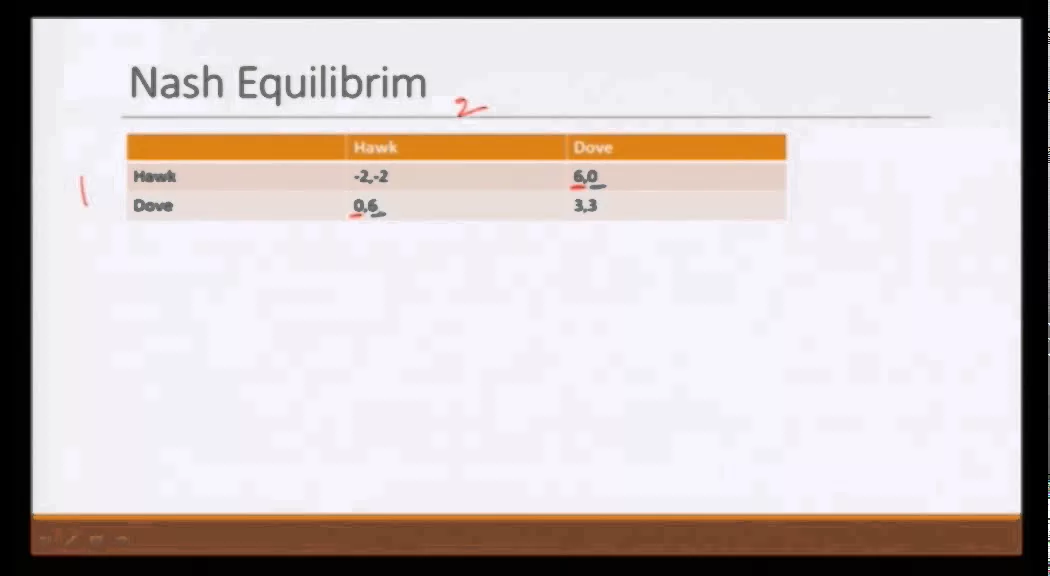
So today I'm going to spend most of today just looking at examples and talking about them. So here's another example of a game we might imagine and once again it's a two-by-two game, a nice and simple game, and here the payoffs are as follows. So down the diagonal we have 0,0, 0,0 and off the diagonal we have 2,1 and 1,2.
So what is this game essentially?
It's very, very similar to a game we've seen already in class, anybody? This is essentially Battle of the Sexes. I've taken the Battle of the Sexes Game, The Dating Game, I've just twiddled it around to make it symmetric, so this is a symmetric version of Battle of the Sexes or our dating game.
You can think of this game also in the context of driving around. So you could imagine that one version of this game, you sometimes hear this game referred to as chicken. What's the game chicken when cars are involved? Anybody?
What's the game chicken when cars are involved?
It's probably a good thing that people don't know this.
No one knows this? Okay, all right somebody knows it. Can I get the mic way back there? Yeah shout it out.
Right, so you can imagine, here we are on a road that perhaps isn't big enough to have driving and driving on the right. These two cars face each other, they drive towards each other, both of them going in the middle of the road, and the loser is the person who swerves first. If you think of A as being the aggressive strategy of not swerving and B as being the less aggressive, more benevolent strategy, if you like, of swerving--so the best thing for you is for you to be aggressive and the other person to swerve, and then at least they remain alive. Conversely, if you're benevolent and they swerve, you remain alive but they win and unfortunately now, if you're both aggressive you get nothing, and the way we've written this game, if you're both benevolent you get nothing.
You can imagine making some more negatives here.
So this is a game that seems kind of important in nature, not just in teenage male behavior but in animal behavior, since we're talking about aggression and non-aggression.
So what's evolutionarily stable in this game?
Well remember our starting point is what?
Our starting point is to look for symmetric Nash Equilibria.
So are there any symmetric Nash Equilibria in this game and if so what are they? There are some Nash Equilibria in pure strategies, there are some Nash Equilibria in this game, for example, (A,B) is a Nash Equilibrium and (B,A) is a Nash Equilibrium, but unfortunately they're not symmetric, and so far we're focusing on games that are symmetric, this is random matching. There's no asymmetry in the rows--in the row and column player, although in the handout--not the handout, in the reading packet I made for you--they do also look at some asymmetric versions of games, but for now we're just looking at symmetry. So neither (A,B) nor (B,A) will serve our purpose because they're not symmetric Nash Equilibria. In fact, there is no symmetric pure strategy Nash Equilibrium in this game.
So it can't be that if this was a species, if this was an animal that came in, that had two possible strategies, aggression or passivity, it can't be the case in this particular game that you end up with 100% aggression out there--100% aggressive genes out there--or 100% unaggressive genes out there. In either case, if you had 100% aggressive genes out there, then it would be doing very, very badly and you get an invasion of passive genes and if you had 100% passive genes out there, you'd get an invasion of aggressive genes. You can't have a pure ESS, a pure evolutionarily stable gene mix out there.
So what does that suggest? It suggests we should start looking at mixed strategies. There is a mixed strategy, there is a symmetric mixed strategy Nash Equilibrium in the game and we could go through and work it out.
We all know now--probably you've been laboring through the homework assignments--so you all know how to find a mixed strategy Nash Equilibrium in this game, you have to set the mix to make the other player indifferent between her two strategies. But this is a game we've seen already, it's essentially Battle of the Sexes, so you probably remember from a week ago what that equilibrium mix is. Can anyone remember what the equilibrium mix in Battle of the Sexes?
Its (2/3,1/3), turns out that (2/3,1/3) is a Nash Equilibrium here. So if you go back to your notes a week ago you'll find something very much like that was a Nash Equilibrium in the original version of Battle of the Sexes.
A week ago it would have been (2/3,1/3), (1/3,2/3) because things weren't symmetric. Now I've made things symmetric, it's just (2/3,1/3) for both players.
You can check it out. So what's this telling us?
It's telling us that there's at least an equilibrium in this game in which 2/3 of the genes are aggressive and 1/3 of the genes are unaggressive. But does that mean anything?
What could that mean? In terms of biology what could that mean? Well, so far, we've been looking at evolutionarily stable pure strategies and the evolutionarily stable pure strategies correspond to evolutionarily stable situations in nature which are what are called monomorphic.
Monomorphic means one shape or one type out there, but you can also have situations in nature where there are actually stable mixed types and they're called polymorphic.
It's probably not hyphenated, it's probably just one word.
So you can have a monomorphic population, that's what we've focused on so far, but you could also have a mixed population. Now for this to be a mixed population we better change the definition accordingly.
We'll come back and talk about what it means in a second a bit more, but first we better make sure we have an okay definition for it. So what I'm going to do is I'm going to drag this definition down and do something you're not meant to do usually in teaching, I'm going to use the eraser to correct my definition. So here I have my pure strategy definition and let me just change it into a definition that will allow for these polymorphic populations.
So I'm going to change this into a P, I'm going to change this pure into mixed, and everywhere you see an Ŝ I'm going to put a P,, and over here too and everywhere you see an S' I'm going to put a P.''
The reason I'm doing this this way is I want to emphasize that there's nothing new here, I'm just writing down the same definitions we had before, except I'm now allowing for the idea of populations being mixed, and I'm also, just to note in passing, I'm also allowing for the possibility that a mutation might be mixed.
Did I catch them all? So I've just gone through the definition you have and I've switched everything from pure to mixed.
So in our example does the mix 2/3,1/3 satisfy the definition above? Let's go through carefully.
So (2/3,1/3) is a Nash Equilibrium so we've satisfied part A, it's a symmetric Nash Equilibrium, so we're okay there. Is this equilibrium a strict equilibrium? Is this mixed population 2/3 aggressive and 1/3 unaggressive, or this mixed strategy, is it a strict equilibrium? How do deviations do against it?
Anybody? Go ahead.
Student: Equally well. Professor Ben Polak: Equally well, thank you.
So it can't be a strict Nash Equilibrium, because if we deviated to A we'd do as well as we were doing in the mix, or if we deviated to B, we'd do as well as we're doing in the mix. Another way of saying it is, an A mutation does exactly as well against this mix as the mix does against itself, and a B mutation does exactly as well. In fact, that's how we constructed the equilibrium in the first place.
We chose a P that made you indifferent between A and B, so in a mixed Nash Equilibrium it can't be strict since it is mixed. In a mixed Nash Equilibrium, a genuinely mixed Nash Equilibrium by definition, you're indifferent between the strategies in the mix.
So to show that this is in fact evolutionarily stable we'd have to show rule B, so we need to show--we need to check--let's give ourselves some room here--we need to check how the payoff of this strategy, let's call it P, how P does against all possible deviations and compare that with how those deviations do against themselves.
We have to make this comparison - how does this mix do against all other possible mixes versus how those mixes do against themselves? We'd have to do this, unfortunately, we'd have to check this for all possible--and now we have to be careful--all possible mixed mutations P''. So that would take us a while, it's actually possible to do. If you do enough math, it isn't so hard to do. So rather than prove that to you, let me give you a heuristic argument why this is the case.
I'm going to try and convince you without actually proving it that this is indeed the case. So here we are with this population, exactly 2/3 of the population is aggressive and 1/3 of the population is passive. Suppose there is a mutation, P'', that is more aggressive than P, it's a relatively aggressively mutation. For example, this mutation may be 100% aggressive, or at least it may be very, very highly aggressively, maybe 90% aggressive or something like that.
Now I want to argue that that aggressive mutation is going to die out and I'm going to argue it by thinking about this rule.
So I want to argue that the reason this very aggressive mutation dies out is because the aggressive mutation does very badly against itself. Is that right?
If you have a very aggressive mutant, the very aggressive mutants do very, very badly against themselves, they get 0. And that's going to cause them to die out. What about the other extreme?
What about a deviation that's very passive?
So a very nice mutation, a very passive type, for example, it could a 100% B or you know 99% B or 98% B, how will that do?
Well it turns out, in this game again, it doesn't do very well against itself and in addition, the original mix, the mixed P that is more aggressive than this very passive mutation does very well against the mutation. So the mix that's in there, the mix that's in the population already is relatively aggressive compared to this very passive mutation and so the incumbent, the relatively aggressive incumbents are doing very, very well on average against the mutation, and hence once again, this equality holds. So just heuristically, without proving it, more aggressive mutations are going to lose out here because they do very badly against themselves, and more passive mutations are going to do badly because they make life easy for P which is more aggressive. So it wasn't a proof but it was a heuristic argument and it turns out indeed to be the case.
So in this particular game, a game you could imagine in nature, a game involving aggression and passivity within this species, it turns out that in this example the only equilibrium is a mixed equilibrium with 2/3 aggressive and 1/3 unaggressive. And this raises the question: what does it mean? What does it mean to have a mix in nature? So it could mean two different things. It could mean that the gene itself is randomizing. It could mean that the strategy played by the particular ant, squirrel, lion, or spider is actually to randomize, right, that's possible. But there's another thing it could mean that's probably a little bit more important.
What's the other thing it could mean?
It could mean that in the stable mix, the evolutionarily stable population, for this particular spider say, it could be that there are actually two types surviving stably in these proportions. If you go back to what we said about mixed strategies a week ago, we said one of the possible interpretations of mixed strategies is not that people are necessarily randomizing, but that you see a mix of different strategies in society. Again in nature, one of the impossible interpretations here, the polymorphic population interpretation, is that, rather than just have all of the species look and act alike, it could be there's a stable mix of behaviors and/or appearances in this species. So let me try and convince you that that's not an uninteresting idea.
So again, with apologies I'm not a biologist, I've spent a bit of time on the web this weekend trying to come up with good examples for you and the example I really wanted to come up with, I couldn't find on the web, which makes me think maybe it's apocryphal, but I'll tell you the story anyway. It's not entirely apocryphal, it may just be that my version of it's apocryphal.
So this particular example I have in mind, is to do with elephant seals, and I think even if it isn't true of elephant seals, it's definitely true of certain types of fish, except that elephant seals make a better story. So imagine that these elephant seals--it turns out that there are two possible mating strategies for male elephant seals.
By the way, do you all know what elephant seals are?
They're these big--people are looking blankly at me.
You all have some rough image in your mind of an elephant seal? You've all seen enough nature shows at night? Yes, no, yes?
Okay, so there are two male mating strategies for the male elephant seal. One successful male mating strategy is to be the head, the dominant, or a dominant elephant male, male elephant seal, and have as it were, a harem of many female elephant seals with which the male mates with.
For the males in the room don't get too happy, these are elephant seals, they're not you guys.
So one possible successful strategy is to be a successful bull elephant seal and have many, many, many potentially wives, so to be a polygamist. Presumably to do that well a good idea, a thing that would go well with that strategy is to be huge. So you could imagine the successful male elephant seal being an enormous animal.
It looks like a sort of a linebacker in football and basically fights off all other big elephant seals that show up.
But it turns out, I think I'm right in saying if I did my research correctly, this is true among northern elephant seals but not true among southern elephant seals, so the Arctic not the Antarctic, but someone's going to correct me. Once it's on the web I'm going to get floods of emails saying that I've got this wrong.
But never mind. So it turns out that this is not quite evolutionarily stable. Why is this not evolutionarily stable? What's the alternative male strategy that can successfully invade the large bull harem keeper elephant seal? Any guesses?
Anyone looking for a successful career as an elephant seal, as a male elephant seal? Say that again?
Student: [Inaudible] Professor Ben Polak: Good, so good thank you. Did people catch that?
Good, an alternative strategy is to be a male elephant seal who looks remarkably like a female elephant seal.
Instead of looking like a linebacker, they look like a wide receiver. I'm offending somebody in the football team. You get the idea, right?
What do they do? They sneak in among these large numbers of male elephant seals and they just mate with a few of them. So they look like a female seal, and they can hide among the female elephant seals in the harem, and they mate with a few of them and provided this is successful enough it'll be evolutionarily stable for the female elephant seal to want to mate with that too. Now I forget if actually this is exactly right, but it's certainly--I did enough research over the weekend to know it's right at least in some species, and the nicest part of this story is that at least some biologists have a nice technical name for this strategy that was well described by our friend at the back, and the name for this strategy is SLF, and since we're on film I'm going to tell you what the S and the L are, but you'll have to guess the rest. So this is sneaky, this is little, and you can guess what that is.
So this turns out to be actually quite a common occurrence. It's been observed in a number of different species, perhaps not with the full added color I just gave to it. So having convinced you that polymorphic populations can be interesting, let's go back to a case, a more subtle case, of aggression and non-aggression, because that seems to be one of the most important things we can think of in animal behavior. So let's go back and look at a harder example of this, where we started.
So as these examples get harder, they also get more interesting. So that's why I want to get a little bit harder.
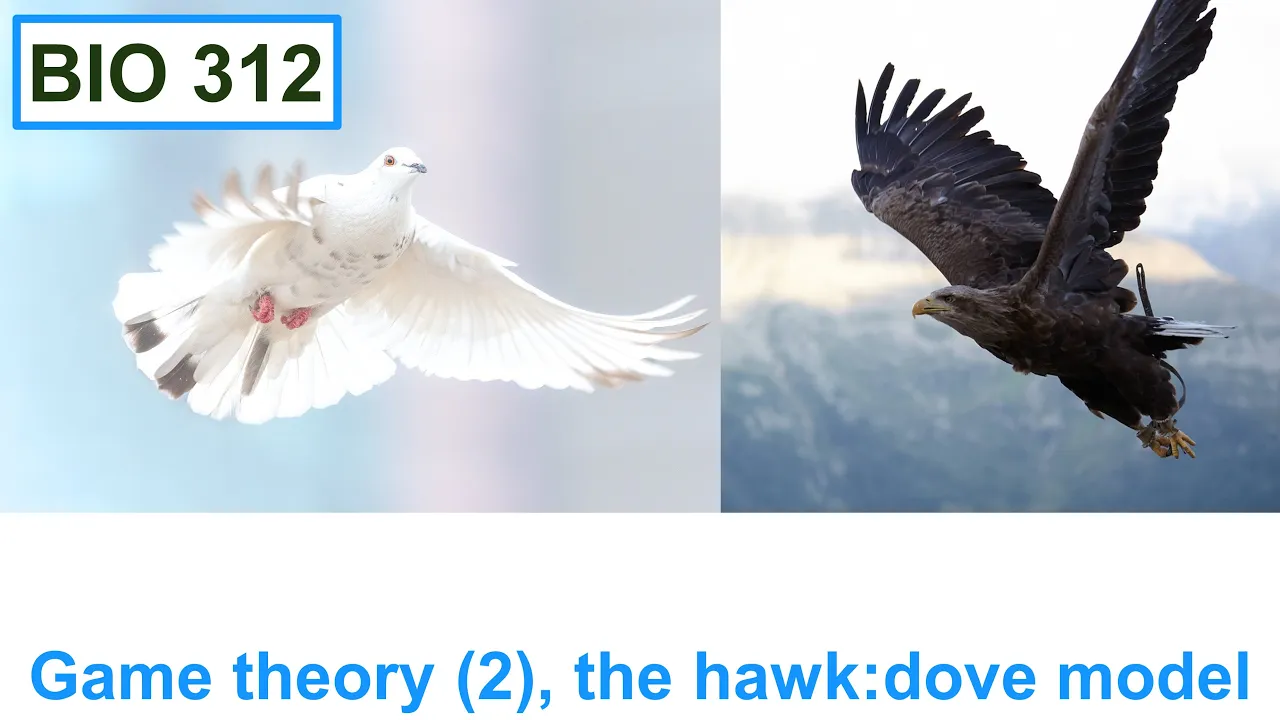
So the chicken game, the Battle of the Sexes game, is not a particularly interesting version of aggression and non-aggression. Let's look at a more general version of aggression versus non-aggression, and let's look at a game that's been studied a lot by biologists and a little bit by economists called hawk-dove.
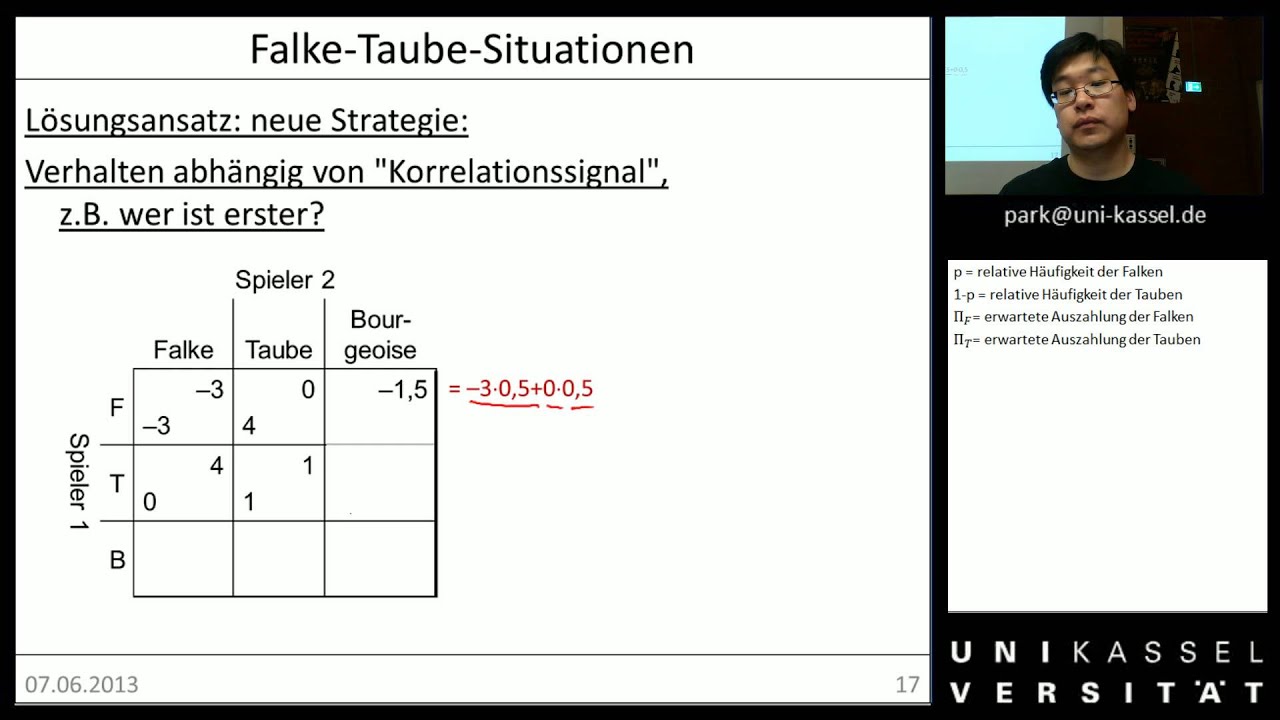
And again, just to stress, we're talking about within species competition here, so I don't mean hawks versus doves. I mean thinking of hawk as being an aggressive strategy and dove as being a dovish, a passive strategy. So here's the game and now we're going to look at more general payoffs than we did before. So this is the hawk strategy, this is the dove strategy--hawk and dove--and the payoffs are as follows. V + C--sorry, start again.
(V-C)/2 and (V-C)/2 and here we get V/2 and V/2, and here we get V and 0 and here we get 0 and V.
So this is a generalization, a more interesting version of the game we saw already. Let's just talk about it a little bit. So the idea here is there's some potential battle that can occur among these two animals and the prize in the battle is V.
So V is the victor's spoils and we're going to assume that V is positive. And unfortunately, if the animals fight--so if the hawk meets another hawk and they fight one another--then there are costs of fighting.
So the costs of fighting are C, and again, we'll assume that they're positive. So this is the cost of fighting.
This more general format is going to allow us to do two things. We're going to look and ask what is going to be evolutionarily stable, including mixtures now. And we're also going to be allowed to ask, able to ask, what happens, what will happen to the evolutionarily stable mix as we change the prize or as we change the cost of fighting? Seems a more interesting, a richer game. Okay, so let's start off by asking could we have an evolutionarily stable population of doves? So is D an evolutionarily stable strategy? I'll start using the term ESS now. So ESS means the evolutionarily stable strategy. Is D in an ESS.
So in this game, could it be the case that we end up with a population of doves?
Seems a nice thing to imagine, but is it going to occur in this game in nature? What do people think?
How do we go about checking that?
What's the first step? First step is to ask, is (D, D) a Nash Equilibrium? If it's evolutionarily stable, in particular, (D,D) would have to be a Nash Equilibrium. That's going to make it pretty easy to check, so is (D, D) a Nash Equilibrium in this game? It's not, but why not?
Because if you had a mutation, keep on tempted to say deviation, but you want to think of it as mutation.
If I had a mutation of hawks, the hawk mutation against the doves is getting V, whereas, dove against dove is only getting V/2, so it's not Nash.
So we can't have a evolutionarily stable population of doves, and the reason is there will be a hawk mutation, an aggressive type will get in there and grow, much like we had last week when we dropped Rahul into the classroom in Prisoner's Dilemma and he grew, or his type grew. So second question: is hawk an evolutionarily stable strategy?
So how do we check this? What we have to look at once again--and ask the question--this is the first question to ask is: is (H,H) a Nash Equilibrium?
So is it a Nash Equilibrium? Well I claim it depends.
I claim it's a Nash Equilibrium provided (V-C)/2 is at least as large as 0. Is that right?
It's a Nash Equilibrium--it's a symmetric Nash Equilibrium --provided hawk against hawk does better, or does at least as well as, dove against hawk. So the answer is yes, if (V-C)/2 is at least as big as 0.
So now we have to think fairly carefully, because there's two cases. So case one is the easy case which is when V is strictly bigger than C.
If V is strictly bigger than C, then (V-C)/2 is strictly positive, is that right? In which case, what kind of a Nash Equilibrium is this?
It's strict right? So if V is bigger than C then (H, H) is a strict Nash Equilibrium.
The second case is if V is equal to C, then (V-C)/2 is actually equal to 0, which is the same as saying that the payoff of H against H is equal to the payoff of dove against hawk. That correct?
So in that case what do we have to check?
Well I've deleted it now, it'll have to come from your notes, what do I have to check in the case in which there's a tie like that?
What do I have to check? I have to check--in this case I need to check how hawk does against dove, because dove will be the mutation.
I need to compare that with the payoff of dove against dove.
So how does hawk do against dove?
What's the payoff of hawk against dove?
Anybody? Payoff of hawk against dove.
It shouldn't be that hard. It's on the board: hawk against dove. Shout it out.
V, thank you. So this is V and how about the payoff of dove against dove? V/2, so which is bigger V or V/2? V is bigger because it's positive, so this is bigger so we're okay.
So what have we shown? We've shown, let's just draw it over here, we've shown, that if V is at least as big as C, then H is an evolutionarily stable strategy. So in this game, in this setting in nature, if the size of the prize to winning the fight is bigger than the cost that would occur if there is a fight, then it can occur that all the animals in this species are going to fight in an evolutionarily stable setting. Let me say it again, if it turns out in this setting in nature that the prize to winning the fight is bigger, or at least as big as, the cost of fighting, then it will turn out that it be evolutionarily stable for all the animals to fight.
The only surviving genes will be the aggressive genes.
What does that mean? So what typically do we think of as the payoffs to fight and the costs of fighting?
Just to put this in a biological context.
The fight could be about what? It could be--let's go back to where we started from--it could be males fighting for the right to mate with females. This could be pretty important for genetic fitness. It could be females fighting over the right to mate with males.
It could also be fighting over, for example, food or shelter. So if the prize is large and the cost of fighting is small, you're going to see fights in nature. But we're not done yet, why are we not done? Because we've only considered the case when V is bigger than C.
So we also need to consider the case when C is bigger than V.
This is the case where the cost of fighting are high relative to the prize in the particular setting we're looking at.
So again let's go back to the example, suppose the cost of fighting could be that the animal could lose a leg or even its life, and the prize is just today's meal, and perhaps there are other meals out there.
Then we expect something different to occur.
However, we've already concluded that even in this setting it cannot be the case only to have doves in the population. We've shown that even in the case where the costs of fighting are high relative to the prizes, it cannot be evolutionarily stable only to have dove genes around; passive genes around.
So in this case, it must be the case that if anything is evolutionarily stable it's going to be what?
It's going to be a mix. So in this case, we know that H is not ESS and we know that D is not ESS.
So what about a mix?
What about some mix P? We could actually put P the in here. We can imagine looking for a mix P, 1- P that will be stable. Now how we do go about finding a possible mixed population that has some chance or some hope of being evolutionarily stable? So here we are we're biologists.
We're about to set up an experiment.
We're about to either experiment, or about to go out and do some field work out there.
And you want to set things up. And we're asking the question: what's the mix we expect to see?
What's the first exercise we should do here?
Well if it has any hope to be evolutionarily stable, what does it have to be? It has to be a symmetric Nash Equilibrium. So the first step is, step one find a symmetric mixed Nash Equilibrium in which people will be playing P (,1- P). It's symmetric, so both sides will be playing this.
So this is good review for the exam on Wednesday.
How do I go about finding a mixed equilibrium here?
Shouldn't be too many blank faces.
This is likely to come up on the exam on Wednesday.
Let's get some cold calling going on here.
How do I find the mix strategy? Just find anybody.
How do we find--how do I find a mixed strategy equilibrium?
Student: Just use the other player's payoff.
Professor Ben Polak: I use the other player's payoffs and what do I do with the other person's payoffs?
Student: You set them equal.
Professor Ben Polak: Set them equal, okay.
So here it's a symmetric game. It's really there's only one population out there. So all I need, I need the payoff of hawk against P or (P, 1-P), I need this to be equal to the payoff of dove against this P. So the payoff of hawk is going to be what? Just reading up from up there--let's use our pointer--so hawk P of the time will meet another hawk and get this payoff.
So they'll get--so P of the time they'll get a payoff of (V-C)/2 and 1- P of the time they'll meet a dove and get a payoff of V. And dove against this same mix (P, 1- P): P of the time they'll meet a hawk and get nothing and 1-P of the time they'll meet another dove and get V/2.
Everyone happy with the way I did that?
That should be pretty familiar territory to everybody by now, is that right? So I'm going to set these two things equal to each other since they must be equal, if this is in fact a mixed strategy equilibrium.
And then I'm going to play around with the algebra.
So as to save time I did it at home, so trust me on this--this is implication with the word trust on top of it--trust me that I got the algebra right or check me at home.
This is going to turn out to imply that P equals V/C.
So it turns out that there is in fact a mixed Nash Equilibirum. There's a mixed Nash Equilibrium which is of the following form, V/C and 1-V/C played by both players.
Is this a strict Nash Equilibrium?
I've found the Nash Equilibrium, is it strict?
Everyone should be shouting it out.
Is it strict? It can't be strict because it's mixed right? By definition it's not.
It can't be strict because we know that deviating to H, or, for that matter, deviating to D yields the same payoff. So it can't be a strict Nash Equilibrium. So we need to check something.
So we need to check not strict; so we need to check whether U of P against P'' is bigger than U of P'' against itself, and we need to check this for all possible mutations P''.
Again, that would take a little bit of time to do in class, so just trust me on it and once again, let me give you the heuristic argument I gave to you before.
It's essentially the same argument.
So the heuristic argument I gave to you before was: imagine a P', a mutation, that is more aggressive than our candidate equilibrium.
If it's more aggressive then it's going to do very, very badly against itself because C is bigger than V in this case. So it's actually going to get negative payoffs against itself. Since it gets negative payoffs against itself, it turns out that will cause it to die out. Conversely, imagine a mutation that's relatively soft, that's relatively dovish, this mutation is very good for the incumbents because the incumbents essentially beat up on it or score very highly on it. So once again, the more dovish mutation will die out.
So again, that isn't a proof but trust the argument.
We need to show this but it does in fact turn out to be the case. So what have we shown here?
It didn't prove the last bit, but what we've argued is that, in the case in which the cost of fighting in nature are bigger than the prizes of winning the fight, it is not the case that we end up with a 100% doves.
So we don't end up with no fights, for example: no fights is not what we would expect to observe in nature.
And we don't end up with a 100% fights: 100% fights is not what you expect to see in nature. What we end up with is a mixture of hawks and doves, such that V/C is the proportion of hawks. So the fights that occur are essentially V/C squared. We can actually observe those fights in nature. What lessons can we draw from this? So biology lessons.
So we used a lot of what we've learned in the last day or so to figure out what the ESS was there.
We kind of did the nerdy part. Now let's try and draw some lessons from it.
So the first thing we know is--I've hidden what we care about here--so we know that if V is smaller than C, then the evolutionarily stable mixed population has V/C hawks.
So let's just see how much of this makes sense.
So as V goes up, as the prizes go up--if you took the same species and put them into a setting in which the prizes tended to be larger--what would we expect to see?
Would we expect to see the proportion of hawks up or down?
Up right: as V goes up, we see more hawks.
What else do we see? Not so surprisingly as C goes up--we look at settings where the cost of fighting is higher--we tend to see more doves.
Now this is in ESS, so more hawks in the evolutionarily stable mix. And more doves in the evolutionarily stable mix. It's possible, of course that the species in question can recognize these two different situations and be coded differently, to behave differently in these two different situations but that's beyond the class for now. Perhaps a more interesting observation is about the payoffs.
Let's look at the actual genetic fitness of the species overall. So in this mix what is the payoff? Well how are we going to figure out what is the payoff? So the payoff in this mix, we can actually construct by looking at the payoff to dove.
It doesn't really matter whether you look at the payoff to dove or the payoff to hawk. Let's look at the payoff to dove. So the payoff was what?
It was, if you were dove, then 1-V/C of the time, you met another dove and in that instance you get a payoff of V/2 and it must be the payoff to being a dove is the same since they're mixing. This is the payoff.
So what's happening to this payoff as we increase the cost of fighting? What happens as C rises?
So just to note out, what happens as C goes up?
So you might think naively, you might think that if you're in a setting, be it a social evolutionary setting or a biology, a nature evolutionary setting, you might think that as the cost of fighting goes up for you guys in society, or for the ants, antelopes, or lions we're talking about, you might think the payoffs in society go down.
Costs of fighting go up, more limbs get lost and so on, sounds like that's going to be bad for the overall genetic fitness of the species. But in fact we don't find that.
What happens as C goes up? The payoff goes up.
As C goes up, the payoff goes up.
As we take C bigger, this begets smaller, which means this is bigger. Everyone see that?
Just look at that term (1-V/C)(V/2), it's actually increasing in C. So how does that work?
As the costs of fighting go up, it's true that if you do fight, you're more likely to lose a finger, or a limb, or a claw, or whatever those things are called, or a foot or whatever it is you're likely to lose.
But the number of fights that actually occur in this evolutionarily stable mix goes down and it goes down sufficiently much to compensate you for that.
Kind of a remarkable thing. So these animals that actually are going to lose a lot through fighting are actually going to do rather well overall because of that mix effect.
I feel like it's one of those strategic effects.
Now of course that raises a question, which is what would happen if a particular part of this species evolved that had lower costs of fighting? It could regrow a leg.
Sounds like that would do pretty well, and that would be bad news for the species as a whole.
Third thing we can observe here is what's sometimes called identification.
So what does identification mean here?
It means that by observing the data in nature, by going out and filming these animals behaving for hours and hours, or changing their setting in a lab and seeing how they interact, or changing their setting in the field and seeing how they interact, we can actually observe something, namely the proportion of fights. Perhaps we can do better now and actually look at their genetics directly since science has evolved, and we can actually back out the V and the C.
By looking at the proportion of hawk genes out there or hawkish behavior out there, we can actually identify what must be the ratio of V to C. We can tell what the ratio V/C is from looking at data. We started off with a little matrix, I've just written in V's and C's, I didn't put any numbers in there. We can't tell what V is, we can't tell what C is, but we can tell what the ratio is by looking at real world data.
So if you spend enough hours in front of the TV watching nature shows you could back this out. Not literally, you need to actually do some serious work.
So this is a useful input of theory into empirical science.
You want theory to be able to set up the science so you can back out the unknowns in the theory: and that's called identification, not just in biology but in Economics as well. Now there's one other thing you'd like theory to be other than identifiable.
You'd like theory to be testable.
You'd like theory to make predictions that were kind of outside of the sample you started with.
Is what I'm saying familiar to everyone in the room.
This is a very familiar idea I'm hoping to everybody, slightly philosophy but a very familiar idea.
You have a new theory. It's one thing for that theory to explain the existing facts, but you'd like it to predict new facts. Why?
Because it's a little easy--it might be a little bit too easy to reverse engineer a model or theory to fit existing facts, but if it has to deal with new facts, that's kind of exciting, that's a real test. Does that make sense?
So you might ask about this theory, you might say, well it's just a whole bunch of 'just so stories'.
Does anyone know what I mean by a 'just so story'?
It's children's stories, written by Kipling, and people sometimes accuse a lot of evolutionary theory as being 'just so stories', because you know what the fact is already, and you reverse the game, you come up with a story afterwards. That doesn't sound like good science. So you'd like this theory, this theory that matches Game Theory with evolution, to predict something that we hadn't seen before.
And then we can go out and look for it, and see if it's there, and that's exactly what we now have.
So our last example is a slightly more complicated game again.
The slightly more complicated game has three strategies and the strategies are called, I'll tell you what the strategies are called in a second actually, I'll give you the payoffs first of all.
So once again this is a game about different forms of aggression and we'll look at other interpretations in a second. Once again, V is going to be the prize for winning, 0 is going to be the prize for losing, and 1 is if it's a tie. I'm just short sighted enough that I can't read my own writing.
So I hope I've got this right, there we go.
So this is the game, and we're going to assume that the prize V is somewhere between 1 and 2.
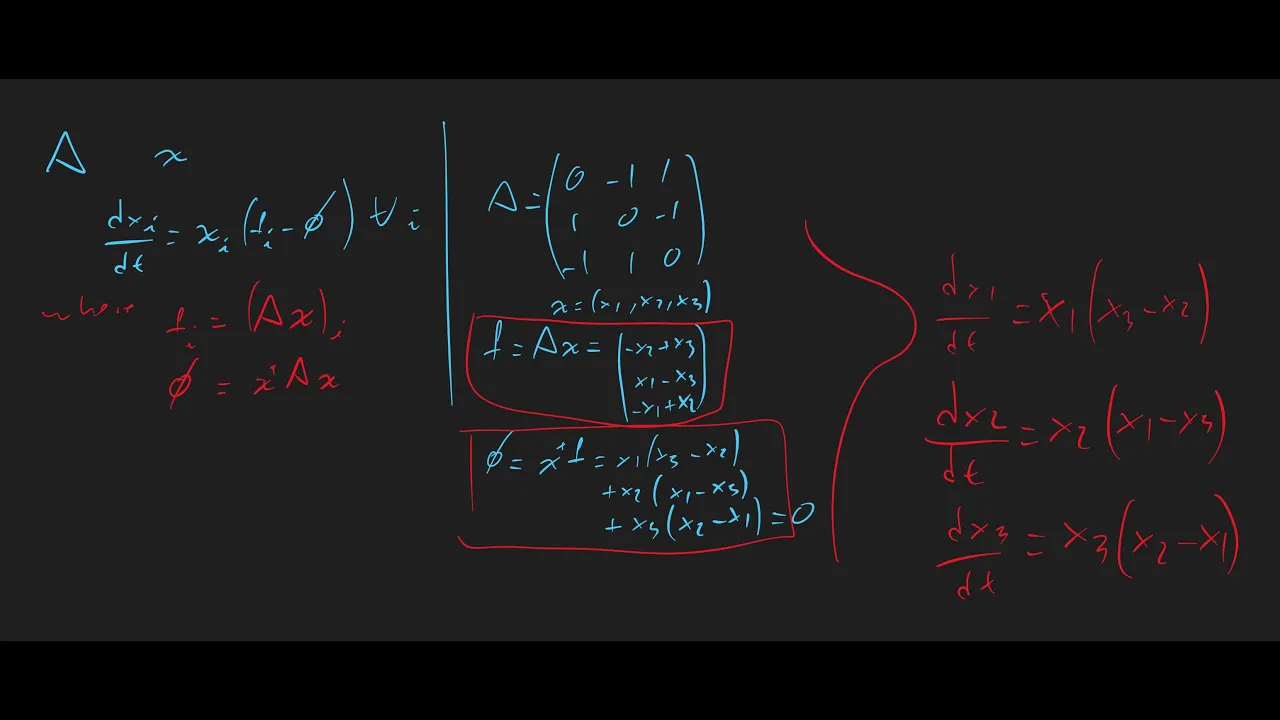
So V you can think of as winning, 0 is losing, and 1 is if it's a tie. Does anyone recognize what this game essentially is? It's essentially rock, paper, scissors. And it turns out that when biologists play rock, paper, scissors they give it a different name, they call it "scratch, bite, and trample." Scratch, bite, and trample is essentially the tactics of the Australian football team. So scratch, bite, and trample are the three strategies, and it's a little bit like rock, paper, and scissors.
How do we change it? First, we added 1 to all the payoffs to make sure there are no negatives in there and second we added a little bit more than 1 to winning.
If we added 1 to everything--sorry, a little bit less than 1 to winning.
So if we added 1 to everything then V would have been 2, but we kept V somewhere between 1 and 2.
So this is certainly a game, you can imagine in nature, there's three possible strategies for this species and the payoff matrix happens to look like this.
So where's my prediction going to come from?
Well since this is rock, paper, scissors we know that there's really only one hope for an evolutionarily stable strategy. Since it's essentially rock, paper, scissors what would, if there is an evolutionarily stable strategy or evolutionarily stable mix, what must it be? (1/3,1/3,1/3).
So the only hope for an ESS is (1/3,1/3,1/3)--let's put that in here. So (1/3,1/3,1/3) and you can check at home that that indeed is a mixed-strategy equilibrium.
And the question is: is this evolutionarily stable?
So we know it's a Nash Equilibrium that I've given you, and we know it's not a strict Nash Equilibrium.
Everyone okay with that? It can't be a strict Nash Equilibrium because it's mixed. So if this is an ESS it must be the case--we'd have to check that--let's call this P again like we've been doing--we have to check that the payoff from P against any other P' would have to be bigger than the payoff from P' against itself. We need that to be the case.
So let P' be scratch. So let's compare these things.
So U of P against scratch is what?
Well you're playing against scratch, you are 1/3 scratch, 1/3 bite, 1/3 trample. So 1/3 of the time you get 1,1/3 of the time you get nothing, and 1/3 of the time you get V. Is that right?
So your payoff is (1+V)/3. How would we do if we're scratch against scratch? The payoff of scratch against scratch is what? No prizes for this, what's the payoff of scratch against scratch?
1. Which is bigger, (1+V)/3 or 1?
Well look, V is less than 2 so (1+V)/3 is less than 1.
So 1 is bigger. So in this game the only hope for an evolutionarily stable mix was a (1/3,1/3,1/3) and it isn't stable. So here's an example.
In this example there is no evolutionarily stable strategy.
There's no evolutionarily stable mix.
Then the obvious question is, what does that mean in nature?
Can we find a setting that looks like rock, paper, scissors in nature in which nothing is ES?
If nothing is ES what's going to happen?
We're going to see a kind of cycling around.
You're going to see a lot of the scratch strategy, followed by a lot of the trample strategy, followed by a lot of the bite strategy and so on.
So it turns out that's exactly what you see when you look at these, the example I've left you on the web.
There's an article in nature in the mid 90s that looked at a certain type of lizard. And these lizards come in three colors. I forget what the colors are, I know I wrote it down. One is orange; one is yellow; and one is blue.
And these lizards have three strategies.
The orange lizard is like our big elephant bull: it likes to keep a harem of many--or a large territory with many female lizards in it to mate with.
But that can be invaded by our SLF strategy which turns out to be the yellow lizard. The yellow lizard can invade and just mate with a few of these female lizards.
But when there are too many of these sneaky yellow lizards, then it turns out that they can be invaded by a blue lizard: and the blue lizard has much smaller territories, it's almost monogamous. So what happens in nature is you get a cycle, orange invaded by yellow, invaded by blue: harem keeper invaded by sneaky, invaded by monogamous invaded by harem keeper again.
Indeed, the population does cycle around exactly as predicted by the model, so here's an example of evolutionary theory, via Game Theory, making a prediction that we can actually go off and test and find. This, for biologists, was like finding a black hole, it's a really cool thing.
We'll leave evolution here: mid-term on Wednesday, we'll come back to do something totally different next week.
See you on Wednesday.
Up Next

Auctions Explained: English & Vickrey Sealed-Bid Formats
@rhill7186
473 views•2020-06-14

Impact of Yuan in Indo-Russian Trade Amid Sanctions
@WION
261.9K views•2022-07-01

Monetary Policy Explained: Central Banking & the Fed
@YaleCourses
249.5K views•2012-04-05

The Age of Easy Money: Fed & Inflation | Full Documentary
@frontline
21.2M views•2023-03-15
Related Study Plans & Knowledge Roadmaps
Structured learning paths in Economics