





















Dark matter, thought to constitute 85% of the universe's mass, remains undetected despite decades of experimental efforts; while the DAMA/LIBRA experiment observes an annual signal that could indicate dark matter particles passing through Earth as our planet orbits the galaxy, conflicting results from other experiments and the lack of direct detection continue to challenge scientists' understanding of this mysterious substance that holds galaxies together through gravitational effects.
The Absurd Search for Dark Matter: Why Physicists Are Stuck
Added:Understanding galactic rotation curves and the observational evidence that led to the dark matter hypothesis.
Familiarity with the Standard Model of particle physics, specifically the distinction between baryonic and non-baryonic matter.
Basic knowledge of the four fundamental forces, explaining why dark matter is 'dark' (non-interactive with electromagnetism).
An overview of the current cosmological model (Lambda-CDM) and the estimated mass-energy budget of the universe.
Exploring alternative gravity theories, such as Modified Newtonian Dynamics (MOND), that attempt to explain rotational anomalies without dark matter.
Studying the physics of next-generation detectors, including axion haloscopes (ADMX) and larger liquid noble gas experiments (LZ, XENONnT).
Investigating non-WIMP dark matter candidates, such as sterile neutrinos, primordial black holes, and fuzzy dark matter.
Analyzing the broader philosophical and methodological challenges in modern physics when confronting negative experimental results.
10.8M views286.8Klikes16:32Original Release: 2022-06-02
I am at a gold mine a couple hours outside of Melbourne, because, one kilometer underground, they're putting in a detector to look for dark matter.
Let's go.
(epic music) It's gonna take 30 minutes to go down a kilometer underground.
Dark matter is thought to make up 85% of all the matter in existence.
It could form a shadow universe five times more massive than everything we can see.
Over the past several decades, over 50 experiments have tried to make a direct detection of dark matter, but none of them has found anything, except one.
Under a mountain in the Italian Alps, there is a dark matter detector called DAMA/LIBRA.
It's been collecting data for around 20 years and, every year, it sees the same peculiar results.
The rate of detections increases to a peak in June and then decreases to a minimum in November.
Some scientists think this could be the first direct evidence of dark matter.
But why would dark matter create a periodic annual signal?
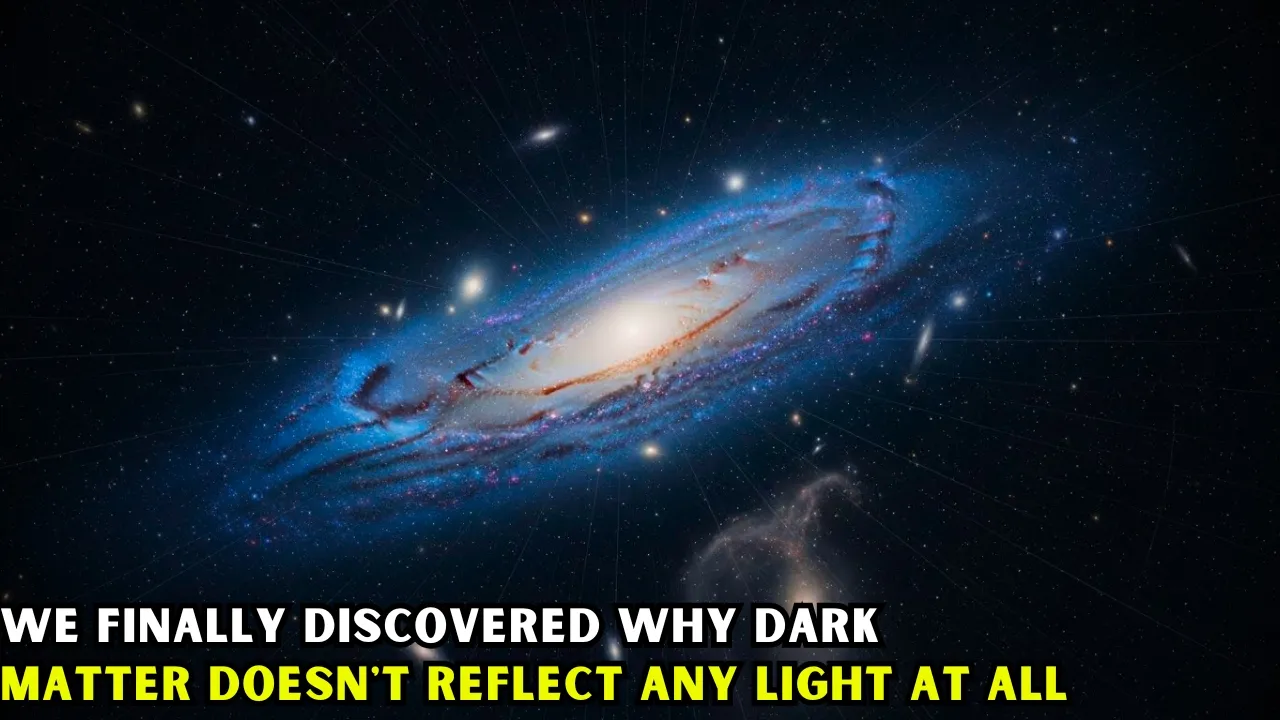
Well, this is our galaxy, or at least what it looks like with visible light.
Astronomers suspect it is surrounded and permeated by a huge sphere of dark matter, invisible particles that are zipping around all in random directions.
According to most theories, dark matter doesn't interact with anything including itself, except through gravity.
We think there should be five times as much dark matter as there is ordinary matter.
Now, our solar system is moving around the galaxy at 220 kilometers per second.
That means we're also moving through dark matter at this rate, except earth orbits the sun at 30 kilometers a second.
So, for half the year, we're moving with the sun, going faster through dark matter.
And, the other half the year, we're moving in the opposite direction, so going slower through dark matter.
And, the idea is we encounter more dark matter when we're moving through it fastest, which happens to be in June, and less of it when we're moving slowest, which happens in November.
The actual geometry is a little more complicated.
The solar system is tilted at 60 degrees relative to the plane of the galaxy, but the idea still works.
So, the signal observed at DAMA/LIBRA may be due to this motion through dark matter or it might not be due to dark matter at all.
It could just be something mundane, like the temperature, humidity, moisture in the soil, the snow on the mountain, or the number of tourists in Italy.
All of these things fluctuate with a period of one year.
And, that is why they're gonna build an almost identical experiment in the Southern hemisphere, down the bottom of this gold mine outside of Melbourne, because, there, the seasons are reversed, but our motion through dark matter is still the same.
So, if we see the same signal, it's pretty strong evidence for the existence of dark matter.
One of the big problems that DAMA/LIBRA has is that there are other very similar experiments that don't see anything.
And, this has led to a lot of uncertainty about is the DAMA/LIBRA signal really dark matter?
So, yeah, we don't know, right?
The favorite thing in science... But, why do we think dark matter exists in the first place?
In 1933, Swiss astronomer, Fritz Zwicky, was studying the coma cluster, a collection of more than a thousand galaxies.
These galaxies are gravitationally bound together.
So, they all orbit around their collective center of mass.
Zwicky measured the orbital speeds of these galaxies and found that somewhere moving way faster than he expected, it was as if there was a lot more matter in the cluster than he could see, pulling everything inwards.
So, he proposed the existence of invisible matter, which he called dunkle materie, the origin of the term dark matter.
No one really took this idea seriously, but 40 years later, dark matter turned up again.
Vera Ruben and Kent Ford observed the motion of stars in the Andromeda Galaxy.
And, they expected that the further out from the center you go, the slower the stars would be orbiting, but this is not what they found.
The rotational velocity stays almost constant with increasing distance from the center.
Without additional mass in the galaxy to pull those stars in, they should be flung off into space.
The result was the same in other galaxies.
Using radio telescopes, Albert Bosma and others measured hydrogen gas even further out from a galaxy center, but the rotational velocity still stayed constant.
One way to explain this is to posit the existence of matter we can't see, dark matter, which holds all these galaxies together.
So, let's say you have a star and this represents the mass of everything in the center of the galaxy that's pulling the star in.
The star can maintain a stable orbit if it's centripetal force is equal to the gravitational attraction to all the mass in the rest of the galaxy.
And, so you can see that at about a distance of one meter, this is the speed of the orbit.
Okay, but what happens if we add some dark matter?
So, this water bottle represents the matter we can't see, now there is more mass pulling this star into the middle, which means, at the same orbit, it can now go much faster, and, in fact, it must go faster to maintain that orbit.
And, this explains the observation.
This is what we see.
(metal clanking) (Derek laughing) By looking at the rotation speeds of stars, scientists estimate that about 85% of the mass of a galaxy is dark matter.
But, there's another way to explain these observations without invoking dark matter.
And, that is to modify our theory of gravity.
What's the supporting evidence for thinking that the particle idea is totally misguided and we should actually be looking at a revised theory of gravity?
We can either invoke something we can't see or you just say, well, the universe is what we can see, and we need a way to explain what's going on out there.
And, the only way we can do that is by modifying the laws of physics.
So, when you look at the outskirts of galaxies, they've got a lot of centripetal acceleration.
Dark matter says that well, that centripetal acceleration is due to the gravitational effect of dark matter.
Whereas, the people who like MOND will say, no, that's centripetal acceleration, that's just the fact that it's now reached this floor and can't get any lower.
So, they, they're saying that there's not additional force due to dark matter, but there's a limit to how low the acceleration could go.
I think the consensus is hugely in favor of it being a physical substance, in that it just seems reasonable that is that it could be other particles out there that we haven't seen yet.
And, there's more evidence.
This is the bullet cluster, a site where two clusters of galaxies collided.
Most of the ordinary mass of these clusters is in the interstellar gas.
And, when the collision occurred, the interstellar gas interacted, heated up, and slowed down.
So, you'd expect that most of the mass of the bullet cluster would be in the middle where all of this gas is.
But, if you use gravitational lensing, the way that gravity bends light, you can actually measure where most of the mass in this picture is.
And, it isn't in the middle.
It's actually on either side.
So, the best way to explain this is that when the clusters collided, all that gas got stuck in the middle, but the dark matter passed right through, creating the most gravitational lensing where we can see the least ordinary matter.
Even more evidence for dark matter comes from the oldest light in the universe.
380,000 years after the big bang, light could finally travel through the universe unimpeded.
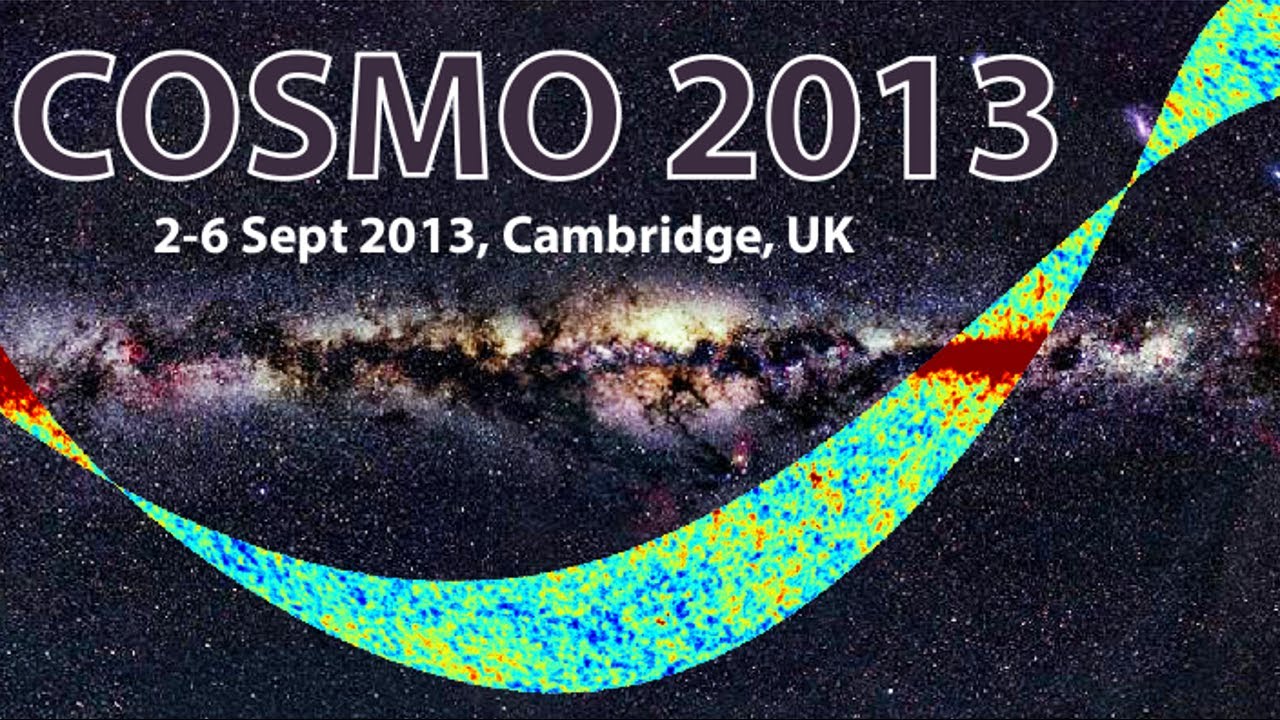
And, this is what we see as the cosmic microwave background or CMB.
The red spots show where the early universe was a little hotter and the blue spots show where it was a little cooler, but these temperature differences were tiny.
Just 0.01%, but they are there.
And, you can turn this picture into a graph by counting up how many blobs there are of different sizes.
So, there's the most common size blob, which results in this peak, but there are also other common size blobs.
And, so you get these other peaks of decreasing size.
Now, the height of these peaks depends on how much dark matter there is.
In a universe without dark matter, the graph looks like this, but as dark matter increases, the amplitudes of even numbered peaks decreases.
To match the measurements of the CMB, we need about five times as much dark matter as ordinary matter.
This figure also agrees with the amount of dark matter required to explain the motion of stars in galaxies and the motion of galaxies in clusters.
So, the dark matter hypothesis explains a lot of different observations with a simple theoretical framework, that there's some type of particle out there that only interacts through gravity.
But, what is this particle exactly?
Well, since we don't know, scientists have proposed a whole bunch of different things that it could be.
And, now we have to try to go out and find them.
The approach differs depending on what you're trying to find.
Dama Libra and the detector at the bottom of the gold mine are looking for WIMPs, weakly interacting massive particles.
These particles are expected to weigh about as much as a proton, but interact with ordinary matter extremely weakly.
At the heart of the detector, our seven seven kilogram crystals of pure sodium iodide.
So, that's actually sodium iodide in there.
Yeah.
I didn't expect it to be so clear.
The idea is that very, very rarely a dark matter particle may hit a nucleus in the crystal and transfer its energy.
This creates a flash of light called a scintillation, which is detected by photomultiplier tubes, very sensitive light detectors, which are positioned above and below each crystal.
But, there's a problem, even the purest sodium iodide crystal contains radioactive potassium.
And, when a potassium atom decays, it emits an electron and a gamma ray.
Now, the electron can cause a scintillation in the crystal just like the hypothesized dark matter particle.
So, to eliminate these events, the sodium iodide crystals are submerged in a tank full of 12 tons of linear alkylbenzene.
This is a liquid scintillator that emits light when exposed to a gamma ray and that light can then be detected by photo multiplier tubes in the tank.
So, if there's a simultaneous detection in the crystal and in the tank, it was most likely a potassium decay, not a dark matter event, but there's another problem, cosmic rays.
Energetic particles from the sun and other galaxies hit the top of Earth's atmosphere creating muons, essentially heavy electrons, which stream toward the earth at close to the speed of light.
Muons can also create flashes of light in the crystal.
This is Muon detector, and it's got these three paddles of plastic here separated by some pieces of steel.
If we see a flash of light in all three, basically the same time, then we know that Muon has passed through them.
So, if I hit reset, we can see, counting up the muons being seen.
So, it's at least a few a second.
This is why all sensitive particle detectors are located deep underground Here, we have the muon detector, now one kilometer underground, and it's been running for something like 15 minutes, and there have been no muon counts.
Yeah, we have to leave this running for a long time, I think, even if we wanted to get a single hit.
We expect the number of muons down here to be about a million less.
And, we didn't see a million at the top, so we're probably not gonna see any down here.
And, this is the whole point of putting a dark matter detector underground.
You wanna get rid of all the background that would create noise in the detector.
But, even this shielding is not enough.
We all have muon detectors immediately above the tank.
So, if a flash is seen in a crystal at the same time a muon is detected, it can be ruled out.
Being underground brings its own challenges.
The walls of the mine contain trace amounts of radioactive elements like uranium and thorium, which decay into radon gas.
The requirements here are fairly serious for dark matter experiments.
We have to completely control the environment, in particular, the radon level.
To counteract this, the walls of the cavern are coated with special paint to contain radioactive particles.
The crystals are immersed in a continuous stream of pure nitrogen gas.
And, the entire detector is shielded by 120 tons of steel and plastic.
Wow, look at the size of that cavern.
There is a lot riding on this experiment.
It will validate or disprove one of the most contentious results in physics.
So, if we see nothing, well, this is the death of DAMA/LIBRA but if we see something, well, we are all happy.
I actually like the idea that because 80% of the mass of the universe is dark matter or dark stuff, maybe there's more than just one particle that dark matter is made of.
It could be an entire dark standard model if you like.
A dark version of everything that we can see or maybe something more complex, 'cause there's so much more of it.
Like I really hope it's that.
- Do you think that dark matter interacts with ordinary matter?
- If we want to find out what this stuff is, we better hope there's some level of interaction that we can at least probe when it comes to doing experiments.
If God gave me the great book of physics and there were two sections, section A and section B, one for the luminous matter and one for dark matter, and they didn't talk to each other, I would say that was a very peculiar universe.
But, in science, we have to live with the possibility that, at some level, we may never find the answer.
It may elude us, but at least we tried.
The sponsor of this video, Brilliant, is the opposite of dark matter.
You see it everywhere and it's highly interactive.
Brilliant is an innovative stem learning platform that guides you through engaging, hands on courses in math, science, and computer science.
They have great courses on so many topics from pre-algebra to probability, to computer science fundamentals.
It's the ideal compliment to watching educational YouTube videos.
After learning about a topic, you can dive deeper and get your hands dirty, so you really understand it.
For example, if you wanna learn more about dark matter, gravitational lensing, and the cosmic microwave background, I highly recommend their astrophysics course.
A lot of care and attention goes into all their courses.
Every lesson and interactive simulation builds on what you've learned previously.
And, every step of the way, your knowledge is tested through quizzes, which check your understanding and reinforce what you've learned.
If you get stuck, there's always a helpful hint.
So, I encourage you to check out the courses on offer over at brilliant.org/veritasium.
And, I bet you'll find something there that you wanna learn more about.
Plus, if you click through right now, Brilliant are offering 20% off an annual premium subscription to the first 200 people to sign up.
So, I want to thank Brilliant for supporting Veritasium and I want to thank you for watching.
Up Next

109:27
General Relativity Lecture 1: The Equivalence Principle Explained
@stanford
4.3M views•2012-10-17

4:32
How Tuned Mass Dampers Stop Structures from Shaking
@MinutePhysics
573K views•2018-08-28

33:44
The Blue LED: A Decade-Long Scientific Challenge Explained
@veritasium
46.5M views•2024-02-08

27:14
Entropy and the Second Law of Thermodynamics Explained
@veritasium
27.5M views•2023-07-01
Related Study Plans & Knowledge Roadmaps
Structured learning paths in Physics
physics
Medical Physics: Imaging, MRI & Radiotherapy
01Foundations of Radiation and Matter Interaction
02X-Ray Imaging and Computed Tomography (CT)
03Magnetic Resonance Imaging (MRI) Physics
+ 3 more learning modules
15h6 modules
Explore Roadmap
physics
Nuclear Physics (Decay, Fission & Reactors)
01Atomic Structure and the Binding Force
02Radioactive Decay and Half-Life
03Nuclear Fission Mechanics and Chain Reactions
+ 2 more learning modules
12h5 modules
Explore Roadmap
physics
Soft Matter (Polymers, Colloids & Rheology)
01Foundations of Soft Matter & Thermal Forces
02Polymer Physics and Macromolecules
03Colloids, Surfactants, and Self-Assembly
+ 2 more learning modules
38h5 modules
Explore Roadmap
physics
Analytical Mechanics: Lagrangian & Hamiltonian
01Mathematical Foundations: Calculus of Variations
02From Newtonian Mechanics to Constraint Dynamics
03The Principle of Least Action & Lagrangian Mechanics
+ 3 more learning modules
28h6 modules
Explore Roadmap