






![10년만에 돌아온 김정운 교수의 창의성 특강 f. 문화심리학자 김정운 교수 [신과대화]](https://i.ytimg.com/vi/pG3PHxxlbNc/hqdefault.jpg)














![Dirigido por Tarkovski (1988) [Documentário Completo - Legendado PT-BR]](https://i.ytimg.com/vi/-hy-i6k2N4Q/maxresdefault.jpg)



Stream of consciousness is a literary technique that captures the continuous, unstructured flow of a character's thoughts and feelings, originating from William James's 1890 psychological concept of 'stream of thought' where thinking occurs as a mingling of ideas interrupted by environmental stimuli; this technique was first applied to fiction by Dorothy Richardson in her 1915 novel 'Pointed Roofs,' and later developed through specific forms like direct interior monologue (as seen in Joyce's 'Ulysses') and indirect interior monologue (as practiced by Virginia Woolf), which allows novelists to represent the complexity of human experience by getting inside characters' minds and showing how sense impressions, memories, and emotions mingle in daily life.
Stream of Consciousness in Modernist Novels Explained
Added:I'm Ruth Hoberman and this is an installment of The Close Reading podcast.
I'm going to be talking about "stream of consciousness," which is a term that's often used to talk about the way in which modernist novels get inside the consciousness of character's heads.
The term comes from the work of William James who was a philosopher in the late 19th century and also the brother of novelist, Henry James.
In his 1890 book, "Principles of Psychology" he uses the term "stream of thought," arguing that thinking does not happen in terms of separate ideas, but in fact, there's a mingling of ideas that is often stopped and started by the things in our environment, or by thoughts that we arrive at and then stop thinking about them.
May Sinclaire was a novelist herself and read a lot of psychology, and she took the term from William James when she reviewed a novel in 1915 by Dorothy Richardson.
The novel was called "Pointed Roofs" and it's the first volume of a multivolume book called "Pilgrimage" that follows a young girl, Miriam Henderson through her maturation.
And Richardson was really the first to spend that many volumes chronicling the thoughts passing through a single character's mind.
Sinclair, in her review, used the term "stream of consciousness" and I am going to read the opening passage, or one of the opening passages of "Pointed Roofs."
[reads passage].
You can hear that the passage is in the third person, it made her think, but it is very much a flow of thought going through Miriam's mind.
The street organ player outside her window triggers a chain of associations that have no particular logic to them, other than the fact that they all happened to Miriam in the past in the presence of that street organ sound.
"Nothing happens", Sinclair writes, "its just life going on and on."
"It is Miriam Henderson's stream of consciousness going on and on."
Now "stream of consciousness" is a kind of broad descriptive term, and sometimes it's more useful to think in terms of more specific techniques, one of which is the "interior monologue".
When the stream of consciousness is particularly extended in alogical, we often call that an interior monologue.
And this can be direct when we're in the first person and have no narrator intervening between us and the character's consciousness.
The most famous example of this comes from James Joyce's 1922 "Ulysses", which ends with Molly Bloom in bed at the end of the novel and a lot of thoughts going through her head as she's half asleep.
[reads passage].
Here we have first person and obviously no narrator making sense of what Molly is thinking, there are no sentences, there is no punctuation, it's a jumble of memories as Molly remembers being courted by her husband Leopold.
And you can also sense that at this point in the novel, Molly is half asleep, she is lying in bed, she's had sex that afternoon with a lover, and she's beginning to menstruate, and so all of these bodily experiences are shaping her thoughts as she remembers back, 20 or 30 years.
"Indirect interior monologue" does involve a narrative presence and Virginia Woolf often uses that technique.
She actually writes about narrative method in a 1919 essay called "Modern Novels", and they're talking about James Joyce, she says.... [reads passage].
Now in describing Joyce, she was also describing her own method, which she used in 1925, in which she describes the atoms as they fall upon the minds of various characters but mainly Clarissa Dalloway.
At the beginning of that novel, Clarissa steps outside her front door and thinks... [reads passage].
She's been thinking about the fact that the doors will have to be taken off their hinges in order to make space for the party that she's giving that night.
And just that thought of hinges makes her think about the sound of the hinges and sends her mind back to her young adulthood when she was at Borden, where she grew up in the country and that sets off a chain of associations in her mind.
Wolf talked in another essay in 1925 about life as a semi-transparent envelope, a luminous halo, and what she was getting at, I think, explains why she used stream of consciousness in her novels.
To get at the core of human experience she felt you had to get inside people's minds, and at the complexity of what it feels like to be a human being from day-to-day, having all of our sense impressions mingled with memories and perceptions and emotional states.
And she felt that it was the job of the novelists to get all that experience in all its complexity.
[no dialogue].
Up Next
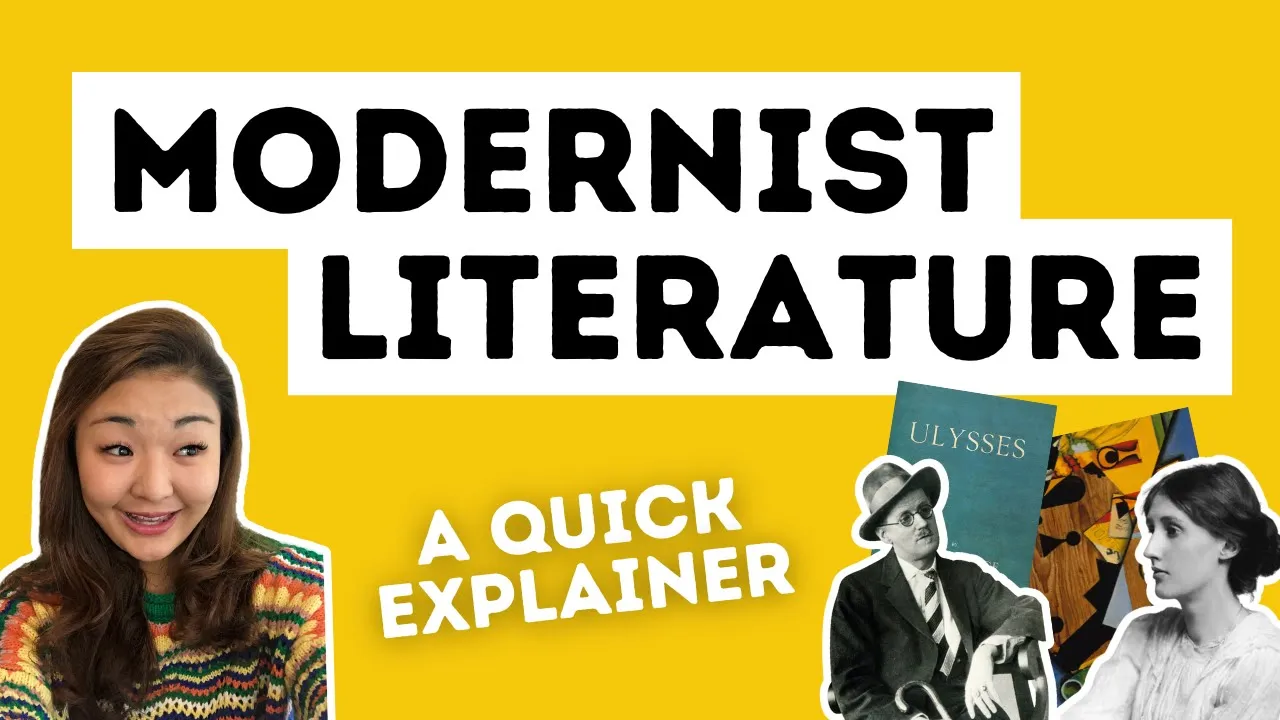
Modernist Literature: Key Concepts & Context Explained
@JenChan
22.2K views•2022-08-28

Formalism in Literary Criticism: An Academic Lecture Overview
@mattalberhasky9952
39.1K views•2015-08-05

Point of View in Fiction: First Person vs. Third Person
@magicalthriftyteacher
153.8K views•2014-03-31

1984: Orwell's Dystopian World and the Mechanisms of Totalitarianism
@AlternateHistoryHub
7M views•2017-03-04
Related Study Plans & Knowledge Roadmaps
Structured learning paths in Literature