



























Flannery O'Connor (1925-1964) was an American novelist and short story writer from rural Georgia who became a master of the grotesque in Southern Gothic literature; despite her devout Catholic faith and personal struggles with lupus, she fearlessly explored complex moral themes including the coexistence of piety and sin, racism, and redemption through her vividly drawn characters and unsavory scenarios, ultimately revealing the variety and nuance of human character.
Flannery O'Connor: Master of the Southern Gothic Grotesque
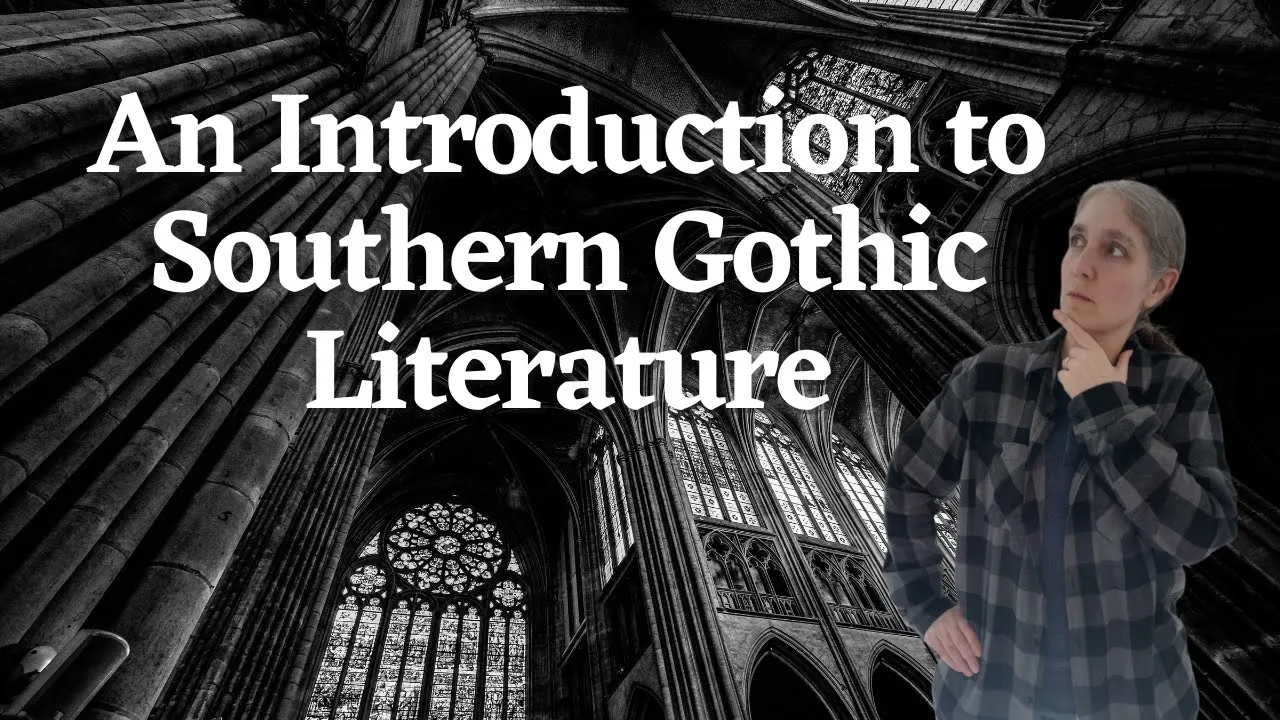
Added:Introduction to the Southern Gothic literary genre, including its defining characteristics such as decaying settings, eccentric characters, and dark humor.
The concept of the 'grotesque' in literature and art, specifically how it merges the bizarre, tragic, and comic to evoke deep emotional or intellectual responses.
Basic tenets of mid-20th-century Roman Catholic theology, particularly the concepts of original sin, divine grace, and spiritual revelation.
The socio-historical context of the post-WWII American South, including lingering tensions surrounding class, race, and changing religious landscapes.
A close reading and textual analysis of O'Connor's major short stories, such as 'A Good Man Is Hard to Find' and 'Good Country People', to identify her narrative strategies.
A comparative study of O'Connor's work alongside other prominent Southern Gothic writers, such as William Faulkner, Carson McCullers, and Cormac McCarthy.
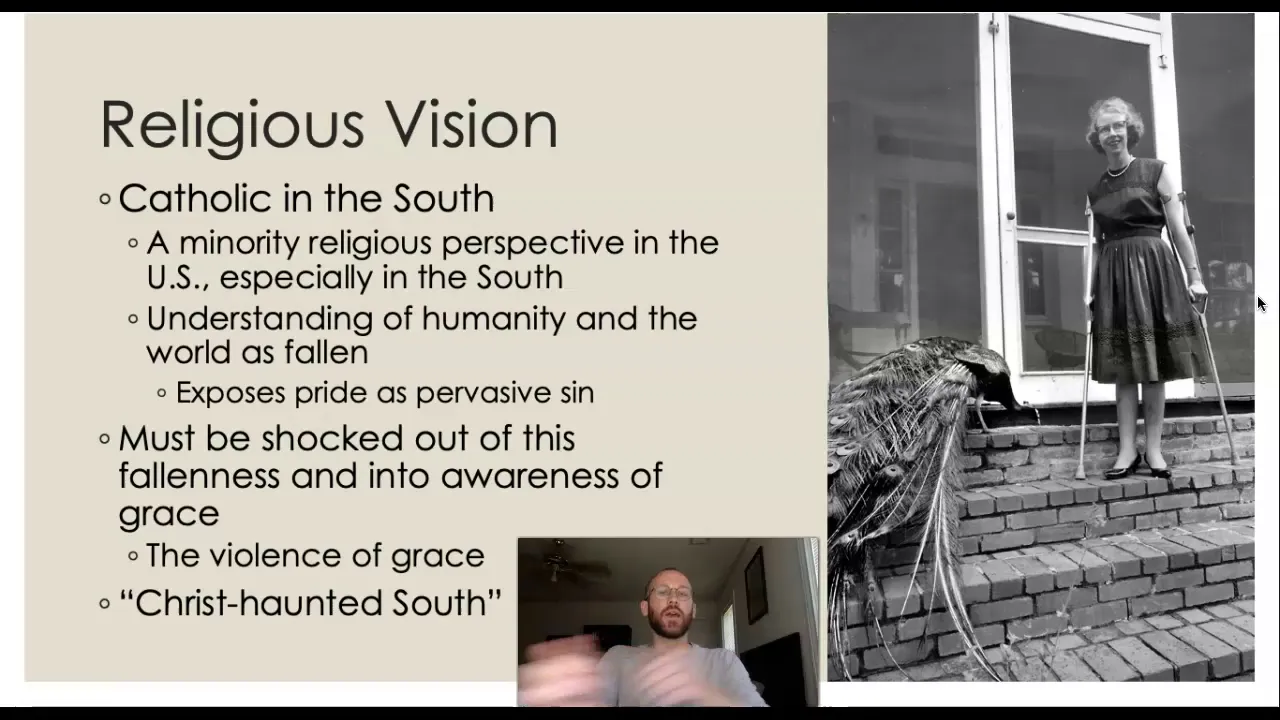
An exploration of theological literary criticism, focusing on how writers use violence and the unexpected to shock characters and readers into spiritual realization.
An examination of O'Connor's lasting influence on contemporary literature, cinema, and television that utilize Southern Gothic and neo-grotesque elements.
424.9K views10.9Klikes4:11Original Release: 2019-01-29
A garrulous grandmother and a roaming bandit face off on a dirt road.
A Bible salesman lures a one-legged philosopher into a barn.
A traveling handyman teaches a deaf woman her first word on an old plantation.
From her farm in rural Georgia, surrounded by a flock of pet birds, Flannery O’Connor scribbled tales of outcasts, intruders and misfits staged in the world she knew best: the American South.
She published two novels, but is perhaps best known for her short stories, which explored small-town life with stinging language, offbeat humor, and delightfully unsavory scenarios.
In her spare time O’Connor drew cartoons, and her writing is also brimming with caricature.
In her stories, a mother has a face “as broad and innocent as a cabbage,” a man has as much drive as a “floor mop,” and one woman’s body is shaped like “a funeral urn.” The names of her characters are equally sly.
Take the story “The Life You Save May be Your Own,” where the one-handed drifter Tom Shiftlet wanders into the lives of an old woman named Lucynell Crater and her deaf and mute daughter.
Though Mrs. Crater is self-assured, her isolated home is falling apart.
At first, we may be suspicious of Shiftlet’s motives when he offers to help around the house, but O’Connor soon reveals the old woman to be just as scheming as her unexpected guest– and rattles the reader’s presumptions about who has the upper hand.
For O’Connor, no subject was off limits.
Though she was a devout Catholic, she wasn’t afraid to explore the possibility of pious thought and unpious behavior co-existing in the same person.
In her novel The Violent Bear it Away, the main character grapples with the choice to become a man of God – but also sets fires and commits murder.
The book opens with the reluctant prophet in a particularly compromising position: “Francis Marion Tarwater’s uncle had been dead for only half a day when the boy got too drunk to finish digging his grave.” This leaves a passerby to “drag the body from the breakfast table where it was still sitting and bury it […] with enough dirt on top to keep the dogs from digging it up.” Though her own politics are still debated, O’Connor’s fiction could also be attuned to the racism of the South.
In “Everything that Rises Must Converge,” she depicts a son raging at his mother’s bigotry.
But the story reveals that he has his own blind spots and suggests that simply recognizing evil doesn’t exempt his character from scrutiny.
Even as O’Connor probes the most unsavory aspects of humanity, she leaves the door to redemption open a crack.
In “A Good Man is Hard to Find,” she redeems an insufferable grandmother for forgiving a hardened criminal, even as he closes in on her family.
Though we might balk at the price the woman pays for this redemption, we’re forced to confront the nuance in moments we might otherwise consider purely violent or evil.
O’Connor’s mastery of the grotesque and her explorations of the insularity and superstition of the South led her to be classified as a Southern Gothic writer.
But her work pushed beyond the purely ridiculous and frightening characteristics associated with the genre to reveal the variety and nuance of human character.
She knew some of this variety was uncomfortable, and that her stories could be an acquired taste – but she took pleasure in challenging her readers.
O’Connor died of lupus at the age of 39, after the disease had mostly confined her to her farm in Georgia for twelve years.
During those years, she penned much of her most imaginative work.
Her ability to flit between revulsion and revelation continues to draw readers to her endlessly surprising fictional worlds.
As her character Tom Shiftlet notes, the body is “like a house: it don’t go anywhere, but the spirit, lady, is like an automobile: always on the move.”
Up Next

64:32
Pat Conroy's The Prince of Tides | Book Club Discussion
@PatConroyLiteraryCenter
641 views•2019-08-21

13:43
Formalism in Literary Criticism: An Academic Lecture Overview
@mattalberhasky9952
39.1K views•2015-08-05
4:45
Sylvia Plath's Poetry: Why Her Unflinching Voice Still Matters
@TEDEd
2.3M views•2019-03-07

15:25
1984: Orwell's Dystopian World and the Mechanisms of Totalitarianism
@AlternateHistoryHub
7M views•2017-03-04
Related Study Plans & Knowledge Roadmaps
Structured learning paths in Literature
literature
Graphic Memoirs: Visual Art, Trauma & History
01Foundations of Sequential Art and Visual Language
02Autographics and Processing Historical Trauma
03Visualizing Personal Trauma, Grief, and Graphic Medicine
+ 2 more learning modules
14h5 modules
Explore Roadmap
literature
Campus Novels: Evolution, Themes & Critique
01Introduction to the Campus Novel Genre
02Mid-Century Satire and the Post-War Academy
03Dark Academia and the Critique of Privilege
+ 2 more learning modules
14h5 modules
Explore Roadmap
literature
Theater of the Absurd: Philosophy & Plays
01Postwar Existentialism & Historical Roots
02Dismantling Narrative: Esslin & Absurdist Conventions
03Samuel Beckett and Tragicomic Existentialism
+ 2 more learning modules
12h5 modules
Explore Roadmap
literature
Revenge Tragedy: Justice, Madness & State
01Foundations of Early Modern English Theatre
02Anatomy of Revenge: Structural Conventions
03Psychological Complexity: Madness and Melancholy
+ 2 more learning modules
15h5 modules
Explore Roadmap