Personal space and proximity refer to the physical distance individuals maintain during interactions, which varies significantly across cultures—Latin American and Middle Eastern cultures typically prefer closer proximity indicating friendliness, while North American and Northern European cultures generally require more personal space; effective cross-cultural communication requires observing others' behavior, erring on the side of maintaining greater distance when uncertain, recognizing discomfort signals like stepping back or leaning away, and asking permission when unsure about appropriate proximity levels.
Cross-Cultural Communication: Proximity and Personal Space Norms
Added:Deep Dive
Introduction to Nonverbal Communication: Understanding how eye contact, gestures, and body language convey meaning without words.

Психология общения. Урок 4. Невербальная коммуникация. Виды невербальных средств общения
22.9K
Nonverbal communication is defined as body movements expressing emotional reactions that clarify or modify verbal messages. German psychologist Carl An Hart and Charles Darwin considered it a universal international language. Modern research shows verbal communication conveys only 20-40% of information, with 60-80% transmitted nonverbally. Components include body language (facial expressions, posture, gait), proxemics (spatial organization), auxiliary means (clothing, appearance), acoustic elements (voice qualities, pauses), tactile communication (touch), and olfactory signals (scents). Nonverbal communication carries additional information about external appearance and expressive movements, with both innate and culturally conditioned components.
Click to watch →
Communication English Unit 2 Language Of Communication | English AECC | EXTRAPERSONAL COMMUNICATION
27.7K
Non-verbal communication is the process of conveying messages without using spoken or written words. It involves body language, facial expressions, gestures, and physical movements. This form of communication plays a major role in the communication process, often conveying more information than verbal language alone. Body language includes physical movements like nodding to indicate agreement. Facial expressions are powerful tools that convey emotions and attitudes. Gestures are hand movements used to explain or emphasize points. Together, these elements help communicate meaning effectively and can either reinforce or contradict verbal messages.
Click to watch →

Employability Skills Class 11 Retail Session3 Non verbal communication| part2 Communication Skills
581
Non-verbal communication is a form of communication where no words are spoken, using body language, gestures, and facial expressions instead. It strengthens messages, helps appear professional, makes spoken content more effective, and helps understand audience reactions. When verbal communication is blocked by noise or distance, non-verbal cues become essential. Types include facial expressions showing emotions, posture indicating confidence, gestures describing movements, body language conveying ideas, and touch like handshakes. Effective use involves matching expressions with speech, maintaining relaxed posture, and using appropriate gestures.
Click to watch →

MCM301 Short Lecture 8_Highlighted Questions_MCM301short Lectures_Mid Term_Full Detail In Short Time
10.2K
Non-verbal communication encompasses all communication elements except spoken words. Key components include appearance, facial expressions, eye contact, gestures, touch, posture, voice, silence, and time/space. Verbal and non-verbal messages must align for effective communication; when they contradict, people trust non-verbal cues more. Physical appearance conveys education, credibility, and social status. Facial expressions are the most powerful non-verbal tool, revealing emotions like happiness, sadness, anger, and fear. Eye contact signals interest, respect, and openness, with cultural variations in appropriate duration.
Click to watch →

Non Verbal Communication
381
Non-verbal communication refers to the transmission of messages through body language, facial expressions, gestures, and physical cues rather than spoken or written words. This form of communication is essential for effective interpersonal interaction and can convey emotions, attitudes, and intentions that may not be explicitly stated verbally. Understanding non-verbal communication helps individuals interpret social cues and improve their communication skills in various contexts.
Click to watch →
Deep Dive
The Concept of Culture and Socialization: Familiarity with how cultural backgrounds shape individual behaviors, social norms, and expectations.

Plus One Sociology | Golden questions | Eduport Plus One
5.1K
This comprehensive section covers the fundamental concepts of culture and socialization in sociology. It begins with defining culture through the perspectives of E.B. Tyler and Bronislaw Malinowski, who described culture as the complex whole including knowledge, beliefs, art, morals, law, customs, and habits acquired through society membership. The section distinguishes between material culture (tangible objects like tools, technology, and buildings) and non-material culture (intangible elements like beliefs, values, and traditions). It introduces cultural lag as the gap between rapid material change and slower cultural adaptation. The three dimensions of culture are explained: cognitive (knowledge and beliefs), normative (values and norms), and material (physical objects). Socialization is defined as the process transforming individuals into functioning members of society through learning cultural practices, values, and social skills.
Click to watch →

Plus One Humanities | Sociology - 4. Culture and Socialisation | Eduport
5.3K
Culture is a complex whole including knowledge, beliefs, art, morals, law, customs, and other capabilities acquired by man as a member of society, encompassing three dimensions: cognitive (knowledge and understanding), normative (rules and values), and material (physical objects and tools). Socialization is the process by which helpless infants gradually become self-aware, knowledgeable persons skilled in the ways of the culture into which they are born, with key agencies including family, school, peer groups, mass media, religion, and occupation groups.
Click to watch →
Culture and Socialisation class 11 One-Shot | Culture and Socialisation Class 11 | ~ Savvy Di
4.7K
Culture is the way of life encompassing beliefs, values, customs, and practices that shape human behavior, while socialization is the lifelong process through which individuals learn and internalize cultural norms, values, and behaviors from various agents like family, school, and peer groups; these two concepts are interdependent as socialization enables individuals to understand and participate in their culture, and culture provides the framework for socialization to occur.
Click to watch →
Bihar pgt Sociology NCERT CLASS 11 LESSON 4 - संस्कृति और समाजीकरण Dr Mainpal by Dr Mainpal Saharan
21.1K
Culture is a complex whole encompassing knowledge, art, beliefs, laws, customs, and traditions that members of a social system acquire, while socialization is the lifelong process through which individuals transform from biological beings into social beings by learning and internalizing social values, norms, and behaviors through agents like family, neighborhood, peer groups, schools, and mass media.
Click to watch →

Sociology Optional | Class XI NCERT Chapter 4: Culture & Socialization (Part 1) | UPSC Sociology 📚🔥
171
Culture is a common understanding acquired through living in society, encompassing cognitive (understanding), normative (rules and values), and material (tools and technology) dimensions, which helps individuals navigate social interactions and provides identity; culture is dynamic and constantly evolves, and no culture can be considered superior or inferior as each develops within its specific geographic and social context. Socialization is the process through which individuals become members of society, learning norms, values, and behaviors through primary agencies like family and secondary agencies like schools, peer groups, and religious institutions.
Click to watch →
Deep Dive
Basic Definition of Proxemics: An initial understanding of Edward T. Hall's study of space and how humans use physical distance in social interactions.

Proxemics | Proxemics in nonverbal Communication | Space Language |
1.4K
Proxemics is a type of non-verbal communication introduced by anthropologist Edward T. Hall. It refers to the study of how people use space and distance during communication, also known as 'space language' or 'distance language.' Proxemics examines the spatial relationships between communicators and how these distances affect communication effectiveness. The concept applies to various contexts including classrooms, meetings, and family interactions. Proxemics consists of four distinct levels: Intimate Space (0-1.5 feet), Personal Space (1.5-4 feet), Social Space (4-12 feet), and Public Space (12+ feet). Each zone represents a different distance range serving specific communication purposes.
Click to watch →

Why Sharing Headphones Is So Romantic
35.4K
Proxemics is the study of humans' use of space and the effects it has on emotions. Cultural anthropologist Edward T. Hall defined proxemics as 'the interrelated observations and theories of humans use of space as a specialized elaboration of culture.' This field examines how the physical distance between people influences their behavior, communication, and social interactions.
Click to watch →
UGC NET JRF Communication Classes 2026 | UGC NET JRF Communication Booster Series Class
3.3K
Proxemics (also called proxemics or proxemics) is the study of how physical space and distance are used as a form of communication. This includes the use of personal space, territorial behavior, and the physical arrangement of people in relation to each other. Proxemics can convey messages about relationships, intimacy, power dynamics, and social status.
Click to watch →

The Spider Dress That Reacts To Personal Space Invaders
537.2K
Proxemics is the study of personal space, a term coined by anthropologist Edward T. Hall in 1963. It examines how people react when others get too close or approach too quickly, providing a framework for understanding abstract questions about interpersonal distance and spatial behavior.
Click to watch →

Proxemics in Nonverbal Communication - Space And Distance In ComminicationII कितनी दूरी पर बात करें
16.3K
Proxemics is a form of non-verbal communication that involves understanding and maintaining appropriate physical space and distance during conversations. It is also referred to as physical space language or personal space language. The concept focuses on how much space people should keep between themselves and others when communicating, and when to maintain specific distances based on the relationship and context.
Click to watch →
Deep Dive
High-Context vs. Low-Context Communication: Knowing the distinction between cultures that rely heavily on explicit verbal communication versus those relying on contextual cues.
Dimensions of Culture
917
High context and low context cultures represent a key dimension of communication. Low context cultures (American, German, Scandinavian) are taught to say what they mean, so understanding them requires looking at what they said. High context cultures (Japanese, Chinese, Thai, Korean, Arabic, French, Portuguese, Italian, Spanish) use many words but the meaning is more subtle, nuanced, and circular. To understand high context speakers, one must look behind the words and at what is not said. Low context communicators are good at being clear and dealing with conflict directly, while high context communicators are more indirect. Understanding these differences is essential for effective cross-cultural interaction.
Click to watch →

CONTEXTO ALTO Y BAJO - Comunicación Intercultural
4K
Edward Hall's classification divides communication into high and low context cultures. High context communication relies on implicit, indirect verbal messages where most information exists in the physical and cultural context, requiring shared understanding and creating comfortable interpersonal relationships. Low context communication uses explicit verbal language with direct, unambiguous information, relying on written rules and logical reasoning. This framework explains why different cultures communicate differently and why misunderstandings occur between them.
Click to watch →

High Context Culture – Low Context Culture. How much information is enough?
7.5K
High context communication features implicitly embedded meaning at different levels of social and cultural context, values indirect verbal interaction, and emphasizes reading non-verbal expressions. It tends to give simple, ambiguous, non-contextual messages and uses spiral logic. Low context communication overtly displays meanings through direct communication forms, values direct verbal interaction, and places great stress on words and technical signs. It emphasizes linear logic and highly structured messages with details.
Click to watch →

On Edward T. Hall's Dimentions of Cultural Difference
214
Low context communication uses explicit verbal messages where speakers are responsible for clear, persuasive messages and listeners easily decode them. High context communication draws on context, shared knowledge, and non-verbal cues where meaning is implicit and listeners must read between the lines. Low context cultures (Northern Europe, US, UK) emphasize individualistic values, linear logic, and speaker-oriented styles. High context cultures (Asia) emphasize group-oriented values, spiral logic, and context-based understanding.
Click to watch →
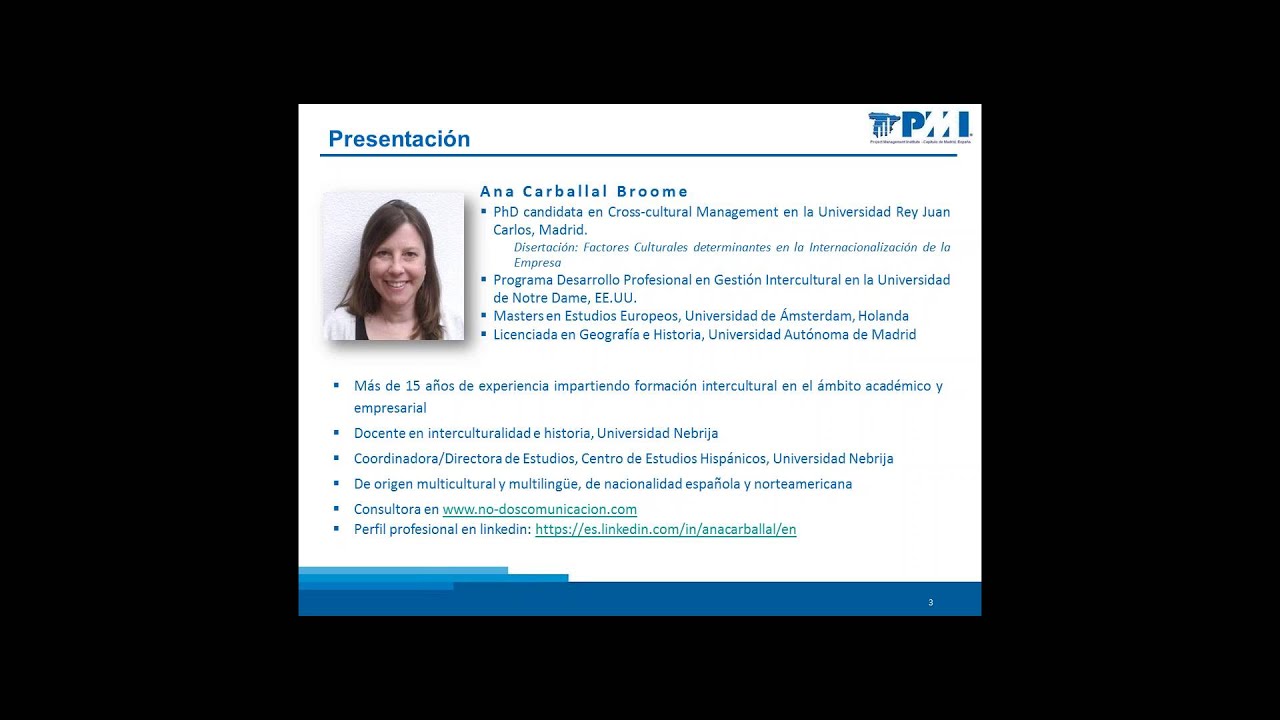
2016 02 25 18 30 Webinar Reunión de socios Febrero 2016 PMI Madrid Spain Chapter
243
High-context cultures (such as many Asian and Arab cultures, and Spain) communicate with implicit messages where meaning is derived from context, non-verbal cues, and shared understanding. Low-context cultures (such as the Netherlands, Scandinavia, and the United States) communicate explicitly with direct, clear messages. In high-context cultures, people expect others to 'read between the lines' and understand unspoken meanings, while in low-context cultures, direct communication is preferred and considered efficient.
Click to watch →
Prerequisite Knowledge
- Concept 01Introduction to Nonverbal Communication: Understanding how eye contact, gestures, and body language convey meaning without words.
- Concept 02The Concept of Culture and Socialization: Familiarity with how cultural backgrounds shape individual behaviors, social norms, and expectations.
- Concept 03Basic Definition of Proxemics: An initial understanding of Edward T. Hall's study of space and how humans use physical distance in social interactions.
- Concept 04High-Context vs. Low-Context Communication: Knowing the distinction between cultures that rely heavily on explicit verbal communication versus those relying on contextual cues.
Subsequent Learning
- Step 01Cross-Cultural Haptics (Touch) and Kinesics (Body Movement): Exploring other dimensions of physical communication beyond distance, such as handshakes, bowing, and physical touch.
- Step 02Intercultural Negotiation Tactics: Applying spatial awareness and nonverbal sensitivity to international business negotiations and conflict resolution.
- Step 03Global Workplace Etiquette: Studying specific professional standards regarding personal space and interaction in multicultural organizations.
- Step 04Environmental and Spatial Design (Architectural Proxemics): Understanding how different cultures design office spaces, public transport, and urban environments based on spatial preferences.
Defining Space
Cultural Norms
Defining Space
0:00Playing Section
- 1
Explains personal space as an invisible boundary during interactions.
- 2
Discusses how proximity affects communication comfort and connection levels.
The Critique of Cultural Essentialism in Proxemics
While traditional cross-cultural communication frameworks categorize nations into rigid personal space archetypes (such as Edward T. Hall's 'high-contact' versus 'low-contact' cultures), critics argue this approach promotes cultural essentialism and stereotyping. This counterpoint suggests that teaching fixed cultural norms oversimplifies human interaction. Modern sociolinguists and psychologists emphasize that personal space is highly dynamic and influenced more by immediate situational context, individual personality, gender, age, urban density, and power dynamics than by national origin. Furthermore, in increasingly globalized and multicultural English-speaking environments, individuals frequently adapt, code-switch, and negotiate spatial boundaries in real-time, rendering static cultural generalizations obsolete and potentially misleading.
Deep Dive
Cross-Cultural Haptics (Touch) and Kinesics (Body Movement): Exploring other dimensions of physical communication beyond distance, such as handshakes, bowing, and physical touch.
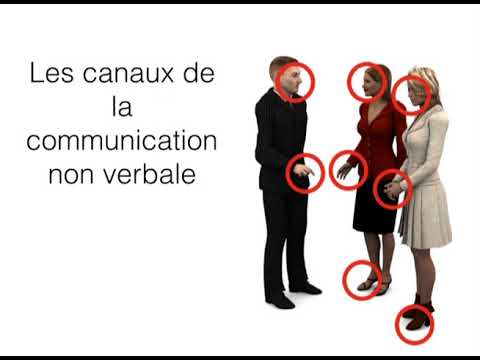
Pierrich Plusquel - La science derrière le langage du corps
126.2K
Proxemics studies personal space, with the personal zone approximately 70 centimeters around a person. The amygdala activates when someone approaches too closely. Cultural factors significantly influence personal space norms—Turkish people stand closer together than Americans. People with autism spectrum disorder have a personal space of about 3 meters, while maltreated children maintain approximately 1.5 meters. Haptics studies touch, which covers 16% of body weight and significantly influences perception. Research shows brief touch (one second) makes people perceive others as more likable and honest. Kinesics studies body movements and posture, with the 'akimbo' posture (hands on hips) signaling power and dominance. Walking style reveals emotions: anger shows heavier gait, sadness shows reduced movement, and joy shows faster pace.
Click to watch →

Non-verbal Communication||Meaning||All Types Of Communication||Kinesics||Proxemic||Haptic||Chromatic
110
Kinesics is communication through body movements and gestures, culturally bound. Hand and leg positions communicate: hands on chin indicate thinking, hands on head indicate boredom, thumbs up signals approval, hands in pockets show defensiveness, finger tapping indicates impatience, nose touching suggests lying. Gestures include: hands on hips (aggression), legs crossed (relaxation), hands clasped (defensiveness), walking straight (confidence), head down (depression). Body posture: open indicates confidence, closed indicates nervousness, leaning forward shows interest, leaning backward shows disinterest. Proxemics studies how physical space between individuals influences communication. Four zones exist: intimate (0-1.5 feet) for close relationships, personal (1.5-4 feet) for friends, social (4-10 feet) for business encounters, and public (10+ feet) for public spaces. Furniture arrangement communicates relationship dynamics: face-to-face indicates interview or superior-subordinate, side-by-side indicates equality or collaboration, back-to-back indicates separation. Haptics is touch communication: handshakes (dominant, submissive, equal, aggressive, finger-tip), hugs/kisses (personal choice, culture-dependent).
Click to watch →

МУЖЧИНА С ПОДВОХОМ | Разоблачение Валентина Шишкина
546.4K
Kinesics is the study of non-verbal communication through body language. The speaker introduces Valentin Shishkin as the founder of kinesics, though the first book on this topic was published in 1952. The speaker demonstrates practical applications of kinesics, including proper techniques for standing up from a chair, taking selfies, and drinking from a glass. The crab vs. button concept illustrates how people perceive each other differently based on their own self-perception.
Click to watch →

Classifying Communication, verbal, kinesis, haptics, proxemics, chronemics, business communication
488.7K
Haptics refers to the study of touch as a form of non-verbal communication. Touch conveys emotions, intentions, and social meanings through physical contact. Different types of touch communicate different messages: a warm embrace conveys happiness and affection, while a slap conveys anger or punishment. Cultural norms and relationship contexts determine what types of touch are appropriate in different situations.
Click to watch →

NON-VERBAL COMMUNICATION| COMMUNICATION| NTA UGC NET EXAM |PAPER 1
229
Non-verbal communication encompasses six main types: Kinesics (body movements), Proxemics (space usage), Haptics (touch), Oculesics (eye behavior), Vocalics (vocal cues), and Body Language. Kinesics includes emblems (finger on lips), illustrators (showing five fingers), affective displays (facial expressions), regulators (nodding), and adapters (nail-biting). Proxemics divides space into intimate (1.5 feet), personal (1.5-4 feet), social (4-12 feet), and public (12-25 feet) zones. Haptics, derived from Greek 'hapticos' meaning touch, includes handshakes and kisses.
Click to watch →
Deep Dive
Intercultural Negotiation Tactics: Applying spatial awareness and nonverbal sensitivity to international business negotiations and conflict resolution.

Overcome these 3 typical East-West negotiation mistakes
303
Intercultural negotiators commonly make three critical mistakes: (1) neglecting intercultural preparation entirely, (2) confusing national culture with personal negotiation style, and (3) doing preparation but forgetting it under negotiation pressure. These mistakes are particularly damaging because the first 3-5 minutes of any negotiation are decisive. Effective preparation requires researching individuals through LinkedIn and company websites, understanding cultural etiquette including greetings and body language, and using resources like Erin Meyer's Culture Map. Crucially, only about half of people from any country represent their culture's typical negotiation style, so individual assessment through profile analysis and behavioral cues is essential.
Click to watch →

POURPARLER - Mieux négocier grâce aux neurosciences - Erwan Deveze
33K
Cross-cultural negotiation requires understanding that interpreters are the most important team members, serving as gateways to understanding other cultures. The first rule is avoiding moralizing—lecturing about what is wrong (torture, killing) causes immediate loss of legitimacy. The appropriate approach is adopting a low posture, refusing power struggles, and seeking understanding without judgment. This is essential when dealing with people who have experienced decades of war and conflict.
Click to watch →
GF3 - Clase 11 - Diplomado en Consulta Previa - Julio Cesar Alvear
112
Effective intercultural negotiation requires specific skills including active listening, patience, and the ability to understand different perspectives. Active listening involves giving 100% attention to the speaker, not interrupting or contradicting, helping the speaker deepen their ideas, and listening beyond words to understand the full message. Intention is a creative principle in negotiation, as the intention of each party affects the outcome and durability of agreements.
Click to watch →

EIPM Webinar: intercultural intelligence and Negociations
163
This section provides strategies for handling cultural tensions during negotiations. Three main approaches exist: clarification (restating confusing elements to diffuse misunderstandings), breaks (coffee breaks or rescheduling to reset emotions and reduce tension), and empathy (using trained awareness of cultural differences and counterpart emotions to manage conflicts calmly). Empathy involves asking clarifying questions and ideally being prepared in advance. Reducing stress and building trust requires showing genuine respect and interest in counterparts' beliefs and cultural needs, creating empathy without needing complete personal knowledge. This approach builds professional closeness through negotiations while transcending cultural barriers.
Click to watch →
![¿Cómo tener éxito en una negociación intercultural? CORTHORN, Diego. [14 de junio de 2023]](https://i.ytimg.com/vi/F22RDOp6WJA/maxresdefault.jpg)
¿Cómo tener éxito en una negociación intercultural? CORTHORN, Diego. [14 de junio de 2023]
641
Successful intercultural negotiation requires understanding cultural differences through frameworks like Richard Lewis's model (linear-active, multi-active, and reactive cultures), conducting thorough pre-negotiation research including BATNA (Best Alternative to Negotiated Agreement), adapting communication styles (verbal and non-verbal), and building trust through empathy and respect for cultural norms; effective negotiators must be prepared with clear objectives, understand the other party's interests, and employ collaborative strategies that create value for all parties involved.
Click to watch →
Deep Dive
Global Workplace Etiquette: Studying specific professional standards regarding personal space and interaction in multicultural organizations.

Workplace Series: Workplace Etiquette
2.5K
Workplace etiquette encompasses 11 key principles: arriving early (at least 5 minutes), maintaining personal and workspace cleanliness, respecting personal boundaries and avoiding gossip, practicing health consciousness in interactions, not interrupting others, respecting co-workers by avoiding inappropriate comments, honoring commitments, being proactive in work, greeting others politely, wearing appropriate clothing, and being clear about your intentions to prevent misunderstandings.
Click to watch →

ITI Employability Skills Question Paper 2025 Set-01 | ITI Employability Skills 2nd Year
53.8K
Workplace etiquette is a code of behavior based on respect, values, and professionalism. It refers to the proper conduct and behavioral standards expected in professional work environments, encompassing how individuals should interact with colleagues, supervisors, and clients.
Click to watch →

Workplace etiquette ..Josh & letsbeu
2K
To handle workplace negativity and fake colleagues, remember your primary purpose is to earn a paycheck, not to make friends or socialize; ignore people who throw shade because they are miserable, and maintain professional boundaries by not sharing personal information on social media platforms like Facebook and Instagram, especially with coworkers, to protect your professional reputation and avoid workplace conflicts.
Click to watch →

कार्यस्थल पर किन शिष्टाचारों का रखे ध्यान | Office Etiquettes | Empowered Employees - Ep. 3
108
Workplace etiquette refers to the code of conduct expected in professional environments, functioning as the 'glue' that holds organizational culture together. Research shows good etiquette increases productivity by 20%, happiness by 70%, and networking by 85%. Communication etiquette encompasses verbal language standards, avoiding discriminatory words, and using respectful, culturally refined language like 'Ganga-Jamuni Tehzeeb'. Phone etiquette requires treating voice calls as in-person interactions, compensating for absent body language through more polite and informative communication.
Click to watch →

Workplace Etiquette Part 2.wmv
59.8K
Professional workplace conduct requires maintaining appropriate boundaries, avoiding gossip and inappropriate comments, using proper communication etiquette in emails and phone calls, and understanding that inappropriate behavior can result in serious consequences including termination or legal action.
Click to watch →
Deep Dive
Environmental and Spatial Design (Architectural Proxemics): Understanding how different cultures design office spaces, public transport, and urban environments based on spatial preferences.

Students propose bubble diagrams from their plant idea / ARCH DESIGN 4 WEEK 7 B / Zoom Raw Footage
513
This segment explores proxemics and spatial intimacy in architectural design. Proxemics refers to the study of how people use space and the distances they maintain from others. In thermal bath design, the steam creates different levels of intimacy within the space. Thicker steam creates more private areas with smaller radii, while thinner steam creates more public areas with larger radii. The design can use vapor pressure to determine the height of spaces and create different zones of intimacy. This approach allows designers to create spaces that respond to user needs for privacy and social interaction, with different areas offering different levels of openness and enclosure.
Click to watch →

ARCH 1311 Lecture 27 - Video #1: Architectural Determinism
1.6K
Proxemics is the study of nonverbal communication related to personal space and how comfortable people are with others at certain distances. It varies by culture—some cultures are more formal and uncomfortable with close proximity, while others are more comfortable with it. Typical North American norms include: intimate space (within 2 feet), personal space (2-4 feet), social space (4-12 feet), and public space (more than 12 feet). These distances influence architectural boundaries and spacing for workspaces and living spaces. Open relationships allow people to face each other directly, while blocked relationships (such as having a desk between people) create psychological and physical barriers. This is common in offices where people feel more protected behind desks. Architects study proxemics to determine appropriate space sizes and configurations that support comfortable human interaction.
Click to watch →

WAFVirtual 2020 - Thinkspace
130
Anthropologist Edward Hall's proxemics theory identifies four types of personal space: social space (8-10 meters for identification), personal space (for facial recognition and mood inference), conversation space (up to 1.25 meters for verbal interaction), and intimate space (reserved for close relationships, with unauthorized entry constituting aggression). Humans process billions of bits of environmental information through sensory pathways, with conscious processing capacity around 80 bits per second versus total capacity of 11 million bits per second. The conversational space of approximately 1.2 meters is physiologically determined by voice acoustics, ear function, and visual perception. Sound stimuli are processed faster than visual stimuli, explaining why musicians play by ear. Time operates at multiple scales simultaneously, with social interactions occurring at specific temporal frequencies. Compressing time or forcing behavioral patterns through space design induces stress, while appropriate spatial configurations promote healthy human encounters and well-being.
Click to watch →

INFS 325 Session 5 - Non-Verbal Communication
1.4K
Proxemics examines how space and territory communicate meaning. Physical positioning—sitting beside versus across someone—indicates intimacy levels. Environmental arrangements including office design, furniture placement, and desk size convey personal and organizational identity. Higher status individuals typically have more space and better-protected territories. Time usage also communicates status, as keeping others waiting signals authority. These environmental cues work alongside body language to create comprehensive nonverbal messages about individuals and their positions within social hierarchies.
Click to watch →
![Can we REALLY build on Mars? [SPACE ARCHITECTURE]](https://i.ytimg.com/vi/N3KxgUxPhqI/maxresdefault.jpg)
Can we REALLY build on Mars? [SPACE ARCHITECTURE]
1.2M
Edward T Hall's concept of proxemics reveals humans possess an innate spatial dimension governing relationships to others and surroundings. Disruption of these dimensions through crowding or poor design causes severe psychological impacts, as demonstrated by Norwegian rat experiments where 48 rats without personal space experienced population boom followed by extinction due to behavioral distortion, tumors, and organ enlargement. Despite human cognitive sophistication, our limbic system—the brain's emotional processing center—remains evolutionarily ancient with direct brainstem connections, meaning instincts still influence behavior. Cultural backgrounds further shape spatial needs: Japanese culture historically used paper walls for selective auditory filtering and softer speech, while German culture requires thick soundproof walls to prevent intrusion feelings. Effective enclosed environment design must account for these invisible spatial dimensions alongside physical performance requirements.
Click to watch →
Defining Space
Cultural Norms
Defining Space
0:00- 1
Explains personal space as an invisible boundary during interactions.
- 2
Discusses how proximity affects communication comfort and connection levels.
The Critique of Cultural Essentialism in Proxemics
While traditional cross-cultural communication frameworks categorize nations into rigid personal space archetypes (such as Edward T. Hall's 'high-contact' versus 'low-contact' cultures), critics argue this approach promotes cultural essentialism and stereotyping. This counterpoint suggests that teaching fixed cultural norms oversimplifies human interaction. Modern sociolinguists and psychologists emphasize that personal space is highly dynamic and influenced more by immediate situational context, individual personality, gender, age, urban density, and power dynamics than by national origin. Furthermore, in increasingly globalized and multicultural English-speaking environments, individuals frequently adapt, code-switch, and negotiate spatial boundaries in real-time, rendering static cultural generalizations obsolete and potentially misleading.
Introduction to Nonverbal Communication: Understanding how eye contact, gestures, and body language convey meaning without words.
The Concept of Culture and Socialization: Familiarity with how cultural backgrounds shape individual behaviors, social norms, and expectations.
Basic Definition of Proxemics: An initial understanding of Edward T. Hall's study of space and how humans use physical distance in social interactions.
High-Context vs. Low-Context Communication: Knowing the distinction between cultures that rely heavily on explicit verbal communication versus those relying on contextual cues.
Cross-Cultural Haptics (Touch) and Kinesics (Body Movement): Exploring other dimensions of physical communication beyond distance, such as handshakes, bowing, and physical touch.
Intercultural Negotiation Tactics: Applying spatial awareness and nonverbal sensitivity to international business negotiations and conflict resolution.
Global Workplace Etiquette: Studying specific professional standards regarding personal space and interaction in multicultural organizations.
Environmental and Spatial Design (Architectural Proxemics): Understanding how different cultures design office spaces, public transport, and urban environments based on spatial preferences.
279 views2likes3:29@SpeakFluentEnglishNowOriginal Release: 2023-07-20
understanding proximity and personal space a cross-cultural perspective hello everyone today we're going to discuss a very interesting aspect of English conversational practice proximity and personal space just about the words we use but also the non-verbal cues that often shape our interactions it's important to understand these nuances especially as they can vary greatly from culture to culture when we interact with others we unknowingly maintain a certain distance from them this invisible boundary is what we call personal space similarly proximity refers to the physical closeness or distance between two individuals during interaction both personal space and proximity play a critical role in communication shaping how comfortable we feel and how well we connect with others [Music] different cultures have different norms for proximity and personal space In some cultures such as many Latin American and Middle Eastern societies closer proximity is common indicating friendliness and Trust on the other hand cultures like those in North America and Northern Europe typically prefer more personal space it's essential to be aware of these cultural variations to ensure respectful and effective communication in many English-speaking cultures particularly the United States and the United Kingdom maintaining a certain level of personal space is common this is especially the case in professional or formal settings in casual settings the boundaries can be somewhat relaxed however it's always better to err on the side of caution and maintain a respectful distance until a closer proximity Is explicitly established to ensure respectful interaction in English-speaking cultures here are a few key tips 1. observe and mimic pay attention to how others are interacting if they maintain a certain distance do the same 2. air on the side of more space if unsure it's better to maintain more space rather than less 3. be aware of discomfort signals if someone steps back or leans away from you they may feel their personal space is being invaded respect that and adjust your distance 4. ask if uncertain if you're unsure it's always better to ask people generally appreciate the respect for their personal space and comfort understanding the concept of proximity and personal space and how they vary across cultures can greatly enhance our communication skills and relationships remember when in doubt it's always better to maintain a bit more space and be sensitive to the other person's comfort communicating and we'll see you in our next video
Up Next

58:33
Ayahuasca & Amazonian Shamanism: Substance, Soul, and Sensation
@entheonaut6018
264 views•2018-07-04

26:41
Sensory Ethnography Explained by Sarah Pink | Research Methods
@NCRMUK
26.1K views•2015-03-27

4:45
Proxemics Explained: The Study of Personal Space
@Vox
536K views•2016-07-05

10:38
Psychology of Internet Trolling and Pranks Explained
@AzzyLand
10.7M views•2017-12-20
Related Study Plans & Knowledge Roadmaps
Structured learning paths in Anthropology
anthropology
Sensory Anthropology (Culture & Perception)
01Foundations of Sensory Anthropology
02Soundscapes and Acoustic Ecology
03Smellscapes and the Anthropology of Odor
+ 3 more learning modules
14h6 modules
Explore Roadmap
anthropology
Space Anthropology: Analogs, Culture & Habitats
01Foundations of Space Anthropology & Cosmic Imaginaries
02Extreme Isolation & Micro-Societies in Orbit
03Space Analog Habitats & Earth-Based Simulations
+ 2 more learning modules
15h5 modules
Explore Roadmap
anthropology
Legal Anthropology: Customary Law & Pluralism
01Foundations of Legal Anthropology and Social Justice
02Legal Pluralism: Coexisting Legal Systems
03Customary Law and Indigenous Dispute Resolution
+ 2 more learning modules
15h5 modules
Explore Roadmap
anthropology
Global Tourism: Gaze, Authenticity & Heritage
01Introduction to the Sociology of Tourism
02The 'Tourist Gaze' (John Urry)
03Staged Authenticity in Tourism
+ 3 more learning modules
14h6 modules
Explore Roadmap