A closure is a function that captures and maintains access to variables from its enclosing scope, allowing it to remember and modify those variables even after the outer function has finished executing. This enables the inner function to keep state across multiple calls, such as incrementing a counter that persists between invocations.
Understanding JavaScript Closures: A Simple Breakdown
Added:Deep Dive
Understanding JavaScript scope (lexical, global, and local scope) and how variable accessibility is determined.

Master JavaScript Closures: Ace Your Next Tech Interview with These Key Tips!
70K
Lexical scope determines a variable's accessibility based on where it is declared in the source code, not where it is called. Variables declared outside a function are accessible inside that function and its nested functions. When a variable is declared inside a function, the JavaScript engine searches for it in the parent scope first, then continues searching up the scope chain until it reaches the root. This means variable accessibility is determined by the declaration position in the code structure.
Click to watch →

Scope trong JavaScript | Phạm vi truy cập trong JavaScript
49.1K
Scope in JavaScript determines where variables can be accessed and used. There are three types: Global Scope (variables declared outside any function accessible everywhere), Block Scope (variables declared with 'let' or 'const' inside curly braces only accessible within that block), and Function Scope (variables declared inside a function only accessible within that function). Functions declared in the global scope can be called from anywhere. Each function call creates a new scope, meaning variables declared inside a function are not shared between different calls. Functions declared inside another function are only accessible within the outer function. Functions can access variables from their own scope and parent scopes (scope chaining). Variables declared in outer scopes can be accessed from inner scopes, but variables declared in inner scopes cannot be accessed from outer scopes. Scope can be visualized as nested boxes where the global scope is the largest box containing all other scopes. When accessing a variable, JavaScript searches in the current scope first, then parent scopes, and finally the global scope. Variables declared after they are used will cause a ReferenceError. Global variables persist in memory until the program ends, which is why they should be used sparingly. Variables declared with 'let' or 'const' in blocks are automatically cleaned up when the block ends. Functions declared inside other functions are cleaned up when the outer function completes. However, when a function is returned from another function, the returned function maintains references to variables in its scope (closure), meaning those variables are not cleaned up even after the outer function completes.
Click to watch →
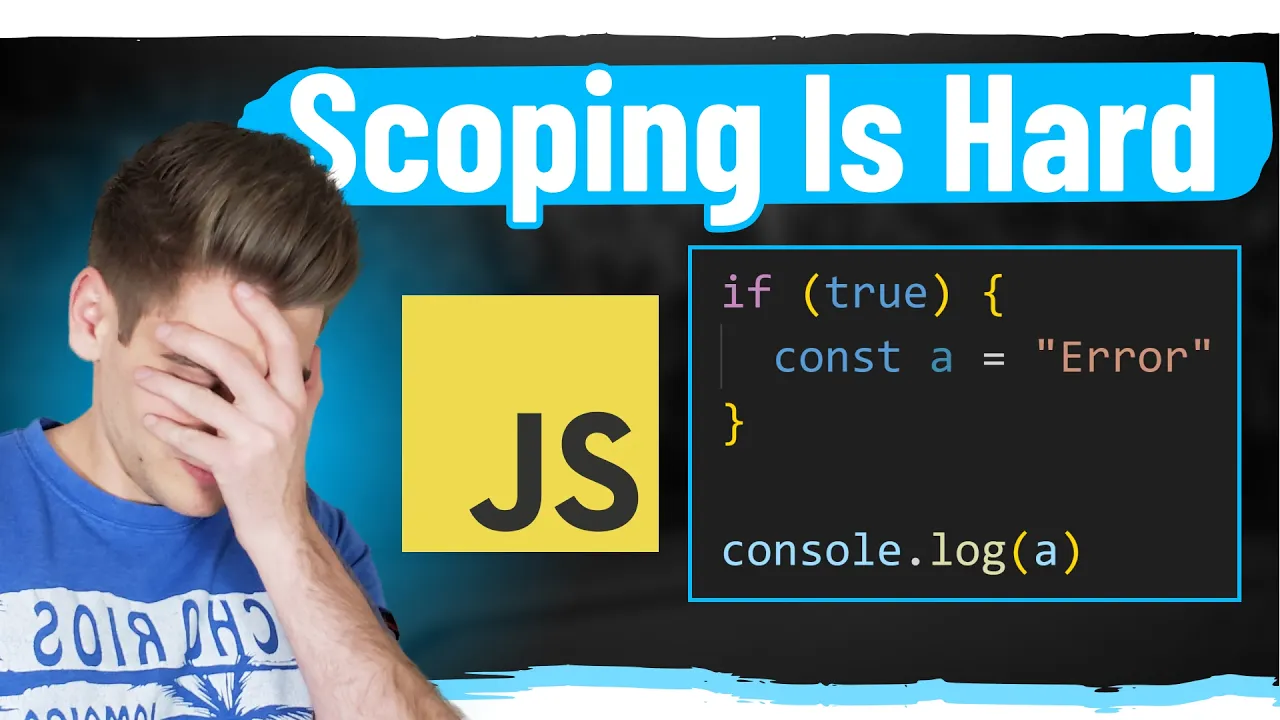
If You Cannot Name All 5 JS Scopes You Need To Watch This Video
74.5K
JavaScript has 5 distinct scoping levels (block scope, local scope, script scope, module scope, and global scope) that determine variable accessibility; variables are always resolved by starting from the innermost scope and working outward, with VAR variables being hoisted to the top of their containing function or global scope, while let and const create true block scope.
Click to watch →

Top 100 JavaScript Interview Question and Answers - HINDI
168K
JavaScript scope determines variable accessibility: global (entire script), function (within functions), and block (within let/const declarations). Hoisting moves function declarations and var declarations to the top of their scope during compilation, but not let/const. Error handling uses try-catch-finally blocks to manage runtime errors gracefully. The throw statement creates custom errors. Understanding scope, hoisting, and error handling is essential for writing robust JavaScript code.
Click to watch →
17: Let and Const Variables | JavaScript Block Scope and Function Scope | JavaScript Tutorial
55.4K
JavaScript has two types of scope: global scope and local scope. Global scope occurs when a variable is declared at the root level of a file or document, making it accessible throughout the entire page. Local scope occurs when a variable is declared inside a function, making it accessible only within that function. Variables in local scope cannot be accessed from outside the function, while variables in global scope can be accessed from anywhere in the document.
Click to watch →
Deep Dive
Familiarity with first-class functions, specifically the ability to pass functions as arguments and return them from other functions.
Programming Terms: First-Class Functions
301.1K
First-class functions are functions that can be treated like any other variable or object in a programming language, meaning they can be assigned to variables, passed as arguments to other functions, and returned as results from functions; this concept enables powerful programming patterns such as higher-order functions, closures, and currying.
Click to watch →

Чудовищно функциональный JavaScript
56.3K
JavaScript functions are first-class citizens, meaning they can be assigned to variables, passed as arguments, and returned from other functions. Higher-order functions take other functions as arguments or return functions as results. Closures allow functions to remember their lexical environment, enabling powerful patterns like creating language-specific greeting functions. Higher-order components in React follow the same pattern, adding functionality to existing components without modifying them.
Click to watch →

Функциональное программирование от А до Я. ФП на JS. Монады, функторы, каррирование, композиция
98.4K
First-class functions can be passed as arguments, returned from functions, assigned to variables, and stored in data structures. Higher-order functions either accept other functions as arguments or return new functions. Examples include map, reduce, and filter. These enable powerful patterns like memoization, debouncing, and creating specialized functions. Higher-order functions provide tremendous flexibility by allowing functions to be composed, combined, and reused throughout the codebase, forming the foundation for functional programming patterns.
Click to watch →

Variable/Function Hoisting && Function Calls in JS || JavaScript Series 2024
91.3K
Functions are first-class citizens in JavaScript, meaning they can be treated like any other value. Functions can be assigned to variables, passed as arguments to other functions, returned from other functions, stored in arrays and objects, and used as object properties. This flexibility enables powerful patterns like higher-order functions, closures, and functional programming techniques.
Click to watch →

Functions as objects | Day 21 | Complete JavaScript Course 2025
12.6K
Functions can be passed as arguments to other functions, satisfying the second condition for first class citizen status. When a function is passed as an argument, the function object's memory address is passed to the receiving function. The receiving function can then access and invoke the passed function. This enables powerful patterns like higher-order functions and callbacks.
Click to watch →
Deep Dive
Basic knowledge of the JavaScript execution context and how the call stack manages function execution.
How does javascript execute code + call stack | chai aur #javascript
350.8K
JavaScript executes code through execution contexts, which are environments where code runs. There are two types: Global Execution Context (created first, containing global variables and the Window object) and Function Execution Context (created when a function is called). JavaScript execution occurs in two phases: Memory Creation Phase (where variables are declared and memory is allocated) and Execution Phase (where actual code runs). The Call Stack manages function execution using a Last-In-First-Out (LIFO) principle, where the last function called is the first to complete. When a function is called, a new execution context is created, undergoes both phases, and then returns to the parent context.
Click to watch →

How JavaScript call stack works | Call stack and execution context explained with example in Hindi
7.5K
The JavaScript call stack is a data structure that manages function execution using the Last-In-First-Out (LIFO) principle, where each function call is pushed onto the stack when invoked and popped off when it completes, with the global execution context (anonymous function) serving as the base of the stack.
Click to watch →
5 Execution Contexts and The Call Stack
3.5K
JavaScript code executes within execution contexts, which are environments containing variables, arguments, and scope information. A global execution context handles top-level code, while each function call creates its own context. Each context contains a variable environment, scope chain, and 'this' keyword. Regular functions have their own arguments object, while arrow functions inherit these from parent functions. The call stack manages execution by pushing contexts when functions are called and popping them when functions return. JavaScript has only one thread of execution, so functions run to completion before the caller continues. The call stack acts as a map ensuring execution order is never lost.
Click to watch →

Introduction and History of Javascript
268
JavaScript execution involves multiple contexts: global execution context, function execution contexts, and call stack. The global execution context is where code runs before any function is called. Function execution contexts are created when functions are invoked. The call stack is a data structure that manages function execution in JavaScript. It follows the Last-In-First-Out (LIFO) principle, where the last function called is the first one to be executed. When a function is called, it is pushed onto the stack, and when it completes, it is popped off.
Click to watch →
NJB100 - Getting started with NodeJS
689
JavaScript execution context is a mechanism that explains how code runs in JavaScript. When a JavaScript file is encountered by the interpreter, a global execution context is automatically created with two phases: creation and execution. During creation, the interpreter scans code from top to bottom, taking note of variables and function declarations, and allocating memory for them. The 'this' keyword points to the global object (window). During execution, actual code runs including variable assignments and function calls. The call stack manages execution using the First In Last Out (FILO) principle. When code runs, the global execution context is pushed onto the stack. When a function is called, a new function execution context is created and pushed onto the stack, becoming the active context. When a function completes, its execution context is popped off the stack and destroyed, and control flow returns to the previous context. This process continues until the global execution context is also popped, indicating the program has finished executing.
Click to watch →
Prerequisite Knowledge
- Concept 01Understanding JavaScript scope (lexical, global, and local scope) and how variable accessibility is determined.
- Concept 02Familiarity with first-class functions, specifically the ability to pass functions as arguments and return them from other functions.
- Concept 03Basic knowledge of the JavaScript execution context and how the call stack manages function execution.
Subsequent Learning
- Step 01Implementing the Module Pattern and creating private variables to achieve data encapsulation.
- Step 02Advanced functional programming concepts such as currying, partial application, and memoization.
- Step 03Managing memory and avoiding potential memory leaks caused by retaining variables in closures.
- Step 04Applying closures in asynchronous JavaScript, such as preserving state inside loops, event handlers, and callbacks.
Closure Overvew
Variable Memory
State Persistence
Closure Overvew
0:00Playing Section
- 1
Defines a closure with an inner function.
- 2
Inner function retains access to outer variables.
- 3
Shows a practical counter example.
The Costs of Closures: Memory Leaks and Performance Overhead
While closures are a fundamental and powerful feature in JavaScript for encapsulation, they come with significant engineering trade-offs that simple tutorials often overlook. Because a closure retains a reference to its outer lexical environment, variables in that outer scope cannot be garbage-collected as long as the closure exists. This frequently leads to memory leaks, especially in long-running applications or when closures are created inside loops. Additionally, resolving variables across deeply nested scope chains incurs a performance penalty. Critics of closure overuse argue that they can make code harder to debug and reason about, advocating instead for alternative design patterns such as explicit state-passing with pure functions or object-oriented encapsulation using modern JavaScript class private fields.
Deep Dive
Implementing the Module Pattern and creating private variables to achieve data encapsulation.

Demystifying JavaScript Closure
27.8K
The module pattern uses closure to create private variables and functions. An immediately invoked function expression (IIFE) defines private variables and functions, then returns selected functions as an object. The returned functions retain closure over the private scope, allowing them to access private variables while keeping other variables hidden from the global scope. This pattern enables controlled access to internal module state, where returned functions can be called from anywhere in the code and will always have access to the private scope they were created in.
Click to watch →

23 - معرفی ماژول Module و Module Pattern در جاوا اسکریپت
290
The Module Pattern in JavaScript follows a specific structure: define a function that serves as the module, declare private variables and functions inside it, and return an object that exposes only the necessary components to the outside world. The function name becomes the module name, and the returned object's properties serve as the public interface. External code accesses module functions through these public properties. Variables defined inside the module function are private and not accessible from outside unless explicitly exposed in the returned object. This demonstrates the encapsulation principle where internal state remains hidden unless intentionally exposed. The module can also accept parameters during initialization for configuration.
Click to watch →

04 Modules: 01 The Basic Module Pattern
16.1K
The basic module pattern uses an immediately invoked function expression (IIFE) that returns an object, creating a private scope for internal variables and functions. Internal variables must be declared as local variables (var) rather than object properties, and the this keyword cannot access them. Public methods are exposed through the returned object. A variation defines methods as function references on the returned object, allowing internal calls while maintaining public access. The pattern can also accept external libraries as parameters, providing control over dependencies while keeping implementation details hidden.
Click to watch →

16 JavaScript Module Pattern and Revealing Module Pattern
11K
The module pattern uses an immediately invoked function expression (IIFE) to create a function that returns an object containing public functions and variables while keeping private variables hidden. Private variables (like 'count') are defined inside the IIFE and are inaccessible outside the module. Public functions (like 'increment', 'reset', 'get', 'set') are exposed as properties of the returned object. This approach reduces global namespace impact to just one variable, minimizes naming collision risks, and provides encapsulation. Getter and setter functions enable controlled access to private data. The pattern is also known as encapsulation in software development terms.
Click to watch →

JS: Azonnal meghívott függvénykifejezés (IIFE) JavaScriptben – titkos fegyver kezdőknek
547
The Module Pattern uses IIFEs to create private variables and functions that are hidden from external code. Variables declared inside the IIFE with 'let' or 'var' are private and cannot be accessed from outside. Inner functions can access these private variables through closure, allowing controlled exposure of functionality. The pattern returns an object containing only public methods, creating a clean API. This encapsulation prevents bugs from unintended modifications and maintains internal state integrity.
Click to watch →
Deep Dive
Advanced functional programming concepts such as currying, partial application, and memoization.
Функциональное программирование от А до Я. ФП на JS. Монады, функторы, каррирование, композиция
98.4K
Currying is the process of transforming a function that takes multiple arguments into a sequence of functions each taking a single argument. Partial application fixes some arguments of a function, returning a new function that takes the remaining arguments. For example, a userHasRole function that checks if a user has a specific role can be partially applied to create clientHasRole or operatorHasRole functions that only require the role argument. This reduces boilerplate and improves code clarity by reducing the number of arguments needed in common cases.
Click to watch →

Functional programming design patterns by Scott Wlaschin
199.1K
Every multi-argument function in functional programming is fundamentally a one-parameter function that returns another function. This process, called currying, allows any function to be partially applied by fixing some arguments and returning a new function waiting for the remaining arguments. Partial application enables creating reusable helper functions from general-purpose operations. For example, adding 1 to a number can be transformed into a function that takes a number and returns a new function that adds that fixed number to its argument.
Click to watch →

Функциональное программирование
12.8K
Partial application fixes some function arguments and returns a new function with fewer parameters. Currying transforms multi-argument functions into chains of single-argument functions. These techniques enable function specialization—creating specific versions of general functions by pre-filling arguments. They help reduce code duplication and enable creating reusable function components.
Click to watch →

How to Curry Functions | An Advanced Javascript Tutorial on Currying
64.5K
Currying transforms multi-parameter functions into sequences of unary functions, enabling incremental parameter passing. Named after mathematician Haskell B. Curry, this concept from lambda calculus allows functions to return other functions expecting remaining parameters. Practical applications include partial application (creating specialized functions like times10 from curriedMultiply), and function composition where functions accept other functions as parameters, enabling complex workflows built from simple reusable components.
Click to watch →
Scala: Beyond the basics with Christopher Batey
50.1K
This section teaches currying (defining functions with multiple parameter lists), partial application (specializing functions by fixing some arguments), and functional composition (chaining functions together). Scala provides compose (right-to-left) and andThen (left-to-right) operators for composition. These techniques enable building complex functionality from simple, testable components while reducing coupling between code layers.
Click to watch →
Deep Dive
Managing memory and avoiding potential memory leaks caused by retaining variables in closures.

The tail of a memory leak in the Angular compiler with Joost Koehoorn
162
When multiple functions share the same lexical scope, they all reference the same closure scope. If one function retains a variable that another function doesn't need, the entire closure scope remains allocated. For example, if two functions share a scope containing variables A and B, and only one function uses B, both functions cause B to be retained in memory. This creates memory leaks when long-lived callbacks retain closure scopes containing unused variables.
Click to watch →

Memory 3 - Fixing Memory Leaks in Closures with Capture List (iOS, Xcode 9, Swift 4)
19K
Closures are self-contained blocks of functionality that can be passed around and used in code, similar to blocks in Objective-C, lambdas in C#, or anonymous methods in other languages. They are functions without names that can be assigned to variables and passed as parameters. Critically, closures are reference types in Swift, meaning they are their own objects with their own memory address. When a closure is assigned to a property or passed around, only a pointer to its memory address is passed. Retain cycles occur when closures capture 'self' with strong references while the outer scope also holds strong references to the closure, creating circular references that prevent deallocation. Swift closures can capture values from their outer scope without explicit passing, and capture lists allow developers to control reference strength by changing captured variables from strong to weak or unowned, which breaks retain cycles and prevents memory leaks.
Click to watch →

Пишем на PHP и не теряем память • Валентин Удальцов • BeerPHP • 6 июня 2024
9.2K
Closures that capture variables from their parent scope can cause memory leaks if they are stored in static properties or global variables without being used. Static closures should be marked with the 'static' keyword to prevent them from capturing variables. Using static analysis tools like PHPCS with the static lambda fixer can automatically add 'static' where appropriate, preventing unintended memory leaks from unused closures. The example demonstrates how a closure stored in a static property but never used creates a memory leak, as the closure persists indefinitely without being garbage collected.
Click to watch →

C# - Замыкание (Closure) - 63
281
Closures can cause memory leaks because they create references that prevent garbage collection. When closures capture variables, those variables live longer than the method in which they were declared. Circular references between objects prevent garbage collection entirely. A common bug occurs when closures capture loop variables—since all closures reference the same variable, they all use the final value rather than their intended individual values. This was fixed in .NET 5, where closures now capture values at creation time. To prevent memory leaks, always unsubscribe from event listeners, use named methods instead of anonymous methods, and implement IDisposable pattern when appropriate.
Click to watch →
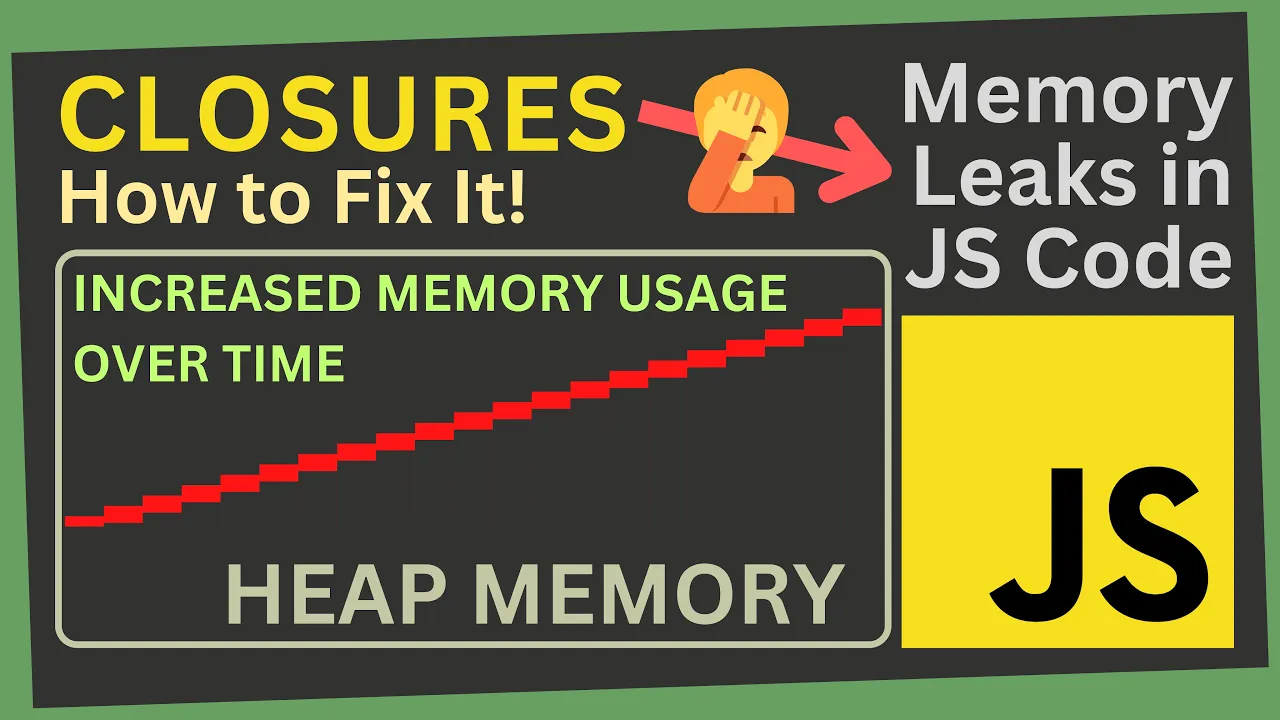
Understanding and Fixing Leaks Caused by Closures | Prevent Memory Leaks in your JS Code | Part XII
421
Closures can cause memory leaks because they retain references to variables from their outer scope even after the outer function completes execution. While function-scoped variables are automatically cleared when the function exits, closures keep these variables alive, leading to progressive memory consumption. Memory leaks manifest as steadily increasing memory usage over time, which can be detected using profiling tools like process.memoryUsage() in Node.js or the Performance tab in Chrome DevTools. To fix these leaks, developers should reduce the number of closures created by moving code that creates closures outside of loops or event handlers. This ensures only one closure is created instead of multiple closures per iteration, maintaining the same functionality while eliminating the memory leak.
Click to watch →
Deep Dive
Applying closures in asynchronous JavaScript, such as preserving state inside loops, event handlers, and callbacks.
Scopes and Closures In-depth 21 - Closures In async Callbacks
36.9K
When using asynchronous callbacks like setTimeout inside a loop, closures capture the loop variable by reference, not by value, so all callbacks execute after the loop completes and access the final value of the variable rather than the value at the time each callback was scheduled.
Click to watch →

Понимание javascript - замыкания, контекст, callback.
144.8K
This extensive section addresses context preservation and asynchronous programming in JavaScript. To correctly capture the current value of a loop variable when attaching event handlers, you can use closures by defining an anonymous function inside the loop and using 'this' or by creating a closure that captures the current value. The event object in JavaScript contains useful properties like 'target' (the element that triggered the event), 'currentTarget' (the element the listener is attached to), and 'type' (the event type). When using setInterval to call a function repeatedly, the function is called in the global context, which can cause problems if it expects 'this' to refer to a specific element. To preserve the correct context, you can use closures by defining an anonymous function inside the outer function and calling it within setInterval. A callback function is a function passed as an argument to another function and executed after some operation completes. Callbacks are essential for handling asynchronous operations in JavaScript, such as network requests or animations, where you don't know when the operation will complete. When calling a callback directly, it executes in the global context (Window object), which can cause problems if it expects to operate on a specific element.
Click to watch →
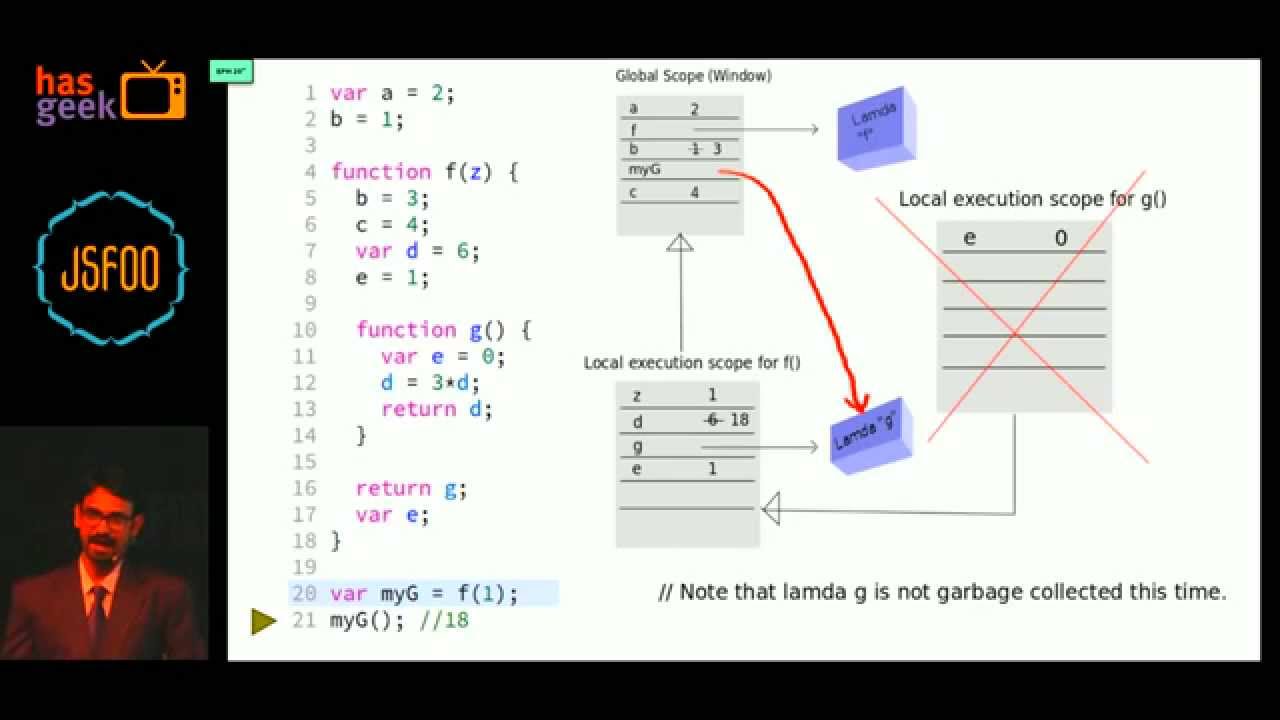
Arindam Paul - JavaScript VM internals, EventLoop, Async and ScopeChains
166.9K
A closure is an implicit permanent link between a function and its scope chain, which is heap memory containing the outer execution environment. When a function is defined, it captures a reference to its outer scope, which is copied to each execution. This enables asynchronous programming because callbacks can access outer variables even after the outer function completes. The JavaScript runtime consists of only a call stack and heap. The event loop manages asynchronous operations outside the runtime, using a callback queue and render queue. When the call stack is empty, the event loop moves tasks from the callback queue to the call stack for execution.
Click to watch →

#0 Cобеседование Junior Frontend разработчика
244.4K
Closures allow inner functions to access variables from their enclosing scope, creating powerful patterns for stateful functions. The classic setTimeout closure problem occurs when functions capture the same variable reference, causing all callbacks to output the final value. The solution involves creating new scopes for each iteration using IIFEs. Understanding closures is fundamental for advanced JavaScript patterns and debugging asynchronous code.
Click to watch →

Scopes and Closures In-depth 19 - Closures In Callbacks
43.5K
Closures are essential in JavaScript callbacks because when a function is passed to another function (like setTimeout), it captures and retains access to the variables in its original scope, allowing it to access those variables even when executed in a different context; this is demonstrated by how setTimeout schedules a function to execute after a delay while preserving the scope variables from when the function was created.
Click to watch →
Closure Overvew
Variable Memory
State Persistence
Closure Overvew
0:00- 1
Defines a closure with an inner function.
- 2
Inner function retains access to outer variables.
- 3
Shows a practical counter example.
The Costs of Closures: Memory Leaks and Performance Overhead
While closures are a fundamental and powerful feature in JavaScript for encapsulation, they come with significant engineering trade-offs that simple tutorials often overlook. Because a closure retains a reference to its outer lexical environment, variables in that outer scope cannot be garbage-collected as long as the closure exists. This frequently leads to memory leaks, especially in long-running applications or when closures are created inside loops. Additionally, resolving variables across deeply nested scope chains incurs a performance penalty. Critics of closure overuse argue that they can make code harder to debug and reason about, advocating instead for alternative design patterns such as explicit state-passing with pure functions or object-oriented encapsulation using modern JavaScript class private fields.
Understanding JavaScript scope (lexical, global, and local scope) and how variable accessibility is determined.
Familiarity with first-class functions, specifically the ability to pass functions as arguments and return them from other functions.
Basic knowledge of the JavaScript execution context and how the call stack manages function execution.
Implementing the Module Pattern and creating private variables to achieve data encapsulation.
Advanced functional programming concepts such as currying, partial application, and memoization.
Managing memory and avoiding potential memory leaks caused by retaining variables in closures.
Applying closures in asynchronous JavaScript, such as preserving state inside loops, event handlers, and callbacks.
14.6K views83likes0:13@freecodecampOriginal Release: 2025-12-09
Closure counter. This is a closure. The inner function remembers the count variable even after the counter finishes running. Each call to my counter increases the same count. Closures keep variables alive.
Up Next

60:52
Lambda Calculus Explained: History, Semantics, and Programming Applications
@NDC
99.6K views•2020-02-26

87:26
Introduction to Secure Multiparty Computation with Yehuda Lindell
@fhe_org
7.7K views•2021-02-04

85:36
Rust Programming Tutorial for Beginners: A Comprehensive Guide
@freecodecamp
354.1K views•2021-11-30

19:25
Enigma Machine Mechanics: WWII Encryption Explained
@JaredOwen
13.2M views•2021-12-11
Related Study Plans & Knowledge Roadmaps
Structured learning paths in Computer Science
computer-science
Container Runtimes: Namespaces, Cgroups & Go
01Linux Systems & Go Programming Foundations
02The Core of Isolation: Chroot and Filesystems
03Linux Namespaces: Process Isolation
+ 3 more learning modules
32h6 modules
Explore Roadmap
computer-science
Building a CHIP-8 Emulator: Rust & CPU Basics
01Computer Architecture Foundations (Bits & Bytes)
02Rust Programming for Systems Development
03CHIP-8 Virtual Hardware Specifications
+ 2 more learning modules
32h5 modules
Explore Roadmap
computer-science
Building BitTorrent: Go, P2P & Concurrency
01Go Fundamentals & Concurrency
02Networking Foundations & P2P Architecture
03Bencode Parsing & Torrent Metadata
+ 3 more learning modules
26h6 modules
Explore Roadmap
computer-science
Actor Models (C++ Concurrency & Lock-Free)
01C++ Multi-Threading Foundations
02Thread Pools and Task Scheduling
03Atomics and Lock-Free Queue Design
+ 3 more learning modules
45h6 modules
Explore Roadmap