























![[YTN 사이언스] 마이크로 로봇으로 질병 치료한다…박종오 마이크로의료... / YTN 사이언스](https://i.ytimg.com/vi/ftcwWJ9j7HY/hqdefault.jpg)


Soft robotics represents a paradigm shift from traditional rigid robots designed for precision in controlled factory environments to flexible, compliant machines that can safely navigate unpredictable real-world situations; by mimicking nature's use of soft materials and distributed actuation, these robots can adapt to their environment, perform delicate medical procedures like minimally invasive surgery, and interact safely with humans and fragile objects without requiring extensive computational planning or precise environmental measurements.
Flexible Soft Robots: Revolutionizing Surgery and Medicine | Giada Gerboni, TED
Added:Basic concepts of traditional robotics, specifically rigid-body kinematics and the mechanical limitations of hard metallic structures.
The principles of biomimicry, or how engineers translate biological structures (such as octopus tentacles or plant growth) into mechanical designs.
Fundamentals of minimally invasive surgery (MIS) and the clinical need for flexible navigational tools in complex anatomical pathways.
Introductory materials science, particularly the properties of elastomers, polymers, and flexible smart materials.
Actuation and control mechanisms in soft robotics, such as fluidic elastomer actuators, pneumatic networks, and tendon-driven systems.
Soft sensing technologies, including how flexible and stretchable sensors detect force, strain, and spatial orientation inside the human body.
Biocompatibility and regulatory approval pathways (such as FDA standards) for introducing soft-robotic materials into clinical environments.
Advanced clinical applications, including targeted drug delivery, micro-scale soft robots, and autonomous vascular navigation.
222.7K views5.6Klikes9:28Original Release: 2018-07-05
So, robots.
Robots can be programmed to do the same task millions of times with minimal error, something very difficult for us, right?
And it can be very impressive to watch them at work.
Look at them.
I could watch them for hours.
No?
What is less impressive is that if you take these robots out of the factories, where the environments are not perfectly known and measured like here, to do even a simple task which doesn't require much precision, this is what can happen.
I mean, opening a door, you don't require much precision.
(Laughter) Or a small error in the measurements, he misses the valve, and that's it -- (Laughter) with no way of recovering, most of the time.
So why is that?
Well, for many years, robots have been designed to emphasize speed and precision, and this translates into a very specific architecture.
If you take a robot arm, it's a very well-defined set of rigid links and motors, what we call actuators, they move the links about the joints.
In this robotic structure, you have to perfectly measure your environment, so what is around, and you have to perfectly program every movement of the robot joints, because a small error can generate a very large fault, so you can damage something or you can get your robot damaged if something is harder.
So let's talk about them a moment.
And don't think about the brains of these robots or how carefully we program them, but rather look at their bodies.
There is obviously something wrong with it, because what makes a robot precise and strong also makes them ridiculously dangerous and ineffective in the real world, because their body cannot deform or better adjust to the interaction with the real world.
So think about the opposite approach, being softer than anything else around you.
Well, maybe you think that you're not really able to do anything if you're soft, probably.
Well, nature teaches us the opposite.
For example, at the bottom of the ocean, under thousands of pounds of hydrostatic pressure, a completely soft animal can move and interact with a much stiffer object than him.
He walks by carrying around this coconut shell thanks to the flexibility of his tentacles, which serve as both his feet and hands.
And apparently, an octopus can also open a jar.
It's pretty impressive, right?
But clearly, this is not enabled just by the brain of this animal, but also by his body, and it's a clear example, maybe the clearest example, of embodied intelligence, which is a kind of intelligence that all living organisms have.
We all have that.
Our body, its shape, material and structure, plays a fundamental role during a physical task, because we can conform to our environment so we can succeed in a large variety of situations without much planning or calculations ahead.
So why don't we put some of this embodied intelligence into our robotic machines, to release them from relying on excessive work on computation and sensing?
Well, to do that, we can follow the strategy of nature, because with evolution, she's done a pretty good job in designing machines for environment interaction.
And it's easy to notice that nature uses soft material frequently and stiff material sparingly.
And this is what is done in this new field of robotics, which is called "soft robotics," in which the main objective is not to make super-precise machines, because we've already got them, but to make robots able to face unexpected situations in the real world, so able to go out there.
And what makes a robot soft is first of all its compliant body, which is made of materials or structures that can undergo very large deformations, so no more rigid links, and secondly, to move them, we use what we call distributed actuation, so we have to control continuously the shape of this very deformable body, which has the effect of having a lot of links and joints, but we don't have any stiff structure at all.
So you can imagine that building a soft robot is a very different process than stiff robotics, where you have links, gears, screws that you must combine in a very defined way.
In soft robots, you just build your actuator from scratch most of the time, but you shape your flexible material to the form that responds to a certain input.
For example, here, you can just deform a structure doing a fairly complex shape if you think about doing the same with rigid links and joints, and here, what you use is just one input, such as air pressure.
OK, but let's see some cool examples of soft robots.
Here is a little cute guy developed at Harvard University, and he walks thanks to waves of pressure applied along its body, and thanks to the flexibility, he can also sneak under a low bridge, keep walking, and then keep walking a little bit different afterwards.
And it's a very preliminary prototype, but they also built a more robust version with power on board that can actually be sent out in the world and face real-world interactions like a car passing it over it... and keep working.
It's cute.
(Laughter) Or a robotic fish, which swims like a real fish does in water simply because it has a soft tail with distributed actuation using still air pressure.
That was from MIT, and of course, we have a robotic octopus.
This was actually one of the first projects developed in this new field of soft robots.
Here, you see the artificial tentacle, but they actually built an entire machine with several tentacles they could just throw in the water, and you see that it can kind of go around and do submarine exploration in a different way than rigid robots would do.
But this is very important for delicate environments, such as coral reefs.
Let's go back to the ground.
Here, you see the view from a growing robot developed by my colleagues in Stanford.
You see the camera fixed on top.
And this robot is particular, because using air pressure, it grows from the tip, while the rest of the body stays in firm contact with the environment.
And this is inspired by plants, not animals, which grows via the material in a similar manner so it can face a pretty large variety of situations.
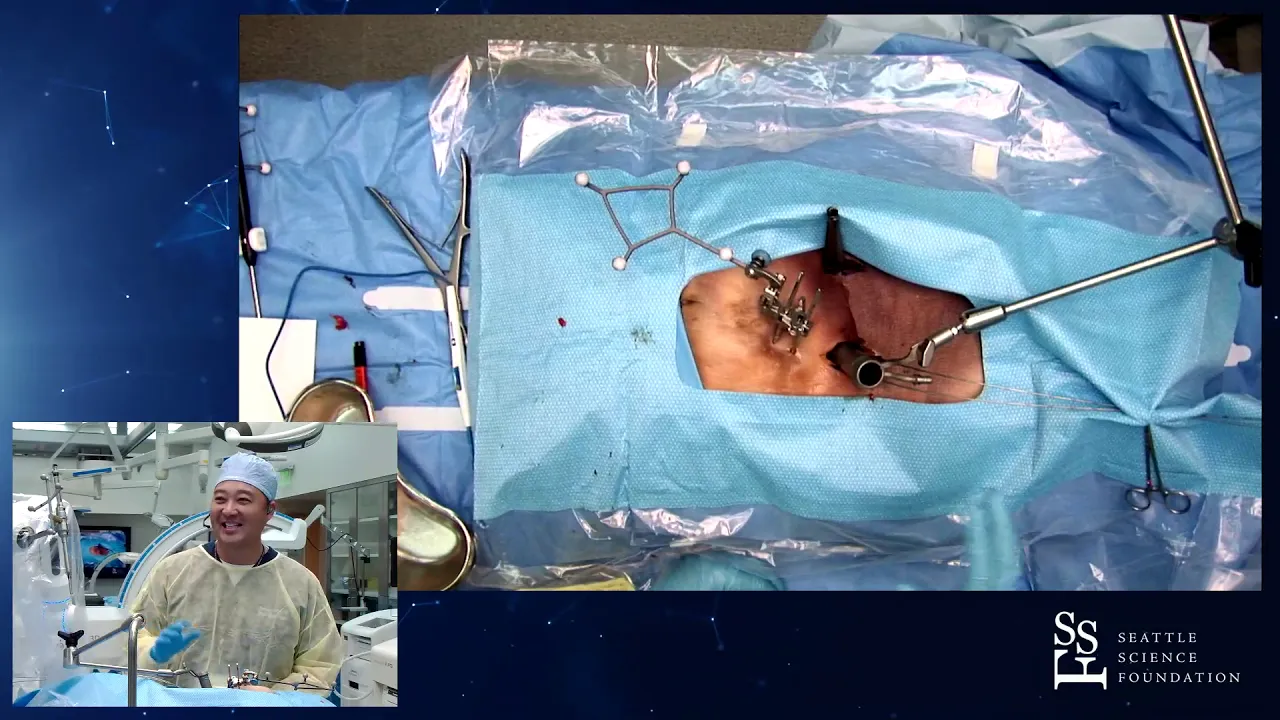
But I'm a biomedical engineer, and perhaps the application I like the most is in the medical field, and it's very difficult to imagine a closer interaction with the human body than actually going inside the body, for example, to perform a minimally invasive procedure.
And here, robots can be very helpful with the surgeon, because they must enter the body using small holes and straight instruments, and these instruments must interact with very delicate structures in a very uncertain environment, and this must be done safely.
Also bringing the camera inside the body, so bringing the eyes of the surgeon inside the surgical field can be very challenging if you use a rigid stick, like a classic endoscope.
With my previous research group in Europe, we developed this soft camera robot for surgery, which is very different from a classic endoscope, which can move thanks to the flexibility of the module that can bend in every direction and also elongate.
And this was actually used by surgeons to see what they were doing with other instruments from different points of view, without caring that much about what was touched around.
And here you see the soft robot in action, and it just goes inside.
This is a body simulator, not a real human body.
It goes around.
You have a light, because usually, you don't have too many lights inside your body.
We hope.
(Laughter) But sometimes, a surgical procedure can even be done using a single needle, and in Stanford now, we are working on a very flexible needle, kind of a very tiny soft robot which is mechanically designed to use the interaction with the tissues and steer around inside a solid organ.
This makes it possible to reach many different targets, such as tumors, deep inside a solid organ by using one single insertion point.
And you can even steer around the structure that you want to avoid on the way to the target.
So clearly, this is a pretty exciting time for robotics.
We have robots that have to deal with soft structures, so this poses new and very challenging questions for the robotics community, and indeed, we are just starting to learn how to control, how to put sensors on these very flexible structures.
But of course, we are not even close to what nature figured out in millions of years of evolution.
But one thing I know for sure: robots will be softer and safer, and they will be out there helping people.
Thank you.
(Applause)
Up Next
15:27
Position Control of Pneumatic Actuators Using Arduino and Feedback Sensors
@jamesbruton
198.1K views•2019-01-29

58:25
MathWorks Virtual RoboSub Simulation Environment | Webinar 2026
@RoboNationInc
209 views•2026-03-10

11:04
How to Build a Self-Balancing Robot: Arduino Nano & MPU6050
@easytechzones
16.8K views•2022-03-09

25:22
Micromouse: The Fastest Maze-Solving Robots on Earth
@veritasium
23.5M views•2023-05-24
Related Study Plans & Knowledge Roadmaps
Structured learning paths in Robotics
robotics
Building Delta Robots: Kinematics & Pico
01Foundations of Delta Robots & Mechanical Design
02Electronics and Microcontroller Setup with Pi Pico
03Delta Robot Kinematics and Coordinate Math
+ 3 more learning modules
65h6 modules
Explore Roadmap
robotics
Building Ballbots: Dynamics, Kalman & LQR
01Embedded Electronics & Omniwheel Actuation
02Ballbot Kinematics & Rigid Body Dynamics
03IMU Sensors & Kalman Filter State Estimation
+ 2 more learning modules
42h5 modules
Explore Roadmap
robotics
Micromouse: Hardware, PID Control & Flood-Fill
01Electronics & Teensy Microcontroller Basics
02Sensors and Actuators: Motors, Encoders & IR
03Precision Movement: Implementing PID Control
+ 2 more learning modules
35h5 modules
Explore Roadmap
robotics
CDPR: Kinematics, Arduino & Winch Control
01Foundations of Arduino & Basic Electronics
02Stepper Motors and Winch Mechanics
03Kinematics of 2D Cable-Driven Robots
+ 2 more learning modules
28h5 modules
Explore Roadmap