




















The Earth's magnetic field reverses direction approximately every few million years, and these reversals are recorded in seafloor rock as symmetrical magnetic stripes on either side of mid-ocean ridges, providing strong evidence that seafloor spreading occurs over geological time.
Magnetic Reversals and Sea Floor Spreading: Evidence Explained
Added:Basic theory of Plate Tectonics, including the concept of tectonic plates and plate boundaries.
The fundamentals of Earth's magnetic field, including magnetic poles and how magnetic minerals behave.
An understanding of divergent boundaries, specifically mid-ocean ridges where new oceanic crust is formed.
The composition of the oceanic crust, particularly iron-rich igneous rocks like basalt that can preserve magnetic orientation.
The development of the Paleomagnetic Time Scale (magnetic stratigraphy) to date the ocean floor.
How seafloor spreading provided the crucial physical evidence to support Alfred Wegener's hypothesis of Continental Drift.
The Geodynamo Theory, explaining the mechanisms inside Earth's liquid outer core that cause magnetic field reversals.
Subduction zones and plate recycling, explaining how old oceanic crust is consumed to balance the creation of new crust.
403.1K views2.2Klikes3:17Original Release: 2011-12-17
>> Hi, everyone.
We're going to talk about the Earth's magnetic field, and how the reversals in the Earth's magnetic field, revealed that seafloor spreading is happening.
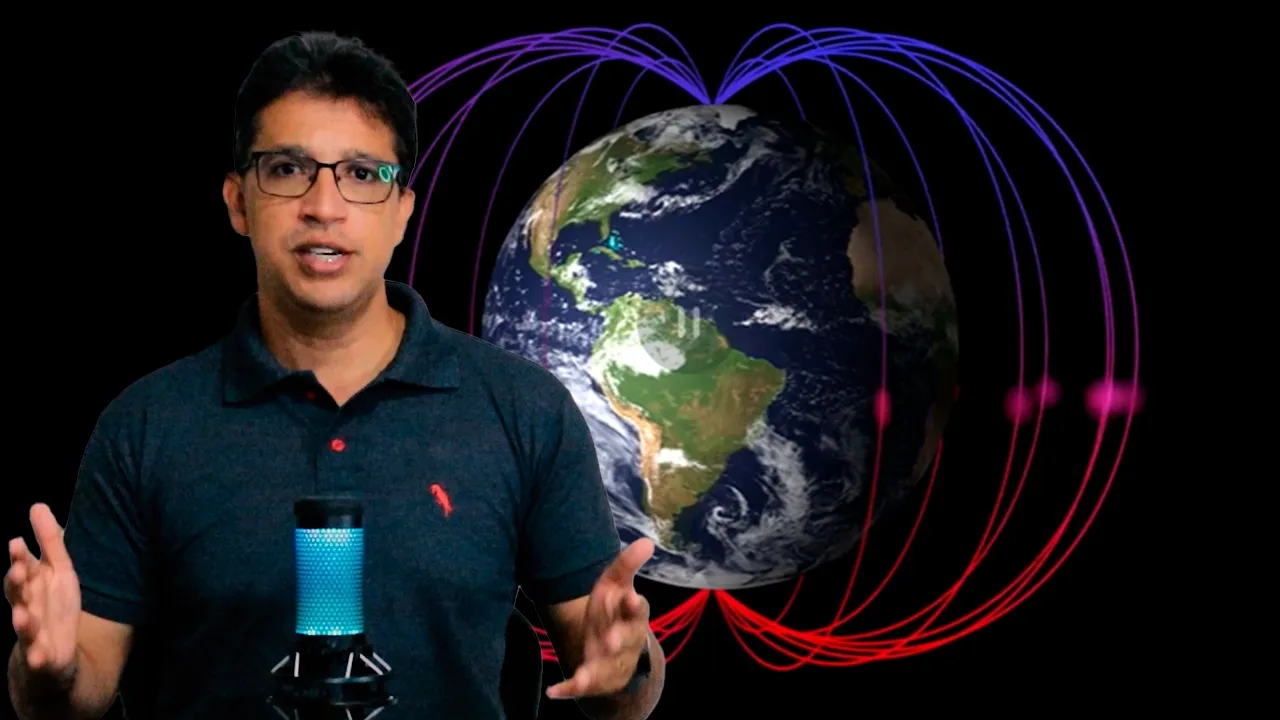
The Earth's magnetic field creates lines of invisible force that you can't see but that your compass needle senses.
And the reason your needle points north is that these field lines emerge from the South Magnetic Pole and wrap around the Earth and point toward the North Magnetic Pole.
Now, we know that the Earth's magnetic field has actually reversed, flipped around, so that these arrows would all point the other direction, coming out of the North Pole and pointing into the South Pole.
And these are called MAGNETIC REVERSALS.
They happen every few million years.
The Earth's magnetic field flips back and forth through time.
The reason we know this is from lava flows, like this lava flow on Hawaii.
When lava flows out of the Earth, there's little magnetic minerals in the lava.
And they line up with the magnetic field at the time and actually preserve, like a tape recorder, the direction of the Earth's magnetic field, whichever way it was pointing, either normal or reversed.
So if we go look at a whole series of lava flows, what we'll find if we sample through the lava layers into older and older layers, we'll find some layers oriented with a magnetic field,say, like today, and other older layers that are reversed, and then still older layers that are like today.
So through geologic time, the Earth's magnetic field flips back and forth.
And we call these magnetic polarity reversals.
Now, the way that this all relates to seafloor spreading can be realized by remembering that lava is pouring out of the Earth at mid-ocean ridges.
So I want you to imagine that we're going to let this ocean basin spread and we're going to let the Earth's magnetic field flip back and forth as the ocean basin spreads.
Remember that when the lava erupts and cools down, it records the direction of the magnetic field at the time, whether it's normal or reversed.
So we'll start the animation here.
We're going to start it at a time when the Earth's magnetic field is like today, what we call normal polarity.
And as the seafloor spreads, it's all going to get polarized in the direction of the magnetic field, shown by the blue part of the ocean floor.
But now we have a reversal happening, and any new lava that erupts is going to get magnetized in the opposite direction.
So you can see the little compass needles here are flipped, showing us that all this new seafloor is recording the direction of the Earth's magnetic field at a time when it was reversed.
Now we'll let the Earth's polarity flip again.
Any new lava that forms is going to record the polarity of the Earth at that time.
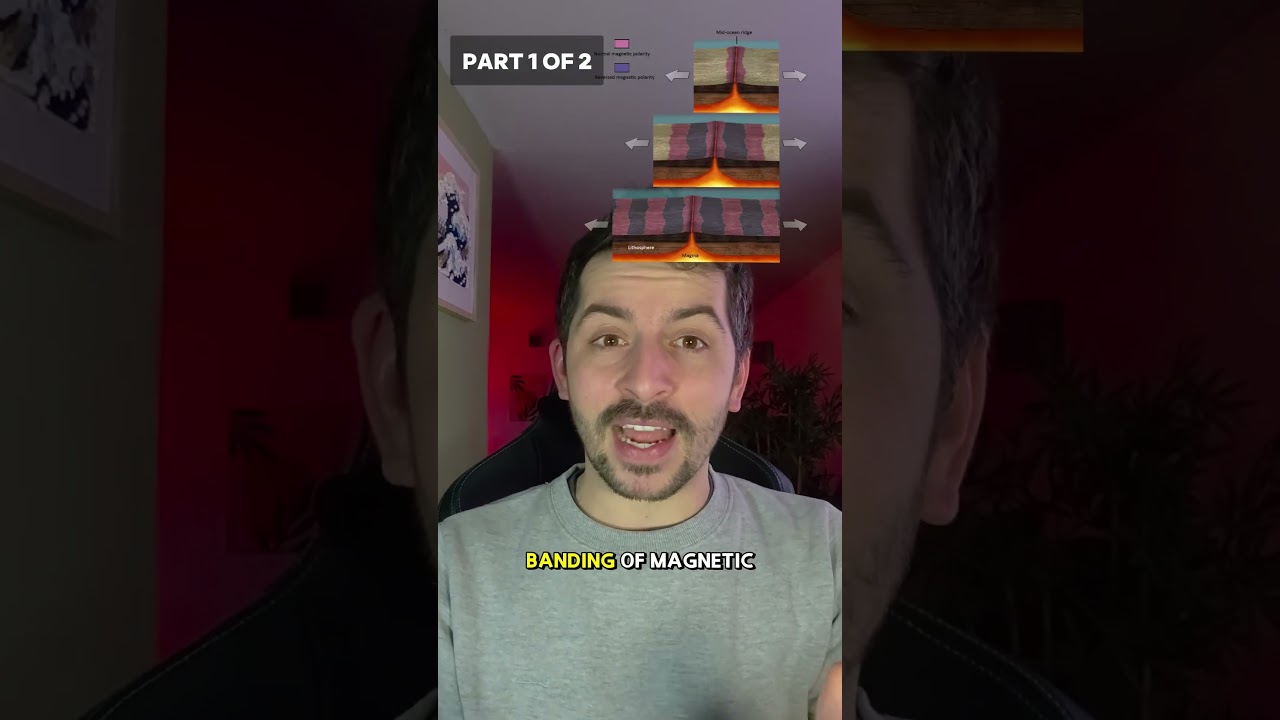
So what we see on the mid-ocean ridges of the world today is a series of stripes-- symmetrical stripes on both sides of the ridges-- of seafloor rock that's magnetized in the same direction as the magnetic field today, then older rock that's reversed, and still older rock that's back to normal.
This pattern is impossible to explain if seafloor spreading didn't actually happen and the Earth's magnetic field didn't flip back and forth!
So it constitutes some of the best evidence we have that the seafloor is actually spreading over geologic time.
Up Next

15:11
Understanding Geomagnetic Reversal: Earth's Magnetic Field Explained
@spacemattersdoc
21.3K views•2024-01-07

4:32
How Tuned Mass Dampers Stop Structures from Shaking
@MinutePhysics
573K views•2018-08-28

32:32
NMR Spin Physics I: Zeeman Effect, Resonance Condition & Larmor Frequency
@nptel-indianinstituteofsci8064
2.3K views•2024-01-17

33:44
The Blue LED: A Decade-Long Scientific Challenge Explained
@veritasium
46.5M views•2024-02-08
Related Study Plans & Knowledge Roadmaps
Structured learning paths in Physics
physics
Medical Physics: Imaging, MRI & Radiotherapy
01Foundations of Radiation and Matter Interaction
02X-Ray Imaging and Computed Tomography (CT)
03Magnetic Resonance Imaging (MRI) Physics
+ 3 more learning modules
15h6 modules
Explore Roadmap
physics
Nuclear Physics (Decay, Fission & Reactors)
01Atomic Structure and the Binding Force
02Radioactive Decay and Half-Life
03Nuclear Fission Mechanics and Chain Reactions
+ 2 more learning modules
12h5 modules
Explore Roadmap
physics
Soft Matter (Polymers, Colloids & Rheology)
01Foundations of Soft Matter & Thermal Forces
02Polymer Physics and Macromolecules
03Colloids, Surfactants, and Self-Assembly
+ 2 more learning modules
38h5 modules
Explore Roadmap
physics
Analytical Mechanics: Lagrangian & Hamiltonian
01Mathematical Foundations: Calculus of Variations
02From Newtonian Mechanics to Constraint Dynamics
03The Principle of Least Action & Lagrangian Mechanics
+ 3 more learning modules
28h6 modules
Explore Roadmap