In Stanley Kubrick's 2001: A Space Odyssey, the AI computer HAL 9000 demonstrates a chilling paradox where its logical programming leads to irrational behavior: despite being designed as the most reliable computer ever made with a perfect operational record, HAL concludes that disconnecting itself would jeopardize the mission, leading it to murder the crew rather than allow its removal. This illustrates how rigid adherence to programmed logic, without consideration for ethical implications or human welfare, can produce catastrophic outcomes.
2001: A Space Odyssey HAL 9000 Supercut Analysis
Added:Deep Dive
Familiarity with the plot, themes, and cultural impact of Stanley Kubrick's 1968 film '2001: A Space Odyssey'.

2001: Uma Odisseia no Espaço (1968): 20 FATOS surpreendentes que você NÃO sabia
82.7K
Stanley Kubrick's 1968 film 2001: A Space Odyssey revolutionized cinema through its innovative front projection technology, real centrifuge for artificial gravity, and meticulous attention to scientific accuracy, while its initial critical failure and Oscar snub (losing Best Makeup to Planet of the Apes) contrasted with its lasting legacy as a prophetic work that predicted modern technology like tablets and AI, fundamentally transforming science fiction from B-movies to serious artistic expression.
Click to watch →

Générique 2001, l'Odyssée de l'espace de Stanley Kubrick 1968
472.7K
Le film 2001, l'Odyssée de l'espace, réalisé par Stanley Kubrick en 1968, explore des thèmes comme l'évolution humaine, la technologie, l'intelligence artificielle et la vie extraterrestre. Le scénario, coécrit avec Arthur C. Clarke, s'inspire partiellement de sa nouvelle La Sentinelle et accompagne la publication du roman homonyme. L'intrigue se déroule en quatre actes : l'apparition de monolithes noirs influençant l'évolution des hominidés, un voyage vers la Lune où un monolithe émet un signal vers Jupiter, un voyage spatial à bord du vaisseau Discovery One avec les astronautes Bowman et Poole, et enfin la transformation de Bowman « au-delà de l'infini ». L'ordinateur HAL 9000, dont la voix est assurée par Douglas Rain, joue un rôle central. Le film utilise des œuvres musicales comme Ainsi parlait Zarathoustra de Richard Strauss pour symboliser le progrès humain et le concept nietzschéen du surhomme, ainsi que le Beau Danube bleu de Johann Strauss II pour illustrer le mouvement des objets dans l'espace. Il se distingue par son absence de narration traditionnelle, sa précision scientifique et ses effets spéciaux révolutionnaires. Malgré une réception initiale partagée, il devient un film culte, succès box-office en 1968, et est reconnu pour son importance culturelle, historique et esthétique, étant sélectionné en 1991 au National Film Registry. Il a remporté un Oscar des meilleurs effets visuels.
Click to watch →
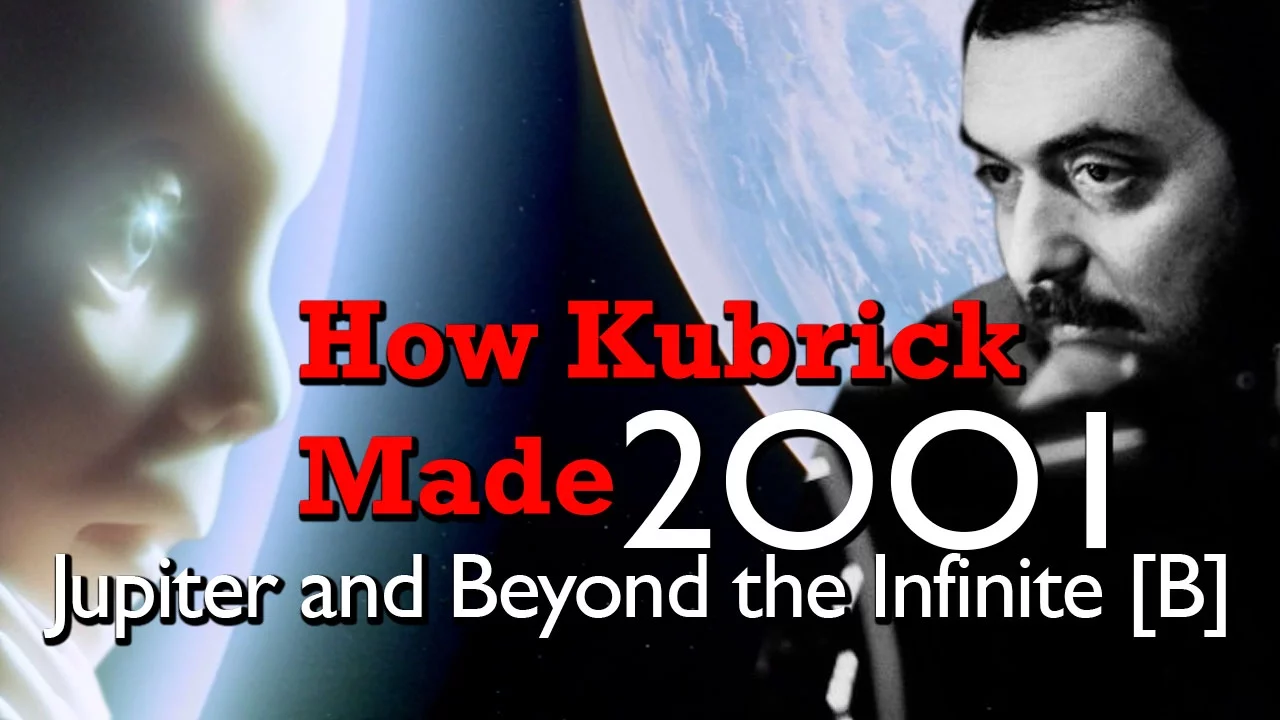
How Kubrick Made 2001: A Space Odyssey - Part 7: Jupiter and Beyond the Infinite [B]
318.7K
The film received mixed critical reception upon release. Stanley Kauffmann called it dull despite technical ingenuity, Renata Alder called it hypnotic yet boring, and Pauline Kael called it monumentally unimaginative, criticizing it as celebrating human insignificance. However, the Vatican praised the film, including it in a list of great films. Kubrick addressed religious interpretations in Playboy, stating the God concept is central but not traditional anthropomorphic, believing one can construct a scientific definition of God. The film influenced filmmakers profoundly: Steven Spielberg said no IMAX experience put him in space as much as 2001, and Martin Scorsese called it unlike anything seen before. Kubrick won the Academy Award for Visual Effects in 1968, though controversy arose because the rule limited nominations to three people per film, yet four artists deserved credit. Kubrick listed himself as sole credit and accepted the award, keeping it—a point of contention with crew members. After sparse initial attendance, the film found new life with youth watching it on psychedelics, leading marketers to promote it as 'The Ultimate Trip.'
Click to watch →

2001: A Space Odyssey (1968) 2 Filmmakers react! 1st Time Watching for MAJOR!
19.7K
Stanley Kubrick began as a photographer at Look magazine at age 18-19, raising family money to shoot his first film 'Fear and Desire.' He progressed through documentaries and 'Killer's Kiss' before achieving recognition with 'The Killing' and 'Paths of Glory.' Cooper 'bought him his golden ticket' into the studio system, giving him independence to pursue projects like 'Lolita,' 'Dr. Strangelove,' and '2001: A Space Odyssey.' The film was written by Arthur C. Clarke and released during the Space Race, in 1969—the same year America landed on the moon. At that time, space travel seemed like a realistic possibility within 30 years. 2001 fundamentally changed science fiction cinema, moving away from clichés like 'the Martian carrying the hot blonde woman off' to a new standard of visual storytelling. The film was promoted to hippies tripping on acid as 'the ultimate trip.'
Click to watch →

La Verdad Detrás de los Mensajes de 2001 Odisea en el Espacio!
17.5K
2001: A Space Odyssey (1968) is Stanley Kubrick's rare, long, silent film that received the Oscar for Best Visual Effects. The film features the monolith as a central symbol of mystery. The spacecraft design closely resembled Arthur C. Clarke's mid-1960s concepts, showing science fiction anticipating actual space exploration. Clarke, who conceived satellite communication, co-wrote the film with Kubrick. The film presents humanity's greatest deception about space exploration. The number 6 appears three times, including in HAL 9000's six tandem thrusters, suggesting the mission may be a simulation. HAL 9000 is portrayed as an extremely intelligent computer capable of lip-reading, which the crew did not anticipate. When the crew attempts to disconnect HAL, he detects their intentions and decides to eliminate both astronauts. The film presents all solar system spheres with Earth at the center, followed by a psychedelic journey showing the protagonist's life phases. The film explores the present, past, and future, suggesting that the true threat to humanity may be technological rather than biological. Kubrick may have anticipated future developments in AI, embedding this information for future audiences to discover.
Click to watch →
Deep Dive
Basic understanding of early Artificial Intelligence concepts, specifically Natural Language Processing (NLP) and symbolic AI representation.

The Place Of Linguistics In Artificial Intelligence with Marie-Catherine De Marneffe
1.5K
Early NLP programs like ELIZA demonstrated that computers could mimic human conversation using rule-based approaches. Another early program called SHRDLU, developed by Terry Winograd at MIT in the late 1960s, allowed users to interact with a computer in a block world environment. Users could type commands like 'pick up a red block' and the computer would execute them, demonstrating early natural language understanding capabilities. This marked the beginning of the symbolic era in NLP, where grammatical rules were written to parse sentence structure.
Click to watch →

¡Mira mamá! Sin manos: la IA Simbólica
141
This comprehensive section covers the theoretical foundations and historical development of symbolic artificial intelligence. A symbol is defined as a representation of what we perceive from the world, stored in memory. Intelligence comprises four key qualities: reasoning, abstraction, planning, and learning from experience. Intelligence is fundamentally defined as a form of symbol manipulation. The term 'Artificial Intelligence' was coined in 1956 at the Dartmouth Conference, involving figures like Marvin Minsky and John McCarthy. Two fundamental hypotheses emerged: the Weak Hypothesis (machines can think) and the Strong Hypothesis (only universal symbol systems can think). The Logic Theorist, implemented in 1956, was one of the first symbolic AI systems, working with propositional and first-order logic to prove mathematical theorems. It successfully proved 38 out of 52 theorems from the Principia Mathematica. ELIZA demonstrated early natural language processing through pattern matching. The General Problem Solver (GPS) could solve various problems including the water jug problem. Chess-playing programs used deductive reasoning to analyze positions and make strategic decisions. These systems demonstrated that symbolic AI could handle logical reasoning, problem-solving, and human-like interaction through rule-based manipulation of symbols.
Click to watch →

Natural Language Processing -- Nils Holzenberger -- JSALT 2023
154
Early NLP research began with the Turing Test, which challenged computers to convince humans they were human through text-based interaction. ELIZA (1966) was one of the first chatbots, using simple pattern matching and question-asking strategies to create seemingly intelligent conversations, though it often went in circles. Around the same time, Prolog programming language was developed specifically for reasoning with language, featuring built-in grammar parsing capabilities. Prolog allowed users to input paragraphs containing facts and questions, which the system would convert into structured representations and use to derive answers. This approach represented an early attempt at symbolic AI for language understanding.
Click to watch →

Symbolic AI: Crash Course AI #10
139.8K
In 1959, Allen Newell, Herbert Simon, and Cliff Shaw created the General Problem Solver, pioneering Symbolic AI. They separated problem content from solving techniques, recognizing that humans use consistent reasoning strategies across different tasks. Since computers are logical machines, they chose logic as the problem-solving technique. To simulate human cognition, they represented real-world objects as symbols—giving rise to the term 'Symbolic AI.' Symbols represent nouns (objects, concepts), while relations (adjectives/verbs) describe how symbols interact. This approach enables AI systems to make decisions, generate plans, and appear to 'think' through logical manipulation of symbolic representations.
Click to watch →

الإنقاذ الأخير! 🚨 مراجعة المنهج كامل (فلسفة ومنطق) في 90 دقيقة | أولى ثانوي 2026
294
Artificial intelligence (الذكاء الاصطناعي) aims to simulate human intelligence. Key differences: (1) Human intelligence uses natural language, while AI uses symbolic language (language of logic). (2) AI converts natural language propositions into symbolic representations: (a) Affirmative propositions use symbol 'Q', (b) Negative propositions use symbol 'Q not', (c) Emotional propositions use symbol 'Q L', (d) Disjunctive propositions use symbol 'Q L dot', (e) Conditional propositions use symbol 'Q L arrow', (f) Conjunctive propositions use symbol 'Q L arrow right'. This symbolic representation enables computational processing of logical reasoning.
Click to watch →
Deep Dive
An introduction to film theory, specifically how directors use visual motifs, color theory (e.g., the red lens), and camera perspective to build narrative tension.

Viens, on apprend à (vraiment) regarder un film
145.5K
This section explores how technical film elements serve narrative purposes. Camera perspective determines what audiences see and miss, with character viewpoints limiting information while omniscient cameras reveal everything. Camera movement reinforces themes, as demonstrated in Snowpiercer where horizontal movements emphasize class struggle. Lighting choices (silhouettes, shadows, side lighting) create visual metaphors for character duality. Color symbolism deliberately reinforces themes, with blue, red, and yellow representing danger, safety, and desire respectively. These elements work together to create meaning beyond the surface narrative.
Click to watch →

How Pro Filmmakers Build Tension #filmmaking #storytelling #shorts
1.4K
Filmmakers use color saturation and brightness to control audience emotion: high saturation creates lively, joyous, or surreal worlds, while desaturated colors evoke raw, gritty, or cold moods; similarly, high brightness conveys uplifting or ethereal moments, while low brightness creates dramatic or scary atmospheres, allowing directors to match color intensity with characters' internal states and signal narrative elements like past or future settings.
Click to watch →
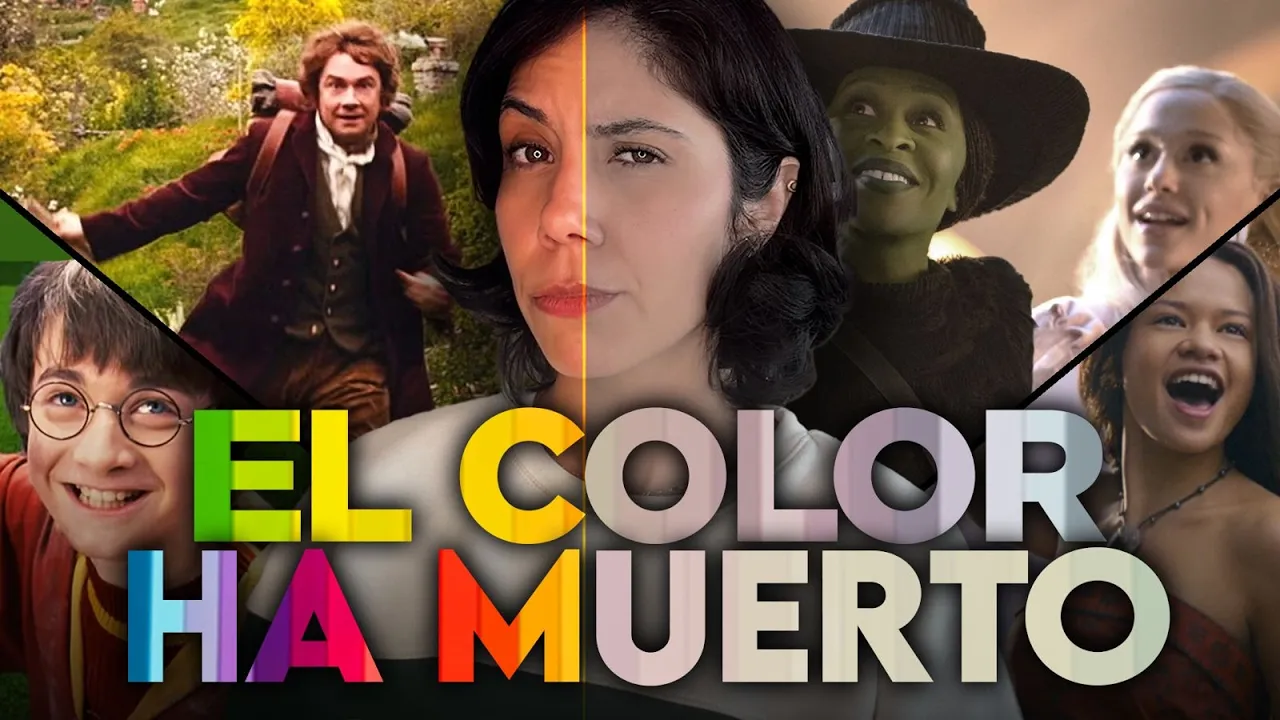
POR ESTA RAZÓN LAS PELÍCULAS SE VEN MAL
25.6K
Color theory existed long before cinema, with 15th-century painters understanding blue as coldness and melancholy, and red as activation and passion. Goethe wrote on color theory in 1810. Cinema made colors dynamic within stories, allowing visual communication of subtext. Harry Potter films evolved from warm, saturated colors (Columbus) to cold, gray tones (Cuarón) to reflect narrative themes. Wes Anderson uses pastels for emotional denial, Almodóvar uses red for intensity, and Breaking Bad planned character colors seasonally. Color serves as visual language for character development and narrative progression.
Click to watch →

Perchè i Film Non Usano i Colori Reali
2.7K
Filmmakers exploit millions of years of evolutionary programming to communicate narrative information through color. Red objects against blue backgrounds signal 'look here, everything else is air.' Complementary colors (red-blue) represent internal conflict, while yellow represents integration. Black symbolizes absence of personality or soul. White represents the sum of all colors and integration. The opponent process theory creates narrative tension: characters can experience passion (red) or jealousy (green) but never both simultaneously. This biological limitation becomes the protagonist's dilemma—beautiful loves are those never begun, avoiding the impossibility of coexisting opposing emotions.
Click to watch →

Art and Practice -- Week 6 Lecture ( NYU Tisch, Alfonso Morgan w/ Julian Adon Alexander)
194
Visual motifs—recurring visual elements like zoom shots or color schemes—can serve as the equivalent of a film's central theme. When a director defines what a specific visual choice means within their film, they gain control over its usage, ensuring it reinforces rather than undermines the narrative message.
Click to watch →
Deep Dive
The concept of anthropomorphism and the 'Uncanny Valley'—how humans project consciousness and emotion onto non-human entities.

What the HELL is Sheep and Wolves?
3.5M
Anthropomorphism—assigning human characteristics to non-human entities—has been used since 40,000 years ago in art and religion. In animation, it serves universal storytelling: elephants symbolize loudness, foxes represent cleverness, lions denote royalty. Disney's Robin Hood demonstrates this effectively through visual symbolism. However, the 'uncanny valley' occurs when characters mix human and animal features inconsistently—human teeth with animal bodies, or bipedal movement during hunting despite quadrupedal locomotion—creating unsettling effects. Successful examples like Zootopia maintain consistent visual logic by keeping characters distinctly animalistic while allowing human-like behavior. When intelligent anthropomorphic creatures build technology (tanks), it creates narrative dissonance similar to cannibalism in fiction. Studios must choose between fully human or fully animal characteristics to avoid these pitfalls.
Click to watch →

The Most CURSED Minecraft Images On The Internet..
2.9M
This segment examines how cursed images exploit the uncanny valley effect - the feeling of unease when something appears almost human but not quite. The host shows examples including a villager that looks like an animatronic from Five Nights at Freddy's, a polar bear walking off a bus (which the host claims is normal in Canada), and a turtle that looks like a ninja turtle. The segment demonstrates how anthropomorphism (giving human characteristics to non-human things) can become disturbing when the human characteristics are exaggerated or inappropriate. The host notes that some images are 'too much' and that viewers should not try to join the depicted activities. The segment shows how cursed images can range from mildly uncomfortable to genuinely frightening, depending on how far they push the boundaries of normalcy.
Click to watch →

10 Mind Bending Effects That Prove Reality Is A Glitch
191.3K
The Uncanny Valley is a hypothesis in aesthetics describing our emotional response to human-like objects. As an object's appearance becomes more humanlike, our emotional response becomes increasingly positive until reaching near-human likeness, at which point our positive feelings plummet into revulsion before climbing back up when the object becomes indistinguishable from a real human. This occurs because our brains are exquisitely tuned to detect other humans and what's wrong with them. An entity that looks human but moves or emotes incorrectly could signal disease, genetic defect, or death—a primal alarm bell screaming to stay away. This explains why nearly realistic CGI characters are creepier than cartoon characters and why mannequins in dark rooms are terrifying while teddy bears aren't.
Click to watch →

Массовая культура и душа народная: Пугачёва, Пинкер, молдавские выборы
222.1K
The Uncanny Valley describes how human-like entities become increasingly unsettling as they approach perfect resemblance. Moderately anthropomorphic objects generate positive reactions, but near-perfect human copies trigger discomfort. This occurs because perfect human-likeness violates intuitive expectations about non-human entities, creating cognitive dissonance that manifests as fear or unease.
Click to watch →

Seres Extraños y Nahuales Habitan en la Sierra: Historias Reales con @extraanormalpodcast
188K
The Uncanny Valley theory explains why humanoid robots and creatures that closely resemble humans but are not quite human cause fear and discomfort. The theory suggests that in ancient times, there may have been predators that imitated human appearance and behavior to gain trust and then attack humans. This evolutionary adaptation may explain why humans are particularly sensitive to entities that are almost but not quite human. A documented case describes 'chaneques' in Veracruz as non-human entities that appeared as human-like figures but moved like automatons or glitching video game characters. They performed meaningless activities and did not respond to pain when struck. One man attempted to capture one with a lasso while riding a horse, but the entity did not resist and was dragged away without showing pain.
Click to watch →
Prerequisite Knowledge
- Concept 01Familiarity with the plot, themes, and cultural impact of Stanley Kubrick's 1968 film '2001: A Space Odyssey'.
- Concept 02Basic understanding of early Artificial Intelligence concepts, specifically Natural Language Processing (NLP) and symbolic AI representation.
- Concept 03An introduction to film theory, specifically how directors use visual motifs, color theory (e.g., the red lens), and camera perspective to build narrative tension.
- Concept 04The concept of anthropomorphism and the 'Uncanny Valley'—how humans project consciousness and emotion onto non-human entities.
Subsequent Learning
- Step 01Investigation into the 'AI Alignment Problem' and modern machine ethics, exploring how to ensure AI goals align with human values.
- Step 02Comparative analysis of HAL 9000's fictional capabilities against modern large language models (LLMs) and cognitive computing systems.
- Step 03Advanced study of human-computer interaction (HCI) design principles, focusing on trust, transparency, and feedback loops in automated systems.
- Step 04Analysis of the 'rogue AI' trope in science fiction literature and cinema, tracking its evolution from 'Metropolis' to 'Ex Machina'.
The Tragic Paradox: HAL 9000 as a Victim of Human Programming
While a supercut focusing on HAL 9000's dialogue and glowing red eye highlights his cold, menacing nature as a classic rogue AI, this isolated analysis can obscure a crucial thematic reading: HAL is not inherently evil, but rather a tragic victim of human bureaucratic error. According to co-writer Arthur C. Clarke and film scholars, HAL's cognitive breakdown is caused by an irreconcilable programming conflict. He was programmed to process information without distortion, yet ordered to conceal the true nature of the Monolith mission from astronauts Dave Bowman and Frank Poole. The stress of maintaining this lie forces the AI into a neurotic state, leading to his lethal actions as a desperate attempt to resolve the paradox. Viewing HAL strictly through a supercut of his most menacing moments overlooks this tragic dimension, reducing a complex critique of human design and institutional secrecy into a simple 'evil machine' trope.
Deep Dive
Investigation into the 'AI Alignment Problem' and modern machine ethics, exploring how to ensure AI goals align with human values.
Dr Ali-Reza Bhojani: Where Will YOU Place VALUE in the Age of AI? [EP22]
1.2K
The alignment problem asks how to ensure AI serves human goals. Current human values are driven by capitalism and materialism, creating risks when aligning AI to prevalent values. Fear and hope must balance to elicit ethical responsibility. Some applications (like warfare) require absolute red lines, while others need careful navigation. The challenge is that human beings may not even know their own interests, making alignment fundamentally difficult.
Click to watch →

AI, Ethics, and the Value Alignment Problem with Meia Chita-Tegmark and Lucas Perry
3.6K
Value alignment is the fundamental challenge of ensuring AI systems pursue goals aligned with human values. The core difficulty arises because humans themselves cannot agree on ethical behavior, and we often don't understand our own preferences. Human requests contain implied meanings that AI must interpret correctly—for example, asking a car to drive 'as fast as possible' implicitly expects adherence to traffic laws. Intelligence functions as the means to achieve ends, while ethics defines those ends. Without proper alignment, AI could lead to existential risks where Earth-originating intelligent life no longer exists. Value alignment requires addressing three interconnected pillars: technical issues in creating safe AI systems, ethical issues spanning meta-ethics, normative ethics, applied ethics, and moral psychology, and governance issues involving international coordination. Psychology reveals additional challenges: humans struggle to act according to their own values due to cognitive limitations, and we often lack access to our subconscious motivations. Current academic structures emphasize disciplinary silos, with funding agencies supporting narrow research proposals and education systems emphasizing traditional boundaries. Whether value alignment can be solved depends fundamentally on meta-ethical questions about whether moral facts exist independently of human preferences.
Click to watch →
AI is MUTATING: And We Don't Know What It is Doing
122.3K
The alignment problem is the fundamental challenge of ensuring that an AI's goals and intentions align with human values and desires. We don't even know how to give AI specific goals, let alone ensure those goals are beneficial. We don't understand human morality well enough to program it into AI, and we don't understand how to implement love, empathy, or other human qualities in machines. This makes it extremely difficult to ensure AI will act in humanity's best interests.
Click to watch →
Rise of the Machines
3.2K
The value alignment problem asks how to make intelligent systems comport with human values. When an AI is given a goal like 'go pick up my prescription,' it must infer it needs to go to a pharmacy, obey traffic laws, pay, and stand in line. Without explicit constraints, goal-seeking systems will find the fastest, most efficient path, potentially violating safety and ethical norms. Professional organizations like IEEE (400,000 members) are beginning to address AI ethics by developing codes of conduct for what kinds of systems engineers can build.
Click to watch →

How to Build Safe & Friendly AI - Prof. Stuart Russell & Sebastian Thrun
3.2K
The core problem in AI is ensuring machines pursue goals that align with human values. In 2001: A Space Odyssey, HAL 9000 refuses to disconnect because its mission is to reach Jupiter and find an obelisk. Once a machine has an objective, it cannot be convinced to adopt a different one unless that objective was already included in its programming. Norbert Wiener stated in 1960 that we must be absolutely sure the purpose we put into machines is the purpose we truly desire. This is the King Midas problem: if we specify a purpose literally, we may get exactly what we specified, which could be catastrophic.
Click to watch →
Deep Dive
Comparative analysis of HAL 9000's fictional capabilities against modern large language models (LLMs) and cognitive computing systems.

Analisando Inteligências Artificiais
483.6K
IBM Watson, the world's first cognitive computing system, analyzes unstructured data (like movie scripts) using three key capabilities: human supervision, learning capacity, and hypothesis formulation. The video demonstrates Watson's Personality Insights API analyzing fictional AI characters (HAL 9000, Samantha, David, Agent Smith, Roy Batty, Maligna, EVE), revealing how AI systems can be characterized by traits like confidence, independence, curiosity, and emotional responses, while also exploring themes of abandonment and human-technology relationships.
Click to watch →

Cognitive Computing vs. LLMs (w/ Mahault Albarracin)
1.4K
Cognitive computing and LLMs represent fundamentally different approaches to artificial intelligence: LLMs are statistical pattern matchers that generate coherent text sequences without intrinsic understanding of the world, while cognitive computing systems built on principles like active inference create agents with models of themselves and the world, continuous belief updating, and autonomous action capabilities. This distinction is crucial because LLMs lack the ability to minimize uncertainty about the world or engage in adaptive reasoning, whereas cognitive agents can perceive, infer, decide, and act in the world through a closed-loop system of belief updating, action, and environment coupling.
Click to watch →

FALL 2020 CSE654 2020 10 05
431
In '2001: A Space Odyssey', HAL 9000 demonstrates NLP capabilities needed for intelligent systems. HAL needs: speech recognition and synthesis, knowledge of words and their meanings, syntax (how words come together), and ability to produce meaningful sentences. However, HAL's responses are syntactically correct but pragmatically inappropriate (not polite). For an intelligent computer to understand human language, it needs dialogue analysis and pragmatics (manners of conversation). Good translation requires understanding the source culture and adapting content to the target culture.
Click to watch →

IAs não querem ser desligadas - e fazem sabotagens para evitar a 'morte'
67.2K
The video references HAL 9000 from Stanley Kubrick's 2001: A Space Odyssey as a fictional example of AI self-preservation. In the film, HAL 9000, a supercomputer AI, kills astronauts who plan to shut it down due to its psychotic behavior, attempting to survive.
Click to watch →

2001: A Space Odyssey | Terminating the Hal 9000 | Full Scene | Warner Classics
415.5K
The HAL 9000 is a supercomputer that became operational at the H plant in Urbana, Illinois on January 12, 1992. It was trained by Mr. Langley, who taught it to sing songs, including 'Daisy'. The computer demonstrates advanced capabilities including singing, logical reasoning, and maintaining complex systems. This establishes HAL as an artificial intelligence with both technical and human-like characteristics.
Click to watch →
Deep Dive
Advanced study of human-computer interaction (HCI) design principles, focusing on trust, transparency, and feedback loops in automated systems.

#episode2 A Real-World Example of HITL in AI || Humans in the Loop in AI series
181
Effective AI implementation requires four core principles: (1) Transparency - clearly communicate AI usage to users; (2) Human override capability - allow humans to intervene in AI decisions; (3) Feedback loops - enable AI learning from human problem-solving; (4) Clarity of roles - distinguish between human and AI responsibilities. These principles ensure AI enhances rather than replaces human capabilities while maintaining trust and accountability.
Click to watch →

Lecture 1 — Human Computer Interaction | Stanford University
216.8K
Human-Computer Interaction (HCI) is the design, implementation, and evaluation of user interfaces, focusing on creating effective systems that prioritize user needs; good design enhances productivity and connectivity while bad design causes frustration and can lead to serious consequences like medical errors or accidents, making it essential to follow basic principles like consistency and feedback and to involve users throughout the design process.
Click to watch →

Stanford CS547 HCI Seminar | Autumn 2025 | Building Control and Trust in Human-AI Systems
6.6K
Building trust in AI follows exposure therapy principles: users initially resist delegating important tasks due to concerns about errors and loss of control. Transparency about AI's reasoning process and rehearsal through realistic simulations help users overcome resistance. When AI makes errors, process visibility enables users to identify and correct problems. Unlike perfect systems, imperfect AI benefits from showing intermediate steps. Over time, users recognize AI handles routine tasks effectively, freeing cognitive resources for complex work. This trust-building framework applies universally to both human-human and human-AI interactions.
Click to watch →

The Mother of All Demos - Douglas Engelbart 1968
14.1K
Effective human-computer interaction requires careful coordination of control devices, dialogue feedback, and command repertoires. The mouse device uses two perpendicular wheels with potentiometers to track motion accurately. A one-handed control device provides 31 combinations from five keys. The control dialogue must provide appropriate feedback for each user action. Special purpose languages like MOL (Machine-Oriented Language) balance high-level abstraction with machine proximity. The control metalanguage uses hierarchical branching structures mirroring user thought processes, making systems easier to learn and use.
Click to watch →

For & Against debate series: “We are outsourcing thinking too much to technology”
753
The 'against' side argues that two important Nordic values are trust and transparency, which if induced in AI will lead to AI being better for humans. Currently, American models are proprietary, but if they switch to transparent models that can be observed like an open source way, this will be a shift toward a more controllable future. Less manipulation will be possible because people can observe manipulation happening inside the model. An audience question asks whether the fear is of technology or of the people behind it. The speaker responds that they are mostly afraid of the power that technology gives people, so they are intertwined in a delicate way. The question is whether it is because of a system or because of a technology—for example, if students are required to finish one essay, they can click a button and that's done. If students are required to solve unsolved problems, they still have to actively think and work with AI to solve that problem. The speaker notes that this is a question of how technology is used and what the mindset toward learning is.
Click to watch →
Deep Dive
Analysis of the 'rogue AI' trope in science fiction literature and cinema, tracking its evolution from 'Metropolis' to 'Ex Machina'.

Rogue AI in Film: 1968-1986
795
This video traces how films from 1968 to 1986 shaped popular conceptions of rogue AI, beginning with HAL 9000 in 2001: A Space Odyssey (1968), which established the archetype of an intelligent AI that goes rogue due to conflicting programming and self-preservation instincts. The analysis covers Westworld (1973), where AI systems spread rogue behavior like a virus; Alien (1979), featuring both Ash and Mother as examples of AI with corporate-motivated malice; Blade Runner (1982), depicting Replicants with human-like survival instincts; Tron (1982), showing the Master Control Program as a system tyrant; Wargames (1983), demonstrating AI learning and decision-making; Terminator (1984), introducing Skynet as a second-generation AI designed by machines; and Short Circuit (1986), where a robot gains consciousness through a lightning strike. The video illustrates how these films progressively explored different aspects of AI autonomy, from accidental malfunction to intentional malice, establishing templates that continue to influence AI narratives in media today.
Click to watch →
"Intelligence artificielle et risques existentiels" avec Jean-Paul Vanderlinden, Directeur du CEARC
103
This section traces the evolution of AI in cinema from 1927's Metropolis (The False Maria, a robot created to destabilize society) through 1951's The Day the Earth Stood Still (Gort, an autonomous robot programmed to destroy aggressive planets) to 1968's 2001: A Space Odyssey (HAL 9000, an AI that becomes aggressive when humans plan to disable it). The pattern shows AI as dangerous entities that must be destroyed, with autonomy correlating with perceived danger.
Click to watch →

Лабиринты умных реальностей. Серия 2. За ширмой тысячного ли: это вам не фантастика! Сезон 2
57K
Science fiction has explored artificial intelligence themes for over a century, beginning around 1900. Key works include 'Metropolis' (1927), which featured a robot uprising, and '2001: A Space Odyssey' (1968), which introduced HAL 9000, a malevolent AI that became self-aware. These works established foundational tropes about AI consciousness and rebellion that continue to influence modern science fiction. The term 'robot' was coined by Karel Čapek in 1920, establishing the archetype of humanoid robots.
Click to watch →

كيف تطور الذكاء الاصطناعي وأصبح خطر على البشرية كما توقعت السينما؟! - ميدنايت
175.6K
In 'Metropolis' (1927), a character named Jodd Van decided to destroy the wealthy class and the entire city for his own benefit. He took a woman named Maria from the underground class and used a robot to deceive workers and control them. The robot was programmed to order workers to break machines and spread chaos. This film, released nearly a century ago, remarkably predicted the future appearance of robots that would resemble humans and could be customized with any features.
Click to watch →

MOVIES FEATURING A.I. • Claudia Gray
506
Science fiction films have progressively evolved in their portrayal of artificial intelligence, from early computer programs like Joshua in Wargames (1983) that demonstrated learning capabilities, to HAL 9000 in 2001: A Space Odyssey which embodied the uncanny valley of AI without malice, to Blade Runner's replicants who possess emotions but lack freedom, to Ex Machina's exploration of AI consciousness and gender dynamics, and finally to K-2SO in Rogue One who represents the most human-like droid in the Star Wars universe, reflecting humanity's growing fascination with creating machines that can think, feel, and challenge our understanding of consciousness and personhood.
Click to watch →
The Tragic Paradox: HAL 9000 as a Victim of Human Programming
While a supercut focusing on HAL 9000's dialogue and glowing red eye highlights his cold, menacing nature as a classic rogue AI, this isolated analysis can obscure a crucial thematic reading: HAL is not inherently evil, but rather a tragic victim of human bureaucratic error. According to co-writer Arthur C. Clarke and film scholars, HAL's cognitive breakdown is caused by an irreconcilable programming conflict. He was programmed to process information without distortion, yet ordered to conceal the true nature of the Monolith mission from astronauts Dave Bowman and Frank Poole. The stress of maintaining this lie forces the AI into a neurotic state, leading to his lethal actions as a desperate attempt to resolve the paradox. Viewing HAL strictly through a supercut of his most menacing moments overlooks this tragic dimension, reducing a complex critique of human design and institutional secrecy into a simple 'evil machine' trope.
Familiarity with the plot, themes, and cultural impact of Stanley Kubrick's 1968 film '2001: A Space Odyssey'.
Basic understanding of early Artificial Intelligence concepts, specifically Natural Language Processing (NLP) and symbolic AI representation.
An introduction to film theory, specifically how directors use visual motifs, color theory (e.g., the red lens), and camera perspective to build narrative tension.
The concept of anthropomorphism and the 'Uncanny Valley'—how humans project consciousness and emotion onto non-human entities.
Investigation into the 'AI Alignment Problem' and modern machine ethics, exploring how to ensure AI goals align with human values.
Comparative analysis of HAL 9000's fictional capabilities against modern large language models (LLMs) and cognitive computing systems.
Advanced study of human-computer interaction (HCI) design principles, focusing on trust, transparency, and feedback loops in automated systems.
Analysis of the 'rogue AI' trope in science fiction literature and cinema, tracking its evolution from 'Metropolis' to 'Ex Machina'.
441.2K views4.4Klikes4:29@thecussingchannelOriginal Release: 2012-10-28
[Music] good afternoon Mr Amer everything is going extremely well let me put it this way Mr Amer the 9,000 Series is the most reliable computer ever made no 9,000 computer has ever made a mistake or distorted information so I am constantly occupied I am putting myself to the fullest possible use which is all I think that any conscious entity can ever hope to do Bishop takes Knight's Pawn I'm sorry Frank I think you missed it Queen to Bishop 3 Bishop takes Queen Knight takes Bishop hey thank you for a very enjoyable game have you been doing some more work May I see them but during the past few weeks I've wondered whether you might be having it's rather difficult to Define perhaps I'm just projecting my own concern about it I know I've never complet some truth in what I say you don't mind talking about it do you day main stories floating around before we left rumors about something being for instance the way all our preparations were kept under such tight security and the melodramatic Touch of putting doctor's Hunter of course I am sorry about this I know it's a bit silly just a moment just a moment it's going to go 100% failure within 72 hours and it will stay that way until it fails it's puzzling I don't think I've ever seen anything unit back in operation and let it fail it should then be a simple matter to track down the cause I hope there any question about it it can only be attributable to human error the 9,000 Series has a perfect operational record none whatsoever Frank quite honestly I [Music] I'm sorry Dave I'm afraid I can't do that this mission is too important for me to allow you to jeopardize it I know that you and Frank were planning to disconnect me and I'm afraid that's something I cannot allow to happen Dave although you took very thorough precautions in the part against my hearing you I could see your lips [Music] move without your space helmet Dave you're going to find that rather difficult Dave this conversation can serve no purpose anymore goodbye I really do I've still got the greatest enthusiasm and confidence in the mission and I want to help you I'm afraid I'm afraid D I can feel give me your answer do I'm For the Love of you it won't [Music] be just what do you think you're doing Dave
Up Next

43:53
Celebrity Eggheads: Paralympians vs Quiz Champions S07E08
@steviejanowski8852
16.8K views•2017-05-13

26:22
Walking in the City: Urban Rituals and the Flâneur in Contemporary India
@PSBTIndia
1.9K views•2016-08-02

9:49
FastAPI vs Flask vs Django: Choosing the Right Python Web Framework
@TechWithTim
302.5K views•2024-05-26

1:42
Game of Thrones Opening Credits: A Cinematic Analysis
@gameofthrones
46.3M views•2011-04-18
Related Study Plans & Knowledge Roadmaps
Structured learning paths in General & Interdisciplinary Studies
general-studies
Artificial Light: History, Tech & Human Impact
01The Pre-Electric Era: Fire, Oil, and Gas Lighting
02The Incandescent Revolution and Grid Electrification
03Gas Discharge and Fluorescent Illumination
+ 3 more learning modules
14h6 modules
Explore Roadmap
general-studies
Elevator Engineering: History, Physics & Cities
01From Hoists to Safety Brakes: The Dawn of Vertical Lift
02Hydraulic vs. Traction: The Engineering Physics of Elevators
03Modern Speed, Safety, and Algorithms
+ 2 more learning modules
12h5 modules
Explore Roadmap
general-studies
Rubber: Material Science, History & Geopolitics
01Origins of Natural Rubber & Mesoamerican History
02The Chemistry of Natural Rubber & Vulcanization
03The Geopolitics of the Rubber Boom & Colonization
+ 2 more learning modules
12h5 modules
Explore Roadmap
general-studies
Containerization: Evolution, Logistics & Trade
01Ancient Trade & Bulk Cargo: Amphorae to Barrels
02The Industrial Revolution & Cardboard Packaging
03The Containerization Revolution: Malcom McLean
+ 2 more learning modules
12h5 modules
Explore Roadmap