





![|| Turbo Machines || Derivation || Force Exerted By The Jet || [Hindi]](https://i.ytimg.com/vi_webp/Lqeoz7unZG4/maxresdefault.webp)


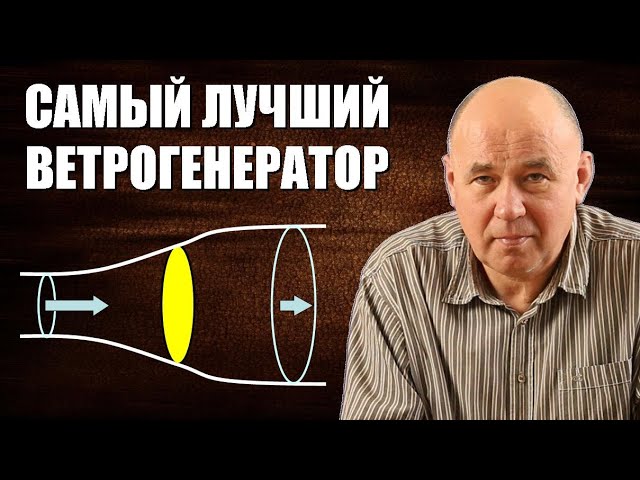











Wind turbines cannot extract all kinetic energy from wind because doing so would stop the wind entirely, preventing any airflow through the turbine. The optimal efficiency occurs when wind speed is reduced to one-third of its incoming value, achieving approximately 59% energy extraction efficiency (known as Betz's limit), because this balances the trade-off between extracting more energy per unit of wind and maintaining sufficient wind volume to continue extracting energy.
Windmill Energy Efficiency: The Physics of Wind Turbines
Added:The concept of Kinetic Energy and Mass Flow Rate, specifically how moving air masses carry energy.
The Principle of Conservation of Energy, to understand how wind energy is transferred and transformed rather than lost.
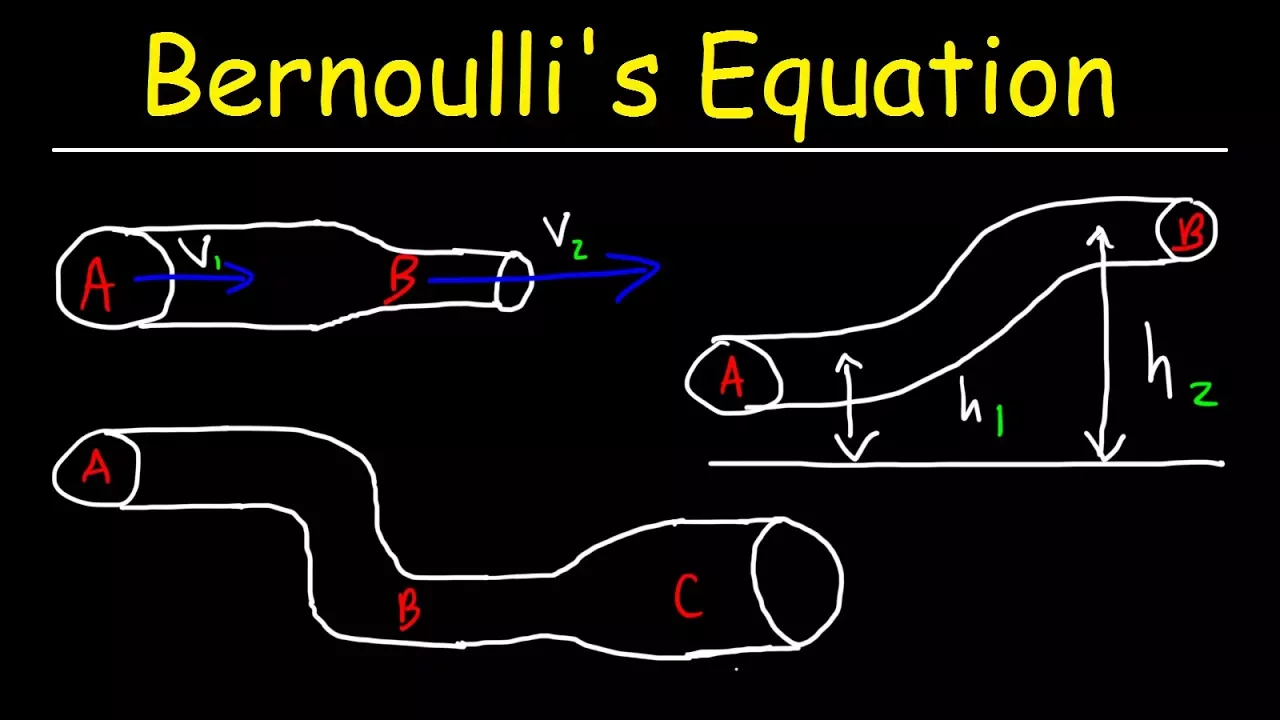
Basic Fluid Dynamics, including concepts of fluid speed, pressure differentials, and Bernoulli's principle.
Newton's Laws of Motion, particularly how forces are exerted by fluid flows on solid structures like turbine blades.
Betz's Law and its mathematical derivation using Actuator Disk Theory.
Engineering losses in real-world wind turbines, exploring why actual operational efficiency is typically 35-45% due to drag, wake effects, and mechanical friction.
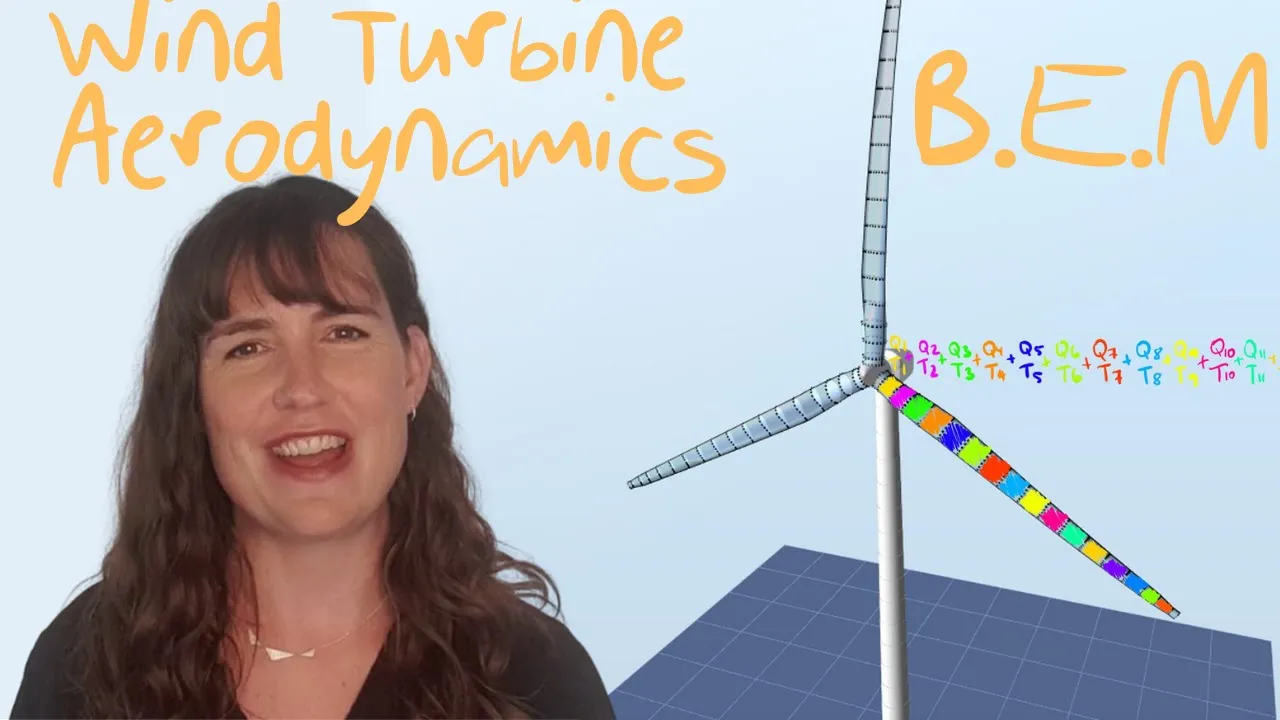
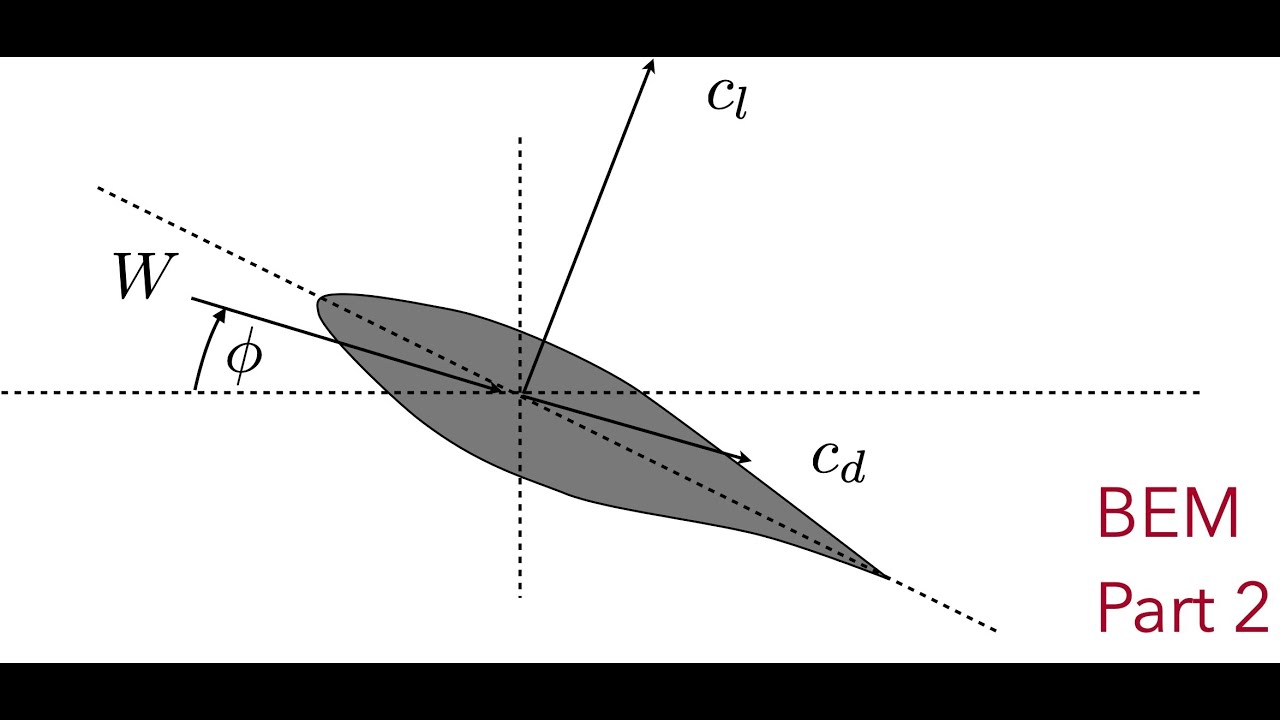
The role of Blade Element Momentum (BEM) theory in modern aerodynamic design of turbine blades.
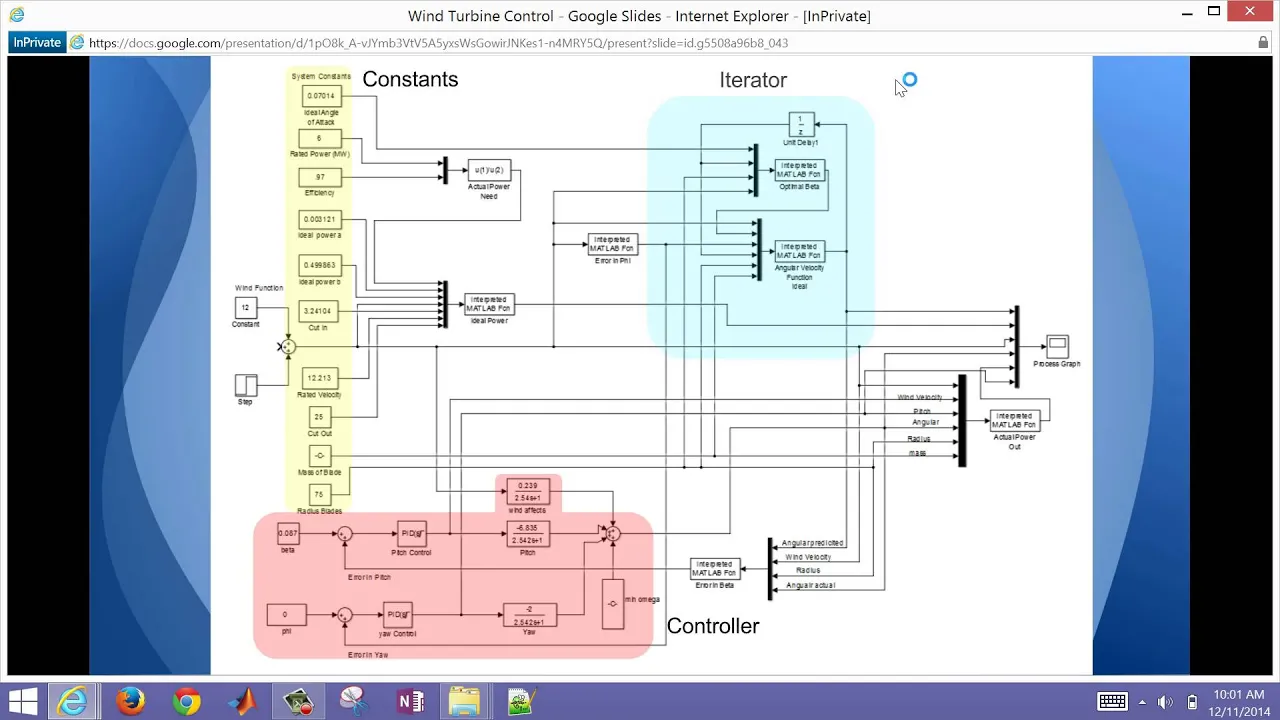
Control systems in wind energy, such as pitch and yaw control mechanisms used to optimize efficiency in variable wind speeds.
543.3K views27.2Klikes3:02Original Release: 2021-04-01
The paradox of windmills is this: extract kinetic energy from the wind while still letting the wind past. Unlike a dam, where you extract the potential energy from the height of the water and so you can lower the water as much as you want without slowing the flow, with a windmill, you extract kinetic energy from the *motion* of the wind, which causes the wind to slow down.
So how much wind should a windmill mill?
Well, the maximum possible amount of energy you can extract from the wind is simply the difference between its initial and final kinetic energy. Kinetic energy depends on speed squared, so if the outgoing wind speed is, say, half of the incoming speed, then the final wind energy will be a quarter of the initial energy, meaning that three quarters of the energy of the wind was extracted when it passed the windmill.
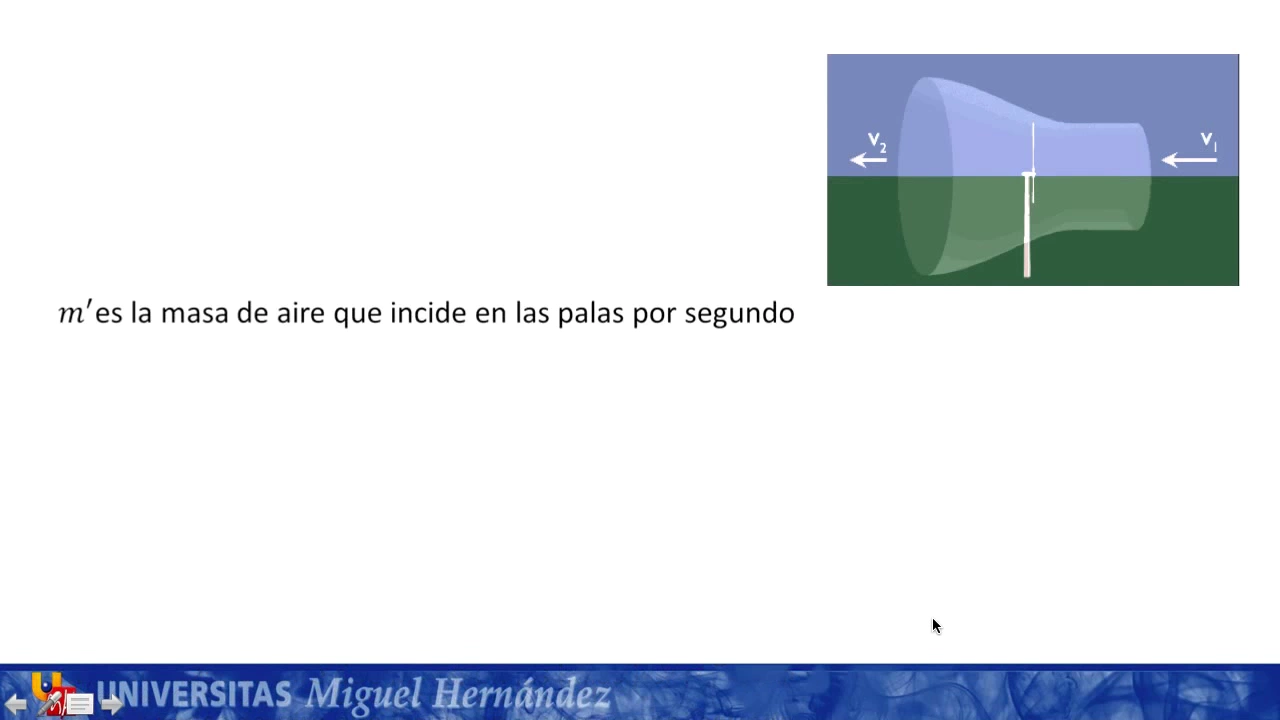
But then there's the question of how much of the wind you can actually extract energy from. It turns out that the speed of the wind at a windmill is halfway between the incoming and outgoing wind speeds. So for a final wind speed of half the incoming speed, the speed at the windmill will be three fourths the incoming speed, which means only three fourths as much wind can actually pass the windmill every second.
Combining these two facts means that a windmill that slows the wind to half its initial speed allows three fourths as much wind to pass and extracts three fourths of the energy from that wind, for a total efficiency of three fourths times three fourths, or 56.25%.
Doing the same math for other possible wind speed reductions, you find that the most efficient windmill possible slows the wind to a third of its incoming speed. Reducing to 1/3 speed achieves a kinetic energy "efficiency" of v^2-(v/3)^2 equals 88.88% of the energy of wind passing the windmill is extracted. And reducing the wind to 1/3 speed after the windmill means the wind passing the windmill is going at 2/3 speed, so 2/3 as much wind passes through the windmill. And 88.88% energy extraction from 2/3 of the wind results in an overall efficiency of 88.88*2/3 = 59.259 percent.
A windmill that slows the wind down below 1/3 speed will get a higher percentage of the energy but from even less wind, for a lower overall efficiency. And a windmill that slows the wind down less will get a lower percentage of the energy from somewhat more wind, again for a lower overall efficiency.
So how much wind should a windmill mill? 2/3 of it, for 59% efficiency in extracting the energy.
Obviously, real world windmills are far more complicated and have way more engineering considerations, so the 59% number may not apply exactly.
Ok, Henry here, I've put a bonus video on Nebula that covers some details I had to leave out of the main video. Nebula is the Streamy-award-nominated independent streaming service that's the co-sponsor of this video, built by and for a collection of educational video creators including Real Engineering, Mike Boyd, Up and Atom, Jordan Harrod - and me. And Nebula has partnered with CuriosityStream, which offers thousands of documentaries and nonfiction titles, to give you access to both platforms in one go... for just a few dollars a month! I really enjoyed watching the European Inventor Award episode about Henrik Stiesdal, who has been intimately involved in the invention and development of modern wind turbines, building the first offshore wind farm, and more. Sign up for CuriosityStream using the link in the description and you'll also get access to Nebula, including the bonus video that goes with this one, as well as an ad-free viewing experience across the site. And you'll also get 26% off an annual subscription to CuriosityStream.
Up Next

10:52
Betz's Law: Maximum Efficiency of Wind Turbines (59.3%) Derivation
@DerekElsworth
78.5K views•2016-01-10

12:53
21cm Hyperfine Transition in Neutral Hydrogen: Radio Astronomy Basics
@AaronRobertParsons
12.4K views•2011-10-13
21:43
Feynman's Lost Lecture: Why Planets Orbit in Ellipses | Physics Explained
@MinutePhysics
3.7M views•2018-07-20

27:14
Entropy and the Second Law of Thermodynamics Explained
@veritasium
27.5M views•2023-07-01
Related Study Plans & Knowledge Roadmaps
Structured learning paths in Physics
physics
Nuclear Physics (Decay, Fission & Reactors)
01Atomic Structure and the Binding Force
02Radioactive Decay and Half-Life
03Nuclear Fission Mechanics and Chain Reactions
+ 2 more learning modules
12h5 modules
Explore Roadmap
physics
Soft Matter (Polymers, Colloids & Rheology)
01Foundations of Soft Matter & Thermal Forces
02Polymer Physics and Macromolecules
03Colloids, Surfactants, and Self-Assembly
+ 2 more learning modules
38h5 modules
Explore Roadmap
physics
Analytical Mechanics: Lagrangian & Hamiltonian
01Mathematical Foundations: Calculus of Variations
02From Newtonian Mechanics to Constraint Dynamics
03The Principle of Least Action & Lagrangian Mechanics
+ 3 more learning modules
28h6 modules
Explore Roadmap
physics
General Relativity (Spacetime & Cosmology)
01Foundations of Relativity: Special Relativity
02The Geometry of Spacetime: Equivalence Principle & Curvature
03Einstein's Field Equations: The Mathematics of Gravity
+ 2 more learning modules
55h5 modules
Explore Roadmap