


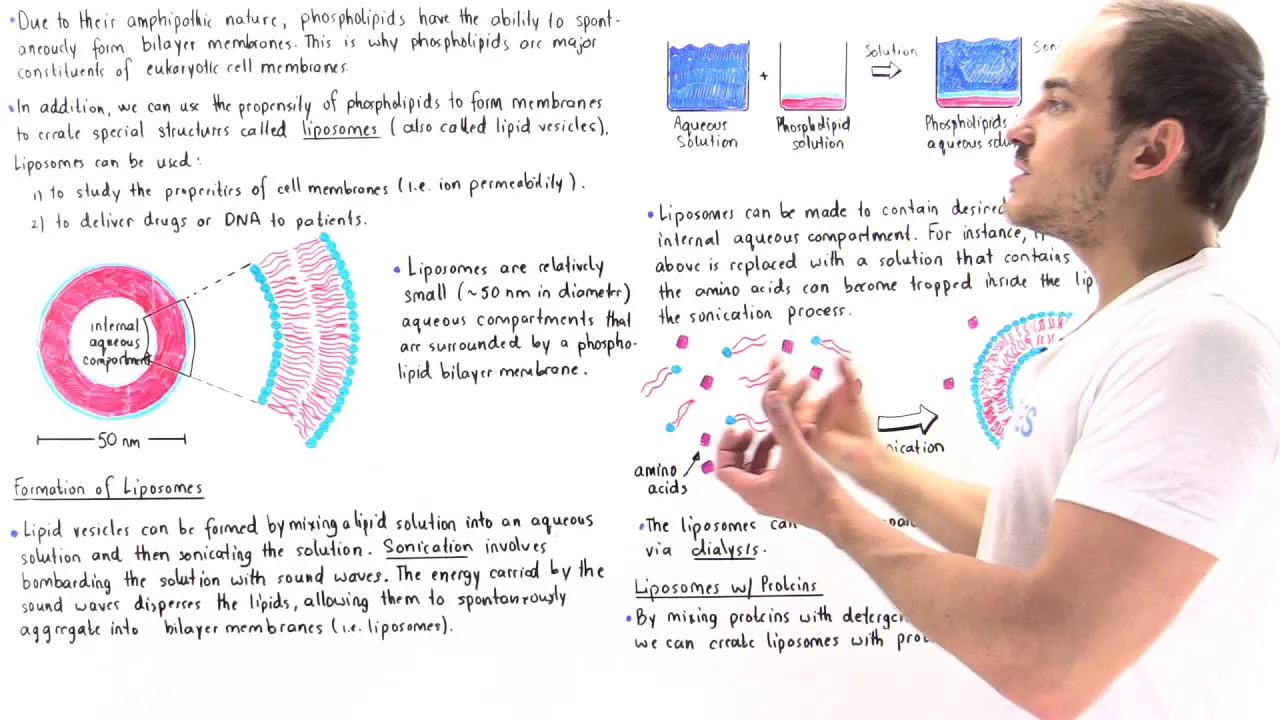


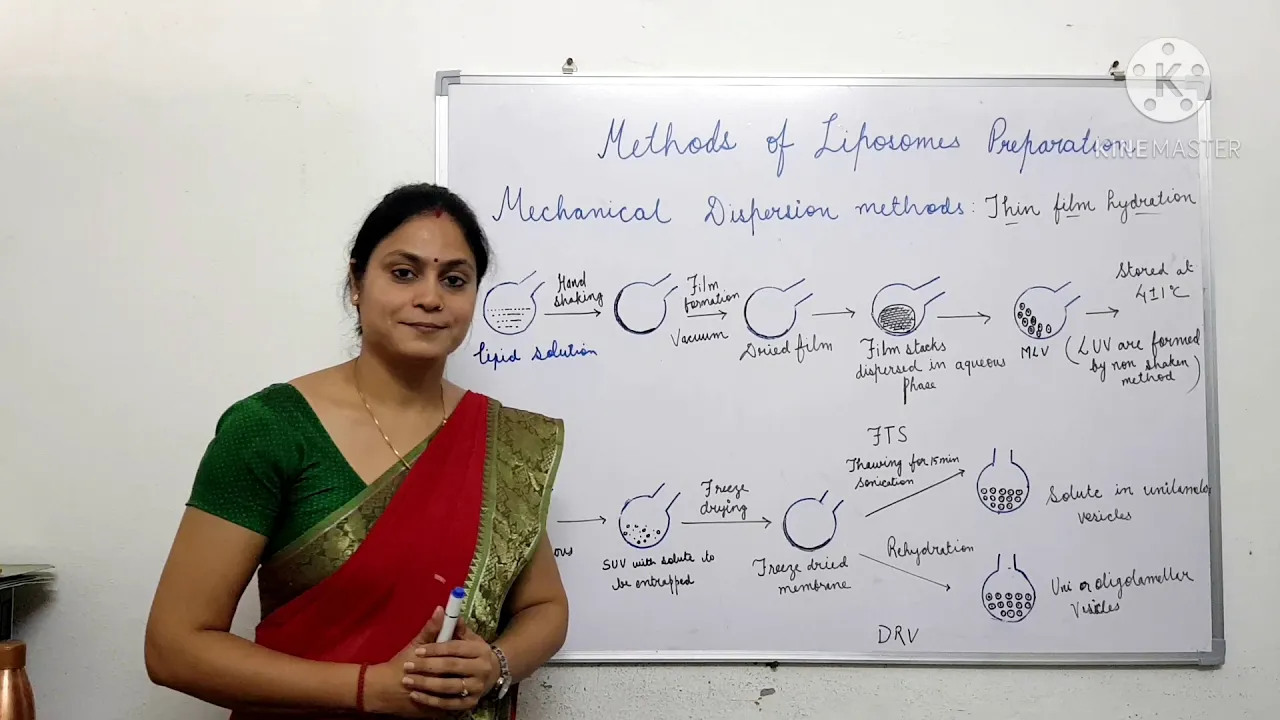

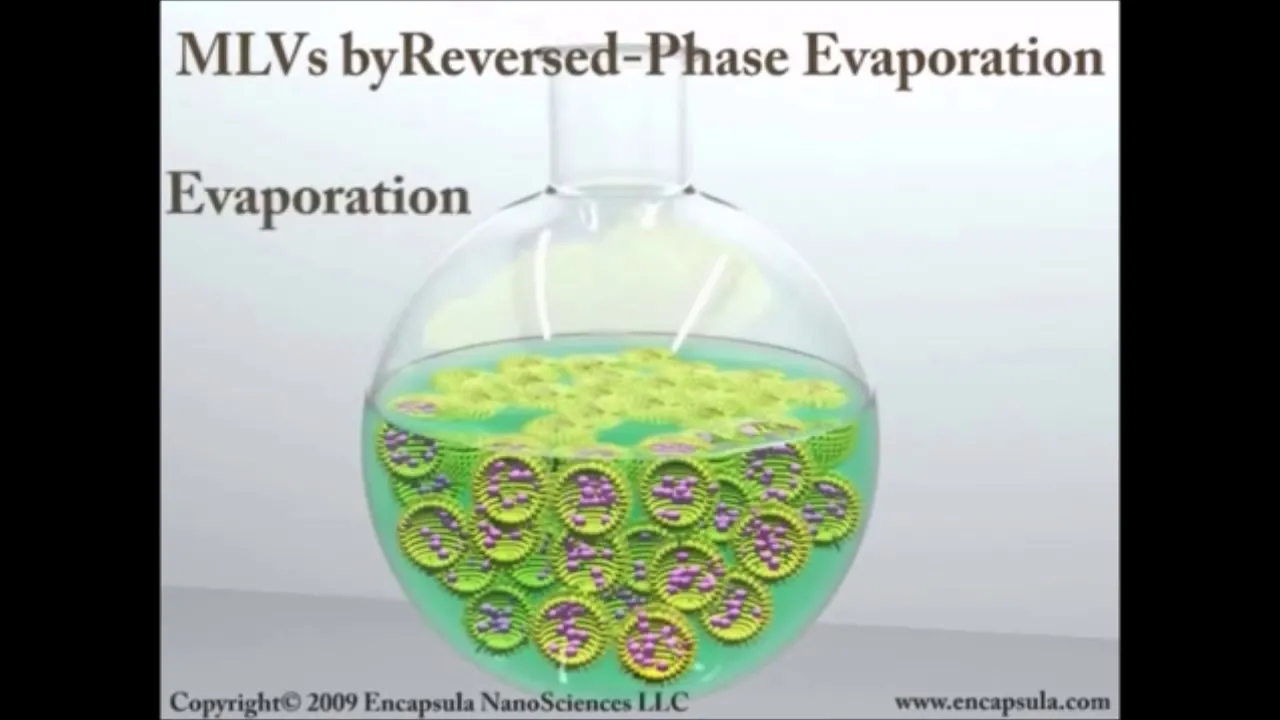








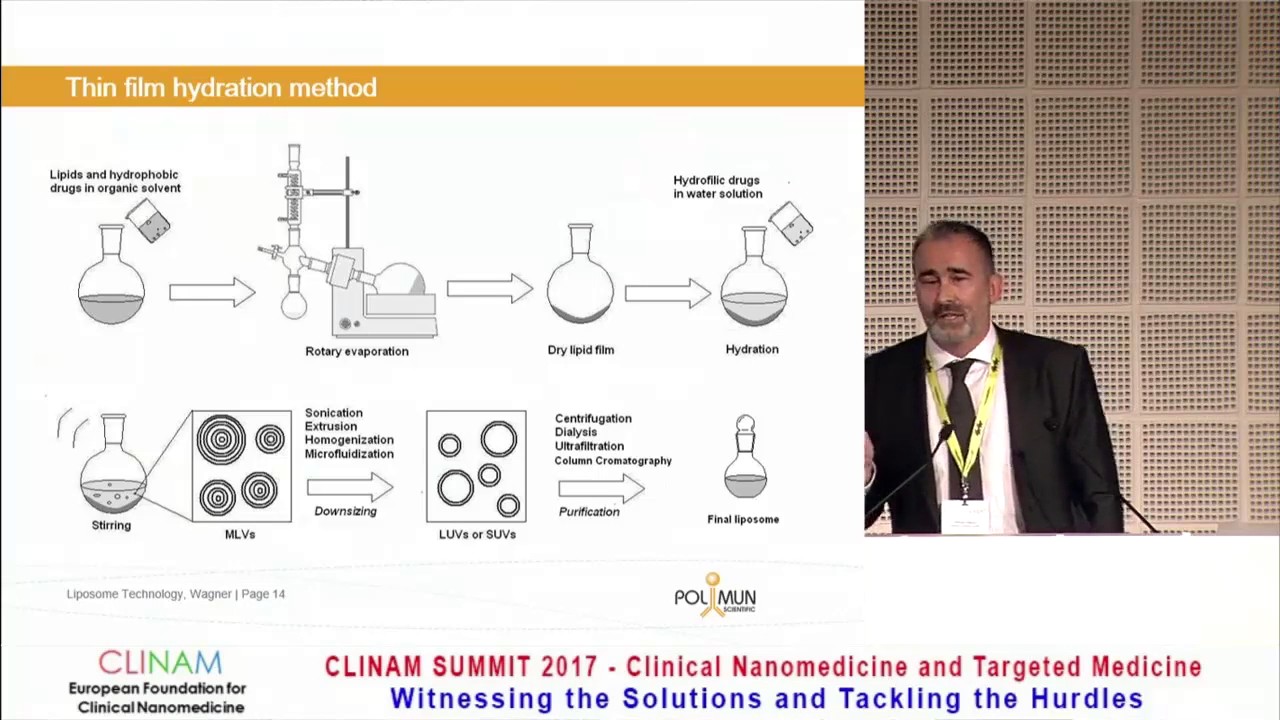


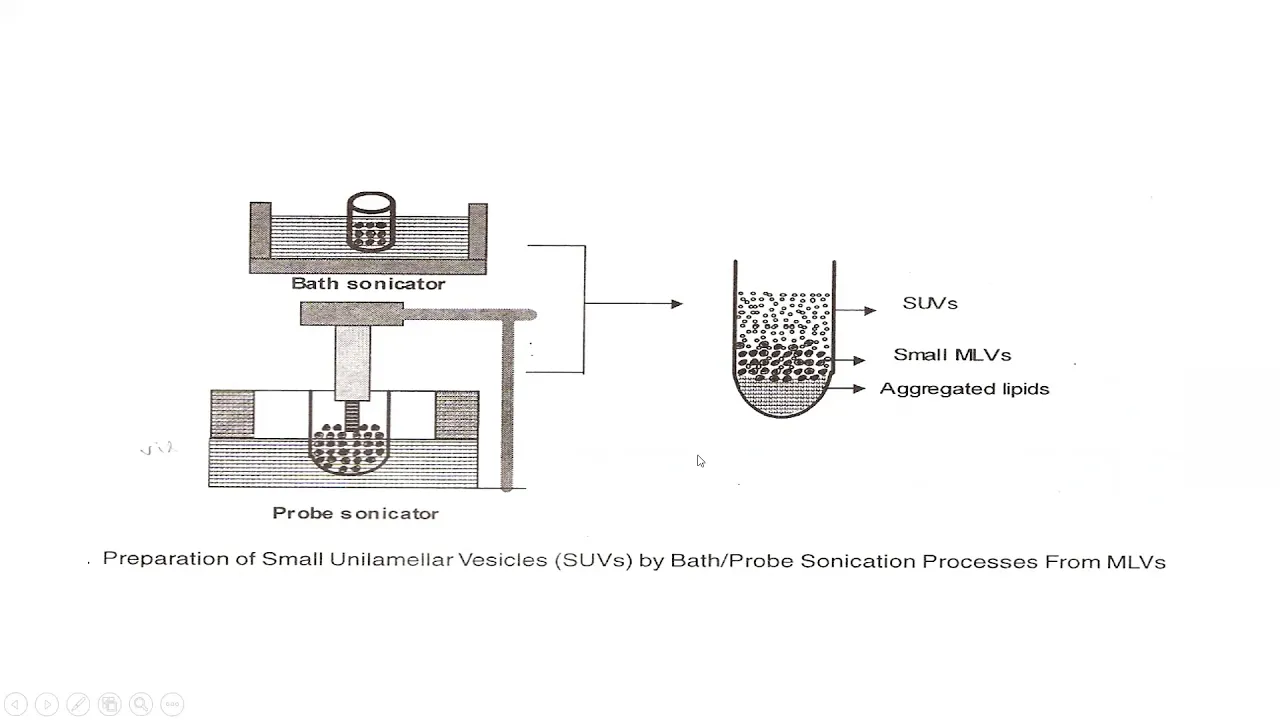
Liposome evaluation encompasses three main categories: physical characterization (including size, size distribution, shape, surface charge, lamellarity, and phase behavior determined by techniques like laser light scattering, transmission electron microscopy, electrophoresis, and differential scanning calorimetry); chemical characterization (assessing phospholipid content via colorimetric assays, cholesterol content via HPLC, drug content using UV-visible spectroscopy, and detecting lipid peroxidation); and biological characterization (evaluating sterility, pyrogenicity, and animal toxicity). Key parameters include entrapment efficiency (calculated as [(initial drug - free drug)/initial drug] × 100) and percentage drug loading (calculated as [entrapped drug/total liposome weight] × 100), which are essential for pharmaceutical quality control and formulation optimization.
Liposomes Part 3: Evaluation & Characterization Methods
Added:hi students i'm doctor bhadrinath and today's video is a liposomes part 3 that is the last part in this part 3 we will see evaluation of liposomes it is exclusively for the evaluation part three part one and part two is already completed and you can check my previous videos okay right see generally this evaluation of liposomes is very difficult not easy just like a tablet's evaluation is easy just like a hardness so probability disintegration resolution that and all we can be carrying very easy job okay and here liposuction of instruments lot of equipments okay and almost total your analysis of technology you should have if you want to analyze the uh libraries see you need a x-ray knowledge knowledge of the x-ray laser light generally we are using to play like a different images will come laser light here we are using uh laser light for the analysis of the lipos just imagine like this is about your syllabus here they have mentioned the liposomes and their applications and all and most of the students they are doing a mistake that evaluation they are writing a spelling as an evolution evolution means development keep in your mind evolution evaluation means analysis yeah keep in your mind evaluation don't try to work evaluation a is transfer analysis we are going to be test here so there is a mainly three types of characteristics you you have to be evaluated in case of the liposomes physical characterization chemical characterization and biological characterization biological characterization either liposomes are the toxic or it is doing any harmful to the patient like that biological evaluation chemistry what is a possible if it's present what is the cholesterol present what is the how much content is present and physical characterization so like that three classifications are there these three evaluations are very very important you have to be right in the examination this is about the physical characterization like in size uh see here liposome size see liposome size size distribution how many particles uh how many particles are small size how many particles are medium size how many particles are bigger size what is the average of like size distribution also can be used by using a laser light scattering i have told you laser light we are playing temp transmission electron microscopy not your ordinary microscopy not your compound microscope what you observe in your regular classes or regular practical classes in your college not that this is stem transmission electron microscopy very very costly okay and the gel permeation technique gel exclusion chromatography all we are using for the size and size distribution and the shape either the liposome is having a round shape or global shape or irregular shape we are using attempt okay same here temp and the freezer fracture you have to freeze the liposomes and make it fracture freeze fracture keep in your mind electron microscopy surface charge liposucts having a positive charge or negative charges that is also very important we can be determined by using a free flow electrophoresis and the surface electrical potential since there was a charges and potency must be there okay zeta potentiometer we are using lamellarity liposum is either unilaterality or multi-laminality how many levels are our project okay by using a small x-ray see here we are using x-ray scattering 31p nmr series fracture electron microscopy esc potentiometer we are using electrophoresis chromatography oh my god it's a very tough job liposuction is very tough job face behavior how the liposomes will behave like this freeze fracture electron microscopy dse differential scanning that is also a very big chapter in your analysis okay so you need the complete knowledge of the analysis we know that pharmacy is a multi-disciplinary subject you have to know each and every subject up to the depths and the entrapment fcc see a drug is present inside the liposuction how much drug is entrapped how much drug is remained outside like that entrapment efficiency percentage of drug loading inside the lipology like a specific analytical method of each group like a mini column centrifugation ion exchange chromatography that is also one big book is there chromatography radio leveling rate of drug relation how the truck is at what rate drug is releasing from the liposomes can be determined by using a diffusion cell dialysis etc that is about physical characterization important i will tell you in detail okay chemical characterization like a phospholipid all these are the phospholipids is possible in between the phospholipids there is a cholesterol also so possible if it contains how much assay since it is a chemistry chemical characterization cholesterol content by using hplc cholesterol oxidation possible liquid content very very important let us say light just like a tube light bar light assay uh sweet uh stamat assay bar light switch like that you can remember drag the container suitable for specific respective drag for paracetamol uh uv visible spectroscopy like that so drug content it depends upon the specific drug and the possible lipid peroxidation is possible if it's undergo the peroxidase oxidation that you can be determined by using uv absorption tbs acid iodometric assay glc gas liquid chromatography see here how many analytical techniques are here past four liquid hydrolysis hplc tnc thin layer chromatography cholesterol oxidation antioxidant degradation osmolarity by a hosmometer like that and biological parameter how many aerobics organisms are present in your preparation how many anaerobic uh organisms are present that you can be determined by using a culture test like this okay under pyrogenicity either your liposuction having a property of increasing the body temperature lamellae's largest [Music] animal toxicity we have to do is like a survival rate of the animal how many you have to give your levels to the animals and you have to check what is the survival rate histology like a disciple tissue pathology of animal tissue histology of animal tissue and either it is a biological hazard this is my mobile app you can be downloaded from my google play store okay after that you can be opening the app go to the store option here all my presentations are available in the pdf format like am form c b form c part d all the courses okay all the subjects single handed playlist here uh this is about my youtube channel go to the playlist option there i have arranged all my videos subject-wise explanation videos each subject if you click on that you will get a chapter way yeah see important is we are going to be cover here entrapment hcc how much truck is entrapped see here 500 mg of paracetamol you have used to prepare a liposome keep in your mind all 500 energy will not enter into the liposuction this is empty level so all 500 mg will not enter only see here only few amount of the 300 mg or 350 mg for 400 mg will enter remaining will be like this this is called a drug this is called so what you have to do how much amount of entrapment efficiency means you have to go for centrifugation if you go for centrifugation free drug you see uninterrupted drug will starts floating on that and a tripod a drug which is a trap drug liposomes here bottom see the bottom now what you have to go for the filtration so that you will get a supernatural liquid an entrepreneur can be determined and the liposomes you have to dissolve with the organic solvent so all liposomes will be dissolved free the amount of the drug which is present inside the liposomes will become outside come outside rupture of liposomes release of the drug that druggie can be determined by using a respective uv visible r spectroscopy whatever it may be okay this entrapment efficiency can be using this formula weight of the initial drug what you have taken and the weight of the free drug divided by weight of the initial drug okay uh percentage of drug loading also very important amount of entrap drug how much amount is entrapped inside a liposome divided by total weight of the liposomes the water weight of the liposomes into 100 all these formulas are very very important this is the same procedure what i have explained same we can be right in the examination particle size and size distribution particle size can be determined by the two techniques laser light scattering you can play with the laser light put on a laser light just to keep on your liposome solution you can find the laser light transmission electron microscopy that i will explain you after measuring so directly you can take a picture from a microscope like that you can measure photograph of the liposomes will come in the temp microscopy or scanning here 20 nanometer like this you can be measured easily directly after that how many particles see a particle count under diameter how many what is the diameter like that range histogram you can prepare a histogram particle size distribution okay that says these two i will explain you know laser light scattering this is a laser light scattering technique measures the particle size laser light you have to make to fall on the particle group see here laser light this laser light you have to make it on the particle group so these are the liposomes what happen here see here this this is the thing what happening you have to write all these points you have to be right in the examination some of the laser light will be reflected some of the light will be refracted some of the light will be absorbed under radiated some of the light will be diffracted see here diffracted see the differences my dear students so what happened here see some of the light is transmitted directly see no diffraction more refraction directly transmission like that so all these points the images diffracted or scattered image directly the image of this liposomes will be there on the detecting plane okay so these parts are very very important all are the key points diagram is very important temp transmission electron microscopy they don't write your compound microscopy the examination it measures the particle size is a high voltage electron keep in your mind so that voltage passage of electrons is nothing but current electron gun will be there this gun forces uh on the sample electrons will be forced towards the sample see here sample this diagram you cannot write in the examination only this you can be right okay this is for your understanding purpose uh so what happened second lens will be the secondary length of primary length so directly electron beam it falls here here we can take a screen on the screen directly see this is a liposome surface it is having a charge that charge is called as a surface charge okay surface charge is nothing but a charge which is present on the surface of the liposome surface are maybe negative or it may be neutral also but most in most cases it is a positive or negative the presence of charge is due to the composition of the head groups possible presence of the cholesterol this charge is very very important because it bounces the stability of the liposomes kinetic properties of liposomes movement kinetic and also extent of environment distribution inside the body how the liposuction will be distributed it will be done by the surface charge and the interaction with the target cells it can be determined by the free flow electrophoresis so this is free flow electrophoresis very simple it consists of a two electrode negative electrode and positive electrode here inside between gel will be there now sample wells here you can keep the sample liposome sample here see if your liposomes having a negative charge then it will be attracted by the positive electrode so it starts moving through the gel it will be attracted it will be travelled to the past it depends upon that you can be determined uh either it is a positive charge or negative charge this is about the procedure these points directly and surface potency can be determined by using a cheetah potentiometer three types of surface charges are there see here this is negatively charged particles see here all negative charges your liposomes is negatively charged for example say here so automatically it attracts the positive charge opposite it attracts now this positively charged electro again it attracts the negative charge to the particles ions negative charge and ion see here negative charge to the ion this is called electric double layer positive layer negative layer see here like that it is called electric double layer uh see that these lines are very very important so how much are present here on the surface of the blue color is called a surface potential and here standard potential first layer is called potency is called as a stereo layer cheetah potential third layer last layer potency is called as a zeta potential so totally three are there surface potential sterno potential zeta potential surface first row and second row like that you can remember these three things you can be detected with the help of a jitter potentiometer r zeta sizer phase behavior how the how it behaves by using a dac differential scanning algorithm here you can take the standard reference amp reference and here you can take the sample you have to apply the current voltage electric voltage so what happens it starts melting see your glass transition temperature crystallization how it behaves melting cross linking oxidation all these by using a dac and phospholipid content how much amount of the passport if it suffers possible if it's the building blocks of the liposomes determined by the part let us say let us say you have to add first perchloric acid to the liposomes so phospholipids distracted into inorganic phosphate now you add ammonium molybdenum see here ammonium molybdenum the inorganic phosphate now it is converted into phosphor malefic acid which is present in the blue color so higher the blue color you can say higher than liposome uh phospholipids okay lesser the possible lipids lesser the intensity of the blue color it is a directly proportional blue color you can be used by using simple chromatography sorry calorimetry color not calorimetry coloring color color colorimetry calorie heat calorimeter heat differential scanning calorimetry here this is calorometric 830 nanometer you have to be determined intensity of the blue color which is directly proportional and we came to the last slide drag release see here our branch diffusion we are using here you have to keep all the liposomes these liposomes will be passes through the semi-permeable membrane and it will be entered here how much amount of that is entered here in into your body like that you can you have to take the sample see here all liposomes are there all these liposomes comes from here this is liposome formulation so what is the rate of diffusion rate of transport okay rate of absorption all the rate of release all these things you can be determined by using this formula percentage of cumulativity is equal to weight of drug related divided by weight of the drug in the max man okay into 100 this is called a frag diffusion cell we can also use a dissolution also is a disintegrate sorry dissolution operators you can be use it no problem and also can be used that depends upon your formulation type liposomal formulation type so i'll end my session here so can all my presentations you can be find in my mobile app so i'll end my session
Up Next

PEG and PEGylation: A Historical Review of Their Evolution
@Elsevierpublishing
4.9K views•2017-08-04
Quantitative Real-Time PCR (qPCR): Principle, Method & Data Analysis
@animatedbiologywitharpan
129.2K views•2023-09-06
Microbial Degradation of Plastics: Biodegradation Pathways & Sustainability
@majeedhammad
2.9K views•2021-04-11

CRISPR and Genetic Engineering: How Gene Editing Works and Why It Matters
@kurzgesagt
30.5M views•2016-08-10
Related Study Plans & Knowledge Roadmaps
Structured learning paths in Biotechnology