Eugene Ionesco's play 'Rhinoceros' uses the absurd transformation of citizens into rhinoceroses as a powerful metaphor for human susceptibility to mass conformity and ideological manipulation, with protagonist Berenger representing the individual's struggle to resist groupthink and maintain personal identity against overwhelming social pressures.
Rhinoceros by Eugène Ionesco | Theater of the Absurd | Summary & Analysis
Added:Deep Dive
An understanding of the 'Theater of the Absurd' movement and its departure from traditional dramatic realism.
Beckett, Ionesco, and the Theater of the Absurd: Crash Course Theater #45
326K
The Theater of the Absurd was a 1950s theatrical movement that rejected realism and embraced the idea that life doesn't make sense, influenced by existential philosophy and the trauma of World War II; key playwrights like Samuel Beckett (Waiting for Godot), Eugene Ionesco (The Bald Soprano), and Jean Genet (The Maids) created plays with disordered plots, unmotivated actions, and nonsensical dialogue to help audiences accept life's inherent meaninglessness with dignity and find liberation rather than despair.
Click to watch →

theatre of the absurd | ba 3rd semester | unit 1 Drama Types | English | drama types ba 3rd semester
3.6K
Theatre of the Absurd is a theatrical movement that emerged after World War II as a response to the absurdity of human existence. The term 'absurd' means strange or bizarre. This movement presents bizarre elements from human life on stage, featuring confused characters and audiences. Unlike traditional drama, it lacks a fixed story line. The movement combines existentialist philosophy with dramatic elements to create a theatrical style that presents a world that cannot be logically explained. Drama itself is defined as a rational and emotional imitation of life, serving as a representation of human existence.
Click to watch →

#169 BEGE 142 || UNDERSTANDING DRAMA-ENG (FINAL CLASS) || IMPORTANT QUESTIONS | IGNOU WALAY
7.9K
Theater of the Absurd is a theatrical movement that emerged in Europe after World War II (1945). It represents a significant shift from traditional theatrical forms. The movement is based on existentialist philosophy, which holds that human existence is inherently meaningless. Playwrights abandoned traditional plot structures (sequence of actions and events) and character development techniques. Instead, they focused on representing the realistic conditions of post-war society and exploring existential themes. This movement fundamentally changed how drama was written and performed, moving away from conventional narrative structures toward fragmented, non-linear storytelling that reflected the fractured state of the world.
Click to watch →
Literatura Fundamental 47 - O Rinoceronte - Viviane da Costa Pereira
23.8K
Ionesco began writing for theater because he disliked what was being done in theater at the time. In the 1950s, French theater was dominated by 19th-century conventions, Brecht's theater of resistance, and Sartre's existentialist theater. Ionesco opposed all these forms. His first play, 'The Bald Soprano' (1950), was written as a joke and challenged the theater's need to represent reality or tell stories. This play is considered the first true work of Theater of the Absurd, predating Beckett's 'Waiting for Godot' (1954). The key difference between Theater of the Absurd and existentialist theater lies in form: existentialist plays treat absurd themes but maintain linear, comprehensible structures, while Theater of the Absurd presents absurd themes alongside absurd forms, creating incomprehensible narratives that challenge traditional theatrical conventions.
Click to watch →
Teatro do absurdo
39.7K
The Theater of the Absurd is a theatrical movement that emerged in post-WWII Europe, characterized by the use of illogical language, meaningless dialogue, and situations that reflect the absurdity of human existence; it challenges traditional theatrical conventions like time, space, and action, and serves as a philosophical critique of alienated society where language fails to communicate genuine meaning between people.
Click to watch →
Deep Dive
Historical context of mid-20th century Europe, specifically the rise of totalitarianism, fascism, and Nazism.
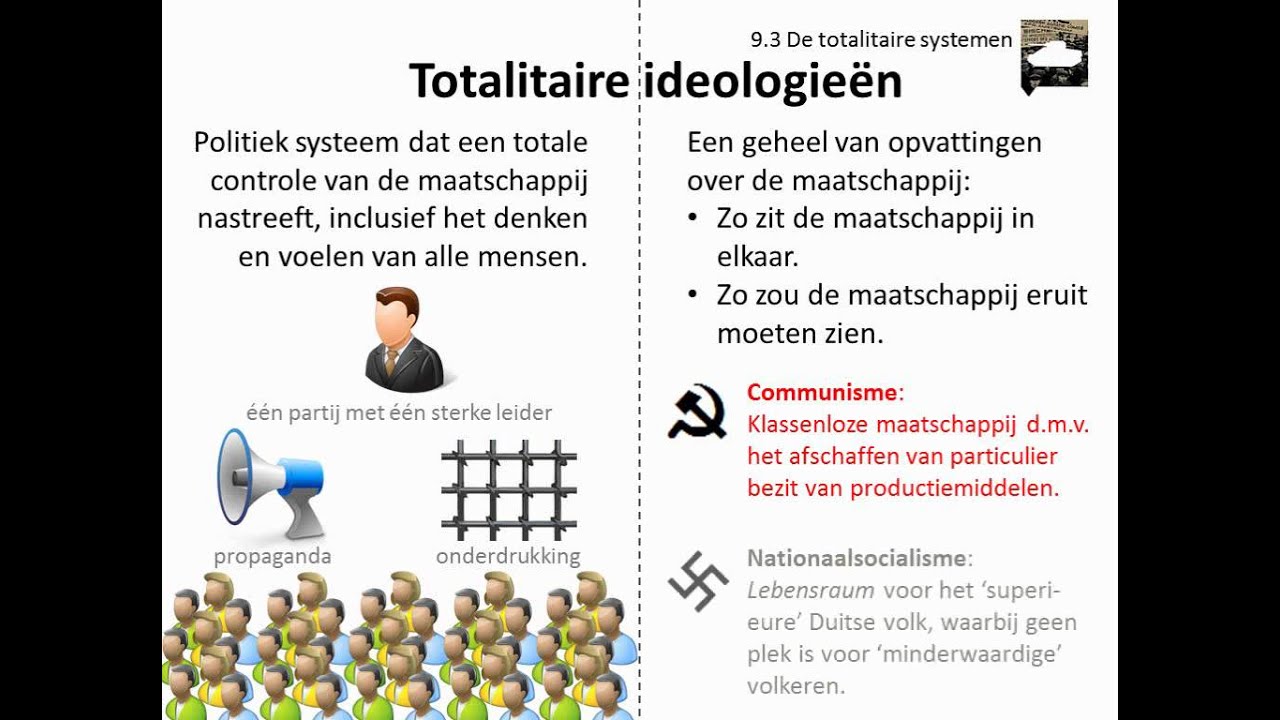
9.3OUDE VIDEO!!!
34.4K
Totalitarian systems emerged in the 20th century, particularly in the Soviet Union under Stalin and Germany under Hitler, resulting in tens of millions of deaths. These regimes arose from the aftermath of World War I and the economic crisis of the 1930s, which created widespread dissatisfaction across Europe. In Russia, communists rose against the Tsar in 1917 due to war dissatisfaction. In Germany, the Treaty of Versailles imposed heavy reparations, and the 1930s crisis created discontent. In Italy, political chaos led to Mussolini's rise in 1922. These conditions enabled totalitarian leaders to gain power by promising improvement to suffering populations.
Click to watch →

Volume 3 03 O fascismo e o nazismo
12.8K
The rise of fascism and Nazism in 20th century Europe was driven by post-WWI economic crises, national humiliation, and social instability, which allowed extremist movements to exploit popular grievances through scapegoating minorities, propaganda, and paramilitary violence; these regimes implemented state-controlled economies, established concentration camps, and pursued aggressive expansionism, ultimately leading to World War II and the Holocaust, though their ideologies of racism and authoritarianism persist as ongoing dangers requiring vigilance and education.
Click to watch →

01/06 - 9° ANO (EF) - HISTORIA - CAPITULO 6: A ASCENÇÃO DO FASCISMO E DO NAZISMO NA EUROPA - DAWDSON
3.5K
The rise of fascism and nazism in Europe between 1918-1939 was driven by the aftermath of World War I, the Great Depression of 1929, and the growth of socialist parties, with Mussolini establishing fascist rule in Italy through a 1922 coup and Hitler gaining power in Germany through elections in 1933; these totalitarian regimes shared characteristics including extreme nationalism, xenophobia, total state control over society and economy, cult of personality around the leader, and aggressive expansionism, with key differences being that fascism emphasized state supremacy while nazism emphasized racial superiority of the Aryan race, leading to the Holocaust and ultimately World War II.
Click to watch →

Miniserie-Episodul 2. 💣Ideologii și practici politice (Democrație versus Comunism, Fascism, Nazism)
12.2K
Totalitarian regimes emerged in 20th century Europe following World War I due to harsh peace terms, territorial losses, economic crises, and political instability. These regimes shared common characteristics: single-party rule, elimination of opposition, propaganda, censorship, and violation of human rights. The three major totalitarian ideologies were communism (first established in Russia in 1917), fascism (established in Italy in 1922), and Nazism (established in Germany in 1933). Each regime exploited post-war grievances to gain power, with Germany's harsh Treaty of Versailles conditions being particularly significant for the rise of Nazism.
Click to watch →

TOTALITARISMO NA EUROPA NO SÉCULO XX - Prof. Macari
8K
Totalitarianism is a government system where the ruler stands above all, including the law, with complete power concentrated in one person. Fascism, invented by Benito Mussolini in Italy in 1922, is characterized by state supremacy ('everything for the state, nothing against the state'), nationalism, militarism, totalitarianism, imperialism, and cult of personality. These regimes spread across Europe in the 20th century, appearing in Italy (Mussolini), Germany (Hitler), Spain (Franco), and Portugal (Salazar). Italian fascism used Blackshirts and squadristi as paramilitary forces, signed the Lateran Treaty with the Catholic Church, and demanded absolute loyalty from followers. Nazi Germany was based on Social Darwinism and eugenics, systematically persecuting Jews, Roma, blacks, homosexuals, and disabled people. All fascist regimes shared common characteristics: anti-communism, control of press and education, xenophobia, militarism, secret police, mass propaganda, and cult of personality. These regimes ultimately failed, with Mussolini in 1943, Hitler in 1945, Franco in 1975, and Salazar in 1968.
Click to watch →
Deep Dive
Familiarity with the literary concept of allegory, where physical transformations or events represent abstract ideological shifts.
The Dark Side of Dorothy Gale | The Wizard of Oz’s REAL Villain
7.7K
The Wizard of Oz serves as political allegory for 1890s American politics: Munchkins represent oppressed laborers under eastern banking elites; Scarecrow symbolizes stereotyped but complex farmers; Tin Woodman represents industrial workers stripped of humanity; Dorothy embodies the American everyman. The yellow brick road represents the treacherous gold standard; silver shoes represent populist free silver solution. L. Frank Baum's editorials reveal belief in manifest destiny—the ideology that American settlers were divinely destined to expand across North America, framing westward expansion as holy mission rather than conquest. Two weeks after Wounded Knee massacre, Baum wrote that pioneers had declared safety depended upon total extermination of Indians.
Click to watch →

Allegory English Literature
20.1K
Conceptual allegory is used to explain abstract ideas, moral principles, or philosophical concepts. In John Bunyan's Pilgrim's Progress, the main character's journey symbolizes the spiritual path of Christianity, illustrating the problems and challenges a pilgrim may face on this spiritual journey. This type of allegory transforms abstract concepts into concrete narrative experiences.
Click to watch →

Allegory in English Literature | Detailed Explanation for UP LT Grade English | Learn with Pavan Sir
723
Allegory is a literary device where abstract ideas, moral principles, political concepts, and spiritual truths are represented through characters, events, and symbols. It operates on two levels: literal meaning (surface story) and symbolic meaning (deeper message). Key features include dual meaning, extensive personification of abstract concepts like virtues and vices, and serving moral, political, or religious purposes. Allegory is considered an extended metaphor running throughout an entire work. Three main types exist: moral allegory (virtues and vices), religious/spiritual allegory (spiritual truths), and political allegory (criticizing governments and social systems). Famous examples include Spenser's 'The Faerie Queene' (virtues and Queen Elizabeth), Bunyan's 'The Pilgrim's Progress' (Christian's spiritual journey), Orwell's 'Animal Farm' (Russian Revolution satire), Golding's 'Lord of the Flies' (civilization vs. savagery), and Milton's 'Paradise Lost' (humanity's fall from grace). Allegory allows writers to indirectly criticize authority without consequences, engages readers on multiple levels, and connects literature with philosophy, morality, and politics.
Click to watch →

Die Zwei Bücher der Menschheit - VGFE Band 2 Episode 3 - Chnopfloch
49.1K
An allegory is a literary device where characters, events, or objects represent abstract ideas, moral qualities, or political concepts. In classical literature, C.S. Lewis used allegory through Aslan representing Christ, while George Orwell employed it in Animal Farm to satirize communism. Understanding allegory requires recognizing that surface-level narrative elements symbolize deeper meanings, allowing authors to convey complex ideas indirectly.
Click to watch →

Jekyll Jekyl Hyde Live Action!
69.8K
This video explores the consequences of consuming a magical potion that transforms a character into a morally corrupt version of themselves. The narrative demonstrates that once a transformation begins, it cannot be easily reversed even by removing the source of the change. The story explicitly defines allegory as 'a story where the characters stand for abstract ideas,' using the transformation from Jack Highle to Jackle High as an example of how concrete characters can represent abstract concepts like good and evil. The narrative illustrates that literary devices like allegory allow authors to explore complex moral and psychological themes through symbolic characters and events.
Click to watch →
Deep Dive
Basic concepts of Existentialism, particularly the tension between individual choice and societal pressure.

Becoming Human | Part III of The Inner Commons | Knowing One's Self | KEI Network |
1.2K
Existentialism explores the human condition as one of despair and anguish because humans are condemned to be free. This freedom is scary, especially in the age of atheism where many feel abandoned by God. However, existentialism also contains a sense of duty to act as though all people would act the same way, meaning each person contributes to the definition of humanity with each word and action. There is an essential conflict between what is expected from a person (social constraints, cultural boundaries) and what may come out of the individual (freethinking, being oneself). Different social structures shape different behaviors, with some environments encouraging exploration and others suppressing creativity that might entertain alternative ways of governing and behaving.
Click to watch →

FILOZOFIE EXISTENȚIALISTĂ: Când Ființa Umană Stă În Fața Abisului
233
When God, traditional authority, and social roles are eliminated, what remains is the individual standing before their own existence without a given purpose, with radical freedom to make of oneself whatever one desires, and with radical responsibility that comes with this freedom—the responsibility of not being able to blame anyone else. Sartre captured this in the famous phrase 'Existence precedes essence.' For manufactured objects, essence precedes existence; for human beings, there is no craftsman, no pre-existing design. Human beings exist first and then, through their choices, create their own essence. Choice is inevitable—even the choice not to choose is a choice. Existentialists carefully distinguished anxiety from ordinary fear: fear has an object, while existential anxiety has no specific object and appears when one becomes aware of the structure of one's situation—that one is free, must choose, and is responsible for the person one becomes. Bad faith is the term Sartre used for self-deception through which people avoid the anxiety of freedom. It takes many forms: claiming one had no choice, that the situation demanded a specific response, or complete identification with a social role—becoming entirely the waiter, entirely the parent, entirely the professional, leaving no room for consciousness that transcends each role.
Click to watch →

Palestra sobre o livro O EXISTENCIALISMO É UM HUMANISMO (1946) com o Prof. Dr. Carlos Eduardo Moura)
155
Sartre's famous phrase 'We have never been so free as during the German invasion' (from 'The Republic of Silence') shows that existentialism humanism shows that each of our choices is a choice for the collective. If one chooses quietism, one is also choosing a silent and submitted society. If one runs the risks of engagement to fight against the oppressive system, one also chooses another form of society, of organization for other generations. There is no right or wrong. One will be choosing engagement, but at the same time one's engagement refers to a collectivity. This individualism does not exist. The struggle is inevitable, the choice is inevitable. The oppressed society suffocates to a certain extent that this self ends up alienating so much, disengaging so much from its impulse to produce itself in a free way, that the oppression ends up extrapolating through another path.
Click to watch →

Existentialism | Western Schools of Philosophy | For UGC NET Education B.Ed., M.Ed.& Other Exams
206
Existentialism emphasizes human freedom and choice, stating that life is shaped by personal decisions rather than predetermined rules. Struggle and conflict build character, and responsibility and self-discipline are essential. Society's rules are not always natural or meaningful, and the irrational and emotional parts of life are important. Living with purpose is a personal act. Existentialism rejects: that life is only about wealth, pleasure, and honor; that society's rules automatically define personal values; that passive acceptance of fate is sufficient; that science alone can solve human problems; and that people are born good but spoiled by society. In metaphysics, there is no fixed ultimate reality; reality is individual existence, and truth is subjective. In epistemology, no knowledge exists without human existence; knowledge is choice-based. In axiology, no moral values are fixed; values are created by free choice.
Click to watch →

철학적 방법으로서의 직관┃채운 선생님의 베르그손 읽기 『베르그손주의』4┃사이재 집중강좌
964
Human society exists in a dynamic tension between social pressure (which creates obligation and promotes conformity) and individual resistance (which promotes personal autonomy). This tension creates the unique variability of human societies, preventing them from becoming static or purely conformist. When individuals completely align themselves with social pressures, society becomes inert and static, becoming exclusionary and resistant to change. Creative emotions emerge from the deep dimensions of human experience that cannot be reduced to social pressure or individual resistance, breaking the circular patterns of social and individual dynamics.
Click to watch →
Prerequisite Knowledge
- Concept 01An understanding of the 'Theater of the Absurd' movement and its departure from traditional dramatic realism.
- Concept 02Historical context of mid-20th century Europe, specifically the rise of totalitarianism, fascism, and Nazism.
- Concept 03Familiarity with the literary concept of allegory, where physical transformations or events represent abstract ideological shifts.
- Concept 04Basic concepts of Existentialism, particularly the tension between individual choice and societal pressure.
Subsequent Learning
- Step 01A comparative study of Eugène Ionesco's other absurdist plays, such as 'The Bald Soprano' and 'The Chairs'.
- Step 02Exploration of social psychology concepts related to mass hysteria, groupthink, and the Asch conformity experiments.
- Step 03Analysis of other mid-20th-century anti-totalitarian literature, such as Franz Kafka's 'The Metamorphosis' or George Orwell's '1984'.
- Step 04Examination of the ethical and philosophical debates surrounding passive complicity versus active political resistance.
Plot Overview
Symbolic Meaning
Plot Overview
0:00Playing Section
- 1
Bérenger witnesses rhinos transform his town, friends, and love interest.
- 2
He resists conformity, ultimately affirming his humanity against the herd.
The Marxist and Social Realist Critique of Absurdist Apoliticism
A major counterpoint to the traditional reading of Rhinoceros as a profound anti-fascist allegory comes from Marxist and social realist critics, famously highlighted in the debate between critic Kenneth Tynan and Eugène Ionesco. Critics from this perspective argue that Ionesco’s absurdist framework is politically defeatist and bourgeois. By attributing fascism and totalitarianism to a generalized, metaphysical "conformity" or an inherent flaw in human nature, the play strips these dangerous movements of their specific historical, economic, and class-based origins. From this viewpoint, Rhinoceros promotes an isolated, passive individualism (embodied by Bérenger) that fails to offer any constructive framework for collective, organized social resistance. By treating historical crises as absurd, inevitable conditions rather than preventable socio-political realities, the play is seen by critics as politically disengaged and fatalistic.
Deep Dive
A comparative study of Eugène Ionesco's other absurdist plays, such as 'The Bald Soprano' and 'The Chairs'.

La Leçon de Eugène Ionesco (Fiche de lecture) :… de Baptiste Frankinet · Extrait du livre audio
739
Eugène Ionesco (1909-1994), born to a Rouen father and French mother, became a naturalized French citizen in 1951. He is the leading figure of the Theatre of the Absurd, a theatrical genre emerging after World War II that challenged classical theatre conventions. His major works include 'The Bald Soprano' (1950), 'The Lesson' (1951), 'The Chairs' (1952), and 'CETA.' Elected to the French Academy in 1970, Ionesco left extensive commentaries on his work including 'Notes,' 'Contains,' and 'Journal en miette.' The Theatre of the Absurd used absurd situations and nonsensical dialogues to explore human existence, communication failures, and the breakdown of rational thought in post-war society.
Click to watch →

ТЕАТР АБСУРДА ЭЖЕНА ИОНЕСКО
16K
Eugène Ionesco (1909-1994) was born in Romania to a Romanian-French family. His unhappy childhood—divorced parents, feeling like an outsider in both countries—shaped his themes of identity crisis and loneliness. In the 1930s, he witnessed Romanian fascism and the rise of intellectuals like Emil Cioran and Mircea Eliade who sympathized with fascist ideology. In 1938, he emigrated to France, never returning. His first play 'The Bald Soprano' (1950) caused outrage, but he persisted. By 1959, 'Rhinoceros' made him a European star. His work evolved from radical formal experimentation to philosophical depth, with later works becoming increasingly autobiographical. 'The Bald Soprano' was written after Ionesco worked as a textbook corrector, discovering 'language death'—the absurdity of language in learning materials. The play features two couples exchanging meaningless dialogues about trivial matters. Characters are interchangeable and identical, with no distinguishing features beyond names. The play ends with speech breaking down into meaningless sounds. Written in 1950, five years after World War I, it critiques how people without critical thinking skills are easily manipulated by propaganda, transforming into fascists and murderers. Time becomes absurd—clocks strike randomly—symbolizing the breakdown of logic and meaning. Additionally, language itself 'dies' in the play's final scenes. 'The Chairs' (1952) features an old man and woman who invite all of humanity to an island to share their wisdom. The stage is filled with invisible chairs representing invisible guests. The old man, unable to express himself, entrusts his message to a specially trained orator. However, the orator is deaf and mute, having not heard anything the old man said. This symbolizes the fundamental problem of communication: how meaning is lost in transmission. The play can be interpreted as a metaphor for art, religion, and language attempting to express transcendent truths but ultimately failing.
Click to watch →

Las sillas - Eugene Ionesco
1.7K
Eugène Ionesco (1909-1994) was a Romanian-born French playwright and leading exponent of Theatre of the Absurd, recognized for his work 'The Bald Soprano.' His dramatic style combines burlesque and drama, radicalizing banal situations to reflect society and demonstrate human inability to communicate. In 'The Chairs' (1952), Ionesco explores the theme that communication with society is fundamentally communication with oneself. The characters invite invisible guests, creating theatrical illusions that reveal the self-referential nature of human discourse. The play's tragicomic structure, with sophisticated language and farcical tone, culminates in the arrival of a deaf and mute orator who delivers no message, symbolizing the absence of meaning in human existence.
Click to watch →
Beckett, Ionesco, and the Theater of the Absurd: Crash Course Theater #45
326K
Romanian playwright Eugene Ionesco (1909-1994) created absurdist works like 'The Bald Soprano' and 'Rhinoceros.' Born in Romania and moving between countries, Ionesco learned English by memorizing simple sentences that later appeared in his plays. 'The Bald Soprano' features two couples (Smiths and Martins) who discover they have been married for years despite thinking they are strangers. The play uses seemingly simple language to disguise serious preoccupations with randomness, entropy, and death, reflecting Ionesco's desire to access an unreachable better world.
Click to watch →
summary : The Chairs(play) by Eugene Ionesco summary
1.1K
The Chairs is a seminal work by Romanian playwright Eugène Ionesco (1909-1994), published in 1962 and associated with the Theatre of the Absurd. The play features three visible characters—an Old Man, an Old Woman, and a Child—while all other characters exist only as invisible imagination. The Old Man possesses a message for the world, but the Old Woman forgets it. As invisible guests arrive, including a Lady, Colonel, and Emperor, the room becomes overwhelmed with imagined presence. The Old Man becomes excited upon recognizing his former lover among the guests. The invisible man eventually delivers the message but cannot communicate effectively. The Old Man and Old Woman commit suicide, unable to accept reality. The play explores the theme that people prefer death when their illusions are shattered by harsh reality, demonstrating how the Theatre of the Absurd uses surreal elements to critique human existence.
Click to watch →
Deep Dive
Exploration of social psychology concepts related to mass hysteria, groupthink, and the Asch conformity experiments.
The Social Psychology of Leftist Mass Hysteria (Part 1)
55.9K
Solomon Asch's 1951 conformity experiments demonstrated the powerful influence of group pressure on individual judgment. In these experiments, participants were asked to match line lengths, but confederates deliberately gave incorrect answers. Remarkably, many real participants conformed to the obviously wrong group opinion rather than stating the correct answer. This research established that willingness to conform to a group can be so strong that individuals will essentially lie about objective facts when pressured by a majority group, even when the correct answer is clearly visible.
Click to watch →
Psychological Tricks | What Is Mass Formation Psychosis? | Prof. Mattias Desmet| AMP
892.5K
Solomon Asch's conformity experiments demonstrated mass formation dynamics in laboratory settings. Participants were asked to identify which line matched a standard line length. When confederates deliberately gave wrong answers, approximately 70% of participants also gave wrong answers, either genuinely believing them or simply conforming to avoid social rejection. This demonstrates how easily people can be influenced to abandon independent judgment under group pressure.
Click to watch →

Le conformisme social / Expérience de Asch
137.9K
Solomon Asch's 1956 experiment demonstrated that 37% of participants conformed to incorrect group answers when asked to match line lengths, revealing that social pressure can override individual judgment even when the correct answer is obvious; this conformity occurs because people seek to avoid rejection and fit in with the group, a phenomenon that explains everyday behaviors like following crowds or mimicking others' actions.
Click to watch →

Como o ódio gratuito é criado: Experimentos da Psicologia do Comportamento - Hora Boa Podcast
36.1K
In Asch's conformity experiments, participants judged which of three lines matched a standard line. While the correct answer was obvious, confederates (actors) gave wrong answers. Only 25% of participants answered correctly on all trials, while 75% conformed to the group's incorrect response. Some participants made occasional errors to appear conforming while still getting most answers right. This demonstrates the powerful influence of group pressure on individual judgment. The experiment became foundational in social psychology and helped explain how ordinary people could participate in atrocities under certain conditions.
Click to watch →

LOOK UP—The Science of Cultural Evolution
3.6M
Solomon Asch's conformity experiments revealed how easily people conform to group pressure despite obvious contradictions. In his study, participants were asked to identify which line matched a standard line after seeing three comparison lines. When confederates deliberately gave incorrect answers, 75% of participants gave at least one incorrect answer, and 50% changed their perceptions so that the group norm became their view of reality. This demonstrates that intelligent, well-meaning people are willing to call white black under social pressure, with conformity rates varying across cultures from 14% in Belgium to 58% in Indian culture.
Click to watch →
Deep Dive
Analysis of other mid-20th-century anti-totalitarian literature, such as Franz Kafka's 'The Metamorphosis' or George Orwell's '1984'.

10 лучших первых строчек в истории литературы. ЧАСТЬ 2: Кафка, Оруэлл, где Толстой? (#20.2)
232.7K
Absurdism and anti-utopian literature share techniques of subverting reader expectations. Franz Kafka's 'The Metamorphosis' uses literary counterpoint where mundane and extraordinary elements coexist—'awoke from troubled dreams' contrasts with 'transformed into a monstrous insect'—making the impossible seem inevitable. George Orwell's '1984' achieves semantic density through oxymorons ('clocks striking thirteen'), historical allusion to Chaucer, and temporal symbolism. Both authors demonstrate how effective openings can convey complex philosophical ideas through carefully crafted language that challenges conventional narrative logic and establishes entire literary movements.
Click to watch →
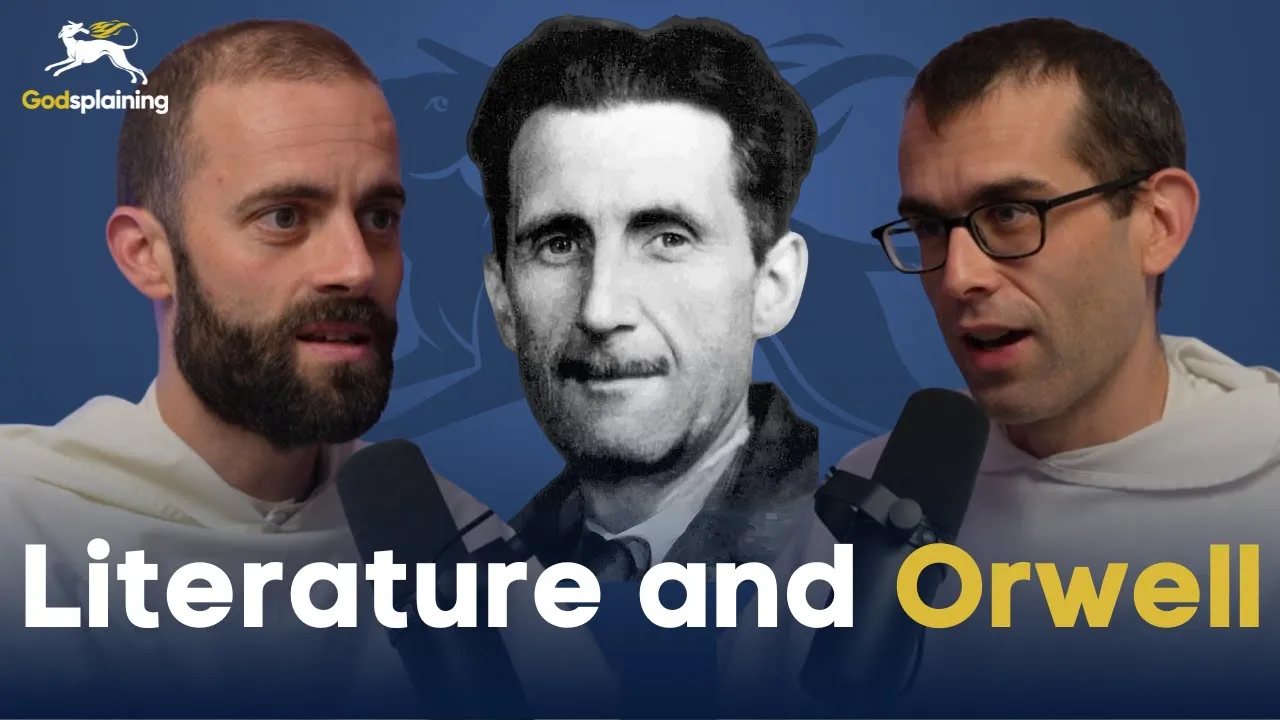
Literature and Orwell | Fr. Bonaventure Chapman & Fr. Gregory Pine
4.6K
Orwell's most famous novels, 'Animal Farm' and '1984,' are anti-totalitarian works that critique authoritarian systems. '1984' is structured in three sections: censorship and Newspeak, a romantic escape, and torture. Newspeak demonstrates how controlling vocabulary limits thought, while 'doublethink' shows how people hold contradictory beliefs. Orwell and Huxley presented different models of control: Orwell believed top-down manipulation of language and history, while Huxley believed control through pleasure. In the 21st century, both models appear relevant as social media provides both top-down manipulation and self-directed pleasure that numbs critical thinking.
Click to watch →

Дом Культуры Юрия Мамина Выпуск 46/House of Culture by Mamin Episode 46
26.9K
George Orwell (1903-1950) was a British writer and journalist whose works 'Animal Farm' and '1984' became the most revealing works about the socialist system, with influence on Soviet intellectuals difficult to overestimate. In 2008, Times ranked Orwell second among 50 greatest English-language writers of the postwar period. The term 'Cold War' was coined by Orwell in 'Animal Farm.' The speaker met Orwell through his Moscow friend Garik, an engineer and representative of the 'suffering intelligentsia,' who had a photocopied copy of 'Animal Farm' that he would read aloud to the speaker, who would then read it all night on Garik's Moscow kitchen to spread banned literature. Like Saltykov-Shchedrin's works, Orwell's 'Animal Farm' created a caricatured, humorous, yet recognizable world of Soviet society. Orwell was born in British India as Eric Arthur Blair. His father worked in colonial administration in India. When Eric was one year old, his mother took him and his sister to England. After reaching maturity, he served in colonial police in Burma, then returned to England. In 1933, he published his first novel 'Burmese Days' in Paris and London. In 1936, he married journalist Eileen O'Shaughnessy and traveled to Spain where the Civil War had begun. He joined the militia as a secretary in the British volunteers' headquarters. Orwell was in a militia unit where barracks were dirty and chaotic, with broken furniture and rotting refuse being thrown out while the city population starved. When combat time came, no orders were executed because Spaniards were imprecise with time. Only the fact that the enemy army fought no better saved the situation. Orwell described this in 'Homage to Catalonia.' He was wounded in the throat by a Francoist sniper and spent weeks in a hospital. His wife returned him to England, and he became a convinced anti-Stalinist while remaining a socialist. In one article, he described the prospect of socialist development: 'In the end, we will have a regime where all opposition parties and newspapers will be banned, and any significant dissident will end up in prison.' In 1938, he was diagnosed with tuberculosis. Like 'Animal Farm,' '1984' was published in small print runs and faced harsh criticism. Orwell, who dedicated his life to warning humanity about the looming danger, was deeply disappointed that his novel did not become a revelation. Six months after his death, his friend Richard Rees remembered him: 'I was in a literary gathering when someone announced Orwell's death. In the ensuing silence, I was struck by the thought that from now on this direct, good, and fierce man would become one of the most powerful myths of the 20th century.' The concept of 'Cold War' began to gain strength rapidly. In the West, people suddenly remembered 'Animal Farm' and '1984,' which were immediately published in millions of copies, with '1984' translated into 60 languages and selling 50,000 copies daily in the United States.
Click to watch →

A Metamorfose, de Franz Kafka - Resumo e Análise
29.7K
Franz Kafka's 'The Metamorphosis' (1915) explores existential themes through Gregor Samsa's transformation into an insect, demonstrating how humans construct their identity through external roles and relationships; when these external foundations collapse, individuals face despair and potential self-destruction, as Gregor's identity was entirely dependent on his role as a breadwinner for his family, illustrating the existentialist principle that existence precedes essence and that humans must actively construct meaning rather than finding it externally.
Click to watch →

"1984" и "Мы". От идеального мира к катастрофе
16K
Anti-utopian literature emerged in the early 20th century as a response to humanity's quest for perfect society, with Zamyatin's 'We' (1920s) and Orwell's '1984' (1948) serving as foundational works. While both novels explore totalitarian control, they differ fundamentally: Zamyatin's mechanized world offers hope through the possibility of change and children as potential saviors, while Orwell's world presents absolute pessimism where love cannot save society and the future remains hopeless. Both works use symbolic elements like 'Newspeak' and 'doublethink' to demonstrate how language and thought control maintain power, making them perpetually relevant as warnings about authoritarianism.
Click to watch →
Deep Dive
Examination of the ethical and philosophical debates surrounding passive complicity versus active political resistance.

STORIA DI SUPERAMENTO✨LUI l'ha ABBANDONATA all'ALTARE–8 anni DOPO lei era il GIUDICE del suo PROCESS
120
In legal and moral terms, there is an important distinction between active complicity and passive complicity. The video explains that the emerging picture was 'quello di un uomo che aveva fatto errori reali' (that of a man who had made real errors) 'non nel senso del criminale che pianifica, nel senso di chi non ha avuto il coraggio di fare quello che andava fatto nel momento in cui andava fatto' (not in the sense of a criminal who plans, but in the sense of someone who didn't have the courage to do what needed to be done at the time it needed to be done). The video notes this was 'una distinzione giuridicamente importante' (a legally important distinction) and 'anche, Nerea lo sapeva, una distinzione moralmente complicata' (also, Nerea knew, a morally complicated distinction).
Click to watch →

Правда, оправдание и самооправдание. Публичная лекция Дмитрия Глуховского
417.6K
Passive complicity through inaction constitutes participation in the evil being committed. Those who simply do not speak up or take action are effectively participating in the atrocities. Active resistance, even in small ways such as supporting Ukrainian refugees, expressing opposition, or asking for forgiveness, represents a form of moral responsibility that distinguishes those who actively resist from those who passively accept the state's narrative.
Click to watch →

Welche Teile fehlen im Puzzle noch ?
36.7K
Political systems can be challenged through active opposition (doing something wrong) or passive resistance (failing to do something right). The German population is described as bearing the greatest guilt through passive resistance, where people accept the status quo rather than actively opposing problematic systems.
Click to watch →

Alexander Kluge speaks to Michael Haneke
8.7K
Thomas Aquinas distinguished between active evil-doing and passive complicity. According to this view, failing to act against injustice (passive complicity) can be morally worse than actively committing wrongs. This perspective holds that those who remain inactive in the face of wrongdoing bear significant moral responsibility for the continuation of evil.
Click to watch →

Amid ceasefire, Omar El Akkad on the politics that betrayed Gaza | The Take
16.6K
There is an immense dichotomy between those who actively resist atrocities and those who remain complicit. Those who witness carnage and haven't looked away become deeply angry and impolite, while those privileged enough not to have their neighborhoods destroyed tend toward polite, oblivious environments. Arab governments similarly perform virtue while privately maintaining complicity, fearing revolutionary contagion after the Arab Spring. This pattern reveals how institutional power enables systematic avoidance of moral responsibility through carefully managed public personas.
Click to watch →
Plot Overview
Symbolic Meaning
Plot Overview
0:00- 1
Bérenger witnesses rhinos transform his town, friends, and love interest.
- 2
He resists conformity, ultimately affirming his humanity against the herd.
The Marxist and Social Realist Critique of Absurdist Apoliticism
A major counterpoint to the traditional reading of Rhinoceros as a profound anti-fascist allegory comes from Marxist and social realist critics, famously highlighted in the debate between critic Kenneth Tynan and Eugène Ionesco. Critics from this perspective argue that Ionesco’s absurdist framework is politically defeatist and bourgeois. By attributing fascism and totalitarianism to a generalized, metaphysical "conformity" or an inherent flaw in human nature, the play strips these dangerous movements of their specific historical, economic, and class-based origins. From this viewpoint, Rhinoceros promotes an isolated, passive individualism (embodied by Bérenger) that fails to offer any constructive framework for collective, organized social resistance. By treating historical crises as absurd, inevitable conditions rather than preventable socio-political realities, the play is seen by critics as politically disengaged and fatalistic.
An understanding of the 'Theater of the Absurd' movement and its departure from traditional dramatic realism.
Historical context of mid-20th century Europe, specifically the rise of totalitarianism, fascism, and Nazism.
Familiarity with the literary concept of allegory, where physical transformations or events represent abstract ideological shifts.
Basic concepts of Existentialism, particularly the tension between individual choice and societal pressure.
A comparative study of Eugène Ionesco's other absurdist plays, such as 'The Bald Soprano' and 'The Chairs'.
Exploration of social psychology concepts related to mass hysteria, groupthink, and the Asch conformity experiments.
Analysis of other mid-20th-century anti-totalitarian literature, such as Franz Kafka's 'The Metamorphosis' or George Orwell's '1984'.
Examination of the ethical and philosophical debates surrounding passive complicity versus active political resistance.
70.6K views549likes3:22@GhostCopsOriginal Release: 2008-04-29
[Music] hello and welcome to a brief introduction to rhinoceros a play by Eugene ionesco the play revolves around a fellow named baringer an apathetic drunker it begins with baringer at a cafe in France where he surrounded by an involved in several philosophical conversations all interrupted by a passing rhinoceros this odd occurrence leads to a new conversation about philosophy until again a rhinoceros passes by this time trampling a cat while while the poor Kitty's owner cries the cafe goers discuss the origin of the Rhino and whether it was the same one as before later barer goes to work his co-workers are discussing the Rhinos his boss believing skeptically that they are simply a mass delusion suddenly a coworker attacks the building having actually become a rhinoceros his wife feeling a sense of Duty joins her husband and becomes a rhino herself barager then visits Jean his best friend Jean a rhino during the visit and attacks baringer who narrowly escapes soon the entire city is transformed and baringer is surrounded by rhinos he joins up with Daisy a girl he's interested in and together they resist transforming eventually though Daisy succumbs to the Savage Allure of the Rhino's Beauty and makes the transformation baringer is left the sole lonely and transformed human being he begins to doubt his humanity and finds himself unable to recognize his friends and photographs he even recognizes is his own image in a photo of ugly people pictures made more ugly when compared to The Elegant Rhino heads he envies the Rhino's bodies skin and horns but at the brink of desperation decides to fight the rhinos and retain his Humanity this play is interpreted and stated to be a metaphor for the resistance against Conformity specifically social and political ideologies like communism and fascism the author ionesco was an innovator in the theater of the Absurd early in life he began rejecting the physical world in traditional communication this outlook on life as well as his experiences in World War II era France permeated his work especially rhinoceros this kind of play popular in the 40s 50s and 60s endeavored to break down the usual rules of the theater and present absurd situations circular logic cliche or PFI dialogue and otherwise surreal situations as a genre at examine existentialism and identity through its ability to present strange scenarios or situations typically untouched by theater the content of rhinoceros is highly symbolic ionesco himself has stated that the play tackles human nature and its inclination towards Conformity most agree that the Rhinos symbolize fascism and communism and the various characters in their transitions represent different kinds of people's reactions and relationships with these ideologies it is important to note though that the Rhinos can stand in for any movement of mass Conformity ionesco chose the rhinoceros because of its Savage and Mindless nature baringer is of course the Everyman apathetic detached and a drunk he represents our power to deny and resist the pressures of group think and the basic lust for power that every person inevitably Encounters in their life we hope you've enjoyed this brief introduction to rhinoceros by Eugene ionesco and enjoy the rest of your trip to the rhinoceros Museum
Up Next

10:22
The Dumb Waiter – Harold Pinter | Act 1 Analysis & Performance
@Fantasy9Knight
117.7K views•2009-12-26

13:43
Formalism in Literary Criticism: An Academic Lecture Overview
@mattalberhasky9952
39.1K views•2015-08-05

6:08
Point of View in Fiction: First Person vs. Third Person
@magicalthriftyteacher
153.8K views•2014-03-31

15:25
1984: Orwell's Dystopian World and the Mechanisms of Totalitarianism
@AlternateHistoryHub
7M views•2017-03-04
Related Study Plans & Knowledge Roadmaps
Structured learning paths in Literature
literature
Graphic Memoirs: Visual Art, Trauma & History
01Foundations of Sequential Art and Visual Language
02Autographics and Processing Historical Trauma
03Visualizing Personal Trauma, Grief, and Graphic Medicine
+ 2 more learning modules
14h5 modules
Explore Roadmap
literature
Campus Novels: Evolution, Themes & Critique
01Introduction to the Campus Novel Genre
02Mid-Century Satire and the Post-War Academy
03Dark Academia and the Critique of Privilege
+ 2 more learning modules
14h5 modules
Explore Roadmap
literature
Theater of the Absurd: Philosophy & Plays
01Postwar Existentialism & Historical Roots
02Dismantling Narrative: Esslin & Absurdist Conventions
03Samuel Beckett and Tragicomic Existentialism
+ 2 more learning modules
12h5 modules
Explore Roadmap
literature
Revenge Tragedy: Justice, Madness & State
01Foundations of Early Modern English Theatre
02Anatomy of Revenge: Structural Conventions
03Psychological Complexity: Madness and Melancholy
+ 2 more learning modules
15h5 modules
Explore Roadmap