



![FÍSICA - Ondas mecánicas [CICLO FREE]](https://i.ytimg.com/vi/nS8naSEz1_4/maxresdefault.jpg)












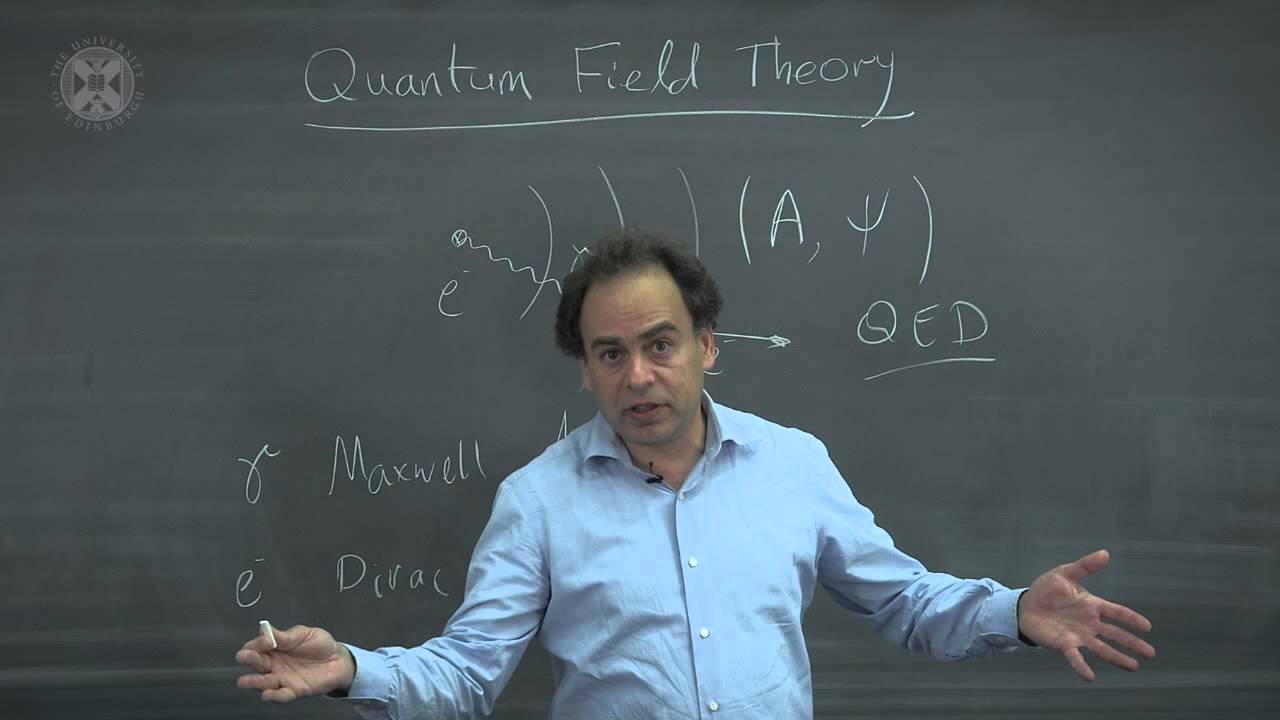
Maxwell's equations reveal that light is an electromagnetic wave whose speed is determined by the permittivity (ε₀) and permeability (μ₀) of free space, calculated as c = 1/√(ε₀μ₀), approximately 300,000 km/s; this insight, derived from combining Gauss's laws, Faraday's law, and Ampere's law with Maxwell's addition of displacement current, established that light is a manifestation of electricity and magnetism and set the stage for Einstein's theory of relativity.
Why Is the Speed of Light Constant? Maxwell's Equations Explained
Added:The fundamental concepts of electric and magnetic fields, including how moving charges generate magnetic fields and changing magnetic fields induce electric currents.
Basic wave mechanics, specifically how wave speed is mathematically related to wave frequency and wavelength.
An introductory understanding of vector calculus concepts such as divergence and curl, which form the mathematical language of Maxwell's equations.
The historical context of the 'luminiferous aether,' which was once believed to be the medium through which light waves traveled.
Albert Einstein's Special Theory of Relativity, which directly builds upon the constancy of the speed of light in all inertial reference frames.
The relativistic consequences of a constant speed of light, such as time dilation, length contraction, and the relativity of simultaneity.
The propagation of electromagnetic waves through different physical media and the concept of the refractive index.
An introduction to Quantum Electrodynamics (QED), exploring how classical electromagnetic wave theory transitions into the quantum behavior of photons.
2M views63.8Klikes13:19Original Release: 2020-03-25
I’m super excited to tell you that this video is a collaboration with the History Guy channel. So while this video is all about Maxwell’s equations, they have simultaneously uploaded a fascinating video on the interesting life of James Clerk Maxwell. Check out their video at the link in the description.
Think of any high tech appliance that you routinely use. You phone, your tv, your computer, your refrigerator, toaster, light bulb, your car, just about anything. I can guarantee that some engineer somewhere, sometime, used one of these equations to design it.
Almost all modern technology is based on them. These are called Maxwell’s equations in honor of Scottish physicist James Clerk Maxwell who published them in 1865. He is not as well known as Newton or Einstein, but his contributions to science are arguably among the greatest.
Somewhat like Einstein, he built on the concepts originated by other scientists, but synthesized them and put them in mathematical terms, that allowed us to see a new kind of relationship, in this case between electricity & magnetism, and light. He showed that they were really just manifestations of the same phenomenon. This is one of the most important and practical set of idea in all of classical physics.
But I think even Maxwell could not have imagined their huge implications for technology. Not only do they describe about every electrical and magnetic phenomenon, but believe it or not, hidden within these equations is a fundamental truth about the nature of light, and why it is the ultimate speed of the universe.
And this truth, helped set the stage for another famous physicist, who would later change our paradigm about the nature of reality itself.
The explanation is coming up right now… These equations look intimidating. But don’t worry, we are not going to derive them. I am only going to show you what they mean and what they imply in practical terms. And we are going to visualize them with graphics that I hope you'll find useful.
Objects have something called a charge. This is a property of matter like mass is a property of matter. In practical terms, what this means for large objects with negative charge, is that it has more electrons than protons.
The first thing I want you to visualize is that if you have a static object with a charge, it will affect only other charges. And if you have a static magnet, it will affect only other magnets. It will not affect charges.
But if you have a moving charge, it will affect a magnet. And if you have a moving magnet, it will affect a charge.
At the simplest level of description that’s what these four equations are telling us.
It is best to think of this as a field, similar to the quantum fields of quantum field theory that I spoke about in another video. But for visualization you can think of this as being similar to the gravitational field.
The first equation is a formula that tells us how electrical charges create electrical fields. It is based on concepts developed by Carl Friedrich Gauss. It basically tells us that if you have an electrical charge, there will be an electrical field emanating from it.
If you want to know the strength of this electrical field, you can calculate it using this equation. Note that the strength of this electric field is proportional to a constant called Epsilon naught. This is known as the vacuum permittivity.
This is a property of the vacuum of space. It can be thought of as the resistance of free space against the formation of an electrical field.
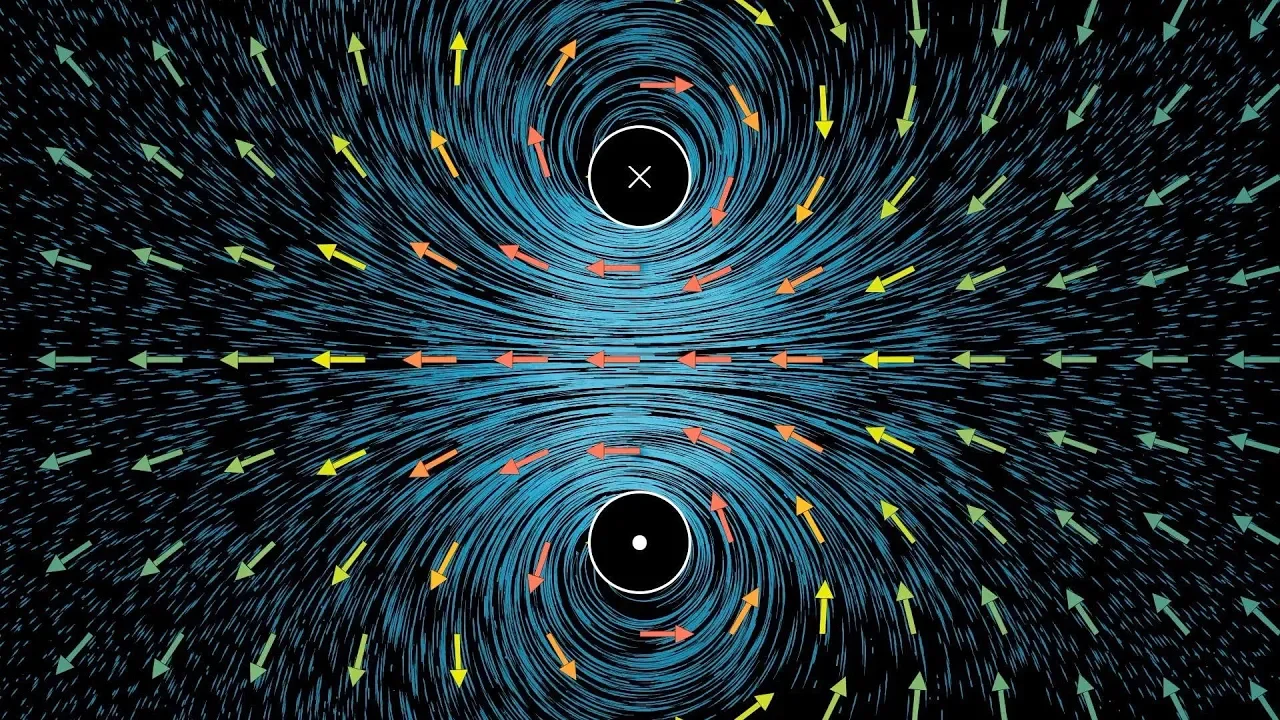
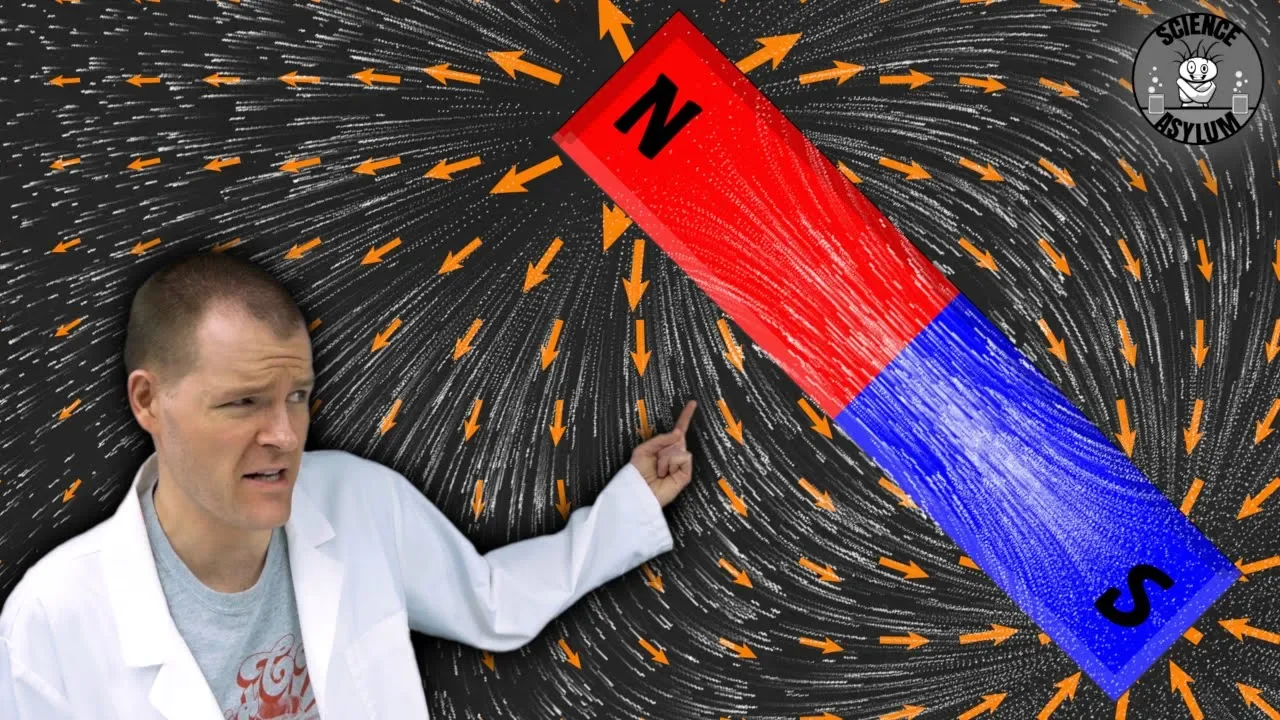
The second equation is referred to as Gauss’s law for magnetism. It is the equivalent of the same equation for magnetism. But it’s kind of a negative law. It basically says that if you had the same sphere but instead of it having a charge inside, it was a magnet, you will never find a configuration where the magnetic lines of force always point outward, or always point inwards. There is always as much field pointed out as there is pointed in.
It will be in loops.
In other words, a magnet will always have two poles. There are no magnetic monopoles.
You can not have a positive magnet or north pole by itself or a south pole by itself.
You might say, well I can take this magnet and cut out the north pole – wouldn’t that create a monopole? No, you would just create a smaller magnet with two poles. You can keep cutting this in half over and over, and you would always have two poles.
The third equation is called faraday’s law. This law basically says that if you move a magnet, you will create an electric field. In other words if you change the magnetic field with time, it creates an electric field. What does it mean to create an electrical field? It just means that if you put a charge there, it will be affected. It will be accelerated.
This equation tells engineers how to generate electricity from a generator. You can take large magnets and rotate them, and if you put a wire near it, as you move the magnet, then electricity will be created in the wire. This is because there are electric charges in the metal wire and as electric field lines are created, these charge will move, creating a current of electricity.
The fourth equation is Ampere’s law. It basically says that if you have a moving charge through a wire, or an electrical current, you generate a magnetic field. In other words, two wires can be attracted to each other if they have current flowing through it.
The equation will tell you how strong the magnetic field would be. So if you have a given current flowing through a wire, let’s say one amp, and you are one meter away, how strong would the magnetic field would be at that point.
This requires another constant of nature called mu naught. This is known as the permeability of free space. This can be thought of as the ability of free space to allow magnetic lines of force to go through it.
Note that there are two terms in this equation. One term tells you the moving electrical charges can create magnetic fields. And the second term tells you that moving electrical fields can also create magnetic fields. This idea of magnetic fields being created from electric fields was Maxwell’s addition to Ampere’s law. And he just thought it up in his head.
It was not based on experiment. He figured that there should be some symmetry with Farday’s law. Because if moving magnetic fields could create electric fields, then moving electric fields should also create magnetic fields.
Now, I want you to take note of epsilon naught and mu naught.
Both of these constants have to be measured, since they are inherent properties of nature.
They are not derived from anything.
You might say at this point, well, you’re just talking about electricity and magnets.
What does this have to do with light? So here comes the most interesting part.
Let’s take what we have gleaned from Maxwell’s equation, and now put it to practical use.
Put yourself in Maxwell’s shoes at this point.
You are working with equations and concepts that other people really don’t know about much in the early 1860’s, and you are staring at them for a long time, trying to see some patterns here. And you are mathematically trying to figure out what these equations are telling you.
So now you think to yourself, maybe I'll do a thought experiment. What if I take an electric charge and put it on a pole, outside my house, and I just move it up and down, up and down. What will this cause? Well, if you did that then, according to ampere’s law, if an electric field moves or changes with time, it would create a magnetic field perpendicular to that.
And because of the changing movement, of up and down that you're making with the charge, the magnetic field would also be changing with time. And according to Faraday’s law the moving magnetic field lines would create another new set of electric field lines.
Now, since the same thing is happening to these new electric field lines, that is, they are changing over time, they would in turn create new magnetic field lines. And the new moving magnetic field lines would create yet more electric field lines.
So this becomes like an unstoppable positive feedback loop of electric fields creating magnetic fields creating electrical fields, creating magnetic fields, and so on. Each is produced by the movement of the other.
You have just created a self propagating wave.
This is analogous to throwing a rock in a lake. It disturbs the water, so the water starts to oscillate, and pulls its neighboring molecules up. So the first wave will pull its neighboring molecules up, which oscillates more water, which moves more of the molecules from neighboring water. And this is the way a water wave propagates.
So now you Mr. Maxwell, are trying to figure out what kind of wave you have just created.
This wave must be occurring in nature because electricity and magnetism exist. So you think about that. Well, what would this wave look like? How fast is this wave moving?
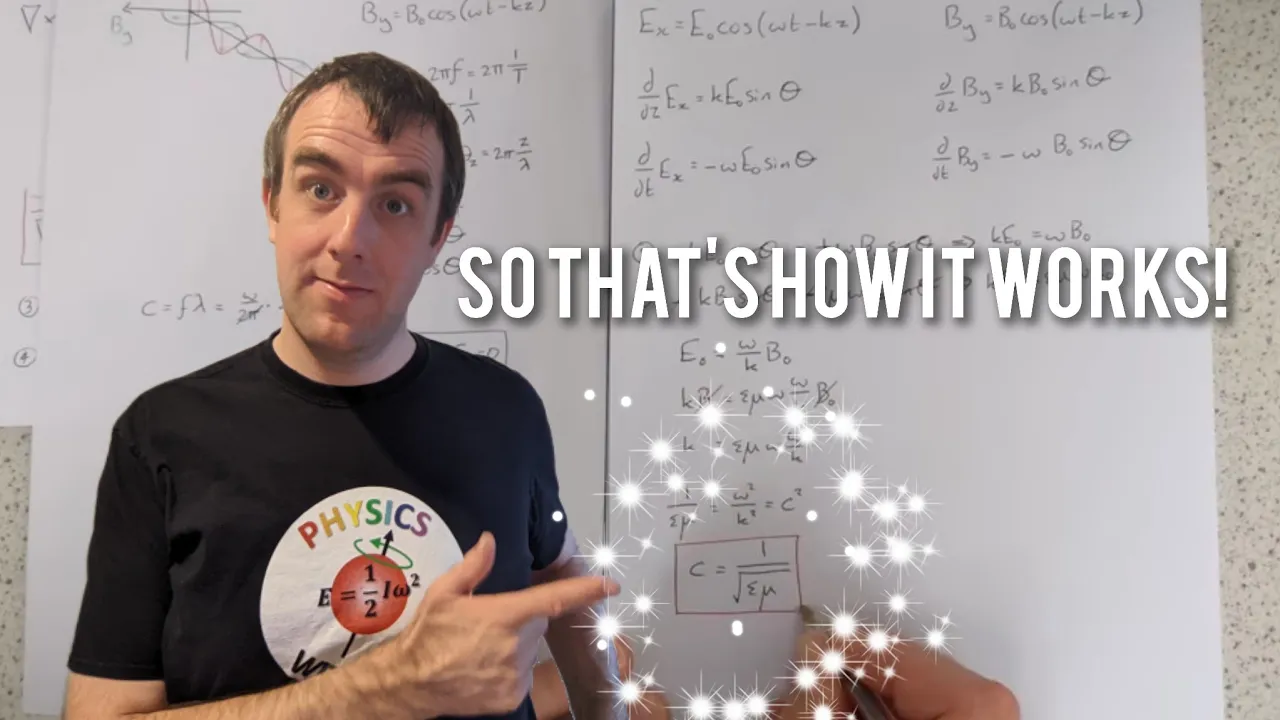
So you calculate using what you think the speed could be by manipulating the equations that you have. You do this by, using advanced multivariable calculus, which Maxwell was exceptionally good at. We won’t go through how it’s done here. But what he come up with is one over “V’ squared is equal to epsilon naught times Mu naught.
Solving you get Velocity, you get that it's equal to the square root of one over epsilon naught times Mu naught.
So what the equations are saying is, the velocity of this wave is inversely proportional to the permittivity and permeability of free space. Does this even make any sense?
Well, permittivity can be thought of, as I said earlier, as the resistance of free space against the formation of an electrical field. Think of this like viscosity, a more viscous fluid like molasses would be harder to swim through than water. You wouldn’t swim very fast in molasses.
Similarly, a wave flowing through a substance with lower permittivity would propagate faster.
For free space, epsilon naught is equal to the following number (see above).
And permeability can be thought of as the resistance of a material against the formation of a magnetic field.
And it's equal to this number (see above).
So it makes sense that the velocity of any wave would be inversely proportional to the resistance of the substance it is travelling in.
You might ask, well why are mu naught and epsilon naught those exact values. That’s a good question. No one knows why. These are just the constants of nature.
These are properties of free space that tell us how fast magnetic fields and electric fields can interact with each other. If there is a finite speed with which the electric and magnetic fields can interact with each other, then it sets a limit on how fast these fields can propagate through space.
In a different substance, or a different universe, these constants could be different.
Now we take the measured values of these two constants, and do some simple math.
Lo and behold what you find is that the wave you have just created is moving at about 300,000 km per second. This is really fast. This would go all the way around the earth almost 8 times, or close to the distance of the moon in one second. What kind of wave moves this fast?
You're Maxwell, and you say to yourself, "Wait a minute, you remember that in 1728, English astronomer James Bradley, had calculated what the speed of light is. It's about 297,000 km/sec.
And a huge Eureka moment hits him that light must really just be a manifestation of electricity and magnetism. It is an electromagnetic wave.
Can you imagine how Maxwell’s insight from this must have felt? There was a point in time when Maxwell was the only person in the world who realized this.
Now, he could not prove it at the time but about 20 years later, Heinrich Hertz, proved experimentally that Maxwell was absolutely right.
And the rest of the story is that about 40 years later another great scientist by the name of Albert Einstein did his own thought experiments, inspired by Maxwell’s equations.
And his thought experiment was based on one simple assumption. He asked himself, if the speed of light is an inherent property of space, why would this speed be any different based on the speed of the observer?
It should not matter whether you measured the speed of light moving on a fast train, or whether you measured it standing still. It should be the same regardless of your reference frame.
And it was from this simple assumption, that he came up with the special theory of relativity in 1905, which changed our ideas about the nature of time.
Later in his life, when people suggested to Einstein that stood on the shoulders of Newton, he corrected them and said, no I stand on the shoulders of James Clerk Maxwell.
The man who inspired not only Einstein, but to a large extent is responsible for creating the equations used by every electrical engineer to create some our most cherished and useful technologies that we use today, is James Clerk Maxwell. And as the History guy like to say. This is history worth remembering.
Guys…if you want to learn more about the interesting life of James Clerk Maxwell, check out the superb video on the History Guy channel at the link in the description.
Click the like button if you like this video, and post a question in the comments. I try to answer all of them. And I will see you in the next video my friend!
Up Next
8:02
How Antennas Work: Electromagnetic Wave Propagation Explained
@SabinCivil
8.1M views•2019-07-07

12:53
21cm Hyperfine Transition in Neutral Hydrogen: Radio Astronomy Basics
@AaronRobertParsons
12.4K views•2011-10-13
18:42
Particle Physics Explained Visually via Feynman Diagrams
@ArvinAsh
421.7K views•2020-12-20

27:14
Entropy and the Second Law of Thermodynamics Explained
@veritasium
27.5M views•2023-07-01
Related Study Plans & Knowledge Roadmaps
Structured learning paths in Physics
physics
Nuclear Physics (Decay, Fission & Reactors)
01Atomic Structure and the Binding Force
02Radioactive Decay and Half-Life
03Nuclear Fission Mechanics and Chain Reactions
+ 2 more learning modules
12h5 modules
Explore Roadmap
physics
Soft Matter (Polymers, Colloids & Rheology)
01Foundations of Soft Matter & Thermal Forces
02Polymer Physics and Macromolecules
03Colloids, Surfactants, and Self-Assembly
+ 2 more learning modules
38h5 modules
Explore Roadmap
physics
Analytical Mechanics: Lagrangian & Hamiltonian
01Mathematical Foundations: Calculus of Variations
02From Newtonian Mechanics to Constraint Dynamics
03The Principle of Least Action & Lagrangian Mechanics
+ 3 more learning modules
28h6 modules
Explore Roadmap
physics
General Relativity (Spacetime & Cosmology)
01Foundations of Relativity: Special Relativity
02The Geometry of Spacetime: Equivalence Principle & Curvature
03Einstein's Field Equations: The Mathematics of Gravity
+ 2 more learning modules
55h5 modules
Explore Roadmap