




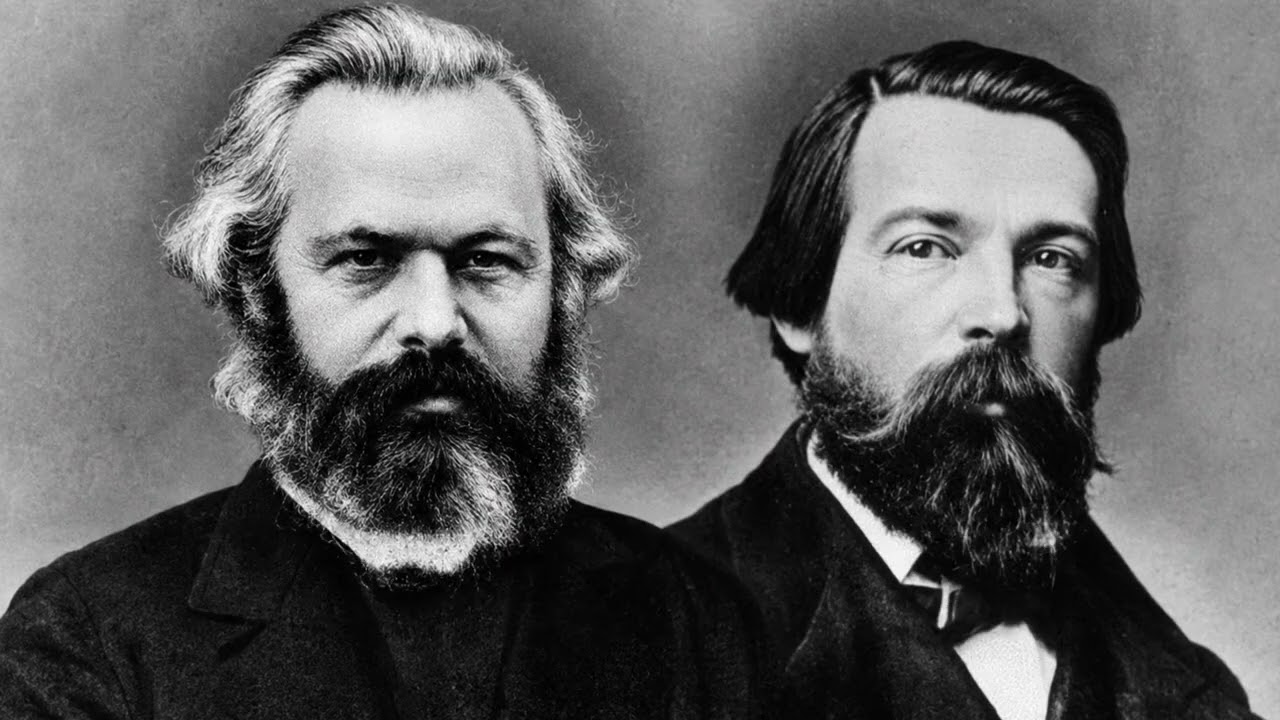

























Friedrich Engels' 1884 work 'The Origin of the Family, Private Property, and the State' explains how human family structures evolved through material conditions: primitive promiscuity gave way to consanguineous families, then matrilineal clans (as seen in the Iroquois Confederacy), before transitioning to monogamy with the rise of private property and patriarchal control. Engels argues that monogamy emerged not from romantic ideals but from economic imperatives—men needed to ensure paternity and inheritance control as wealth accumulated. This transition marked what Engels called 'the world-historic defeat of the female sex,' as women were subordinated within the patriarchal family. The state similarly emerged as a tool for protecting property and class interests, replacing kin-based institutions. Engels concludes that genuine gender equality and the abolition of the family as an economic unit require the abolition of private property and the establishment of collective ownership under socialism.
Engels on the Origin of the Family, Private Property, and the State
Added:This video was made possible by the generous support of my patrons. If you would like to join them in helping grow this channel, you can do so at the links in the description below.
When Karl Marx died in March 1883, he left behind a substantial collection of notes on a wide range of subjects, including a detailed study of the work of American anthropologist Lewis Henry Morgan.
Morgan traced the historical development of human society through three major stages: savagery, barbarism, and civilization. These historical epochs, taken together, reflect a continuous, though uneven progression in which human societies expanded their mastery over nature and developed increasingly complex social forms.
Morgan's framework offers a materialist foundation for understanding early human history, not merely through abstract ideas, but through the evolution of labor, technology, and social organization.
Morgan focused primarily on the first two stages and the transition to the third. To describe these periods more precisely, he divided both savagery and barbarism into lower, middle, and upper stages based chiefly on advancements in food production. He argued that humanity's increasing ability to control and expand its food supply was the decisive factor in its success as a species.
According to Frederick Engles, Morgan's 1877 work, Ancient Society, represented a breakthrough on par with Darwin's theory of evolution.
It was Engles claimed the first systematic attempt to analyze prehistoric societies using a scientific method. Morgan discovered aresh in America the materialistic conception of history discovered by Markx 40 years ago and in his comparison of barbarism and civilization it had led him in the main points to the same conclusions as marks.
Engles believed that Markx had intended to develop a critical booklength analysis of Morgan's findings and took it upon himself to fulfill that ambition. The origin of the family private property and the state was written between early April and May 26th 1884.
In it, Angles integrated Morgan's discoveries into the dialectical materialist worldview he and Markx had developed over the preceding decades. He supplemented Morgan's anthropological insights by extending them into an analysis of the forces and relations of production, demonstrating how the development of tools, trade, and property relations shaped family structures and conversely how kinship systems influence the evolution of economic and political institutions.
Engles further developed Morgan's analysis to examine the transformation of the family in the modern era of civilization, arguing that civilization itself had progressed through successive stages of slavery, feudalism, and capitalism, each with its own corresponding family form.
The origin of the family, private property, and the state thus illustrates the concrete universality of dialectical materialism and its ability to adapt fluidly to the historical object under its investigation. It was, as Vladimir Lenon would later describe, one of the fundamental works of modern socialism.
The earliest stage of social development is referred to as the lower stage of savagery.
This period marks the initial separation of humans from the natural world, described by angles as the childhood of the human race.
Although there is no direct scientific evidence of what life at this stage truly looked like, and no recorded history of any society existing at such a rudimentary level, Morgan makes certain inferences by reasoning from the assumption that human beings evolved from the animal kingdom.
It is likely that early humans lived in a way still deeply embedded in nature, surviving only in favorable environments such as tropical or subtropical forests.
They may have partly lived in trees to avoid larger predators, and given their limited technological development, probably did not yet hunt for food.
Instead, they likely sustained themselves on naturally available resources like fruits, nuts, and roots.
According to Engles, the most significant development of this period was the emergence of cooperative productive relations and the parallel development of articulate speech. Key features that began to distinguish humans from other animals.
The middle stage of savagery was marked by two critical technological advancements. The mastery of fire and the consumption of aquatic animals, including fish, shellfish, and crabs.
The ability to control fire revolutionized human diets by making food easier to digest and expanding the range of edible resources. It also enabled early human groups to migrate into colder regions by following rivers and coastlines where cooked food and warmth became essential for survival.
During this period, diets diversified significantly as cooking techniques began to emerge and simple tools and weapons such as clubs and spears were developed to hunt small animals.
However, hunting was still unreliable and meat constituted only a minor part of overall caloric intake. In conditions of extreme scarcity, some groups even resorted to cannibalism. Engles notes that certain indigenous populations, including some Aboriginal Australians and Polynesians, encountered by European explorers, were still living under material conditions of the stage at time of contact.
In the upper stage of savagery, the invention of the bow and arrow represented a major leap in technological knowledge and hunting efficiency. This innovation required accumulated skill and practical experience and led to more reliable food sources.
Human groups began to form semi-permanent villages and further develop material culture. They produced wooden utensils, wo bark into fabrics, constructed baskets, carved dugout canoes, and built simple wooden dwellings with stone tools and axes, allowing for improved construction and craftsmanship.
Societies such as the indigenous peoples of the Pacific Northwest represent cultures that advanced to this stage without developing pottery.
Morgan identified the bow and arrow as the defining weapon of the age of savagery, just as the iron sword would later characterize barbarism and firearms would come to define civilization.
Throughout the lower stages of savagery, there was no conception of the family in the modern sense. However, based on anthropological evidence from later stages, Engles believes that we can make an educated assumption about the emergence of early kinship structures during this time.
He and Morgan argued that hypothetically at the very earliest stages of human society, no stable sexual relationships or rules would have existed and everyone would have had sexual access to everyone else within the community.
This system referred to as primitive promiscuity featured no restrictions on sexual intercourse, including those between parents and children, no concept of individual marriage, no consistent kinship structures, and no incest taboos.
As Engles writes, "Before incest was invented, for incest is an invention and a very valuable one, too, sexual intercourse between parents and children did not arouse any more repulsion than sexual intercourse between other persons of different generations.
But if we consider the most primitive known forms of family, apart from their conceptions of incest, then the form of sexual intercourse can only be described as promiscuous in so far as the restrictions later established by custom did not yet exist.
Out of primitive promiscuity would have emerged an early family formation which Engles and Morgan refer to as the Consenuine family. A kinship system based on social reproduction through blood relations.
Consuenious relations represent a more developed and structured form of family organization in which sexual relations were permitted among brothers and sisters but not between parents and children. In the Consenuine family, sexual relations among close-b blood relatives were not only permitted, but likely encouraged to maintain group cohesion.
Within this system, there was no notion of exclusive pairings or permanent unions between individuals, and sexual jealousy and possessiveness had not yet emerged. Engles points out that jealousy is a trait that develops only later. For early humans, such jealousy would have hindered the formation of large stable communities necessary for survival. As Engles puts it, mutual toleration among the adult males, freedom from jealousy was the first condition for the formation of those larger permanent groups in which alone animals could become men.
Matrinality tracing lineage through the mother's line naturally arose during this period since maternity was always certain while paternity could not be reliably known. This gave rise to matrinal clans or gents which became the basic organizing unit of early communal society.
The Consenuine family has long since disappeared. Even the most primitive societies known to history provide no surviving examples of it in practice.
But nevertheless, it represents a crucial transitional phase bridging the gap between a state of total promiscuity and the development of more structured family systems in later stages of human development.
[Music] The epoch of barbarism was marked by the domestication of animals, the cultivation of plants, and the production of food through increasingly specialized human labor. One of the most significant technological developments of this period was the invention of pottery.
Early pottery likely developed from the practice of coating woven baskets or wooden vessels with clay to make them fireproof. Over time, people discovered that clay alone could serve as a durable, heatresistant material. This innovation improved cooking efficiency and enabled safer long-term food storage.
Because pottery emerged independently in many different societies, Engles notes it as a universal benchmark of early human development, a sign that the progress made in production was essentially the same across vast geographic distances.
However, as barbarism advanced, distinct regional paths of development emerged, particularly between the eastern hemisphere in Europe, Asia, and Africa, and the Western Hemisphere in the Americas. Differences that were shaped by the varying availability of domesticable plants and animals.
In the middle stage of barbarism, societies in the Americas began cultivating staple crops such as maize, beans, and melons while domesticating animals like the llama and the turkey.
Others like the PBLO of the American Southwest and settlements in Mexico, Central America, and Peru developed stone architecture, employed irrigation agriculture, and practiced metalwork, even though they had not discovered iron, and largely relied on stone tools.
In contrast, the eastern hemisphere's middle stage of barbarism was defined by the domestication of livestock, especially cattle, goats, and sheep, which provided both meat and milk.
This shift was transformative in developing herd economies and grassland settlements. Grain cultivation soon followed, initially for livestock feed, but later for human consumption as well.
The overall dietary shift towards protein richch foods, especially meat and dairy, likely enhanced physical and cognitive development. Angles citing Morgan remarks that groups with primarily vegetarian diets often had smaller cranial capacity than those relying on meat. Due to the new stability of food production, cannibalism eventually disappeared or became confined to ritual or symbolic practices.
During the transition from the lower to middle stage of barbarism, incest taboos began to expand, most significantly in prohibiting sexual relations between siblings. These prohibitions emerged within the context of the historical emergence of the Panaluan family, a form of group marriage in which groups of brothers collectively shared groups of sisters as wives and vice versa. The Ponoluan family was the first family structure based on exogamy, marriage outside of one's own kinship ties, which structured family relations in a manner that allowed for the regulation and prevention of incest altogether. As Engles puts it, the prohibition of sexual relations between brothers and sisters first gave rise to the necessity for more distant marriage. And the consequence of this was the introduction of group marriage.
With the stabilization of group marriage came the rise of the gens, a social unit based on common descent through the maternal line. The Jens regulated marriage, inheritance, and property. And within this matrinal system, women held central authority as the bearers of disscent and managers of household production and food distribution. This gave rise to a social formation that was structured and organized around matrinal clans with women exerting influence in both domestic and political spheres.
As kinship systems became more complex, incest taboos broadened and group marriage gave way to pairing marriages where one man and one woman lived together. Yet these unions remained unstable and could be easily dissolved.
Men often retained sexual freedom while women were expected to remain faithful.
Inheritance and lineage still followed the mother's line with the man's position in the household remaining secondary. But despite these changes, overall communal households endured and women continued to play leading roles, especially in societies like the Irakqua where matrinal norms persisted.
Unlike the Consuin family which Engles and Morgan described mostly in theoretical terms, the Panoluan and Pering families were supported by empirical evidence. Morgan's study of the Irakqua Confederacy or Hodnos people provided a concrete model of matrineal society in the middle and upper stages of barbarism.
The Irakqua Confederacy was a stateless federation originally composed of five autonomous nations. The Mohawk, Senica, Oneda, Kauga, and Onendga. A sixth, the Tuscarora joined later.
Each nation was organized around long houses tied to matrinal gents. Several gents formed a clan. Several clans made up a nation, and the five nations formed the Irakqua Confederacy.
Because of the uncertain paternity in Ponoluan marriage, descent was traced through the mother. A child belonged to the mother's genens and kinship was structured accordingly. A mother's sister was also considered the mother and their children were siblings. In contrast, a mother's brother was not regarded as a father and his children were not considered siblings.
Each clan was thus anchored by the kinship ties of the women forming a stable social and political foundation.
One of the cardinal principles of the gens was exogamy. Marriage within one's own gens was strictly forbidden not only as a custom but as a binding legal and moral rule. Exogamy preserved social cohesion, prevented incest and structured intergroup alliances.
The entirety of the Irakqua Confederacy demanded that the rules surrounding exogamy were always observed.
Leadership within the Irakqua Confederacy was democratic, decentralized, and revocable with women holding considerable political power.
Each clanmother appointed a civil, war, and peace chief who could all be removed by vote. Councils made decisions by consensus. They did not have an executive branch or head chief and had no standing army. They could not convene themselves, but had to be called on by one of the tribes. Council meetings were public, and every member of the Irakqua Confederacy could speak with women playing the most prominent roles in these deliberations.
The Jens was therefore not merely a kinship group but a comprehensive social, economic and political institution. Property though limited in extent remained within the Gens and was passed down matrineally.
Men's property went to their sisters or maternal uncles not to their wives or children while women's property passed on to daughters or sisters and not to brothers.
Engles argues that the core ideals of liberty, equality, and fraternity, though not formally articulated by the Irakqua Confederacy, were lived principles in this society. Everyone was free and equal, including women. There could be no slaves. The men as brothers lived together in peace and freedom.
Yet Engles acknowledges the limitations and does not romanticize the gentile order. It could not support large populations, manage complex production, or regulate the growing contradictions of property and class.
As these societies expanded, the rise of private property, especially in livestock, and later in land, undermined communal ownership. Wealth began accumulating in the hands of men. And with it came the desire to pass property to their own children, leading to the overthrow of the mother right and the rise of patriarchy.
The upper stage of barbarism began with the smelting of iron ore and ended with the invention of alphabetic writing. An event that marked the dawn of civilization proper.
This period witnessed an explosion of technological innovation with the development of iron tools such as the plow, axe, and sickle, enabling large-scale clearings of forests, the expansion of agriculture, and increased productivity.
These societies developed advanced metalwork, domestic architecture, ship building, the use of the pottery wheel, and fortified urban centers, resulting in greater population density, more permanent settlements, and organized production.
These societies also produced epic poetry, mythology, and rudimentary legal codes, laying the cultural foundations for the emergence of civilization.
Early Indo-Uropean societies were initially organized around the gens or clan, a kinbased unit comparable to that of the Irakqua.
In gentile society, the absence of private property and social classes meant that rights and duties were indivisible, equality was the norm, and communal life was a natural extension of daily survival. Homes, boats, and fields were used and owned collectively, and households were typically shared by multiple families. Labor was divided primarily among gendered lines. Men hunted, fished, and produced tools, while women oversaw the household, prepared food, and wo textiles.
Angles emphasizes the uniqueness of this egalitarian structure, noting that this was the epoch in which, as Morgan expresses it, human labor was still in its infancy. Nevertheless, people did not need to work more than what was good for them. The production of means of subsistence was the task of the men. The women had their own field of production, housekeeping, which included cooking, weaving, and clothing. The household was the industrial unit.
This balance was disrupted with the rise of pastoralism, especially in Central Asia. Pastoral societies specialized in animal husbandry and began producing large surpluses of meat, milk, hides, and wool, which allowed for regular trade with neighboring groups. This marked the first major division of labor and initiated a shift from occasional bartering to organized commodity production and exchange.
Simultaneously, the shift from horiculture to large-scale agriculture began to take root. In areas with harsh winters, the need to store grain and fodder led to systematic farming and the managed use of grasslands.
Although land was still held collectively and allotted by the Gens for use, these temporary rights gradually became permanent, forming the basis for private property in land.
Technological advances began accelerating. The invention of the loom increased textile output, and metallurgy advanced through the use of copper, tin, and bronze, while gold and silver, once valued for ritual or aesthetic purposes, began to function as mediums of exchange, foreshadowing their later role as money.
The advent of iron technology represented a decisive turning point in human history as it enabled societies to radically increase their productive capacities. Clearing forests, expanding agriculture, and constructing walled towns. New agricultural products such as wine and oil diversified food production while the separation of agriculture from handiccrafts constituted a second great division of labor leading to the development of commodity exchange and international trade.
The widespread production of surpluses created demand for additional labor which was achieved by enslaving foreigners. War and conquest, initially defensive, turned increasingly into campaigns for plunder and the enslavement of captives.
Slavery became the dominant mode of production in agriculture, crafts, and domestic life, establishing a new class division between master and slave. In short, warfare itself became a tool of economic accumulation. In Engle's words, "War was now no longer waged for the simple purpose of robbery, but for conquest and the subjugation of peoples.
These wars supplied slaves in ever growing numbers and became a regular source of wealth.
The accumulation of surplus wealth deepened inequality and weakened communal bonds even among free citizens.
Eventually, growing populations and intensified conflict required centralized authority in the form of the state. Tribal chiefs became replaced by permanent military leaders, hereditary kings, and warrior elites whose authority no longer derived from communal consensus, but through the authority of their post.
For Engles, the state arises when these class antagonisms outgrow the ability of kinship-based institutions to mediate them. The state is not a neutral or eternal structure. It is the historical product of class divisions. In Greece and Rome, for example, the state replaced kinship with law, consensus with force, and communal governance with oligarchy. It emerged not to serve all, but to protect property and reinforce the dominance of the ruling class.
Although the state presents itself as an impartial mediator, it is fundamentally a coercive institution. Unlike the gens which function through kinship and reciprocity, the state governs through territorial control and organized violence. It creates a public power, standing armies, police, prisons, and tax authorities that exist above and apart from the people. In Athens, the old gentile constitution was preserved in name but hollowed out in substance.
Athenian so-called democracy rested on a base of 360,000 slaves, 90,000 citizens, and a marginalized class of women and foreigners.
Similarly, in Rome, the gens persisted ceremonially, but patriarchal property laws came to dominate. The 12 tables, for example, codified male inheritance, and the Servian constitution replaced kinship with wealth-based class stratification.
Among the Celtics and Germans, gentile traditions lasted longer, especially communal landholding and clan-based law.
Yet, even here, these institutions eroded when Germanic tribes settled in the Roman world where chiefs gave way to kings.
The feudal system emerged as a new form of class society that unlike slavery allowed some degree of labor autonomy.
While communal resistance was often organized through village councils and collective land rights.
However, the feudal epoch contained its own contradictions which led to a gradual shift in production and distribution. Towards the end of the feudal epoch, the merchant class, once peripheral, gained immense influence by mediating between producers.
Without creating value themselves, the merchant class amassed great wealth through trade. The invention of minted money, the rise of debt and usery, and the commodification of land led to widespread dispossession, while mortgages became instruments of expropriation, and the chasm between rich and poor widened.
While this epoch produced extraordinary advances in productivity and culture, Engles warns that it did so through the unleashing of commodity production, class rule, state domination, urbanization, antagonisms between the town and countryside, and the lowest instincts of greed, the lust for gain, covetousness, and self-interest.
Engles concludes that the state is therefore not the rational ideal that Hegel had imagined, but a transitory institution, a product of class contradictions destined to wither away.
Whether in the form of the ancient slave state, the feudal monarchy, or the modern bourgeoa republic, the state has always functioned as an instrument for holding down the exploited. Even in democratic forms, legal equality masks the dominance of wealth, which asserts itself through corruption, finance, and control over production.
Civilization thus emerges as a contradictory phase. It develops humanity's material capacities while entrenching new forms of oppression. But this very contradiction also contains the conditions for its transcendence. As capitalism exhausts its historic potential and the productive forces strain against the limits of private property and class rule, Engles envisions a new form of society, one based on collective ownership, democratic control of production, and the abolition of the state.
[Music] The transition from pairing marriage to monogamy marked a fundamental transformation in the structure of the family. Engles argues that monogamy did not emerge from romantic love, moral ideals, or personal choice, but from the economic imperatives of a society transitioning from barbarism to civilization.
Specifically, it was driven by the rise of private property, particularly the accumulation and concentration of wealth in the hands of men.
As agricultural production and private ownership expanded, men sought to ensure that their property would pass on to their biological sons. This required a shift from matrinal to patrinal descent, what Engles calls the father right.
Inheritance laws were transformed to reflect and reinforce male dominance, undermining earlier customs like exogamy and communal landholding.
Once organized household communities based on shared labor and collective property disintegrated into smaller individualized family units that cultivated land privately, the private family rooted in patriarchal control became the core economic unit of society.
With men increasingly responsible for food production and the ownership of herds, they claimed legal control over family wealth. Monogamy, especially as applied to women, was institutionalized to guarantee paternity, ensuring that inherited property would remain within the male bloodline, a restructuring of kinship relations that shattered the older matrineal system.
Engles describes this moment as the world historic defeat of the female sex.
The man took command in the home also.
The woman was degraded and reduced to servitude. She became the slave of his lust and a mere instrument for the production of children.
Women once central to subsistence production were now subordinated within the household. Their exclusion from socially productive labor, Engles argues, became the material foundation of their oppression. Genuine gender equality, he insists, is therefore impossible so long as women are confined to private domestic labor outside the sphere of social production.
Unlike pairing marriage, which allowed either partner to dissolve the union, monogous marriage placed new constraints particularly on women as it became increasingly patriarchal.
Men could freely end marriages and retain sexual autonomy, while women were expected to remain faithful, submissive, and legally bound. Male infidelity was socially tolerated and often institutionalized in law. For instance, the Napoleonic Code permitted men to maintain mistresses, providing they did not bring them into the family home. In Home Greece, women were not treated as companions or equals, and their primary value lay in their reproductive function.
Wealthy men not only had wives but also enslaved concubines for sexual use, some of whom were housed alongside their legal wife. Children born from these concubines were entitled to a portion of their father's inheritance and were considered free. Meanwhile, the legal wife was expected to remain sexually faithful and tolerate the husband's extrammarital relationships.
Engles maintains that monogamy was never about mutual love or companionship. It was about controlling women's sexuality and reproduction. Its coexistence with slavery, he argues, institutionalized a double standard. Monogamy was enforced upon women, but not upon men. The patriarchal household thus became a microcosm of class society where sexual inequality mirrored the broader structures of domination between the master and the slave. As he writes, monogous marriage comes to the scene as the subjugation of one sex by the other.
It announces a struggle between the sexes unknown throughout the whole previous prehistoric period.
The first class opposition that appears in history coincides with the development of the antagonism between man and woman in monogous marriage and the first class oppression coincides with that of the female sex by the male.
Engles argues that from its inception monogamy contained internal contradictions such as adultery and prostitution.
These practices were not merely tolerated with the advent of monogamy, but institutionalized within ancient class society.
Adultery was a male privilege that ensured the continued sexual freedom of men while condemning and punishing women for the same behaviors.
Engles therefore argues that adultery is not a moral failure of individuals, but a symptom of monogamy's fundamental hypocrisy maintained and reinforced by the social institutions of civilization.
These contradictions manifested socially as monogamy produced new roles, the neglected wife and the unfaithful husband, figures that reveal the tension between the appearance and reality of bourgeoa family life.
Legal systems help preserve this fiction. Under Napoleonic law, for example, any child born within a marriage was legally presumed to be the husbands, regardless of actual paternity, thus safeguarding male property rights through symbolic legitimacy.
Engles further critiques liberal legalism which claims that modern marriage is grounded in equality. He compares this to the so-called free labor contract between worker and capitalist. While both parties may appear equal before the law, material inequality makes the relationship inherently coercive. The same logic applies to marriage. Women may formally consent, but their decision is shaped by economic dependence, social conditioning, and patriarchal norms.
In other words, even with legal rights, women often enter marriage under material constraints.
Family inheritance, parental pressure, and gender norms encourage women to prioritize security over autonomy. For Engles, this transforms bourgeoa marriage into a form of legalized prostitution.
If she gives herself to the man, it is not as a result of personal inclination, but in return for payment. The man buys her into his service with food, shelter, and clothing. She becomes a mere instrument of production.
Nevertheless, Angel sees the possibility of transformation within workingclass relationships.
Among the proletariat, where little or no property exists to inherit, patriarchal control over female sexuality loses its material foundation.
As industrial capitalism draws women into the workforce, they gain economic independence, undermining the male monopoly over family authority.
In proletarian households, Engles argues patriarchal monogamy begins to dissolve.
Although capitalism reproduces many forms of inequality, it also dismantles feudal traditions and inherited privileges.
Contract replaces status, including marriage. This opens up the door for unions based on affection and mutual respect rather than economic calculation or parental arrangement. Workingclass couples may still form long-term partnerships and marry, but these unions are no longer defined by property, inheritance, or control over women's sexuality. Within proletarian families, women often become the breadwinner, and relationships become more reciprocal.
Engles sees this development as a prefiguration of what marriage might become under socialism.
When the means of production are shared in common and the family ceases to be the economic unit of society, the existing family will become obsolete. A new form of marriage will develop based on the equality of the sexes and the full freedom of the individual. For Engles as well as Markx, the abolition of private property and the socialization of production are necessary preconditions for ending women's subordination in the family.
Only when economic compulsion is abolished can genuine monogamy based on mutual love, equality, and freedom become a general reality.
In this future society, women will never have to sell themselves, and men will never have to purchase sex or subordinate love to wealth. New forms of intimate life will emerge, grounded in freedom, solidarity, and the emancipation of both sexes.
Up Next
Sociological Theories of Family and Marriage Explained
@crashcourse
797.5K views•2017-12-11
Contemporary Sociological Theory: Micro, Macro, Integrative
@NaSESYNC
45.7K views•2016-02-17

How to Analyze Conversations Scientifically | Elizabeth Stokoe | TEDx
@TEDx
1M views•2014-12-04
What is Sociology? The Sociological Perspective Explained
@crashcourse
4.6M views•2017-03-13
Related Study Plans & Knowledge Roadmaps
Structured learning paths in Sociology