




















In M&A transactions, seller carry-back financing can be structured as first position (replacing traditional bank financing entirely) or second position (supplementing bank financing). First position seller finance is typically pursued when traditional financing is difficult to obtain and sellers are highly motivated, offering tax benefits and interest income to sellers. Second position seller finance, where sellers carry the remaining 20% after securing 80% bank financing, requires careful negotiation of terms (interest rate, amortization period) to ensure banks accept it as equity. Banks are more likely to accept second position notes when terms are favorable (matching first lien rates, long amortization periods) and when the deal has strong financial metrics like a Debt Service Coverage Ratio (DSCR) exceeding 200%, which demonstrates sufficient cash flow to service all debt obligations.
Seller Finance in M&A: Equity Structuring for Healthcare Acquisitions
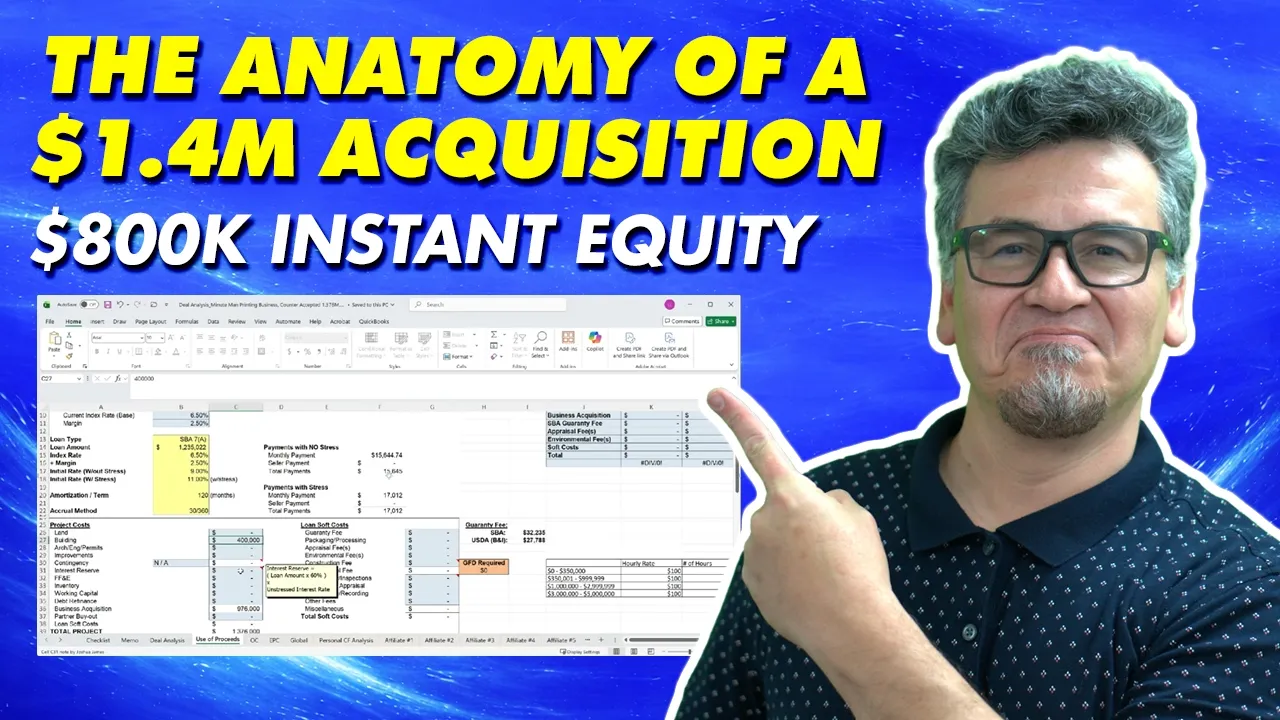
Added:hey it's Jason Rogers here and what I want to do for you in this video firstly is I want to discuss with you some of the differences between a seller carry back in a first position versus a seller carry back in a second position my seller carry back I mean seller finance I also want to talk to you about whether or not that seller carry back if put in a second position will count as equity in your deal and what things you can do to influence whether or not a bank if you're going to procure the first position loan from a traditional bank how you can get that bank to really allow you to count the seller carry back second position note as equity I also want to dive into some financials here and run through a mock deal but first things first let's talk about the seller carry back from the first position now you're generally going to procure a seller carry back the first position note when you have a strong rapport with the seller and or when the seller simply extremely motivated to sell and he or she knows that your deal will be difficult for you to finance using traditional finance now what I would say is is that I would not go to the seller day 1 and ask for seller finance at least from my experience I found that to be a mediocre strategy at best what I would do instead is that was I would assume you could procure the finance and only if and when you find real challenges in procuring finance from a traditional bank you try the SBA route you try commercial debt maybe even talk to hard money lenders though the interest rates they were going to be higher right but you you explore different financing options and only when you find it very challenging for you to procure that first position financing from a traditional bank or a traditional lender only then would I really go to the seller in and let him or her know let the seller know hey we're having a difficult time procuring this first position financing because of X Y or Z reasons and ideally it's based it's best if those reasons are based on things the seller does not have in the deal right maybe your deals too rural or there's not a strong enough statement of cash flows over the last three years or fill in the blank right some challenge that's keeping you from getting the deal financed that lenders aren't liking that's a result of the business itself that's really a great entrance for you to bring up the first position seller finance option of hey if you want to get this deal done you may need to carry the paper because after we spoke with every single bank within a 50 mile radius of your deal here's what we're finding here the challenges we're seeing we weren't even able to procure finance from the SBA program from three of these different banks that we talked to for your deal right so for that reason or these reasons we'd like you to consider using seller finance if you really want to sell if the seller is motivated and he or she knows you've really worked hard to get the finance and if you put together a great team so that the seller knows you're not just some Joe Schmoe but you actually have a great team behind you and you're great team collectively is saying yeah this deals not gonna get financed traditionally that is a lot more leverage to actually get you to get the seller finance of course - for the first position seller finance note it's worth articulating to the seller some of the benefits that carrying the paper on that first position note will really have namely he's going to pay less in taxes and capital gains and he's going to accrue or she's going to accrue the seller is going to accrue interest income right because they may alone you eighty percent or a hundred percent of the of the deal a hundred percent is great if you're able to procure that right but they may loan you 80 or 100 or seventy percent of the deal and it's a six percent interest rate right so you're you generating interest income so that's obviously a benefit as well for the seller but now let's talk about the seller carry back in the second position this is a different animal this is where the seller basically says hey if you can bring me 80% of the money up front then all carry the final twenty percent the seller will do that pretty regularly for them they're pretty happy look I'm gonna get most of my cash paid up front I'm gonna get a little bit of interest income on the back end from that second position carry back note everything is gravy for them the big question becomes will the banks go for it and this is really the more complicated topic and it's not as simple as yes or no although the simple answer is is it depends it depends on a host of factors including the deal itself is it a hot deal the asset class that the deals in right does the bank have a favorable view point towards that asset class next it depends on you the collective view you individually as well as your leadership that you've assembled right your board of direct your advisory board it also depends on the management team that you'll be procuring when you buy this asset is it a strong management team is it a team that has shown the consistent ability to do enough in income to easily pay off the debt service it also depends on the terms of the second position note right because that second position note is a bank note now okay let me back up it's not a bank note that you're gonna pay back to the bank but its debt it's a note that you're essentially paying to another bank it's instead of paying it to ABC Bank you're paying it to the bank of Bob Smith the seller but it's still a note that needs to get carried there needs to get paid and therefore it's going to eat up your free cash flow and so the question becomes what are the terms of that second position no is the seller asking for a 20% interest rate on a 5-year M well if so that's pretty much gonna eat up the free cash flow the deal there's no longer going to be free cash flow on the deal versus maybe the seller says hey I'll match the interest rate of the first lien note right so if you procure it firstly note of five and a half percent all on the second position take a five and a half percent interest rate and I'll do a 30-year ramp which means you're gonna make them much smaller payment well that's very different in the bank will be much more open to allowing that equity or that seller finance to count as equity again if the terms are are such that you're not paying nearly as much to the seller because here's what I can tell you after having met with tons of banks from the west coast all the way near these go straight I can tell you that banks are always trying to get theirs first they always want to know they're gonna get theirs first that's why banks will only ever consider a first position note because they don't want to play around with the idea of hey you know somebody's gonna eat before me that's just is not something they really go for it all another thing that's going to influence whether or not that that seller carry back counts as equity is are you dealing with the SBA program or are you dealing with a traditional private commercial note right a traditional bank note from from a bank where it's their money and they're on the hook for it they're gonna be a lot more conservative than if they're backed by the government through an SBA program so if you're able to get through the SBA program you can probably almost certainly negotiate that seller carry back second with greater confidence right you can negotiate that more likely because again if the long goes bad it's not the bank that's on the hook with the SBA it's largely the government now sometimes I've heard that the government will back fifty percent and then the banks on the hook for the other fifty but it D risks the deal for the banks so that's obviously a relevant factor but those are some of the influences about the seller carry back both on the first position and on the second position regarding both carry really the debt portion as well as the equity portion now let's dive into a deal here one second I get some coffee or it's top of the morning for me let's get into this okay let's dive in now to this deal that I just pulled on the internet like I've done with a lot of these recent videos I just find these things like just Google these deals now I'm not suggesting we make a big disclaimer I'm not suggesting that you find deals on the Internet the only reason I'm doing this is because I want to give you lots of relevant examples from different sectors but again the best and hottest deals are gonna be found off market off market but any rates in this particular deal the sellers asking for three point nine nine million he's doing one point three million and EBIT up let's find how many times earnings is the seller asking for how many times earnings let's move everything out real simple here we just take the asking price / - eBay table okay Andy's asking it's just over three times earnings right so is that a good deal I don't definitively know again because I don't know the nuance of this business but let's just say for the sake of argument that we know that this is a strong business and we go back to the seller and say look you're looking for 3.0 five times earnings I was looking for 2.8 times earnings how about we settle at two point nine two times earnings we will offer you two point nine two times earnings which equals equals sum eBay da times two point nine two okay you're asking for three point nine nine we're gonna offer you three point eight one four and let's just say boom accepted I offer accepted okay let's say now with a service based business like like the in-home senior care business I'm almost certain you can get that approved through the SBA so let's just assume let's assume the SBA will loan the first 80% of the deal okay let's assume we're gonna loan the first 80% of the deal we're gonna do so first of all what is 80 percent of this deal huh that's an important question what is it well let's figure it out right so we have this number times 0.8 okay that's how much they're saying we're gonna loan okay will loan you that much so okay so what that means now is we need to come up with another ideally another 30% because we don't just want to get to the total price we want to over financed this sum so that we have some working capital in our back pocket easier said than done and through traditional M&A you're usually expected to inject some of your own equity into the deal but let's just trying to do a true know of our none of our own money into the deal so let's just say we want to come up with another 30% and what we want to do is we want to go to the seller and see if we can get the seller to carry another 30% right so let's do this what is this times 0.3 okay we want the seller to carry this much here we're gonna pay out you know we're gonna pay out 70% right so we're gonna the agreement is we'll pay mister seller 70 percent he finances 30 right now if we got the assurance from the bank that we could get 80 why are we only going to pay the seller well because we're going to keep 10% for ourselves is we're capital whether we want to truly have working capital in case of a rainy day whether we want to cut some bread amongst our team in ourselves right but but let's just let's just work through this real quick so we'll pay the seller the seller 70% in cash he finances the 30% okay and that is what 30% is now let's go back here real quick because we need to start talking what are the terms that the first of all let's say the bank says will loan this amount here right remember this this is 80% of the deal they're gonna give you that much in cash through the SBA program backed by the government best place to get your money if you can so now okay we're gonna loan you that much and we will loan you on a ten-year am at 6% okay we're gonna loan you that money on a 10-year and at 6% so how much how much does this loan cost on a 10-year and at 6% give me one sec let's go to the loan calculator okay so it just took the three million this amount three million in change three oh five one eight three seven I rounded up the this sense whoops and and I put that in here three oh five one eight three seven six percent interest rate on a ten-year am will say it's fully advertised and what we have is a PA payment that you can see here of thirty three thousand eight hundred eighty one dollars and sixty five cents okay so that's gonna cost us this and I'm just gonna use whole numbers right so I'm just gonna call that two and get rid of the cents okay this is how much the loans gonna cost us at 6% per month now let's just copy and paste this how much is that gonna cost us per year hmm well pretty simple we just take the monthly payment times twelve okay so it's gonna cost us four hundred six thousand per year now so far we're fine because even up here assuming these numbers are true and of course we can't do due diligence on a deal is in an Excel spreadsheet that were that were workshopping here live but you would of course want to do a host of due diligence processes from an accounting perspective from a financial perspective from an operational perspective all of it you want to check the the revenues you're gonna want to check the expenses and you're gonna want to confirm that this numbers true right but right now we're fine because yeah we can make this you know we have a 1.3 million and EBIT on this loan is gonna cost us four hundred six thousand we almost have a million left but remember we're not out of the woods yet we still need to negotiate the seller carry back second and this is assuming that the bank is gonna go for this seller carry back second but with the way the DSCR is looking like it'll shape up we'll do the math on that in a minute but it looks like that'll be fine you know and I'm not gonna run the DSCR yet because what I want to do first is negotiate this so again we're gonna pay the seller at 70% in cash he's gonna find ass to find a 30% alright so now let's say okay mister seller we offer you 7% on a 30-year and I say 20 on a 20-year am fully amortized so we're gonna pay out over the next 20 years and let's say he says screw you I want nine percent and I want it on a ten-year am fine you can have it fully advertised but those are the terms we want and let's say we go back to the center come on and how about eight and fine we'll leave you up right because before we had it at nine let me confirm that yeah before we had it at nine so we say no dude come on eight and find the ten-year Empoleon the ten-year amp fully amortized fine then let's say he says you know he spits on a hand handshake deal and then you yank it and there she is right so now we need to come up with we need this much more the loan of this much more on these terms so let's enter this into the calculator one second okay so one one four four four three nine I rounded up the cents one one four four four three nine when I copy and paste it doesn't work that's why I have to enter it manually and we have the 8% interest rate on the 10-year am its fully amortized so there's no balloon payment we calculate that and our principal Calissa interest payment per month is thirteen thousand eight hundred eighty five dollars and twenty cents right so this note cost per month question mark how much does it cost per month boom it cost that much this no costs per year how much oh that's pretty simple equals some this time is twelve boom now how much is our total debt payment under this arrangement per month right because we have the first position note to the bank under the SBA program and then we have our seller carry back and the way this is negotiated and organized we were gonna be paying both off simultaneously let's see if this is feasible and if this is something we could truly pull off right now here's what we're gonna do we take the second position note and we take the first position note and we add them up that's how much we're gonna be paying in debt per month I'm gonna copy this I'm gonna paste this and I'm just gonna change this to how much now are we paying per year how much is our total debt payment under this arrangement per year well we take this we times it by twelve and wallah we're paying five hundred seventy three thousand two hundred six now here's the big question what is our cumulative DSE our debt service coverage I could type well that'd be cool ratio huh what is it that's put the question mark what is it right let's calculate it our DSCR is gonna be our a bit off divided by our total debt payment principal plus interest boom wait something didn't go right there oh I didn't hit the formula correctly people some IVA da divided by total that payment and boom let's change this this is actually a gravy deal I mean this thing totally pencils out word over 200% that is green this is this is gravy this is really good really good that's something a bank will go for all day long over a hundred 25 percent of bank will really consider over a hundred fifty percent of bank will start to get excited about and over two hundred percent big-time when you get a DSCR of over two hundred percent now they will consider this seller note as equity in your deal why because when you pay off both the bank and the seller of course the sellers gonna subordinators position I mean that's one thing you're you're never gonna negotiate around this first note to the SBA or to the bank that's a first position no which means if things ever get tight you make that debt payment first and not the seller second position note but if you can get the seller to agree to these terms when she's actually getting good terms 8% interest rate that's a good return right trying to get 8% return on an open market if you're a conservative investor you won't on a ten-year am fully amortise Alisha's can make that money over the next ten years that's that's steady you know unless he's really old or she's really old they're gonna be okay with that that's a great little retirement payout for the next ten years right for the bank they're backed by the SBA so it's not really that risky but the one big elephant the room is is that you negotiated an over financed of ten percent by getting the sellers financed 30 and having the SBA Bank in the bank and the SBA agree to go 80 so you're gonna need to sell the bank on that but again with this right here combined with a strong executive summary of a world-class leadership team that you've put together and if this is a strong business that you've done a ton of due diligence in and you really believe in that gross revenue that you can increase it ideally and if you believe that EBIT is strong yeah this is a deal that you can do
Up Next

Earnout Structure: How to Avoid Getting Burned in a Business Sale
@BuilttoSell
335 views•2019-07-16

Retention Habits of Top DTC Ecommerce Brands Revealed
@SendItPodcast
44K views•2026-03-03

Decoy Effect: How Pricing Psychology Influences Consumer Spending
@bobinvestsUS
90K views•2026-01-05

The Planned Obsolescence of Light Bulbs and Tech
@veritasium
25.3M views•2021-03-26
Related Study Plans & Knowledge Roadmaps
Structured learning paths in Business