Stream of consciousness is a literary technique that mimics the natural, chaotic flow of human thoughts, jumping between ideas without clear order and capturing fragmented perceptions and emotions, as exemplified by Virginia Woolf and James Joyce; in contrast, interior monologue presents a character's thoughts in a more organized, rational, and coherent manner, allowing readers to directly access their logical reasoning and emotions, making it particularly effective for dramatic or poetic expression.
Stream of Consciousness vs Interior Monologue: Literary Techniques Explained
Added:Deep Dive
Basic narrative perspectives, particularly the differences between first-person and third-person limited points of view.
مراجعة رقم 01 /فرنسية سنة اولى ثانوي علمي /أدبي --- / la nouvelle réaliste
885K
In narrative, there are two main points of view: (1) First-person point of view (récit à la première personne) - the narrator is a character in the story, telling events from their own perspective, and (2) Third-person point of view (récit à la troisième personne) - the narrator is an external observer telling events from outside the story.
Click to watch →

MODULE 2 POLYPHONY IN TEXTS. INTRODUCING LITERATURE. PART 1. FIRST SEMESTER CALICUT UNIVERSITY.
30.5K
Writers can tell stories from their own point of view or from the perspective of characters. First person point of view uses 'I' as the narrator, typically a character within the story, as seen in 'Treasure Island' where Jim Hawkins narrates. Third person point of view uses an observer narrator who knows everything about characters and events. Third person is divided into omniscient (knows all) and limited (knows only one character's thoughts and feelings).
Click to watch →
6 - Сессия Практики - "Иммунитет Сознания" НейроСталкинг.
1.9K
This segment explores the practice of asking questions from both first-person and third-person perspectives. The practice involves asking questions as 'I' and then observing the same question from a third-person perspective (as 'Salamat wants to...'). The key insight is that first-person questions create more emotionally intense and linear answers, while third-person questions create more free, varied, and less emotionally charged responses. This difference reveals how the first-person perspective creates a sense of urgency and need for external validation. The third-person perspective creates a state where intuitive perception of reality becomes natural and effortless, allowing one to play with situations rather than being trapped inside them.
Click to watch →
Типы повествования: От первого лица, От третьего лица
39.4K
Narrative modes determine how authors tell stories by choosing who tells the story and from what perspective. First-person narration uses 'I' and places readers inside a character's mind, allowing access to their thoughts and emotions while limiting knowledge of other characters' events. Third-person narration uses 'he,' 'she,' or 'they' and can range from fixed character perspectives to omniscient 'god mode' where the narrator knows everything across all characters. Authors can combine these modes strategically, using first-person for character intimacy and third-person for broader world-building. Each mode has distinct strengths and weaknesses affecting story presentation, character development, and reader engagement.
Click to watch →
Weaponized Victimhood: How To Exploit Trauma
102.5K
Research examined whether first-person or third-person narratives affected victim perception. In the iPad theft scenario, there was no relationship between perceived morality and victimhood when the narrative was given from the first-person perspective, and there was even a small negative relationship between trustworthiness and victimhood. In contrast, victims were still seen as more moral and trustworthy than neutral targets regardless of perspective in the idea theft narrative. This suggests that when victims tell their own stories, outside observers are more skeptical compared to when third parties report on victimization, implying external verification lends credibility.
Click to watch →
Deep Dive
An introduction to Literary Modernism and the cultural/historical context of the early 20th century.

Modernism: An Introduction
8.3K
Literary modernism emerged in the early 20th century as a response to profound intellectual and cultural shifts, drawing from the revolutionary ideas of Darwin (evolutionary theory challenging stable human nature), Marx (materialist critique of ideology), Nietzsche (perspectivism and the will to power), and Freud (the unconscious mind), which collectively undermined traditional notions of truth, identity, and progress; this intellectual crisis manifested aesthetically through fragmented forms like Cubism in visual arts and stream-of-consciousness techniques in literature, exemplified by T.S. Eliot's 'The Waste Land' (1922) and James Joyce's 'Ulysses' (1922), which broke from conventional narrative continuity to represent the alienation and disconnection of modern existence.
Click to watch →
Introduction to Literary Modernism
2.6K
Literary Modernism is a movement in literature and the arts dating from 1913 to 1945, characterized by the exploration of psychological states of mind, alienation, and social rupture; it began in 1913 due to three key events—the publication of Imagist poetry by Ezra Pound and H.D., the Armory Show in New York City featuring European modernist paintings, and Igor Stravinsky's controversial ballet 'The Rite of Spring' in Paris—which collectively signaled the emergence of modernist aesthetics across multiple art forms.
Click to watch →

Understanding Literary Modernism With Prufrock
175
Literary modernism emerged during the Victorian, Edwardian, and interwar periods (1890s-1940s), characterized by urbanization, industrialization, secularization, and psychological transformation. The First World War marked a massive break in European civilization, leaving modernists to grapple with a fragmented, unfamiliar world. Modernism is inherently reactionary and futurist, operating through a Hegelian dialectic of taking shards from the old world to build something new that is both related to and different from tradition. Many modernist figures exhibited fascist political tendencies: Pound broadcast for Mussolini until his death in the 1970s; Wyndham Lewis visited Hitler's Germany; T.E. Hulme translated George Sorel's 'Reflections on Violence' into English. Modernism involves recognizing that the world ancestors knew no longer exists, requiring radical change while simultaneously looking toward the past to bring aspects of it within new frameworks.
Click to watch →

English Literature | Modernism: historical/cultural background and new literary techniques
64.6K
Modernism emerged in England during the first half of the 20th century (1901-1945), arising from profound social and historical upheavals. Key factors included the peaceful Edwardian era followed by World War I's devastating disillusionment, the suffragette movement's fight for women's voting rights, Ireland's struggle for home rule, and the rise of totalitarian ideologies. James Joyce, imprisoned for advocating Irish independence, developed his concept of the antihero—a character who rejects fighting for any cause. These events collectively created the intellectual and emotional foundation for modernist literature's radical departure from Victorian traditions.
Click to watch →

NTA NET 30-Day Study Plan 6 | Early 20th Century | Dr Kalyani Vallath
5.2K
This comprehensive session covers the transition from late 19th to early 20th century literature. Key topics include: the flourishing of realism and impressionism in France; W.B. Yeats founding the Abbey Theatre in 1899 with Lady Gregory and Edward Martyn, influenced by Japanese Noh theater; Oscar Wilde's imprisonment in Reading Jail (1895-1897) and his satirical masterpiece 'The Importance of Being Earnest'; Joseph Conrad's preface to 'The Nigger of the 'Narcissus'' as a modernist manifesto; Rudyard Kipling's 'Kim' exploring colonial identity; D.H. Lawrence's debut 'The White Peacock' (1913) through 'Women in Love' (1920); T.S. Eliot developing poetic impersonality theory; and George Bernard Shaw's social critiques. The session traces how these authors transformed literature through fragmentation, allusion, and psychological depth, marking the definitive emergence of literary modernism.
Click to watch →
Deep Dive
The fundamental concept of character interiority and how authors represent a character's inner life.

Write Better Characters ♡ diving deeper into characterization and character arcs
8.2K
Interiority refers to what happens inside a character's mind - their thoughts, feelings, and internal monologue. Unlike external actions which are shown physically, interiority reveals the 'why' behind character behavior. For example, if a character hates waiting in lines, their external reaction might be sighing or checking their watch, but their internal thought might reveal they feel impatient, resentful, or believe waiting wastes time. Understanding interiority helps authors explain why characters behave as they do, adding psychological depth to characterization.
Click to watch →

Interiority: The Secret to Writing Fiction That Readers Will Remember
1.9K
Interiority refers to a character's internal life—including private thoughts, emotions, questions, judgments, and contradictions—expressed on the page, which transforms readers from passive observers into active participants in the story by providing emotional immersion, character depth, and thematic resonance; effective interiority requires balancing specificity with pacing, using techniques like narrating immediate reactions, interpreting events through character reflection, and presenting conflicting desires, while avoiding both insufficient interiority (which leaves readers disconnected) and excessive interiority (which creates narrative drag).
Click to watch →

Interiority─Write Better Descriptions
2.8K
Interiority is the fundamental principle that allows readers to merge with the perspective character's mind, experiencing what they sense, think, and feel. In narrative fiction, interiority applies to first-person and third-person limited perspectives, where the narration is strictly limited to one character at a time (the POV character). For single-protagonist stories, this is the protagonist; for ensemble casts with multiple equal protagonists, they take turns being the POV character chapter by chapter. The goal is to create a seamless connection between reader and character's consciousness.
Click to watch →
La Chronique des Bridgerton: Tome 1- Une Romance Incroyable !!
114
Interiority refers to the presentation of a character's inner thoughts and motivations. When authors provide access to a character's internal perspective, readers can understand the subtleties of their behavior that might otherwise seem contradictory. Simon's interiority reveals that while he projects an image of arrogance, he is actually honorable, determined, and respectful - demonstrating how narrative perspective shapes character understanding.
Click to watch →

#94: How to Reveal Your Character’s Inner Life on the Page
151
Interiority is 'on the page access to a protagonist's psyche as they process information,' encompassing thoughts, feelings, memories, and inner struggles. Novels uniquely invite readers into minds, making interiority essential—without it, readers feel cheated. It is internal and partial, rooted in each character's unique worldview, fears, hopes, and biases. To identify interiority, ask: Can a security camera capture this? Is it neutral? If both answers are yes, it's not interiority. Writing effective interiority requires upfront character development (understanding worldview, fears, motivations) and plot development. Use ten scene-level questions: goal, motivation, starting feelings, hopes, fears, confidence, conflict reactions, setting/character reactions, ending feelings, and plot position. Writers often fail by relying too heavily on physical sensations, creating clichéd drama.
Click to watch →
Deep Dive
General familiarity with the key figures of modernist literature, specifically Virginia Woolf and James Joyce.
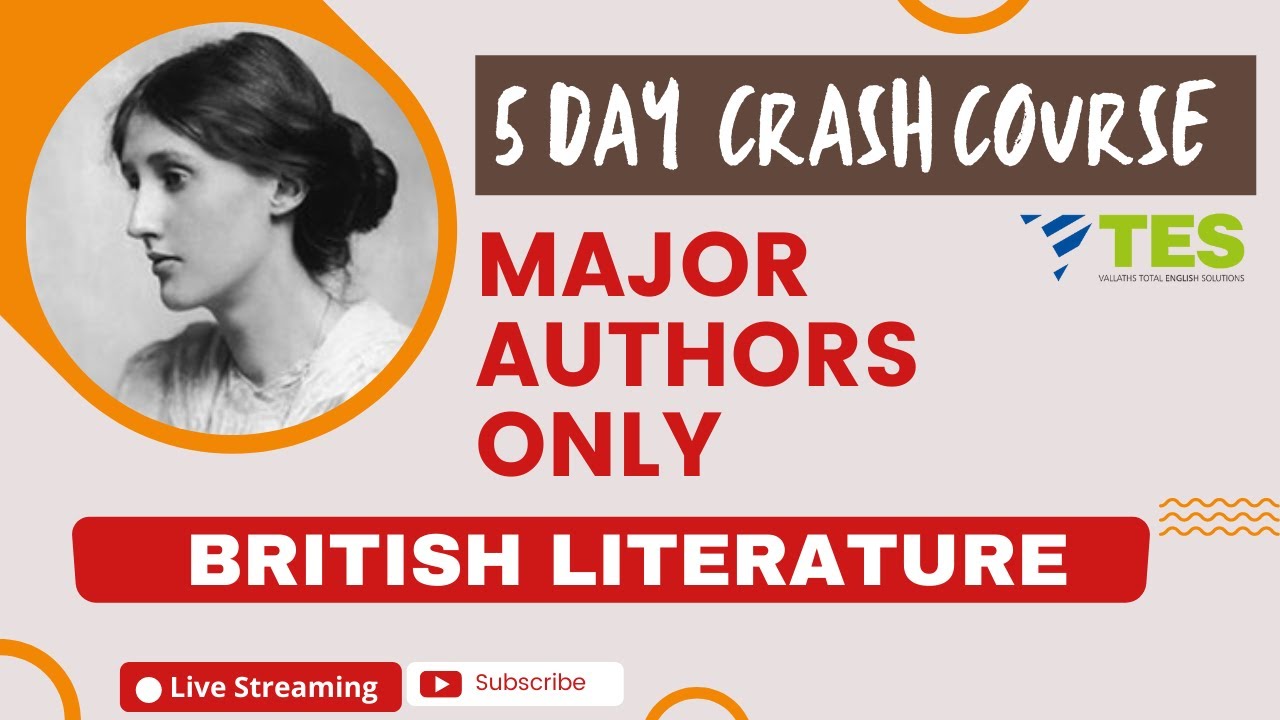
MAJOR AUTHORS ONLY British Literature for WB SET, G SET, JK SET, NTA NET
7.6K
Virginia Woolf (1882) wrote modernist novels including 'The Voyage Out', 'Mrs. Dalloway', 'To the Lighthouse' (three parts: 'The Window', 'Time Passes', 'The Lighthouse'), and 'The Waves' (stream of consciousness of six characters). James Joyce (1882) wrote 'Dubliners' (15 short stories), 'A Portrait of the Artist as a Young Man', and 'Ulysses' (1922). Both pioneered stream-of-consciousness technique and fragmented narrative structures that revolutionized 20th-century fiction.
Click to watch →

British Literature
103.8K
Modernism was a literary movement based on stream of consciousness, a technique from the 1920s that attempts to capture characters' thoughts and feelings as they occur. James Joyce and Virginia Woolf were the two most famous modernist authors, with Joyce's Ulysses and Woolf's Mrs. Dalloway being key examples. These novels can be very difficult to read because they focus on inner monologues rather than traditional narrative structures.
Click to watch →

Virginia Woolf ROASTS James Joyce
721.9K
Virginia Woolf famously criticized James Joyce's Ulysses, describing it as 'a misfire genius' that was 'diffuse, brackish, pretentious, and underbred,' arguing that first-rate writers should respect writing too much to be 'tricky' or perform 'stunts,' comparing Joyce to a self-conscious schoolboy who loses his head due to egotism.
Click to watch →

OPERE MONDO- Terzo incontro: Sara Sullam - James Joyce, Ulysses.
10.6K
Joyce and Virginia Woolf are often identified as the definitive modernists, with their experimental approaches setting the standard for the movement. However, this identification is somewhat restrictive, as it marginalizes other important modernist voices. Joyce and Woolf were aware that Ulysses 'eats up' other novels within it, refunctionalizing works that might otherwise be considered non-modernist. Moretti analyzes stream of consciousness as a 'problem-solving' technique, allowing Joyce to represent the overwhelming complexity of modern consciousness. Modernism coincides with the emergence of cinema as a new narrative medium. Virginia Woolf argued that cinema has its own specific expressive capabilities, and Joyce was deeply fascinated by cinema, even attempting to open a cinema in Dublin in 1909. Ulysses is considered a work of world literature because it profoundly interrogates national boundaries and the concept of nation. Joyce's movement from Dublin to Trieste in 1904, then to Zurich and Paris, reflects the novel's engagement with multiple national contexts.
Click to watch →
UGCNET English Literature🔥| Complete Modern Age One shot #ugcnet #ugcnetenglishliterature #nta
5.3K
James Joyce is a major Modern Age novelist known for his innovative literary techniques. His most important works include 'Dubliners' (1914), 'A Portrait of the Artist as a Young Man' (1916), 'Ulysses' (1922), and 'Finnegans Wake' (1939). Key literary techniques include: (1) Stream of consciousness (used in 'Ulysses'), (2) Epiphany (sudden realization, used in 'Dubliners'), (3) Parody and pastiche (used in 'A Portrait of the Artist as a Young Man'), and (4) Non-linear and fragmented narrative (used in 'Finnegans Wake'). 'Dubliners' is a collection of 15 short stories all set in Dublin, with 'The Dead' being the most famous. 'A Portrait of the Artist as a Young Man' follows Stephen Dedalus's journey from childhood to adulthood, exploring questions of identity and artistic vocation. 'Ulysses' (1922) is set in Dublin on June 16, 1904 (Bloomsday), divided into three parts: Telemachus, Ulysses, and Nausicaa, reimagining Homer's Odyssey in modern times. Virginia Woolf is a major Modern Age novelist and essayist. Her important works include 'Mrs. Dalloway' (1925), 'To the Lighthouse' (1927), 'Orlando: A Biography' (1928), and 'A Room of One's Own' (1929). 'Mrs. Dalloway' is a landmark novel using stream of consciousness to explore the inner lives of characters in a single day. 'To the Lighthouse' is divided into three parts: 'The Window' (summer holiday in Scotland), 'Time Passes' (10 years pass with deaths of Mrs. Ramsay, her son, and daughter), and 'The Lighthouse' (completing their journey). 'A Room of One's Own' is considered a foundational text in feminism. Woolf founded Hogarth Press with her husband Leonard Woolf, which published works by T.S. Eliot and other modernist writers.
Click to watch →
Prerequisite Knowledge
- Concept 01Basic narrative perspectives, particularly the differences between first-person and third-person limited points of view.
- Concept 02An introduction to Literary Modernism and the cultural/historical context of the early 20th century.
- Concept 03The fundamental concept of character interiority and how authors represent a character's inner life.
- Concept 04General familiarity with the key figures of modernist literature, specifically Virginia Woolf and James Joyce.
Subsequent Learning
- Step 01The study of 'Free Indirect Discourse' (or style indirect libre) as a distinct narrative technique blending narrator and character voices.
- Step 02The influence of early psychology (such as William James's concept of the 'stream of thought') on literary form and structure.
- Step 03Conducting close-reading analyses of specific passages in landmark modernist texts like James Joyce's 'Ulysses' and Virginia Woolf's 'Mrs. Dalloway'.
- Step 04Practical application of stream of consciousness and interior monologue within creative writing and narrative design.
- Step 05Investigating how contemporary and postmodern authors have evolved or adapted these modernist techniques in 21st-century literature.
Techniques Unpacked
Usage and Impact
Techniques Unpacked
0:03Playing Section
- 1
Defines stream of consciousness as chaotic, mimicking natural thought flow.
- 2
Explains interior monologue as structured, logical, and rational.
- 3
Compares purposes: immersion versus dramatizing inner conflict.
The Fallacy of Rigid Distinction: Overlap in Narratological Theory
While introductory guides often present 'stream of consciousness' and 'interior monologue' as distinct techniques—with the former capturing chaotic, pre-verbal sensory data and the latter representing structured inner speech—many prominent narrative theorists challenge this rigid dichotomy. Scholars such as Dorrit Cohn and Seymour Chatman argue that the terms are frequently used interchangeably in practice, and that drawing a sharp line between them is structurally untenable. From a linguistic perspective, both techniques rely on similar grammatical devices, such as free indirect discourse, to simulate interiority. Furthermore, cognitive narratologists argue that neither technique actually replicates the true nature of human thought, which is largely non-verbal and non-linear. Instead, they are highly stylized literary illusions. Overemphasizing their differences can mislead students into treating fluid, overlapping aesthetic choices as rigid grammatical rules, obscuring how authors like Woolf and Joyce actually blended these modes to evoke subjectivity.
Deep Dive
The study of 'Free Indirect Discourse' (or style indirect libre) as a distinct narrative technique blending narrator and character voices.

Conversaciones — Francisco Bitar
1.7K
Style indirect libre (free indirect style) is a sophisticated narrative technique that merges the narrator's voice with the character's consciousness. Francisco Bitar explains that this approach involves the narrator's discourse becoming indistinguishable from the character's subjectivity, creating a seamless flow between external narration and internal thought. This technique allows for a unique form of psychological representation where the reader experiences character consciousness directly while remaining aware of the narrative construction. The style represents a sophisticated approach to narrative voice that maintains the artifice of fiction while achieving psychological depth.
Click to watch →
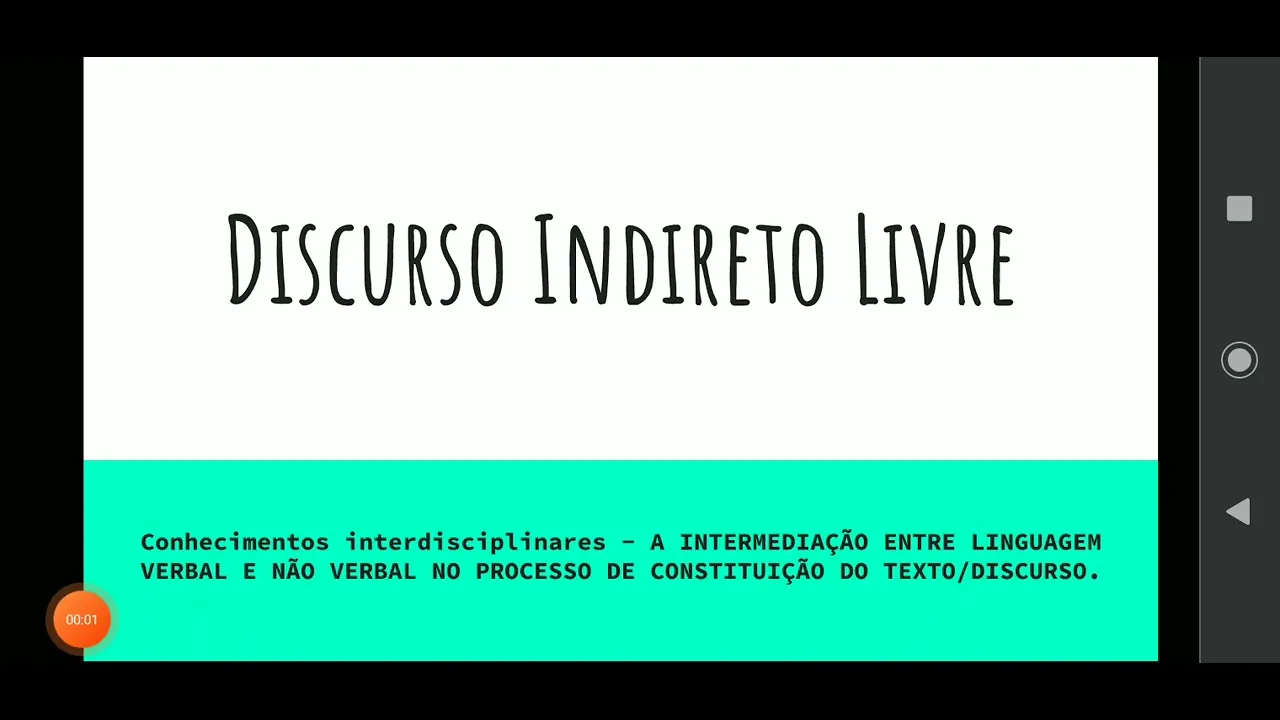
Discurso indireto livre
461
Discurso indireto livre is a narrative technique where the narrator's voice and the character's voice become intertwined without clear boundaries, combining characteristics of both direct discourse (retaining interrogative, imperative, and exclamatory sentences, interjections, and expressive elements) and indirect discourse (using pronouns, temporal and spatial indicators in the same way as indirect speech). This technique creates verisimilitude by allowing the narrator to incorporate the character's thoughts, feelings, and speech patterns while maintaining their own narrative voice, effectively placing the reader in the character's perspective without the explicit markers of direct speech.
Click to watch →

UP TGT / PGT/ GIC / UGC NET English | CHAPTER 03
473
Free indirect discourse is a narrative technique where the narrator tells the story in the third person but utilizes the character's own voice, thoughts, and language. This creates a blend of narrator and character perspectives. For example, 'Ramesh looked at his watch. Oh, he thought, the boss will kill me today.' The narrator reports the character's thoughts in the character's own voice while maintaining third-person narration.
Click to watch →

Entrevista com Luiz Carreira / Literatura não é enfeite nem gritaria
16.2K
Free indirect discourse is a narrative technique that blends the narrator's voice with a character's thoughts. Readers must understand grammatical markers (verb agreement, paragraph breaks) to identify whose perspective is being expressed.
Click to watch →

CALICUT UNIVERSIT 4TH SEM| APPRECIATING FICTION | MODULE 1|PART 2|
4.8K
Free indirect discourse is a narrative technique where the narrator and the characters enjoy equal stature. Characters are not plotted as the object of narration by an omniscient narrator but as subjects capable of self-expression. This technique blends the narrator's voice with the character's thoughts and perspectives.
Click to watch →
Deep Dive
The influence of early psychology (such as William James's concept of the 'stream of thought') on literary form and structure.
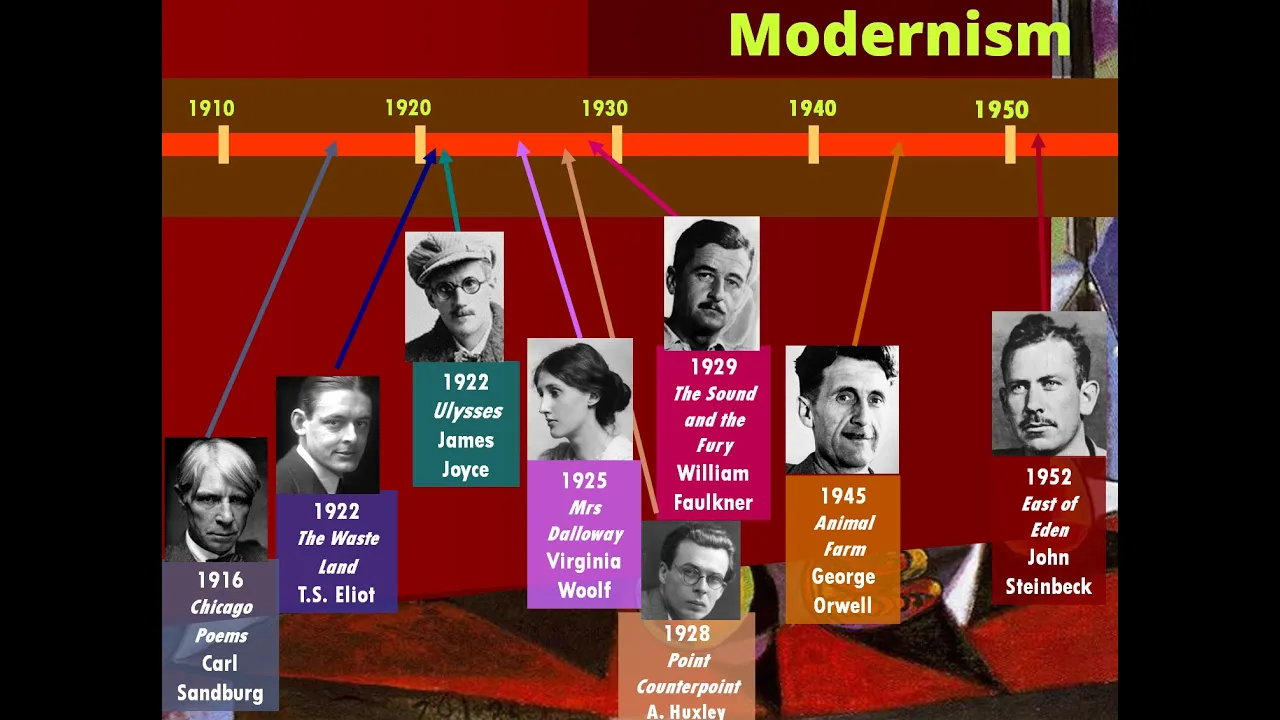
Modernism: contexts and features. Adrian Otoiu
274
William James, brother of novelist Henry James, revolutionized psychology by describing consciousness as a 'stream' rather than discrete thoughts. He argued consciousness flows continuously with innate feelings, thoughts, and sensations—not all verbalizable. James identified substantive phases (where mental states develop and brew) and transitive phases (where they change rapidly). This concept profoundly influenced literature, leading writers to invent techniques for representing simultaneous thoughts in linear text. James Joyce pioneered the stream of consciousness technique in 'Ulysses,' allowing multiple thoughts to intertwine, appear, and disappear in striking formats. Molly Bloom's monologue consists of three massive sentences spanning dozens of pages with no punctuation, demonstrating extreme representation of continuous mental flow.
Click to watch →
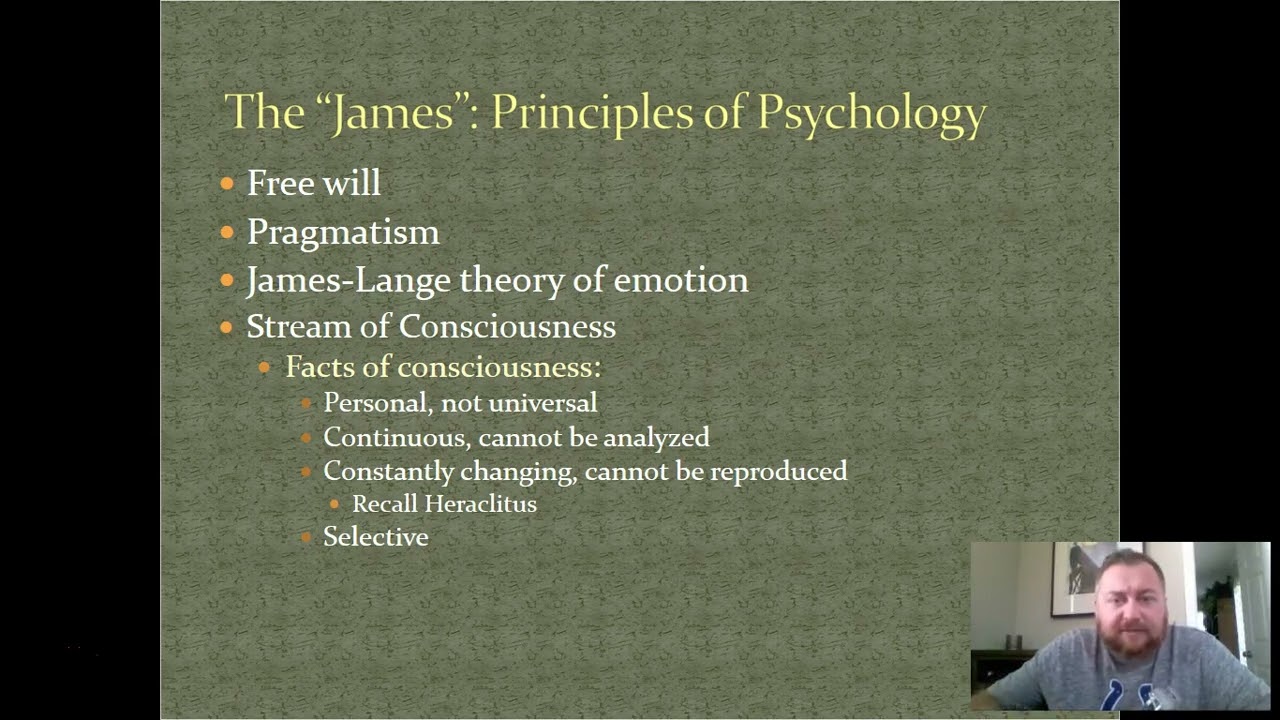
UCF PSY4604 Chapter12
685
This section explores James's stream of consciousness concept and its broader influence. James used the river metaphor to describe continuous mental flow, arguing consciousness is personal (different for each person), continuous (cannot be analyzed into bits), and selective (we actively choose what to attend to). This influenced literature, leading to the stream of consciousness writing style exemplified by Willa Cather. The section then introduces Hugo Münsterberg, a Wundt student who became a Harvard faculty member and pioneer in applied psychology. Münsterberg recognized psychotherapy as applying psychological knowledge to help people, was a fan of Freud, and arranged for Freud to lecture in America.
Click to watch →

William James: Roving Philosophical Report
107
William James revolutionized psychology by proposing that consciousness is not linear or logical but rather an uneven, flowing stream of thought. This concept, described as 'the stream of thought,' moves quickly across associations, pauses for conclusions, and restarts. Around 1900, novelists adopted this idea, with James Joyce's 'Ulysses' (1922) exemplifying the approach through interior monologue that wanders associatively. Joyce's work shifted literary emphasis from physical setting to character perception, using sensory details like smell, taste, and sound. James discovered consciousness has musical qualities—motifs that come, go, and reprise—creating a flowing stream of thoughts, associations, and recollections that constitute our sense of self.
Click to watch →

Lugares con Genio - Londres de Virginia Woolf
3.6K
In the early 20th century, English literature reached a new impulse that would establish the foundations of modernity in the Anglo-Saxon world. During the final years of the 19th century, writers and scientists had prepared the ground for this revolution. Robert Browning perfected the dramatic monologue as a structural form of poetry. William James, from psychology, formulated the concept of 'stream of consciousness' with French and English traditions as antecedents. His brother Henry James used this as a narrative method, practically inventing the modern psychological novel. These ideas, combined with Freud's psychoanalytic theory, exerted a great influence on Virginia Woolf's work.
Click to watch →
Lecture - 102 ।। Araby - Class 01।। Introduction to Prose ।। English Hons 1st Year, NU
3.8K
William James, the father of American psychology, is associated with stream of consciousness. This connects the literary technique to its psychological origins, showing how the concept of continuous mental flow was developed in psychology before being applied to literature.
Click to watch →
Deep Dive
Conducting close-reading analyses of specific passages in landmark modernist texts like James Joyce's 'Ulysses' and Virginia Woolf's 'Mrs. Dalloway'.
British Literature
103.8K
Modernism was a literary movement based on stream of consciousness, a technique from the 1920s that attempts to capture characters' thoughts and feelings as they occur. James Joyce and Virginia Woolf were the two most famous modernist authors, with Joyce's Ulysses and Woolf's Mrs. Dalloway being key examples. These novels can be very difficult to read because they focus on inner monologues rather than traditional narrative structures.
Click to watch →
OPERE MONDO- Terzo incontro: Sara Sullam - James Joyce, Ulysses.
10.6K
Joyce and Virginia Woolf are often identified as the definitive modernists, with their experimental approaches setting the standard for the movement. However, this identification is somewhat restrictive, as it marginalizes other important modernist voices. Joyce and Woolf were aware that Ulysses 'eats up' other novels within it, refunctionalizing works that might otherwise be considered non-modernist. Moretti analyzes stream of consciousness as a 'problem-solving' technique, allowing Joyce to represent the overwhelming complexity of modern consciousness. Modernism coincides with the emergence of cinema as a new narrative medium. Virginia Woolf argued that cinema has its own specific expressive capabilities, and Joyce was deeply fascinated by cinema, even attempting to open a cinema in Dublin in 1909. Ulysses is considered a work of world literature because it profoundly interrogates national boundaries and the concept of nation. Joyce's movement from Dublin to Trieste in 1904, then to Zurich and Paris, reflects the novel's engagement with multiple national contexts.
Click to watch →
Modern Artists: The Original Shitposters! | B2W: ZEITGEIST! I E.14 - Winter 1922
44.9K
In February 1922, James Joyce's novel Ulysses was published in Ireland. It is widely regarded not only as one of the greatest works of modernist literature but one of the greatest in the English language, as well as one of the most difficult to read. The novel chronicles one day, June 16, 1904, in Dublin, and its protagonist Leopold Bloom's various encounters. It is written mainly as stream-of-consciousness, following the many thoughts and feelings that go through a character's head, but it also jumps between numerous styles from translated early Latin to sing-song to the journalistic style of a newspaper. Upon publication, Ulysses was immediately praised as a modernist landmark in English literature, with T.S. Eliot declaring it to be 'the most important expression which the present age has found.' Others were less enthusiastic—Virginia Woolfe gave up after about 200 pages, writing in her diary 'an illiterate, underbred book it seems to me: the book of a self-taught working man, & we all know how distressing they are.'
Click to watch →

Nelle Gallerie di Mrs Dalloway
5.8K
Mrs Dalloway is often described as 'an Ulysses in female form' - meaning it follows the same experimental structure as Joyce's Ulysses, which also takes place in a single day. Like Ulysses, Mrs Dalloway explores the consciousness of an ordinary person (Leopold Bloom in Dublin, Clarissa Dalloway in London) through stream of consciousness technique. However, the novel is not merely a copy but represents a distinct approach to the same experimental tradition, with Woolf's method differing from Joyce's while achieving similar goals of exploring human consciousness.
Click to watch →

How to Read Ulysses by James Joyce (10 Tips)
210K
Chapter 9 (Scylla and Charybdis) takes place in the library at 2 PM with dialectic technique, featuring Stephen's theory of Hamlet: 'Every life is many days... we walk through ourselves meeting robbers, ghosts, giants, old men, young men, wives, widows, brothers in love, but always meeting ourselves.' Chapter 14 (Oxen of the Sun) takes place in a hospital with embryonic development technique, containing parodies representing the growth of the English language in compressed space—including inflections of John Bunyan, Thomas Malory, Sir Thomas Brown, Anglo-Saxon alliterative tradition, old church sermons, Latin translations, Defoe, and Dickens. The final chapter (Penelope) treats readers to Molly Bloom's interior monologue—a personal, intimate experience. June 16th, 1904 is celebrated worldwide as Bloomsday, commemorating Joyce's sexual awakening with Nora Barnacle. Joyce fled Ireland with Nora to live in France, Switzerland, and Italy. The novel ends with 'Trieste-Zurich-Paris 1914-1921,' representing Joyce's exile journey. Approach Ulysses with an attitude of play, joy, and without assuming there's a correct way to approach it—if you expect frustration, you'll get that; if you expect laughs, you'll get that. Dubliners is the easiest entrance into Joyce's work, being a short story collection with more straightforward writing though still precise and masterful. Reading Dubliners is a fantastic complement to Ulysses—treating yourself to one new story per week while reading Ulysses is rewarding. Modernism refers to experimental literature from the first quarter of the 20th century, exemplified by Virginia Woolf, Marcel Proust, and James Joyce. Modernism focuses on the micro rather than the macro, treating intensely individual novels rather than social novels. There is intense self-referentiality—modern works are about themselves and aren't exactly representational. They are disjointed (unlike Victorian harmony). Modernism deals openly with sexuality, is sympathetic to feminism and different sexualities, and reverses typical gender norms. Content becomes subservient to style. Ulysses had a difficult birth and was at the center of one of literature's biggest censorship trials. Different readers find different things in texts, making typical reader hypotheses impossible. Joyce's works respond superbly to group readings—each member contributes particular insights triggering others, creating growing networks of meanings.
Click to watch →
Deep Dive
Practical application of stream of consciousness and interior monologue within creative writing and narrative design.

LT GRADE / GIC ENGLISH MAINS | MRS. DALLOWAY | Answer Writing Skills |
1K
Stream of consciousness is a narrative method that attempts to reproduce the natural flow of human thought. It captures the continuous flow of thoughts, memories, and emotions in the human mind. The key characteristic is that human thinking does not follow strict logical order. The technique tries to capture mental flow before it is fully organized, presenting thoughts as they appear randomly, fragmented, and associatively. Interior monologue is the direct presentation of character's inner speech. It is still inside the mind but is usually more coherent, more grammatical, and more shaped than stream of consciousness. Dramatic monologue is a special poetic form in which one speaker addresses a silent listener in a specific dramatic situation. Soliloquy is a dramatic device in which a character usually alone on stage speaks aloud thoughts that are not really conversing. Aside is a short speech and brief remark made by a character that is meant for the audience or for himself.
Click to watch →
Ao Farol (Virginia Woolf) 🏴 | Tatiana Feltrin
54.7K
Stream of consciousness and interior monologue are related but distinct narrative techniques. Stream of consciousness transcribes the tangled internal thoughts of a character as naturally as possible, resulting in a mixture of logical reasoning, momentary impressions, and seemingly disconnected associations. Interior monologue, while also exposing character interiors, is organized by the narrator and tends to be more structured.
Click to watch →
ORLANDO, DE VIRGINIA WOOLF (#271)
25.8K
Modernist writers developed innovative techniques to represent the complexity of human experience. Stream of consciousness attempts to reproduce the actual way humans think, capturing the simultaneous flow of thoughts, memories, feelings, and associations without traditional sentence structure. Internal monologue allows characters to engage in self-conversation within their own minds, presenting arguments and reaching conclusions without external dialogue. These techniques, pioneered by Virginia Woolf and other modernists, represent a fundamental departure from 19th-century literary conventions and challenge readers to engage with more complex narrative forms.
Click to watch →

Exploring Stream of Consciousness and Interior Monologue in Literature|Virginia Woolf, Mrs.Dalloway|
2K
Stream of consciousness is a narrative technique that captures the natural, continuous flow of a character's thoughts, emotions, and sensory impressions in real-time, often using incomplete sentences, lack of punctuation, and broken grammar to mimic the authentic mental process, as exemplified by Virginia Woolf's 'Mrs. Dalloway' and James Joyce's 'Ulysses'; in contrast, interior monologue presents a character's inner thoughts in a more structured, coherent form that follows traditional grammar rules and logical sentence structure.
Click to watch →
STREAM OF CONSCIOUS/ INTERIOR MONOLOGUES (TECHNIQUE OF WRITING) - ORIGIN, DEFINITION & KEY FEATURES
1.6K
The term 'Stream of Consciousness' was first used in a literary context in 1918 by Virginia Woolf in a magazine review published in 'The Egoist,' where she analyzed Dorothea Richardson's novels. Richardson initially objected to the term, but critics continued to use it, and it eventually became a standard literary term. Stream of Consciousness is often referred to as 'Interior Monologue' in literary criticism, emphasizing that it reveals a character's inner thoughts directly without narrator intervention. While the terms are closely related and often used interchangeably, there are subtle differences: interior monologue typically uses proper grammar and sentence structure, making thoughts appear more complete, while stream of consciousness deliberately breaks grammatical rules for raw realism. Before the term was coined, many writers used techniques that would later be recognized as stream of consciousness. Laurence Sterne's 'Tristram Shandy' (1757) focused on mental processes rather than action. John Neal's 'The Puritan' (1823) used long emotional sentences showing mental confusion. Edgar Allan Poe's 'The Tell-Tale Heart' (1843) revealed inner mental tension. Leo Tolstoy's 'War and Peace' and 'Anna Karenina' explored psychological depth. Ambrose Bierce's 'An Occurrence at Owl Creek Bridge' (1890) broke time order to show mental states.
Click to watch →
Deep Dive
Investigating how contemporary and postmodern authors have evolved or adapted these modernist techniques in 21st-century literature.

11.SINIF | 2.Dönem | 1.Yazılı | RÜŞTÜ HOCA
143.3K
This section covers modernist and postmodernist literary techniques. Key techniques include geriye dönüş (flashback), pastiş (pastiche), ironi (irony), özetleme (summary), and gösterme (showing rather than telling). These novels feature iç konuşma (internal monologue) and bilinç çatışmaları (consciousness conflicts). Important authors include Oğuz Atay (Tutunamayanlar), Yusuf Atılgan (Anayurt Oteli), and Adalet Ağaoğlu. The section also covers anlatım bozuklukları (narrative errors) including gereksiz sözcük kullanımı (unnecessary word usage), sözcüğün yanlış yer kullanımı (incorrect word placement), and sıralama yanlışlığı (incorrect ordering).
Click to watch →
HÜLYA HOCA İLE EDEBİYAT 12. SINIF 🌟🌟🌟 1.DÖNEM 1.YAZILI KONU ANLATIMI 1. VE 2. ÜNİTE
19.1K
Modernist and postmodernist literature employ sophisticated narrative techniques: summary condenses events; flashback provides context; dialogue and internal monologue reveal character psychology; stream of consciousness presents rapid, non-logical thought associations; psychological analysis explains character states; montage incorporates other texts within narratives. These techniques enable authors to explore consciousness, memory, and subjective experience in ways that traditional narrative cannot achieve, fundamentally transforming how readers engage with literary texts.
Click to watch →

HISTORIA DE LA LITERATURA UNIVERSAL || La pecera de Raquel
38.8K
Modernism (late 19th to mid-20th century) originated in Latin America before spreading to Europe, characterized by linguistic renewal and experimentation. Vanguardias (20th century) emerged from Industrial Revolution developments, seeking originality through subjective expression. Key movements include Futurism, Cubism, Dadaism, Surrealism, Expressionism, Creacionismo, and Ultraísmo, with authors like Woolf, Mann, and Joyce. Post-vanguardism (post-WWII) incorporated Marxist thought, while Postmodernism (late 20th century) broke from linearity, allowing multiple timelines and eliminating omniscient narrators. Contemporary literature (post-WWII to present) poses questions, reflects social criticism, and utilizes comic books and non-linear structures.
Click to watch →
What Is Postmodern Literature ? Exam Time Important Authors And Books. Live Free Class At 8 PM.
7.6K
Postmodern literature emerged after World War II (1945) as a response to the perceived absurdity and meaninglessness of existence, characterized by unreliable narrators, multiple narratives, fragmentation, open-endedness, pastiche, and paranoia, with key Indian authors including Chaudhary, Bharti Mukherjee, Sameer Rohit Chaudhary, Devi Roy, and Charu Nivedita, while important English postmodern authors include John Fowles, Thomas Pynchon, William Gaddis, Cormac McCarthy, John Barth, Samuel Beckett, Harold Pinter, and Eugene Ionesco.
Click to watch →

Stephen Hicks: Postmodernism: Reprise
275.3K
Modernism emerged approximately 400-500 years ago during the Western Renaissance, characterized by revolutionary transformations including globalization, scientific revolution (Copernicus, anatomy), Protestant Reformation, and development of scientific disciplines. Philosophically, modernism holds that the world is rationally intelligible to each individual, not just an elect few with special cognitive insights. This universalizing perspective claims that with proper education and literacy, every human being can understand the world for themselves, leading to expanded rights, freedom, and self-responsibility extending beyond religious or political elites to all people regardless of gender, ethnicity, or race. The core belief is that genuine progress in knowledge is possible, benefiting humanity conceptually and technologically. Postmodernism, as defined by Jean-François Lyotard, is fundamentally skepticism toward meta-narratives—grand comprehensive stories explaining everything about the universe. This skepticism developed from increasing philosophical doubt over the past century and a half, pushing back against early modernist claims that reason is highly competent and that we can ultimately figure out all important truths. In milder forms, postmodernism questions our ability to know the world; in stronger forms, it denies that truth or knowledge exists at all, reducing everything to subjective opinions. A major problem is postmodern denial of any world outside linguistic construction, viewing meaning as necessarily embedded in circular linguistic contexts where each word depends on other words—a dictionary-like circularity that ignores consciousness as a relational phenomenon responsive to external reality. Postmodernists introduce power as the fundamental motivation underlying all human action, sneaking it through the back door of their linguistic analysis, which creates problematic implications for grounding values and knowledge objectively.
Click to watch →
Techniques Unpacked
Usage and Impact
Techniques Unpacked
0:03- 1
Defines stream of consciousness as chaotic, mimicking natural thought flow.
- 2
Explains interior monologue as structured, logical, and rational.
- 3
Compares purposes: immersion versus dramatizing inner conflict.
The Fallacy of Rigid Distinction: Overlap in Narratological Theory
While introductory guides often present 'stream of consciousness' and 'interior monologue' as distinct techniques—with the former capturing chaotic, pre-verbal sensory data and the latter representing structured inner speech—many prominent narrative theorists challenge this rigid dichotomy. Scholars such as Dorrit Cohn and Seymour Chatman argue that the terms are frequently used interchangeably in practice, and that drawing a sharp line between them is structurally untenable. From a linguistic perspective, both techniques rely on similar grammatical devices, such as free indirect discourse, to simulate interiority. Furthermore, cognitive narratologists argue that neither technique actually replicates the true nature of human thought, which is largely non-verbal and non-linear. Instead, they are highly stylized literary illusions. Overemphasizing their differences can mislead students into treating fluid, overlapping aesthetic choices as rigid grammatical rules, obscuring how authors like Woolf and Joyce actually blended these modes to evoke subjectivity.
Basic narrative perspectives, particularly the differences between first-person and third-person limited points of view.
An introduction to Literary Modernism and the cultural/historical context of the early 20th century.
The fundamental concept of character interiority and how authors represent a character's inner life.
General familiarity with the key figures of modernist literature, specifically Virginia Woolf and James Joyce.
The study of 'Free Indirect Discourse' (or style indirect libre) as a distinct narrative technique blending narrator and character voices.
The influence of early psychology (such as William James's concept of the 'stream of thought') on literary form and structure.
Conducting close-reading analyses of specific passages in landmark modernist texts like James Joyce's 'Ulysses' and Virginia Woolf's 'Mrs. Dalloway'.
Practical application of stream of consciousness and interior monologue within creative writing and narrative design.
Investigating how contemporary and postmodern authors have evolved or adapted these modernist techniques in 21st-century literature.
243 views5likes3:05@LiteraryIconsOriginal Release: 2025-04-18
What's the difference between stream of consciousness and interior monologue? Have you ever wondered how authors capture the essence of a character's thoughts? Today, we will break down the differences between stream of consciousness and interior monologue. Both techniques are used to representing a character's thoughts, but they have distinct characteristics.
Stream of consciousness is a method that aims to mimic the natural flow of thoughts in a character's mind. This technique is often instructed reflecting how our thoughts can jump from one idea to another without a clear order. It captures sensory perceptions, fragmented thoughts and emotions. Authors like Virginia Wolf and James Joyce are well known for using this style.
On the other hand, interior monologue presents a character's thoughts in a more organized way. This technique allows readers to see a character's rational thoughts and feelings directly, often without a narrator's interference.
Interior monologue is typically more structured and is commonly found in poetry and drama. One key difference is organization. Stream of consciousness lacks structure, showcasing the chaotic nature of human thought.
In contrast, interior monologue tends to be more logical and coherent. The purpose of these techniques also varies. Stream of consciousness immerses readers in a character's mind, capturing the fluidity of their thoughts. Interior monologue often dramatizes a character's inner conflict or conveys specific information about their situation. When we look at modern novels like Virginia Wolf's, Mrs. Doway stream of consciousness plays a vital role.
Wolf uses this technique to delve into her character's inner lives, creating a sense of immediacy and intimacy. Readers experience the fluid and structured nature of thoughts, which is central to her exploration of societal pressures and personal identity. In contrast, interior monologue might be used in a more dramatic or poetic context. It conveys a character's rational thoughts and emotions in a clearer manner. Both techniques serve different narrative purposes. Stream of consciousness allows authors to capture the essence of modern life and the human experience. Interior monologue focuses on dramatic or poetic expression.
In summary, while both techniques representing a character's thoughts, stream of consciousness is fluid and unstructured, mirroring human consciousness. Interior monologue is more organized and rational, often used for specific emotional or situational content. Understanding these differences can deepen your appreciation of literature and the ways authors convey complex thoughts and feelings.
Up Next
13:21
James Joyce: The Stream of Consciousness in Literature
@theschooloflifetv
1.1M views•2016-08-05

13:43
Formalism in Literary Criticism: An Academic Lecture Overview
@mattalberhasky9952
39.1K views•2015-08-05

6:08
Point of View in Fiction: First Person vs. Third Person
@magicalthriftyteacher
153.8K views•2014-03-31

15:25
1984: Orwell's Dystopian World and the Mechanisms of Totalitarianism
@AlternateHistoryHub
7M views•2017-03-04
Related Study Plans & Knowledge Roadmaps
Structured learning paths in Literature
literature
Graphic Memoirs: Visual Art, Trauma & History
01Foundations of Sequential Art and Visual Language
02Autographics and Processing Historical Trauma
03Visualizing Personal Trauma, Grief, and Graphic Medicine
+ 2 more learning modules
14h5 modules
Explore Roadmap
literature
Campus Novels: Evolution, Themes & Critique
01Introduction to the Campus Novel Genre
02Mid-Century Satire and the Post-War Academy
03Dark Academia and the Critique of Privilege
+ 2 more learning modules
14h5 modules
Explore Roadmap
literature
Theater of the Absurd: Philosophy & Plays
01Postwar Existentialism & Historical Roots
02Dismantling Narrative: Esslin & Absurdist Conventions
03Samuel Beckett and Tragicomic Existentialism
+ 2 more learning modules
12h5 modules
Explore Roadmap
literature
Revenge Tragedy: Justice, Madness & State
01Foundations of Early Modern English Theatre
02Anatomy of Revenge: Structural Conventions
03Psychological Complexity: Madness and Melancholy
+ 2 more learning modules
15h5 modules
Explore Roadmap